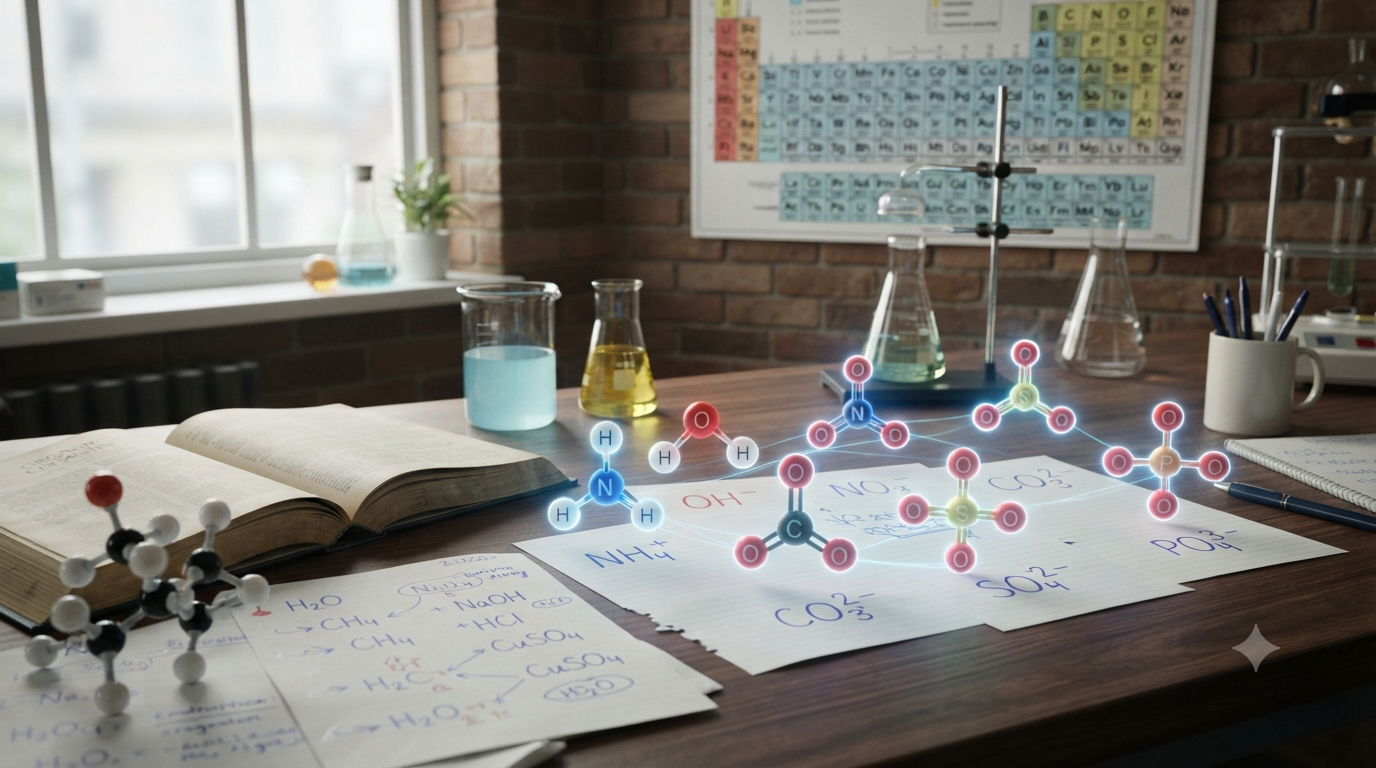

Polyatomic ions are groups of two or more atoms that are chemically bonded together and carry an overall electrical charge. Unlike monatomic ions, which contain only one atom, polyatomic ions behave as a single charged unit in chemical reactions and compounds. Learning their names, formulas, and charges is an important part of understanding inorganic chemistry and writing chemical formulas correctly.
Polyatomic ions are commonly found in acids, bases, salts, minerals, and many substances used in everyday life. Familiar examples include sulfate (SO₄²⁻), nitrate (NO₃⁻), carbonate (CO₃²⁻), hydroxide (OH⁻), and ammonium (NH₄⁺). Although each ion contains several atoms, its overall charge determines how it combines with other ions.
Understanding common polyatomic ions becomes much easier when their formulas and charges are learned together. Once these ions are familiar, writing formulas for ionic compounds, naming compounds, and balancing chemical equations becomes more straightforward.
What Is a Polyatomic Ion?
A polyatomic ion is a charged group of two or more covalently bonded atoms that behaves as one unit in a chemical reaction.
For example, the sulfate ion contains one sulfur atom and four oxygen atoms:
SO₄²⁻
The atoms inside the sulfate ion are held together by chemical bonds, while the entire group has an overall charge of −2.
Another example is the ammonium ion:
NH₄⁺
It contains one nitrogen atom and four hydrogen atoms and has an overall charge of +1.
The charge belongs to the entire group rather than to each individual atom.
Polyatomic Ions vs Monatomic Ions
A monatomic ion consists of only one atom. Examples include:
Na⁺ — sodium ion
K⁺ — potassium ion
Ca²⁺ — calcium ion
Cl⁻ — chloride ion
O²⁻ — oxide ion
A polyatomic ion contains two or more atoms. Examples include:
OH⁻ — hydroxide ion
NO₃⁻ — nitrate ion
SO₄²⁻ — sulfate ion
CO₃²⁻ — carbonate ion
NH₄⁺ — ammonium ion
Both types of ions can combine to form ionic compounds.
Why Are Polyatomic Ions Important?
Polyatomic ions appear in a large number of chemical substances. They are important because they allow chemists to represent complex groups of atoms using a single chemical formula.
For example, sodium sulfate is written as:
Na₂SO₄
The sulfate ion remains together as SO₄²⁻ while two sodium ions, Na⁺, provide the total +2 charge needed to balance the −2 charge of sulfate.
Polyatomic ions are also useful when studying:
Ionic compounds
Acids and bases
Chemical reactions
Solubility
Oxidation and reduction
Fertilizers
Minerals
Biological chemistry
Environmental chemistry
Knowing common polyatomic ions therefore provides a foundation for many areas of chemistry.
Common Polyatomic Ions and Their Formulas
The following table contains some of the most frequently encountered polyatomic ions.
| Name | Formula | Charge |
|---|---|---|
| Ammonium | NH₄⁺ | +1 |
| Hydroxide | OH⁻ | −1 |
| Nitrate | NO₃⁻ | −1 |
| Nitrite | NO₂⁻ | −1 |
| Acetate | C₂H₃O₂⁻ | −1 |
| Cyanide | CN⁻ | −1 |
| Permanganate | MnO₄⁻ | −1 |
| Hypochlorite | ClO⁻ | −1 |
| Chlorite | ClO₂⁻ | −1 |
| Chlorate | ClO₃⁻ | −1 |
| Perchlorate | ClO₄⁻ | −1 |
| Bicarbonate | HCO₃⁻ | −1 |
| Carbonate | CO₃²⁻ | −2 |
| Sulfate | SO₄²⁻ | −2 |
| Sulfite | SO₃²⁻ | −2 |
| Chromate | CrO₄²⁻ | −2 |
| Dichromate | Cr₂O₇²⁻ | −2 |
| Oxalate | C₂O₄²⁻ | −2 |
| Peroxide | O₂²⁻ | −2 |
| Phosphate | PO₄³⁻ | −3 |
| Phosphite | PO₃³⁻ | −3 |
These ions are especially useful to memorize because they occur frequently in chemical formulas and reactions.
Common Polyatomic Ions With a +1 Charge
Most commonly encountered polyatomic ions are negatively charged, but there are also positively charged polyatomic ions.
Ammonium Ion
The ammonium ion is:
NH₄⁺
It consists of one nitrogen atom and four hydrogen atoms and carries a +1 charge.
Ammonium is especially important because it is one of the most common positively charged polyatomic ions in introductory chemistry.
Examples of compounds containing ammonium include:
NH₄Cl — ammonium chloride
NH₄NO₃ — ammonium nitrate
(NH₄)₂SO₄ — ammonium sulfate
When ammonium combines with a negatively charged ion, the charges must balance to produce a neutral compound.
Common Polyatomic Ions With a −1 Charge
Many important polyatomic ions carry a −1 charge.
Hydroxide
OH⁻
Hydroxide contains one oxygen atom and one hydrogen atom. It is commonly found in bases such as sodium hydroxide:
NaOH
Nitrate
NO₃⁻
Nitrate contains one nitrogen atom and three oxygen atoms.
Examples include:
NaNO₃ — sodium nitrate
KNO₃ — potassium nitrate
Ca(NO₃)₂ — calcium nitrate
Nitrite
NO₂⁻
Nitrite contains one nitrogen atom and two oxygen atoms.
The difference between nitrate and nitrite is the number of oxygen atoms:
Nitrate = NO₃⁻
Nitrite = NO₂⁻
Acetate
C₂H₃O₂⁻
Acetate is commonly encountered in organic and inorganic chemistry. Sodium acetate, for example, has the formula:
NaC₂H₃O₂
Bicarbonate
HCO₃⁻
Bicarbonate is also called hydrogen carbonate. It contains hydrogen, carbon, and oxygen.
Sodium bicarbonate is:
NaHCO₃
This compound is commonly known as baking soda.
Cyanide
CN⁻
Cyanide contains carbon and nitrogen and carries a −1 charge. It is an important ion in chemical chemistry, although compounds containing cyanide can be highly toxic.
Common Polyatomic Ions With a −2 Charge
Several widely used polyatomic ions have a −2 charge.
Carbonate
CO₃²⁻
Carbonate contains one carbon atom and three oxygen atoms.
Examples include:
Na₂CO₃ — sodium carbonate
CaCO₃ — calcium carbonate
Calcium carbonate is an important component of limestone, chalk, and many shells.
Sulfate
SO₄²⁻
Sulfate contains one sulfur atom and four oxygen atoms.
Examples include:
Na₂SO₄ — sodium sulfate
CaSO₄ — calcium sulfate
CuSO₄ — copper(II) sulfate
Sulfite
SO₃²⁻
Sulfite contains one sulfur atom and three oxygen atoms.
The relationship between sulfate and sulfite is useful to remember:
Sulfate = SO₄²⁻
Sulfite = SO₃²⁻
The sulfite ion has one fewer oxygen atom than sulfate.
Chromate
CrO₄²⁻
Chromate contains one chromium atom and four oxygen atoms.
Dichromate
Cr₂O₇²⁻
Dichromate contains two chromium atoms and seven oxygen atoms.
The formulas of chromate and dichromate should not be confused:
Chromate = CrO₄²⁻
Dichromate = Cr₂O₇²⁻
Common Polyatomic Ions With a −3 Charge
Phosphate
PO₄³⁻
Phosphate contains one phosphorus atom and four oxygen atoms. It is one of the most important polyatomic ions in chemistry and biology.
Examples include:
Na₃PO₄ — sodium phosphate
Ca₃(PO₄)₂ — calcium phosphate
Phosphate compounds are also important in biological systems because phosphorus is present in molecules involved in energy transfer and genetic material.
Phosphite
PO₃³⁻
Phosphite contains one phosphorus atom and three oxygen atoms.
The difference between phosphate and phosphite follows a pattern similar to sulfate and sulfite:
Phosphate = PO₄³⁻
Phosphite = PO₃³⁻
Oxyanion Series and the Number of Oxygen Atoms
Some elements form a series of related polyatomic ions containing different numbers of oxygen atoms. Chlorine provides a useful example.
The four common chlorine oxyanions are:
Hypochlorite — ClO⁻
Chlorite — ClO₂⁻
Chlorate — ClO₃⁻
Perchlorate — ClO₄⁻
The prefixes and suffixes help indicate the relative number of oxygen atoms.
In this series:
ClO⁻ < ClO₂⁻ < ClO₃⁻ < ClO₄⁻
The number of oxygen atoms increases from hypochlorite to perchlorate.
A similar pattern occurs with sulfur:
Sulfite = SO₃²⁻
Sulfate = SO₄²⁻
And with nitrogen:
Nitrite = NO₂⁻
Nitrate = NO₃⁻
Recognizing these patterns can make memorization easier.
How to Write Formulas Using Polyatomic Ions
When writing the formula of an ionic compound, the total positive charge must equal the total negative charge.
For example, consider calcium nitrate.
Calcium forms:
Ca²⁺
Nitrate is:
NO₃⁻
One calcium ion has a +2 charge, while one nitrate ion has a −1 charge. Therefore, two nitrate ions are needed:
Ca(NO₃)₂
Parentheses are necessary because the entire nitrate ion occurs twice.
Another example is aluminum sulfate.
Aluminum forms:
Al³⁺
Sulfate is:
SO₄²⁻
The smallest common total charge is 6. Therefore, two aluminum ions and three sulfate ions are needed:
Al₂(SO₄)₃
The parentheses show that the sulfate group occurs three times.
When Are Parentheses Needed?
Parentheses are used when a polyatomic ion appears more than once in a chemical formula.
For example:
NaNO₃
Only one nitrate ion is present, so parentheses are unnecessary.
But calcium nitrate is:
Ca(NO₃)₂
Two nitrate ions are present, so parentheses are required.
Similarly:
Al₂(SO₄)₃
contains three sulfate ions.
A useful rule is:
If a polyatomic ion needs a subscript greater than 1, place the ion in parentheses before writing the subscript.
How to Memorize Common Polyatomic Ions
Memorizing every polyatomic ion at once can be difficult. A better approach is to learn them in groups.
Start with the most common ions:
OH⁻ — hydroxide
NO₃⁻ — nitrate
CO₃²⁻ — carbonate
SO₄²⁻ — sulfate
PO₄³⁻ — phosphate
NH₄⁺ — ammonium
Once these are familiar, learn related ions such as nitrite, sulfite, phosphite, and the chlorine oxyanions.
It is also helpful to memorize the charge together with the formula. Knowing only the name is not enough when writing chemical formulas.
Common Polyatomic Ions Quick Reference
For quick revision, these are some of the most important ions to remember:
NH₄⁺ — ammonium
OH⁻ — hydroxide
NO₃⁻ — nitrate
NO₂⁻ — nitrite
HCO₃⁻ — bicarbonate
C₂H₃O₂⁻ — acetate
CN⁻ — cyanide
ClO⁻ — hypochlorite
ClO₂⁻ — chlorite
ClO₃⁻ — chlorate
ClO₄⁻ — perchlorate
MnO₄⁻ — permanganate
CO₃²⁻ — carbonate
SO₄²⁻ — sulfate
SO₃²⁻ — sulfite
CrO₄²⁻ — chromate
Cr₂O₇²⁻ — dichromate
C₂O₄²⁻ — oxalate
O₂²⁻ — peroxide
PO₄³⁻ — phosphate
PO₃³⁻ — phosphite
Common Mistakes When Using Polyatomic Ions
One common mistake is forgetting the charge of the entire ion. For example, sulfate is SO₄²⁻, not SO₄⁻.
Another mistake is changing the formula of a polyatomic ion when it is used in a compound. The atoms within the ion generally remain grouped together.
Parentheses are another frequent source of errors. For example, calcium hydroxide is:
Ca(OH)₂
not CaOH₂.
The parentheses indicate that there are two complete hydroxide ions.
It is also important not to confuse ions with similar names. Nitrate and nitrite, for example, have different formulas and different numbers of oxygen atoms.
Conclusion
Polyatomic ions are groups of covalently bonded atoms that carry an overall electrical charge and behave as single units in many chemical reactions. Common examples include ammonium, hydroxide, nitrate, carbonate, sulfate, phosphate, and several related oxyanions.
Learning the formula and charge together is the most useful way to remember these ions. Recognizing patterns such as nitrate and nitrite, sulfate and sulfite, and the chlorine oxyanion series can also make memorization easier. Once common polyatomic ions become familiar, writing ionic compound formulas, naming compounds, and understanding chemical reactions becomes much more manageable. A strong knowledge of these ions provides an important foundation for further study in chemistry.
FAQs
1. What is a polyatomic ion?
A polyatomic ion is a charged group of two or more atoms that are chemically bonded together and behave as a single unit in chemical reactions. The atoms within the group are usually connected by covalent bonds, while the entire group has an overall positive or negative charge. For example, sulfate is written as SO₄²⁻ and contains one sulfur atom and four oxygen atoms. Nitrate is NO₃⁻, while ammonium is NH₄⁺. Polyatomic ions are commonly found in ionic compounds, acids, bases, minerals, and biological substances. Learning their formulas and charges makes it easier to write chemical formulas and understand many chemical reactions.
2. What are some common polyatomic ions?
Some common polyatomic ions include ammonium (NH₄⁺), hydroxide (OH⁻), nitrate (NO₃⁻), nitrite (NO₂⁻), carbonate (CO₃²⁻), sulfate (SO₄²⁻), sulfite (SO₃²⁻), phosphate (PO₄³⁻), bicarbonate (HCO₃⁻), and acetate (C₂H₃O₂⁻). Other important examples include chromate (CrO₄²⁻), dichromate (Cr₂O₇²⁻), permanganate (MnO₄⁻), and oxalate (C₂O₄²⁻). Each ion has a specific combination of atoms and an overall charge. Remembering both the formula and charge is important because the charge determines how the polyatomic ion combines with other ions to form electrically neutral compounds.
3. What is the formula of the sulfate ion?
The formula of the sulfate ion is SO₄²⁻. It contains one sulfur atom and four oxygen atoms and has an overall charge of −2. Sulfate is one of the most frequently encountered polyatomic ions in chemistry. It forms compounds with many positively charged ions. For example, sodium sulfate has the formula Na₂SO₄ because two Na⁺ ions are needed to balance one SO₄²⁻ ion. Calcium sulfate is written as CaSO₄ because Ca²⁺ and SO₄²⁻ have equal and opposite charges. Remembering sulfate as SO₄²⁻ is especially useful when writing formulas for ionic compounds.
4. What is the difference between sulfate and sulfite?
Sulfate and sulfite are related polyatomic ions, but they contain different numbers of oxygen atoms. The sulfate ion is SO₄²⁻, while the sulfite ion is SO₃²⁻. Both ions have the same overall charge of −2, but sulfate contains four oxygen atoms and sulfite contains three. This naming pattern is also seen in other polyatomic ions. The suffix “-ate” generally indicates more oxygen atoms than the corresponding “-ite” ion. Therefore, remembering sulfate as SO₄²⁻ and sulfite as SO₃²⁻ can help prevent confusion when writing chemical formulas and identifying compounds.
5. What is the charge of the nitrate ion?
The nitrate ion has the formula NO₃⁻ and carries a −1 charge. It consists of one nitrogen atom and three oxygen atoms. Because its charge is −1, nitrate can combine with a +1 ion in a one-to-one ratio. For example, sodium nitrate is NaNO₃ because Na⁺ balances NO₃⁻. When nitrate combines with calcium, two nitrate ions are required because calcium has a +2 charge. Therefore, calcium nitrate is Ca(NO₃)₂. The parentheses show that the nitrate ion occurs twice. Remembering both NO₃⁻ and its −1 charge is important for correctly writing chemical formulas.
6. Why are parentheses used with polyatomic ions?
Parentheses are used when a polyatomic ion appears more than once in a chemical formula. For example, calcium nitrate is written as Ca(NO₃)₂. The subscript 2 outside the parentheses means that there are two complete nitrate ions. Similarly, aluminum sulfate is Al₂(SO₄)₃, which contains three sulfate ions. Parentheses are not needed when only one polyatomic ion is present. For example, sodium nitrate is NaNO₃, not Na(NO₃). The parentheses help show that the entire polyatomic group is being multiplied by the subscript. This makes the composition of the compound clear.
7. What is the formula of the ammonium ion?
The formula of the ammonium ion is NH₄⁺. It contains one nitrogen atom and four hydrogen atoms and carries an overall positive charge of +1. Ammonium is one of the most important positively charged polyatomic ions commonly studied in chemistry. It can combine with negatively charged ions to form ionic compounds. For example, ammonium chloride is NH₄Cl, while ammonium sulfate is (NH₄)₂SO₄. In ammonium sulfate, two NH₄⁺ ions are needed to balance the −2 charge of sulfate. Remembering NH₄⁺ is particularly useful because most common polyatomic ions have negative charges.
8. How do you write a compound formula using polyatomic ions?
To write a compound formula using polyatomic ions, first identify the ions and their charges. Then balance the total positive and negative charges so that the compound is electrically neutral. For example, calcium is Ca²⁺ and nitrate is NO₃⁻. Two nitrate ions are needed to balance one calcium ion, giving Ca(NO₃)₂. For aluminum sulfate, aluminum is Al³⁺ and sulfate is SO₄²⁻. Two aluminum ions and three sulfate ions give Al₂(SO₄)₃. Parentheses are used when more than one polyatomic ion is required. Always check the final formula to ensure that the total charge equals zero.
9. What is the difference between nitrate and nitrite?
Nitrate and nitrite are two related nitrogen-containing polyatomic ions. Nitrate has the formula NO₃⁻, while nitrite has the formula NO₂⁻. Both ions carry a −1 charge, but nitrate contains three oxygen atoms and nitrite contains two. The suffix “-ate” generally represents the form with more oxygen atoms, while “-ite” represents the form with fewer oxygen atoms. For example, sodium nitrate is NaNO₃, whereas sodium nitrite is NaNO₂. Remembering this difference is important because changing the number of oxygen atoms changes the identity of the ion and the compound.
10. How can I memorize common polyatomic ions easily?
A useful way to memorize polyatomic ions is to learn them in small groups rather than trying to remember every ion at once. Start with frequently used ions such as NH₄⁺, OH⁻, NO₃⁻, CO₃²⁻, SO₄²⁻, and PO₄³⁻. Learn each formula together with its name and charge. Next, study related pairs such as nitrate and nitrite or sulfate and sulfite. The chlorine oxyanion series, including hypochlorite, chlorite, chlorate, and perchlorate, can also be learned as a pattern. Regularly writing formulas for ionic compounds provides practice and helps reinforce both the formulas and their charges.
Related Posts
How to Determine Atomic Ratios From Chemical Formulas
Chemical formulas provide much more information than simply telling us which elements are present in a substance. The symbols and […]
Read MoreHow Atomic Ratios Differ From Mass Ratios in Compounds
When we study chemical compounds, we often use ratios to describe how their elements are combined. Two important types of […]
Read MoreWhy Chemical Formulas Use Whole Number Subscripts
Chemical formulas are one of the simplest ways scientists communicate information about substances. A formula such as H₂O tells us […]
Read MoreHow Whole Number Ratios Are Used in Chemical Formulas
Chemical formulas are a simple way of showing what a substance is made of. A formula tells us which elements […]
Read MoreHow to Identify the Simplest Ratio in a Chemical Formula
Chemical formulas do more than identify substances. They also show how atoms of different elements are combined. By looking carefully […]
Read MoreFormula Units vs Molecules in Chemistry
Chemistry uses formulas to describe the substances that make up the world around us. When we see formulas such as […]
Read MoreWhat Is the Meaning of Formula Units in Chemistry?
In chemistry, substances are often represented using chemical formulas. A chemical formula tells us which elements are present and, in […]
Read MoreHow Chemical Formulas Represent Fixed Composition
A chemical formula is much more than a short name for a substance. It gives important information about what a […]
Read MoreHow to Interpret the Ratio of Elements in a Compound
When a chemical compound is represented by a chemical formula, the symbols and numbers in that formula contain important information […]
Read MoreHow Chemical Formula Ratios Describe Compound Composition
A chemical formula is much more than a short way of naming a compound. It provides important information about what […]
Read MoreHow are chemical formulas used in stoichiometric calculations?
Chemical formulas are one of the most important tools used in chemistry. They tell us which elements are present in […]
Read MoreHow can chemical formulas be used to understand chemical reactions?
Chemical reactions are processes in which substances change into new substances. We can observe some reactions through changes in color, […]
Read MoreWhy do some substances have simple formulas while others have complex formulas?
Chemical formulas are one of the simplest ways to describe what a substance is made of. A formula such as […]
Read MoreHow can beginners memorize important chemical formulas without confusion?
Learning chemical formulas can feel confusing when you are just starting chemistry. There may be many formulas to remember, different […]
Read MoreWhich chemistry formulas are essential for beginners to learn first?
Chemistry becomes much easier when you understand the formulas used to represent substances, reactions, quantities, and relationships between different chemical […]
Read MoreHow should a student organize chemistry formulas for easy revision?
Chemistry involves many formulas, symbols, equations, ions, compounds, and numerical relationships. As the syllabus grows, simply memorizing formulas one after […]
Read MoreWhat is the difference between molecular and empirical formulas?
Chemical formulas give us a compact way to describe the composition of substances. Instead of writing the names and numbers […]
Read MoreWhy can different compounds have the same empirical formula?
An empirical formula gives the simplest whole-number ratio of atoms present in a compound. It is useful because it tells […]
Read MoreHow do parentheses affect the number of atoms in a formula?
Chemical formulas tell us which elements are present in a substance and how many atoms of each element are included. […]
Read MoreHow can you count atoms from a chemical formula?
A chemical formula tells us much more than the name of a substance. It also gives information about the types […]
Read MoreWhy is a subscript different from a coefficient?
When learning chemical formulas, two small numbers can appear next to chemical symbols and look surprisingly similar. One is called […]
Read MoreWhat does a coefficient mean in a chemical equation?
A chemical equation is a compact way of representing a chemical reaction. It tells us which substances take part in […]
Read MoreWhat does a subscript mean in a chemical formula?
A chemical formula is a short way of showing what a substance is made of. Instead of writing the names […]
Read MoreHow can you identify the elements present in a formula?
A chemical formula is a short way of showing what a substance is made of. Instead of writing the complete […]
Read MoreHow are element symbols used to write chemical formulas?
Chemical formulas are one of the simplest and most useful ways to represent substances in chemistry. Instead of writing the […]
Read MoreWhat is the difference between a chemical symbol and a chemical formula?
Chemistry uses a special language to describe elements, atoms, compounds, and chemical substances. Two of the most basic parts of […]
Read MoreWhat information can be obtained from a chemical formula?
A chemical formula is a short and powerful way of representing a substance. It uses chemical symbols and numbers to […]
Read MoreHow does a chemical formula represent a substance?
A chemical formula is a short and precise way of representing a substance using chemical symbols and numbers. Instead of […]
Read MoreWhy are chemical formulas important in chemistry?
Chemistry is the study of matter, its properties, composition, and the changes it undergoes. To understand and communicate these ideas […]
Read MoreWhat exactly is a chemical formula?
A chemical formula is a short way of representing a chemical substance using symbols and numbers. Instead of writing the […]
Read More