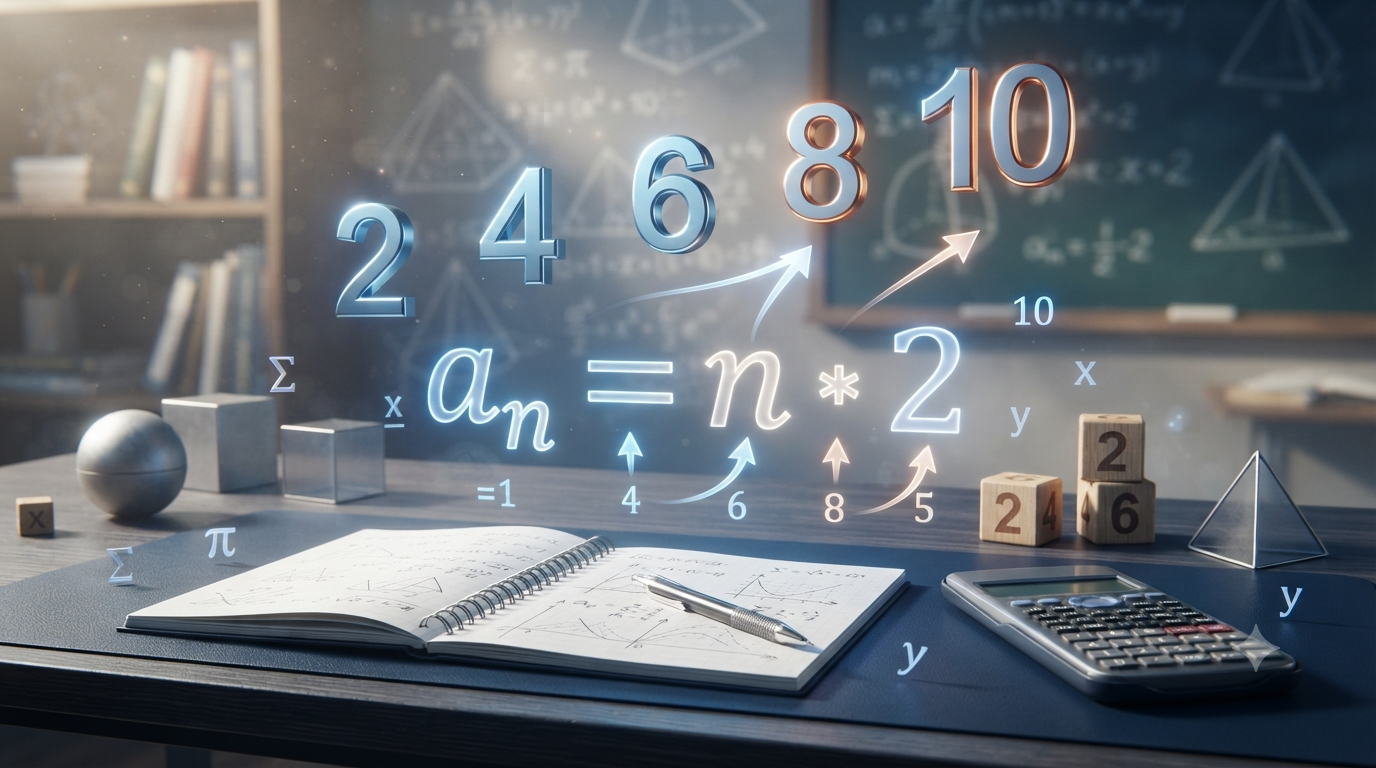
Numerical sequences are lists of numbers arranged in a particular order. Some sequences may look simple, such as 2, 4, 6, 8, 10, while others can contain more complicated patterns. Finding the rule behind a sequence is an important part of mathematics because it helps us understand how numbers are connected and predict what comes next.
A formula can make this process much easier. Instead of looking at every number separately, a formula describes the general relationship between the position of a number and its value. Once the formula is known, we can find any term in the sequence without writing out all the terms before it.
Formulas are especially useful when a sequence contains a repeating, increasing, decreasing, or more complex pattern. They help turn observations into a precise mathematical rule. In this article, we will explore how formulas help identify patterns in numerical sequences and how they can be used to predict and calculate terms efficiently.
What Is a Numerical Sequence?
A numerical sequence is an ordered list of numbers that follows a particular rule or pattern.
For example:
2, 4, 6, 8, 10, 12, …
Here, each number is 2 greater than the previous number. The sequence continues according to the same pattern.
Another example is:
5, 10, 15, 20, 25, …
In this sequence, each term increases by 5.
The numbers in a sequence are called terms. Their positions are usually represented by a positive integer called the term number or index.
For example:
First term → position 1
Second term → position 2
Third term → position 3
Fourth term → position 4
A formula can connect the position of a term to the actual value of that term.
Why Are Patterns Important in Sequences?
A pattern tells us how one term is related to another or how the sequence behaves as the term number increases.
Consider:
3, 6, 9, 12, 15, …
It is easy to see that 3 is added each time. But imagine being asked to find the 100th term.
Writing all 100 terms would take time. Instead, we can recognize that the sequence follows a simple rule:
nth term = 3 × n
Therefore:
100th term = 3 × 100 = 300
The formula allows us to move directly from the position of a term to its value.
This is one of the main reasons formulas are useful for studying numerical patterns.
How Does a Formula Represent a Sequence?
A formula for a sequence usually uses a variable such as n to represent the position of a term.
For example, consider:
4, 8, 12, 16, 20, …
The terms are multiples of 4. The formula is:
aₙ = 4n
Here:
aₙ represents the nth term.
n represents the position of the term.
4n gives the value of the term at that position.
We can test the formula:
For n = 1:
a₁ = 4(1) = 4
For n = 2:
a₂ = 4(2) = 8
For n = 5:
a₅ = 4(5) = 20
The formula produces every term in the sequence.
Formulas Help Reveal Arithmetic Patterns
One of the simplest types of numerical sequence is an arithmetic sequence. In an arithmetic sequence, the same number is added or subtracted from one term to get the next.
For example:
7, 10, 13, 16, 19, …
The common difference is 3.
The general formula for the nth term of an arithmetic sequence is:
aₙ = a₁ + (n − 1)d
where:
aₙ is the nth term.
a₁ is the first term.
d is the common difference.
n is the position of the term.
For the sequence above:
a₁ = 7
d = 3
Therefore:
aₙ = 7 + (n − 1)3
This formula can be simplified:
aₙ = 3n + 4
Now we can find any term directly.
For example, the 20th term is:
a₂₀ = 3(20) + 4
a₂₀ = 64
The formula therefore provides a compact description of the entire pattern.
Formulas Help Identify Multiplicative Patterns
Not every sequence increases by the same amount. Some sequences follow a multiplication or division pattern.
Consider:
2, 6, 18, 54, 162, …
Each term is multiplied by 3 to produce the next term.
This is called a geometric sequence.
A geometric sequence has the general nth-term formula:
aₙ = a₁rⁿ⁻¹
where:
aₙ is the nth term.
a₁ is the first term.
r is the common ratio.
n is the term position.
For this sequence:
a₁ = 2
r = 3
Therefore:
aₙ = 2 × 3ⁿ⁻¹
To find the fifth term:
a₅ = 2 × 3⁴
a₅ = 162
The formula clearly shows that the sequence grows much faster than an arithmetic sequence.
First Differences Can Reveal a Pattern
One useful method for investigating a sequence is to calculate the differences between consecutive terms.
Consider:
5, 8, 11, 14, 17, …
The differences are:
8 − 5 = 3
11 − 8 = 3
14 − 11 = 3
17 − 14 = 3
Because the first differences are constant, the sequence is arithmetic.
Now consider:
1, 4, 9, 16, 25, …
The differences are:
4 − 1 = 3
9 − 4 = 5
16 − 9 = 7
25 − 16 = 9
The differences are not constant, but they follow their own pattern: 3, 5, 7, 9, …
If we calculate the differences of these differences, we get:
5 − 3 = 2
7 − 5 = 2
9 − 7 = 2
The second differences are constant.
This suggests that the sequence follows a quadratic pattern. In fact, the terms are the squares of their positions:
aₙ = n²
A formula therefore helps explain the deeper structure behind the numbers.
Formulas Can Help Distinguish Different Types of Patterns
Looking only at a few terms can sometimes make different patterns appear similar.
For example:
2, 4, 6, 8, …
The obvious formula is:
aₙ = 2n
But a limited number of terms can sometimes be represented by more than one mathematical rule. This is why identifying a pattern should involve checking whether the proposed formula continues to work for all relevant terms.
Formulas provide a way to test a suspected pattern.
Suppose we think a sequence follows:
aₙ = n² + 1
For n = 1:
a₁ = 1² + 1 = 2
For n = 2:
a₂ = 2² + 1 = 5
For n = 3:
a₃ = 3² + 1 = 10
So the sequence would be:
2, 5, 10, 17, 26, …
The formula gives us a precise way to verify the pattern.
Formulas Make Large Terms Easier to Find
One of the greatest advantages of formulas is that they allow us to calculate distant terms without listing every term.
Consider:
6, 12, 18, 24, 30, …
The formula is:
aₙ = 6n
Suppose we want the 1,000th term.
Without a formula, we would need to continue the sequence until reaching the 1,000th position.
With the formula:
a₁₀₀₀ = 6 × 1,000
a₁₀₀₀ = 6,000
This shows how formulas transform a long numerical pattern into a simple calculation.
Formulas Help Predict Future Terms
A formula is not only useful for finding terms that already appear in a sequence. It can also help predict future terms.
Consider:
10, 15, 20, 25, 30, …
The pattern increases by 5.
Its formula is:
aₙ = 10 + (n − 1)5
Suppose we want to know what comes much later in the sequence.
For the 50th term:
a₅₀ = 10 + (50 − 1)5
a₅₀ = 255
The formula allows us to predict the value without manually extending the sequence.
Formulas Can Show How Quickly a Sequence Grows
Different formulas produce different growth patterns.
Compare these three sequences:
2, 4, 6, 8, 10, …
1, 4, 9, 16, 25, …
2, 4, 8, 16, 32, …
Their formulas can be written as:
aₙ = 2n
aₙ = n²
aₙ = 2ⁿ
These formulas show three different types of growth.
The first grows linearly because the same amount is added each time.
The second grows quadratically because the term depends on the square of its position.
The third grows exponentially because the position appears as an exponent.
By examining the formula, we can understand not only what the terms are but also how rapidly the sequence changes.
How to Find a Formula from a Sequence
Finding a formula often begins with looking carefully at the terms.
A useful process is:
Step 1: Write the Term Positions
Suppose the sequence is:
3, 7, 11, 15, 19, …
Write the positions:
| Position | Term |
|---|---|
| 1 | 3 |
| 2 | 7 |
| 3 | 11 |
| 4 | 15 |
| 5 | 19 |
Step 2: Look for a Common Difference
Calculate:
7 − 3 = 4
11 − 7 = 4
15 − 11 = 4
19 − 15 = 4
The common difference is 4.
Step 3: Use the Arithmetic Sequence Formula
The first term is 3 and the common difference is 4.
So:
aₙ = 3 + (n − 1)4
Simplifying:
aₙ = 4n − 1
Step 4: Test the Formula
For n = 1:
a₁ = 4(1) − 1 = 3
For n = 3:
a₃ = 4(3) − 1 = 11
For n = 5:
a₅ = 4(5) − 1 = 19
The formula matches the sequence.
Testing is an important part of identifying a pattern because it helps confirm that the formula works beyond the first few terms.
Formulas Can Describe Real-World Patterns
Numerical sequences are not limited to textbook exercises. Patterns represented by formulas appear in many areas of science, mathematics, technology, and everyday life.
For example, a savings plan may increase by a fixed amount each month. A population may grow according to a particular mathematical model. The number of objects in a repeating geometric arrangement may follow a sequence. Computer algorithms can also generate numerical sequences according to formulas or rules.
In each case, a formula provides a compact way to describe how a quantity changes.
This is one reason understanding sequences is useful beyond basic mathematics.
Why a Formula Is More Powerful Than a List of Numbers
A list of numbers shows the results of a pattern, but a formula describes the rule behind those results.
For example:
5, 10, 15, 20, 25, …
The list tells us several values.
The formula:
aₙ = 5n
tells us something much more powerful. It explains how every term is generated and allows us to calculate any term directly.
A formula can therefore be thought of as a mathematical shortcut that captures the structure of a sequence.
Instead of memorizing many individual numbers, we can understand the relationship that produces them.
Common Mistakes When Identifying Sequence Patterns
Finding patterns can sometimes lead to incorrect conclusions.
One common mistake is assuming that the pattern must involve addition or subtraction. Some sequences are multiplicative, quadratic, exponential, or based on another rule.
Another mistake is checking only one or two terms. A formula should be tested against several terms whenever possible.
It is also important to distinguish between the term number and the term value. For example, in the sequence 4, 8, 12, 16, the third term is 12. The number 3 represents its position, while 12 represents its value.
Keeping these ideas separate makes it easier to build and understand formulas.
Conclusion
Formulas are powerful tools for identifying and understanding patterns in numerical sequences. They connect the position of a term with its value and provide a precise mathematical description of how a sequence behaves.
For simple arithmetic sequences, formulas can show a constant increase or decrease. For geometric sequences, they reveal repeated multiplication or division. Differences between terms can also help identify quadratic and other patterns.
Most importantly, formulas allow us to calculate distant terms, predict future values, compare different types of growth, and verify whether a suspected pattern is correct.
A sequence gives us a collection of numbers, but a formula helps us understand the rule connecting those numbers. Once that rule is identified, a seemingly long or complicated sequence can often be described with a single mathematical expression.
FAQs
1. What is a numerical sequence?
A numerical sequence is an ordered list of numbers that follows a particular rule or pattern. Each number in the sequence is called a term, and its position is called the term number or index. For example, 3, 6, 9, 12, 15 is a numerical sequence in which each term increases by 3. Sequences can follow many different patterns, including addition, subtraction, multiplication, division, powers, or more complex relationships. Studying sequences helps us understand how numbers are connected. Formulas make this understanding easier because they can describe the relationship between the position of a term and its value.
2. How does a formula help identify a pattern in a sequence?
A formula describes the general rule that connects a term’s position with its value. Instead of examining every number individually, we can use the formula to determine any term directly. For example, in the sequence 4, 8, 12, 16, 20, the formula is aₙ = 4n. Here, n represents the position of the term. When n = 5, the formula gives 4 × 5 = 20. By testing different values of n, we can see that the formula generates the sequence. Therefore, a formula helps turn an observed numerical pattern into a precise mathematical rule.
3. How can you find the formula for an arithmetic sequence?
To find the formula for an arithmetic sequence, first identify the first term and then calculate the common difference between consecutive terms. The general formula is aₙ = a₁ + (n − 1)d, where a₁ is the first term, d is the common difference, and n represents the term position. For example, consider 5, 8, 11, 14, 17. The first term is 5 and the common difference is 3. Therefore, the formula is aₙ = 5 + (n − 1)3. This can be simplified to aₙ = 3n + 2, which generates every term in the sequence.
4. How do differences between terms help identify patterns?
Calculating differences between consecutive terms is a useful way to investigate a sequence. If the first differences are constant, the sequence is usually arithmetic. For example, in 7, 11, 15, 19, the differences are 4, 4, and 4. This shows a constant pattern. If the first differences are not constant, we can calculate the differences again. For example, in 1, 4, 9, 16, 25, the first differences are 3, 5, 7, and 9. The second differences are all 2. Constant second differences indicate a quadratic pattern. Difference tables therefore help reveal hidden mathematical relationships.
5. Can formulas be used to find a term far into a sequence?
Yes, one of the main advantages of a formula is that it allows us to find a distant term without listing all the terms before it. Consider the sequence 6, 12, 18, 24, 30, and so on. Its formula is aₙ = 6n. If we want the 100th term, we simply substitute n = 100. This gives a₁₀₀ = 6 × 100 = 600. Without the formula, we would have to continue the sequence until reaching the 100th term. Formulas therefore save time and make calculations involving large term numbers much more efficient.
6. How do formulas help predict future terms in a sequence?
A formula can describe the rule that controls how a sequence continues. Once the rule is known, future terms can be calculated even when they have not yet been written. For example, consider 10, 15, 20, 25, 30, and so on. The sequence increases by 5, giving the formula aₙ = 10 + (n − 1)5. Using this formula, we can calculate the 20th term or any later term directly. This makes formulas useful for prediction. Rather than guessing what comes next, we use the mathematical relationship represented by the formula to determine future values accurately.
7. How can a formula show whether a sequence is increasing or decreasing?
A formula can provide information about how the values of a sequence change as the term number increases. For example, the formula aₙ = 3n produces an increasing sequence because larger values of n produce larger values of aₙ. Similarly, a formula such as aₙ = 20 − 2n produces a decreasing sequence because the value decreases as n increases. More complicated formulas may produce patterns that increase, decrease, or change their rate of growth. Examining how the formula depends on n helps us understand the overall behavior of the sequence rather than simply observing individual terms.
8. What is the difference between an arithmetic and geometric sequence?
An arithmetic sequence changes by adding or subtracting the same number from each term. For example, 4, 7, 10, 13 has a common difference of 3. A geometric sequence changes by multiplying or dividing each term by the same number. For example, 2, 6, 18, 54 has a common ratio of 3. Arithmetic sequences can generally be represented using a linear formula such as aₙ = a₁ + (n − 1)d, while geometric sequences use a formula such as aₙ = a₁rⁿ⁻¹. Recognizing whether the pattern is additive or multiplicative helps determine the appropriate formula.
9. Why should a sequence formula be tested?
A formula should be tested because observing a few terms does not always guarantee that a proposed rule is correct. Different mathematical rules can sometimes produce the same first few values but behave differently later. After creating a formula, substitute several term positions into it and compare the results with the original sequence. For example, if a formula is proposed for the sequence 2, 5, 10, 17, substitute n = 1, 2, 3, and 4 to check the results. Testing provides evidence that the formula correctly represents the intended pattern and helps prevent errors.
10. Why are formulas important when studying numerical sequences?
Formulas are important because they provide a compact and precise way to describe an entire sequence. A list of numbers shows individual terms, but a formula explains the relationship that generates those terms. It can help identify patterns, calculate any term, predict future values, compare different sequences, and understand how quickly a sequence grows or decreases. For example, the formula aₙ = n² immediately tells us that the terms depend on the square of their positions. This is much more informative than simply listing 1, 4, 9, 16, and 25. Formulas therefore help transform numerical observations into mathematical understanding.