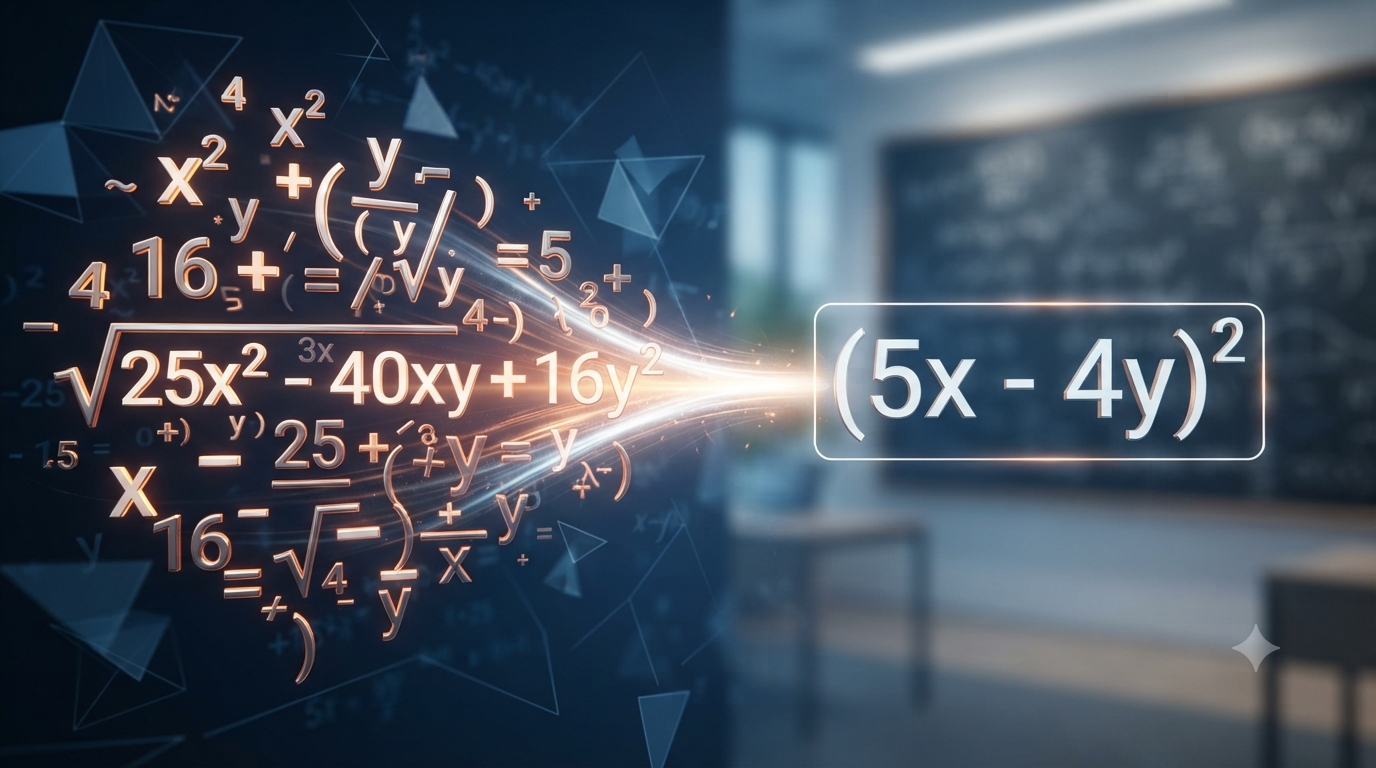
Mathematical formulas can sometimes look complicated because they contain many terms, operations, and symbols. When several terms are added, subtracted, or multiplied together, it may be difficult to see how the different parts of the expression are related. Factoring is one of the most useful methods for making such expressions easier to read and understand. Instead of leaving an expression as a sum or difference of several terms, factoring rewrites it as a product of simpler expressions.
For example, the expression
6x + 12
contains two terms. At first glance, the relationship between them may not be obvious. However, both terms contain a common factor of 6. We can therefore write:
6x + 12 = 6(x + 2)
The new form immediately shows that 6 is common to both terms and that the remaining part is x + 2.
Factoring does more than make an expression shorter. It can reveal hidden patterns, simplify calculations, make equations easier to solve, and help us understand how different parts of a formula are connected. This is why factoring is an important skill throughout mathematics.
What Is Factoring?
Factoring is the process of rewriting a mathematical expression as a product of two or more simpler expressions called factors.
For example:
x² + 5x = x(x + 5)
The original expression has two terms:
x²
5x
Both terms contain x, so x can be taken outside the parentheses:
x² + 5x = x(x + 5)
Here, x and x + 5 are factors.
Factoring is essentially the reverse of expanding brackets. If we multiply:
x(x + 5)
we get:
x² + 5x
So factoring and expansion are closely related processes.
Why Can a Formula Look Complicated?
A formula may appear complicated for several reasons. It might contain many terms, repeated quantities, powers, fractions, or combinations of different operations.
Consider:
8x² + 12x
There are only two terms, but the expression can still look somewhat complicated. Both terms contain common factors. In particular, they share 4x.
Therefore:
8x² + 12x = 4x(2x + 3)
The factored form makes the structure easier to recognize.
The original expression tells us that two quantities are being added. The factored expression tells us that the entire quantity is made by multiplying 4x by 2x + 3.
That structural information can be very useful.
Factoring Reveals Common Factors
One of the simplest ways factoring makes a formula easier to understand is by revealing common factors.
Consider:
15x + 20
Both terms are divisible by 5. Factoring out 5 gives:
15x + 20 = 5(3x + 4)
The common factor is now clearly visible.
This can be especially useful when an expression contains many terms.
For example:
12a + 18b + 24c
All three terms have a common factor of 6:
12a + 18b + 24c = 6(2a + 3b + 4c)
The factored form shows that every term is connected to the same factor, 6.
This can help us recognize relationships that are less obvious in the expanded form.
Factoring Can Reduce Visual Complexity
A long expression can be difficult to read because our attention has to move across many individual terms.
For example:
7x² + 14x + 21
can be factored as:
7(x² + 2x + 3)
The second form is shorter and visually simpler.
Although the mathematical value has not changed, the expression is now organized around a common factor.
This is one important idea in mathematics: a simpler form does not necessarily contain less information. It can simply organize the same information more clearly.
Factoring often provides this kind of organization.
Factoring Makes Structure Easier to See
Sometimes the main advantage of factoring is not that an expression becomes shorter, but that its internal structure becomes visible.
Consider:
x² − 9
This expression may initially look like a simple subtraction problem. However, it follows the pattern of a difference of two squares:
x² − 3²
Using the difference-of-squares identity:
a² − b² = (a − b)(a + b)
we get:
x² − 9 = (x − 3)(x + 3)
The factored form reveals something that was hidden before: the expression consists of two related factors, x − 3 and x + 3.
This structure becomes particularly useful when solving equations.
Factoring Can Make Equations Easier to Solve
Factoring is especially powerful when working with equations.
Consider:
x² + 5x + 6 = 0
The equation contains a quadratic expression. It may not be immediately obvious which values of x make it equal to zero.
Factoring gives:
(x + 2)(x + 3) = 0
Now the equation has a much clearer structure.
For a product to equal zero, at least one of its factors must be zero. Therefore:
x + 2 = 0
or
x + 3 = 0
So:
x = −2
or
x = −3
Factoring has transformed a quadratic equation into two simpler equations.
This demonstrates an important reason why factoring is so useful: it can expose the parts of an expression that determine its behavior.
Factoring Helps Identify Important Values
A factored expression can make important values easier to identify.
Consider:
(x − 4)(x + 1)
The expression becomes zero when either factor becomes zero.
Therefore:
x = 4
or
x = −1
These values are called the roots or zeros of the expression.
If the same expression were written in expanded form:
x² − 3x − 4
the roots would not be as immediately visible.
Both forms are mathematically equivalent, but they emphasize different information.
The expanded form can be useful for some calculations, while the factored form makes the zeros easier to see.
Factoring Can Simplify Fractions
Factoring can also make algebraic fractions easier to simplify.
Consider:
(x² − 9) / (x − 3)
At first, the numerator and denominator do not appear to have a common factor. But the numerator can be factored:
x² − 9 = (x − 3)(x + 3)
Therefore:
[(x − 3)(x + 3)] / (x − 3)
For x ≠ 3, the common factor can be cancelled:
x + 3
Factoring has revealed the common factor that was hidden in the original expression.
Without factoring, the simplification would be difficult to recognize.
Factoring Helps Us Understand Relationships
Mathematical formulas often describe relationships between quantities. Factoring can make those relationships easier to see.
Suppose we have:
12x² + 18x
Factoring gives:
6x(2x + 3)
Now we can see that the entire expression depends on two main components:
the factor 6x
the factor 2x + 3
This can help us reason about how the expression changes when x changes.
For example, if x = 0, the factor 6x becomes zero, so the entire expression becomes zero.
The factored form makes this behavior particularly obvious.
Factoring Can Highlight Zeros
When an expression is written as a product, it becomes easier to identify values that make the expression equal to zero.
Consider:
3x(x − 5)(x + 2)
The expression is zero if any one of the factors is zero.
Therefore:
x = 0
x = 5
or
x = −2
The factored form provides this information almost immediately.
If the expression were expanded first, it would become:
3x³ − 9x² − 30x
The same information is still present, but it is much harder to recognize.
Factoring Can Make Calculations More Efficient
Factoring is not only about understanding. It can also make calculations faster.
Consider:
48 × 25
Instead of multiplying directly, we can recognize that:
48 × 25 = 12 × 4 × 25
Since:
4 × 25 = 100
we get:
12 × 100 = 1200
This is not algebraic factoring in exactly the same form as factoring a polynomial, but it demonstrates the same mathematical idea: breaking a quantity into useful factors can make a calculation easier.
The ability to choose a helpful factorization is therefore an important part of mathematical problem-solving.
Factoring Can Reveal Hidden Patterns
Many algebraic expressions follow standard patterns. Factoring can help us recognize them.
For example:
a² + 2ab + b²
can be factored as:
(a + b)²
Similarly:
a² − 2ab + b²
becomes:
(a − b)²
And:
a² − b²
becomes:
(a − b)(a + b)
These patterns are important because they allow complicated-looking expressions to be rewritten in compact forms.
Once students become familiar with these patterns, they can often recognize the structure of an expression almost immediately.
Factoring and Expanding Show Different Information
It is important to understand that neither factored form nor expanded form is always better.
Different forms are useful for different purposes.
For example:
(x + 2)(x + 3)
is useful for identifying the roots of a quadratic equation.
But if we want to compare coefficients or combine the expression with another polynomial, the expanded form may be more convenient:
x² + 5x + 6
Both expressions represent exactly the same mathematical quantity.
The choice of form depends on what we are trying to understand or calculate.
This is one of the most important lessons about factoring: factoring does not change the mathematics; it changes the way the mathematics is organized.
Factoring Does Not Always Make an Expression Simpler
Although factoring can often make formulas easier to understand, it does not always produce a better-looking expression.
For example:
x² + x + 1
does not factor into simple linear factors using ordinary integer coefficients.
Trying to force every expression into a factored form can sometimes make the result less useful or more complicated.
Therefore, the goal should not be to factor an expression simply because factoring is possible. The goal is to choose a form that makes the mathematical structure or purpose clearer.
Factoring Is a Form of Mathematical Organization
A useful way to think about factoring is to compare it with organizing information.
Imagine a collection of objects that are scattered across a table. The objects may all be present, but their relationships are difficult to see. Grouping related objects together makes the overall arrangement easier to understand.
Factoring does something similar with algebraic expressions.
It groups common mathematical components together.
For example:
4x + 8
becomes:
4(x + 2)
The factor 4 is separated from the remaining expression. This grouping makes the relationship between the terms clearer.
In this sense, factoring is not merely a calculation technique. It is also a method of organizing mathematical information.
Factoring in More Advanced Mathematics
The importance of factoring continues well beyond basic algebra.
Factoring is used in quadratic equations, polynomial functions, algebraic fractions, coordinate geometry, calculus, number theory, and many other areas of mathematics.
In higher mathematics, expressions may become much larger and more complicated. Being able to identify common factors and useful structures can make those expressions manageable.
For example, factoring can help when simplifying algebraic expressions before differentiation or integration. It can also help identify roots of polynomial functions and analyze where a function is positive or negative.
The basic idea remains the same: find useful factors and rewrite the expression in a form that exposes its structure.
A Simple Example of the Difference
Consider the expression:
x² + 7x + 12
In expanded form, we see three terms.
By factoring:
x² + 7x + 12 = (x + 3)(x + 4)
we immediately see that the expression is the product of two simpler expressions.
This tells us several things:
The expression has factors x + 3 and x + 4.
The expression becomes zero when x = −3 or x = −4.
The structure of the quadratic is easier to recognize.
The equation x² + 7x + 12 = 0 can be solved quickly.
A single factoring step has therefore made several mathematical properties easier to see.
How to Know When Factoring Is Useful
Factoring is particularly useful when you want to:
Find common factors in an expression.
Simplify an algebraic fraction.
Solve a quadratic or polynomial equation.
Find the zeros or roots of a polynomial.
Recognize a standard algebraic identity.
Reduce the visual complexity of an expression.
Understand how different terms are related.
Make later calculations easier.
Analyze the behavior of a mathematical expression.
Rewrite a formula into a more useful form.
The important question is not simply, “Can I factor this?” A better question is, “Will factoring help me see or calculate something more easily?”
Conclusion
Factoring can sometimes make a complicated formula easier to understand because it reveals the structure hidden inside the expression. Common factors become visible, long expressions can become more organized, roots can be identified more easily, equations can become simpler to solve, and algebraic fractions can often be reduced.
For example:
x² + 5x + 6
may not immediately reveal much about its structure. But after factoring:
(x + 2)(x + 3)
the relationship between its parts becomes much clearer.
Factoring does not change the value of an expression. Instead, it gives us another way to look at the same mathematical information. The best form depends on what we want to do with the formula. Sometimes the expanded form is more useful, while at other times the factored form provides a much clearer picture.
Ultimately, learning to factor is not just about following algebraic rules. It is about learning to recognize patterns, organize information, and choose a mathematical form that makes an idea easier to see.
FAQs
1. Why can factoring make a formula easier to understand?
Factoring can make a formula easier to understand because it reveals the common parts and structure hidden within an expression. For example, 6x + 12 can be written as 6(x + 2). The factored form clearly shows that 6 is common to both terms. Factoring can also reveal relationships between quantities, identify important values, and reduce visual complexity. In equations, a factored form can make solutions easier to find. Instead of viewing an expression as several separate terms, we can see how those terms are connected through multiplication. This makes factoring useful for both calculation and mathematical understanding.
2. What is factoring in mathematics?
Factoring is the process of rewriting a mathematical expression as a product of two or more simpler expressions called factors. For example, x² + 5x can be written as x(x + 5). In this example, x is a common factor of both terms. Factoring is essentially the reverse of expanding brackets. When we multiply x(x + 5), we get x² + 5x again. Factoring is commonly used with numbers, algebraic expressions, polynomials, and equations. It helps organize mathematical expressions and can make important relationships easier to recognize.
3. How does factoring reveal the structure of an expression?
Factoring reveals structure by grouping related parts of an expression into factors. Consider x² − 9. In its original form, the relationship between the terms may not be immediately obvious. Recognizing it as a difference of two squares allows us to write x² − 9 = (x − 3)(x + 3). The factored form shows that the expression consists of two related factors. This structure can provide useful information about the expression, especially when solving equations or identifying values that make it equal to zero. Factoring therefore helps us see relationships that may be hidden in expanded form.
4. Can factoring make a complicated equation easier to solve?
Yes, factoring can make many equations significantly easier to solve. Consider x² + 5x + 6 = 0. Factoring gives (x + 2)(x + 3) = 0. Once the equation is written as a product, we can use the zero-product property. This means that if a product is zero, at least one of its factors must be zero. Therefore, x + 2 = 0 or x + 3 = 0, giving x = −2 or x = −3. Factoring transforms one quadratic equation into simpler equations, making its solutions much easier to identify.
5. How does factoring help find the roots of a polynomial?
Factoring makes the roots of a polynomial easier to identify because the factors show which values make the expression equal to zero. For example, consider x² − 5x + 6. Factoring gives (x − 2)(x − 3). The expression becomes zero when either factor equals zero. Therefore, the roots are x = 2 and x = 3. If the polynomial remained in expanded form, these values might be less obvious. Factored form therefore provides a direct connection between the factors and the roots. This is especially useful when studying polynomial equations and functions.
6. Does factoring always make a mathematical expression simpler?
No, factoring does not always make an expression simpler or more useful. The usefulness of factoring depends on what you are trying to do. For example, x² + 5x + 6 becomes (x + 2)(x + 3), which is useful for finding roots. However, some expressions cannot be factored easily using simple integers. In other situations, the expanded form may be more convenient for calculations. Factoring should therefore be viewed as a way of changing the form of an expression rather than automatically making it better. The most useful form depends on the mathematical task.
7. How can factoring simplify algebraic fractions?
Factoring can reveal common factors in the numerator and denominator of an algebraic fraction. For example, consider (x² − 9)/(x − 3). The numerator can be factored using the difference-of-squares identity: x² − 9 = (x − 3)(x + 3). The fraction then becomes [(x − 3)(x + 3)]/(x − 3). For x ≠ 3, the common factor x − 3 can be cancelled, leaving x + 3. Without factoring the numerator, the common factor would remain hidden. This shows how factoring can turn a complicated algebraic fraction into a much simpler expression.
8. What is the difference between factored and expanded form?
Factored and expanded forms represent the same mathematical expression, but they organize the information differently. For example, (x + 2)(x + 3) is a factored form, while x² + 5x + 6 is its expanded form. The expanded form shows individual terms and can be useful for combining or comparing polynomials. The factored form shows multiplication between simpler expressions and is often useful for finding roots or simplifying equations. Neither form is universally better. The most appropriate form depends on the purpose. Understanding both forms allows you to choose the representation that makes a particular problem easier.
9. Why is factoring important in algebra?
Factoring is important in algebra because it helps simplify expressions, solve equations, identify roots, recognize patterns, and reveal relationships between quantities. It is used in many topics, including quadratic equations, polynomial functions, algebraic fractions, and mathematical identities. For example, a² − b² can be factored as (a − b)(a + b). Recognizing this pattern can save time and make further calculations easier. Factoring also develops an important mathematical skill: recognizing structure. Instead of treating every expression as a collection of separate terms, factoring teaches us to look for common elements and useful patterns within mathematical expressions.
10. Is factoring only useful for simplifying formulas?
No. Factoring is useful for much more than simply making formulas shorter. It can help reveal common factors, identify roots, solve equations, simplify fractions, recognize algebraic patterns, and understand how an expression behaves. For example, 3x(x − 5)(x + 2) immediately shows that the expression is zero when x = 0, 5, or −2. This information is not as obvious when the expression is expanded. Factoring can also make later mathematical operations easier. Therefore, its main value is not simply reducing the number of symbols. It changes the form of an expression so that important mathematical information becomes easier to see.