Arithmetic is one of the simplest areas of mathematics, but it plays an important role in computer science. Computers constantly perform calculations when processing data, storing information, running programs, displaying graphics, handling networks, and making decisions. Even operations that appear very basic, such as addition or division, form the foundation of many more advanced computational processes.
The four basic arithmetic operations are addition, subtraction, multiplication, and division. Computer systems also commonly use related operations such as modulus (remainder), increment, and decrement. Understanding these operations helps beginners understand how computers manipulate numbers and how programming languages perform calculations.
In computer science, arithmetic is not limited to ordinary whole numbers. Computers can work with integers, decimal numbers, binary numbers, and other numerical representations. The way a computer stores a number can affect how an arithmetic operation behaves. Therefore, learning basic arithmetic operations is an important first step toward understanding programming, algorithms, data structures, computer architecture, and many other areas of computer science.
What Are Arithmetic Operations in Computer Science?
Arithmetic operations are mathematical operations used by a computer to calculate or manipulate numerical values. A program can use arithmetic to calculate totals, compare quantities, determine positions, measure distances, process data, or control how many times an instruction is repeated.
For example, a program may need to calculate the total price of several products:
Total = Price × Quantity
Or it may calculate the average of several numbers:
Average = Sum of values ÷ Number of values
These calculations use the same basic arithmetic operations that are taught in elementary mathematics.
In programming, arithmetic operations are usually represented using operators. Common operators include:
+ for addition
− or – for subtraction
× or * for multiplication
÷ or / for division
% for modulus or remainder
++ for increment in languages that support it
— for decrement in languages that support it
The exact symbols and behavior can vary between programming languages, but the underlying mathematical ideas remain similar.
Addition
Addition combines two or more numerical values to produce a total.
Example:
8 + 5 = 13
In computer programs, addition is commonly represented by the + operator.
For example:
total = 8 + 5
The computer evaluates the expression and stores the result, 13, in the variable total.
Addition is used in many computer science applications. A program may add values to calculate a total, update a counter, determine a position, or combine measurements.
For example, suppose a program keeps track of the number of visitors to a website. If 120 people visit in the morning and 85 visit in the afternoon, the program can calculate the total as:
120 + 85 = 205
Addition is also fundamental to computer hardware. At the lowest level, computers use electronic circuits called adders to perform binary addition.
Subtraction
Subtraction finds the difference between numerical values.
Example:
15 − 6 = 9
In programming, subtraction is usually represented by the – operator.
For example:
remaining = 15 - 6
The result is 9.
Subtraction is useful when a program needs to determine how much remains, calculate a difference, update a value downward, or measure the distance between two numerical values.
Consider a program that manages inventory. If a store has 500 items and sells 75, the remaining inventory can be calculated as:
500 − 75 = 425
Subtraction is also commonly used in algorithms. For example, a program can subtract two coordinates to determine the difference between their positions.
Multiplication
Multiplication is repeated addition and is used to calculate the product of two or more values.
Example:
7 × 4 = 28
In many programming languages, multiplication is represented by the * operator because the multiplication symbol × is not normally used in source code.
For example:
area = length * width
If the length is 10 and the width is 5:
10 × 5 = 50
Multiplication is widely used in computer science. Programs use it to calculate areas, costs, quantities, memory requirements, coordinates, and many other values.
For example, if a computer image is 800 pixels wide and 600 pixels high, the total number of pixels can be calculated as:
800 × 600 = 480,000 pixels
Multiplication is also important in computer graphics, scientific computing, machine learning, cryptography, and numerical algorithms.
Division
Division determines how many times one number is contained in another number or divides a quantity into equal parts.
Example:
20 ÷ 4 = 5
In programming, division is generally represented by the / operator.
For example:
average = total / count
If the total is 100 and the count is 5:
100 ÷ 5 = 20
Division is commonly used for calculating averages, ratios, percentages, rates, measurements, and proportions.
However, division in programming can behave differently depending on the data type. For example, when two integers are divided in some programming languages, the result may be an integer rather than a decimal value.
For example:
7 ÷ 2 = 3.5
But integer division may produce:
7 ÷ 2 = 3
The exact behavior depends on the programming language and the types of values being used.
Division by Zero
Division by zero is an important concept in computer programming.
Mathematically, division by zero is undefined. A program cannot normally calculate:
10 ÷ 0
If a program attempts such an operation, the result may be an error, exception, or special value depending on the programming language and numerical data type.
Programmers therefore need to handle situations where the divisor could be zero.
Modulus and the Remainder Operation
The modulus operation gives the remainder after division.
It is usually represented by the % operator.
For example:
17 % 5 = 2
This is because 17 divided by 5 gives a quotient of 3 with a remainder of 2.
Another example is:
20 % 4 = 0
There is no remainder because 20 is exactly divisible by 4.
The modulus operation is extremely useful in programming. It can be used to determine whether a number is even or odd.
For example:
10 % 2 = 0
Because the remainder is zero, 10 is even.
But:
11 % 2 = 1
Therefore, 11 is odd.
Modulus is also useful for repeating patterns, cycling through positions, working with clocks, distributing items, and controlling periodic operations.
For example, a program might use modulus to repeatedly cycle through a list of values:
position = index % 5
This ensures that the position remains within a range of 0 to 4.
Increment Operation
An increment operation increases a value, usually by one.
For example:
x = x + 1
If x is 5, after the operation its value becomes 6.
Some programming languages provide an increment operator:
x++
This is commonly used with counters and loops.
For example, a program may use a counter to process items one by one:
counter = counter + 1
Each time the operation runs, the counter increases by one.
Incrementing is especially common in loops, where a program repeatedly performs an action while moving from one number to the next.
Decrement Operation
A decrement operation decreases a value, usually by one.
For example:
x = x − 1
If x is 10, the new value becomes 9.
Some programming languages support:
x--
Decrement operations are commonly used in countdowns, loops, counters, and resource management.
For example, a program might start with 10 available attempts and decrease the number after each attempt.
Arithmetic Expressions
Computer programs often combine several arithmetic operations into a single expression.
For example:
result = 10 + 5 × 2
This expression contains both addition and multiplication.
The computer must determine which operation should be performed first. This is known as operator precedence.
Multiplication and division generally have higher precedence than addition and subtraction.
Therefore:
10 + 5 × 2 = 10 + 10 = 20
It is not:
15 × 2 = 30
Parentheses can be used to change the order.
For example:
(10 + 5) × 2 = 30
Understanding operator precedence is important because an expression can produce an unexpected result if its operations are not arranged correctly.
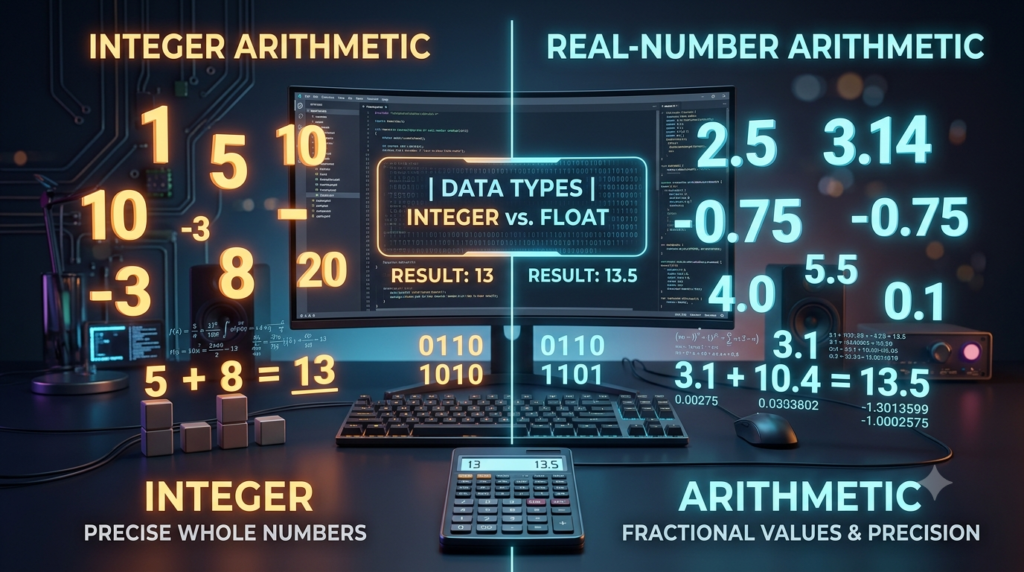
Integer and Floating-Point Arithmetic
Computers can represent numbers in different ways. Two common categories are integers and floating-point numbers.
Integers are whole numbers such as:
−5, 0, 8, 25, 100
Floating-point numbers can represent values with fractional parts, such as:
3.14, 0.5, 12.75
Arithmetic involving integers is generally straightforward. However, floating-point arithmetic can sometimes produce small precision differences because many decimal values cannot be represented exactly in binary computer systems.
For example, a calculation that appears mathematically exact may internally produce a value very close to the expected result rather than exactly equal to it.
This is important in applications involving money, scientific calculations, simulations, and numerical algorithms.
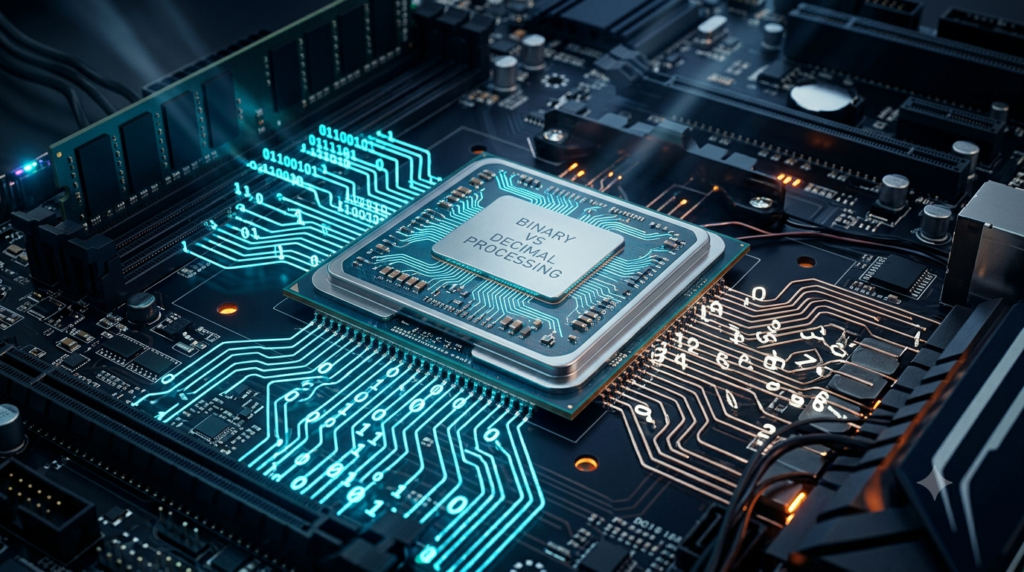
Arithmetic with Binary Numbers
Computers fundamentally process information using binary digits, or bits, which have values of 0 and 1.
Binary arithmetic follows rules similar to decimal arithmetic, but it uses only two digits.
For example:
1 + 1 = 10₂
Here, 10₂ represents the decimal number 2.
Binary addition is particularly important because digital circuits inside processors perform arithmetic using electronic logic circuits.
For example:
101
In decimal numbers, this represents:
5 + 3 = 8
Understanding binary arithmetic helps explain how computers represent and process numerical data internally.
Arithmetic Operations in Algorithms
Arithmetic operations are fundamental building blocks of algorithms.
An algorithm may use addition to calculate a total, subtraction to determine a difference, multiplication to scale a value, division to calculate an average, or modulus to identify repeating patterns.
For example, an algorithm for calculating the average of three numbers can be expressed as:
Average = (Number 1 + Number 2 + Number 3) ÷ 3
If the numbers are 10, 20, and 30:
Average = (10 + 20 + 30) ÷ 3
Average = 60 ÷ 3
Average = 20
This simple example demonstrates how multiple arithmetic operations can work together inside an algorithm.
Arithmetic Operations in Programming
Programming languages provide operators that allow developers to perform arithmetic directly in code.
A simple example can be represented as:
a = 20
The program can then use these results for further calculations or decisions.
Arithmetic operations are often combined with variables, conditions, loops, functions, and data structures. As a result, even advanced software systems rely on these basic mathematical operations.
Why Basic Arithmetic Matters in Computer Science
Learning arithmetic operations is important because they appear throughout computer science.
They are used in:
Programming and software development
Algorithms
Computer graphics
Game development
Data analysis
Scientific computing
Artificial intelligence
Machine learning
Cryptography
Networking
Database systems
Computer architecture
Financial software
Simulations
For example, graphics programs use arithmetic to calculate pixel positions and transformations. Games use arithmetic to calculate movement, scores, distances, and physics. Data analysis programs use arithmetic to calculate totals, averages, percentages, and statistical values.
Even complex algorithms are often built from many simple operations working together.
Common Mistakes in Arithmetic Programming
Beginners often make mistakes when using arithmetic operations in programs. Some common problems include:
Confusing Multiplication and Division Operators
In many programming languages, * represents multiplication and / represents division. Using the wrong operator can change the result completely.
Forgetting Operator Precedence
An expression such as:
5 + 3 × 2
produces 11 because multiplication is performed before addition.
Using parentheses makes the intended calculation clearer:
(5 + 3) × 2 = 16
Unexpected Integer Division
Dividing integers may produce an integer result in some programming languages.
For example:
7 ÷ 2 = 3
instead of:
3.5
The exact behavior depends on the programming language.
Dividing by Zero
Programs should prevent situations where a value is divided by zero.
Overflow
A computer stores numbers within a limited range depending on the data type. If a calculation produces a value larger than the supported range, an overflow can occur.
For example, an integer type with a limited maximum value cannot represent arbitrarily large numbers.
Conclusion
Basic arithmetic operations are among the most important mathematical foundations of computer science. Addition, subtraction, multiplication, and division allow computers to calculate and manipulate numerical data. Related operations such as modulus, increment, and decrement provide additional ways to work with numbers in programs.
These operations may look simple, but they are used throughout programming, algorithms, computer graphics, data processing, scientific computing, and computer hardware. Understanding how arithmetic works with integers, floating-point numbers, and binary values also helps beginners understand why computers sometimes produce results differently from ordinary handwritten calculations.
A strong understanding of basic arithmetic makes it easier to learn programming and more advanced computer science concepts. Once these operations become familiar, they can be combined with variables, conditions, loops, functions, and algorithms to solve increasingly complex computational problems.
FAQs
1. What are basic arithmetic operations in computer science?
Basic arithmetic operations in computer science are mathematical calculations used to manipulate numerical values in programs and computer systems. The main operations are addition, subtraction, multiplication, and division. Other commonly used operations include modulus, increment, and decrement. These operations allow programs to calculate totals, differences, products, averages, positions, and many other values. Arithmetic is used in programming, algorithms, data processing, graphics, simulations, and computer hardware. Although these operations are mathematically simple, they form an important foundation for understanding how computers process numerical information and how programmers create calculations to solve different computational problems.
2. What are the four basic arithmetic operations used in programming?
The four basic arithmetic operations used in programming are addition, subtraction, multiplication, and division. Addition combines values, subtraction finds a difference, multiplication calculates a product, and division determines a quotient. Common programming operators are +, -, *, and /, respectively. For example, 8 + 2 produces 10, while 8 * 2 produces 16. These operations are used in calculations involving variables, constants, measurements, counters, prices, coordinates, and many other types of data. Understanding these four operations is essential for beginners because more advanced programming calculations are often built by combining them with other operators and programming concepts.
3. What is the modulus operation in computer science?
The modulus operation calculates the remainder left after one number is divided by another. It is commonly represented by the % operator in programming languages. For example, 17 % 5 produces 2 because 17 divided by 5 leaves a remainder of 2. Modulus is particularly useful for checking whether numbers are even or odd. If a number divided by 2 has a remainder of zero, it is even. Modulus is also used for repeating patterns, cycling through positions, controlling counters, and handling periodic operations. It is an important arithmetic operation in programming and algorithm development.
4. Why is arithmetic important in computer science?
Arithmetic is important because computers constantly calculate and manipulate numerical information. Programs use arithmetic to calculate totals, averages, distances, percentages, positions, sizes, and measurements. Arithmetic is also fundamental to algorithms and computer hardware. For example, graphics programs use calculations to determine pixel positions, while games use arithmetic to calculate movement and scores. Data analysis uses arithmetic to process numerical datasets, and scientific software uses it for mathematical models and simulations. Even complex software applications rely on basic operations such as addition, subtraction, multiplication, and division. Therefore, understanding arithmetic provides an essential foundation for learning programming and computer science.
5. What arithmetic operators are commonly used in programming?
Common arithmetic operators include + for addition, - for subtraction, * for multiplication, / for division, and % for modulus. Some programming languages also support increment and decrement operators such as ++ and --. These operators allow programmers to perform calculations directly within expressions and instructions. For example, total = price * quantity calculates a product and stores it in a variable. The exact operators and their behavior can vary between programming languages. Learning the purpose of each operator helps beginners understand program expressions and perform numerical calculations correctly.
6. What is integer arithmetic in programming?
Integer arithmetic refers to calculations performed using whole-number values without fractional parts. Examples of integers include -10, 0, 5, and 100. Programs commonly use integers for counting objects, storing indexes, representing quantities, and performing discrete calculations. Addition, subtraction, multiplication, division, and modulus can all be performed on integers. However, division involving integers may behave differently depending on the programming language. In some languages or situations, dividing two integers can produce an integer result rather than a decimal value. Understanding integer arithmetic is important because many programming tasks involve counting, indexing, and manipulating whole-number data.
7. What is floating-point arithmetic in computer science?
Floating-point arithmetic is used to perform calculations with numbers that can contain fractional parts, such as 3.14, 0.5, or 12.75. It is commonly used when programs need to represent measurements, scientific values, percentages, distances, or other quantities that are not necessarily whole numbers. Computers store floating-point values using a binary representation, so some decimal numbers cannot be represented exactly. As a result, calculations involving floating-point numbers can sometimes produce very small rounding or precision differences. Programmers need to consider these limitations when developing applications involving scientific calculations, financial values, simulations, or other situations where numerical accuracy is important.
8. What is operator precedence in arithmetic expressions?
Operator precedence determines the order in which different arithmetic operations are evaluated within an expression. Multiplication and division generally have higher precedence than addition and subtraction. For example, in 10 + 5 * 2, multiplication is performed first, producing 10, and then addition produces 20. Parentheses can be used to change the order of calculation. For example, (10 + 5) * 2 produces 30. Understanding operator precedence is important because using operations in the wrong order can produce an unexpected result. Programmers often use parentheses to make complex arithmetic expressions clearer and reduce the possibility of calculation errors.
9. Why is binary arithmetic important in computer science?
Binary arithmetic is important because digital computers fundamentally represent and process information using binary digits, called bits. Each bit can have a value of 0 or 1. Computers use binary arithmetic inside their electronic circuits to perform calculations. For example, binary addition follows rules that allow a processor to calculate numerical results using combinations of zeros and ones. Understanding binary arithmetic helps explain how numbers are represented internally and how processors perform calculations. It also provides a foundation for learning topics such as computer architecture, digital logic, data representation, memory, and low-level programming.
10. What are common mistakes when using arithmetic operations in programming?
Common arithmetic mistakes include using the wrong operator, misunderstanding operator precedence, accidentally performing integer division, dividing by zero, and ignoring numerical overflow or precision limitations. For example, using / instead of * can produce a completely different result. Similarly, an expression such as 5 + 3 * 2 may produce an unexpected result for someone unfamiliar with operator precedence. Programs should also handle situations where division by zero might occur. When working with large numbers or floating-point values, programmers must consider the limitations of the chosen data type. Careful testing and clear expressions can help prevent arithmetic errors.