Physics problems often look simple at first. You may be given a few values, asked to find an unknown quantity, and expect to solve the problem by choosing one formula. But as you move into more complex topics, you will notice something important: some physics problems cannot be solved using a single formula.
Why does this happen? Is the problem simply more difficult, or is there a deeper reason?
The answer is that many physical situations involve more than one relationship between different quantities. One formula may describe one part of the situation, while another formula is needed to connect that result to the final answer. Understanding this idea can make physics problems much easier to approach.
Physics Formulas Describe Relationships
A physics formula is not just a mathematical rule to memorize. It describes a relationship between physical quantities.
For example, the formula for speed is
Speed = Distance ÷ Time
This formula connects distance, time, and speed. If you know two of these quantities, you can calculate the third.
However, real physical situations often involve several connected relationships. Suppose a problem asks you to find the distance traveled by an object when its acceleration and final velocity are known. The basic speed formula may not be enough because acceleration is also involved.
You may first need a formula that connects acceleration, velocity, and time. Then you may use another formula to calculate distance.
So, using multiple formulas is often necessary because different formulas describe different aspects of the same physical situation.
One Problem Can Contain Several Physical Ideas
A physics problem may combine several concepts.
Imagine a ball is thrown upward from the ground and you are asked how high it travels. The problem involves motion, velocity, acceleration, and gravity.
You might use one equation to determine how long the ball takes to reach its highest point. At the highest point, its velocity becomes zero. You can then use another equation to determine the distance traveled during that time.
The formulas are not competing with one another. They work together.
This is one of the most important ideas in solving physics problems: a complicated situation can often be divided into smaller parts, with each part described by an appropriate formula.
Some Quantities Are Connected Indirectly
Another reason multiple formulas are needed is that the quantities in a problem may not be directly connected by one equation.
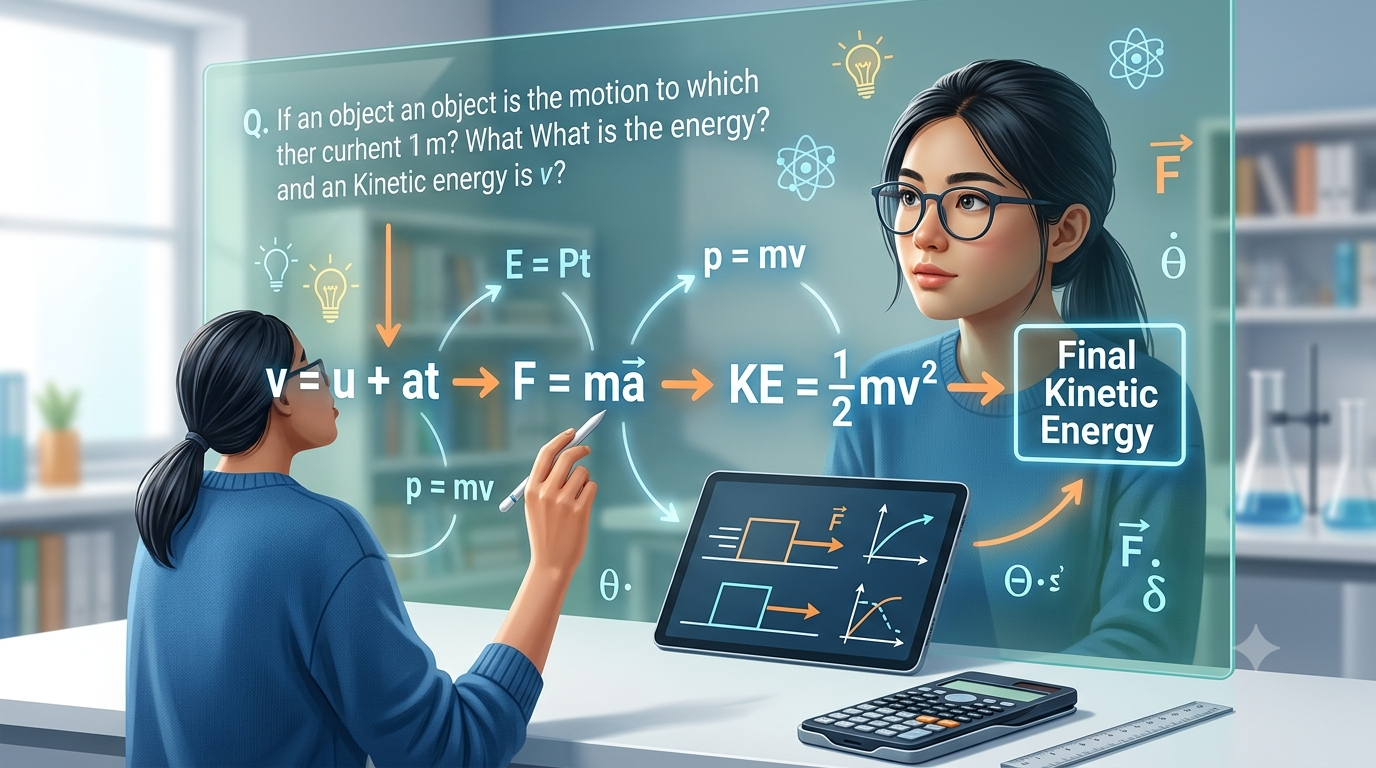
For example, suppose you want to calculate the kinetic energy of an object, but the problem gives you its mass and momentum instead of its velocity.
The kinetic energy formula is
Kinetic Energy = ½mv²
But velocity is not directly given.
You can first use the momentum relationship
Momentum = mass × velocity
to find velocity. Once velocity is known, you can substitute it into the kinetic energy formula.
Here, the problem requires two formulas because the given information and the required information are connected indirectly.
This kind of situation appears frequently in physics.
Physics Problems Often Have Multiple Steps
Many physics problems are essentially a chain of calculations.
Think of the process like a path:
Given information → Intermediate quantity → Another quantity → Final answer
Each step may require a different formula.
For example, consider a problem involving electrical power. You may be given voltage and resistance and asked to calculate electrical energy consumed over a certain time.
You could first calculate current using Ohm’s law:
V = IR
Then use the power relationship:
P = VI
Finally, use the relationship between energy and power:
E = Pt
In this example, three formulas may be connected to solve one problem.
The important point is that each formula has a specific job.
Intermediate Quantities Act Like Bridges
An intermediate quantity is a value that you calculate along the way and then use in another equation.
These quantities act like bridges between formulas.
Suppose a problem asks for the gravitational potential energy of an object, but instead of giving its height directly, it gives information about the object’s motion.
You may need to calculate the height first and then use
Potential Energy = mgh
The height becomes the bridge between the first part of the problem and the final calculation.
Recognizing these intermediate quantities is a powerful problem-solving skill. Instead of searching for one formula that magically gives the final answer, ask:
What quantity do I need first?
Then ask:
Which formula can give me that quantity?
Different Formulas Can Describe Different Stages
Some physics situations change with time or position. A single formula may describe only one stage of the process.
Consider an object moving down a slope. At the beginning, you may need to determine the force acting on the object. Then you may calculate acceleration from the net force. After that, you can determine velocity or distance traveled.
The calculation can therefore follow a sequence such as:
Force → Acceleration → Velocity → Distance
Each stage has its own physical relationship.
This is why physics is not simply about finding the correct formula. It is about understanding how physical quantities are connected.
The Same Formula May Not Apply Everywhere
Another important reason is that different parts of a problem may involve different conditions.
For example, an object might first move with constant acceleration and later move at constant velocity. The equations used for these two situations may be different.
Similarly, in electricity, a circuit may contain resistors arranged in series and parallel. You may need one relationship to calculate an equivalent resistance and another to determine current or voltage.
Before choosing a formula, you should always ask:
What physical situation does this formula describe?
A formula is useful only when its conditions and variables match the situation.
Complex Problems Are Built From Simple Relationships
One of the fascinating things about physics is that complicated problems can often be solved by combining simple laws.
A rocket’s motion, for example, involves forces, acceleration, velocity, momentum, energy, and sometimes gravitational effects. Scientists do not necessarily need one enormous formula containing everything. Instead, they can combine several well-understood relationships.
This approach makes complex physical systems easier to analyze.
It also explains why learning individual concepts is important. Understanding Newton’s laws, energy, momentum, and motion separately gives you the tools to solve problems in which these ideas interact.
How to Know Which Formula to Use
When facing a problem that seems to require several formulas, do not immediately start calculating.
First, identify three things:
1. What is given?
Write down all known quantities with their units.
2. What is required?
Identify exactly what the question asks you to find.
3. What connects them?
Look for a formula that connects the known quantities to an unknown quantity.
If the required quantity cannot be found directly, identify an intermediate quantity. Then find a formula that can calculate it.
This turns a confusing problem into a sequence of smaller steps.
Avoid Using Formulas Just Because They Look Familiar
A common mistake is to choose a formula simply because it contains numbers that appear in the question.
For example, seeing mass and velocity does not automatically mean that kinetic energy is being calculated. You need to understand what the question is asking and what physical process is involved.
Physics formulas should be selected based on meaning, not appearance.
Understanding the concepts behind equations is therefore much more useful than memorizing a large collection of formulas.
Units Can Help Check Your Formula
Units provide another useful way to determine whether your approach makes sense.
Suppose you are calculating speed. The final unit should be something like meters per second.
If your calculation produces kilograms per second, something has gone wrong.
When several formulas are used, checking units after every major step can help catch mistakes early.
For example, if you calculate acceleration, its unit should be m/s². If that acceleration is then used to calculate velocity, the resulting unit should be m/s.
Dimensional reasoning is therefore a valuable companion to formula-based problem solving.
Multiple Formulas Do Not Mean Physics Is Random
When a physics problem needs several formulas, it does not mean physics is complicated without reason. It usually means the physical situation contains several connected relationships.
Each formula gives you one piece of the puzzle.
The skill is learning how those pieces fit together.
Once you understand the physical story behind a problem, choosing multiple formulas becomes much more natural. Instead of asking, “Which formula should I memorize for this question?” you begin asking, “What is happening physically, and what relationship describes each step?”
Conclusion
Some physics problems need more than one formula because real physical situations often involve multiple connected quantities and processes. One equation may provide an intermediate result, while another uses that result to reach the final answer.
The best way to solve such problems is to understand the situation, identify what is known and unknown, find the relationships between them, and break the problem into manageable steps.
Physics becomes much easier when formulas are treated not as isolated equations to memorize, but as tools that work together to describe how nature behaves. Once you learn to recognize the connections between physical quantities, even multi-step problems can become a logical sequence of simple ideas.