
Why do some physical quantities have no units?

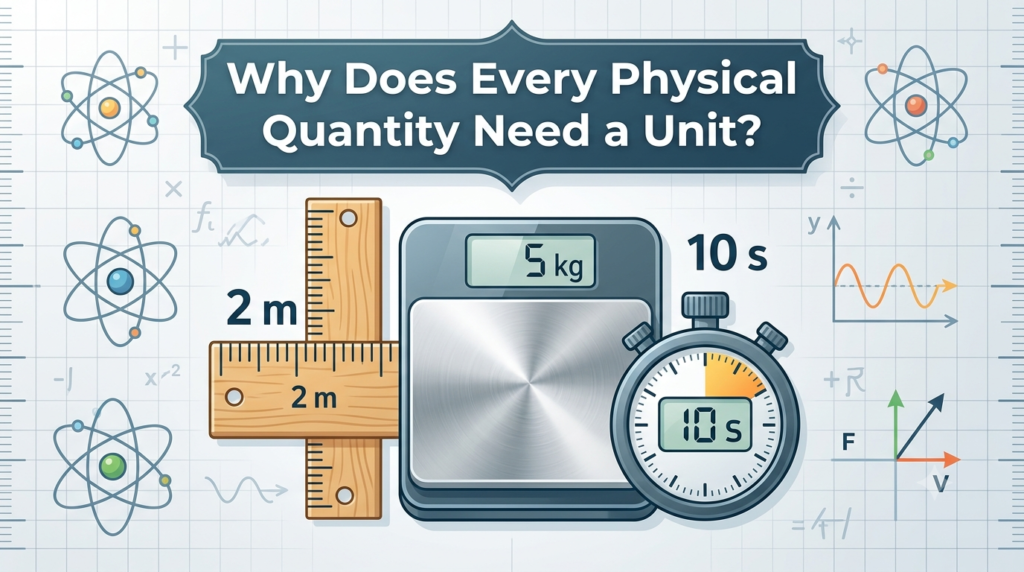
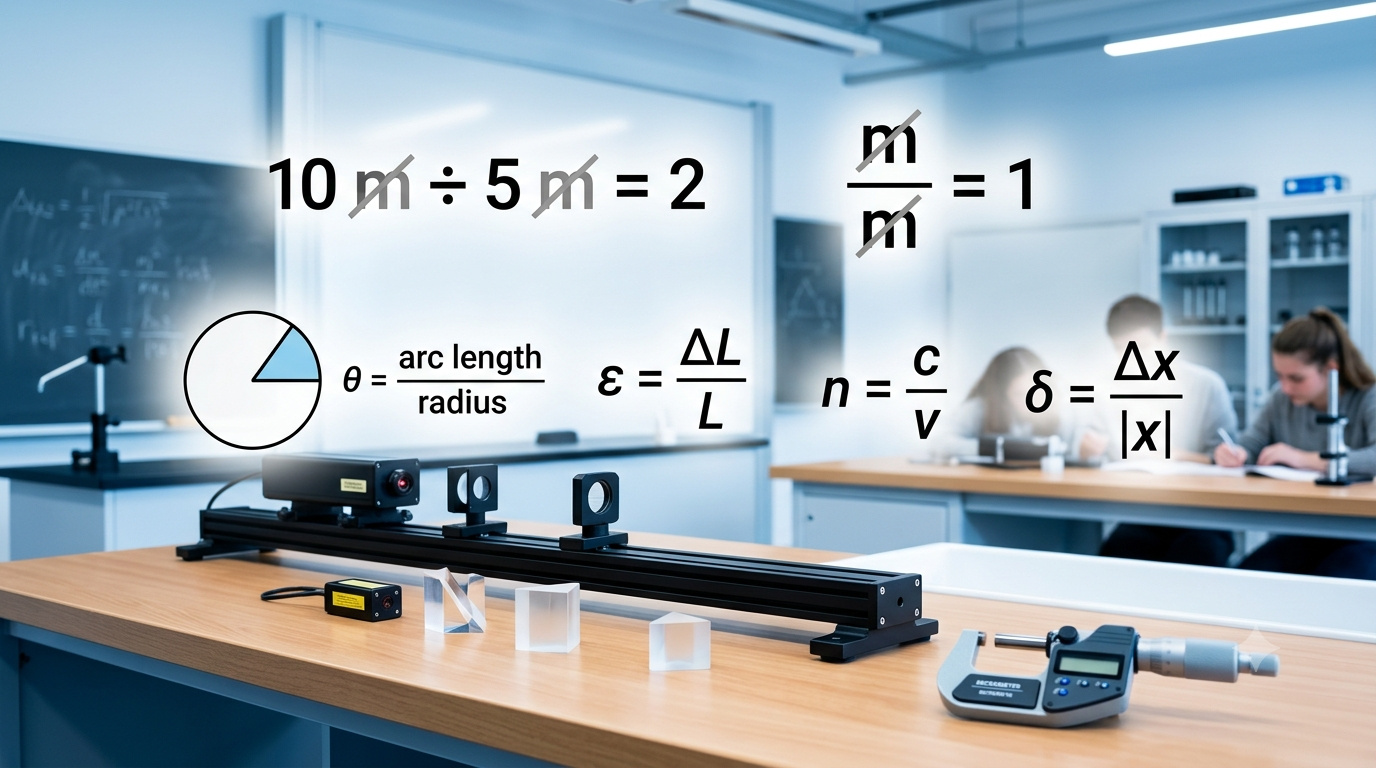
A set-up in a physics laboratory, where floating-point equations and measurement equipment are displayed to visually explain dimensionless physical quantities.

When we study physics, we usually encounter quantities such as length, mass, time, speed, force, and energy. Each of these physical quantities has a unit. Length can be measured in metres, mass in kilograms, and time in seconds. Units help us describe the size of a physical quantity clearly and consistently.

However, physics also contains some quantities that are described as dimensionless or are said to have no units. At first, this can seem strange. If a quantity represents something measurable, how can it have no unit?

The answer becomes clear when we understand what units actually represent and how some physical quantities are formed from ratios of similar quantities.

What Is a Physical Unit?

A unit is a standard quantity used to express a measurement. For example, if we say that a table is 2 metres long, the number 2 tells us how many times the standard metre fits into the length of the table.

The metre is the unit, while 2 is the numerical value.

Similarly:

  • Mass is commonly measured in kilograms.

  • Time is measured in seconds.

  • Temperature is measured in kelvin.

  • Electric current is measured in amperes.

  • Length is measured in metres.

Units make measurements meaningful. Saying that a car is travelling at “20” does not tell us whether its speed is 20 metres per second, 20 kilometres per hour, or something else.

What Does Dimensionless Mean?

A dimensionless quantity is a physical quantity whose dimensions cancel out completely. Such quantities are often obtained by dividing one physical quantity by another quantity of the same kind.

For example, consider the ratio of two lengths:

Ratio = length₁ / length₂

Suppose one object is 10 metres long and another is 5 metres long.

Ratio = 10 m / 5 m = 2

The metre cancels because both quantities have the same unit:

m / m = 1

The result is simply 2. There is no remaining unit.

This is why ratios between similar quantities are often dimensionless.

Ratios Are a Common Source of Unitless Quantities

Many dimensionless quantities in physics are created through ratios.

Consider relative density. It compares the density of one substance with the density of another reference substance:

Relative density = density of substance / density of reference substance

Both densities have the same unit, such as kg/m³. Therefore:

kg/m³ ÷ kg/m³ = 1

The units cancel, leaving a pure number.

Similarly, refractive index is related to the ratio of the speed of light in vacuum to its speed in a material:

n = c / v

Both speeds are measured in metres per second, so the units cancel:

(m/s) / (m/s) = 1

Therefore, refractive index has no unit.

Angles Are Another Interesting Example

Angles provide one of the most familiar examples of a quantity that can be dimensionless.

In radians, an angle is defined as:

θ = arc length / radius

Both arc length and radius are lengths. Therefore:

θ = metre / metre

The units cancel.

As a result, the radian is technically dimensionless.

For example, if an arc has a length of 2 metres and the radius is 1 metre:

θ = 2 m / 1 m = 2

The angle is therefore 2 radians.

Although radians are treated as a named unit in many calculations, they are dimensionless from the point of view of dimensional analysis.

Strain Has No Unit

Another important example is strain.

When a material is stretched, its length may increase. Strain describes how much the length changes compared with its original length:

Strain = change in length / original length

Suppose a wire originally has a length of 2 metres and becomes 2.01 metres long. The change in length is 0.01 metres.

Therefore:

Strain = 0.01 m / 2 m = 0.005

The metres cancel.

Strain is therefore dimensionless. It is sometimes expressed as a percentage, such as 0.5%, but the underlying quantity has no physical unit.

Relative Error Is Dimensionless

Measurement science provides another useful example.

Suppose an experiment gives a measured value and a reference or accepted value. The relative error can be written as:

Relative error = absolute error / accepted value

Both the error and the accepted value have the same unit.

For example, if the measured length differs from the accepted length by 0.2 metres and the accepted length is 10 metres:

Relative error = 0.2 m / 10 m = 0.02

Again, the metre cancels.

The result can also be expressed as a percentage:

0.02 × 100 = 2%

This tells us how large the error is compared with the quantity being measured.

Why Do Physicists Use Dimensionless Quantities?

Dimensionless quantities are extremely useful because they allow physicists to compare quantities without being tied to a particular measurement system.

Imagine comparing the size of two objects. If one length is measured in metres and another in centimetres, we first need to convert them into compatible units. But once the ratio is formed correctly, the units disappear.

This makes dimensionless quantities especially useful in equations, experiments, and scientific comparisons.

They can also reveal whether two physical situations are fundamentally similar. For example, engineers and physicists use dimensionless numbers to compare fluid flows, heat transfer, chemical reactions, and many other physical processes.

Dimensionless Does Not Mean Meaningless

It is important to understand that having no unit does not mean having no physical meaning.

A dimensionless quantity can contain extremely useful information.

For example, a refractive index of 1.5 tells us something important about how light behaves in a material. A strain of 0.01 tells us that a material has undergone a relative deformation of 1%. A coefficient of friction tells us about the relationship between frictional force and normal force.

These quantities do not need conventional units because their numerical values already represent relationships between comparable quantities.

Dimensionless Quantities in Physics Equations

Dimensionless quantities also appear naturally in many physics equations.

For example, the coefficient of friction is defined as:

μ = frictional force / normal force

Both forces are measured in newtons:

N / N = 1

Therefore, the coefficient of friction has no unit.

Similarly, quantities such as magnification can be expressed as:

Magnification = image size / object size

Since both sizes have the same unit, the units cancel.

These examples show that dimensionless quantities are not unusual exceptions. They arise naturally whenever one quantity is compared with another quantity of the same dimension.

Does Every Number in Physics Have No Unit?

No. A numerical value by itself does not automatically represent a dimensionless physical quantity.

For example, if we say that a distance is 5, the statement is incomplete. Five what? Five metres? Five kilometres? Five centimetres?

The number becomes physically meaningful only when its unit or context is known.

A dimensionless quantity is different because its definition causes the units to cancel. The number is the result of a physical relationship, such as a ratio between two quantities with identical dimensions.

Units Can Disappear During Calculations

Units can also disappear when performing mathematical operations.

Suppose the speed of an object is 20 m/s and another speed is 10 m/s. Their ratio is:

20 m/s ÷ 10 m/s = 2

The metres per second cancel.

This does not mean that units were unnecessary. They were essential during the calculation because they confirmed that the two quantities could be meaningfully compared.

Therefore, unit cancellation is actually a useful check in physics.

Conclusion

Some physical quantities have no units because they are dimensionless. In many cases, they are formed by dividing one physical quantity by another quantity with the same dimensions. When this happens, the units cancel.

Ratios such as relative density, refractive index, strain, relative error, magnification, and coefficients such as friction provide familiar examples. Angles measured in radians are also dimensionless because a radian is defined as a ratio of two lengths.

Dimensionless quantities are not meaningless numbers. They often describe important physical relationships and allow scientists to compare systems independently of the units used to measure them.

Understanding why some quantities have no units also strengthens our understanding of dimensional analysis. Instead of seeing unitless quantities as strange exceptions, we can recognize them as a natural consequence of comparing similar physical quantities. In physics, sometimes the most useful information is not the size of a quantity itself, but the relationship between two quantities—and that relationship may have no unit at all.

FAQs

What is a dimensionless physical quantity?

A dimensionless physical quantity is a quantity whose dimensions are completely cancelled during its definition or calculation. It is often formed by dividing two physical quantities that have the same dimensions. For example, strain is the ratio of change in length to original length. Both quantities represent length, so their units cancel. The resulting strain has no unit. Other examples include refractive index, relative density, coefficient of friction, magnification, and relative error. Dimensionless quantities are still physically meaningful even though they do not have conventional units. They often describe relationships, comparisons, or proportions between physical quantities.

Why do some physical quantities have no units?
Some physical quantities have no units because they are defined as ratios of quantities having identical units or dimensions. When one quantity is divided by another quantity of the same kind, their units cancel mathematically. For example, relative density is the density of a substance divided by the density of a reference substance. Both densities have units such as kg/m³, so the units cancel. The result is a pure number. This does not mean the quantity is unimportant. Instead, it means that its value represents a comparison or relationship rather than an independent physical measurement requiring a separate unit.
Is a dimensionless quantity the same as a unitless quantity?
The terms dimensionless and unitless are often used interchangeably, but there is a useful distinction. A dimensionless quantity has dimensions that reduce completely to zero through its definition. For example, strain is a ratio of two lengths, so its dimensions cancel. A unitless quantity is commonly used to describe a quantity that does not require a conventional measurement unit. In most introductory physics situations, dimensionless quantities are treated as unitless. However, some dimensionless quantities have named units for convenience. The radian is a good example. It is dimensionless but is still commonly written as “rad” when describing angles.
Is the coefficient of friction dimensionless?

Yes. The coefficient of friction is a dimensionless quantity because it is defined as the ratio of frictional force to normal force. Both frictional force and normal force are measured in newtons. Therefore, their units cancel:

μ = frictional force / normal force

Since:

N / N = 1

the coefficient of friction has no unit. Its numerical value indicates the relationship between the frictional force and the normal force acting between surfaces. For example, if the coefficient of friction is 0.4, it means the frictional force can be related to the normal force through that dimensionless ratio.

Why is strain considered dimensionless?

Strain is considered dimensionless because it compares the change in length with the original length of an object. It is calculated using:

Strain = change in length / original length

Both quantities are measured in units of length, such as metres or centimetres. Therefore, the units cancel during division. For example, if a wire changes in length by 0.02 m and its original length is 2 m, the strain is 0.01. The metre cancels from the calculation. Strain may also be expressed as a percentage. A strain of 0.01 corresponds to 1%, but the basic physical quantity itself remains dimensionless.

Does a dimensionless quantity have no physical meaning?

No. A dimensionless quantity can have considerable physical meaning. The absence of a unit simply means that no independent measurement unit remains after the dimensions cancel. For example, refractive index is dimensionless, but it provides important information about how light travels through a material. Similarly, strain describes relative deformation, while the coefficient of friction describes the relationship between frictional and normal forces. Dimensionless quantities are widely used in physics, engineering, chemistry, and other sciences. They often make it easier to compare different systems because their values do not depend on whether measurements were originally expressed in metres, centimetres, or other compatible units.

Is an angle dimensionless in physics?

An angle measured in radians is dimensionless because a radian is defined as the ratio of arc length to radius:

θ = arc length / radius

Both arc length and radius are lengths, so their dimensions cancel. Therefore, the radian has no fundamental physical dimension. However, “radian” is retained as a named unit because it makes angular measurements easier to understand. For example, an angle may be written as 2 rad. In dimensional analysis, radians are normally treated as dimensionless. Degrees are also dimensionless in a mathematical sense, although they use the degree as a conventional way to express angular size.

Is refractive index a dimensionless quantity?

Yes. Refractive index is dimensionless because it is commonly defined as the ratio of the speed of light in vacuum to its speed in a particular medium:

n = c / v

Both c and v are speeds measured in units such as metres per second. When the ratio is calculated, the units cancel:

(m/s) / (m/s) = 1

Therefore, refractive index has no physical unit. Although it is dimensionless, it provides important information about the optical properties of a material. A higher refractive index generally indicates that light travels more slowly through the material compared with its speed in vacuum.

How can dimensionless quantities help in dimensional analysis?

Dimensionless quantities are extremely useful in dimensional analysis because they help physicists check relationships between physical quantities. When the dimensions of a ratio cancel completely, the result is dimensionless. This can reveal whether quantities have been combined appropriately. For example, dividing a length by another length produces a dimensionless ratio, while dividing a length by a mass does not normally produce a dimensionless quantity. Dimensionless groups are also widely used to compare physical systems. In fluid mechanics, heat transfer, and other fields, dimensionless numbers help researchers identify similarities between experiments and real-world systems even when their sizes differ.

Are all numbers in physics dimensionless?

No. A number in a physics equation does not automatically represent a dimensionless quantity. For example, saying that an object travels at 20 does not provide enough information because the unit could be metres per second, kilometres per hour, or another speed unit. A dimensionless number results when the dimensions of the physical quantities involved cancel completely. For example, a ratio of 20 m/s to 10 m/s gives 2, which is dimensionless. Therefore, it is important to distinguish between a numerical value and a dimensionless physical quantity. Units provide essential information unless the physical definition causes them to cancel.

Related Posts

Leave a Comment

Your email address will not be published. Required fields are marked *

Scroll to Top