Every physics experiment involves measurement. We measure length, time, mass, temperature, voltage, current, speed, or other physical quantities to understand how nature behaves. However, no measurement is perfectly exact. Even with good instruments and careful techniques, the measured value may differ slightly from the true value. This limitation is described by measurement uncertainty.
Measurement uncertainty does not mean that an experiment has failed. Instead, it tells us how much confidence we should have in a measured result. Understanding uncertainty is an essential part of experimental physics because it helps scientists decide whether their results are reliable, whether two measurements agree, and whether an experimental conclusion is supported by evidence.
What Is Measurement Uncertainty?
Measurement uncertainty is an estimate of the range within which the true value of a quantity is expected to lie.
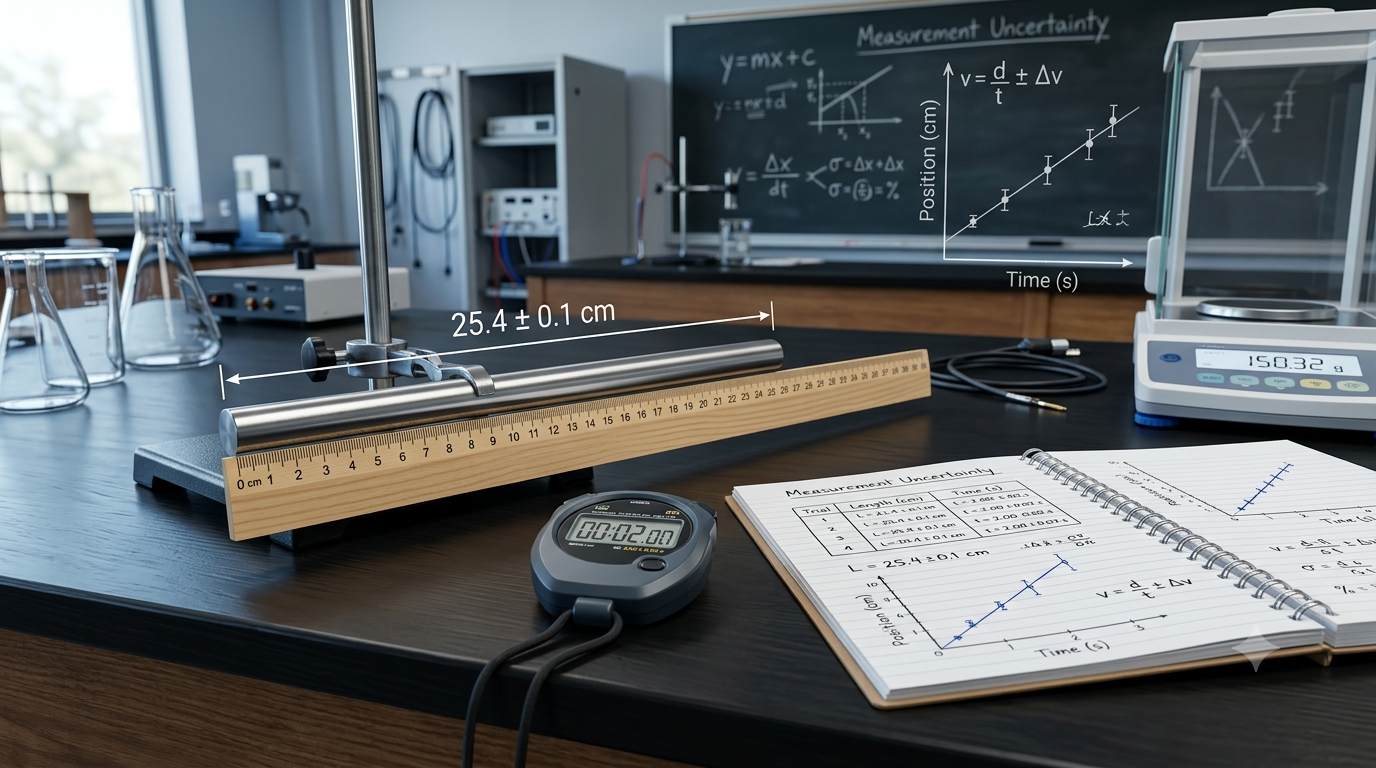
For example, suppose a student measures the length of a metal rod and obtains:
L = 25.4 ± 0.1 cm
The value 25.4 cm is the measured value, while 0.1 cm represents the uncertainty. The result suggests that the actual length is reasonably expected to be close to 25.4 cm, within the stated uncertainty.
Uncertainty can arise from many sources. The measuring instrument may have limited resolution, the experimental setup may introduce variations, or the person taking the measurement may have difficulty reading a scale precisely.
Therefore, a measurement should not always be treated as an exact number. A value such as 10.0 cm contains information about precision, but the uncertainty tells us how much that precision can actually be trusted.
Why Is Uncertainty Important in Physics?
Physics experiments are used to test ideas, discover relationships, and determine physical constants. If measurements contain uncertainty, that uncertainty can affect the conclusions drawn from the experiment.
Imagine an experiment designed to determine the acceleration due to gravity. A student obtains:
g = 9.7 ± 0.3 m/s²
The accepted value near Earth’s surface is approximately 9.8 m/s². Because 9.8 m/s² falls within the experimental uncertainty range, the result is consistent with the expected value.
Now suppose another experiment gives:
g = 8.2 ± 0.1 m/s²
This result is much farther from the expected value, and its small uncertainty means the difference cannot easily be explained by ordinary measurement variation. The experiment may contain a systematic error or some other problem.
Thus, uncertainty helps physicists judge whether an experimental result is reasonable.
Sources of Measurement Uncertainty
Measurement uncertainty can come from several sources.
Instrument Resolution
Every measuring instrument has a limited resolution. A ruler marked in millimetres cannot normally provide the same precision as an instrument capable of measuring micrometres.
Similarly, a digital stopwatch may display time to a certain number of decimal places, but that does not necessarily mean the entire measurement is accurate to that precision.
The smaller the instrument’s resolution, the more precisely a quantity may be measured, assuming other sources of uncertainty are controlled.
Random Variation
Repeated measurements of the same quantity may not produce exactly the same result. For example, measuring the period of a pendulum several times might produce values such as 1.98 s, 2.01 s, 2.00 s, and 1.99 s.
These small differences are examples of random variation. Taking several measurements and calculating their average can reduce the influence of random fluctuations.
Systematic Effects
A systematic error affects measurements in a consistent way. For example, if a balance has not been properly zeroed, every mass measurement may be slightly too high or too low.
Unlike random variation, repeating the measurement does not necessarily remove a systematic effect. Identifying and correcting the source is therefore important.
Uncertainty in Calculations
Measurement uncertainty does not disappear when measured values are used in calculations. It can propagate into the final result.
Suppose an experiment determines speed using:
v = d/t
where d is distance and t is time.
If both distance and time have uncertainties, the calculated speed will also have uncertainty. The final result therefore should not be reported as though it were perfectly exact.
For example, instead of simply writing:
v = 5.0 m/s
an experiment might produce:
v = 5.0 ± 0.2 m/s
The uncertainty gives important information about the reliability of the calculated speed.
The exact method used to calculate uncertainty depends on the mathematical relationship between the measured quantities. For simple experiments, approximate percentage or fractional uncertainty methods are often sufficient. More advanced experiments may use formal uncertainty propagation techniques.
Absolute and Percentage Uncertainty
Uncertainty can be expressed in different ways.
Absolute uncertainty gives the uncertainty in the same units as the measurement.
For example:
Length = 20.0 ± 0.2 cm
Here, 0.2 cm is the absolute uncertainty.
Percentage uncertainty compares the uncertainty with the measured value:
Percentage uncertainty = (uncertainty / measured value) × 100
For the example above:
Percentage uncertainty = (0.2 / 20.0) × 100 = 1%
Percentage uncertainty is useful when comparing the quality of different measurements.
A measurement of 0.2 cm uncertainty may seem small, but its significance depends on the size of the measured quantity. A 0.2 cm uncertainty in a 20 cm measurement represents 1%, while the same uncertainty in a 2 cm measurement represents 10%.
Uncertainty and Experimental Precision
Precision describes how closely repeated measurements agree with one another. An experiment can produce highly consistent measurements while still having a systematic error.
For example, imagine a faulty instrument consistently gives measurements that are 2% too high. Repeated measurements might be almost identical, making the experiment appear very precise. However, the results may still be inaccurate.
This distinction between precision and accuracy is important.
Accuracy refers to how close a measurement is to the accepted or true value, while precision refers to how closely repeated measurements agree.
A good physics experiment aims for both high accuracy and high precision.
How Scientists Reduce Uncertainty
Scientists use several strategies to reduce measurement uncertainty.
First, they select appropriate instruments. A more suitable instrument with better resolution can improve measurement precision.
Second, they repeat measurements. Repetition helps identify random variations and allows researchers to calculate a representative value.
Third, they carefully control experimental conditions. Temperature, air resistance, vibrations, electrical interference, and other environmental factors can influence measurements.
Fourth, scientists calibrate instruments against known standards. Calibration can reveal systematic differences and improve confidence in the results.
Finally, researchers clearly report uncertainty. Hiding uncertainty can make an experimental result appear more certain than it actually is.
Uncertainty When Comparing Results
Measurement uncertainty is especially useful when comparing two experimental results.
Suppose two groups measure the same quantity and obtain:
Group A: 12.4 ± 0.3 units
Group B: 12.6 ± 0.2 units
The central values are different, but their uncertainty ranges overlap. This suggests that the difference may not be statistically or experimentally significant.
In contrast, if one group obtains:
12.4 ± 0.1 units
and another obtains:
14.0 ± 0.1 units
the difference is much larger than the stated uncertainties. This could indicate a genuine difference or a problem with one of the experiments.
Uncertainty therefore provides a meaningful way to compare experimental evidence.
Uncertainty Does Not Mean Failure
Students sometimes think that uncertainty makes a physics experiment less useful. In reality, uncertainty is one of the things that makes experimental science trustworthy.
Science does not usually claim that measurements are perfectly exact. Instead, scientists quantify the limitations of their measurements and use those limitations when interpreting their results.
A result such as 50.0 ± 0.5 units can be more scientifically informative than simply reporting 50.0 units. The uncertainty tells the reader how much confidence to place in the number.
Conclusion
Measurement uncertainty is an unavoidable part of experimental physics. It arises because instruments have limitations, measurements can vary, and experimental conditions are never perfectly controlled. When measured quantities are used in calculations, their uncertainties can also affect the final result.
Rather than treating uncertainty as a weakness, physicists use it as essential information. It helps them evaluate experimental quality, compare results, identify possible errors, and determine whether observations support a physical theory.
The goal of a good experiment is therefore not to eliminate uncertainty completely, which is usually impossible, but to understand, reduce, estimate, and report it properly. Once uncertainty becomes part of the measurement process, experimental results become more meaningful, transparent, and scientifically useful.