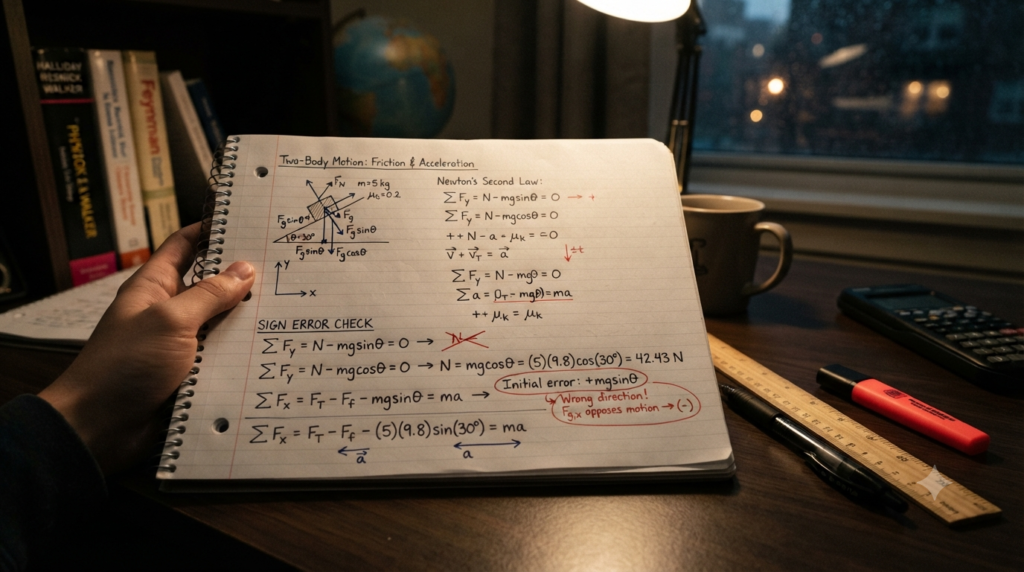
Trigonometry is a branch of mathematics that deals with the relationship between the angles and sides of triangles. It is especially useful when we need to find an unknown side or angle from the information we already know. The basic ideas of trigonometry begin with three important ratios: sine, cosine, and tangent. These ratios are commonly written as sin, cos, and tan.
For a right-angled triangle, each trigonometric ratio compares two sides of the triangle with respect to a particular angle. Once these ratios are understood, several important formulas can be developed from them. Trigonometric formulas are widely used in geometry, physics, engineering, astronomy, navigation, architecture, and many other areas of science and mathematics. This article explains the basic trigonometric ratios, their formulas, important identities, and how they are used.
Understanding a Right-Angled Triangle
Before learning trigonometric ratios, it is important to understand the sides of a right-angled triangle.
A right-angled triangle has one angle equal to 90°. The side opposite the 90° angle is called the hypotenuse. It is always the longest side of the triangle.
The other two sides are identified according to the angle being considered:
Opposite side: The side directly opposite the selected angle.
Adjacent side: The side next to the selected angle, excluding the hypotenuse.
Hypotenuse: The side opposite the right angle.
The names opposite and adjacent can change depending on which angle is being considered. The hypotenuse, however, always remains the side opposite the 90° angle.
Basic Trigonometric Ratios
There are six fundamental trigonometric ratios:
Sine
Cosine
Tangent
Cosecant
Secant
Cotangent
The first three are the most commonly used in basic trigonometry.
A useful way to remember the first three ratios is SOH-CAH-TOA:
SOH: Sin = Opposite / Hypotenuse
CAH: Cos = Adjacent / Hypotenuse
TOA: Tan = Opposite / Adjacent
These relationships apply to a right-angled triangle.
Sine Formula
The sine of an angle is defined as the ratio of the opposite side to the hypotenuse.
sin θ = Opposite / Hypotenuse
Therefore, if the opposite side is represented by O and the hypotenuse by H:
sin θ = O / H
This ratio can be used when the opposite side and hypotenuse are known, or when one of them needs to be calculated.
For example, suppose a right-angled triangle has an opposite side of 6 cm and a hypotenuse of 10 cm. Then:
sin θ = 6 / 10 = 0.6
Thus, the sine of the angle is 0.6.
Cosine Formula
The cosine of an angle is the ratio of the adjacent side to the hypotenuse.
cos θ = Adjacent / Hypotenuse
Using A for the adjacent side and H for the hypotenuse:
cos θ = A / H
For example, if the adjacent side is 8 cm and the hypotenuse is 10 cm:
cos θ = 8 / 10 = 0.8
Therefore, the cosine of the angle is 0.8.
Tangent Formula
The tangent of an angle is the ratio of the opposite side to the adjacent side.
tan θ = Opposite / Adjacent
Using O for the opposite side and A for the adjacent side:
tan θ = O / A
For example, if the opposite side is 6 cm and the adjacent side is 8 cm:
tan θ = 6 / 8 = 0.75
Therefore, the tangent of the angle is 0.75.
The Three Main Trigonometric Ratios
The basic trigonometric ratios can be summarized as follows:
| Ratio | Formula |
|---|---|
| Sine | sin θ = Opposite / Hypotenuse |
| Cosine | cos θ = Adjacent / Hypotenuse |
| Tangent | tan θ = Opposite / Adjacent |
These three ratios form the foundation of basic right-triangle trigonometry.
Reciprocal Trigonometric Ratios
The remaining three basic ratios are the reciprocals of sine, cosine, and tangent.
Cosecant
Cosecant is the reciprocal of sine.
cosec θ = 1 / sin θ
Since:
sin θ = Opposite / Hypotenuse
we get:
cosec θ = Hypotenuse / Opposite
Secant
Secant is the reciprocal of cosine.
sec θ = 1 / cos θ
Since:
cos θ = Adjacent / Hypotenuse
we get:
sec θ = Hypotenuse / Adjacent
Cotangent
Cotangent is the reciprocal of tangent.
cot θ = 1 / tan θ
Since:
tan θ = Opposite / Adjacent
we get:
cot θ = Adjacent / Opposite
The reciprocal ratios can be summarized as:
| Ratio | Formula |
|---|---|
| Cosecant | cosec θ = Hypotenuse / Opposite |
| Secant | sec θ = Hypotenuse / Adjacent |
| Cotangent | cot θ = Adjacent / Opposite |
Relationship Between Sine, Cosine, and Tangent
The three main ratios are connected by an important formula:
tan θ = sin θ / cos θ
This relationship can be derived from their definitions.
We know:
sin θ = Opposite / Hypotenuse
and:
cos θ = Adjacent / Hypotenuse
Therefore:
sin θ / cos θ = (Opposite / Hypotenuse) / (Adjacent / Hypotenuse)
The hypotenuse cancels out, giving:
sin θ / cos θ = Opposite / Adjacent
Since:
tan θ = Opposite / Adjacent
we obtain:
tan θ = sin θ / cos θ
Similarly:
cot θ = cos θ / sin θ
Pythagorean Trigonometric Identities
Some of the most important formulas in trigonometry are called Pythagorean identities. They are based on the Pythagorean theorem.
The three fundamental identities are:
sin² θ + cos² θ = 1
1 + tan² θ = sec² θ
1 + cot² θ = cosec² θ
These identities are useful for simplifying trigonometric expressions and finding an unknown trigonometric ratio when another ratio is known.
The first identity is especially important:
sin² θ + cos² θ = 1
Here, sin² θ means:
(sin θ)²
It does not mean sin of θ².
Deriving the First Pythagorean Identity
The Pythagorean theorem states:
Hypotenuse² = Opposite² + Adjacent²
Dividing the entire equation by Hypotenuse² gives:
1 = Opposite² / Hypotenuse² + Adjacent² / Hypotenuse²
Using the definitions of sine and cosine:
1 = sin² θ + cos² θ
Therefore:
sin² θ + cos² θ = 1
This identity shows that sine and cosine are directly connected through the geometry of a right-angled triangle.
Complementary Angle Formulas
Two angles are called complementary when their sum is 90°.
For example:
θ + (90° − θ) = 90°
The trigonometric ratios of complementary angles have useful relationships:
sin θ = cos(90° − θ)
cos θ = sin(90° − θ)
tan θ = cot(90° − θ)
cot θ = tan(90° − θ)
sec θ = cosec(90° − θ)
cosec θ = sec(90° − θ)
These relationships are useful when an angle is expressed in terms of its complement.
Trigonometric Ratios of Common Angles
Some angles occur frequently in basic trigonometry. Their standard values are important to learn.
| Angle | sin θ | cos θ | tan θ |
|---|---|---|---|
| 0° | 0 | 1 | 0 |
| 30° | 1/2 | √3/2 | 1/√3 |
| 45° | 1/√2 | 1/√2 | 1 |
| 60° | √3/2 | 1/2 | √3 |
| 90° | 1 | 0 | Undefined |
The tangent of 90° is undefined because:
tan 90° = sin 90° / cos 90°
Since:
cos 90° = 0
division by zero is not defined.
Reciprocal Values of Common Angles
The reciprocal ratios can also be obtained from the standard values.
For example:
cosec 30° = 1 / sin 30° = 2
sec 60° = 1 / cos 60° = 2
cot 45° = 1 / tan 45° = 1
These calculations show why understanding reciprocal relationships is useful.
Trigonometric Ratios and the Pythagorean Theorem
Trigonometry and the Pythagorean theorem are closely related.
For a right-angled triangle:
Hypotenuse² = Opposite² + Adjacent²
If two sides are known, the third side can be found using this formula.
For example, suppose the opposite side is 3 cm and the adjacent side is 4 cm. The hypotenuse is:
Hypotenuse² = 3² + 4²
Hypotenuse² = 9 + 16
Hypotenuse² = 25
Therefore:
Hypotenuse = 5 cm
Once the three sides are known, the trigonometric ratios can be calculated easily.
Finding an Unknown Side Using Trigonometric Ratios
Trigonometric ratios can be rearranged to find unknown sides.
From:
sin θ = Opposite / Hypotenuse
we can write:
Opposite = Hypotenuse × sin θ
From:
cos θ = Adjacent / Hypotenuse
we get:
Adjacent = Hypotenuse × cos θ
From:
tan θ = Opposite / Adjacent
we get:
Opposite = Adjacent × tan θ
These formulas are useful in practical problems involving heights, distances, slopes, and angles.
Finding an Unknown Angle
Trigonometry can also be used to find an unknown angle.
If the value of a ratio is known, inverse trigonometric functions can be used.
For example:
θ = sin⁻¹(Opposite / Hypotenuse)
θ = cos⁻¹(Adjacent / Hypotenuse)
θ = tan⁻¹(Opposite / Adjacent)
The symbols sin⁻¹, cos⁻¹, and tan⁻¹ represent inverse trigonometric functions. They should not be confused with reciprocal functions.
For example:
sin⁻¹ x
means the inverse sine of x, while:
1 / sin x
means cosecant x.
Important Trigonometric Formulas at a Glance
The most important basic formulas can be grouped together for quick reference.
Basic Ratios
sin θ = Opposite / Hypotenuse
cos θ = Adjacent / Hypotenuse
tan θ = Opposite / Adjacent
Reciprocal Ratios
cosec θ = 1 / sin θ
sec θ = 1 / cos θ
cot θ = 1 / tan θ
Ratio Relationships
tan θ = sin θ / cos θ
cot θ = cos θ / sin θ
Pythagorean Identities
sin² θ + cos² θ = 1
1 + tan² θ = sec² θ
1 + cot² θ = cosec² θ
Complementary Angle Relationships
sin θ = cos(90° − θ)
cos θ = sin(90° − θ)
tan θ = cot(90° − θ)
Why Trigonometric Ratios Are Important
Trigonometric ratios provide a mathematical way to connect angles with distances. This makes them useful whenever direct measurement is difficult.
For example, the height of a building can be estimated by measuring the distance from the building and the angle of elevation. Similarly, the slope of a road, the height of a tree, the distance to a point, or the position of an object can be calculated using trigonometric relationships.
Trigonometry is also an important part of physics. It appears in the study of forces, waves, circular motion, oscillations, optics, and many other topics. Engineers use trigonometric formulas when designing structures, machines, electrical systems, and communication systems.
In mathematics, trigonometric identities are also used to simplify expressions and solve equations.
Common Mistakes to Avoid
When learning basic trigonometry, a few mistakes occur frequently.
First, always identify the reference angle before deciding which side is opposite and which is adjacent. The same side can be opposite to one angle and adjacent to another.
Second, do not confuse the hypotenuse with the adjacent side. The hypotenuse is always opposite the 90° angle.
Third, remember that tangent is:
tan θ = Opposite / Adjacent
and not Opposite / Hypotenuse.
It is also important to check whether a calculator is set to degrees or radians before calculating trigonometric values. Using the wrong angle mode can produce an incorrect answer even when the formula is correct.
Conclusion
Basic trigonometric ratios provide the foundation for understanding trigonometry. The three main ratios, sine, cosine, and tangent, describe relationships between the sides of a right-angled triangle. Their reciprocal ratios are cosecant, secant, and cotangent. Together, these ratios lead to important identities such as sin² θ + cos² θ = 1 and tan θ = sin θ / cos θ.
Learning these formulas becomes much easier when their relationships with the sides and angles of a triangle are understood rather than simply memorized. Once the basic ratios are familiar, they can be used to solve problems involving unknown sides, angles, heights, distances, slopes, and many real-world applications. These fundamental ideas also provide the groundwork for more advanced topics such as trigonometric equations, graphs, identities, and applications in science and engineering.
FAQs
1. What are the basic trigonometric ratios?
The three basic trigonometric ratios are sine, cosine, and tangent. For a right-angled triangle, sine is the ratio of the opposite side to the hypotenuse, written as sin θ = Opposite / Hypotenuse. Cosine is the ratio of the adjacent side to the hypotenuse, written as cos θ = Adjacent / Hypotenuse. Tangent is the ratio of the opposite side to the adjacent side, written as tan θ = Opposite / Adjacent. These ratios help establish relationships between the angles and sides of a triangle. They are the foundation for solving many basic trigonometric problems involving unknown angles and distances.
2. What is the SOH-CAH-TOA rule in trigonometry?
SOH-CAH-TOA is a simple memory aid for remembering the three main trigonometric ratios. SOH means Sin = Opposite / Hypotenuse, CAH means Cos = Adjacent / Hypotenuse, and TOA means Tan = Opposite / Adjacent. The rule applies to right-angled triangles and helps identify which two sides should be used for a particular trigonometric ratio. Before applying SOH-CAH-TOA, identify the angle being considered and then determine the opposite, adjacent, and hypotenuse sides. This method is especially useful for beginners because it provides an easy way to remember the basic formulas without confusing the different side relationships.
3. What is the formula for sine in a right-angled triangle?
The basic sine formula is sin θ = Opposite / Hypotenuse. Here, θ represents the angle being considered, the opposite side is directly across from that angle, and the hypotenuse is the longest side opposite the right angle. For example, if the opposite side is 6 cm and the hypotenuse is 10 cm, then sin θ = 6/10 = 0.6. The sine ratio is useful when the opposite side or hypotenuse is known and another measurement needs to be calculated. It is also commonly used with inverse sine to determine an unknown angle when the relevant side lengths are available.
4. What is the formula for cosine in trigonometry?
The basic cosine formula is cos θ = Adjacent / Hypotenuse. The adjacent side is the side next to the selected angle, excluding the hypotenuse. The hypotenuse is always the side opposite the 90° angle. For example, if the adjacent side of a right-angled triangle is 8 cm and the hypotenuse is 10 cm, then cos θ = 8/10 = 0.8. Cosine is useful for finding an unknown side or angle when the adjacent side and hypotenuse are involved. It is one of the three fundamental trigonometric ratios and is represented by the abbreviation cos.
5. What is the formula for tangent?
The tangent formula is tan θ = Opposite / Adjacent. Unlike sine and cosine, tangent does not use the hypotenuse directly. Instead, it compares the opposite side with the adjacent side relative to the selected angle. For example, if the opposite side is 6 cm and the adjacent side is 8 cm, then tan θ = 6/8 = 0.75. Tangent is particularly useful for problems involving slopes, heights, angles of elevation, and distances. It can also be related to sine and cosine through the formula tan θ = sin θ / cos θ, which provides another useful way to calculate tangent.
6. What are the reciprocal trigonometric ratios?
The reciprocal trigonometric ratios are cosecant, secant, and cotangent. Cosecant is the reciprocal of sine, so cosec θ = 1/sin θ = Hypotenuse/Opposite. Secant is the reciprocal of cosine, so sec θ = 1/cos θ = Hypotenuse/Adjacent. Cotangent is the reciprocal of tangent, so cot θ = 1/tan θ = Adjacent/Opposite. These ratios are useful when solving trigonometric identities and equations. Understanding the reciprocal relationship makes it easier to remember their formulas. They are especially important when working with the Pythagorean identities involving secant and cosecant.
7. What are the main Pythagorean trigonometric identities?
The three main Pythagorean trigonometric identities are sin² θ + cos² θ = 1, 1 + tan² θ = sec² θ, and 1 + cot² θ = cosec² θ. These identities come from the Pythagorean theorem and are used to simplify trigonometric expressions and solve problems. The first identity is the most fundamental because it directly connects sine and cosine. The other two can be derived from it by dividing by cos² θ or sin² θ. These identities are useful in both basic and advanced trigonometry, particularly when one trigonometric ratio is known and another needs to be determined.
8. What are the standard trigonometric values of common angles?
The commonly used angles in basic trigonometry are 0°, 30°, 45°, 60°, and 90°. Their standard sine, cosine, and tangent values are important for solving many problems. For example, sin 30° = 1/2, cos 60° = 1/2, and tan 45° = 1. Similarly, sin 90° = 1 and cos 0° = 1. The value of tan 90° is undefined because its formula requires division by cos 90°, which equals zero. Learning these standard values helps reduce calculator use and makes it easier to solve trigonometric expressions and equations quickly.
9. How can trigonometric formulas be used to find an unknown side?
Trigonometric formulas can be rearranged to calculate an unknown side of a right-angled triangle. For example, from sin θ = Opposite/Hypotenuse, the opposite side can be found using Opposite = Hypotenuse × sin θ. From cos θ = Adjacent/Hypotenuse, the adjacent side is Adjacent = Hypotenuse × cos θ. From tan θ = Opposite/Adjacent, the opposite side can be calculated as Opposite = Adjacent × tan θ. The appropriate formula depends on which sides and angle are known. After identifying the reference angle and the relevant sides, choose the trigonometric ratio that contains the required unknown measurement.
10. What are trigonometric ratios used for in real life?
Trigonometric ratios are used whenever angles and distances are related. They can help calculate the height of a building, tree, or mountain when direct measurement is difficult. Engineers use trigonometry in structural design, construction, and mechanical systems. In physics, trigonometric relationships are important for studying forces, waves, circular motion, and oscillations. Navigation and surveying also use angles and distances to determine positions. Trigonometry is used in astronomy to study distances and positions of objects in space. By connecting measurable angles with unknown distances, basic trigonometric ratios provide a practical mathematical method for solving many real-world problems.