Physics formulas are mathematical statements that describe relationships between physical quantities. To use a formula correctly, you first need to understand what each symbol represents. These symbols are often called variables because their values can change depending on the situation. Identifying variables correctly makes it easier to substitute values, rearrange formulas, check units, and understand what a physical relationship means.
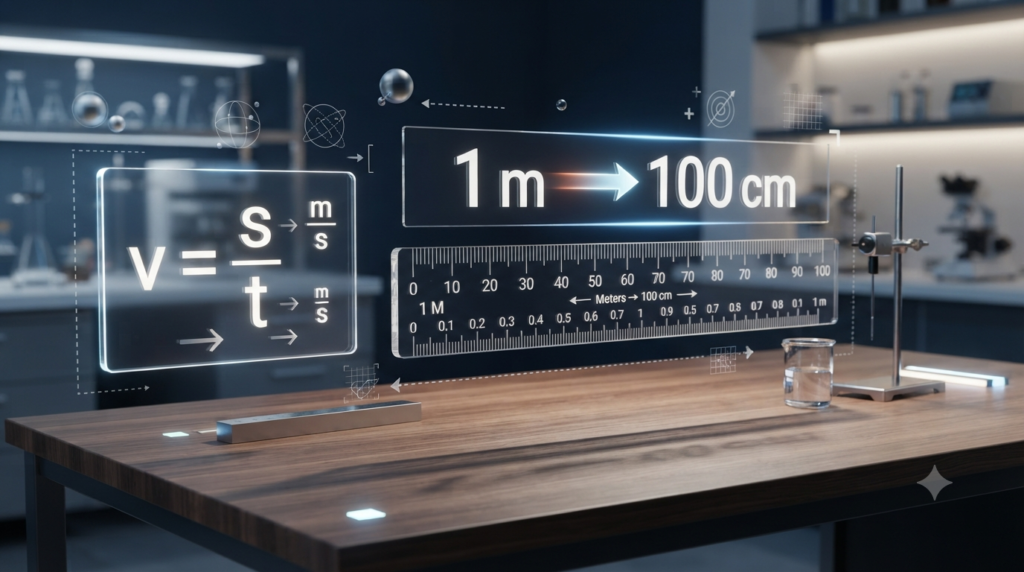
For example, the formula for speed is v = s/t. Here, v represents speed, s represents distance, and t represents time. Once you know what each symbol means, the formula becomes much easier to use. Learning to identify variables is therefore one of the basic skills needed to read and solve physics problems confidently.
What Is a Variable in Physics?
A variable is a symbol that represents a physical quantity whose value can change. Physics commonly uses letters such as v, t, m, F, a, s, and E to represent different quantities.
For example:
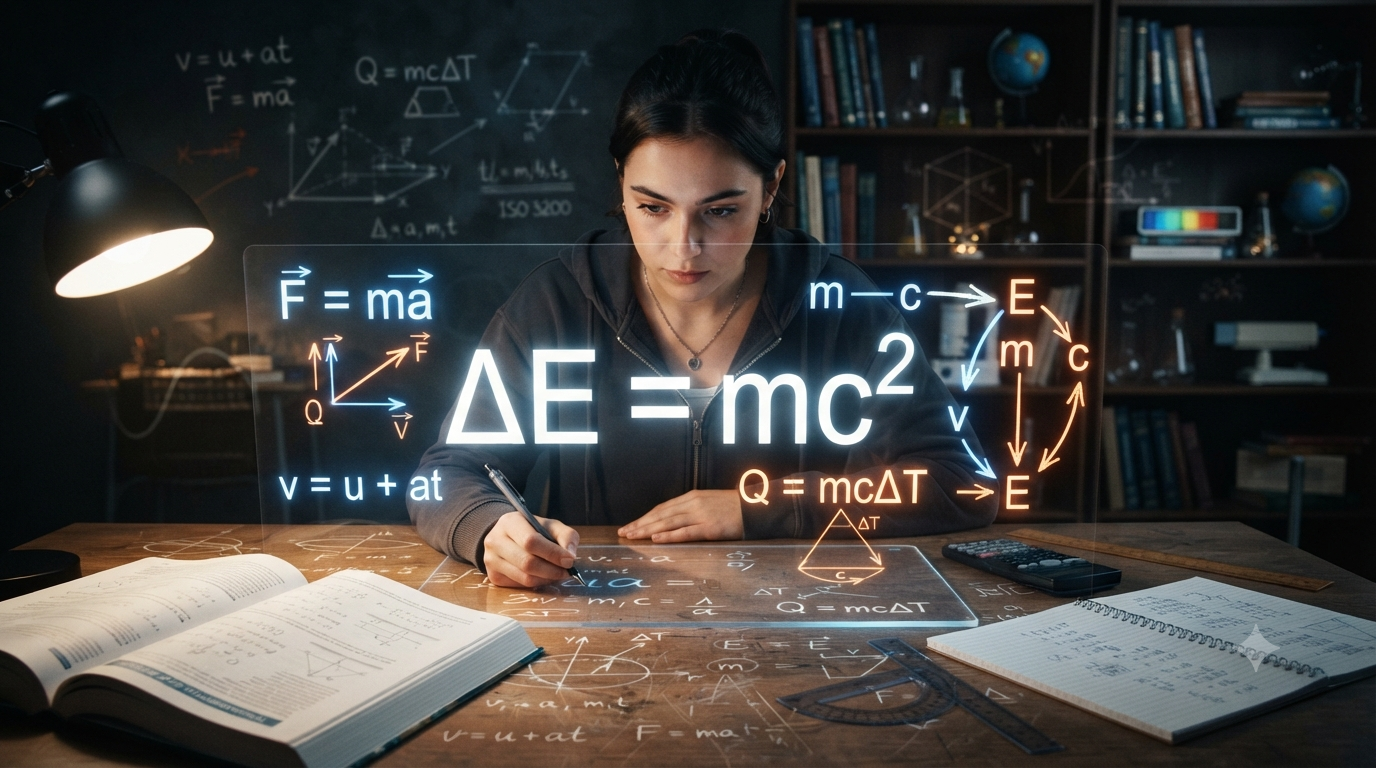
F = ma
In this formula, F represents force, m represents mass, and a represents acceleration. The values of mass and acceleration can change from one situation to another, so the resulting force can also change.
Variables allow physicists to describe many different situations using the same formula instead of writing a separate mathematical statement for every case.
Start by Looking at the Formula
The first step in identifying variables is to look carefully at the entire formula.
Consider:
v = u + at
This equation contains four symbols: v, u, a, and t.
Each symbol represents a physical quantity:
v = final velocity
u = initial velocity
a = acceleration
t = time
The equals sign does not represent a variable. It tells us that the expression on the left has the same value as the expression on the right.
Mathematical signs such as +, −, ×, and ÷ also do not represent physical variables. They show how the quantities are mathematically related.
Learn the Meaning of Common Symbols
Physics uses many symbols repeatedly. Recognizing common symbols can make formulas much easier to understand.
Some frequently used variables include:
m = mass
t = time
v = velocity or speed
u = initial velocity
a = acceleration
F = force
s = displacement
d = distance
p = momentum
W = work
P = power or pressure, depending on the formula
E = energy
Q = heat or electric charge, depending on context
However, a symbol does not always have one fixed meaning. Its meaning depends on the formula and the topic being studied.
For example, P can represent power in one formula and pressure in another. Therefore, never identify a variable only by remembering the letter. Always consider the context.
Check the Context of the Formula
The topic surrounding a formula provides an important clue about the variables.
Consider:
P = F/A
If this formula appears in a chapter about pressure, then P represents pressure, F represents force, and A represents area.
On the other hand:
P = W/t
Here, P represents power, W represents work, and t represents time.
The same symbol can therefore represent different quantities in different areas of physics. Context helps you determine the correct meaning.
Distinguish Variables From Constants
Not every symbol in a physics formula necessarily represents a quantity that changes freely.
Some formulas contain constants. A constant has a fixed value under a particular definition or physical condition.
For example:
F = Gm₁m₂/r²
Here, G is the gravitational constant. Its value is fixed, while m₁, m₂, and r can change from one situation to another.
Similarly, in:
E = mc²
m is the mass, while c represents the speed of light in vacuum. The speed of light is treated as a constant in this relationship.
Recognizing constants is useful because it helps you understand which quantities are changing and which remain fixed.
Identify the Known and Unknown Variables
When solving a physics problem, the formula may contain several variables, but only some values are given.
For example, suppose you are given:
u = 5 m/s
a = 2 m/s²
t = 4 s
and you need to find final velocity using:
v = u + at
Here, u, a, and t are known variables because their values are provided. The variable v is the unknown variable because its value must be calculated.
Identifying the unknown variable before doing calculations helps you choose the correct formula and avoid unnecessary steps.
Look at Subscripts and Superscripts
Some physics formulas use subscripts or superscripts to distinguish between related quantities.
For example:
v₁ and v₂
may represent the velocity at two different points or times.
Similarly:
m₁ and m₂
can represent the masses of two different objects.
The small numbers do not usually create completely different types of variables. Instead, they help distinguish between similar quantities.
Superscripts can have different meanings. For example, m² means metres squared when used as a unit, while v² means velocity multiplied by itself. Therefore, it is important to understand whether a small number belongs to a variable or to a unit.
Use Units to Confirm Variables
Units are one of the best ways to check whether you have correctly identified a variable.
Consider:
v = s/t
Distance s is commonly measured in metres, while time t is measured in seconds. Therefore:
m/s
is the unit obtained for velocity.
Suppose a problem gives a value in kilograms for a variable that you think represents distance. That should immediately make you reconsider your identification.
Units do not always tell you everything about a variable, but they provide a powerful consistency check.
Understand Dependent and Independent Variables
Physics formulas often describe how one quantity depends on another.
For example:
d = vt
If velocity is kept constant, increasing time increases the distance travelled. In this situation, distance depends on time.
Another example is:
F = ma
If mass remains constant, increasing acceleration increases force. Here, force changes according to acceleration.
Understanding these relationships makes formulas more meaningful because you are not simply memorizing symbols. You are seeing how physical quantities influence one another.
Watch for Variables Hidden in More Complex Formulas
Some formulas contain variables that are combined mathematically.
For example:
K = ½mv²
The variables are K, m, and v.
The ½ is a numerical constant, while v² means velocity multiplied by itself. Therefore, v² is not a separate variable. The variable is still v.
Similarly, in:
A = πr²
A and r are variables, while π is a mathematical constant.
Carefully separating variables, constants, numbers, and mathematical operations helps prevent mistakes.
A Simple Method for Identifying Variables
You can use the following method whenever you encounter a new physics formula.
Step 1: Write the Formula
Copy the formula exactly as given.
Step 2: List Every Symbol
Identify each letter or mathematical symbol appearing in the equation.
Step 3: Determine the Physical Meaning
Use the topic, textbook, or surrounding explanation to determine what each symbol represents.
Step 4: Identify Constants
Separate fixed constants from quantities that can change.
Step 5: Check the Units
Confirm that the units associated with each physical quantity make sense.
Step 6: Identify Known and Unknown Values
When solving a problem, mark the values that are given and determine which variable needs to be found.
Step 7: Check the Relationship
Ask what the formula tells you about how the variables are connected.
This process turns an unfamiliar formula into a much easier mathematical and physical relationship.
Example of Identifying Variables
Consider the formula:
Q = mcΔT
This equation is commonly used to calculate the heat transferred when the temperature of a substance changes.
The variables are:
The symbols m, c, and ΔT appear on the right side of the equation and determine the value of Q.
The symbol Δ means change in, so ΔT represents the change in temperature rather than a completely separate variable called delta.
Understanding this distinction is important when reading more advanced physics formulas.
Why Identifying Variables Matters
Correctly identifying variables is more than a mathematical exercise. It helps you understand the physical meaning of an equation.
Once you know what each variable represents, you can determine which measurements are required in an experiment, select appropriate units, substitute values correctly, rearrange equations, and interpret the result.
It also helps when formulas contain similar symbols or when one symbol has different meanings in different topics. Instead of relying entirely on memorization, you can use context, units, and the structure of the equation to determine what each quantity represents.
Common Mistakes When Identifying Variables
One common mistake is assuming that every letter represents a variable. Numerical constants, mathematical constants, and operation symbols should not automatically be treated as variables.
Another mistake is assuming that a symbol always has the same meaning. Physics notation changes according to context.
Students may also confuse a squared or cubed variable with a new variable. In v², for example, the variable remains v.
Ignoring units is another frequent error. Units can reveal whether a variable has been interpreted incorrectly.
Finally, confusing the known and unknown quantities can lead to unnecessary calculations. Always identify what the problem gives you and what it asks you to find.
Conclusion
Identifying variables is one of the most useful skills for reading physics formulas. Start by examining the complete equation, list its symbols, determine the physical meaning of each one, and use context and units to confirm your interpretation. Pay attention to constants, subscripts, superscripts, and symbols such as Δ. When solving problems, separate known variables from the unknown quantity you need to find. With regular practice, physics formulas become more than collections of letters and numbers. They become clear descriptions of how physical quantities are connected.