Percentage to Fraction Converter
Convert any percentage into a simplified fraction instantly.
Fraction Result
Calculation Steps
Common Examples
A Percentage to Fraction Converter is a simple mathematical tool that helps you convert a percentage into a fraction quickly and accurately. Percentages are commonly used in everyday life to represent parts of a whole, such as discounts, exam scores, interest rates, statistics, and measurements. However, fractions are often more useful when working with mathematical calculations, ratios, and comparisons.
Converting a percentage into a fraction is not difficult, but calculating it manually can sometimes take extra time, especially when dealing with decimal percentages or larger numbers. A Percentage to Fraction Converter makes this process easier by automatically converting the entered percentage into a fraction and simplifying it to its lowest terms.
With this online tool, you can enter any valid percentage and get its equivalent fraction within seconds. It also helps you understand the conversion process by displaying the calculation steps.
What Is a Percentage to Fraction Converter?
A Percentage to Fraction Converter is an online mathematical tool that changes a percentage value into an equivalent fraction.
A percentage represents a number out of 100. The word percentage means per hundred. Therefore, converting a percentage into a fraction involves writing the percentage as a number over 100 and then simplifying the resulting fraction.
For example:
25% = 25/100 = 1/4
50% = 50/100 = 1/2
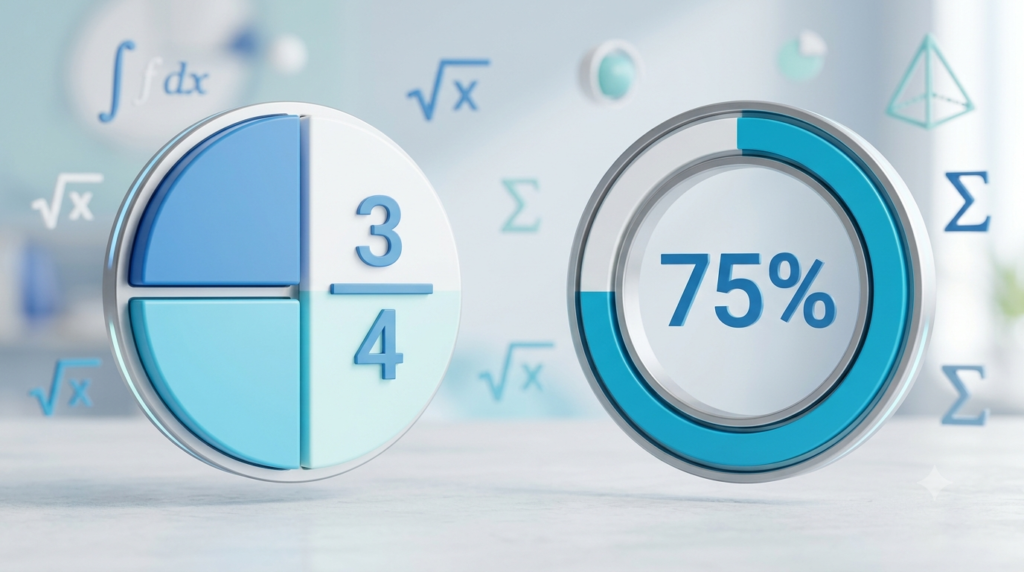
75% = 75/100 = 3/4
20% = 20/100 = 1/5
The converter performs these calculations automatically. You only need to enter the percentage, and the tool displays the equivalent fraction in its simplest form.
This tool is useful for students, teachers, professionals, and anyone who regularly works with percentages and fractions.
How to Use the Percentage to Fraction Converter
Using the Percentage to Fraction Converter is straightforward. You do not need advanced mathematical knowledge to use it.
Follow these simple steps:
Enter the percentage you want to convert into the input field.
Click the Convert to Fraction button.
The tool will calculate the equivalent fraction.
View the numerator and denominator in the result section.
Check the simplified fraction.
Review the calculation steps to understand how the result was obtained.
Use the copy button to copy the fraction for future use.
For example, if you enter 75, the converter displays 3/4 as the simplified fraction.
You can also select one of the common percentage examples displayed below the input field to perform a quick conversion.
How to Convert a Percentage into a Fraction
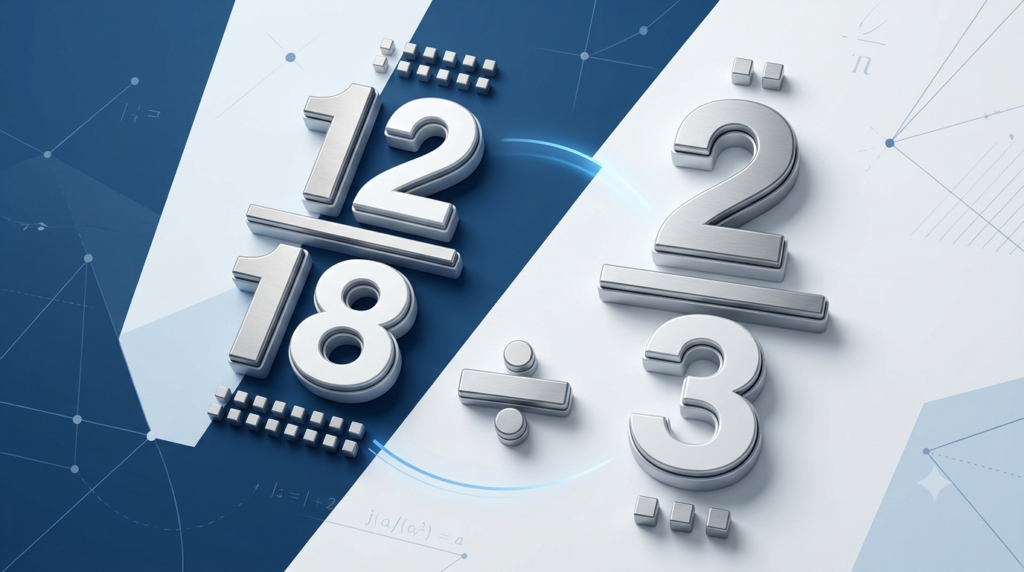
Converting a percentage into a fraction involves a simple mathematical process. Since a percentage means per hundred, the first step is to write the percentage over 100.
After that, simplify the fraction by dividing its numerator and denominator by their greatest common divisor (GCD).
The following steps explain the complete process.
Step 1: Write the Percentage Over 100
Take the given percentage and write it as the numerator of a fraction. Write 100 as the denominator.
For example, consider 40%.
40% = 40/100
This is the first step in converting a percentage into a fraction.
Step 2: Find the Greatest Common Divisor
The Greatest Common Divisor (GCD) is the largest positive number that divides two numbers without leaving a remainder.
In the fraction 40/100, the numerator is 40 and the denominator is 100.
The greatest common divisor of 40 and 100 is 20.
Step 3: Divide Both Numbers by the GCD
Divide the numerator and denominator by their greatest common divisor.
40 ÷ 20 = 2
100 ÷ 20 = 5
Therefore:
40/100 = 2/5
The final answer is 2/5.
This is the simplest form of the fraction because the numerator and denominator have no common factor greater than 1.
Percentage to Fraction Conversion Formula
The basic formula for converting a percentage into a fraction is:
Fraction = Percentage / 100
After applying this formula, simplify the fraction by dividing both the numerator and denominator by their greatest common divisor.
For example, if the percentage is 60%:
Fraction = 60/100
Divide both numbers by 20:
60 ÷ 20 = 3
100 ÷ 20 = 5
Therefore:
60% = 3/5
This formula works for whole-number percentages as well as decimal percentages. For decimal percentages, you may need an additional step to remove the decimal before simplifying.
How to Convert Decimal Percentages into Fractions
Some percentages contain decimal values, such as 12.5%, 37.5%, and 62.5%. These values can also be converted into fractions using the same basic method.
However, you must remove the decimal by multiplying both the numerator and denominator by an appropriate power of 10.
Example 1: Convert 12.5% into a Fraction
First, write the percentage over 100.
12.5% = 12.5/100
Multiply both the numerator and denominator by 10 to remove the decimal.
125/1000
Now divide both numbers by 125.
125 ÷ 125 = 1
1000 ÷ 125 = 8
Therefore:
12.5% = 1/8
Example 2: Convert 37.5% into a Fraction
Write the percentage over 100.
37.5% = 37.5/100
Multiply both numbers by 10.
375/1000
Find the greatest common divisor of 375 and 1000, which is 125.
Divide both numbers by 125.
375 ÷ 125 = 3
1000 ÷ 125 = 8
Therefore:
37.5% = 3/8
Example 3: Convert 62.5% into a Fraction
Start by writing the percentage over 100.
62.5% = 62.5/100
Multiply both numbers by 10.
625/1000
Divide both numbers by 125.
625 ÷ 125 = 5
1000 ÷ 125 = 8
Therefore:
62.5% = 5/8
These examples show that decimal percentages can be converted into simple fractions by removing the decimal and reducing the resulting fraction.
Common Percentage to Fraction Conversions
Some percentage values are used frequently in mathematics, education, shopping, and everyday calculations.
The following table shows common percentages and their equivalent fractions in simplest form.
| Percentage | Fraction | Simplest Form |
|---|---|---|
| 5% | 5/100 | 1/20 |
| 10% | 10/100 | 1/10 |
| 12.5% | 12.5/100 | 1/8 |
| 20% | 20/100 | 1/5 |
| 25% | 25/100 | 1/4 |
| 30% | 30/100 | 3/10 |
| 33.33% | 3333/10000 | 3333/10000 |
| 40% | 40/100 | 2/5 |
| 50% | 50/100 | 1/2 |
| 60% | 60/100 | 3/5 |
| 66.67% | 6667/10000 | 6667/10000 |
| 70% | 70/100 | 7/10 |
| 75% | 75/100 | 3/4 |
| 80% | 80/100 | 4/5 |
| 90% | 90/100 | 9/10 |
| 100% | 100/100 | 1/1 |
| 125% | 125/100 | 5/4 |
| 150% | 150/100 | 3/2 |
| 200% | 200/100 | 2/1 |
Note: Values such as 33.33% and 66.67% are rounded decimal representations. They are not exactly equal to 1/3 and 2/3, respectively. For example, 33⅓% is exactly equal to 1/3.
Understanding the Numerator and Denominator
A fraction consists of two main parts: the numerator and the denominator.
Understanding these parts makes percentage-to-fraction conversion easier.
What Is a Numerator?
The numerator is the upper number in a fraction. It represents how many equal parts are being considered.
For example, in the fraction 3/4, the numerator is 3. This means that three parts are being considered.
What Is a Denominator?
The denominator is the lower number in a fraction. It represents the total number of equal parts into which a whole is divided.
In the fraction 3/4, the denominator is 4. This means that the whole is divided into four equal parts.
When converting a percentage into a fraction, the percentage initially becomes the numerator, while 100 becomes the denominator. The resulting fraction can then be simplified.
What Is a Simplified Fraction?
A simplified fraction is a fraction that has been reduced to its lowest possible terms.
A fraction is in its simplest form when its numerator and denominator have no common positive factor other than 1.
For example:
25/100
Both 25 and 100 can be divided by 25.
25 ÷ 25 = 1
100 ÷ 25 = 4
Therefore:
25/100 = 1/4
The fraction 1/4 is the simplified form of 25/100.
Simplifying fractions makes mathematical expressions easier to read, compare, and calculate.
The Percentage to Fraction Converter automatically performs this simplification, so you do not need to calculate the GCD manually.
Can Percentages Greater Than 100 Be Converted into Fractions?
Yes. Percentages greater than 100 can also be converted into fractions.
A percentage greater than 100 represents a value larger than the original whole. The conversion process remains exactly the same.
For example, consider 150%.
First, write the percentage over 100.
150% = 150/100
Divide both numbers by 50.
150 ÷ 50 = 3
100 ÷ 50 = 2
Therefore:
150% = 3/2
Similarly, 200% can be converted as follows:
200% = 200/100
Divide both numbers by 100.
200% = 2/1
This means that percentages are not limited to values between 0% and 100%. Any valid percentage can be represented as a fraction.
Can Negative Percentages Be Converted into Fractions?
Yes. Negative percentages can also be represented as fractions.
The negative sign remains part of the resulting fraction.
For example:
-25% = -25/100
Divide both numbers by 25.
-25 ÷ 25 = -1
100 ÷ 25 = 4
Therefore:
-25% = -1/4
Negative percentages are useful in situations involving decreases, losses, temperature changes, and other calculations where values fall below a reference point.
The converter can handle negative percentage values and display their equivalent fractions.
Applications of Percentage to Fraction Conversion
Converting percentages into fractions is useful in several areas of mathematics and everyday life.
1. Education and Mathematics
Students frequently work with percentages and fractions in school mathematics. Converting between these forms helps them understand numerical relationships and solve different types of problems.
For example, a student who scores 75% in an examination can represent the score as 3/4.
2. Shopping and Discounts
Percentages are commonly used to describe discounts on products.
For example, a 25% discount can be represented as 1/4 of the original price.
Understanding this relationship can make discount calculations easier.
3. Cooking and Measurements
Recipes sometimes use percentages to describe ingredient proportions. Converting these values into fractions can make measuring and adjusting quantities more convenient.
For example, 50% is equal to 1/2, which is a commonly used measurement in cooking.
4. Data Analysis and Statistics
Percentages are widely used to represent survey results, probabilities, proportions, and statistical information.
Converting percentages into fractions can help when comparing proportions or performing certain mathematical calculations.
5. Financial Calculations
Percentages are used in interest rates, price changes, profit, loss, and financial comparisons.
Representing a percentage as a fraction can sometimes make calculations more straightforward, particularly when working with simple percentage values.
Advantages of Using an Online Percentage to Fraction Converter
An online converter provides a convenient way to perform percentage-to-fraction calculations without manually completing every step.
Some important advantages include:
Fast Results: Convert percentages into fractions within seconds.
Automatic Simplification: Reduce fractions to their lowest terms without manually finding the GCD.
Decimal Support: Convert decimal percentages such as 12.5% and 37.5%.
Negative Value Support: Convert negative percentages into equivalent fractions.
Calculation Steps: Understand how the conversion is performed.
Easy Copying: Copy the calculated fraction for use in notes, assignments, or other calculations.
Simple Interface: Use the tool without requiring advanced mathematical knowledge.
Mobile Compatibility: Access the converter from smartphones, tablets, laptops, and desktop computers.
These features make the tool useful for both quick calculations and learning basic mathematical concepts.
Percentage vs Fraction: Understanding the Difference
Percentages and fractions are two different ways of representing parts of a whole.
A percentage expresses a value in terms of 100, while a fraction expresses a value as a ratio between a numerator and a denominator.
For example, 50% and 1/2 represent the same mathematical value, but they use different numerical formats.
The following table highlights their main differences.
| Percentage | Fraction |
|---|---|
| Represents a value out of 100 | Represents a ratio of two numbers |
| Uses the percentage symbol (%) | Uses a numerator and denominator |
| Example: 25% | Example: 1/4 |
| Common in discounts and statistics | Common in mathematical calculations |
| Easy to compare using a common base of 100 | Can be simplified to the lowest terms |
Both formats are important in mathematics. Knowing how to convert between them helps develop a better understanding of numbers and proportions.
Conclusion
A Percentage to Fraction Converter is a useful online tool for converting percentages into their equivalent fractions quickly and accurately. The conversion process involves writing the percentage over 100 and simplifying the resulting fraction using the greatest common divisor.
Whether you are working with whole-number percentages, decimal values, negative percentages, or values greater than 100%, understanding this conversion makes mathematical calculations easier.
Instead of performing every calculation manually, you can use the online Percentage to Fraction Converter to obtain simplified results and view the steps involved. It is a practical resource for students, teachers, and anyone who wants to work with percentages and fractions more efficiently.
FAQs
1. What is a Percentage to Fraction Converter?
A Percentage to Fraction Converter is an online tool that converts percentage values into equivalent fractions. It automatically changes a percentage into a fraction by placing the percentage value over 100 and simplifying the result. For example, 75% becomes 75/100, which simplifies to 3/4. This tool makes mathematical calculations faster and easier because users do not need to simplify fractions manually. It is useful for students, teachers, and anyone who wants to understand the relationship between percentages and fractions.
2. How do I convert a percentage into a fraction?
To convert a percentage into a fraction, write the percentage value as the numerator and 100 as the denominator. Next, find the greatest common divisor (GCD) of both numbers and divide the numerator and denominator by it. For example, 40% becomes 40/100. The GCD of 40 and 100 is 20. Dividing both numbers by 20 gives 2/5. Therefore, 40% is equal to 2/5 in its simplest fractional form.
3. What is the formula for converting a percentage into a fraction?
The basic formula for converting a percentage into a fraction is Fraction = Percentage / 100. After applying this formula, simplify the resulting fraction by dividing both the numerator and denominator by their greatest common divisor. For example, 60% becomes 60/100. Dividing both numbers by 20 gives 3/5. Therefore, 60% is equivalent to 3/5. This formula works for whole-number percentages and can also be used for decimal percentages after removing the decimal appropriately.
4. How do I convert 25% into a fraction?
To convert 25% into a fraction, first write it as 25/100. Next, find the greatest common divisor of 25 and 100, which is 25. Divide the numerator and denominator by 25. This gives 1/4. Therefore, 25% is equal to 1/4. This means that 25% represents one part out of four equal parts of a whole. You can also use an online converter to obtain this result instantly.
5. How do I convert decimal percentages into fractions?
Decimal percentages can be converted into fractions by first writing the percentage over 100. Then multiply both the numerator and denominator by an appropriate power of 10 to remove the decimal. Finally, simplify the fraction using the greatest common divisor. For example, 12.5% becomes 12.5/100. Multiplying both numbers by 10 gives 125/1000. Dividing both numbers by 125 produces 1/8. Therefore, 12.5% is equal to 1/8.
6. Can I convert percentages greater than 100 into fractions?
Yes, percentages greater than 100 can easily be converted into fractions. The same conversion formula applies regardless of whether the percentage is below, equal to, or above 100%. For example, 150% becomes 150/100. Dividing the numerator and denominator by 50 gives 3/2. Similarly, 200% becomes 200/100, which simplifies to 2/1. These fractions represent values greater than one whole. An online percentage-to-fraction converter can calculate these values automatically.
7. Can negative percentages be converted into fractions?
Yes, negative percentages can also be converted into fractions. The negative sign is retained in the resulting fraction. For example, -25% becomes -25/100. Dividing both the numerator and denominator by 25 gives -1/4. Therefore, -25% is equal to -1/4. Negative percentages are commonly used to represent decreases, losses, and reductions. The conversion process is the same as for positive percentages, except that the negative sign remains in the final result.
8. What is the simplest form of a fraction?
The simplest form of a fraction is a fraction in which the numerator and denominator have no common positive factor other than 1. It is also called the lowest form or simplest terms. For example, 50/100 can be simplified by dividing both numbers by 50, resulting in 1/2. The fraction 1/2 is already in its simplest form. Simplifying fractions makes mathematical expressions easier to understand and use in calculations. Online converters perform this simplification automatically.
9. What is the difference between a percentage and a fraction?
A percentage represents a value out of 100, whereas a fraction represents a part of a whole using a numerator and denominator. Percentages use the symbol %, while fractions are written with two numbers separated by a fraction line. For example, 50% and 1/2 represent the same mathematical value. Percentages are commonly used in discounts, statistics, and financial calculations, while fractions are frequently used in mathematics, measurements, and proportions. Both formats describe parts of a whole in different ways.
10. Is the Percentage to Fraction Converter free to use?
Yes, the online Percentage to Fraction Converter provided on this page is free to use. You can enter a percentage and obtain its equivalent fraction without performing manual calculations. The tool supports whole numbers, decimal percentages, negative values, and percentages greater than 100. It also simplifies the resulting fraction and displays the calculation steps. You can use the copy option to copy your result easily. No mathematical expertise or special software is required to use this tool.