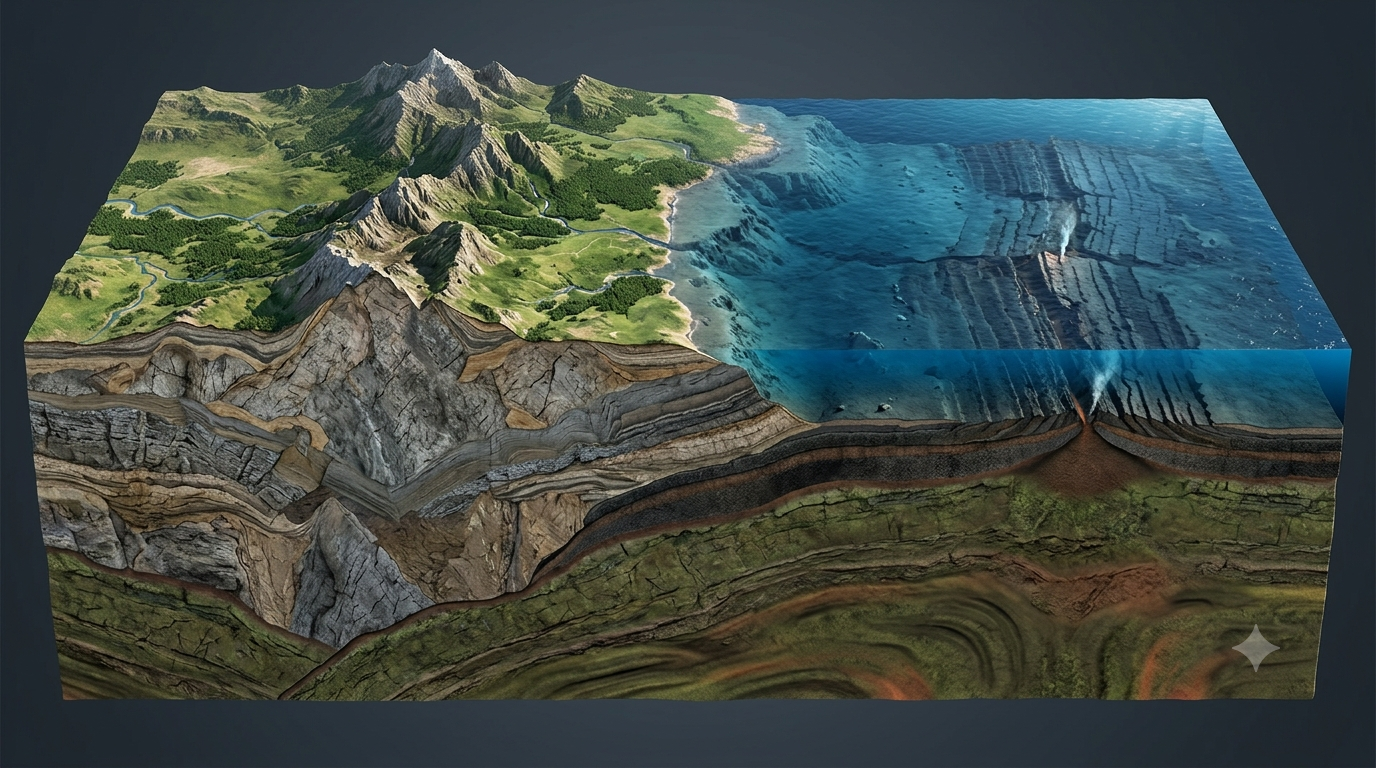
Earth’s outermost solid layer is called the crust. It forms the surface on which we live, build cities, grow crops, and explore the natural world. However, the crust is not the same everywhere. It consists of two main types: continental crust and oceanic crust. Continental crust forms the continents and many large islands, while oceanic crust forms most of the ocean floor. Although both types belong to Earth’s outermost layer, they differ in thickness, composition, density, age, and geological behavior.
Understanding the difference between continental crust and oceanic crust helps explain why continents stand higher than ocean basins, how mountains and ocean trenches develop, and why earthquakes and volcanic activity occur in particular regions. These two types of crust also play an important role in plate tectonics, the process through which Earth’s surface continually changes over geological time.
What Is Continental Crust?
Continental crust is the part of Earth’s crust that forms the continents and the foundations of many islands. It supports a wide range of landscapes, including mountains, plains, plateaus, valleys, and deserts. Continental crust is also the surface on which most human settlements and terrestrial ecosystems exist.
Compared with oceanic crust, continental crust is generally much thicker and less dense. Its composition includes a variety of rocks, particularly granitic rocks, along with sedimentary and metamorphic rocks. These rocks contain minerals rich in silica and aluminum, although the composition varies considerably from one region to another.
Continental crust developed through complex geological processes that occurred over billions of years. Some portions contain extremely ancient rocks that formed during the early history of Earth. Other regions contain younger rocks produced by volcanic activity, mountain building, sediment deposition, and the movement of tectonic plates.
The thickness of continental crust varies depending on the region. It is commonly about 30–40 kilometers thick, although it can be considerably thinner in some areas and reach approximately 70 kilometers or more beneath major mountain ranges. For example, the continental crust beneath the Himalayas and the Tibetan Plateau is unusually thick because of the collision between the Indian and Eurasian tectonic plates.
Continental crust is important because it preserves evidence of Earth’s geological history. Its rocks contain information about ancient oceans, past climates, volcanic eruptions, mountain formation, and the evolution of life.
What Is Oceanic Crust?
Oceanic crust is the portion of Earth’s crust that forms the floor of most ocean basins. It lies beneath the oceans and is found around the world, including beneath the Atlantic, Pacific, Indian, Arctic, and Southern oceans.
Oceanic crust is generally thinner and denser than continental crust. Its main rock type is basalt, a dark-colored volcanic rock that forms when molten material cools and solidifies. Another important rock type is gabbro, which has a similar overall composition to basalt but forms when magma cools slowly beneath Earth’s surface.
Oceanic crust forms mainly at mid-ocean ridges, where tectonic plates move apart. As the plates separate, hot material from the mantle rises toward the surface. When this material melts, the resulting magma cools and solidifies, creating new oceanic crust.
The newly formed crust gradually moves away from the ridge as additional crust develops. Over time, it cools, contracts, and becomes denser. Eventually, much of the older oceanic crust reaches a convergent plate boundary, where it may sink beneath another tectonic plate in a process called subduction.
Because oceanic crust is continuously created and recycled, it is generally much younger than continental crust. Most oceanic crust is less than about 200 million years old, although its exact age varies by location. In contrast, some continental rocks are more than four billion years old.
Oceanic crust is essential to the functioning of Earth’s plate tectonic system. Its formation and destruction influence ocean basin development, volcanic activity, earthquakes, and the long-term movement of continents.
Major Differences Between Continental Crust and Oceanic Crust
Continental and oceanic crust differ in several important ways. The following comparison summarizes their main characteristics.
| Feature | Continental Crust | Oceanic Crust |
|---|---|---|
| Location | Forms continents and many large islands | Forms most ocean floors |
| Average thickness | Commonly about 30–40 km | Commonly about 5–10 km |
| Typical composition | Granitic and other silica-rich rocks, with varied sedimentary and metamorphic rocks | Mainly basalt and gabbro |
| Density | Generally about 2.7 g/cm³ | Generally about 3.0 g/cm³ |
| Typical color of major igneous rocks | Granite is usually light-colored | Basalt is usually dark-colored |
| Age | Can be billions of years old | Generally younger than about 200 million years |
| Formation | Develops through several geological processes over long periods | Forms mainly at mid-ocean ridges |
| Recycling | Much of it survives for billions of years, although it can be altered or destroyed | Frequently recycled into the mantle through subduction |
| Elevation | Generally supports higher land surfaces | Generally lies beneath deeper ocean basins |
| Dominant geological setting | Continents, mountain belts, plateaus, and continental shelves | Ocean basins, mid-ocean ridges, and oceanic plateaus |
These values are approximate. The actual thickness, density, composition, and age of either type of crust can vary depending on its geological history.
1. Difference in Thickness
One of the most noticeable differences between continental and oceanic crust is their thickness.
Continental crust is usually much thicker than oceanic crust. Its thickness commonly ranges from approximately 30 to 40 kilometers, although it can exceed 70 kilometers beneath some major mountain systems.
Oceanic crust is generally much thinner, measuring approximately 5–10 kilometers in thickness. Much of it is around 7 kilometers thick, although variations occur in different oceanic settings.
Why Is Continental Crust Thicker?
Continental crust has developed through a long history of geological activity, including volcanic eruptions, the formation of mountain belts, the collision of tectonic plates, and the accumulation and transformation of rocks. These processes can add material to continents or thicken existing crust.
For example, when two continental plates collide, the crust may be compressed, folded, and pushed upward. The crust can also extend downward into the mantle, forming a deep root beneath a mountain range.
Why Is Oceanic Crust Thinner?
Oceanic crust forms mainly at mid-ocean ridges, where magma rises and solidifies as tectonic plates separate. The process produces a relatively thin layer of new crust.
Although oceanic crust may become covered by thick layers of sediment, these sediments do not change the thickness of the original igneous crust itself.
The difference in thickness helps explain why continental regions and ocean basins generally occupy different elevations.
2. Difference in Composition
Continental and oceanic crust also differ in their chemical and mineral compositions.
Continental crust has a varied composition. Its upper portions commonly contain granitic rocks, while deeper portions can contain more intermediate and mafic rocks. Sedimentary and metamorphic rocks are also widespread throughout continental regions.
Granite contains minerals such as quartz and feldspar, along with other minerals. Many granitic rocks are relatively rich in silica and aluminum compared with typical oceanic crust.
Oceanic crust is primarily composed of basalt and gabbro. These rocks contain minerals such as plagioclase feldspar and pyroxene, and may also contain olivine. They are generally richer in iron and magnesium than typical granitic rocks.
Basalt forms when lava cools relatively quickly at or near Earth’s surface. Gabbro forms when similar magma cools slowly underground, allowing larger mineral crystals to develop.
The difference in composition reflects the processes through which each type of crust forms. Continental crust develops through several stages of melting, crystallization, chemical differentiation, and recycling. Oceanic crust forms mainly from magma generated by partial melting of the mantle beneath spreading centers.
3. Difference in Density
Density is another important characteristic that distinguishes the two types of crust.
Continental crust has an average density of approximately 2.7 grams per cubic centimeter, although the value varies with rock type and depth.
Oceanic crust has an average density of approximately 3.0 grams per cubic centimeter. Its basaltic and gabbroic rocks generally contain more iron and magnesium than the rocks that dominate the upper continental crust.
Because oceanic crust is denser, it tends to sit lower on Earth’s surface than continental crust when both are considered in relation to the underlying mantle.
This relationship helps explain why continents generally rise above sea level while ocean basins lie below it. However, elevation also depends on factors such as crustal thickness, temperature, sediment accumulation, and the movement of tectonic plates.
The principle of isostasy helps explain this balance. Isostasy describes the tendency of Earth’s crust and lithosphere to maintain gravitational balance over the softer, slowly deforming mantle beneath them.
A useful way to understand this idea is to imagine blocks of different thicknesses and densities floating in a softer material. A thick, relatively light block generally stands higher than a thin, denser block. Earth’s crust behaves in a more complex way, but the comparison provides a helpful starting point.
4. Difference in Age
Continental crust and oceanic crust have very different age distributions.
Some parts of continental crust are extremely ancient. They preserve rocks that formed more than four billion years ago, providing evidence of conditions on the early Earth. These ancient regions are often found within stable continental interiors called cratons.
However, not all continental crust is ancient. Mountain belts, volcanic arcs, and sedimentary basins contain rocks that formed much more recently.
Oceanic crust is generally younger because it is continually created at mid-ocean ridges and recycled at subduction zones. As new crust forms, older crust moves away from the ridge. Eventually, much of it sinks back into the mantle.
Most existing oceanic crust is younger than approximately 200 million years, which is relatively recent compared with the age of Earth, about 4.54 billion years.
The age difference provides evidence for seafloor spreading and plate tectonics. Scientists can estimate the age of oceanic crust by studying magnetic patterns in ocean-floor rocks and by measuring the radioactive decay of suitable minerals.
These studies reveal that the ocean floor is not a permanent surface. Instead, it is continually renewed through geological processes.
5. Difference in Formation
The formation of continental and oceanic crust involves different processes, although both are connected to heat from Earth’s interior and the movement of tectonic plates.
Formation of Continental Crust
Continental crust has formed and evolved through a combination of geological processes over billions of years.
Partial melting of mantle-derived rocks and older crust can produce magma with different chemical compositions. As magma cools, minerals crystallize at different temperatures, changing the composition of the remaining melt.
Repeated melting, crystallization, volcanic activity, and the recycling of older rocks can produce silica-rich materials that contribute to continental crust.
Subduction also plays an important role. When an oceanic plate sinks beneath another plate, water and other substances released from the descending plate can promote melting in the overlying mantle. The resulting magmas may contribute to volcanic arcs and, through further geological processes, the growth of continental crust.
Continental crust can also become thicker when tectonic plates collide, compressing rocks and pushing sections of crust upward.
Formation of Oceanic Crust
Oceanic crust forms mainly at divergent plate boundaries, especially along mid-ocean ridges.
When tectonic plates move apart, hot mantle material rises to fill the space. As it rises, the pressure decreases, allowing part of the mantle to melt. This process is known as decompression melting.
The resulting magma moves upward and cools, forming basaltic lava near the surface and gabbro deeper within the crust.
As more magma reaches the ridge, new oceanic crust forms and pushes older crust away from the spreading center. This continuous process is called seafloor spreading.
The formation of oceanic crust is one of the clearest examples of how Earth’s internal heat drives geological change.
6. Difference in Recycling and Destruction
The way continental and oceanic crust are recycled is another major difference.
Oceanic crust is frequently destroyed or recycled through subduction. At convergent plate boundaries, a dense oceanic plate may descend beneath another oceanic or continental plate. As it sinks, it carries crustal rocks and sediments into the mantle.
This process can produce deep ocean trenches, earthquakes, and volcanic activity. Over time, much of the oceanic crust returns to the mantle, where its materials become part of Earth’s internal geological cycle.
Continental crust behaves differently. Because it is generally less dense than oceanic crust, it is more resistant to being pulled deep into the mantle as a whole. Large portions of continental crust can therefore survive for billions of years.
However, continental crust is not permanent or completely immune to destruction. Erosion removes material from mountains and transports sediments to rivers, lakes, and oceans. Tectonic collisions can bury or deform crust, while subduction-related processes may recycle some continental material into the mantle. Parts of continents can also be stretched, fragmented, or separated.
The important distinction is that oceanic crust is more extensively recycled on geological timescales, while substantial portions of continental crust can remain preserved for extremely long periods.
7. Difference in Elevation and Landforms
Continental crust and oceanic crust generally support different surface elevations and landforms.
Continental crust forms most of Earth’s dry land. Its varied thickness, composition, and geological history contribute to the formation of mountain ranges, plateaus, plains, valleys, and other landscapes.
Oceanic crust generally lies beneath ocean water and forms the foundations of ocean basins. Its geological features include mid-ocean ridges, abyssal plains, seamounts, and deep-sea trenches.
The difference in elevation is closely related to crustal thickness and density. Continental crust is typically thicker and less dense, allowing it to stand higher relative to the mantle. Oceanic crust is thinner and denser, so it generally occupies lower elevations.
However, not every continental region is above sea level, and not every oceanic feature lies at the same depth. Some continental areas are submerged beneath shallow seas, forming continental shelves. Meanwhile, volcanic islands can rise above sea level even though they are built on oceanic crust.
These examples demonstrate that the relationship between crust type and elevation is important but not absolute.
8. Difference in Geological Activity
Both continental and oceanic crust experience geological activity, but the types of activity and their locations vary.
Continental crust contains many regions affected by earthquakes, volcanic eruptions, mountain building, and fault movements. These processes are especially common near tectonic plate boundaries, although earthquakes can also occur within the interiors of plates.
For example, the Himalayas formed because the Indian Plate collided with the Eurasian Plate. The collision compressed and thickened the continental crust, creating one of the world’s highest mountain systems.
Oceanic crust experiences substantial volcanic activity along mid-ocean ridges, where new crust forms. Earthquakes occur as plates separate, slide past one another, or collide. At subduction zones, oceanic plates descend into the mantle, generating powerful earthquakes and often contributing to volcanic activity.
The Pacific Ring of Fire is a major example of geological activity associated with the movement and subduction of oceanic plates around the Pacific Ocean.
However, geological activity is not determined solely by whether crust is continental or oceanic. Plate boundaries, heat flow, faults, magma movement, and regional stress all influence where and how geological events occur.
9. Why Are Continents Higher Than Ocean Floors?
A common question is why continents generally rise above the ocean floor.
The main explanation involves differences in crustal thickness and density, together with the principle of isostasy.
Continental crust is typically thicker and less dense than oceanic crust. As a result, continental lithosphere generally stands at a higher elevation relative to the mantle.
Oceanic lithosphere begins relatively thin at mid-ocean ridges. As it moves away from the ridge, it cools and becomes denser. The seafloor consequently becomes deeper with increasing distance from many spreading centers, although local geological features create variations.
Continental crust can also be elevated by mountain building, volcanic activity, and the upward movement of material within Earth. Conversely, it can sink or become submerged because of tectonic processes, cooling, sediment loading, and changes in the underlying lithosphere.
Sea level also affects whether land is exposed or submerged. Therefore, the difference between continents and ocean basins cannot be explained by crustal thickness alone. Density, temperature, lithospheric structure, and geological history all contribute.
10. How Scientists Study Continental and Oceanic Crust
Scientists use several methods to investigate the structure and composition of Earth’s crust.
Seismic Waves
Earthquakes produce seismic waves that travel through Earth’s interior. By measuring how these waves change speed and direction, scientists can estimate the thickness and structure of the crust.
Seismic studies have revealed that continental crust is generally thicker than oceanic crust and that both types are separated from the mantle by a boundary known as the Mohorovičić discontinuity, or Moho.
Rock Samples
Geologists examine rocks collected from continents, volcanic islands, ocean drilling projects, and the seafloor. Their mineral composition, chemical properties, and ages help scientists understand how the crust formed.
Ocean-Floor Mapping
Sonar systems and other mapping technologies measure ocean depth and reveal features such as mid-ocean ridges, trenches, and seamounts.
These maps provide important evidence of seafloor spreading and the movement of tectonic plates.
Radiometric Dating
Radiometric dating uses the predictable decay of radioactive isotopes to estimate the age of suitable rocks and minerals. This method helps identify ancient continental rocks and determine when particular portions of oceanic crust formed.
Together, these techniques allow scientists to reconstruct Earth’s geological history and improve their understanding of the processes that shape the planet.
Importance of Understanding the Two Types of Crust
Understanding continental and oceanic crust is important for several scientific and practical reasons.
First, it helps explain plate tectonics, including the movement of continents, the opening and closing of ocean basins, and the formation of mountain ranges.
Second, studying crustal composition helps geologists understand the distribution of mineral resources. Continental regions contain many important mineral deposits, while oceanic environments may contain resources associated with hydrothermal systems and seafloor geology. The presence of a resource depends on local geological conditions rather than crust type alone.
Third, understanding the relationship between crust and plate boundaries helps scientists assess earthquake and volcanic hazards. Although crust type alone cannot predict a specific event, geological information contributes to hazard mapping and risk assessment.
Finally, studying the crust reveals information about Earth’s early history. Ancient continental rocks preserve evidence of past geological environments, while oceanic crust provides a record of relatively recent seafloor spreading and plate movement.
Conclusion
Continental crust and oceanic crust are the two main types of Earth’s crust, but they differ in several important ways. Continental crust is generally thicker, less dense, more compositionally varied, and capable of preserving ancient rocks for billions of years. Oceanic crust is thinner, denser, primarily basaltic, and continually created at mid-ocean ridges and recycled through subduction.
These differences help explain why continents generally stand higher than ocean basins and why the ocean floor is much younger than many continental regions. Both types of crust are essential parts of Earth’s dynamic geological system. By studying their composition, structure, formation, and movement, scientists can better understand how mountains rise, oceans develop, earthquakes occur, and our planet continues to change over time.
FAQs
1. What is the main difference between continental crust and oceanic crust?
The main difference between continental crust and oceanic crust is their thickness, density, composition, and age. Continental crust forms the continents and is generally thicker and less dense. It contains many types of rocks, including granite, sedimentary rocks, and metamorphic rocks. Oceanic crust forms most of the ocean floor and is thinner and denser. It consists mainly of basalt and gabbro. Continental crust can preserve rocks that are billions of years old, whereas most oceanic crust is younger than about 200 million years because it is continually created at mid-ocean ridges and recycled through subduction zones.
2. Which type of crust is thicker, continental or oceanic?
Continental crust is thicker than oceanic crust. It commonly measures about 30–40 kilometers in thickness, although it can exceed 70 kilometers beneath major mountain ranges. Oceanic crust is usually about 5–10 kilometers thick, with an average close to 7 kilometers. The difference results from the geological processes through which the two types of crust form and develop. Continental crust grows through processes such as melting, volcanic activity, and the collision of tectonic plates. Oceanic crust forms mainly when magma rises and solidifies at mid-ocean ridges, producing a comparatively thin layer of new crust.
3. Why is oceanic crust denser than continental crust?
Oceanic crust is generally denser because it contains more iron- and magnesium-rich minerals than the rocks that dominate much of the continental crust. Its main rocks, basalt and gabbro, are typically denser than granite, which is common in the upper continental crust. Oceanic crust also changes as it moves away from mid-ocean ridges. It cools, contracts, and becomes part of increasingly dense oceanic lithosphere. These characteristics help explain why ocean basins generally lie below continental regions. Density is not identical everywhere, however, because both types of crust contain different rocks and experience different geological conditions.
4. What rocks are found in continental crust and oceanic crust?
Continental crust contains a wide variety of rocks, including granite, sandstone, limestone, shale, and metamorphic rocks such as gneiss and schist. Granite is especially important because it represents a common type of silica-rich continental rock. Oceanic crust consists mainly of basalt and gabbro. Basalt forms when lava cools relatively quickly at or near the seafloor, while gabbro forms when magma cools slowly beneath the surface. Although these rocks have broadly similar chemical compositions, their different cooling histories produce different textures. Studying these rocks helps geologists understand how Earth’s crust forms and changes over time.
5. Why is continental crust older than oceanic crust?
Continental crust can survive for billions of years because it is generally less dense and less likely to be carried deep into the mantle as an entire section. Some continental regions contain rocks formed more than four billion years ago. Oceanic crust, in contrast, is continually produced at mid-ocean ridges and destroyed or recycled at subduction zones. As tectonic plates move, older oceanic crust eventually reaches regions where it can sink beneath another plate. Consequently, most oceanic crust is younger than about 200 million years. This difference in age provides important evidence for seafloor spreading and the continuous movement of Earth’s tectonic plates.
6. How is oceanic crust formed?
Oceanic crust forms mainly at mid-ocean ridges, where two tectonic plates move apart. As the plates separate, hot material from the mantle rises toward the surface. The decrease in pressure allows some of this material to melt through a process called decompression melting. The resulting magma moves upward and cools, forming basalt near the seafloor and gabbro deeper within the crust. As additional magma solidifies, new oceanic crust develops and pushes older crust away from the ridge. This process is known as seafloor spreading. It continuously renews the ocean floor and plays a central role in plate tectonics.
7. Why do continents generally stand higher than ocean floors?
Continents generally stand higher than ocean floors because continental crust is usually thicker and less dense than oceanic crust. This difference is related to isostasy, the gravitational balance between Earth’s crust and the underlying mantle. Thick, relatively buoyant continental crust tends to stand higher, while thinner, denser oceanic crust generally occupies lower elevations. Oceanic lithosphere also cools and becomes denser as it moves away from mid-ocean ridges, causing the seafloor to deepen in many regions. However, elevation is influenced by several factors, including crustal thickness, temperature, tectonic forces, sediment accumulation, and sea level. Therefore, crustal composition alone does not determine elevation.
8. What happens to oceanic crust when tectonic plates collide?
When tectonic plates collide, oceanic crust may sink beneath another plate through a process called subduction. Because oceanic lithosphere is often denser than the material it encounters, it can descend into the mantle at a convergent plate boundary. This process creates deep ocean trenches and generates earthquakes. Water and other substances released from the descending plate can also promote melting in the mantle above it, contributing to volcanic activity. Over geological time, much of the oceanic crust is recycled into Earth’s interior. However, some oceanic crust can be preserved or incorporated into continental regions through tectonic processes.
9. Can continental crust sink beneath oceanic crust?
Continental crust is generally less dense than oceanic crust, so it usually resists sinking into the mantle as a whole. At a convergent boundary, dense oceanic lithosphere commonly subducts beneath continental lithosphere. However, continental crust can descend to considerable depths under certain conditions, particularly during continental collisions. Parts of it may be pulled downward, buried, or incorporated into complex tectonic structures. Continental crust can also be eroded, fractured, and recycled through various geological processes. Therefore, it is not completely immune to destruction. The key difference is that continental crust is generally more buoyant and tends to survive longer than oceanic crust.
10. Why is understanding continental and oceanic crust important?
Understanding continental and oceanic crust helps scientists explain how Earth changes over geological time. Their differences in thickness, density, and composition influence the formation of continents, ocean basins, mountain ranges, and deep-sea trenches. Studying these crustal types also provides evidence for plate tectonics, including seafloor spreading and subduction. Geologists examine crustal rocks to understand Earth’s ancient history and investigate the formation of mineral resources. Knowledge of tectonic structures also contributes to assessments of earthquake and volcanic hazards. By studying both types of crust, scientists gain a clearer understanding of Earth’s internal processes and the forces that shape the planet’s surface.