Science helps us understand the natural world, from the smallest particles inside an atom to the largest structures in the universe. Whether we are learning about physics, chemistry, biology, astronomy, or environmental science, we regularly encounter words that describe scientific ideas, processes, and discoveries. Understanding these words makes scientific information easier to read, interpret, and apply in everyday life.
Scientific terminology may seem difficult at first because some words are unfamiliar or have meanings that differ from their everyday use. However, most scientific terms become easier to understand when they are explained with simple definitions and practical examples. Learning these terms also helps us communicate scientific ideas more accurately and distinguish reliable evidence from unsupported claims.
This article introduces essential scientific terminology that every beginner should understand. It covers the basic language of science, scientific investigation, measurements, experiments, matter, energy, living organisms, and the interpretation of scientific information.
1. What Is Scientific Terminology?
Scientific terminology refers to the specialized words and expressions used to describe scientific concepts, observations, processes, measurements, and relationships. These terms allow scientists, students, researchers, and curious readers to communicate clearly about complex subjects.
For example, the word temperature describes how hot or cold something is, while mass describes the amount of matter in an object. Although people sometimes confuse these ideas, they represent different physical properties.
Similarly, photosynthesis describes the process through which plants, algae, and certain bacteria convert light energy into chemical energy. Knowing this term makes it easier to understand how many organisms obtain the energy they need.
Scientific terminology is important because it gives precise meanings to ideas that might otherwise require lengthy explanations. It also helps readers understand textbooks, research articles, educational videos, and science-related news.
2. Basic Terms Used in Science
Several fundamental terms appear across almost every scientific discipline. Understanding them provides a strong foundation for learning more advanced concepts.
Observation
An observation is information obtained by using the senses or scientific instruments. Observations can be qualitative or quantitative.
For example, noticing that a metal object becomes warmer in sunlight is a qualitative observation. Measuring its temperature with a thermometer provides quantitative information.
Scientists use observations to identify patterns, recognize problems, and develop questions for further investigation.
Evidence
Evidence is information that supports or challenges a scientific explanation or claim. It may come from experiments, measurements, observations, or previously collected scientific data.
For example, repeated measurements showing that a substance expands when heated can provide evidence about its thermal behavior.
Reliable scientific conclusions depend on the quality of the evidence, the methods used to collect it, and whether alternative explanations have been considered.
Fact
A scientific fact is an observation or finding that is consistently supported by reliable evidence. Scientific facts are not simply personal opinions or beliefs.
For example, pure water freezes at approximately 0°C under standard atmospheric pressure. This statement describes a measurable physical phenomenon under specified conditions.
The conditions matter because changes in pressure or the presence of dissolved substances can affect the freezing point.
Theory
In science, a theory is a well-supported explanation of natural phenomena based on extensive evidence. It connects observations and findings into a framework that helps explain how or why something happens.
The theory of evolution explains how populations of living organisms change across generations. Germ theory explains the role of microorganisms in many diseases.
A scientific theory is not merely an untested guess. It is a comprehensive explanation that has survived substantial examination and can be refined when new evidence becomes available.
Law
A scientific law describes a consistent pattern or relationship observed in nature, often expressed mathematically.
For example, Newton’s laws of motion describe relationships between forces and the motion of objects. The law of conservation of energy states that energy is conserved in an isolated system.
A scientific law and a scientific theory serve different purposes. A law describes a relationship or pattern, while a theory explains aspects of how or why natural phenomena occur.
3. Important Terms in Scientific Investigation
Scientific investigation is a systematic process used to explore questions, test explanations, and develop knowledge.
Scientific Method
The scientific method refers to a structured approach to investigating questions about the natural world. It commonly involves making observations, asking questions, proposing explanations, conducting investigations, analyzing results, and communicating conclusions.
Scientists do not always follow these steps in one fixed order. Depending on the research question, they may repeat experiments, revise hypotheses, develop models, or collect additional evidence.
The central principles are careful observation, logical reasoning, reliable evidence, and openness to correction.
Hypothesis
A hypothesis is a proposed explanation or prediction that can be investigated using observations or experiments.
For example, a person might hypothesize that seeds exposed to more light will develop more leaves under otherwise similar growing conditions.
A useful hypothesis identifies a relationship that can be examined. It should be specific enough to guide an investigation and allow the results to support, challenge, or refine the proposed explanation.
Experiment
An experiment is an investigation designed to examine a question or test a prediction under controlled or systematically varied conditions.
For example, a researcher might grow identical plant seedlings under different light intensities while keeping water, soil, and temperature as similar as possible.
Experiments help researchers investigate relationships between variables and evaluate possible explanations.
Variable
A variable is a factor or characteristic that can change or take different values during an investigation.
In a plant-growth experiment, variables might include light intensity, water quantity, temperature, and plant height.
Understanding variables is essential because researchers must identify which factors they are changing, measuring, or keeping consistent.
Independent Variable
The independent variable is the factor deliberately changed or systematically varied to investigate its effect.
In an experiment examining how light affects plant growth, light intensity could be the independent variable.
Researchers select different values of this variable and examine whether the outcome changes.
Dependent Variable
The dependent variable is the outcome measured during an investigation.
If researchers change light intensity and measure plant height after two weeks, plant height is the dependent variable.
The dependent variable is examined to determine whether it changes in association with the independent variable.
Controlled Variable
A controlled variable is a factor kept constant, or carefully managed, to make a comparison more meaningful.
For example, researchers studying the effects of light on plant growth might use the same plant species, soil type, pot size, and watering schedule.
Controlling relevant factors helps reduce alternative explanations for observed results.
4. Terms Related to Data and Measurement
Scientific research frequently involves collecting numerical information and interpreting it carefully.
Data
Data are recorded observations, measurements, or other information collected during an investigation.
Data can include temperature readings, photographs, survey responses, laboratory measurements, and counts of organisms.
Scientists analyze data to identify patterns, compare results, and evaluate explanations.
Qualitative Data
Qualitative data describe qualities or characteristics rather than numerical quantities.
Examples include the color of a solution, the texture of a mineral, and the presence of bubbles during a chemical reaction.
These observations can be valuable even when they are not expressed as numbers.
Quantitative Data
Quantitative data consist of numerical measurements or counts.
Examples include a temperature of 25°C, a mass of 10 grams, or a plant height of 15 centimeters.
Quantitative data make it possible to calculate differences, compare values, and identify numerical relationships.
Measurement
Measurement is the process of determining the size, amount, or value of a property by comparing it with an accepted unit.
For example, a ruler measures length, a balance measures mass, and a thermometer measures temperature.
Accurate measurements require suitable instruments, appropriate methods, and careful recording.
SI Units
The International System of Units, abbreviated SI, is the internationally recognized system of measurement used throughout science.
Common SI units include the metre for length, kilogram for mass, second for time, ampere for electric current, kelvin for thermodynamic temperature, mole for amount of substance, and candela for luminous intensity.
Using standardized units allows researchers around the world to compare measurements and communicate results consistently.
Accuracy and Precision
Accuracy describes how close a measurement is to the accepted or true value. Precision describes how close repeated measurements are to one another.
For example, if the accepted length of an object is 10.0 cm, measurements of 10.0 cm, 10.1 cm, and 9.9 cm are both close together and close to the accepted value.
However, repeated measurements of 8.0 cm, 8.1 cm, and 8.0 cm are relatively precise but not accurate for an object whose accepted length is 10.0 cm.
Both qualities matter when collecting reliable scientific data.
5. Essential Terms in Physics
Physics investigates matter, energy, motion, forces, and the fundamental behavior of the physical universe.
Matter
Matter is anything that has mass and occupies space. Air, water, rocks, metals, and living organisms are examples of matter.
Matter is made up of particles, including atoms and molecules, although the organization and behavior of these particles vary between substances and physical states.
Energy
Energy is the capacity of a system to cause change or transfer energy through interactions. It appears in forms such as kinetic, potential, thermal, chemical, electrical, and radiant energy.
For example, a moving bicycle has kinetic energy, while a raised object has gravitational potential energy relative to a chosen reference level.
Energy can be transferred and transformed from one form to another. In an isolated system, total energy remains conserved.
Force
A force is an interaction that can change an object’s motion or deform it. Forces have both magnitude and direction.
Gravity pulls objects toward Earth, while friction opposes relative motion between surfaces in contact.
In classical mechanics, the net force on an object is related to its mass and acceleration.
Motion
Motion refers to a change in an object’s position over time relative to a reference point.
A moving car, a falling stone, and Earth orbiting the Sun all demonstrate motion. Scientists describe motion using concepts such as distance, displacement, speed, velocity, and acceleration.
Gravity
Gravity is the attractive interaction between objects with mass in the classical description of nature. It helps keep planets in orbit around stars and causes objects near Earth’s surface to fall when unsupported.
Modern physics describes gravity more deeply through Einstein’s general theory of relativity, which explains it in terms of the curvature of spacetime.
6. Essential Terms in Chemistry
Chemistry focuses on the composition, structure, properties, and transformations of matter.
Atom
An atom is the smallest unit of a chemical element that retains that element’s chemical identity.
Atoms contain a nucleus made of protons and usually neutrons, surrounded by electrons. The number of protons determines which element an atom represents.
For example, every hydrogen atom has one proton, while every carbon atom has six.
Molecule
A molecule consists of two or more atoms chemically bonded together as a discrete unit.
Water molecules contain two hydrogen atoms bonded to one oxygen atom. Oxygen gas commonly exists as molecules containing two oxygen atoms.
Not every chemical substance consists of separate molecules. Many ionic solids, for example, form extended structures rather than individual molecular units.
Element
An element is a pure substance consisting of atoms with the same number of protons.
Examples include oxygen, carbon, iron, and gold. Each element has its own atomic number and characteristic chemical behavior.
Elements are organized in the periodic table according to their atomic numbers and other properties.
Compound
A compound is a substance formed when two or more different elements are chemically combined in fixed proportions.
Water is a compound containing hydrogen and oxygen. Sodium chloride is another compound formed from sodium and chlorine.
Compounds have properties that can differ significantly from those of the elements from which they are formed.
Chemical Reaction
A chemical reaction is a process in which substances are transformed into other substances through the rearrangement of atoms and chemical bonds.
Rust formation, combustion, digestion, and many industrial processes involve chemical reactions.
During an ordinary chemical reaction, atoms are rearranged rather than created or destroyed. This principle underlies the conservation of mass in a closed chemical system.
7. Essential Terms in Biology
Biology is the scientific study of living organisms and their interactions with one another and their environments.
Cell
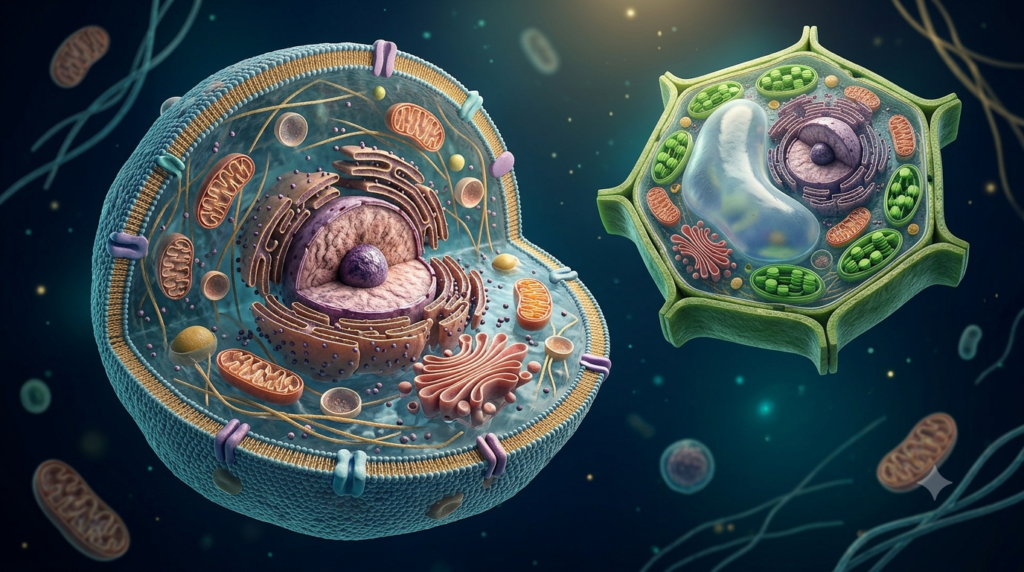
A cell is the basic structural and functional unit of life. Some organisms consist of a single cell, while others contain many specialized cells.
Cells carry out essential activities such as obtaining energy, producing molecules, maintaining internal conditions, and responding to their surroundings.
Organism
An organism is an individual living system, such as a bacterium, plant, fungus, or animal.
Organisms may be unicellular or multicellular. In multicellular organisms, different cells often specialize in particular functions and work together.
Tissue
A tissue is a group of similar or coordinated cells that work together to perform a particular function.
Examples include muscle tissue, nervous tissue, and epithelial tissue in animals, as well as vascular tissue in plants.
Different tissues combine to form organs that perform more complex tasks.
Photosynthesis
Photosynthesis is the process by which plants, algae, and certain bacteria convert light energy into chemical energy.
In plants, photosynthesis uses carbon dioxide and water to produce energy-rich carbohydrates, with oxygen released as a by-product under typical oxygen-producing conditions.
This process supports many food chains and plays an important role in the global carbon cycle.
Ecosystem
An ecosystem consists of a community of organisms and the nonliving components of their environment interacting as a system.
A pond ecosystem, for example, includes organisms such as algae, fish, and microorganisms, along with water, dissolved nutrients, sunlight, and other physical conditions.
Energy flows through ecosystems, while matter cycles between organisms and their surroundings.
8. Important Terms in Scientific Reasoning
Scientific knowledge depends not only on collecting information but also on interpreting it logically.
Theory and Hypothesis
Although these terms are sometimes used interchangeably in everyday conversation, they have different meanings in science.
A hypothesis is a proposed explanation or prediction that can be investigated. A scientific theory is a broader explanation supported by a substantial body of evidence.
A hypothesis may contribute to the development or testing of a theory, but a theory is not simply a hypothesis that has been proven true.
Correlation
Correlation describes an association between two variables. When one variable changes, another may also tend to change.
For example, ice cream sales and swimming activity may both increase during warmer weather. This does not mean that buying ice cream directly causes people to swim. Temperature may influence both variables.
Correlation can help scientists identify patterns, but additional evidence is often needed to determine whether a causal relationship exists.
Causation
Causation means that a factor contributes to producing a particular outcome.
For example, under suitable conditions, increasing the temperature of a chemical system can change its reaction rate. The precise effect depends on the substances and reaction involved.
Establishing causation requires more than observing that two variables change together. Researchers must consider alternative explanations, the underlying mechanism, and the quality of the evidence.
Scientific Model
A scientific model is a simplified representation of an object, process, or system used to explain observations and make predictions.
Examples include models of atoms, diagrams of the water cycle, mathematical descriptions of planetary motion, and computer simulations of climate.
Every model has limitations because it emphasizes certain features while simplifying or omitting others. Models are revised when new evidence or better methods improve our understanding.
Peer Review
Peer review is a process in which other experts evaluate scientific work before or after publication, depending on the context.
Reviewers may examine the research methods, evidence, reasoning, clarity, and significance of a study. Their feedback can help identify weaknesses and improve the work.
Peer review is an important quality-control process, but it does not guarantee that every published conclusion is correct. Scientific findings remain open to further examination and replication.
Replication
Replication involves repeating a study or investigation to determine whether its findings can be reproduced.
When independent researchers obtain similar results using appropriate methods, confidence in the findings may increase.
Differences between studies can also be informative because they may reveal hidden variables, limitations in earlier methods, or conditions under which a result does not hold.
9. Common Scientific Terms That Beginners Often Confuse
Some scientific terms sound similar or are frequently used incorrectly. Understanding their differences prevents common misunderstandings.
Mass and Weight
Mass measures the amount of matter in an object and is commonly expressed in kilograms. Weight is the gravitational force acting on an object and is measured in newtons.
An object’s mass remains approximately the same when it moves from Earth to the Moon, but its weight changes because the gravitational field is weaker on the Moon.
Heat and Temperature
Temperature describes the thermal state of a system and is related to the average microscopic kinetic energy of its particles in many ordinary situations.
Heat is energy transferred between systems because of a temperature difference.
A large container of warm water may contain more internal energy than a small cup of hot water, even though the cup has a higher temperature. The concepts are related, but they are not interchangeable.
Speed and Velocity
Speed describes how quickly an object covers distance. Velocity describes the rate of change of displacement and includes direction.
A car traveling at 60 km/h has a speed of 60 km/h. To specify its velocity, a direction must also be provided, such as 60 km/h north.
Hypothesis and Theory
A hypothesis is a testable proposed explanation or prediction. A theory is a well-supported explanatory framework.
Calling a scientific theory an untested guess misunderstands the meaning of the term in science.
Scientific Fact and Scientific Opinion
A scientific fact is supported by reproducible observations or strong evidence. A scientific opinion is an individual’s interpretation or judgment, which may or may not be supported by sufficient evidence.
Scientists can disagree about interpretations, methods, and the strength of evidence. Such disagreements are evaluated through reasoning, testing, and additional research rather than by personal authority alone.
10. Why Understanding Scientific Terminology Matters
Learning scientific terminology makes science more accessible and improves the way we evaluate information.
First, it improves comprehension. Readers who understand terms such as hypothesis, variable, molecule, and ecosystem can follow scientific explanations more easily.
Second, it supports critical thinking. Recognizing the difference between correlation and causation helps people avoid misleading conclusions. Understanding scientific evidence also makes it easier to assess claims in news reports, advertisements, and social media posts.
Third, scientific terminology improves communication. Using precise terms allows people to describe observations, ask meaningful questions, and explain ideas without unnecessary confusion.
Finally, it builds a foundation for further learning. Beginners who understand basic scientific language can gradually explore advanced subjects such as genetics, quantum physics, climate science, biotechnology, and astronomy.
The goal is not to memorize every scientific word at once. It is to understand the most useful terms, recognize how they are applied, and build connections between them through continued learning.
11. How Beginners Can Learn Scientific Terms Effectively
Learning scientific vocabulary becomes easier when it is connected to real experiences rather than memorized as a list of definitions.
Learn Terms by Topic
Start with one subject at a time. For example, learn basic terms related to matter, atoms, and chemical reactions before moving to more advanced chemistry.
Organizing vocabulary by topic helps you understand how related concepts work together.
Use Simple Examples
Connect each term to an everyday situation. When learning about evaporation, observe water disappearing from a wet surface. When studying force, consider how pushing a shopping cart changes its motion.
Practical examples make abstract ideas easier to remember.
Compare Similar Terms
Create short comparisons for terms that are often confused, such as mass and weight, heat and temperature, or speed and velocity.
Identifying their differences is often more useful than memorizing isolated definitions.
Read Reliable Science Resources
Use science textbooks, educational websites, university resources, and reputable scientific publications. Check unfamiliar words in reliable glossaries or dictionaries, paying attention to how each term is used in context.
When reading science news, distinguish between the actual research findings and the interpretation presented by the writer.
Review and Apply What You Learn
Write a definition in your own words, give an example, and explain the term to someone else. You can also create flashcards, draw diagrams, or answer simple questions.
Regular review helps strengthen memory and reveals which concepts need further clarification.
Conclusion
Scientific terminology is the language that helps us describe, investigate, and understand the natural world. Words such as observation, evidence, hypothesis, theory, variable, matter, energy, atom, cell, and ecosystem form an important foundation for learning science.
Understanding these terms also helps beginners recognize the differences between scientific explanations, measurements, opinions, and unsupported claims. This knowledge is useful not only in formal education but also when interpreting health information, environmental issues, technological developments, and scientific discoveries reported in everyday life.
You do not need to learn every scientific term immediately. Begin with basic definitions, connect them to familiar examples, and review them regularly. As your vocabulary grows, scientific articles and explanations will become easier to understand. With curiosity and consistent practice, anyone can develop the scientific language needed to explore the world more confidently.
FAQs
1. What is scientific terminology?
Scientific terminology refers to the specialized words and expressions used to describe scientific concepts, processes, observations, and discoveries. These terms help people communicate scientific information clearly and accurately. Examples include hypothesis, energy, atom, cell, ecosystem, and observation. Each term has a specific meaning that helps explain how the natural world works. Understanding scientific terminology makes it easier to read science textbooks, research articles, and educational resources. Beginners can develop their scientific vocabulary by learning basic definitions, studying examples, and connecting new terms with everyday experiences. A strong vocabulary provides a foundation for understanding more advanced scientific concepts.
2. Why is it important to learn basic scientific terms?
Learning basic scientific terms helps beginners understand scientific explanations and communicate ideas more accurately. Without knowing essential vocabulary, even simple science articles may seem difficult to follow. Terms such as matter, energy, evidence, and hypothesis provide the foundation for understanding many scientific subjects. Scientific vocabulary also improves critical thinking by helping readers distinguish between evidence-based conclusions and unsupported claims. It is useful when studying physics, chemistry, biology, astronomy, and environmental science. Furthermore, understanding scientific language helps people interpret scientific news, technological developments, and health information more carefully. Learning a few important terms regularly can make science easier and more enjoyable.
3. What is the difference between a scientific theory and a hypothesis?
A hypothesis is a proposed explanation or prediction that can be investigated through observations or experiments. For example, a researcher might hypothesize that increasing light exposure will affect plant growth. A scientific theory is a broader explanation supported by extensive evidence and repeated investigation. The theory of evolution is an example of a well-established scientific theory. In everyday conversation, the word theory sometimes means a guess, but its scientific meaning is different. A theory is not simply an untested idea. Both hypotheses and theories are important because they help scientists investigate questions, explain observations, and improve scientific understanding.
4. What is the scientific method?
The scientific method is a systematic approach used to investigate questions about the natural world. It commonly involves making observations, identifying a question, developing a hypothesis, collecting data, analyzing results, and drawing conclusions. For example, a researcher studying plant growth might investigate whether different amounts of sunlight affect plant height. The researcher would collect measurements and compare the results before evaluating the hypothesis. Scientific investigations do not always follow one fixed sequence because researchers may repeat tests or revise their questions. The main principles are careful observation, logical reasoning, reliable evidence, and willingness to change explanations when new evidence becomes available.
5. What is the difference between qualitative and quantitative data?
Qualitative data describe characteristics or qualities, while quantitative data provide numerical measurements or counts. For example, describing a flower as red or a mineral as rough produces qualitative data. Measuring a flower’s height as 12 centimeters or recording a temperature of 30°C produces quantitative data. Both types of information are useful in scientific investigations. Qualitative observations can help researchers identify patterns and describe changes, while quantitative measurements allow them to calculate differences and compare results. Scientists often use both types together to develop a more complete understanding of a subject. The appropriate type depends on the research question and investigation methods.
6. What is the difference between accuracy and precision in science?
Accuracy describes how close a measurement is to an accepted or true value. Precision describes how close repeated measurements are to one another. For example, if an object’s accepted length is 10 centimeters, measurements of 10.0, 10.1, and 9.9 centimeters are both close to the accepted value and relatively close together. However, measurements of 8.0, 8.1, and 8.0 centimeters are precise but inaccurate for that object. Scientists aim to achieve both accuracy and precision when collecting data. Understanding these concepts helps researchers evaluate measuring instruments, identify possible errors, and improve the reliability of experimental results.
7. What are independent, dependent, and controlled variables?
Independent, dependent, and controlled variables are important components of many scientific experiments. The independent variable is the factor deliberately changed by the researcher. The dependent variable is the outcome measured to determine whether it changes. Controlled variables are factors kept constant or carefully managed to make comparisons meaningful. For example, when investigating how sunlight affects plant growth, light exposure may be the independent variable, plant height may be the dependent variable, and water quantity may be controlled. Identifying these variables helps researchers organize experiments and interpret their findings. Properly managing variables also reduces the influence of alternative explanations on experimental results.
8. What is the difference between mass and weight?
Mass measures the amount of matter in an object and is commonly expressed in kilograms. Weight is the gravitational force acting on that object and is measured in newtons. Although the terms are often used interchangeably in everyday conversation, they describe different physical quantities. An object has approximately the same mass on Earth and the Moon, but its weight is lower on the Moon because lunar gravity is weaker. Understanding this distinction is important in physics, engineering, and scientific measurement. Mass is commonly measured using a balance, while weight can be measured using a force-measuring instrument such as a spring scale.
9. What is the difference between correlation and causation?
Correlation describes an association between two variables, meaning they show a relationship or tend to change together. Causation means that one factor contributes to producing a particular outcome. For example, ice cream sales and swimming activity may both increase during hot weather. However, this correlation does not mean that ice cream purchases cause swimming. Temperature may influence both activities. Scientists investigate causation by considering alternative explanations, conducting suitable experiments, and examining supporting evidence. Understanding this distinction helps beginners evaluate scientific studies, advertisements, and news reports more critically. It prevents the mistaken assumption that every observed relationship represents a direct cause-and-effect connection.
10. How can beginners learn and remember scientific terminology?
Beginners can learn scientific terminology more effectively by studying a few related terms at a time and connecting each definition to a practical example. Organizing vocabulary by subject, such as physics, chemistry, or biology, helps build connections between concepts. Writing definitions in simple language, creating flashcards, drawing diagrams, and reviewing unfamiliar words regularly can improve retention. Comparing commonly confused terms, such as heat and temperature, is also useful. Reading reliable educational resources helps learners understand how scientific words are used in context. Most importantly, beginners should apply new vocabulary when explaining everyday observations. Consistent practice gradually builds confidence and makes scientific information easier to understand.