Living organisms are made up of many different structures that work together to maintain life. From the smallest atoms that form the molecules inside cells to the enormous ecosystems that cover Earth, every level of biological organization has an important role in the natural world. These levels help scientists understand how living things are built, how their bodies function, how organisms interact with one another, and how life is connected to the environment.
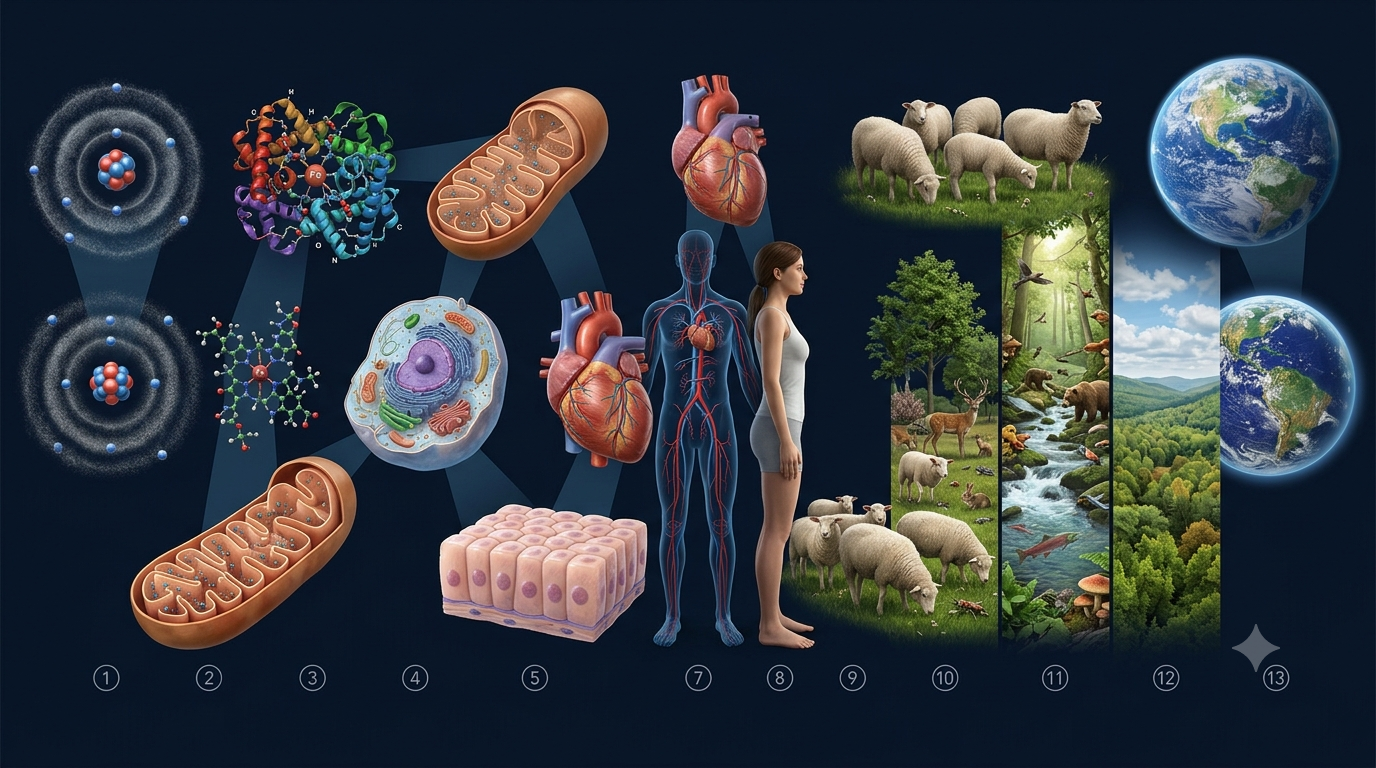
The levels of biological organization describe the arrangement of biological structures from the simplest chemical components to the most complex systems on Earth. The major levels include atoms, molecules, organelles, cells, tissues, organs, organ systems, organisms, populations, communities, ecosystems, biomes, and the biosphere. Each level builds upon the structures and processes of the levels below it. Understanding these levels provides a foundation for studying biology, ecology, genetics, physiology, and many other branches of science.
What Are the Levels of Biological Organization?
The levels of biological organization are the different stages at which living matter is arranged, from microscopic chemical components to large-scale ecological systems. Each level has specific structures and functions that contribute to the overall organization of life.
For example, atoms combine to form molecules, molecules help build cell structures, cells form tissues, and tissues combine to form organs. In multicellular organisms, organs work together in organ systems to maintain the body’s activities. Organisms also interact with members of their species and with other species, forming populations, communities, and ecosystems.
This organization is hierarchical, meaning that smaller components contribute to larger structures. However, higher levels often display properties that cannot be understood by studying their individual components alone. These properties emerge from the interactions between the components.
1. Atoms
Atoms are the basic units of chemical elements and form the foundation of biological matter. Although atoms are not alive, they are essential components of every living organism.
An atom consists of a nucleus containing protons and usually neutrons, surrounded by electrons. Different elements have different numbers of protons, which determine their chemical identities.
Several elements are particularly important for life. Carbon, hydrogen, oxygen, nitrogen, phosphorus, and sulfur are major elements found in biological molecules. Carbon is especially important because it can form stable bonds with many other atoms, allowing the formation of complex molecules.
For example, oxygen and hydrogen atoms combine to form water, while carbon, hydrogen, and oxygen are present in carbohydrates. Nitrogen is an essential component of proteins and nucleic acids.
Atoms do not perform biological functions independently in the same way that cells or organs do. Instead, their chemical properties allow them to combine into the molecules necessary for life.
2. Molecules
Molecules form when two or more atoms join through chemical bonds. Biological molecules are essential for building cells, storing energy, carrying genetic information, and controlling chemical reactions.
Water is one of the most abundant molecules in living organisms. It acts as a solvent, helps transport substances, participates in chemical reactions, and regulates temperature.
Other important biological molecules include carbohydrates, lipids, proteins, and nucleic acids.
Carbohydrates provide energy and may also serve structural functions. Lipids store energy and form the main components of cell membranes. Proteins perform many functions, including transporting substances, supporting tissues, defending the body, and speeding up chemical reactions as enzymes. Nucleic acids, such as DNA and RNA, store and help use genetic information.
For example, glucose is a simple sugar that cells can break down to obtain energy. DNA contains the genetic instructions required for the development and functioning of an organism.
Molecules create the chemical foundation on which cellular life depends.
3. Organelles
Organelles are specialized structures within cells that perform particular functions. Many organelles are surrounded by membranes, although some important cellular structures are not membrane-bound.
Organelles allow cells to carry out different activities efficiently by organizing their internal processes.
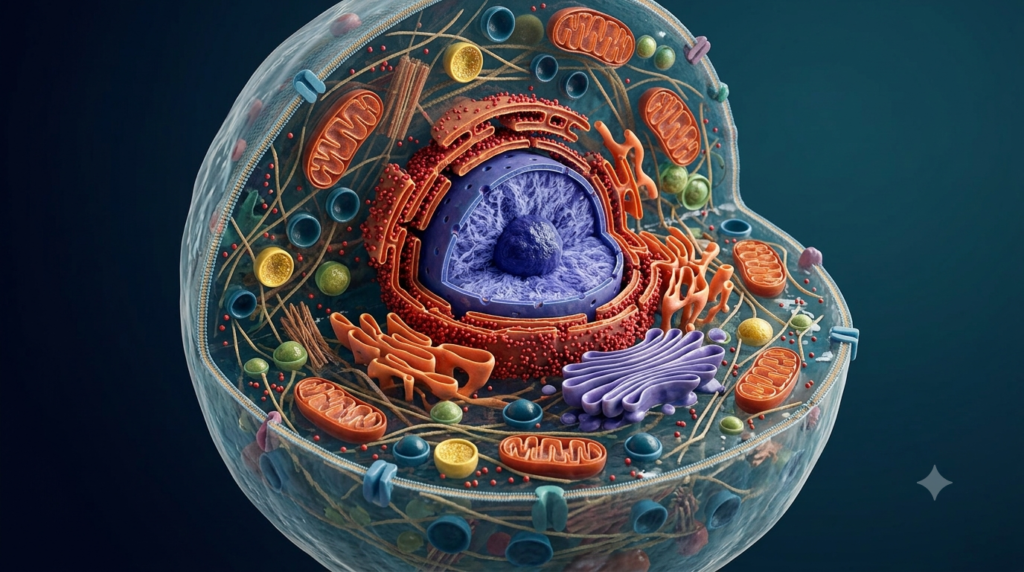
The nucleus of a typical eukaryotic cell contains most of its DNA and helps regulate gene expression. Mitochondria are involved in cellular respiration and produce much of the ATP used by many eukaryotic cells. Ribosomes build proteins, while the endoplasmic reticulum helps synthesize and process proteins and lipids. The Golgi apparatus modifies, sorts, and packages many substances for transport.
Plant cells contain additional structures, including chloroplasts, which carry out photosynthesis. Vacuoles also help plant cells store substances and maintain internal pressure.
Not all cells contain the same organelles. Bacteria and archaea are prokaryotes and do not have a membrane-bound nucleus or the typical membrane-bound organelles found in eukaryotic cells.
Organelles demonstrate how complex chemical components can be organized into functional structures within a cell.
4. Cells
The cell is the basic structural and functional unit of life. All known living organisms consist of one or more cells, and essential life processes take place within them.
Some organisms, such as bacteria and many protists, consist of a single cell. These unicellular organisms perform all the activities necessary for survival within that cell. Other organisms, including humans, trees, and many animals, are multicellular and contain many specialized cells.
Cells are generally classified into two major types: prokaryotic and eukaryotic. Prokaryotic cells lack a membrane-bound nucleus, whereas eukaryotic cells contain a nucleus and other specialized internal structures.
Human cells provide examples of cellular specialization. Red blood cells transport oxygen, nerve cells transmit electrical signals, and muscle cells contract to produce movement. In plants, root hair cells help absorb water and mineral ions, while leaf cells contain chloroplasts for photosynthesis.
Cells obtain nutrients, use energy, respond to their surroundings, and maintain internal conditions. In multicellular organisms, they also communicate and coordinate their activities with other cells.
The cell is the first level in this hierarchy that is generally considered fully living.
5. Tissues
A tissue is a group of similar cells, together with their surrounding material where applicable, that work together to perform a particular function. Tissues are especially important in multicellular organisms because they allow different groups of cells to specialize.
In animals, four major tissue types are commonly recognized.
Epithelial tissue covers body surfaces, lines internal organs and cavities, and forms many glands. It protects the body, absorbs substances, and secretes materials.
Connective tissue supports, binds, protects, or connects other tissues. Examples include bone, cartilage, blood, and adipose tissue.
Muscle tissue contracts to produce movement. Skeletal muscle helps move the body, cardiac muscle pumps blood through the heart, and smooth muscle moves substances through organs such as the intestines.
Nervous tissue receives and transmits signals. It consists mainly of neurons and supporting cells that help coordinate body activities.
Plants also have specialized tissues. Xylem transports water and minerals from roots to other parts of the plant, while phloem transports sugars and other organic substances. Dermal tissue protects the plant, and ground tissue performs functions such as photosynthesis and storage.
Tissues make it possible for specialized cells to cooperate in carrying out more complex functions.
6. Organs
An organ is a structure made of two or more tissue types that work together to perform one or more specific functions. Organs contain different tissues because many biological activities require several types of cells to cooperate.
The human heart is an example of an organ. It contains cardiac muscle tissue that contracts, connective tissue that provides support, epithelial tissue that lines internal surfaces, and nervous tissue that helps regulate its activity.
The stomach is another example. Its muscular layers help mix food, epithelial cells produce protective mucus and digestive secretions, and connective tissue supports its structure.
Plant organs include roots, stems, leaves, flowers, fruits, and seeds. Roots absorb water and minerals and help anchor plants in the soil. Stems support leaves and flowers and transport substances. Leaves usually perform most of a plant’s photosynthesis.
Each organ has a particular role, but its function depends on the coordinated activity of its tissues. A healthy organ therefore requires its component tissues to work together effectively.
7. Organ Systems
An organ system consists of multiple organs that cooperate to carry out major functions in an organism. Organ systems allow complex organisms to perform activities that cannot be completed efficiently by a single organ.
The human body contains several major organ systems.
The digestive system breaks down food and absorbs nutrients. The respiratory system exchanges oxygen and carbon dioxide with the environment. The circulatory system transports oxygen, nutrients, hormones, and waste products through the body.
The nervous system receives information, processes signals, and coordinates rapid responses. The endocrine system releases hormones that regulate processes such as growth, metabolism, and reproduction. The urinary system removes certain wastes and helps regulate water and electrolyte balance.
Other important systems include the skeletal, muscular, immune, lymphatic, integumentary, and reproductive systems.
These systems do not operate independently. For example, the respiratory system supplies oxygen to the blood, while the circulatory system delivers that oxygen to body cells. Cells use oxygen during aerobic respiration to help produce ATP. The urinary system then helps remove certain waste products generated by metabolism.
The coordinated activity of organ systems supports homeostasis, which is the regulation of relatively stable internal conditions despite changes inside or outside the body.
8. Organism
An organism is an individual living thing. It may consist of a single cell or many cells organized into tissues, organs, and organ systems.
Examples include a bacterium, an amoeba, a mushroom, a flowering plant, a fish, and a human being.
In unicellular organisms, one cell performs all essential life functions. In multicellular organisms, specialized cells cooperate to support the survival of the entire individual.
Organisms obtain resources, use energy, respond to their environments, maintain internal organization, and carry out processes associated with growth and reproduction. Different organisms perform these functions in different ways according to their biology and environmental conditions.
For example, a green plant captures light energy through photosynthesis and uses it to produce organic compounds. A human obtains energy by consuming food and digesting it into substances that cells can use.
An organism also interacts with its surroundings. It may compete for resources, avoid predators, reproduce, or cooperate with other organisms. These interactions connect the individual level of biological organization with larger ecological levels.
9. Population
A population consists of individuals of the same species living in a particular area at a particular time. Members of a population may interact, compete for resources, and reproduce with one another, although the extent of these interactions varies among species.
For example, all the deer of one species living in a forest may be considered a population. Similarly, a group of oak trees of the same species growing in a particular woodland forms a plant population.
Population size is influenced by births, deaths, immigration, and emigration. When individuals are born or enter an area, population size may increase. When individuals die or leave, population size may decrease.
The availability of food, water, shelter, and suitable breeding sites can affect population growth. Predation, disease, competition, and environmental changes can also influence population numbers.
Scientists study populations to understand how species survive, spread, and respond to changing conditions. Population studies are important in wildlife conservation, agriculture, fisheries management, and the control of invasive species.
10. Community
A biological community consists of populations of different species living in the same area and interacting with one another.
For example, a forest community may contain trees, shrubs, grasses, fungi, bacteria, insects, birds, mammals, and many other organisms. These species are connected through relationships such as feeding, competition, pollination, parasitism, and mutualism.
Predation occurs when one organism captures and consumes another. Competition occurs when organisms require the same limited resources. Mutualism is an interaction in which both participating species benefit.
An example of mutualism is the relationship between many flowering plants and their pollinators. Bees obtain food from flowers, while the plants may benefit when pollen is transferred between flowers.
Decomposers, including many fungi and bacteria, break down dead organic matter and release nutrients that can be reused by other organisms. Their activity helps connect different members of a community.
Communities change over time as species populations fluctuate, organisms interact, and environmental conditions change. Understanding communities helps scientists explain biodiversity and the relationships that maintain ecological systems.
11. Ecosystem
An ecosystem includes a biological community and the nonliving environment with which it interacts. It consists of both biotic factors, such as plants and animals, and abiotic factors, such as water, sunlight, temperature, air, soil, and minerals.
Ecosystems can vary greatly in size. A small pond, a forest, a grassland, a desert, and a coral reef can all be studied as ecosystems.
Two major processes are especially important in ecosystems: energy flow and nutrient cycling.
Most ecosystems receive their primary energy input from sunlight. Producers, such as green plants and algae, use photosynthesis to convert light energy into chemical energy stored in organic compounds. Consumers obtain energy by eating producers or other consumers. Decomposers break down dead organisms and waste materials, returning nutrients to the environment.
Energy flows through an ecosystem and is eventually dispersed as heat. In contrast, nutrients such as carbon, nitrogen, and phosphorus are recycled through biological and physical processes.
Abiotic conditions strongly influence which organisms can survive in an ecosystem. For example, the availability of water affects plant growth in deserts, while light penetration and water temperature influence life in aquatic environments.
Ecosystems are dynamic systems. Changes in rainfall, temperature, species populations, or human activities can alter their structure and functioning.
12. Biome
A biome is a large ecological region characterized by a broad pattern of climate, vegetation, and associated animal life. Biomes contain many ecosystems that share certain environmental characteristics.
Terrestrial biomes include tropical rainforests, deserts, grasslands, temperate forests, and tundra. Major aquatic biome types include freshwater and marine environments, which contain diverse ecosystems shaped by factors such as salinity, depth, temperature, and light availability.
Climate is a major factor determining the distribution of terrestrial biomes. Temperature and precipitation influence the types of plants that can grow in a region. Because plants form the foundation of many food webs, vegetation also affects the animals and other organisms that live there.
Tropical rainforests generally experience warm temperatures and high rainfall, supporting high biodiversity. Deserts receive relatively little precipitation, so organisms living there often have adaptations that help them conserve water. Tundra regions experience very low temperatures and short growing seasons, limiting plant growth.
Biomes are not always separated by sharp boundaries. They may gradually transition into one another as climate and environmental conditions change.
Studying biomes helps scientists understand global biodiversity patterns, the effects of climate change, and the distribution of natural resources.
13. Biosphere
The biosphere is the broadest level of biological organization. It includes all regions of Earth where life exists and the living organisms that inhabit them. It encompasses portions of the atmosphere, the land, and aquatic environments, including oceans, lakes, rivers, and underground habitats.
The biosphere connects ecosystems across the planet through the movement of organisms, water, nutrients, and energy. For example, water evaporates from oceans, enters the atmosphere, and returns to land through precipitation. Rivers carry dissolved materials toward the sea, while migrating animals transport nutrients between habitats.
Global cycles of carbon, nitrogen, oxygen, and water help connect living organisms with Earth’s physical systems. Photosynthesis removes carbon dioxide from the environment and stores carbon in organic matter, while respiration and decomposition release carbon back into the atmosphere or other environmental reservoirs.
Human activities can influence the biosphere through deforestation, pollution, urbanization, overexploitation of resources, and greenhouse gas emissions. These activities may affect biodiversity, alter ecosystems, and change the climate.
Protecting the biosphere requires an understanding of how local actions can have wider environmental consequences. Conservation, sustainable resource use, habitat restoration, and pollution reduction can all contribute to maintaining the conditions that support life.
How the Levels of Biological Organization Are Connected
The levels of biological organization are not isolated categories. Each level depends on interactions among components at lower levels, while conditions at higher levels can influence the structures and activities below them.
Consider a tree as an example. Atoms combine to form molecules such as water, sugars, and proteins. These molecules form cellular structures and support the activities of plant cells. Specialized cells form tissues, and tissues make up organs such as roots, stems, and leaves.
These organs work together to maintain the tree as an organism. Multiple trees of the same species may form a population. The tree population interacts with birds, insects, fungi, and other species in a community. Together with soil, water, sunlight, and air, the community forms an ecosystem. That ecosystem exists within a broader biome, and ultimately within the biosphere.
The relationships also work in the opposite direction. Drought at the ecosystem level can affect a tree’s water supply, influencing its cells, tissues, and organs. Changes in climate can alter the distribution of biomes and the populations that can survive within them.
This example demonstrates that biological organization involves both structural hierarchy and continuous interactions across different levels.
Why Are the Levels of Biological Organization Important?
Understanding biological organization helps scientists study life systematically. Instead of trying to explain every biological process at once, researchers can focus on a particular level and then connect their findings with other levels.
In medicine, knowledge of molecules and cells helps researchers understand diseases, while knowledge of tissues, organs, and organ systems helps explain how diseases affect the human body.
In genetics, scientists examine DNA, genes, proteins, and cellular processes to understand inheritance and biological variation. In ecology, researchers study populations, communities, ecosystems, and biomes to understand biodiversity and environmental change.
These levels are also useful in agriculture and conservation. Farmers use knowledge of plant cells, tissues, and whole organisms to improve crop growth, while conservation scientists examine populations and ecosystems to protect endangered species and restore habitats.
The hierarchy also encourages a broader understanding of life. A biological problem may begin at one level but produce effects at several others. For example, pollution may alter the chemistry of water, damage cells in aquatic organisms, reduce animal populations, disrupt food webs, and ultimately affect entire ecosystems.
Recognizing these connections helps scientists develop more complete explanations and effective solutions to biological problems.
Conclusion
The levels of biological organization describe how life is arranged, from atoms and molecules to cells, tissues, organs, organ systems, organisms, populations, communities, ecosystems, biomes, and the biosphere. Each level has distinct characteristics and functions, but none exists entirely independently of the others.
The smallest chemical components support the structures and processes of cells, while specialized cells cooperate to form the tissues and organs of multicellular organisms. Organisms interact with members of their own species and with other species, creating ecological systems that extend across the planet.
Studying these levels helps explain how living things function, how ecosystems remain connected, and how changes in one part of nature can influence many others. By understanding biological organization, we gain a clearer picture of the complexity of life and the importance of protecting the natural systems that sustain it.
FAQs
1. What Are the Levels of Biological Organization?
The levels of biological organization describe how living matter is arranged from simple chemical components to complex ecological systems. These levels include atoms, molecules, organelles, cells, tissues, organs, organ systems, organisms, populations, communities, ecosystems, biomes, and the biosphere. Each level builds upon the structures and interactions of smaller levels. For example, molecules form cellular structures, cells combine to form tissues, and tissues work together to form organs. Understanding these levels helps explain how living organisms function, how different species interact, and how life is connected to the environment at local and global scales.
2. What Is the Smallest Level of Biological Organization?
Atoms are commonly considered the smallest level in the traditional hierarchy of biological organization. They are the basic units of chemical elements, such as carbon, hydrogen, oxygen, and nitrogen, which are essential for life. Atoms combine through chemical bonds to form molecules, including water, glucose, proteins, and DNA. However, atoms themselves are not living. The cell is the smallest structural and functional unit generally recognized as living. This distinction is important because biological organization includes both nonliving chemical components that support life and living structures that perform essential processes, such as metabolism, growth, and cellular regulation.
3. Why Is the Cell Considered the Basic Unit of Life?
The cell is considered the basic unit of life because it is the smallest structure generally capable of carrying out essential life processes. Cells obtain and use energy, maintain internal conditions, respond to their surroundings, and perform chemical reactions necessary for survival. Some organisms, such as bacteria and amoebas, consist of a single cell that performs all essential functions. Multicellular organisms, including humans and plants, contain many specialized cells that cooperate to support the whole organism. Although cells contain smaller components such as atoms, molecules, and organelles, these components cannot independently perform all the activities required for cellular life.
4. What Is the Difference Between a Cell, Tissue, and Organ?
A cell is the basic structural and functional unit of life. A tissue consists of a group of similar or coordinated cells that work together to perform particular functions. An organ contains two or more tissue types working together to carry out specific activities. For example, muscle cells form muscle tissue, and different tissues combine to form the human heart. The heart contains muscle tissue for contraction, connective tissue for support, and epithelial tissue lining its internal surfaces. These levels demonstrate how biological structures become increasingly complex, with each level depending on the coordinated functions of its components.
5. What Is the Difference Between an Organ and an Organ System?
An organ is a structure made of different tissues that work together to perform specific functions. An organ system consists of multiple organs that cooperate to carry out broader physiological activities. For example, the heart is an organ responsible for pumping blood, while the circulatory system includes the heart, blood, and blood vessels that transport substances throughout the body. Similarly, the stomach is an organ within the digestive system, which also includes the mouth, esophagus, intestines, liver, and other structures. Organ systems coordinate essential processes such as digestion, respiration, circulation, waste removal, movement, and the regulation of internal conditions.
6. What Is the Difference Between a Population and a Community?
A population consists of individuals belonging to the same species that live in a particular area at a particular time. For example, all the deer of one species living in a forest may form a population. A community includes populations of different species living and interacting in the same area. A forest community may contain deer, trees, birds, insects, fungi, and bacteria. These organisms interact through feeding relationships, competition, pollination, and decomposition. The main difference is that a population focuses on one species, whereas a community includes multiple species and their biological interactions within a shared environment.
7. What Is the Difference Between a Community and an Ecosystem?
A community includes all the populations of different species living and interacting in a particular area. An ecosystem includes that biological community together with the nonliving environment. Abiotic factors, such as sunlight, water, air, soil, temperature, and minerals, influence the survival and activities of organisms. For example, a pond community contains fish, algae, aquatic plants, insects, and microorganisms. The pond ecosystem also includes water chemistry, dissolved oxygen, sunlight, sediments, and temperature. Ecosystems involve interactions between living and nonliving components, including energy flow and nutrient cycling. Therefore, an ecosystem is broader than a biological community.
8. What Is the Difference Between a Biome and the Biosphere?
A biome is a large ecological region characterized by a broad pattern of climate, vegetation, and associated organisms. Examples include tropical rainforests, deserts, grasslands, and tundra. The biosphere is the global system encompassing all regions of Earth where life exists, including parts of the atmosphere, land, and aquatic environments. A biome contains multiple ecosystems that share certain environmental characteristics, while the biosphere connects ecosystems and biomes across the planet. For example, tropical rainforest ecosystems are part of the tropical rainforest biome, and that biome is one component of Earth’s biosphere. The biosphere represents the broadest level of biological organization.
9. How Are the Levels of Biological Organization Connected?
The levels of biological organization are connected because each level depends on the structures and processes of other levels. Atoms combine to form molecules, molecules support cellular structures, cells form tissues, and tissues contribute to organs. Organs work together in organ systems to maintain an organism. Organisms interact with members of their species and other species, forming populations and communities. These communities interact with nonliving environmental factors to create ecosystems. Ecosystems occur within biomes and collectively contribute to the biosphere. Connections also operate in the opposite direction. For example, climate changes can affect ecosystems, populations, and the functioning of individual organisms.
10. Why Is It Important to Study the Levels of Biological Organization?
Studying the levels of biological organization helps scientists understand life from its smallest chemical components to global ecological systems. In medicine, knowledge of cells, tissues, and organs helps explain how diseases develop and affect the body. In genetics, studying molecules such as DNA helps researchers understand inheritance and biological variation. In ecology, population, community, and ecosystem studies explain biodiversity, food webs, and environmental changes. This knowledge is also useful in agriculture, biotechnology, wildlife conservation, and environmental management. Understanding how different levels interact allows scientists to investigate biological problems more effectively and recognize how changes at one level can influence other parts of living systems.