Astronomy is the scientific study of the universe, including stars, planets, galaxies, black holes, and other celestial objects. Astronomers investigate how these objects form, how they change over time, and how the universe behaves on the largest scales. However, studying space presents a unique challenge because scientists cannot directly touch distant stars, travel to most planets outside our solar system, or conduct experiments on entire galaxies. Instead, they rely on observations, measurements, mathematical models, and carefully tested explanations.
The scientific method provides a systematic approach to solving these problems. It helps astronomers develop questions, form hypotheses, collect evidence, analyze results, and determine whether their explanations agree with observations. Modern astronomical discoveries, from identifying distant exoplanets to studying the early universe, depend on this process. Understanding the scientific method used in astronomical research reveals how scientists transform observations of the night sky into reliable knowledge about the universe.
What Is the Scientific Method in Astronomy?
The scientific method is an organized process used to investigate natural phenomena and develop explanations supported by evidence. In astronomy, it helps scientists study objects and events that are often extremely distant, faint, or impossible to observe directly.
Unlike laboratory sciences, where researchers can sometimes control experimental conditions, astronomers generally study the universe as it naturally exists. They cannot move a star closer, change a planet’s orbit, or repeat a supernova whenever they want. Instead, they observe celestial events, compare measurements, develop theoretical explanations, and test predictions against available evidence.
For example, an astronomer investigating a planet outside our solar system might notice that a star periodically becomes slightly dimmer. The scientist can propose that an orbiting planet passes in front of the star and blocks a small amount of its light. By measuring repeated brightness changes and checking other possible explanations, the astronomer can determine whether the evidence supports the existence of an exoplanet.
The scientific method does not always follow a perfectly straight sequence. Astronomers may return to earlier stages when new evidence appears, instruments improve, or existing explanations fail. Its main purpose is to make research systematic, testable, transparent, and open to correction.
Steps of the Scientific Method Used in Astronomical Research
1. Making Observations
Observation is often the starting point of astronomical research. Astronomers collect information about celestial objects using telescopes, spacecraft, detectors, and other scientific instruments.
These observations may include the brightness, color, temperature, position, motion, and chemical composition of an object. Scientists can also measure radiation across different parts of the electromagnetic spectrum, including radio waves, infrared radiation, visible light, ultraviolet radiation, X-rays, and gamma rays.
Different wavelengths reveal different properties of the universe. For example, visible-light observations can reveal the shapes and structures of galaxies, while radio observations can help scientists study cold gas and energetic astronomical processes.
Observations may be made from the ground, from space, or through automated surveys that monitor large areas of the sky. Astronomers often compare new measurements with earlier records to identify changes that are not immediately obvious.
For instance, repeated observations of a star may reveal variations in its brightness. These variations could be caused by an orbiting planet, a companion star, changing stellar activity, or another astronomical process. The initial observation identifies a phenomenon that requires further investigation.
2. Asking a Scientific Question
After identifying an interesting phenomenon, researchers formulate a specific question that can be investigated using evidence.
A useful scientific question is clear, focused, and connected to measurable properties. Broad questions such as “How does the universe work?” are important, but they must be divided into smaller questions that can be examined systematically.
An astronomer studying a star that changes brightness might ask:
Does the star become dimmer at regular intervals?
What causes the observed brightness changes?
Could an orbiting planet explain the pattern?
How large might the planet be?
Can the observations rule out alternative explanations?
These questions guide the research process and help scientists decide which instruments, observations, and analytical methods are needed.
A well-defined question also prevents researchers from collecting large amounts of data without a clear purpose. It establishes what the investigation is intended to explain and which results would be relevant.
3. Developing a Hypothesis
A hypothesis is a proposed explanation for an observation that can be tested against evidence. In astronomy, hypotheses frequently explain the behavior, structure, origin, or evolution of celestial objects.
For example, if a star becomes dimmer at regular intervals, one hypothesis might be that a planet is passing between the star and Earth. This event is known as a planetary transit.
The hypothesis produces a testable prediction: if a planet repeatedly crosses the star’s visible disk, the star should show a recurring pattern of brightness decreases. The timing and depth of these decreases should also be consistent with a possible planetary orbit.
Scientists may develop several competing hypotheses. The brightness changes might result from a transiting planet, a pair of eclipsing stars, or variations in the star’s own activity.
Considering alternatives is essential because the first explanation that appears reasonable is not necessarily correct. A strong hypothesis must make predictions that observations can potentially support or contradict.
Hypotheses in astronomy are often informed by established physical laws, mathematical calculations, and previous discoveries. However, they remain open to revision when new evidence conflicts with their predictions.
4. Making Predictions
A scientific hypothesis becomes more useful when it produces specific predictions that can be compared with observations.
Astronomers use physical laws and mathematical models to determine what should happen if a proposed explanation is correct. These predictions may concern an object’s future position, its brightness, its spectrum, or the timing of an astronomical event.
For example, if a planet orbits a star, astronomers can estimate when the planet should pass in front of the star again. They can then schedule observations to check whether the predicted event occurs.
Predictions may also involve the properties of an object. A model of a star’s internal structure might predict its temperature, luminosity, or expected lifetime. Scientists can compare these predictions with measurements obtained through telescopes.
A useful prediction must be sufficiently specific to distinguish between competing explanations. If two hypotheses predict different observational outcomes, researchers can seek measurements that help determine which explanation better fits the evidence.
Predictions do not guarantee that a hypothesis is correct. Instead, they establish what evidence should be expected if the hypothesis accurately describes the phenomenon.
5. Designing the Investigation
After developing a hypothesis and its predictions, astronomers design an investigation to collect the necessary evidence.
Astronomical research can involve planning telescope observations, selecting instruments, reviewing existing databases, analyzing archival images, or coordinating measurements from several observatories.
The design depends on the scientific question. Studying a distant galaxy may require deep imaging, while investigating a planet’s atmosphere may require spectroscopy. Measuring the orbit of a binary star may require repeated observations over weeks, months, or even years.
Researchers must also consider practical and technical limitations, including atmospheric interference, instrument sensitivity, observing time, background radiation, and the distance of the target object.
Unlike many laboratory experiments, astronomical investigations generally cannot control the object being studied. Instead, scientists choose when and how to observe it and determine which measurements can provide the strongest test of their hypothesis.
Careful planning helps reduce unnecessary observations and ensures that the collected data can address the original research question.
6. Collecting and Recording Data
Data collection is a central part of astronomical research. Telescopes and scientific instruments record information that can be converted into measurements for further analysis.
A telescope may collect photons from a distant object and direct them toward a camera or detector. The resulting observations can be processed into images, spectra, or numerical measurements.
Common forms of astronomical data include:
Photometric data: Measurements of the brightness of celestial objects.
Spectroscopic data: Measurements of how an object’s light is distributed across wavelengths.
Astrometric data: Measurements of the positions and apparent motions of celestial objects.
Radio observations: Measurements of radio emissions from astronomical sources.
Time-series data: Repeated measurements used to identify changes over time.
Scientists record information about observing conditions, instrument settings, calibration procedures, and data processing methods. These details help researchers evaluate the quality of the measurements.
Astronomers also use calibration observations and reference sources to identify instrumental effects. Without proper calibration, a detector’s limitations or changes in observing conditions might be mistaken for genuine astronomical phenomena.
Collecting data carefully is essential because even an excellent scientific explanation can be undermined by inaccurate measurements or poorly documented procedures.
7. Analyzing the Data
Once observations have been collected, astronomers analyze them to identify patterns, calculate physical properties, and compare the results with their predictions.
Data analysis may involve statistical techniques, computer simulations, mathematical equations, image processing, and specialized software. Large astronomical surveys can produce enormous datasets, making computational methods particularly important.
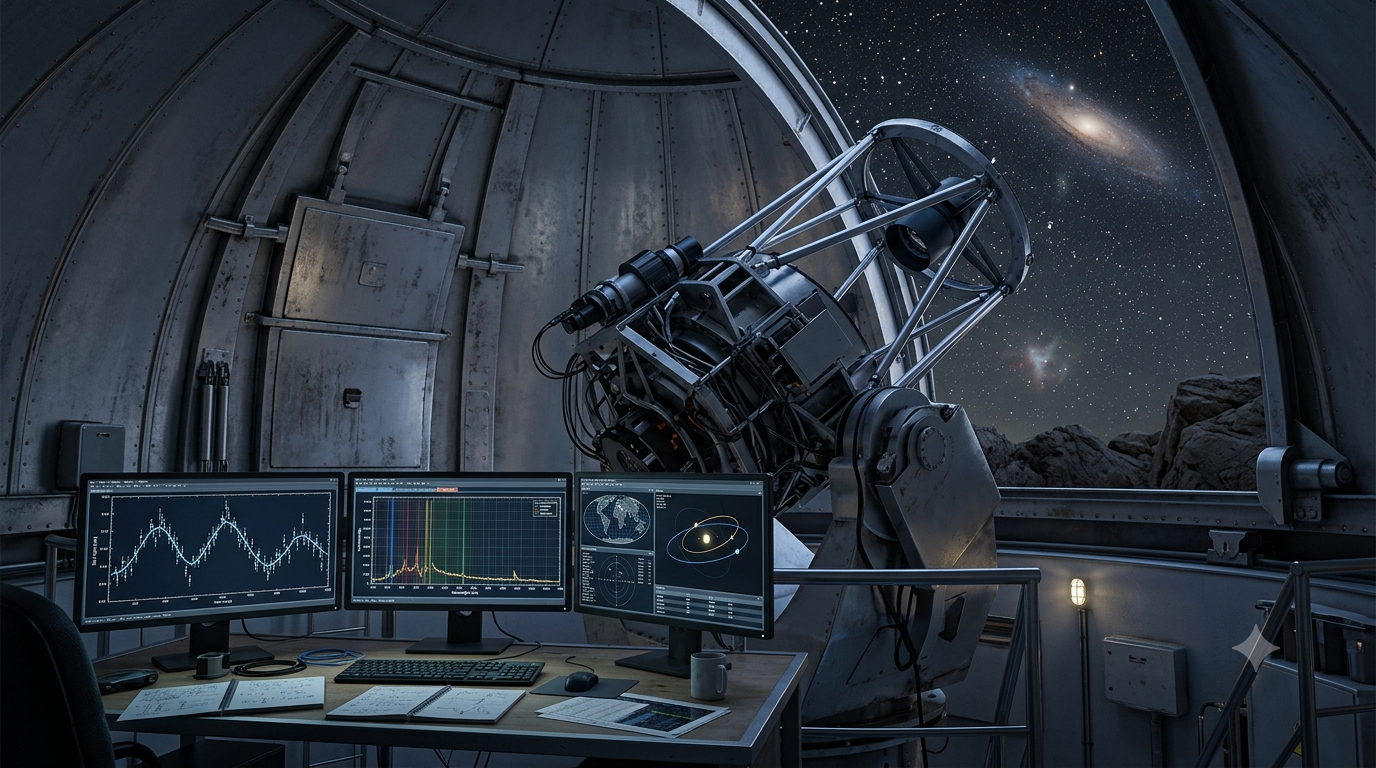
Consider a star whose brightness changes periodically. Astronomers may plot brightness against time to create a light curve. The light curve can reveal the duration, depth, and repetition of brightness decreases.
Researchers can then compare the observed pattern with theoretical models. If the brightness decreases occur at regular intervals and have characteristics consistent with planetary transits, the data may support the hypothesis that a planet orbits the star.
However, scientists must account for measurement uncertainties, missing observations, instrumental noise, and other possible explanations. Statistical analysis helps determine whether an apparent pattern is meaningful or could have arisen by chance.
Astronomers may also use computer simulations to understand complicated processes, such as galaxy formation, stellar evolution, or the movement of matter around black holes. These simulations generate predictions that can be compared with real observations.
8. Testing the Hypothesis
After analyzing the evidence, astronomers evaluate whether the results support the original hypothesis.
A hypothesis receives stronger support when its predictions agree with observations and competing explanations become less plausible. However, agreement with a single observation is rarely sufficient to establish a major astronomical discovery.
In the exoplanet example, a recurring decrease in stellar brightness may indicate a transiting planet. Nevertheless, astronomers must consider whether an eclipsing binary star system or stellar activity could produce a similar pattern.
They may use additional observations to test the explanation. For example, measurements of the star’s radial velocity can reveal whether its motion toward or away from Earth changes because of an orbiting companion. Spectroscopic observations may provide further information about the star and the possible planet.
When several independent measurements support the same explanation, confidence in the hypothesis increases.
If the results contradict the predictions, researchers must investigate why. The original hypothesis may be incorrect, the model may be incomplete, or the observations may contain errors. Scientists may revise the hypothesis and develop new predictions rather than ignoring conflicting evidence.
9. Drawing Conclusions
A scientific conclusion summarizes what the investigation has established and explains how the results relate to the original question.
Astronomers consider whether the evidence supports the hypothesis, whether the predictions were fulfilled, and how reliable the measurements are. They also identify limitations and explain which questions remain unanswered.
For example, observations may provide strong evidence that a planet orbits a particular star without revealing the planet’s complete atmospheric composition. The conclusion should distinguish between what the measurements demonstrate and what remains uncertain.
Scientific conclusions are therefore usually expressed in terms of the strength of the available evidence rather than absolute certainty.
A study might conclude that a proposed explanation is strongly supported, weakly supported, or inconsistent with the observations. It may also identify new questions that require additional research.
This stage is important because scientific knowledge develops gradually. A conclusion can become more precise as scientists collect better data, improve their instruments, or discover previously unknown factors.
10. Publishing Results and Peer Review
Astronomical research becomes part of the wider scientific community when researchers communicate their methods, data, analysis, and conclusions.
Scientists commonly publish their findings in academic journals, present them at conferences, or share datasets through scientific archives. Research papers typically explain the original question, the methods used, the results obtained, and the limitations of the study.
Peer review allows other specialists to evaluate whether the research methods are appropriate, the evidence supports the conclusions, and important limitations have been addressed.
Peer review is not a guarantee that every conclusion is correct. Errors and weaknesses can remain even after publication. However, critical examination helps identify problems and improves the reliability of scientific work.
When possible, sharing data and analysis procedures allows other researchers to examine the evidence independently. This transparency is particularly valuable in astronomy, where major discoveries may depend on complicated observations and statistical calculations.
11. Replication and Independent Verification
Independent verification is essential for determining whether an astronomical result is reliable.
Astronomers may repeat observations, use different instruments, analyze independent datasets, or apply alternative analytical methods. These approaches help establish whether a result reflects a genuine astronomical phenomenon rather than a technical problem or an unusual statistical fluctuation.
For example, an observatory may detect a possible exoplanet through repeated brightness decreases. Researchers at another observatory can collect additional observations to check the transit pattern. Other scientists may examine radial-velocity measurements or independent survey data.
Some astronomical events cannot be repeated on demand. A particular supernova, for instance, cannot be made to explode again for verification. In such cases, scientists examine independent observations, compare similar events, test theoretical predictions, and investigate the physical evidence left behind.
Verification does not always mean reproducing the exact same event. It means determining whether independent evidence and reliable methods support the reported interpretation.
Real Examples of the Scientific Method in Astronomy
Discovering Exoplanets Through Stellar Transits
The transit method is a well-known example of the scientific method in astronomy.
Astronomers monitor the brightness of a star and identify a repeating decrease. They propose that an orbiting planet periodically passes in front of the star. Mathematical models predict the timing and shape of the brightness changes.
Researchers collect additional observations and analyze the light curve. They may also measure the star’s radial velocity to investigate whether a companion object is affecting its motion.
When the measurements agree with the predictions and alternative explanations are sufficiently excluded, the evidence can support the discovery of an exoplanet.
The method demonstrates how a phenomenon that cannot usually be observed directly can be investigated through measurable effects.
Investigating the Expansion of the Universe
Astronomers study the expansion of the universe by measuring the distances and redshifts of galaxies.
Redshift describes the increase in the observed wavelength of light from a source moving away from the observer or participating in the expansion of space. Astronomers combine redshift measurements with distance estimates to investigate how galaxies are distributed and how the universe expands.
Observations show that, on large scales, more distant galaxies generally have larger cosmological redshifts. This relationship provides important evidence for the expansion of the universe.
Scientists compare these measurements with mathematical models of cosmology and use additional evidence, including the cosmic microwave background and the distribution of galaxies, to test and refine their explanations.
The process illustrates how multiple kinds of evidence can contribute to a broader scientific understanding.
Studying Black Holes
Black holes are difficult to investigate because their event horizons prevent light from escaping. However, astronomers can study their effects on surrounding matter and spacetime.
Researchers observe the motion of stars near suspected black holes, measure radiation from hot gas surrounding them, and analyze gravitational waves produced by certain black-hole mergers.
For example, if a star follows a compact orbit around an invisible object with a very large mass, astronomers can use gravitational calculations to estimate the object’s mass and investigate whether it is consistent with a black hole.
Different observations can test different predictions of black-hole physics. Agreement between these independent lines of evidence strengthens scientific explanations of these extreme objects.
These investigations demonstrate that astronomy can study objects indirectly by measuring their observable effects.
Challenges of Applying the Scientific Method in Astronomy
Although the scientific method provides a reliable framework, astronomical research involves several important challenges.
Great Distances and Limited Access
Many celestial objects are too distant for direct exploration. Astronomers must depend on radiation, gravitational effects, and other signals that reach Earth or nearby spacecraft.
Even when spacecraft visit other worlds, the available measurements may cover only a small region or a limited period.
Limited Opportunities for Observation
Some astronomical events occur rarely or last only a short time. A telescope may not be available at the exact moment an event takes place, and weather conditions can prevent ground-based observations.
Researchers often address this problem through coordinated observing networks, automated telescopes, and archived datasets.
Instrumental Errors and Measurement Uncertainty
Telescopes and detectors have finite sensitivity and resolution. Atmospheric turbulence, background radiation, calibration problems, and electronic noise can affect measurements.
Astronomers use calibration procedures, uncertainty estimates, statistical analysis, and independent observations to reduce the impact of these problems.
Testing Competing Explanations
Different physical processes can sometimes produce similar observational patterns. A change in stellar brightness, for example, may be caused by a planet, a companion star, or activity on the star’s surface.
Researchers must consider alternative explanations and seek evidence that can distinguish between them.
Dependence on Models and Assumptions
Astronomers frequently use mathematical models because direct experiments on celestial objects are usually impossible. However, models simplify reality and depend on assumptions.
Scientists evaluate these assumptions, compare predictions with observations, and update models when evidence reveals limitations. A model’s usefulness depends on how well it explains observations and predicts phenomena within its intended range.
The Role of Technology in Modern Astronomical Research
Modern technology has expanded the possibilities of astronomical research. Space telescopes can observe wavelengths that Earth’s atmosphere absorbs, while ground-based observatories use advanced mirrors and detectors to collect increasingly detailed measurements.
Digital cameras and sensitive instruments allow astronomers to detect faint objects and monitor changes over long periods. Spectrographs reveal information about chemical composition, temperature, and motion, while radio telescopes investigate emissions that are invisible to the human eye.
Computers play an equally important role. Astronomers use computational models to simulate the formation of stars and galaxies, statistical tools to analyze observational data, and artificial intelligence techniques to identify patterns in large datasets.
For example, automated systems can examine millions of astronomical images to identify unusual objects that require further investigation. Scientists must still validate these findings and determine whether the detected patterns have a genuine physical explanation.
International collaborations also allow researchers to combine observations from different observatories and share specialized instruments, expertise, and computing resources.
Technology does not replace the scientific method. Instead, it improves scientists’ ability to collect evidence, test predictions, and investigate questions that were previously beyond reach.
Why the Scientific Method Is Important in Astronomy
The scientific method helps astronomers distinguish evidence-based explanations from speculation. Because many astronomical objects cannot be examined directly, careful reasoning and reliable measurements are especially important.
It encourages scientists to test their ideas rather than accept them simply because they seem convincing. It also provides a framework for recognizing uncertainty, identifying errors, and improving existing explanations.
Another major benefit is that the method supports the gradual development of scientific knowledge. One discovery can generate new questions, inspire additional observations, and lead to more accurate models.
The scientific method also makes astronomical research more transparent. When scientists explain their procedures and share evidence, other researchers can evaluate their conclusions and investigate the same questions independently.
Most importantly, it allows astronomy to remain open to new discoveries. Even well-established explanations can be refined when more precise observations reveal details that were previously unknown.
Conclusion
The scientific method used in astronomical research provides a systematic way to investigate the universe through observation, questioning, hypothesis development, prediction, data collection, analysis, and verification. Because astronomers cannot usually control or directly experiment on celestial objects, they rely on measurable evidence and mathematical models to test their explanations. Studies of exoplanets, expanding galaxies, and black holes demonstrate how this approach transforms distant cosmic signals into meaningful scientific knowledge. Although astronomical research faces challenges such as enormous distances, limited observations, and measurement uncertainty, improved technology and independent verification help researchers overcome these difficulties. By continually testing ideas against evidence and revising explanations when necessary, astronomers develop a more accurate understanding of the universe and its physical processes.
FAQs
1. What is the scientific method used in astronomical research?
The scientific method used in astronomical research is a systematic process that helps scientists investigate celestial objects and understand the universe. It involves making observations, asking questions, developing hypotheses, making predictions, collecting data, analyzing results, and drawing conclusions. Astronomers use this approach to study stars, planets, galaxies, black holes, and cosmic events. Since most astronomical objects cannot be examined directly, researchers depend on telescopes, spacecraft, mathematical models, and measurements of electromagnetic radiation. The scientific method helps astronomers test explanations against evidence, recognize uncertainty, and improve their understanding when new observations challenge existing ideas.
2. Why is the scientific method important in astronomy?
The scientific method is important in astronomy because it helps scientists develop reliable explanations of the universe using measurable evidence. Astronomers cannot usually perform controlled experiments on stars, galaxies, or distant planets. Instead, they observe these objects and test hypotheses by comparing predictions with collected data. This process reduces the risk of accepting incorrect explanations based on assumptions or incomplete observations. It also allows researchers to identify errors, investigate alternative possibilities, and refine existing theories. By following systematic scientific procedures, astronomers can investigate complex cosmic phenomena and build a more accurate understanding of the origin, structure, and evolution of the universe.
3. What are the main steps of the scientific method in astronomy?
The main steps of the scientific method in astronomy include making observations, asking a research question, developing a hypothesis, making predictions, designing an investigation, collecting data, analyzing results, testing the hypothesis, and drawing conclusions. Researchers then communicate their findings through scientific publications and allow other scientists to examine the evidence. Independent verification may provide additional support for the conclusions. These steps are not always followed in a fixed order because new observations can lead astronomers to revise earlier ideas. The purpose of the method is to ensure that scientific explanations are evaluated systematically using reliable evidence rather than personal opinions or unsupported assumptions.
4. How do astronomers collect data for scientific research?
Astronomers collect data using ground-based telescopes, space telescopes, spacecraft, radio observatories, cameras, and specialized scientific detectors. These instruments measure properties such as brightness, temperature, position, motion, and the wavelengths of radiation emitted or reflected by celestial objects. Spectroscopy helps scientists investigate chemical composition and motion, while photometry measures changes in brightness. Some researchers also study gravitational waves and particles arriving from space. Astronomers carefully calibrate their instruments and record observing conditions to improve measurement reliability. The collected information is then processed and analyzed using mathematical methods and computer software to identify patterns, test predictions, and investigate astronomical questions.
5. What is a hypothesis in astronomical research?
A hypothesis in astronomical research is a proposed explanation for an observed phenomenon that can be tested using evidence. For example, when astronomers notice that a star becomes dimmer at regular intervals, they may hypothesize that an orbiting planet passes in front of it. This explanation predicts a repeating pattern of brightness decreases. Scientists can test the prediction by collecting additional observations and comparing the results with mathematical models. They also consider alternative explanations, such as eclipsing binary stars or changes in stellar activity. A hypothesis is not automatically accepted as true; it gains support when reliable evidence agrees with its predictions and competing explanations are examined.
6. How do astronomers test their hypotheses without conducting experiments in space?
Astronomers test hypotheses primarily through observations, mathematical calculations, computer simulations, and comparisons with existing scientific knowledge. They cannot usually change the conditions of distant celestial objects, but they can measure their observable effects. For example, scientists investigating a suspected exoplanet can monitor its star for periodic brightness changes and measure the star’s motion. They then compare these measurements with predictions for a planet orbiting the star. Researchers may also use different telescopes or independent datasets to verify their findings. This approach allows astronomers to test explanations without directly manipulating celestial objects, making observation-based investigation a central feature of astronomical science.
7. What role do telescopes play in the scientific method of astronomy?
Telescopes are essential tools in astronomical research because they collect radiation from celestial objects and provide information that scientists can analyze. Optical telescopes observe visible light, while radio, infrared, ultraviolet, X-ray, and gamma-ray instruments investigate other regions of the electromagnetic spectrum. Different instruments reveal different physical properties of stars, planets, galaxies, and other objects. Astronomers use telescope observations to identify phenomena, test hypotheses, and compare predictions with actual measurements. Repeated observations can reveal changes over time, such as planetary transits or stellar explosions. Although telescopes provide important evidence, scientists must calibrate their instruments and account for noise and other sources of measurement uncertainty.
8. How do astronomers know whether their research results are reliable?
Astronomers evaluate reliability by examining data quality, measurement uncertainty, statistical significance, and the consistency between observations and predictions. They consider alternative explanations and check whether instrumental problems could have influenced the results. Independent observations using different instruments or datasets can provide additional evidence. Researchers also publish their methods and conclusions so that other scientists can assess their work through peer review and further investigation. Peer review alone does not guarantee correctness, but it helps identify weaknesses and methodological problems. When several independent lines of evidence support the same explanation, confidence in the findings generally increases. Scientific conclusions remain open to revision when stronger evidence becomes available.
9. What are some examples of the scientific method used in astronomy?
Astronomers use the scientific method in many areas of research. In exoplanet studies, scientists monitor stars for repeated brightness decreases that may indicate orbiting planets. In cosmology, they measure galaxy distances and redshifts to investigate the expansion of the universe. Researchers studying black holes examine the motion of nearby stars, radiation from surrounding matter, and gravitational waves produced during certain mergers. Scientists also investigate stellar evolution by comparing observations of stars at different stages of their lives with theoretical models. In each case, researchers formulate questions, develop explanations, make predictions, collect evidence, and evaluate whether their results support the proposed explanation.
10. How has modern technology improved the scientific method in astronomy?
Modern technology has improved astronomical research by making observations more detailed, sensitive, and efficient. Advanced telescopes detect faint objects and radiation that earlier instruments could not measure reliably. Space observatories can study wavelengths absorbed by Earth’s atmosphere, while powerful computers process enormous datasets and run simulations of complex cosmic processes. Artificial intelligence can help researchers identify unusual patterns in astronomical images and large surveys, although scientists must independently evaluate the findings. Digital archives also allow researchers to compare new observations with historical measurements. These technological advances strengthen the scientific method by improving data collection, analysis, prediction testing, and verification, helping astronomers investigate increasingly complex questions about the universe.