Matter is all around us, from the air we breathe and the water we drink to the food we eat and the soil beneath our feet. Much of this matter consists of mixtures, which are formed when two or more substances are combined physically without undergoing a chemical reaction that changes their chemical identities. Mixtures are an important part of chemistry because they help us understand the composition and properties of everyday materials. Based on how their components are distributed, mixtures are classified into two main types: homogeneous mixtures and heterogeneous mixtures. Although both contain more than one substance, they differ in appearance, composition, and the way their components are distributed. Understanding these differences helps us identify materials, separate substances, and explain many natural and industrial processes.
What Is a Mixture in Chemistry?
A mixture is a physical combination of two or more substances in which each substance generally retains its own chemical identity and properties. The substances that form a mixture are called its components.
For example, when salt dissolves in water, salt and water combine to form saltwater. The salt does not become a completely new chemical substance; instead, its particles become distributed throughout the water. Similarly, air contains several gases, including nitrogen, oxygen, and carbon dioxide, mixed together.
Mixtures can be formed by combining solids, liquids, or gases in different proportions. Unlike compounds, mixtures do not have a fixed chemical composition. The amount of each component can vary depending on how the mixture is prepared.
For example, one glass of saltwater may contain a small amount of salt, while another may contain much more. Both are mixtures, provided the salt is dissolved in the water.
Mixtures are generally classified into two main categories:
Homogeneous mixtures: Mixtures with a uniform composition throughout.
Heterogeneous mixtures: Mixtures with a non-uniform composition in different parts.
These categories help explain how substances are distributed and how their properties vary within a material.
What Is a Homogeneous Mixture?
A homogeneous mixture is a mixture that has a uniform composition throughout. Its components are distributed evenly at the observable scale, so different portions of the mixture have the same composition when properly sampled.
In a homogeneous mixture, the individual components usually cannot be distinguished by simply looking at the mixture. The material appears to be a single phase, even though it contains more than one substance.
For example, when sugar dissolves completely in water, the sugar particles spread throughout the water. The resulting sugar solution looks uniform because there are no visibly separate regions of sugar and water.
Other common examples include saltwater, vinegar, air, and many metal alloys.
Characteristics of Homogeneous Mixtures
Homogeneous mixtures have several important characteristics.
1. Uniform composition
The components are distributed evenly throughout the mixture. A small sample taken from one part should have approximately the same composition as a sample taken from another part, assuming the mixture is well mixed and stable.
2. Usually appear as a single phase
A homogeneous mixture generally appears as one continuous phase. For example, properly prepared saltwater appears as a single liquid phase rather than separate layers of salt and water.
3. Components are not visibly distinguishable
The substances that make up a homogeneous mixture cannot usually be identified separately with the naked eye. Special analytical methods may be needed to determine their composition.
4. Variable composition
The proportions of the components can change. A solution may contain a little or a lot of dissolved salt while remaining homogeneous, provided the salt stays dissolved.
5. Components can often be separated physically
Many homogeneous mixtures can be separated by methods such as evaporation, distillation, or chromatography. The appropriate method depends on the physical and chemical properties of the components.
Examples of Homogeneous Mixtures
Saltwater: When salt dissolves completely in water, it forms a homogeneous mixture. The dissolved salt is distributed throughout the liquid, and the solution has a uniform composition when properly mixed.
Sugar solution: Sugar dissolves in water and forms a uniform solution. The sugar cannot be seen separately, although it remains present in the mixture.
Air: Clean, well-mixed air is a homogeneous mixture of gases, mainly nitrogen and oxygen, with smaller amounts of argon, carbon dioxide, and other gases. Its composition can vary slightly with location and conditions.
Vinegar: Ordinary vinegar is a homogeneous solution containing acetic acid and water, along with small amounts of other substances depending on the product.
Brass: Brass is an alloy made primarily of copper and zinc. Many brass samples are uniform solid solutions, although their detailed structure depends on composition and processing.
Filtered tea: Tea without visible leaves or suspended particles is generally treated as a homogeneous mixture because its dissolved substances are distributed throughout the liquid.
What Is a Heterogeneous Mixture?
A heterogeneous mixture is a mixture that does not have a uniform composition throughout. Its components are distributed unevenly, and different parts of the mixture may contain different proportions of the substances.
In many heterogeneous mixtures, the components can be distinguished by looking at the material. However, visible differences are not required in every case. Some heterogeneous mixtures contain particles that are too small to see without a microscope.
For example, a mixture of sand and water is heterogeneous because the sand does not dissolve and can settle at the bottom. Similarly, oil and water form separate liquid layers under ordinary conditions because they do not mix uniformly.
Soil, vegetable salad, granite, and muddy water are other common examples of heterogeneous mixtures.
Characteristics of Heterogeneous Mixtures
1. Non-uniform composition
Different portions of the mixture may contain different amounts of each component. A sample taken from one location may therefore differ from a sample taken elsewhere.
2. Two or more phases may be present
Many heterogeneous mixtures contain distinct solid, liquid, or gaseous regions. For example, oil and water form two liquid phases when they separate into layers.
3. Components may be distinguishable
In some cases, the components can be seen with the naked eye. The pieces of vegetables in a salad or grains of sand in water are easy to identify.
4. Components may separate over time
Some heterogeneous mixtures are unstable when left undisturbed. Suspended particles may settle, while immiscible liquids may separate into layers.
5. Separation methods depend on the components
Heterogeneous mixtures can often be separated using filtration, decantation, sieving, centrifugation, or other physical methods. The choice depends on particle size, density, and the physical state of the substances.
Examples of Heterogeneous Mixtures
Sand and water: Sand does not dissolve in water. The particles remain separate and may settle at the bottom, producing a non-uniform mixture.
Oil and water: Oil and water are generally immiscible, meaning they do not mix into a single uniform liquid phase under ordinary conditions. They form separate layers when allowed to stand.
Soil: Soil contains varying proportions of mineral particles, organic matter, water, air, and sometimes living organisms. Its composition differs from one portion to another.
Vegetable salad: Different vegetables and other ingredients remain physically distinct. A sample from one part of the salad may contain different ingredients from a sample taken elsewhere.
Granite: Granite is a rock containing minerals such as quartz, feldspar, and mica. These minerals often appear as distinct grains, making granite a common example of a heterogeneous mixture.
Muddy water: Muddy water contains suspended soil or clay particles. The particles are not uniformly dissolved, and some may settle over time.
Difference Between Homogeneous and Heterogeneous Mixtures
Homogeneous and heterogeneous mixtures differ mainly in the distribution of their components and the uniformity of their composition.
| Feature | Homogeneous Mixture | Heterogeneous Mixture |
|---|---|---|
| Composition | Uniform throughout | Non-uniform throughout |
| Distribution | Components are evenly distributed at the relevant scale | Components are unevenly distributed |
| Phases | Usually one phase | Often two or more phases |
| Appearance | Usually looks uniform | May show distinct regions or components |
| Sampling | Small samples generally have similar composition | Different samples may have different compositions |
| Separation | Often uses distillation, evaporation, or chromatography | Often uses filtration, decantation, or sieving |
| Examples | Saltwater, air, vinegar | Sand and water, oil and water, soil |
The main distinction is not simply whether the components are visible. It is whether the mixture has a uniform composition throughout at the scale being considered.
Homogeneous and Heterogeneous Mixtures in Everyday Life
Mixtures are present in nearly every part of daily life. Recognizing their types helps explain how different materials behave and how they can be used.
Food and Beverages
Tea without suspended leaves, vinegar, and a properly prepared sugar solution are examples of homogeneous mixtures. Their dissolved components are distributed throughout the liquid.
In contrast, vegetable salad, cereal in milk, and vegetable soup containing visible pieces are heterogeneous mixtures because their components remain distinguishable or are unevenly distributed.
Some foods may change classification depending on their preparation. For example, a well-filtered soup may appear uniform, while a soup containing large vegetable pieces is clearly heterogeneous.
Air and the Environment
Air is generally treated as a homogeneous mixture of gases under ordinary conditions. Its gases mix to form a uniform gaseous phase, although the exact composition may vary.
However, air containing dust, smoke, or liquid droplets can form a heterogeneous system. The suspended particles or droplets are distributed within the gas rather than dissolved uniformly at the molecular level.
Similarly, seawater is often treated as a homogeneous mixture of dissolved salts in water when clean and well mixed. Seawater containing suspended sand, plankton, or other particles may be heterogeneous.
Medicine and Healthcare
Many medicinal solutions contain active ingredients dissolved uniformly in a liquid. This uniform distribution helps ensure that measured portions contain predictable amounts of the dissolved ingredient.
Some medicines are suspensions, in which solid particles are dispersed throughout a liquid without fully dissolving. These are heterogeneous systems and may require shaking before use so that the particles are distributed more evenly.
Creams and emulsions can also contain multiple phases. Their stability depends on formulation, particle or droplet size, and the presence of suitable stabilizing ingredients.
Industry and Manufacturing
Homogeneous mixtures are important in producing alloys, fuels, cleaning solutions, and many chemical products. Consistent composition is often necessary to obtain predictable material properties.
Heterogeneous mixtures are equally important. Concrete, for example, contains cement paste, sand, gravel, and other components. Its properties depend on the proportions and distribution of those materials.
Industries use different separation processes to obtain useful substances from mixtures. Water treatment may involve sedimentation and filtration, while petroleum refining uses distillation to separate components with different boiling ranges.
Methods Used to Separate Mixtures
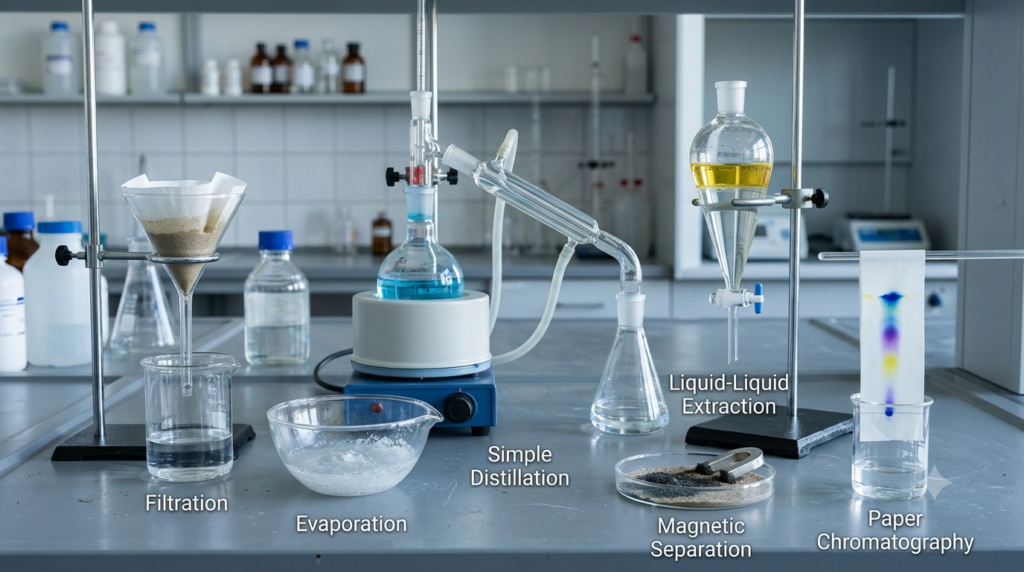
The components of a mixture can often be separated by physical methods because they retain their chemical identities. The best method depends on the properties of the substances and whether the mixture is homogeneous or heterogeneous.
Filtration
Filtration separates an insoluble solid from a fluid by passing the mixture through a filter. The filter allows the fluid to pass through while retaining particles large enough to be trapped.
For example, sand can be separated from water using filter paper. Filtration is also widely used in laboratories and water treatment.
Ordinary filtration cannot separate dissolved salt from saltwater because dissolved ions pass through most standard filters along with the water.
Evaporation
Evaporation can separate a dissolved, non-volatile solid from a liquid. When saltwater is heated or left under suitable conditions, water evaporates and salt may remain behind.
This method is useful when recovering the dissolved solid is more important than collecting the liquid.
Distillation
Distillation separates components using differences in volatility and boiling behavior. The more volatile component vaporizes preferentially and is then condensed into a liquid.
Simple distillation can be used to obtain relatively pure water from saltwater. Fractional distillation is used to separate mixtures of liquids with suitable differences in volatility, such as components of crude oil.
Decantation
Decantation involves carefully pouring a liquid away from a settled solid or from another immiscible liquid layer.
For example, water can be poured off after sand settles to the bottom of a container. The method is simple but may not remove all the fine particles.
Sieving
Sieving separates solid particles based on differences in particle size. A sieve allows smaller particles to pass through while retaining larger ones.
This method is commonly used to separate stones from sand or to sort materials in construction and food processing.
Centrifugation
Centrifugation uses rapid rotation to help separate components with different densities or settling behavior. It can separate suspended particles from liquids more quickly than ordinary settling.
The method is widely used in medical laboratories to separate components of blood samples and in many scientific and industrial processes.
Are Solutions, Colloids, and Suspensions Different?
Solutions, colloids, and suspensions are important categories used to describe how substances are distributed in mixtures. They help explain why some mixtures look uniform while others contain dispersed particles.
Solutions
A solution is a homogeneous mixture in which one or more substances are distributed at the molecular or ionic level within another substance.
For example, saltwater is a solution when the salt is completely dissolved. The dissolved particles are too small to distinguish with an ordinary microscope, and the mixture does not separate by ordinary filtration.
Colloids
A colloid contains particles or droplets dispersed in another substance. These particles are larger than individual molecules but are generally small enough to remain dispersed for long periods.
Milk is a familiar example of a colloid because tiny fat droplets are dispersed throughout a water-based liquid. Fog is another example, consisting of small liquid water droplets dispersed in air.
Colloids can appear uniform to the naked eye, but they are not homogeneous at the microscopic level. They are generally classified as heterogeneous systems in the broader scientific sense.
Suspensions
A suspension contains relatively large particles dispersed in a fluid. The particles may be visible, and many suspensions settle when left undisturbed.
Muddy water is a common example. Its particles can often be removed by filtration or allowed to settle before the clearer liquid is poured away.
These categories show that appearance alone is not always enough to determine whether a mixture is homogeneous or heterogeneous.
How to Identify a Homogeneous or Heterogeneous Mixture
You can use a few simple observations to classify many mixtures.
First, check whether the material looks uniform. If every visible portion appears the same, it may be homogeneous. However, this observation alone is not always conclusive because some heterogeneous mixtures look uniform to the naked eye.
Second, look for separate layers, visible particles, or distinct components. If these are present, the mixture is usually heterogeneous.
Third, consider whether the components are dissolved or merely dispersed. Dissolved salt in water forms a solution, while sand suspended in water forms a heterogeneous mixture.
Finally, remember that the classification depends on the scale of observation. A mixture that appears uniform to the naked eye may contain different microscopic phases. Scientific classification considers the actual structure and distribution of its components, not just its appearance.
Conclusion
Homogeneous and heterogeneous mixtures are two fundamental categories in chemistry that describe how the components of a mixture are distributed. Homogeneous mixtures have a uniform composition and generally appear as a single phase, as seen in saltwater, vinegar, and air. Heterogeneous mixtures have a non-uniform composition and may contain visibly distinct components or multiple phases, as seen in soil, granite, and oil mixed with water. Both types are important in everyday life, scientific research, medicine, and industrial manufacturing. Understanding their characteristics also helps us select appropriate separation methods, such as filtration, evaporation, and distillation. By examining composition, phase structure, and particle distribution, we can identify mixtures more accurately and better understand the materials that surround us.
FAQs
1. What is the main difference between homogeneous and heterogeneous mixtures?
The main difference between homogeneous and heterogeneous mixtures is the uniformity of their composition. A homogeneous mixture has the same composition throughout, meaning its components are evenly distributed. Saltwater, vinegar, and air are common examples. A heterogeneous mixture has a non-uniform composition, so different portions may contain different amounts of its components. Examples include soil, oil mixed with water, and sand mixed with water. Homogeneous mixtures generally appear as a single phase, while heterogeneous mixtures may contain multiple phases. Understanding this difference helps us classify materials and choose suitable methods for separating their components.
2. What are some common examples of homogeneous mixtures?
Common examples of homogeneous mixtures include saltwater, sugar solutions, vinegar, air, and many metal alloys. In saltwater, dissolved salt particles are distributed throughout the water, creating a uniform solution. Sugar behaves similarly when it dissolves completely. Vinegar contains acetic acid dissolved in water, while clean, well-mixed air contains several gases distributed throughout the mixture. Brass is another example because copper and zinc can form a uniform solid solution under suitable conditions. These mixtures may contain different proportions of their components, but they remain homogeneous as long as their composition is uniform within the portion being considered.
3. What are some common examples of heterogeneous mixtures?
Common examples of heterogeneous mixtures include sand mixed with water, oil mixed with water, soil, granite, vegetable salad, and muddy water. In these mixtures, the components are not distributed uniformly throughout the material. For example, sand particles may settle at the bottom of a container, while oil and water form separate layers. Soil contains mineral particles, organic matter, air, water, and other materials in varying proportions. Granite contains different mineral grains that can often be identified visually. Some heterogeneous mixtures contain particles too small to see without special equipment, so a uniform appearance does not always guarantee a homogeneous mixture.
4. Can homogeneous mixtures contain more than one substance?
Yes, homogeneous mixtures contain two or more substances even though they appear uniform. Their components are distributed evenly at the relevant scale, making the mixture look like a single material. For example, saltwater contains both salt and water, while air contains nitrogen, oxygen, and several other gases. These substances retain their chemical identities even after mixing. Unlike a pure compound, a homogeneous mixture does not have a fixed chemical formula or a single required proportion of components. The amounts of its ingredients can change while the mixture remains homogeneous, provided the components continue to form one uniform phase under the given conditions.
5. Can heterogeneous mixtures be separated by physical methods?
Yes, many heterogeneous mixtures can be separated using physical methods because their components retain their chemical identities. The method depends on the physical properties of the substances. Filtration can separate insoluble sand from water, while decantation can remove liquid from settled solids or separate suitable liquid layers. Sieving separates solid particles of different sizes, and centrifugation helps separate components with different settling behavior. A mixture of iron filings and sand can be separated using a magnet because iron is magnetic. These processes do not generally require converting the components into new substances, making physical separation useful in laboratories, industries, and everyday activities.
6. Is saltwater a homogeneous or heterogeneous mixture?
Saltwater is a homogeneous mixture when the salt dissolves completely in the water and forms a uniform solution. The dissolved salt separates into ions that distribute throughout the liquid, so individual salt particles cannot normally be distinguished by looking at the solution. However, if too much salt is added and some remains undissolved at the bottom, the entire contents of the container become a heterogeneous system because both a liquid solution and a separate solid phase are present. Therefore, classification depends on the actual condition of the sample, including how much salt has dissolved and whether any separate phase remains.
7. Is milk a homogeneous or heterogeneous mixture?
Milk may appear homogeneous because it has a uniform white appearance, but ordinary milk is scientifically considered a colloidal system and is heterogeneous at the microscopic level. It contains tiny fat droplets and other dispersed components within a water-based liquid. These droplets are small enough to remain distributed for considerable periods, which makes milk look uniform to the naked eye. Its structure differs from a true solution, in which substances are distributed at the molecular or ionic level. This example demonstrates why appearance alone is not always enough to classify mixtures. Scientists also consider particle size, phase structure, and how components are distributed.
8. What is the difference between a solution, a colloid, and a suspension?
A solution is a homogeneous mixture in which a substance dissolves at the molecular or ionic level, as in saltwater. A colloid contains dispersed particles or droplets that are larger than individual molecules but generally remain distributed for long periods. Milk and fog are common examples. A suspension contains larger particles dispersed in a fluid, and these particles may settle over time. Muddy water is a typical suspension. Solutions generally do not separate through ordinary filtration, whereas suspended particles can often be filtered out. Colloids behave differently because their particles are usually too small for ordinary filtration to remove effectively.
9. Why is air considered a homogeneous mixture?
Air is generally considered a homogeneous mixture because its major gases are distributed uniformly at the ordinary scale under normal, well-mixed conditions. It contains mostly nitrogen and oxygen, along with argon, carbon dioxide, water vapor, and other gases in smaller amounts. These gases mix without forming separate visible layers under ordinary atmospheric conditions. However, air containing smoke, dust, or liquid droplets can form a heterogeneous system because these particles are dispersed rather than dissolved as individual gas molecules. Air composition can also vary with altitude, humidity, and location. Therefore, air is treated as homogeneous in typical conditions, although real atmospheric samples are not always perfectly uniform.
10. Why is it important to understand homogeneous and heterogeneous mixtures?
Understanding homogeneous and heterogeneous mixtures helps us identify materials, explain their properties, and select suitable separation techniques. In everyday life, it helps distinguish dissolved sugar in water from sand suspended in water. In laboratories, scientists use these classifications when preparing solutions, analyzing samples, and separating substances. Industries apply this knowledge in water purification, food production, medicine manufacturing, and metal processing. For example, filtration can remove suspended particles from water, while distillation can separate suitable components of a homogeneous liquid mixture. Learning these concepts also builds a foundation for studying solutions, colloids, suspensions, chemical composition, and other important topics in chemistry.