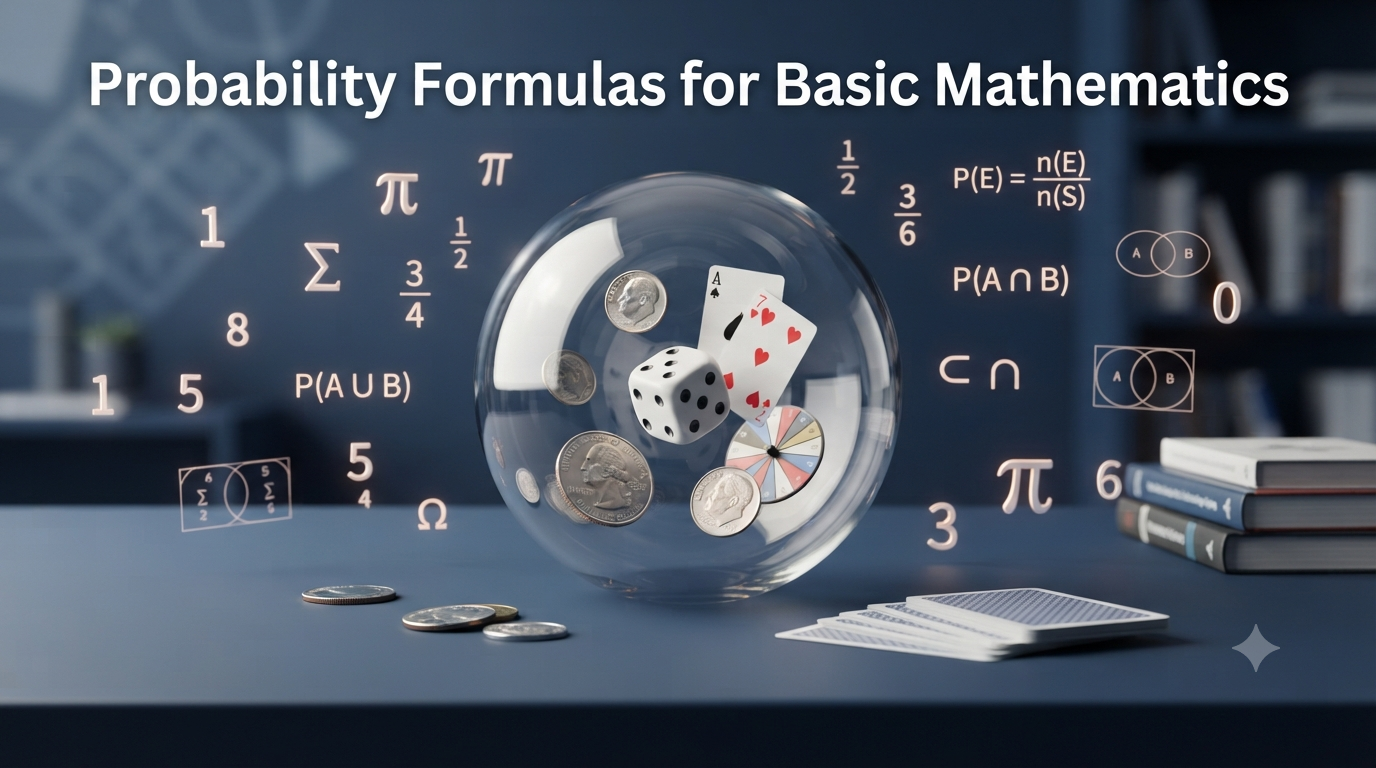
Probability is a branch of mathematics used to measure the chance or likelihood of an event occurring. It helps us understand uncertain situations in a logical and numerical way. From tossing a coin and rolling a die to predicting outcomes in games, surveys, science, and everyday decisions, probability provides a mathematical way to describe uncertainty.
The basic probability formulas are simple once the ideas of outcomes, events, sample spaces, and favorable outcomes are understood. These formulas form the foundation for more advanced topics such as conditional probability, probability distributions, statistics, and probability theory.
In this article, we will learn the important probability formulas used in basic mathematics, understand what each formula means, and see how these formulas can be applied to simple problems.
What Is Probability?
Probability is a numerical measure of how likely an event is to happen. It is generally represented by the letter P.
The probability of an event lies between 0 and 1:
0 ≤ P(E) ≤ 1
A probability of 0 means that the event is impossible, while a probability of 1 means that the event is certain to occur.
For example, when a standard die is rolled, getting a number from 1 to 6 is certain. Therefore, the probability is 1. Getting a 7 on the same die is impossible, so its probability is 0.
Important Terms in Probability
Before learning probability formulas, it is important to understand a few basic terms.
Experiment
An experiment is an action or process that produces an outcome.
For example:
Tossing a coin
Rolling a die
Drawing a card
Selecting a ball from a box
Outcome
An outcome is a possible result of an experiment.
When a coin is tossed, the possible outcomes are:
Head (H) and Tail (T)
When a die is rolled, the possible outcomes are:
1, 2, 3, 4, 5, 6
Sample Space
The sample space is the complete set of all possible outcomes of an experiment. It is usually represented by S.
For a coin toss:
S = {H, T}
For a single die roll:
S = {1, 2, 3, 4, 5, 6}
Event
An event is a particular outcome or group of outcomes that we are interested in.
For example, when a die is rolled, getting an even number is an event.
E = {2, 4, 6}
Favorable Outcomes
Favorable outcomes are the outcomes that satisfy the condition of a particular event.
For example, if we want an even number when rolling a die, the favorable outcomes are 2, 4, and 6.
There are therefore 3 favorable outcomes.
Basic Probability Formula
The most important formula in basic probability is:
P(E) = Number of favorable outcomes / Total number of equally likely outcomes
It can also be written as:
P(E) = n(E) / n(S)
where:
P(E) = probability of event E
n(E) = number of favorable outcomes
n(S) = total number of outcomes in the sample space
This formula is used when all possible outcomes are equally likely.
Example
A die is rolled once. What is the probability of getting a 4?
There is one favorable outcome: 4.
There are six possible outcomes:
S = {1, 2, 3, 4, 5, 6}
Therefore:
P(4) = 1/6
So, the probability of getting a 4 is 1/6.
Probability of an Impossible Event
An impossible event is an event that cannot occur.
The formula is:
P(E) = 0
For example, when a standard six-sided die is rolled, the probability of getting 8 is:
P(8) = 0
because 8 is not a possible outcome.
Probability of a Certain Event
A certain event is an event that must occur.
The formula is:
P(E) = 1
For example, when a standard die is rolled, getting a number less than 7 is certain.
Therefore:
P(number less than 7) = 1
Probability of the Complement of an Event
The complement of an event means that the event does not occur. The complement of event E is commonly represented by E′, Eᶜ, or sometimes not E.
The formula is:
P(E′) = 1 − P(E)
This is one of the most useful probability formulas.
Example
The probability of getting a head when tossing a fair coin is:
P(H) = 1/2
Therefore, the probability of not getting a head is:
P(H′) = 1 − 1/2 = 1/2
So, the probability of getting a tail is 1/2.
Addition Rule of Probability
The addition rule is used when we want to find the probability of event A or B occurring.
For two events A and B, the general formula is:
P(A ∪ B) = P(A) + P(B) − P(A ∩ B)
Here:
A ∪ B means A or B or both
A ∩ B means both A and B
The intersection is subtracted because outcomes common to both events would otherwise be counted twice.
Example
A die is rolled once. Find the probability of getting an even number or a number greater than 4.
Let:
A = {2, 4, 6}
and
B = {5, 6}
The common outcome is:
A ∩ B = {6}
Therefore:
P(A) = 3/6
P(B) = 2/6
P(A ∩ B) = 1/6
Using the addition rule:
P(A ∪ B) = 3/6 + 2/6 − 1/6
P(A ∪ B) = 4/6 = 2/3
Therefore, the probability is 2/3.
Addition Rule for Mutually Exclusive Events
Two events are mutually exclusive when they cannot occur at the same time.
For mutually exclusive events:
P(A ∩ B) = 0
Therefore, the addition formula becomes:
P(A ∪ B) = P(A) + P(B)
Example
When a die is rolled, getting a 2 and getting a 5 are mutually exclusive because one roll cannot produce both numbers.
Therefore:
P(2 or 5) = P(2) + P(5)
= 1/6 + 1/6
= 2/6 = 1/3
Multiplication Rule of Probability
The multiplication rule is used to find the probability that two events occur together.
For general events:
P(A ∩ B) = P(A) × P(B|A)
where P(B|A) means the probability of B occurring given that A has already occurred.
For independent events, the formula becomes simpler:
P(A ∩ B) = P(A) × P(B)
Example
A coin is tossed twice. What is the probability of getting heads on both tosses?
The probability of getting heads on the first toss is:
P(H) = 1/2
The probability of getting heads on the second toss is also:
P(H) = 1/2
The tosses are independent, so:
P(H and H) = 1/2 × 1/2
= 1/4
Therefore, the probability of getting two heads is 1/4.
Conditional Probability Formula
Conditional probability measures the probability of one event occurring when another event is already known to have occurred.
The formula is:
P(A|B) = P(A ∩ B) / P(B)
where P(B) ≠ 0.
Here, P(A|B) is read as “the probability of A given B.”
Example
Suppose a card is selected from a standard deck, and we know that the selected card is a king. What is the probability that it is the king of hearts?
There are four kings in a standard deck, and only one of them is the king of hearts.
Therefore:
P(king of hearts | king) = 1/4
Conditional probability is especially useful when additional information changes the set of possible outcomes.
Probability of Independent Events
Two events are independent if the occurrence of one event does not affect the probability of the other event.
For independent events A and B:
P(A ∩ B) = P(A) × P(B)
For example, tossing a coin and rolling a die are independent experiments.
The result of the coin toss does not change the result of the die roll.
If we want the probability of getting a head and rolling a 6:
P(H and 6) = 1/2 × 1/6
= 1/12
Probability of Dependent Events
Two events are dependent when the occurrence of one event affects the probability of the other.
The formula is:
P(A ∩ B) = P(A) × P(B|A)
A common example is drawing cards from a deck without replacing the first card.
For instance, if two cards are drawn without replacement, the probability of drawing a particular type of second card may change because the first card has already been removed.
Experimental Probability
Probability can also be estimated from actual observations or experiments. This is called experimental probability.
The formula is:
Experimental Probability = Number of times the event occurs / Total number of trials
Example
Suppose a coin is tossed 100 times and heads appear 54 times.
Then:
Experimental Probability of heads = 54/100
= 0.54
The experimental probability may not be exactly equal to the theoretical probability because actual results can vary.
Theoretical Probability
Theoretical probability is calculated using mathematical reasoning rather than actual experimental results.
The basic formula is:
Theoretical Probability = Favorable outcomes / Total equally likely outcomes
For a fair coin:
P(H) = 1/2
For a standard die:
P(6) = 1/6
Theoretical probability provides the expected probability under the stated assumptions.
Probability of At Least One Event
Sometimes we need to find the probability that an event occurs at least once.
The complement rule is useful for this situation.
The general idea is:
P(at least one) = 1 − P(none)
Example
A coin is tossed twice. Find the probability of getting at least one head.
First find the probability of getting no heads.
The only outcome with no heads is:
TT
Therefore:
P(no heads) = 1/4
So:
P(at least one head) = 1 − 1/4
= 3/4
Thus, the probability of getting at least one head is 3/4.
Probability of Exactly One Event
For simple independent trials, the probability of exactly one occurrence can be calculated by considering all possible arrangements.
For example, when a coin is tossed twice, the outcomes are:
HH, HT, TH, TT
Exactly one head occurs in:
HT and TH
There are 2 favorable outcomes out of 4 possible outcomes.
Therefore:
P(exactly one head) = 2/4 = 1/2
For larger problems, combinations and the binomial probability formula can be used.
Binomial Probability Formula
The binomial probability formula is used when an experiment has a fixed number of independent trials, with two possible outcomes for each trial.
The formula is:
P(X = r) = C(n, r) pʳ (1 − p)ⁿ⁻ʳ
where:
n = total number of trials
r = required number of successes
p = probability of success in one trial
1 − p = probability of failure
C(n, r) = number of ways to choose r successes from n trials
This formula is generally introduced after the basic probability rules and counting techniques are understood.
Odds and Probability
Probability and odds are related but are not the same thing.
If an event has a favorable outcomes and b unfavorable outcomes, the odds in favor of the event are:
Odds in favor = Favorable outcomes : Unfavorable outcomes
The probability is:
P(E) = Favorable outcomes / Total outcomes
Since:
Total outcomes = Favorable outcomes + Unfavorable outcomes
we can also write:
P(E) = Favorable outcomes / (Favorable outcomes + Unfavorable outcomes)
For example, if a bag contains 3 red balls and 2 blue balls, the probability of selecting a red ball is:
P(red) = 3/5
The odds in favor of selecting a red ball are:
3 : 2
Important Probability Formulas at a Glance
The following formulas cover many of the basic probability calculations used in mathematics:
Basic probability:
P(E) = n(E) / n(S)
Impossible event:
P(E) = 0
Certain event:
P(E) = 1
Complement rule:
P(E′) = 1 − P(E)
General addition rule:
P(A ∪ B) = P(A) + P(B) − P(A ∩ B)
Addition rule for mutually exclusive events:
P(A ∪ B) = P(A) + P(B)
General multiplication rule:
P(A ∩ B) = P(A) × P(B|A)
Multiplication rule for independent events:
P(A ∩ B) = P(A) × P(B)
Conditional probability:
P(A|B) = P(A ∩ B) / P(B)
Experimental probability:
Experimental Probability = Number of times event occurs / Total number of trials
At least one event:
P(at least one) = 1 − P(none)
Binomial probability:
P(X = r) = C(n, r) pʳ (1 − p)ⁿ⁻ʳ
How to Solve Basic Probability Problems
A simple method can make probability problems easier to solve.
Step 1: Identify the experiment
Determine what is being done, such as tossing a coin, rolling a die, or selecting an object.
Step 2: Find the sample space
List or determine all possible outcomes.
Step 3: Identify the event
Understand exactly what the question is asking for.
Step 4: Count favorable outcomes
Find the outcomes that satisfy the required condition.
Step 5: Select the correct formula
For equally likely outcomes, start with:
P(E) = favorable outcomes / total outcomes
If the question involves “or,” “and,” “not,” or “given,” determine whether the addition, multiplication, complement, or conditional probability rule is appropriate.
Step 6: Simplify the answer
Express the probability as a fraction, decimal, or percentage when appropriate.
Common Mistakes in Probability
Students and beginners often make a few common mistakes when solving probability problems.
One common mistake is using the wrong total number of outcomes. The denominator must represent the relevant sample space for the experiment.
Another mistake is confusing “and” with “or.” The word and often indicates that both events need to occur, while or generally indicates that at least one of the events occurs.
It is also important to distinguish between independent and dependent events. If one event changes the probability of another event, the events should not automatically be treated as independent.
Finally, remember that probability must always lie between 0 and 1. If a calculation produces a negative probability or a value greater than 1, there is an error in the calculation or interpretation.
Conclusion
Probability formulas provide a simple mathematical framework for understanding uncertain events. The basic formula, P(E) = n(E) / n(S), is the starting point for most elementary probability problems. From this foundation, the complement rule, addition rule, multiplication rule, conditional probability, and experimental probability help solve increasingly varied situations.
Understanding what the sample space and event represent is just as important as remembering the formulas. Once these concepts are clear, probability becomes much easier to apply to coins, dice, cards, objects, experiments, and everyday situations. These basic formulas also provide the foundation for more advanced mathematical topics involving probability and statistics.
FAQs
1. What is the basic formula for probability?
The basic probability formula is P(E) = Number of favorable outcomes / Total number of equally likely outcomes. Here, P(E) represents the probability of event E. Favorable outcomes are the outcomes that satisfy the condition of the event, while total outcomes represent all possible outcomes in the sample space. For example, when a standard die is rolled, there are six possible outcomes. If we want to find the probability of getting an even number, the favorable outcomes are 2, 4, and 6. Therefore, the probability is 3/6, which simplifies to 1/2. This formula is the foundation of elementary probability.
2. What is the range of probability?
The probability of any event always lies between 0 and 1, including both values. It can be written as 0 ≤ P(E) ≤ 1. A probability of 0 means the event is impossible, while a probability of 1 means the event is certain to happen. Values between 0 and 1 indicate different levels of likelihood. For example, the probability of getting a 7 when rolling a standard six-sided die is 0 because 7 is impossible. The probability of getting a number from 1 to 6 is 1 because the result must be one of those numbers.
3. What is the formula for the complement of an event?
The complement rule is used to find the probability that an event does not occur. The formula is P(E′) = 1 − P(E). Here, E′ represents the complement of event E. For example, suppose the probability of getting a head when tossing a fair coin is 1/2. The probability of not getting a head is therefore 1 − 1/2 = 1/2. The complement rule is especially useful when calculating the probability of an event that is difficult to count directly. It is also commonly used for problems involving phrases such as “not,” “none,” or “at least one.”
4. What is the addition rule of probability?
The addition rule is used when finding the probability that event A or event B occurs. For two general events, the formula is P(A ∪ B) = P(A) + P(B) − P(A ∩ B). The intersection term is subtracted because outcomes common to both events would otherwise be counted twice. If the two events are mutually exclusive, they cannot occur together, so their intersection is zero. In that case, the formula becomes P(A ∪ B) = P(A) + P(B). The addition rule is useful for problems involving alternatives, such as finding the probability of getting an even number or a number greater than four.
5. What is the multiplication rule of probability?
The multiplication rule is used to calculate the probability that two events occur together. For general events, the formula is P(A ∩ B) = P(A) × P(B|A). The expression P(B|A) represents the probability of B occurring when A has already occurred. When two events are independent, the formula becomes P(A ∩ B) = P(A) × P(B). For example, the probability of getting heads on two consecutive tosses of a fair coin is 1/2 × 1/2 = 1/4. The multiplication rule is particularly important when solving probability problems involving multiple events or repeated experiments.
6. What is conditional probability?
Conditional probability is the probability of an event occurring when another event is already known to have occurred. It is represented by P(A|B) and calculated using the formula P(A|B) = P(A ∩ B) / P(B), provided P(B) is not zero. The additional information provided by event B can change the possible outcomes and therefore change the probability of A. For example, if a card is known to be a king from a standard deck, the probability that it is the king of hearts is 1/4. Conditional probability is an important concept for understanding dependent events and more advanced probability.
7. What is the difference between theoretical and experimental probability?
Theoretical probability is calculated using mathematical reasoning and the possible outcomes of an experiment. Its basic formula is Favorable outcomes / Total equally likely outcomes. Experimental probability, on the other hand, is based on actual observations from repeated trials. Its formula is Number of times the event occurs / Total number of trials. For example, the theoretical probability of getting heads from a fair coin is 1/2. If the coin is tossed 100 times and heads appear 54 times, the experimental probability is 54/100, or 0.54. Experimental results can differ from theoretical probability because actual outcomes vary from trial to trial.
8. What are independent events in probability?
Independent events are events where the occurrence of one event does not affect the probability of the other event. For independent events A and B, the multiplication rule is P(A ∩ B) = P(A) × P(B). For example, tossing a coin and rolling a die are independent experiments because the result of the coin toss does not change the outcome of the die roll. If we want the probability of getting heads and rolling a 6, we multiply their individual probabilities: 1/2 × 1/6 = 1/12. Recognizing independent events helps determine which probability formula should be used.
9. What are mutually exclusive events?
Mutually exclusive events are events that cannot occur at the same time in a single experiment. For mutually exclusive events A and B, P(A ∩ B) = 0. Therefore, their addition formula becomes P(A ∪ B) = P(A) + P(B). For example, when a standard die is rolled once, getting a 2 and getting a 5 are mutually exclusive because the die cannot show both numbers in one roll. The probability of getting either 2 or 5 is therefore 1/6 + 1/6 = 1/3. Understanding mutually exclusive events helps prevent double-counting when applying the addition rule.
10. How can I solve basic probability problems easily?
To solve a basic probability problem, first identify the experiment and determine its possible outcomes. Next, identify the event described in the question and count its favorable outcomes. If the outcomes are equally likely, use P(E) = favorable outcomes / total outcomes. For questions involving “not,” consider the complement rule. For “or,” consider the addition rule, while “and” may require the multiplication rule. Also determine whether events are independent, dependent, or mutually exclusive before choosing a formula. Finally, simplify the answer and check that the probability is between 0 and 1. With practice, these steps make basic probability problems much easier.