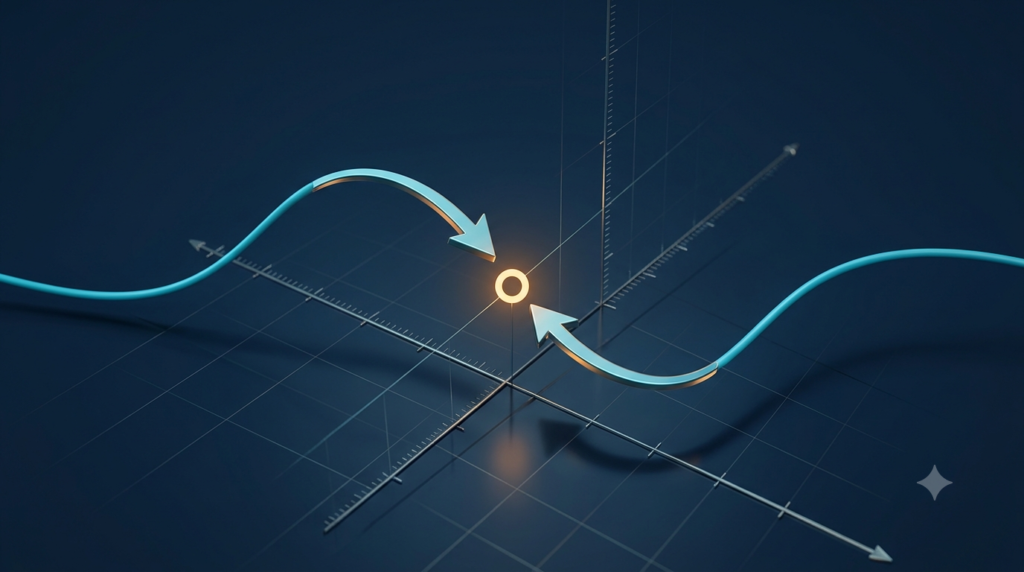
In calculus, a limit is a fundamental concept that helps us understand how a function behaves as its input approaches a particular value. Sometimes, the value of a function at a point does not fully explain what happens around that point. A function may approach a specific number even when it is not defined at that point or when its actual value is different from the number it approaches. The concept of a limit helps us study these situations.
A limit at a point is one of the first important ideas students learn when studying calculus. It provides the foundation for understanding continuity, derivatives, and integrals. Limits are also useful in physics, engineering, economics, and other fields where quantities change continuously. By learning how limits work, we can understand the behavior of mathematical functions and solve problems involving changing values more accurately.
What Is a Limit at a Point?
A limit at a point is the value that a function approaches when its input gets closer and closer to a particular number.
In mathematics, a function is often represented by f(x). Here, x is the input variable, and f(x) represents the corresponding output. When x approaches a particular value, the function’s output may approach another value. This output is called the limit of the function at that point.
For example, consider the function:
f(x) = x + 2
Suppose x approaches 3. As the value of x gets closer to 3, the output of the function gets closer to 5.
We can check this using different values of x:
When x = 2.9, f(x) = 4.9.
When x = 2.99, f(x) = 4.99.
When x = 2.999, f(x) = 4.999.
When x = 3.001, f(x) = 5.001.
When x = 3.01, f(x) = 5.01.
These values show that the output approaches 5 as x approaches 3.
The limit is written as:
limₓ→3 (x + 2) = 5
This expression means that the function x + 2 approaches 5 as x approaches 3.
The important point is that a limit describes what happens near a particular input value. It does not necessarily depend on the function’s actual value at that point.
Understanding the Notation of a Limit
Mathematicians use a special notation to represent limits. Learning this notation makes it easier to read and solve calculus problems.
The general notation is:
limₓ→a f(x) = L
Each part of this expression has a specific meaning.
lim represents the limit.
x → a means that x approaches the value a.
f(x) represents the function being studied.
L represents the value that the function approaches.
For example:
limₓ→2 (x²) = 4
This means that the function x² approaches 4 as x approaches 2.
The arrow indicates that x gets closer to 2. It does not mean that x must equal 2 throughout the process.
This distinction is important because a limit can exist even when the function is undefined at the point being approached. It is the behavior of the function near that point that matters.
How Does a Limit Work?
A limit can be understood by examining how the output of a function changes as its input gets closer to a particular number.
Consider the function:
f(x) = 2x + 1
Suppose we want to determine the limit as x approaches 4.
When x is close to 4, the output is close to 9. This can be seen in the following table.
| Value of x | Value of f(x) |
|---|---|
| 3.9 | 8.8 |
| 3.99 | 8.98 |
| 3.999 | 8.998 |
| 4.001 | 9.002 |
| 4.01 | 9.02 |
| 4.1 | 9.2 |
When x approaches 4 from values smaller than 4, the function output approaches 9. When x approaches 4 from values greater than 4, the output also approaches 9.
Therefore:
limₓ→4 (2x + 1) = 9
This is a simple example of how numerical values can help us understand limits.
A table is useful for observing patterns, but it may not always be enough to prove that a limit exists. Some functions behave differently near a point, so additional algebraic or graphical analysis may be necessary.
Left-Hand and Right-Hand Limits
When studying a limit at a point, it is important to examine the function from both directions.
A value can be approached from the left or from the right. These are called the left-hand limit and the right-hand limit.
Left-Hand Limit
A left-hand limit describes the value that a function approaches when x gets closer to a particular number from smaller values.
For example, when x approaches 3 from the left, its values might be 2.9, 2.99, and 2.999.
The notation is:
limₓ→a⁻ f(x)
The minus sign indicates that x approaches a from the left.
For the function f(x) = x + 2, the left-hand limit as x approaches 3 is 5.
Right-Hand Limit
A right-hand limit describes the value that a function approaches when x gets closer to a particular number from larger values.
For example, when x approaches 3 from the right, its values might be 3.1, 3.01, and 3.001.
The notation is:
limₓ→a⁺ f(x)
The plus sign indicates that x approaches a from the right.
For the function f(x) = x + 2, the right-hand limit as x approaches 3 is also 5.
When Does a Two-Sided Limit Exist?
A two-sided limit exists when the left-hand and right-hand limits both exist and approach the same value.
The condition can be written as:
Left-hand limit = Right-hand limit = L
For example, the function f(x) = x + 2 approaches 5 from both directions when x approaches 3. Therefore, its two-sided limit exists and equals 5.
However, imagine a function that approaches 2 from the left and 6 from the right. Since the two sides approach different values, the two-sided limit does not exist.
Checking both directions is particularly useful when working with graphs and piecewise-defined functions.
Does a Limit Have to Equal the Function Value?
One of the most important ideas in calculus is that a limit does not always equal the actual value of a function at a point.
The limit describes the behavior of the function near the point. The function value describes the output when the input equals that point.
These values may be equal, different, or the function may be undefined at the point.
When the Limit and Function Value Are Equal
Consider the function:
f(x) = x²
As x approaches 2, the function approaches 4.
limₓ→2 x² = 4
The actual function value is also:
f(2) = 4
In this example, the limit equals the function value.
When the Function Is Undefined at the Point
Consider the function:
f(x) = (x² − 4) ÷ (x − 2)
If we substitute x = 2 directly, the numerator and denominator both become zero. The original expression is therefore undefined at that point.
However, the numerator can be factorized:
x² − 4 = (x − 2)(x + 2)
For x ≠ 2, the expression simplifies to:
f(x) = x + 2
As x approaches 2, the simplified expression approaches 4.
Therefore:
limₓ→2 [(x² − 4) ÷ (x − 2)] = 4
Although the original function is undefined at x = 2, its limit exists.
This example shows why a limit is different from direct substitution. The behavior near a point can still be understood even when the original expression has no value at that point.
When the Function Value Is Different from the Limit
Suppose a function follows the rule f(x) = x + 2 near x = 3, but its value is specifically defined as 10 when x = 3.
The function values near 3 still approach 5. Therefore:
limₓ→3 f(x) = 5
However:
f(3) = 10
The limit and function value are different.
Changing the value of a function at a single point does not necessarily change its limit at that point. The limit depends on how the function behaves nearby.
How to Find a Limit at a Point
Several methods can be used to find limits. The best method depends on the expression and the behavior of the function.
Method 1: Direct Substitution
Direct substitution is the simplest way to evaluate many limits.
Consider the function:
f(x) = 3x + 4
Find the limit as x approaches 2.
Substitute x = 2 into the function:
f(2) = 3 × 2 + 4
f(2) = 6 + 4 = 10
Therefore:
limₓ→2 (3x + 4) = 10
Direct substitution works well for polynomial functions and many other functions when substitution produces a defined result.
Method 2: Factorization
Factorization is useful when direct substitution produces an indeterminate form such as zero divided by zero.
Consider the expression:
f(x) = (x² − 9) ÷ (x − 3)
We want to find the limit as x approaches 3.
Direct substitution produces zero divided by zero. This does not tell us the limit’s value.
First, factorize the numerator:
x² − 9 = (x − 3)(x + 3)
The expression becomes:
f(x) = [(x − 3)(x + 3)] ÷ (x − 3)
For x ≠ 3, the common factor can be cancelled:
f(x) = x + 3
Now substitute x = 3 into the simplified expression:
3 + 3 = 6
Therefore:
limₓ→3 [(x² − 9) ÷ (x − 3)] = 6
Factorization makes it possible to determine the limit even though direct substitution into the original expression does not work.
Method 3: Using a Table of Values
A table of values helps estimate a limit by examining inputs close to the point.
Choose several values smaller than the target and several values greater than it. Calculate the corresponding function outputs and look for a pattern.
If the outputs approach the same number from both sides, that number may be the limit.
This method is especially helpful for beginners because it provides a clear numerical picture of the function’s behavior.
However, a finite table cannot always establish a limit conclusively. A function may behave unexpectedly between the values selected, so other methods may be needed.
Method 4: Using a Graph
A graph provides a visual representation of a function’s behavior near a point.
To estimate a limit from a graph, locate the input value being approached and follow the curve from the left and the right. Observe the y-value that the curve approaches.
If both sides approach the same y-value, the two-sided limit exists. If they approach different values, the limit does not exist.
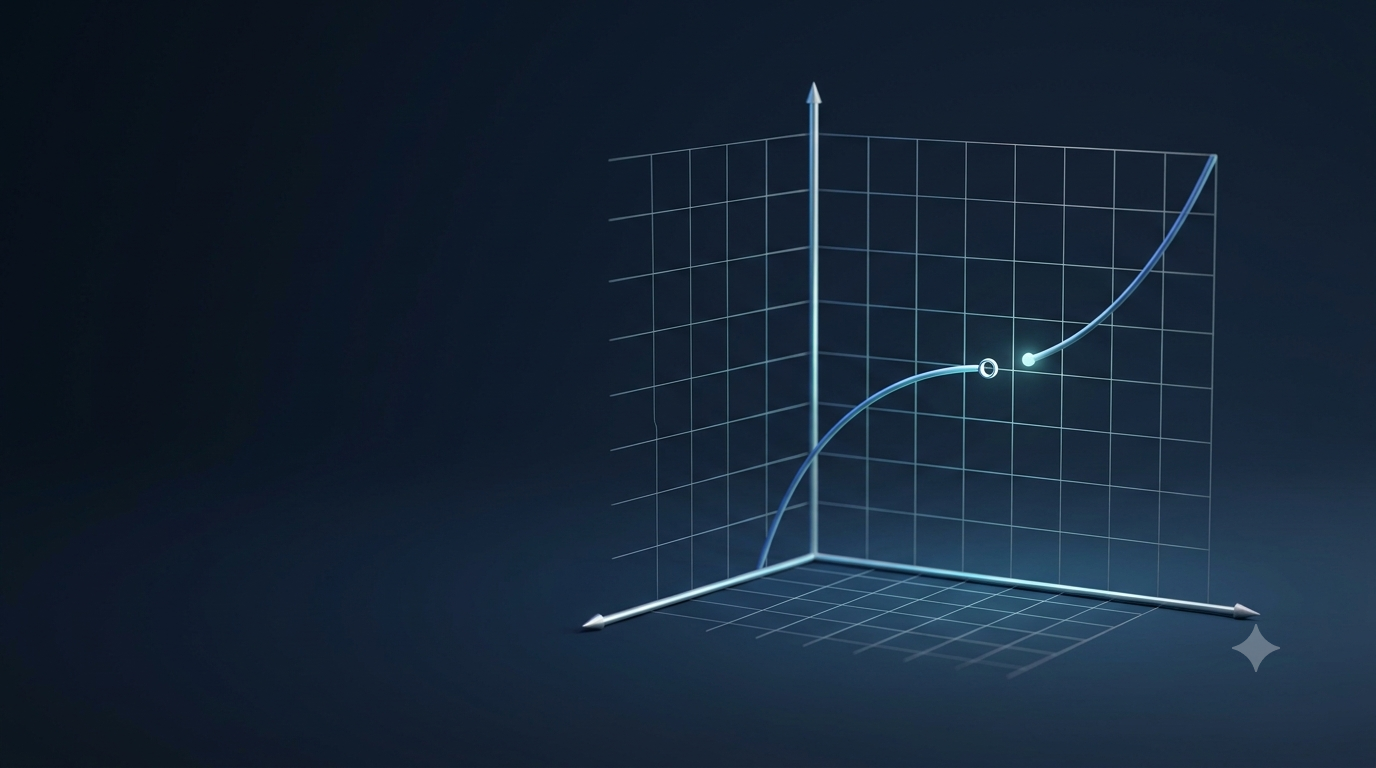
An open circle on a graph may indicate a missing function value at a point. A filled circle may indicate the actual value of the function. These points can be different even when the curve approaches a clear limit.
Graphs are useful for understanding holes, jumps, and other situations where a function’s behavior is not immediately obvious from its formula.
The Relationship Between Limits and Continuity
Limits are closely connected to continuity.
A function is continuous at a point when it has a defined value there, its limit exists, and that limit equals the function value.
For a function to be continuous at x = a, three conditions must be satisfied:
f(a) must be defined.
The limit as x approaches a must exist.
The limit must equal f(a).
The main condition is expressed as:
limₓ→a f(x) = f(a)
For example, the function f(x) = x² is continuous at x = 2 because its limit and actual function value are both 4.
In contrast, a function with a hole may have a limit at a point but fail to be continuous there. This happens when the function is undefined at that point or its actual value differs from the limit.
Understanding this relationship helps us recognize and explain discontinuities in mathematical graphs.
Why Are Limits at a Point Important?
Limits are essential because they allow us to study functions and changing quantities with precision.
Understanding Derivatives
A derivative describes the instantaneous rate of change of a function. It can represent the velocity of a moving object at a particular moment or the rate at which a quantity changes.
The derivative at a point is defined using a limit:
f′(a) = limₕ→0 [f(a + h) − f(a)] ÷ h
Here, h represents a change in the input. As h approaches zero, the expression describes the instantaneous rate of change at the point.
This is one of the most important applications of limits in calculus.
Studying Continuity
Limits help determine whether a function behaves continuously near a point. They can reveal holes, jumps, and other discontinuities.
This is useful when analyzing equations, scientific models, and graphs that represent changing quantities.
Understanding Integrals
Limits are also important in integration. A definite integral can be understood as the accumulated effect of many small quantities, such as the area under a curve.
By examining what happens as these small quantities become increasingly fine, calculus provides a method for calculating areas and accumulated totals.
Applications in Science and Engineering
Limits are used in physics, engineering, economics, and many other fields.
Physicists use calculus to analyze motion and changing physical quantities. Engineers use mathematical models to study how systems respond to changing conditions. Economists use derivatives to examine marginal cost and other rates of change.
Limits provide the mathematical foundation for many of these calculations.
Common Mistakes When Learning Limits
Beginners often make several mistakes when studying limits.
Assuming that the limit must equal the function value: A limit describes behavior near a point, so it may differ from the actual function value.
Treating zero divided by zero as zero: This is an indeterminate form. Additional steps are needed to determine the limit.
Checking only one direction: A two-sided limit requires the left-hand and right-hand limits to exist and be equal.
Assuming that the function must reach the limit: A function can approach a value without taking that value at the point.
Using direct substitution in every problem: Direct substitution works in many cases, but factorization or other techniques may be necessary when the expression is indeterminate.
Avoiding these mistakes makes it easier to solve limit problems accurately and understand more advanced calculus concepts.
Conclusion
A limit at a point describes the value that a function approaches as its input gets closer to a particular number. It focuses on the behavior of a function near that point, so the limit can exist even when the function is undefined there or has a different value at that point. Limits can be evaluated using direct substitution, factorization, tables of values, and graphs. Comparing left-hand and right-hand limits helps determine whether a two-sided limit exists. This concept forms the foundation for continuity, derivatives, and integrals, making it one of the most important topics in calculus. By understanding the meaning of limits and practicing different examples, beginners can develop the skills needed to study more advanced mathematical ideas.
FAQs
1. What is a limit at a point?
A limit at a point is the value that a function approaches as its input gets closer to a particular number. It helps us understand the behavior of a function near that point, even if the function is not defined there. For example, when x approaches 2, the function f(x) = x + 3 approaches 5. Therefore, the limit is 5. Limits are fundamental to calculus because they help explain continuity, instantaneous rates of change, derivatives, and integrals.
2. Why are limits important in calculus?
Limits are important because they provide the foundation for several major concepts in calculus. They help mathematicians study how functions behave near particular points and determine whether functions are continuous. Limits are also used to define derivatives, which measure instantaneous rates of change, and integrals, which calculate accumulated quantities such as areas under curves. In science and engineering, limits help analyze motion, changing temperatures, and other measurable quantities. Understanding limits makes it easier to learn advanced calculus topics and apply mathematical ideas to real-world problems.
3. How is a limit at a point written mathematically?
A limit at a point is commonly written as limₓ→a f(x) = L. In this notation, x approaches the number a, f(x) represents the function, and L is the value that the function approaches. For example, limₓ→2 (x + 3) = 5 means that the function x + 3 approaches 5 as x approaches 2. The notation does not require the function to equal 5 at every nearby input. It describes the behavior of the function as the input gets closer to the specified number.
4. Can a limit exist when a function is undefined at a point?
Yes, a limit can exist even when a function is undefined at a particular point. This happens when the function approaches the same finite value from both sides of that point. For example, consider f(x) = (x² − 4) ÷ (x − 2). The original expression is undefined at x = 2 because its denominator becomes zero. However, factorization simplifies the expression to x + 2 for x ≠ 2. As x approaches 2, the function approaches 4. Therefore, the limit exists and equals 4.
5. What is the difference between a limit and a function value?
A limit describes the value that a function approaches near a particular input, while a function value gives the actual output at that input. These values can be equal or different. For example, a function may approach 5 as x approaches 3, even if its assigned value at x = 3 is 10. In that situation, the limit is 5, but the function value is 10. A function may also be undefined at the point while its limit still exists. This distinction is essential for understanding continuity and discontinuities.
6. What are left-hand and right-hand limits?
A left-hand limit describes the value that a function approaches when the input comes toward a point from smaller values. A right-hand limit describes the value approached from larger values. Both directions are important when determining whether a two-sided limit exists. If the left-hand and right-hand limits approach the same value, the two-sided limit exists and equals that value. If they approach different values, the two-sided limit does not exist. These concepts are especially useful when analyzing piecewise functions, graphs with jumps, and functions that behave differently on either side of a point.
7. How can you calculate a limit at a point?
A limit can be calculated using several methods, depending on the function. Direct substitution is often the simplest approach when replacing the variable with the target value produces a defined result. If substitution produces an indeterminate form such as zero divided by zero, factorization or algebraic simplification may help. Numerical tables and graphs can also provide useful estimates of a limit. For example, to find the limit of x² as x approaches 3, direct substitution gives 3² = 9. Therefore, the limit is 9.
8. What does zero divided by zero mean when finding a limit?
Zero divided by zero is called an indeterminate form. It does not mean that the limit equals zero, nor does it automatically mean that the limit does not exist. Instead, it indicates that direct substitution is insufficient to determine the answer. Additional methods, such as factorization, simplification, or other limit techniques, may be required. For example, the expression (x² − 9) ÷ (x − 3) produces zero divided by zero when x = 3. Factorizing and simplifying the expression gives x + 3 for x ≠ 3, so the limit as x approaches 3 is 6.
9. What is the relationship between limits and continuity?
Limits help determine whether a function is continuous at a particular point. A function is continuous at x = a when its value is defined at that point, its limit exists, and the limit equals the function value. This condition can be written as limₓ→a f(x) = f(a). If the limit exists but the function is undefined at the point, the function is not continuous there. Similarly, if the function value differs from the limit, continuity fails. Therefore, understanding limits is essential for identifying holes, jumps, and other discontinuities in mathematical functions.
10. Where are limits used in real life?
Limits are used in many scientific, technical, and mathematical applications. In physics, they help define instantaneous velocity and acceleration. In engineering, limits support the analysis of changing systems and mathematical models. In economics, calculus uses limits to study marginal cost and other rates of change. Limits also form the basis of derivatives and integrals, which are widely applied in science, statistics, and optimization. Although the concept may initially seem abstract, it provides a precise way to describe how quantities behave as they approach specific values. This makes limits an essential tool in advanced mathematics and practical problem-solving.