Measurement is an essential part of science and everyday life. We measure the length of a table, the temperature of our bodies, the weight of vegetables, the time taken to complete a task, and the amount of liquid in a container. These measurements help us understand the world, compare different quantities, and make accurate decisions. However, measuring something correctly requires more than observation alone. We need suitable instruments designed to measure specific physical quantities. These devices are known as measurement instruments.
Measurement instruments are used in science laboratories, hospitals, factories, construction sites, schools, research centres, and homes. Different instruments measure different quantities, such as length, mass, temperature, time, force, pressure, and electric current. Understanding how these instruments work and how to use them properly helps us obtain reliable results. In this article, we will explore the meaning of measurement instruments, their types, their uses, and the factors that affect measurement accuracy.
What Are Measurement Instruments?
Measurement instruments are devices or tools used to determine the value or magnitude of a physical quantity. They help us express quantities in measurable terms rather than relying only on estimates or visual observations.
For example, a ruler measures length, a thermometer measures temperature, a stopwatch measures time intervals, and a weighing scale measures mass or weight, depending on its design and calibration.
Every measurement involves comparing an unknown quantity with an accepted unit or reference. When we measure the length of a book using a ruler, we compare its length with the scale marked in centimetres or millimetres. The instrument helps us determine a numerical value that represents the measured quantity.
Measurement instruments differ in their construction, working principles, measuring ranges, and levels of precision. Some are simple mechanical devices, while others use electronic sensors, digital displays, or computer-based systems.
Their main purpose is to make measurements more systematic, consistent, and useful for practical applications.
Why Are Measurement Instruments Important?
Measurement instruments are important because accurate measurements support scientific investigations, engineering work, manufacturing, healthcare, and everyday activities.
1. They Improve Measurement Accuracy
Human observation alone cannot provide sufficiently accurate results for many tasks. A person may estimate the temperature of water by touching a container, but a thermometer provides a numerical temperature reading.
Similarly, measuring a small object with a ruler is generally more reliable than estimating its length by sight.
2. They Support Scientific Experiments
Scientists use measurement instruments to collect numerical data during experiments. These measurements help them test hypotheses, identify patterns, compare results, and develop explanations.
For example, a student investigating how temperature affects the dissolving of sugar can use a thermometer to record the water temperature and a stopwatch to measure the time required for the sugar to dissolve.
3. They Help Maintain Quality
Industries use instruments to check whether products meet specified dimensions, weights, temperatures, and other requirements.
For example, a manufacturer may use precision measuring tools to check the diameter of a metal component. Accurate measurements help identify defects and reduce waste.
4. They Support Safety
Many activities require measurements to remain within safe limits. Pressure gauges monitor pressure in equipment, thermometers measure temperatures, and electrical measuring instruments help technicians examine circuits.
Appropriate measurements can help identify unsafe conditions before they cause damage or injury.
5. They Make Results Comparable
Standard measurement units allow people in different locations and laboratories to compare results. If researchers use calibrated instruments and recognised units, their measurements can be interpreted and repeated more easily.
Types of Measurement Instruments
Measurement instruments can be classified according to the physical quantities they measure and the methods they use.
1. Instruments Used to Measure Length
Length-measuring instruments determine the distance between two points or the dimensions of an object.
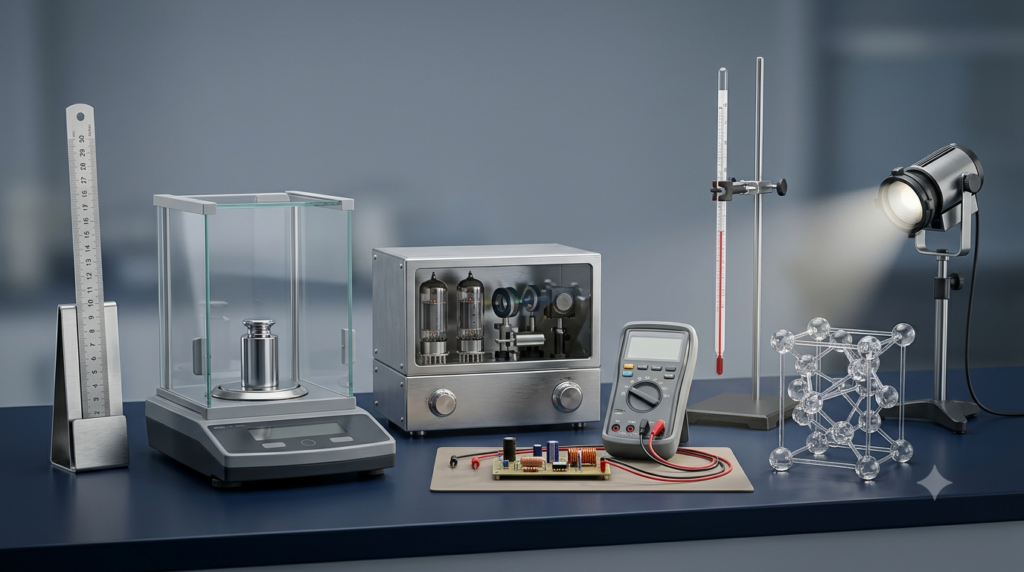
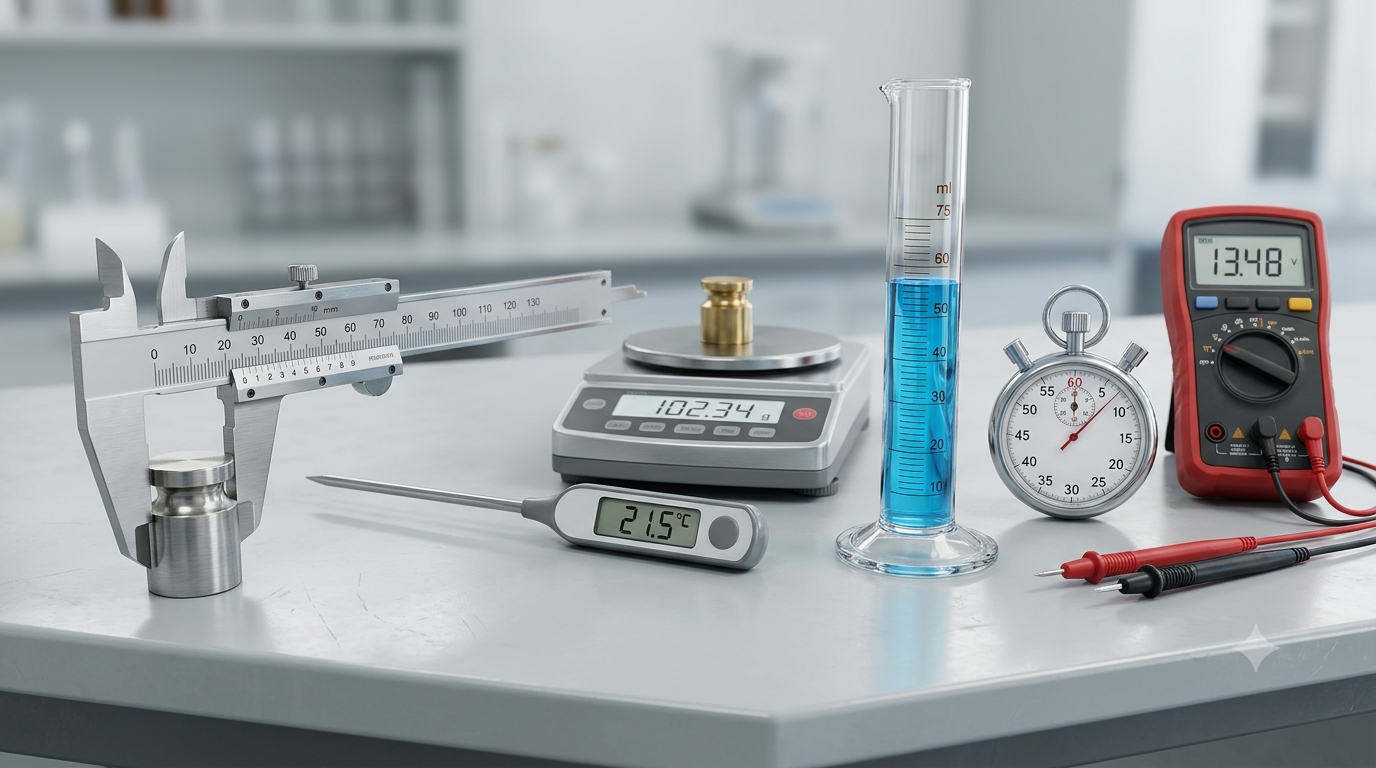
Common examples include rulers, metre scales, measuring tapes, vernier callipers, and micrometers.
A ruler is suitable for measuring the length of a notebook or a small straight object. A measuring tape is useful for measuring larger objects, rooms, and distances around curved surfaces.
Vernier callipers can measure external dimensions, internal dimensions, and depths, depending on their design. A micrometer is commonly used to measure very small thicknesses or diameters with greater resolution than an ordinary ruler.
Example: A student can use a ruler to measure the length of a pencil, while a mechanic may use a vernier calliper to measure the diameter of a metal shaft.
2. Instruments Used to Measure Mass and Weight
Mass and weight are related but different physical quantities.
Mass refers to the amount of matter in an object and is measured in kilograms or grams. Weight is the gravitational force acting on an object and is measured in newtons.
A beam balance or electronic balance is commonly used to determine mass. A spring balance measures force and can be used to measure weight when appropriately calibrated.
Digital weighing scales are widely used in homes, laboratories, shops, and industries. Laboratory balances can measure small masses with high resolution, while industrial weighing systems handle much heavier loads.
Example: A laboratory balance can measure the mass of a chemical sample before an experiment. A spring balance can demonstrate how an object’s weight produces an extension in a spring.
3. Instruments Used to Measure Temperature
Temperature indicates how hot or cold something is and is associated with the thermal state of a substance.
A thermometer is the most familiar temperature-measuring instrument. Thermometers may use liquid expansion, electronic sensors, or infrared radiation to determine temperature.
Common types include laboratory thermometers, clinical thermometers, digital thermometers, and infrared thermometers.
Laboratory thermometers are used to measure the temperature of substances during experiments. Clinical thermometers are designed for measuring body temperature, while infrared thermometers can measure surface temperature without direct contact.
Temperature may be expressed in degrees Celsius (°C), kelvin (K), or degrees Fahrenheit (°F), depending on the application.
Example: A student can use a laboratory thermometer to monitor the temperature of water while heating it during an experiment.
4. Instruments Used to Measure Time
Time-measuring instruments determine the duration between events or indicate the time of day.
Clocks and watches are used to show time, while stopwatches and timers measure time intervals.
In scientific experiments, accurate timing is important when studying motion, chemical reactions, oscillations, and other processes.
Digital stopwatches are often used in school laboratories because they are easy to operate and provide clear readings. Electronic timing systems may be used when experiments require very precise measurements.
Example: A student studying the motion of a pendulum can use a stopwatch to measure the time taken for a specific number of oscillations.
5. Instruments Used to Measure Volume
Volume is the amount of three-dimensional space occupied by a substance or object.
Common volume-measuring instruments include measuring cylinders, pipettes, burettes, volumetric flasks, and graduated containers.
A measuring cylinder is used to measure the volume of liquids. Pipettes transfer measured quantities of liquid, while burettes deliver controlled volumes during titration experiments. Volumetric flasks are designed to contain a specified volume at a stated temperature.
Instruments used in laboratories may provide greater accuracy than ordinary kitchen measuring cups.
Example: A chemistry student can use a measuring cylinder to measure a particular volume of water before mixing it with another liquid.
6. Instruments Used to Measure Force
Force is a push or pull that can change an object’s motion or shape.
A spring balance or force meter can measure force. Some electronic force sensors measure force through changes in electrical signals.
Force is measured in newtons (N), the SI unit of force.
These instruments are useful in physics experiments, mechanical testing, engineering, and research. They can help determine the force required to stretch a spring, pull an object, or compress a material.
Example: A student can attach a spring balance to an object and pull it gently to observe the force indicated by the instrument.
7. Instruments Used to Measure Pressure
Pressure is the force acting perpendicularly on a unit area.
Pressure-measuring instruments include pressure gauges, manometers, and barometers. Different instruments are designed for different pressure ranges and applications.
A pressure gauge measures the pressure of gases or liquids in systems such as tyres, pipelines, and industrial equipment. A manometer measures pressure differences using a fluid column or another suitable mechanism. A barometer measures atmospheric pressure.
Pressure is commonly expressed in pascals (Pa), although other units are also used in practical settings.
Example: A tyre pressure gauge helps determine whether a vehicle tyre has the recommended inflation pressure.
8. Instruments Used to Measure Electrical Quantities
Electrical instruments measure quantities such as electric current, voltage, resistance, and electrical power.
An ammeter measures electric current, a voltmeter measures potential difference, and an ohmmeter measures electrical resistance. A multimeter combines several measurement functions in one instrument.
An oscilloscope displays how an electrical signal changes over time, helping technicians and scientists examine signal shape, timing, and amplitude.
These instruments are used in electronics, electrical engineering, telecommunications, research, and equipment maintenance.
Example: A multimeter can be used to measure the voltage of a battery or check the resistance of a component.
Electrical measurements require appropriate safety precautions. Instruments must be rated for the circuit and measurement category, and their leads and connections must be used according to the manufacturer’s instructions.
9. Instruments Used to Measure Light
Light-measuring instruments are used to examine the intensity, brightness, or other properties of light.
A lux meter measures illuminance, which describes how much luminous flux falls on a surface per unit area. A photometer can measure specified light-related quantities, depending on its design. A spectrometer can separate light into its component wavelengths and help analyse its spectrum.
These instruments are useful in photography, lighting design, laboratories, environmental monitoring, and astronomy.
Example: A lux meter can measure the illuminance on a classroom desk to assess whether the lighting is suitable for reading.
10. Instruments Used to Measure Humidity
Humidity describes the amount of water vapour present in the air. A hygrometer is used to measure humidity.
Many modern hygrometers display relative humidity as a percentage. Relative humidity compares the amount of water vapour in the air with the amount the air could hold at the same temperature under specified conditions.
Humidity measurements are important in weather forecasting, agriculture, food storage, museums, laboratories, and indoor climate control.
Example: A greenhouse operator can use a digital hygrometer to monitor humidity and adjust ventilation when necessary.
How Are Measurement Instruments Used?
Although different instruments operate in different ways, the basic measurement process follows several common steps.
Step 1: Identify the Quantity to Be Measured
First, determine what you need to measure. The quantity might be length, mass, temperature, time, volume, pressure, or electric current.
Identifying the quantity helps you select an appropriate instrument.
For example, a ruler is suitable for measuring length, but it cannot directly measure temperature.
Step 2: Select the Correct Instrument
Choose an instrument that is suitable for the required measurement range and level of detail.
A measuring tape may be appropriate for measuring a room, whereas a micrometer may be more suitable for measuring the thickness of a thin metal sheet.
The instrument should have a suitable range, resolution, and accuracy for the task.
Step 3: Check the Instrument Before Use
Inspect the instrument to make sure it is clean, undamaged, and functioning correctly.
Check whether it needs calibration, whether its display is working, and whether the zero reading is correct when applicable.
For example, if a ruler’s zero mark is damaged, measurement should begin from a clear mark and the initial reading must be accounted for.
Step 4: Position the Instrument Correctly
Place or connect the instrument according to its intended use.
When using a ruler, align the scale with the object. When using a thermometer, follow the manufacturer’s instructions for the substance or surface being measured. When using an ammeter, connect it in series with the circuit under the appropriate safety conditions.
Correct positioning helps reduce measurement errors.
Step 5: Take the Reading Carefully
Observe the reading without rushing. For instruments with graduated scales, identify the smallest scale division and read the scale correctly.
When reading a conventional ruler or measuring cylinder, avoid viewing the scale from an angle. For a transparent liquid in a measuring cylinder, the reading is generally taken at the bottom of the meniscus at eye level, subject to the instrument and liquid involved.
For digital instruments, allow sufficient time for the reading to stabilise when required.
Step 6: Record the Result With Its Unit
A measurement should normally include both a numerical value and the appropriate unit.
For example:
Length: 15 cm
Mass: 250 g
Temperature: 28 °C
Time interval: 12 s
Electric current: 0.5 A
Recording units prevents confusion and makes results easier to interpret and compare.
Step 7: Repeat the Measurement When Necessary
Repeated measurements can help reveal random variation and improve confidence in a result.
If the task allows, take multiple readings under similar conditions. Examine whether the readings agree closely and calculate an average when appropriate.
Repeated measurements cannot automatically remove systematic errors, so instrument calibration and correct technique remain important.
Important Characteristics of Measurement Instruments
Several characteristics determine whether an instrument is suitable for a particular task.
Accuracy
Accuracy describes how close a measurement is to the true value or an accepted reference value. An accurate instrument produces results close to that reference under specified conditions.
Precision
Precision describes the closeness of agreement among repeated measurements. An instrument or measurement process can be precise without being accurate if its readings are consistently shifted away from the reference value.
Resolution
Resolution is the smallest change in the measured quantity that an instrument can distinguish or display.
For example, a digital instrument that displays two decimal places may show finer increments than one that displays only whole numbers. However, additional decimal places do not automatically guarantee greater accuracy.
Measuring Range
The measuring range is the span of values an instrument is designed to measure.
A thermometer designed for ordinary room temperatures may not be suitable for measuring the temperature of a very hot furnace.
Sensitivity
Sensitivity describes how much an instrument’s output changes in response to a change in the measured quantity. A sensitive instrument can respond noticeably to small changes, although sensitivity alone does not determine accuracy.
Calibration
Calibration involves comparing an instrument’s measurements with suitable reference standards to determine its measurement performance. Depending on the results and requirements, adjustment or correction may be necessary.
Regular calibration is particularly important in laboratories, healthcare, manufacturing, and other settings where measurement reliability is essential.
Common Errors in Measurement
Measurement results may differ from the true value for several reasons.
1. Parallax Error
Parallax error occurs when a scale is viewed from the wrong angle. It can be reduced by positioning the eye correctly in relation to the scale and pointer.
2. Zero Error
Zero error occurs when an instrument indicates a nonzero reading when the quantity being measured should be zero. Checking the zero reading before use can help identify this problem.
3. Instrumental Error
Instrumental errors can arise from poor calibration, wear, damage, manufacturing limitations, or unsuitable instrument settings.
4. Environmental Effects
Temperature changes, vibration, humidity, dust, and electromagnetic interference can affect some instruments. Controlling the environment or using suitable equipment helps reduce these effects.
5. Human Error
Incorrect positioning, careless reading, wrong unit conversion, and recording mistakes can lead to inaccurate results. Following a consistent procedure helps minimise these errors.
Applications of Measurement Instruments in Everyday Life
Measurement instruments are used in many situations beyond science laboratories.
Healthcare: Thermometers, blood pressure monitors, and medical weighing scales help healthcare professionals collect important measurements.
Education: Rulers, balances, stopwatches, and laboratory thermometers help students investigate scientific concepts.
Construction: Measuring tapes, levels, laser distance meters, and other instruments help workers check dimensions and alignment.
Agriculture: Soil moisture meters, thermometers, and weather instruments help farmers monitor growing conditions.
Manufacturing: Micrometers, callipers, gauges, and electronic sensors help inspect products and monitor production processes.
Transportation: Speedometers, tyre pressure gauges, fuel measuring systems, and other instruments provide useful operational information.
Weather monitoring: Thermometers, barometers, hygrometers, rain gauges, and anemometers help measure atmospheric conditions.
These examples show that measurement instruments support both simple daily tasks and complex technical operations.
How to Choose the Right Measurement Instrument
Selecting an appropriate instrument improves the usefulness of the measurement.
First, consider the quantity and expected range. Next, determine the accuracy and resolution required for the task. An ordinary ruler may be sufficient for measuring a book, but precision engineering may require specialised equipment.
Consider the environment in which the instrument will be used. Some instruments are designed for high temperatures, moisture, vibration, or outdoor conditions, while others require a controlled laboratory environment.
Also consider ease of use, calibration requirements, durability, and safety. Digital instruments can simplify reading and recording, but their batteries, sensors, settings, and calibration status may need attention.
Most importantly, use an instrument that is suitable for the measurement procedure and follow its operating instructions.
Conclusion
Measurement instruments are essential tools that help us determine the values of physical quantities accurately and systematically. From rulers and thermometers to pressure gauges, balances, and digital multimeters, each instrument is designed for particular measurements and applications. They play an important role in scientific experiments, healthcare, education, manufacturing, construction, agriculture, and everyday life.
To obtain reliable results, it is important to choose the correct instrument, check its condition, use it properly, read the scale carefully, and record the measurement with the correct unit. Understanding accuracy, precision, resolution, calibration, and common measurement errors also helps us interpret results correctly. By learning how measurement instruments work and how they are used, we can develop stronger scientific skills and make better-informed decisions in practical situations.
FAQs
1. What Are Measurement Instruments?
Measurement instruments are tools or devices used to measure physical quantities such as length, mass, temperature, time, volume, force, and pressure. They help determine numerical values by comparing quantities with standard units or reference values. Common examples include rulers, thermometers, stopwatches, measuring cylinders, balances, and pressure gauges. Some instruments operate mechanically, while others use electronic sensors and digital displays. Measurement instruments are essential in science laboratories, healthcare, engineering, manufacturing, and everyday activities. They help people obtain reliable measurements, compare results, perform experiments, and make informed decisions based on measurable information rather than estimates alone.
2. Why Are Measurement Instruments Important in Science?
Measurement instruments are important in science because they help scientists collect numerical data and investigate natural phenomena systematically. Scientific experiments often require accurate measurements of quantities such as temperature, time, distance, mass, and electrical current. These measurements allow researchers to compare observations, test hypotheses, identify patterns, and evaluate experimental results. Without suitable instruments, many scientific investigations would be difficult to perform reliably. Measurement instruments also help researchers repeat experiments and communicate their findings using standard units. From simple classroom experiments to advanced scientific research, these tools support the development of scientific knowledge and improve our understanding of the natural world.
3. What Are the Different Types of Measurement Instruments?
Measurement instruments are classified according to the quantities they measure and their working principles. Rulers and measuring tapes measure length, while balances determine mass. Thermometers measure temperature, and stopwatches measure time intervals. Measuring cylinders, pipettes, and burettes are used to measure liquid volumes. Pressure gauges measure pressure, while spring balances and force meters measure force. Electrical instruments, such as ammeters, voltmeters, and multimeters, measure electrical quantities. Hygrometers measure humidity, and lux meters measure illuminance. Each instrument has a specific purpose, measuring range, and level of precision, making it important to select the correct instrument for every task.
4. What Is the Difference Between Analog and Digital Measurement Instruments?
Analog measurement instruments represent measurements using continuously varying indications, such as a pointer moving across a graduated scale. Examples include traditional dial thermometers and analog pressure gauges. Digital measurement instruments display numerical readings on an electronic screen. Examples include digital thermometers, electronic balances, and digital multimeters. Analog instruments can help users observe gradual changes, while digital instruments often make readings easier to interpret and record. However, neither type is automatically more accurate than the other. Accuracy depends on the instrument’s design, calibration, resolution, and operating conditions. The best choice depends on the measurement requirements and the intended application.
5. How Do You Use Measurement Instruments Correctly?
Using measurement instruments correctly involves several important steps. First, identify the quantity you need to measure and select a suitable instrument. Check its condition, measuring range, and calibration status before use. Position the instrument properly and follow the manufacturer’s instructions. Read the scale carefully, avoiding viewing angles that can cause parallax errors. For digital instruments, allow the reading to stabilise when necessary. Record the measured value with the correct unit, such as centimetres, kilograms, or degrees Celsius. When greater reliability is required, repeat the measurement and compare the results. Proper handling and careful observation help improve measurement quality.
6. What Is the Difference Between Accuracy and Precision in Measurement?
Accuracy and precision describe different aspects of measurement quality. Accuracy refers to how close a measured value is to a true value or accepted reference value. Precision refers to how closely repeated measurements agree with one another. For example, if a reference value is 10.0 centimetres and an instrument repeatedly measures 10.0 centimetres, the results are both accurate and precise within the relevant measurement uncertainty. If it repeatedly measures 10.5 centimetres, the results may be precise but inaccurate. Understanding this difference is important because consistent readings do not necessarily guarantee correct results. Calibration and proper measurement techniques help improve reliability.
7. What Is Calibration of a Measurement Instrument?
Calibration is the process of comparing an instrument’s measurements with suitable reference standards to evaluate its performance. It helps determine whether the instrument produces readings that agree with established reference values within acceptable limits. For example, a laboratory thermometer may be checked against a calibrated reference thermometer. Calibration can reveal measurement errors, including consistent deviations from reference values. Depending on the requirements, an instrument may need adjustment, correction factors, repair, or replacement. Regular calibration is particularly important in scientific laboratories, healthcare, manufacturing, and quality control. It supports reliable measurements, improves confidence in results, and helps maintain consistent measurement standards.
8. What Are the Common Errors in Measurement?
Common measurement errors include parallax error, zero error, instrumental error, environmental error, and human error. Parallax error occurs when a scale is viewed from an incorrect angle. Zero error happens when an instrument shows a reading other than zero under conditions where zero is expected. Instrumental errors may result from damage, wear, or poor calibration. Environmental conditions, such as temperature changes and vibration, can affect certain instruments. Human errors include incorrect positioning, careless reading, and recording the wrong value or unit. These errors can be reduced by checking instruments before use, following proper procedures, repeating measurements, and recording observations carefully.
9. Which Measurement Instruments Are Commonly Used in Science Laboratories?
Science laboratories use various instruments depending on the subject and experiment. Rulers and measuring tapes determine length, while balances measure mass. Thermometers measure temperature, and stopwatches record time intervals. Measuring cylinders, pipettes, burettes, and volumetric flasks help measure and transfer liquids. In physics laboratories, spring balances measure force, while ammeters and voltmeters measure electrical quantities. Microscopes help magnify small specimens, although they are primarily observation instruments rather than direct measuring devices unless equipped with suitable measurement systems. Each instrument serves a particular purpose. Students must learn its correct operation, measuring range, limitations, and safety requirements to obtain dependable experimental results.
10. How Can You Choose the Right Measurement Instrument?
Choosing the right measurement instrument depends on the quantity being measured, the expected measurement range, and the required accuracy and resolution. For example, a ruler is suitable for measuring the length of a book, while a micrometer is better suited to measuring the thickness of a small component. You should also consider the environment, instrument durability, calibration requirements, and ease of use. Digital instruments may simplify reading, but their specifications and limitations still need to be checked. Safety is especially important when measuring electrical quantities, high temperatures, or pressure. Selecting a suitable instrument and following its operating instructions helps produce reliable and meaningful measurements.