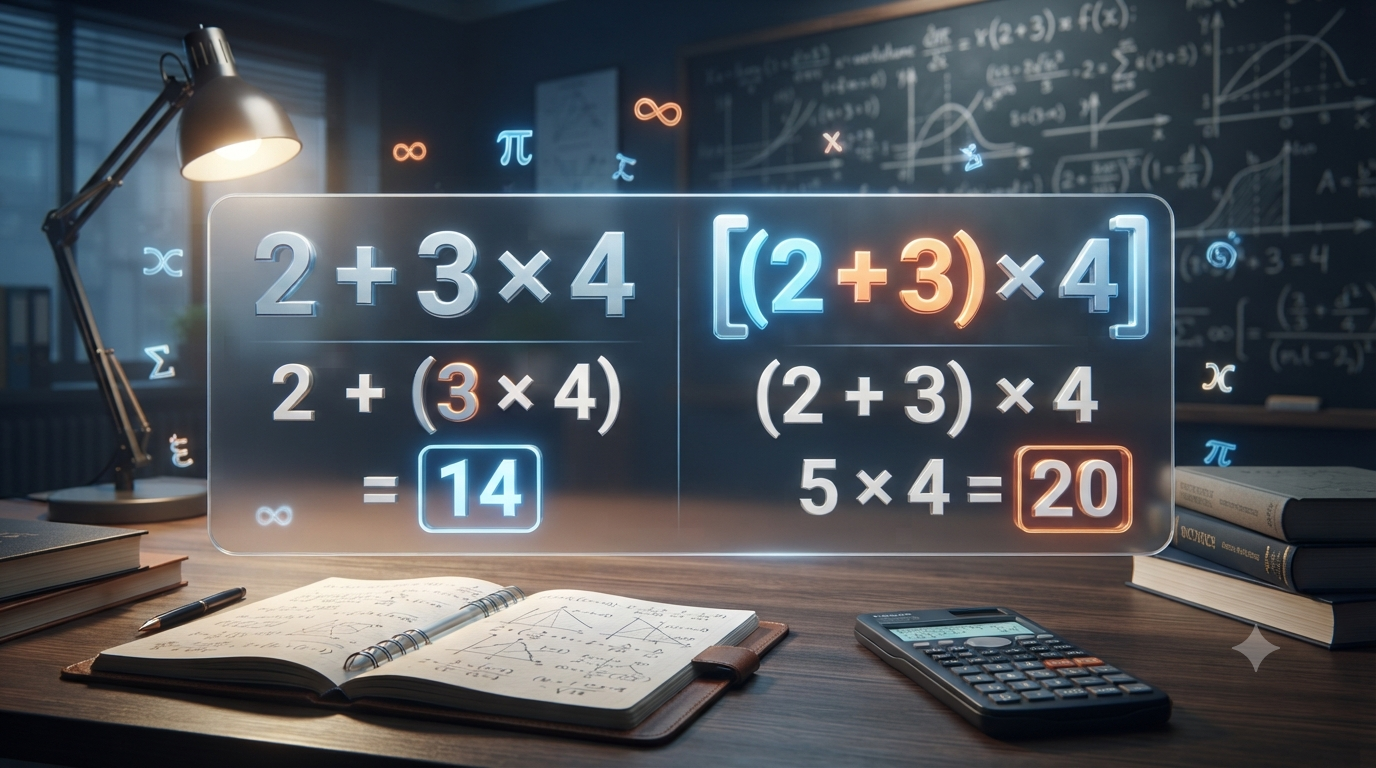
Mathematical formulas are built from numbers, variables, symbols, and operations such as addition, subtraction, multiplication, and division. Although these symbols may look simple, the way they are arranged can completely change the meaning of a formula. Brackets are especially important because they tell us which parts of an expression should be treated together.
Consider the expressions 2 + 3 × 4 and (2 + 3) × 4. They contain exactly the same numbers and operations, but they do not give the same result. In the first expression, multiplication is performed before addition, giving 14. In the second expression, the brackets tell us to add 2 and 3 first, giving 20.
This simple example shows why brackets are more than decorative symbols in mathematics. They provide structure, remove ambiguity, and determine the order in which calculations should be performed. Understanding how brackets work is essential for reading mathematical formulas correctly and avoiding calculation errors.
What Are Brackets in Mathematics?
Brackets are symbols used to group numbers, variables, terms, or mathematical operations together. The most common type is the round bracket, written as ( ).
For example:
(5 + 3)
Here, the brackets group 5 and 3 together and indicate that they should be considered as one part of the expression.
Mathematics also uses other types of grouping symbols, including square brackets [ ] and curly brackets { }. Depending on the context, these may be used to organize more complicated expressions or to distinguish different levels of grouping.
For example:
2 × [3 + (4 − 1)]
In this expression, the brackets make the structure of the calculation clear. The innermost operation is completed first, followed by the square-bracketed expression, and then multiplication.
Why Do Brackets Matter?
Brackets matter because mathematical operations normally follow a specific order. Without brackets, an expression can have a different interpretation from the one intended by the person who wrote it.
For example:
8 + 2 × 3
According to the standard order of operations, multiplication is performed before addition:
8 + (2 × 3)
= 8 + 6
= 14
Now consider:
(8 + 2) × 3
The brackets change the order:
10 × 3 = 30
The same numbers and operations are present, but the brackets change the result from 14 to 30.
Therefore, brackets can change not only how a formula looks but also what the formula actually means.
Brackets and the Order of Operations
To understand why brackets change formulas, it is important to understand the order of operations.
A commonly used order is:
Brackets or grouping symbols
Exponents or powers
Multiplication and division
Addition and subtraction
This is sometimes remembered using acronyms such as PEMDAS or BODMAS.
Brackets have a high priority because they identify a group that should generally be evaluated before operations outside that group.
For example:
4 + (6 × 2)
First calculate the expression inside the brackets:
6 × 2 = 12
Then:
4 + 12 = 16
If the brackets are removed:
4 + 6 × 2
Multiplication still comes before addition, so the answer happens to remain 16.
However, consider:
(4 + 6) × 2
Now the addition happens first:
10 × 2 = 20
This demonstrates that brackets become particularly important when they change the normal order of operations.
Brackets Can Change the Value of an Expression
One of the most direct effects of brackets is changing the numerical value of an expression.
Compare:
12 − 4 + 2
and
12 − (4 + 2)
For the first expression, addition and subtraction have the same priority, so they are evaluated from left to right:
12 − 4 + 2
= 8 + 2
= 10
For the second expression, the brackets require 4 + 2 to be calculated first:
12 − (4 + 2)
= 12 − 6
= 6
The difference is significant. A pair of brackets has changed the answer from 10 to 6.
Brackets Can Change the Meaning of a Negative Number
Brackets are also important when working with negative numbers.
Consider:
−3²
Under the standard order of operations, the exponent applies to 3 first:
−3² = −(3²) = −9
Now compare this with:
(−3)²
Here, the negative number −3 is inside the brackets, so the entire number is squared:
(−3)² = (−3) × (−3) = 9
Therefore:
−3² ≠ (−3)²
The first expression equals −9, while the second equals 9.
This is an important example because brackets determine whether the exponent applies only to the number or to the negative sign as part of the number.
Brackets in Algebra
Brackets become even more important when working with variables and algebraic expressions.
Consider:
3(x + 2)
The brackets indicate that 3 must be multiplied by both x and 2. Using the distributive property:
3(x + 2) = 3x + 6
Now consider:
3x + 2
This is a completely different expression. The 3 is multiplied only by x, while 2 is added separately.
Therefore:
3(x + 2) ≠ 3x + 2
For example, if x = 4:
3(x + 2) = 3(6) = 18
But:
3x + 2 = 12 + 2 = 14
The brackets change the structure of the expression and therefore change its value.
Brackets and the Distributive Property
The distributive property explains many common bracket operations in algebra.
For example:
a(b + c)
means that a is multiplied by the entire quantity b + c.
Therefore:
a(b + c) = ab + ac
Similarly:
a(b − c) = ab − ac
For example:
5(x − 3)
= 5x − 15
The 5 applies to both terms inside the brackets.
A common mistake is to multiply only the first term:
5(x − 3) ≠ 5x − 3
The brackets make it clear that the whole expression x − 3 is being multiplied by 5.
Brackets Can Change the Sign of Terms
Brackets are especially important when a negative sign appears before them.
Consider:
−(x + 5)
The negative sign applies to everything inside the brackets:
−(x + 5) = −x − 5
Similarly:
−(x − 5) = −x + 5
The sign of every term inside the brackets changes when the entire bracketed expression is multiplied by −1.
For example:
10 − (3 + 2)
= 10 − 3 − 2
= 5
The subtraction sign affects both terms inside the brackets.
This is why removing brackets without considering the sign outside them can produce an incorrect answer.
Nested Brackets
Sometimes a formula contains brackets inside other brackets. These are called nested brackets.
For example:
2[3 + (4 − 1)]
Start with the innermost brackets:
4 − 1 = 3
Then:
2[3 + 3]
= 2 × 6
= 12
Nested brackets help organize complicated expressions by showing different levels of grouping.
Another example is:
5{2 + [3(4 + 1)]}
The innermost bracket is evaluated first:
4 + 1 = 5
Then:
3 × 5 = 15
Next:
2 + 15 = 17
Finally:
5 × 17 = 85
Without grouping symbols, it would be much harder to understand the intended structure of such an expression.
Brackets in Fractions
Brackets are also essential when a fraction contains more than one term in the numerator or denominator.
Consider:
(x + 2) / 3
This means the entire quantity x + 2 is divided by 3.
It is different from:
x + 2/3
In the second expression, only 2 is divided by 3.
For example, if x = 4:
(4 + 2) / 3 = 6/3 = 2
But:
4 + 2/3 = 4⅔
The brackets therefore make it clear which quantity is being divided.
The same idea applies to denominators:
1 / (x + 2)
means that the entire quantity x + 2 is in the denominator.
This is very different from:
1/x + 2
where only x is in the denominator.
Brackets in Mathematical Formulas
Scientific and mathematical formulas frequently use brackets to show that an entire quantity should be treated as a single unit.
For example:
A = πr²
does not require brackets because r² is a single power.
But more complicated formulas may need them.
For example:
A = π(R² − r²)
Here, the brackets show that the difference between R² and r² is multiplied by π.
Similarly:
s = ut + ½at²
can be written without brackets because the terms are already clearly separated. But if a quantity such as u + at represents a complete part of another formula, brackets may be needed to show that the whole quantity is being used.
For example:
y = 2(u + at)
The 2 multiplies the entire quantity u + at.
Without brackets, writing:
y = 2u + at
would describe a different relationship.
Brackets Can Make Formulas Clearer
Even when brackets do not change the final result, they can make a mathematical expression easier to understand.
For example:
2 × (3 + 4)
is immediately clear because the grouping is visible.
In some cases, a writer may use brackets to emphasize the intended structure even when standard rules would already make the expression understandable.
Clear grouping becomes particularly valuable in long formulas, scientific equations, computer programming, and calculations involving several variables.
A well-written formula should allow the reader to understand exactly which quantities are connected to each operation.
Different Types of Brackets
Mathematics uses several types of grouping symbols.
Round Brackets
Round brackets are written as:
( )
They are commonly used for basic grouping, algebraic expressions, and function notation.
Example:
2(x + 5)
Square Brackets
Square brackets are written as:
[ ]
They are often used when an expression already contains round brackets.
Example:
3[2 + (4 − 1)]
Curly Brackets
Curly brackets are written as:
{ }
They can be used for another level of grouping or for describing sets.
Example:
2{3 + [4 + (5 − 2)]}
Using different bracket styles can make complex expressions easier to read.
What Happens When Brackets Are Removed?
Removing brackets does not always preserve the meaning of a formula.
For example:
4(2 + 3)
becomes:
4 × 5 = 20
If the brackets are removed incorrectly:
4 × 2 + 3
= 8 + 3
= 11
The meaning has changed.
However, brackets can sometimes be removed safely by applying mathematical rules.
For example:
2(x + 3)
can be expanded as:
2x + 6
Both expressions have the same value.
Therefore, brackets should not simply be deleted. They must be removed using appropriate mathematical properties such as the distributive property.
Common Mistakes Involving Brackets
Several mistakes occur frequently when working with brackets.
Ignoring Brackets
A common error is calculating operations outside the brackets before completing the grouped expression.
For example:
5(2 + 3)
should be calculated as:
5 × 5 = 25
not:
5 × 2 + 3 = 13
Applying a Negative Sign to Only One Term
Consider:
−(x + 4)
The correct expansion is:
−x − 4
not:
−x + 4
Forgetting to Multiply Every Term
For example:
3(x + 2)
should become:
3x + 6
not:
3x + 2
Misreading Fractions
The expression:
(x + 4)/2
means the entire quantity x + 4 is divided by 2.
It should not be interpreted as:
x + 4/2
because those are different expressions.
How to Read a Formula With Brackets Correctly
When you encounter a formula containing brackets, follow these steps:
Identify all the brackets.
Look for nested brackets and start with the innermost group.
Determine which operations are inside each group.
Apply the order of operations.
If variables are present, identify which terms are multiplied or divided by the bracketed expression.
Check whether any negative sign applies to the entire bracket.
Continue simplifying from the inside outward.
Compare the final expression with the original formula to make sure no signs or terms were lost.
This approach is especially useful when working with long algebraic or scientific formulas.
Why Brackets Are Important in Science and Mathematics
Brackets are not limited to basic arithmetic. They are used throughout mathematics, physics, chemistry, statistics, engineering, computer science, and many other fields.
In physics, brackets can group quantities in equations involving motion, energy, waves, and other physical relationships. In algebra and calculus, they help organize expressions involving variables and functions. In statistics, brackets can identify grouped quantities or intervals. In computer programming, different types of brackets are used for functions, arrays, lists, and blocks of code.
The underlying purpose remains the same: brackets communicate structure.
A formula is not simply a collection of numbers and symbols. The arrangement of those symbols tells us how the quantities are related. Brackets make those relationships visible.
Conclusion
Brackets can change the meaning of a mathematical formula by controlling which operations are performed together and which quantities are treated as a single unit. They can change the numerical result, alter algebraic relationships, determine how negative signs and powers are interpreted, and clarify the structure of complicated formulas.
Expressions such as 2 + 3 × 4 and (2 + 3) × 4 show how a simple pair of brackets can change an answer from 14 to 20. In algebra, brackets determine which terms are multiplied, added, subtracted, or divided together. In fractions, they show whether an entire expression belongs in the numerator or denominator.
The key idea is simple: brackets tell us what belongs together. Whenever you see brackets in a mathematical formula, pay close attention to what they contain and to the operation outside them. Understanding this small but fundamental idea can prevent many calculation errors and make even complicated mathematical formulas much easier to read.
FAQs
1. How do brackets change the meaning of a mathematical formula?
Brackets change the meaning of a mathematical formula by grouping numbers, variables, or operations together. They tell us which part of an expression should be calculated first or treated as a single quantity. For example, 2 + 3 × 4 gives 14 because multiplication comes first. However, (2 + 3) × 4 gives 20 because the brackets require the addition to be performed first. In algebra, brackets can also show which terms are multiplied by a number or variable. Therefore, brackets are important because changing their position or removing them can change both the structure and final value of a formula.
2. Why are brackets important in mathematics?
Brackets are important because they make the structure of a mathematical expression clear. They show which numbers, variables, or operations belong together and can control the order in which calculations are performed. For example, 10 − (4 + 2) gives 4, while 10 − 4 + 2 gives 8. The brackets tell us to calculate 4 + 2 before subtracting the result from 10. Brackets are especially useful in algebra, fractions, equations, and scientific formulas. They help prevent ambiguity and calculation errors by clearly showing how different parts of an expression are connected.
3. What is the role of brackets in the order of operations?
Brackets play an important role in the order of operations because expressions inside grouping symbols are generally evaluated before operations outside them. For example, in 5 + (3 × 2), the expression inside the brackets is calculated first, giving 6, and then 5 is added to obtain 11. If the expression is changed to (5 + 3) × 2, the brackets require the addition to be performed first, producing 16. This shows that brackets can override the usual order of operations. They help specify exactly which calculation should take priority within a mathematical expression.
4. Can brackets change the answer to a mathematical expression?
Yes, brackets can completely change the answer to a mathematical expression. Consider 4 + 6 × 2. Following the standard order of operations, multiplication is performed first, giving 16. If brackets are added as (4 + 6) × 2, the addition is performed first, giving 20. Both expressions contain the same numbers and operations, but the brackets change the order of calculation. In algebra, brackets can have an even greater effect because they determine which terms are multiplied or divided together. Therefore, brackets should always be read carefully before solving a mathematical expression.
5. How do brackets affect algebraic expressions?
In algebra, brackets group terms and show how operations should be applied to variables and numbers. For example, 3(x + 2) means that 3 is multiplied by the entire expression x + 2. Using the distributive property, this becomes 3x + 6. Without the brackets, 3x + 2 has a different meaning. Similarly, −(x + 4) means that the negative sign applies to both terms, giving −x − 4. Brackets therefore help define relationships between algebraic terms. They are essential when expanding, simplifying, factoring, and solving algebraic expressions and equations.
6. Why does (−3)² give a different answer from −3²?
The expressions (−3)² and −3² are different because the brackets determine what is included in the exponent. In (−3)², the entire number −3 is squared, so (−3) × (−3) = 9. In −3², the exponent applies to 3 first, and the negative sign remains outside the squared value. Therefore, −3² = −(3²) = −9. This example shows why brackets are important when working with negative numbers and powers. Adding brackets around a negative number can change the result because the brackets make the negative sign part of the quantity being squared.
7. How do brackets affect multiplication in algebra?
Brackets show that a number or variable outside them may need to be multiplied by the entire expression inside. For example, 4(x + 3) means that 4 must be multiplied by both x and 3. Using the distributive property, 4(x + 3) becomes 4x + 12. A common mistake is to multiply 4 only by x and write 4x + 3, which is incorrect. The brackets make the intended relationship clear. Therefore, whenever a number or variable appears directly before brackets, check whether it is multiplying every term inside those brackets.
8. How do brackets affect fractions?
Brackets are important in fractions because they can show whether an entire expression belongs in the numerator or denominator. For example, (x + 4)/2 means that the complete quantity x + 4 is divided by 2. This is different from x + 4/2, where only 4 is divided by 2. Similarly, 1/(x + 2) means that the entire expression x + 2 is the denominator. Without brackets, the intended structure may be misunderstood. Therefore, brackets make fractions involving multiple terms much clearer and help prevent errors when simplifying or evaluating mathematical expressions.
9. What are nested brackets in mathematics?
Nested brackets are brackets placed inside other brackets to organize expressions with several levels of grouping. For example, 2[3 + (4 − 1)] contains square brackets surrounding an expression that includes round brackets. To solve it, start with the innermost brackets: 4 − 1 = 3. Then calculate 3 + 3 = 6, and finally multiply by 2 to get 12. Nested brackets are useful when mathematical expressions become complicated. Different types of brackets, such as round brackets, square brackets, and curly brackets, can be used to make each level of grouping easier to identify.
10. What is the easiest way to solve formulas containing brackets?
The easiest way to solve a formula containing brackets is to work from the innermost brackets outward while following the order of operations. First, identify all grouping symbols and solve the expression inside the innermost brackets. Then simplify the next level of brackets before performing operations outside them. Pay close attention to negative signs, powers, multiplication, and division. In algebra, use the distributive property when brackets need to be expanded. Finally, check that every term and sign has been handled correctly. Following this systematic approach makes complicated formulas easier to understand and reduces calculation mistakes.