
Basic Formulas for Addition Subtraction Multiplication and Division

Basic arithmetic formulas for addition subtraction multiplication and division

Addition, subtraction, multiplication, and division are the four basic arithmetic operations used throughout mathematics. Almost every mathematical calculation, from simple counting to advanced equations, depends on these operations. Understanding their basic formulas makes it easier to work with numbers accurately and confidently.

These operations are not limited to school mathematics. They are used in everyday situations such as calculating prices, comparing quantities, dividing resources, finding totals, measuring differences, and working with percentages. They also form the foundation for algebra, geometry, statistics, physics, chemistry, finance, and many other areas of mathematics and science.

Although the operations themselves are simple, knowing the correct formula, the role of each number, and the relationship between the operations is important. This article explains the basic formulas for addition, subtraction, multiplication, and division with clear examples and practical applications.

What Are the Four Basic Arithmetic Operations?

The four fundamental arithmetic operations are:

  1. Addition (+)

  2. Subtraction (−)

  3. Multiplication (×)

  4. Division (÷)

Each operation has a specific purpose.

Addition combines quantities to find a total.

Subtraction finds the difference between quantities or determines how much remains after something is removed.

Multiplication represents repeated addition or groups of equal quantities.

Division separates a quantity into equal groups or determines how many times one number is contained in another.

These operations are closely connected. Addition and subtraction are inverse operations, while multiplication and division are also inverse operations.

Basic Formula for Addition

Addition is the process of combining two or more numbers to find their total.

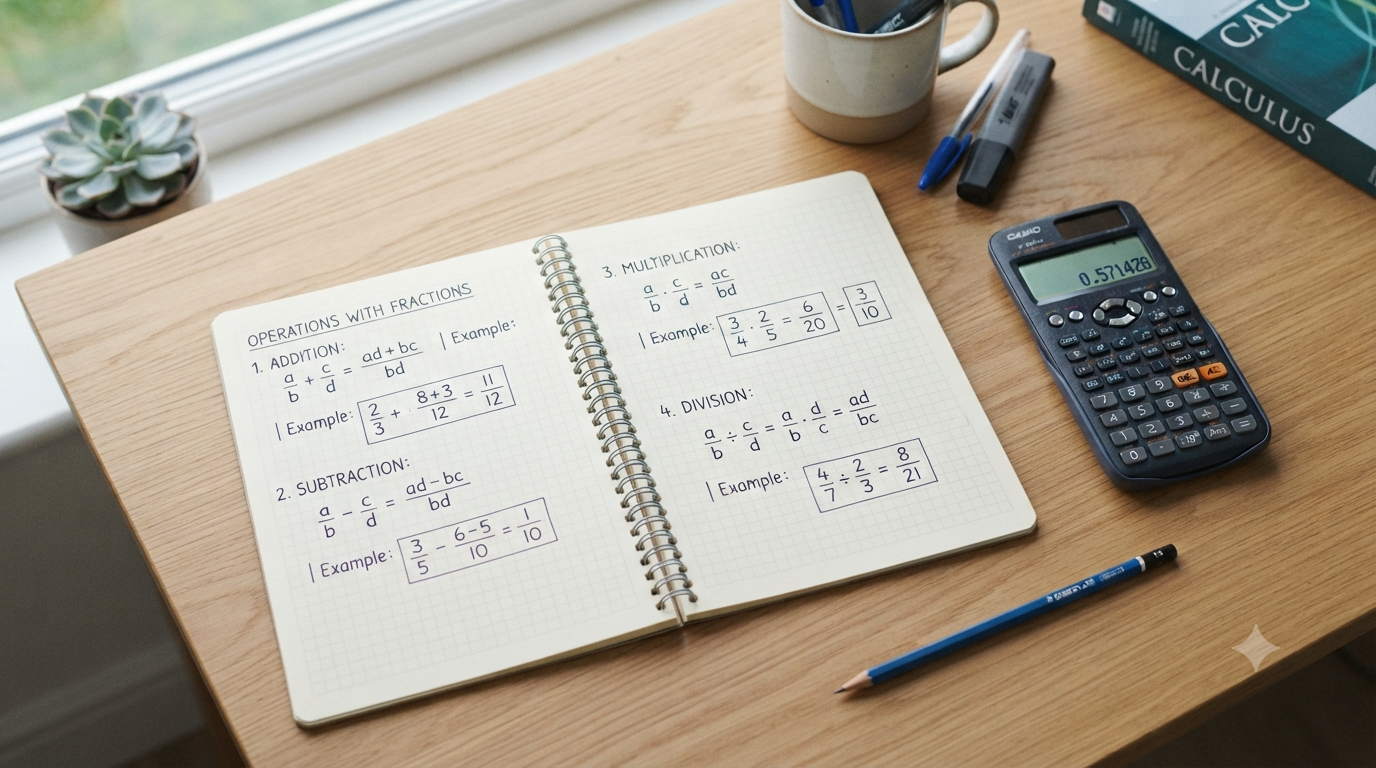
Addition Formula

a + b = c

Here:

  • a = first addend

  • b = second addend

  • c = sum

For example:

7 + 5 = 12

In this example, 7 and 5 are the addends, while 12 is the sum.

Addition With More Than Two Numbers

Addition can involve several numbers.

a + b + c = d

For example:

8 + 6 + 4 = 18

The numbers can be added in different groupings without changing the final result.

(8 + 6) + 4 = 18

and

8 + (6 + 4) = 18

This property is called the associative property of addition.

Important Properties of Addition

Commutative Property

The order of numbers does not change the sum.

a + b = b + a

For example:

9 + 4 = 4 + 9

Both equal 13.

Associative Property

The grouping of numbers does not change the sum.

(a + b) + c = a + (b + c)

For example:

(2 + 3) + 5 = 2 + (3 + 5)

Both sides equal 10.

Additive Identity

Adding zero to a number leaves the number unchanged.

a + 0 = a

For example:

15 + 0 = 15

Basic Formula for Subtraction

Subtraction is used to find the difference between two quantities or to determine how much remains after removing one quantity from another.

Subtraction Formula

a − b = c

Here:

  • a = minuend

  • b = subtrahend

  • c = difference

For example:

15 − 6 = 9

Here, 15 is the minuend, 6 is the subtrahend, and 9 is the difference.

Finding a Missing Number in Subtraction

The subtraction formula can also be rearranged to find an unknown number.

If:

a − b = c

then:

a = b + c

and:

b = a − c

For example, if:

x − 7 = 10

then:

x = 10 + 7

x = 17

This relationship is useful when solving simple mathematical problems.

Subtraction and Zero

Subtracting zero from a number does not change the number.

a − 0 = a

For example:

24 − 0 = 24

However, subtraction is not commutative. Changing the order usually changes the result.

a − b ≠ b − a

For example:

10 − 4 = 6

but

4 − 10 = −6

Therefore, the order of numbers is important in subtraction.

Basic Formula for Multiplication

Multiplication is an arithmetic operation used to find the total of equal groups. It can also be understood as repeated addition.

Multiplication Formula

a × b = c

Here:

  • a = first factor

  • b = second factor

  • c = product

For example:

6 × 4 = 24

Here, 6 and 4 are factors, and 24 is the product.

The same calculation can be understood as repeated addition:

6 + 6 + 6 + 6 = 24

Therefore:

6 × 4 = 24

Multiplication With More Than Two Numbers

Several numbers can be multiplied together.

a × b × c = d

For example:

2 × 3 × 5 = 30

The grouping can change without affecting the result.

(2 × 3) × 5 = 2 × (3 × 5)

Both equal 30.

Important Properties of Multiplication

Commutative Property

The order of factors does not change the product.

a × b = b × a

For example:

7 × 3 = 3 × 7

Both equal 21.

Associative Property

The grouping of factors does not change the product.

(a × b) × c = a × (b × c)

For example:

(2 × 4) × 5 = 2 × (4 × 5)

Both sides equal 40.

Multiplicative Identity

Multiplying any number by 1 leaves the number unchanged.

a × 1 = a

For example:

18 × 1 = 18

Multiplication by Zero

Any number multiplied by zero equals zero.

a × 0 = 0

For example:

25 × 0 = 0

Multiplication as Repeated Addition

Multiplication is particularly useful when the same quantity occurs repeatedly.

Suppose there are 5 boxes with 8 objects in each box. Instead of adding 8 five times:

8 + 8 + 8 + 8 + 8 = 40

we can write:

5 × 8 = 40

This makes multiplication a faster way to calculate equal groups.

Basic Formula for Division

Division is used to split a quantity into equal groups or determine how many times one number is contained in another.

Division Formula

a ÷ b = c

Here:

  • a = dividend

  • b = divisor

  • c = quotient

For example:

20 ÷ 5 = 4

Here, 20 is the dividend, 5 is the divisor, and 4 is the quotient.

Division Formula With Remainder

Sometimes a number cannot be divided evenly.

The general division relationship is:

Dividend = Divisor × Quotient + Remainder

For example:

17 ÷ 5 = 3 remainder 2

Using the formula:

17 = 5 × 3 + 2

Therefore, the dividend is 17, the divisor is 5, the quotient is 3, and the remainder is 2.

Division as the Inverse of Multiplication

Division and multiplication are closely related.

If:

a × b = c

then:

c ÷ b = a

and:

c ÷ a = b

For example:

6 × 7 = 42

Therefore:

42 ÷ 7 = 6

and:

42 ÷ 6 = 7

This relationship is useful for checking calculations.

Division by One

Dividing a number by 1 leaves the number unchanged.

a ÷ 1 = a

For example:

35 ÷ 1 = 35

Division by Zero

Division by zero is not defined in ordinary arithmetic.

For example:

10 ÷ 0

does not have a defined value.

It is important not to treat division by zero as ordinary division.

Relationship Between the Four Operations

The four basic operations are strongly connected.

Addition and subtraction are inverse operations.

If:

a + b = c

then:

c − b = a

and:

c − a = b

For example:

12 + 8 = 20

Therefore:

20 − 8 = 12

and:

20 − 12 = 8

Similarly, multiplication and division are inverse operations.

If:

a × b = c

then:

c ÷ b = a

and:

c ÷ a = b

For example:

9 × 4 = 36

Therefore:

36 ÷ 4 = 9

and:

36 ÷ 9 = 4

Understanding these relationships makes it easier to check whether an answer is correct.

Basic Arithmetic Formulas at a Glance

The most important formulas can be summarized as follows:

OperationBasic FormulaResult
Additiona + bSum
Subtractiona − bDifference
Multiplicationa × bProduct
Divisiona ÷ bQuotient

For division involving a remainder:

Dividend = Divisor × Quotient + Remainder

These formulas provide the basic framework for arithmetic calculations.

Using the Formulas in Everyday Life

Arithmetic operations are used constantly in everyday activities.

Addition

If one book costs ₹120 and another costs ₹180, the total cost is:

₹120 + ₹180 = ₹300

Subtraction

If you have ₹500 and spend ₹275, the remaining amount is:

₹500 − ₹275 = ₹225

Multiplication

If one notebook costs ₹40 and you buy 6 notebooks:

₹40 × 6 = ₹240

Division

If 24 objects are divided equally among 6 groups:

24 ÷ 6 = 4

Each group receives 4 objects.

These examples show how basic arithmetic formulas connect mathematical ideas with real situations.

Solving Simple Problems With Arithmetic Formulas

The most useful approach is to identify what the problem is asking before choosing an operation.

If quantities are being combined, addition is usually required.

If the question asks for a difference, remaining amount, or comparison, subtraction may be appropriate.

If equal groups or repeated quantities are involved, multiplication can simplify the calculation.

If a quantity is being shared equally or separated into groups, division is generally used.

For example, suppose a library has 125 science books and receives 75 additional books.

The total number of books is:

125 + 75 = 200

If the library later gives away 40 books:

200 − 40 = 160

If 160 books are arranged equally on 8 shelves:

160 ÷ 8 = 20

Each shelf contains 20 books.

This example demonstrates how multiple arithmetic operations can be combined to solve a practical problem.

Order of Operations

When a mathematical expression contains more than one arithmetic operation, the order in which the operations are performed matters.

A commonly used order is:

  1. Parentheses or brackets

  2. Exponents

  3. Multiplication and division

  4. Addition and subtraction

Multiplication and division are performed from left to right, and addition and subtraction are also performed from left to right.

For example:

8 + 4 × 3

First perform multiplication:

4 × 3 = 12

Then addition:

8 + 12 = 20

Therefore:

8 + 4 × 3 = 20

It is important not to automatically perform addition before multiplication when no brackets are present.

Checking Arithmetic Answers

One useful way to check an arithmetic calculation is to use its inverse operation.

For addition:

18 + 7 = 25

Check using subtraction:

25 − 7 = 18

For subtraction:

25 − 7 = 18

Check using addition:

18 + 7 = 25

For multiplication:

8 × 6 = 48

Check using division:

48 ÷ 6 = 8

For division:

48 ÷ 6 = 8

Check using multiplication:

8 × 6 = 48

This method helps identify mistakes and strengthens understanding of how arithmetic operations are connected.

Common Mistakes to Avoid

Although the four operations are basic, several common mistakes can lead to incorrect answers.

Confusing the Operation

Always understand what the problem is asking before calculating. Combining quantities, finding differences, creating equal groups, and sharing quantities may require different operations.

Changing the Order in Subtraction

Subtraction is not commutative. Therefore:

15 − 5 ≠ 5 − 15

Changing the Order in Division

Division is also not commutative.

20 ÷ 5 ≠ 5 ÷ 20

Ignoring the Order of Operations

When several operations appear in one expression, follow the correct order instead of calculating strictly from left to right.

Dividing by Zero

Division by zero is undefined in ordinary arithmetic and should not be treated as a regular calculation.

Conclusion

Addition, subtraction, multiplication, and division form the foundation of arithmetic and much of mathematics. Their basic formulas are simple, but understanding what each operation represents is essential for solving problems correctly.

The four fundamental formulas are:

Addition: a + b = c

Subtraction: a − b = c

Multiplication: a × b = c

Division: a ÷ b = c

These operations are closely connected through inverse relationships. Addition can be checked with subtraction, while multiplication can be checked with division. Once these basic relationships become familiar, more advanced mathematical concepts become easier to understand.

Learning these formulas is therefore not just about memorizing symbols. It is about understanding how quantities can be combined, compared, grouped, and divided. These simple ideas provide the foundation for algebra, geometry, statistics, science, and everyday numerical reasoning.

FAQs

1. What are the four basic arithmetic operations?

The four basic arithmetic operations are addition, subtraction, multiplication, and division. Addition combines two or more quantities to find their total. Subtraction finds the difference between quantities or determines how much remains. Multiplication finds the total of equal groups and can be understood as repeated addition. Division separates a quantity into equal groups or determines how many times one number is contained in another. These four operations are the foundation of arithmetic and are used in everyday calculations as well as more advanced areas of mathematics, including algebra, geometry, statistics, physics, chemistry, and financial calculations.

2. What is the basic formula for addition?

The basic formula for addition is a + b = c, where a and b are the numbers being added and c is their sum. For example, 8 + 7 = 15. Addition is used when quantities are combined to find a total. More than two numbers can also be added, such as 4 + 6 + 10 = 20. Addition follows important properties such as the commutative property, which means the order of the numbers does not change the result. For example, 5 + 3 = 3 + 5. Zero is also the additive identity because a + 0 = a.

3. What is the basic formula for subtraction?

The basic formula for subtraction is a − b = c, where a is the minuend, b is the subtrahend, and c is the difference. For example, 18 − 7 = 11. Subtraction is commonly used to find how much remains, compare quantities, or determine the difference between two numbers. Unlike addition, subtraction is not commutative, meaning that changing the order of the numbers usually changes the result. For example, 12 − 5 = 7, while 5 − 12 = −7. Understanding the order of numbers is therefore important when performing subtraction calculations.

4. What is the basic formula for multiplication?

The basic multiplication formula is a × b = c, where a and b are factors and c is the product. For example, 6 × 5 = 30. Multiplication can be understood as repeated addition. For instance, 6 × 5 can represent five groups of six, or 6 + 6 + 6 + 6 + 6 = 30. Multiplication is useful when equal quantities occur repeatedly. It follows properties such as the commutative property, a × b = b × a, and the associative property. Multiplying any number by one leaves it unchanged, while multiplying by zero gives zero.

5. What is the basic formula for division?

The basic division formula is a ÷ b = c, where a is the dividend, b is the divisor, and c is the quotient. For example, 24 ÷ 6 = 4. Division is used to split a quantity into equal groups or determine how many times one number is contained in another. Division is the inverse operation of multiplication. If 6 × 4 = 24, then 24 ÷ 6 = 4. When a number cannot be divided evenly, a remainder may occur. Division by zero is not defined in ordinary arithmetic, so a number cannot be divided by zero.

6. How are addition and subtraction related?

Addition and subtraction are inverse operations, meaning that one can be used to check the other. If a + b = c, then c − b = a and c − a = b. For example, if 12 + 8 = 20, then 20 − 8 = 12 and 20 − 12 = 8. This relationship is useful when solving mathematical problems and checking calculations. Addition combines quantities, while subtraction can undo that combination by removing one quantity from the total. Understanding this connection makes it easier to solve missing-number problems and develop a stronger foundation in arithmetic.

7. How are multiplication and division related?

Multiplication and division are inverse operations. If a × b = c, then c ÷ a = b and c ÷ b = a. For example, 7 × 5 = 35, so 35 ÷ 7 = 5 and 35 ÷ 5 = 7. This relationship provides a useful way to check multiplication and division calculations. Multiplication creates equal groups or combines repeated quantities, while division separates a quantity into equal groups. Learning both operations together helps improve calculation skills and makes it easier to solve problems involving unknown factors, quotients, dividends, or divisors.

8. What is the formula for division with a remainder?

When division does not produce a whole-number quotient, the calculation may have a remainder. The general formula is Dividend = Divisor × Quotient + Remainder. For example, when 17 is divided by 5, the quotient is 3 and the remainder is 2. The relationship can be checked as 17 = 5 × 3 + 2. The remainder must be smaller than the divisor. This formula is useful for checking division problems and understanding how whole quantities can be separated into equal groups when an exact division is not possible.

9. Why are addition, subtraction, multiplication, and division important?

Addition, subtraction, multiplication, and division are important because they form the foundation of arithmetic and many advanced mathematical concepts. They are used in everyday activities such as calculating prices, comparing quantities, measuring differences, sharing items, and managing money. These operations are also required in algebra, geometry, statistics, physics, chemistry, engineering, and computer science. Understanding the basic formulas helps people solve numerical problems more efficiently and accurately. Rather than simply memorizing formulas, it is useful to understand what each operation represents and when it should be used.

10. How can I check an arithmetic calculation?

An arithmetic calculation can often be checked by using its inverse operation. Addition can be checked with subtraction, and subtraction can be checked with addition. For example, if 15 + 9 = 24, check it with 24 − 9 = 15. Multiplication can be checked using division. If 8 × 6 = 48, then 48 ÷ 6 = 8. Division can similarly be checked through multiplication. For example, 48 ÷ 6 = 8 can be verified with 8 × 6 = 48. Using inverse operations is a simple and effective way to identify calculation errors.

Related Posts

Leave a Comment

Your email address will not be published. Required fields are marked *

Scroll to Top