

A chemical formula is a short way of showing what a substance is made of. Instead of writing the complete names of all the elements in a compound, chemists use symbols and numbers to represent them. Learning how to read a chemical formula makes it easier to understand the composition of substances, count atoms, calculate formula mass, and work with chemical equations.
For example, the formula H₂O represents water. It contains the elements hydrogen and oxygen. Similarly, CO₂ contains carbon and oxygen, while NaCl contains sodium and chlorine. At first, chemical formulas may look like combinations of letters and numbers, but each part has a specific meaning.
The easiest way to identify the elements present in a chemical formula is to look for the element symbols. Once you understand how element symbols, capital letters, lowercase letters, subscripts, and brackets work, you can identify the elements in most chemical formulas quickly and accurately.
What Is a Chemical Formula?
A chemical formula is a symbolic representation of a substance. It tells us which elements are present and, in many cases, the relative number of atoms of each element.
For example:
H₂O
The formula H₂O contains two different element symbols:
H = Hydrogen
O = Oxygen
The small number 2 after H tells us that there are two hydrogen atoms for every one oxygen atom.
Another example is CO₂:
C = Carbon
O = Oxygen
The subscript 2 tells us that the formula contains two oxygen atoms for every one carbon atom.
Therefore, identifying the elements in a formula mainly involves recognizing the element symbols rather than focusing first on the numbers.
Start by Looking for Capital Letters
The first step in identifying elements is to look at the capital letters in the chemical formula.
Every element symbol begins with a capital letter. Some element symbols contain only one letter, while others contain two letters.
Examples of one-letter symbols include:
H = Hydrogen
B = Boron
C = Carbon
N = Nitrogen
O = Oxygen
F = Fluorine
P = Phosphorus
S = Sulfur
K = Potassium
I = Iodine
Examples of two-letter symbols include:
Na = Sodium
Mg = Magnesium
Ca = Calcium
Cl = Chlorine
Fe = Iron
Cu = Copper
Zn = Zinc
Ag = Silver
Al = Aluminium
The capital letter is important because it marks the beginning of an element symbol.
For example, in NaCl, the capital letters are N and C, but the element symbols are Na and Cl. The lowercase letters must be read together with the preceding capital letter.
Understand Capital and Lowercase Letters
One of the most important rules for reading chemical formulas is that capitalization matters.
A chemical element symbol always begins with a capital letter. If it has a second letter, that letter is lowercase.
For example:
Cl = Chlorine
Co = Cobalt
Ca = Calcium
These are different element symbols.
It would be incorrect to read Cl as C + l because lowercase l is not a separate element symbol in this context. The two letters together form the symbol Cl for chlorine.
Similarly, Co represents cobalt, not carbon plus another element.
Consider the formula CoCl₂.
It contains:
Co = Cobalt
Cl = Chlorine
There are two different elements in this formula.
This is why you should not simply count every capital letter and assume that each one represents an element. You must check whether a capital letter is followed by a lowercase letter.
Identify One-Letter Element Symbols
Some elements have symbols containing only one letter. When you see one of these letters as an element symbol, it represents that element.
For example:
H₂
The symbol H represents hydrogen.
O₂
The symbol O represents oxygen.
N₂
The symbol N represents nitrogen.
Cl₂
The symbol Cl represents chlorine, even though it contains two letters.
Consider the formula CH₄.
The formula contains:
C = Carbon
H = Hydrogen
The subscript 4 does not represent another element. It tells us that there are four hydrogen atoms.
Therefore, CH₄ contains two elements: carbon and hydrogen.
Identify Two-Letter Element Symbols
Many chemical elements have two-letter symbols. The first letter is always uppercase and the second letter is lowercase.
Some common examples are:
Na = Sodium
Mg = Magnesium
Ca = Calcium
Al = Aluminium
Cl = Chlorine
Fe = Iron
Cu = Copper
Zn = Zinc
Ag = Silver
When reading a formula, a capital letter followed by a lowercase letter should generally be considered one element symbol.
For example:
Na₂CO₃
The formula contains:
Na = Sodium
C = Carbon
O = Oxygen
Therefore, sodium carbonate contains three different elements.
The numbers tell us how many atoms of each element are represented, but they do not introduce new elements.
Subscripts Do Not Represent New Elements
A subscript is a small number written to the lower right of an element symbol. It tells us how many atoms of that element are present in the formula unit or molecule.
For example:
H₂O
The 2 belongs to H, so there are two hydrogen atoms.
The O has no subscript, so it represents one oxygen atom.
Thus:
H₂O contains 2 hydrogen atoms and 1 oxygen atom.
It contains only two elements.
Another example is CO₂.
The 2 belongs to O, so there are two oxygen atoms.
Therefore:
C = Carbon
O = Oxygen
The formula contains two elements and three atoms in total.
A Missing Subscript Means One Atom
When an element symbol has no subscript immediately after it, we assume that its subscript is 1.
For example:
NaCl
Na has no subscript, so it represents one sodium atom.
Cl has no subscript, so it represents one chlorine atom.
Therefore:
NaCl contains:
1 sodium atom
1 chlorine atom
The elements present are sodium and chlorine.
Similarly, in H₂SO₄:
H₂ = Hydrogen
S = Sulfur
O₄ = Oxygen
The sulfur symbol has no subscript, so there is one sulfur atom.
Parentheses and Groups in Chemical Formulas
Some formulas contain parentheses. Parentheses are often used when a group of atoms, such as a polyatomic ion, occurs more than once.
For example:
Ca(OH)₂
To identify the elements, look inside and outside the parentheses.
The formula contains:
Ca = Calcium
O = Oxygen
H = Hydrogen
Therefore, Ca(OH)₂ contains three elements.
The subscript 2 outside the parentheses means that the entire OH group occurs twice. It affects the number of atoms, but it does not introduce another element.
There are:
1 calcium atom
2 oxygen atoms
2 hydrogen atoms
But the number of different elements remains three.
How to Identify Elements in a Formula Step by Step
You can use a simple method for almost any chemical formula.
Step 1: Write the Formula Clearly
Start with the complete chemical formula.
For example:
Al₂(SO₄)₃
Step 2: Find Each Capital Letter
Look for capital letters because they mark the beginning of element symbols.
In Al₂(SO₄)₃, the capital letters are A, S, and O.
Step 3: Check for Lowercase Letters
Check whether a capital letter is followed by a lowercase letter.
Al is one element symbol, not A + l.
So:
Al = Aluminium
S = Sulfur
O = Oxygen
Step 4: Ignore the Subscripts Initially
The numbers are useful for counting atoms, but they are not element symbols.
In Al₂(SO₄)₃, the numbers 2, 4, and 3 do not represent elements.
Step 5: List the Element Names
The elements are:
Aluminium
Sulfur
Oxygen
Therefore, Al₂(SO₄)₃ contains three different elements.
Example 1 H₂O
Let’s identify the elements in water.
Formula:
H₂O
H represents hydrogen.
O represents oxygen.
The subscript 2 tells us that there are two hydrogen atoms.
Therefore:
Elements present: Hydrogen and Oxygen
Number of different elements: 2
Example 2 CO₂
Formula:
CO₂
C = Carbon
O = Oxygen
The subscript 2 indicates two oxygen atoms.
Therefore:
Elements present: Carbon and Oxygen
Number of different elements: 2
Example 3 NH₃
Formula:
NH₃
N = Nitrogen
H = Hydrogen
The subscript 3 belongs to hydrogen.
Therefore:
Elements present: Nitrogen and Hydrogen
Number of different elements: 2
Example 4 CaCO₃
Formula:
CaCO₃
Ca = Calcium
C = Carbon
O = Oxygen
The subscript 3 belongs to oxygen.
Therefore:
Elements present: Calcium, Carbon, and Oxygen
Number of different elements: 3
Example 5 NaHCO₃
Formula:
NaHCO₃
Na = Sodium
H = Hydrogen
C = Carbon
O = Oxygen
Therefore, the formula contains four different elements:
Sodium
Hydrogen
Carbon
Oxygen
The subscript 3 applies only to oxygen.
Example 6 Fe₂O₃
Formula:
Fe₂O₃
Fe = Iron
O = Oxygen
The formula contains:
Iron
Oxygen
The subscripts indicate the number of atoms:
2 iron atoms
3 oxygen atoms
Therefore, Fe₂O₃ contains two different elements.
Example 7 C₆H₁₂O₆
Glucose has the formula C₆H₁₂O₆.
The element symbols are:
C = Carbon
H = Hydrogen
O = Oxygen
The subscripts tell us that the formula represents:
6 carbon atoms
12 hydrogen atoms
6 oxygen atoms
Therefore, glucose contains three different elements: carbon, hydrogen, and oxygen.
Example 8 Mg(OH)₂
Formula:
Mg(OH)₂
The element symbols are:
Mg = Magnesium
O = Oxygen
H = Hydrogen
The subscript 2 outside the parentheses means the OH group occurs twice.
Therefore, the formula contains three different elements.
Example 9 Fe(NO₃)₃
Formula:
Fe(NO₃)₃
The element symbols are:
Fe = Iron
N = Nitrogen
O = Oxygen
Therefore, Fe(NO₃)₃ contains three different elements.
The numbers affect the number of atoms, but the set of elements remains iron, nitrogen, and oxygen.
Why Is It Important to Identify the Elements?
Identifying the elements in a chemical formula is an important basic chemistry skill. It helps you understand the composition of substances before performing more advanced calculations or chemical reasoning.
Once you know which elements are present, you can determine the number of atoms, calculate relative formula mass, study the ratio of elements, and interpret chemical reactions.
For example, if you are given H₂SO₄, identifying the symbols immediately tells you that the substance contains hydrogen, sulfur, and oxygen. You can then use the subscripts to determine the number of atoms represented by the formula.
This skill is also useful when balancing equations, studying chemical compounds, and solving stoichiometry problems.
Common Mistakes When Identifying Elements
Treating Every Letter as a Separate Element
This is one of the most common mistakes.
For example, NaCl does not contain an element called N and another element represented by A. Na is one complete symbol for sodium.
Ignoring Lowercase Letters
The difference between uppercase and lowercase letters is essential.
Co means cobalt, while CO represents carbon and oxygen.
Changing capitalization can completely change the meaning of a formula.
Treating Subscripts as Elements
Numbers such as 2, 3, and 4 do not represent elements.
In CO₂, the 2 tells you how many oxygen atoms are present.
Forgetting Elements Inside Parentheses
In Ca(OH)₂, both oxygen and hydrogen are inside the parentheses. They still count as elements present in the formula.
Confusing Number of Elements With Number of Atoms
These are different ideas.
For example, H₂O contains two different elements but three atoms in total.
The two elements are hydrogen and oxygen.
A Quick Method to Remember
When identifying elements in a chemical formula, remember this simple sequence:
Capital letter → check lowercase letter → identify symbol → ignore subscript initially → repeat
For example:
MgCl₂
Mg → Magnesium
Cl → Chlorine
₂ → tells the number of chlorine atoms
Therefore, MgCl₂ contains two elements: magnesium and chlorine.
Another example:
K₂SO₄
K → Potassium
S → Sulfur
O → Oxygen
Subscripts → tell the number of atoms
Therefore, K₂SO₄ contains three elements.
Conclusion
Identifying the elements present in a chemical formula becomes much easier once you understand how chemical symbols are written. Start by looking for capital letters, then check whether each capital letter is followed by a lowercase letter. Together, these letters form the element symbols. Subscripts tell you how many atoms of an element are represented, but they do not represent additional elements. Parentheses can group atoms together, but every element symbol inside them must still be identified.
By practicing with formulas such as H₂O, CO₂, CaCO₃, NaHCO₃, C₆H₁₂O₆, and Fe(NO₃)₃, you can quickly learn to recognize the elements in more complex formulas. This simple skill provides an important foundation for understanding chemical compounds, equations, formula mass, and stoichiometry.
FAQs
1. How can you identify the elements present in a chemical formula?
To identify the elements present in a chemical formula, look for the element symbols. Each symbol begins with a capital letter and may be followed by a lowercase letter. For example, H₂O contains H for hydrogen and O for oxygen. The small number after a symbol is called a subscript and tells you how many atoms of that element are present. It does not represent another element. In CaCO₃, the symbols are Ca, C, and O, so the formula contains calcium, carbon, and oxygen. Learning to recognize element symbols is the first step in reading chemical formulas correctly.
2. What does a capital letter mean in a chemical formula?
A capital letter usually marks the beginning of an element symbol in a chemical formula. Some element symbols contain only one letter, such as H for hydrogen, while others contain two letters, such as Na for sodium and Cl for chlorine. The first letter is always capitalized, while the second letter, when present, is lowercase. For example, NaCl contains Na and Cl, representing sodium and chlorine. It is important to read the capital and lowercase letters together when they form a two-letter element symbol. This prevents mistakes when identifying the elements present in a chemical formula.
3. Why are lowercase letters important in chemical formulas?
Lowercase letters are important because they can be the second letter of a two-letter element symbol. For example, Cl represents chlorine, while Ca represents calcium and Mg represents magnesium. The lowercase letter should not be treated as a separate element. In NaCl, the correct symbols are Na and Cl, not N, A, C, and L. Similarly, Co represents cobalt as one element symbol. Therefore, when reading a chemical formula, always check whether a capital letter is followed by a lowercase letter. This helps you correctly separate the formula into its individual element symbols.
4. Do subscripts represent different elements?
No. Subscripts do not represent different elements. A subscript is a small number written after an element symbol and tells you how many atoms of that element are represented. For example, in H₂O, the subscript 2 means there are two hydrogen atoms. Oxygen has no subscript, which means one oxygen atom is represented. The formula therefore contains only two elements: hydrogen and oxygen. Similarly, CO₂ contains carbon and oxygen. The subscript 2 tells us there are two oxygen atoms, but it does not introduce a new element. Subscripts describe quantities, not element identities.
5. What does it mean when an element symbol has no subscript?
When an element symbol has no subscript, it means that one atom of that element is represented in the formula unit or molecule. For example, in H₂O, hydrogen has a subscript 2, while oxygen has no subscript. Therefore, the formula represents two hydrogen atoms and one oxygen atom. In NaCl, neither sodium nor chlorine has a subscript, so the formula represents one sodium and one chlorine. Remembering that a missing subscript means one makes it easier to determine the number of atoms after identifying the elements in a chemical formula.
6. How do you identify elements in a formula with parentheses?
When a chemical formula contains parentheses, identify the element symbols both inside and outside the parentheses. For example, Ca(OH)₂ contains Ca, O, and H. Ca represents calcium, O represents oxygen, and H represents hydrogen. The subscript 2 outside the parentheses means the OH group occurs twice. It changes the number of oxygen and hydrogen atoms but does not add new elements. Therefore, Ca(OH)₂ contains three different elements. A useful approach is to first identify every element symbol, then use the subscripts and parentheses to calculate how many atoms of each element are present.
7. How many elements are present in H₂SO₄?
H₂SO₄ contains three different elements. The symbol H represents hydrogen, S represents sulfur, and O represents oxygen. The subscript 2 means there are two hydrogen atoms, while the absence of a subscript after S means there is one sulfur atom. The subscript 4 after O means there are four oxygen atoms. Therefore, H₂SO₄ represents two hydrogen atoms, one sulfur atom, and four oxygen atoms. Although the formula contains seven atoms in total, it contains only three different elements: hydrogen, sulfur, and oxygen. This distinction is important when reading and interpreting chemical formulas.
8. How can you identify elements in NaHCO₃?
To identify the elements in NaHCO₃, separate the formula into its element symbols. Na represents sodium, H represents hydrogen, C represents carbon, and O represents oxygen. Therefore, NaHCO₃ contains four different elements. The subscript 3 applies to oxygen, meaning three oxygen atoms are represented. Sodium, hydrogen, and carbon have no visible subscripts, so one atom of each is represented. The formula therefore contains one sodium atom, one hydrogen atom, one carbon atom, and three oxygen atoms. The key is to recognize Na as one complete element symbol rather than treating N and a as separate symbols.
9. What is the difference between the number of elements and the number of atoms?
The number of different elements tells you how many types of elements are present, while the number of atoms tells you the total quantity of individual atoms represented. For example, H₂O contains two different elements: hydrogen and oxygen. However, it contains three atoms in total—two hydrogen atoms and one oxygen atom. Similarly, CO₂ contains two elements but three atoms. Therefore, the number of elements and the total number of atoms are not always the same. Chemical symbols identify the elements, while subscripts help determine the number of atoms of each element.
10. What is the easiest way to identify elements in a chemical formula?
The easiest method is to look for capital letters and then check whether each one is followed by a lowercase letter. Each complete symbol represents one element. Ignore the subscripts when first identifying the elements because they only indicate the number of atoms. For example, in Al₂(SO₄)₃, identify Al as aluminium, S as sulfur, and O as oxygen. The formula therefore contains three elements. After identifying the symbols, use the subscripts and parentheses to determine the number of atoms. With regular practice, this process becomes quick and makes longer chemical formulas easier to understand.
Related Posts
What Is Friction and Why Is It Important?
Friction is one of the most common forces we experience in everyday life. Whenever you walk, write with a pencil, […]
Read MoreWhat Is Density and How Is It Calculated?

Density is one of the most useful physical quantities in science. It helps us understand how much matter is packed […]
Read MoreHow to Use Chemical Formulas to Balance Chemical Equations
Chemical reactions describe how substances change into new substances. In chemistry, these changes are written using chemical equations. A chemical […]
Read MoreWhy Is Energy Conserved Even When It Seems to Disappear?

Energy is one of the most important ideas in science. We use energy to move objects, produce light, heat homes, […]
Read MoreHow to Calculate Molecular Mass Step by Step

Molecular mass is an important concept in chemistry because it helps us understand how heavy a molecule is compared with […]
Read MoreEssential Chemistry Formulas for Beginners

Chemistry becomes much easier when you understand how chemical formulas represent substances. A chemical formula is a short way of […]
Read MoreHow to Write Simple Chemical Formulas

Chemical formulas are a simple way to represent substances using symbols and numbers. Instead of writing the full name of […]
Read MoreBasic Types of Chemistry Formulas Explained

Chemistry formulas are one of the simplest ways scientists describe substances, reactions, and relationships between different particles. A formula can […]
Read MoreSI Base Units and Their Symbols Explained
Science depends on measurement. Whether scientists are studying the motion of a spacecraft, the temperature of a material, the mass […]
Read MoreCommon Polyatomic Ions and Their Formulas

Polyatomic ions are groups of two or more atoms that are chemically bonded together and carry an overall electrical charge. […]
Read MoreWhat Is a Structural Formula?

A structural formula is a way of representing a chemical compound by showing how its atoms are arranged and connected […]
Read MoreMass and Weight: What Is the Difference?
Have you ever wondered why an object can have the same amount of matter but weigh differently in different places? […]
Read MoreSI Unit of Amount of Substance Mole Explained

The mole is one of the seven SI base units used in science. It is the SI unit of amount […]
Read MoreHow to Organize Physics Formulas for Easy Revision

Physics becomes much easier when formulas are organized in a clear and meaningful way. Many learners struggle not because they […]
Read MoreWhat Is a Condensed Chemical Formula?

A condensed chemical formula is a convenient way of writing the structure of an organic compound without drawing every bond […]
Read MoreCommon Valencies of Important Elements

Valency is one of the basic ideas in chemistry that helps us understand how atoms combine with one another. When […]
Read MoreWhat does a coefficient mean in a chemical equation?

A chemical equation is a compact way of representing a chemical reaction. It tells us which substances take part in […]
Read MoreWhat Are Scalars and Vectors in Physics?
Physics is all about describing how things behave. We talk about the mass of an object, its speed, the distance […]
Read MoreHow Do Physicists Know Whether a Formula Is Correct?

A formula can look simple on paper, but how do physicists know that it actually describes nature? After all, anyone […]
Read MoreWhat Are Physical Quantities in Physics?
Physics is the study of nature and the rules that describe how objects, matter, energy, space, and time behave. To […]
Read MoreWhy are graphs so useful for understanding motion?

Motion is one of the most important ideas in physics. We see motion everywhere around us. A car travels along […]
Read MoreFundamental and Derived Physical Quantities Explained
Physics is the science of understanding how the natural world works. To describe motion, matter, energy, forces, electricity, and many […]
Read MoreWhat Is Momentum in Physics?
Momentum is one of the fundamental concepts in physics used to describe the motion of an object. It helps us […]
Read MoreHow do parentheses affect the number of atoms in a formula?
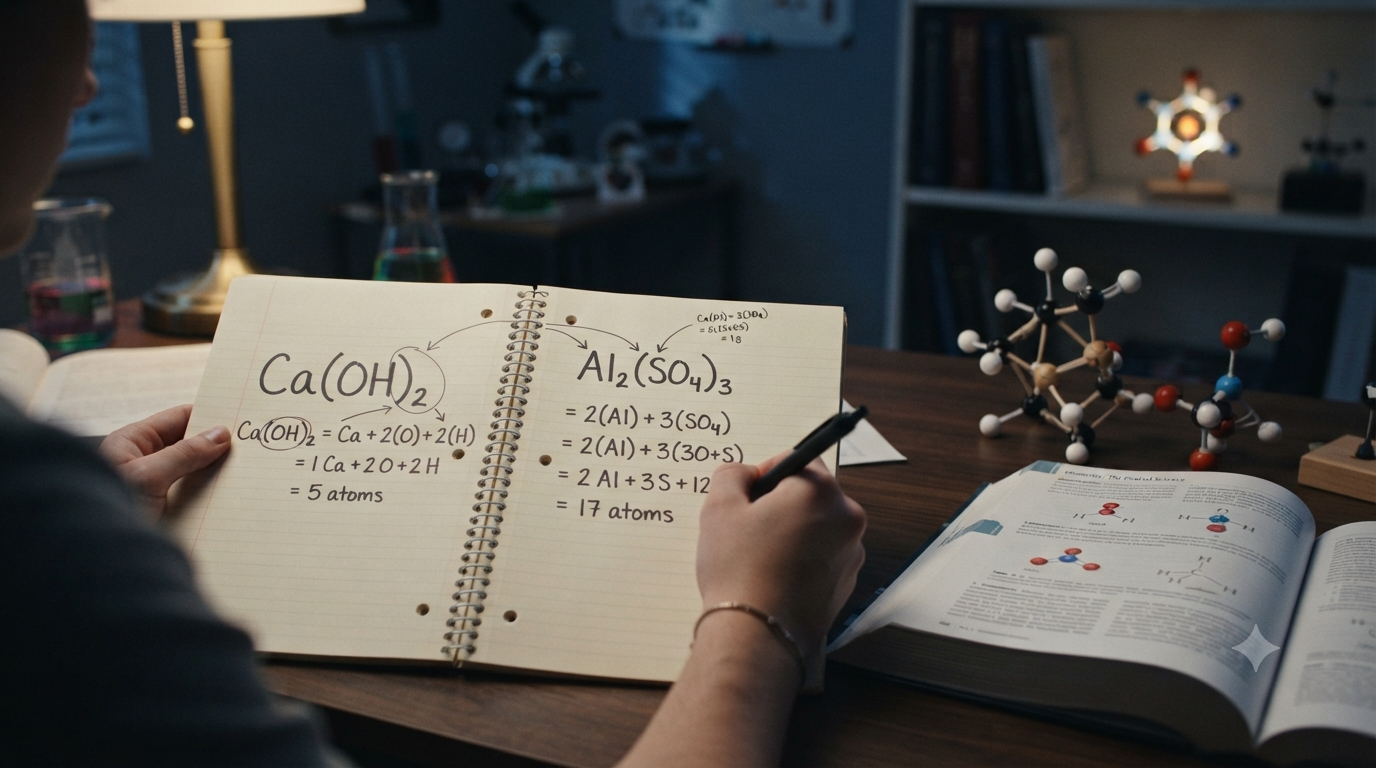
Chemical formulas tell us which elements are present in a substance and how many atoms of each element are included. […]
Read MoreWhat Is Pressure in Physics?

Pressure is one of the most common physical quantities we experience in everyday life, even though we may not always […]
Read MoreWhy Is Physics Important in Everyday Life?
Physics is often introduced as the study of matter, energy, motion, forces, and the laws that govern the universe. It […]
Read MoreWhat Are Chemistry Formulas and Why Are They Important?

Chemistry is the science of substances, their properties, and the changes they undergo. To describe these substances clearly, chemists use […]
Read MoreWhat Is the Meaning of Formula Units in Chemistry?
In chemistry, substances are often represented using chemical formulas. A chemical formula tells us which elements are present and, in […]
Read MoreWhat Do Symbols Mean in Physics Formulas?

Physics formulas are written using mathematical symbols, letters, and numbers. These symbols help scientists describe motion, force, energy, time, temperature, […]
Read MoreThe Seven SI Base Units Explained with Examples

Every measurement in science needs a standard unit. Without standard units, it would be difficult to compare measurements made by […]
Read More