Geometry is an important branch of mathematics that helps us understand the shapes, sizes, positions, and properties of objects. From measuring the length of a pencil to calculating the volume of a water tank, geometrical measurements are used in many everyday activities. To understand these measurements correctly, it is essential to learn about dimensions.
Dimensions describe the measurements needed to represent the size of an object or a geometrical figure. Length, width, and height are common examples of dimensions. A straight line has one dimension, a flat surface has two dimensions, and a solid object has three dimensions. These differences help us distinguish between points, lines, surfaces, and three-dimensional objects.
Understanding dimensions also makes it easier to learn about perimeter, area, surface area, and volume. These concepts are closely connected to geometry and mensuration, a branch of mathematics concerned with measuring geometrical figures. In this article, we will explore the meaning of dimensions, their types, their relationship with geometrical measurements, and their practical applications.
What Are Dimensions in Geometry?
In geometry, a dimension describes a direction or measurement needed to specify the size or position of a geometrical object. The number of dimensions associated with an object depends on its geometrical nature.
For example, a line segment can be measured using its length. A rectangle requires both length and width to describe its size, while a rectangular box requires length, width, and height.
Dimensions are often represented using letters such as l, w, h, and d. These symbols help simplify mathematical expressions and formulas.
Common dimension symbols include:
l = length
w = width
h = height
d = diameter
r = radius
The same letter can have different meanings in different mathematical contexts, so it is important to understand how each symbol is being used.
Dimensions are not limited to physical objects. They also describe abstract geometrical spaces, coordinate systems, and mathematical models.
The Different Types of Dimensions in Geometry
Geometrical objects are commonly classified as zero-dimensional, one-dimensional, two-dimensional, or three-dimensional. Higher-dimensional spaces are also studied in advanced mathematics.
Zero-Dimensional Objects
A point represents an exact position in geometry. It has no length, width, or height, so it is described as a zero-dimensional object.
A point does not occupy any measurable length or area. It simply indicates a location.
For example, a point may represent the position of a city on a simplified map or the intersection of two lines in a geometrical diagram. Although a point is often drawn as a small dot, the dot itself has a visible size only because of the limitations of drawing.
Points are the basic building blocks of many geometrical constructions.
One-Dimensional Objects
A one-dimensional object has only one dimension: length.
A straight line extends indefinitely in both directions. A line segment, however, has two endpoints and a measurable length.
Examples of one-dimensional geometrical objects include line segments and curves considered only in terms of their length.
For example, if a line segment measures 8 centimetres, its length is 8 cm. It does not have a width or thickness in ideal geometry.
One-dimensional measurements are useful when determining distances, the lengths of boundaries, or the paths followed by moving objects.
Two-Dimensional Objects
A two-dimensional object has two dimensions, usually length and width. It has a surface but no thickness in ideal plane geometry.
Examples include squares, rectangles, triangles, circles, and other plane figures.
A rectangle, for instance, has a length and a width. Both measurements are required to describe its size. Its area can then be calculated by multiplying these two dimensions.
Formula for the area of a rectangle:
A = l × w
Here, A represents area, l represents length, and w represents width.
If a rectangle is 6 cm long and 4 cm wide, its area is:
A = 6 × 4 = 24 cm²
Two-dimensional measurements are used in activities such as calculating floor areas, measuring sheets of paper, planning gardens, and designing flat surfaces.
Three-Dimensional Objects
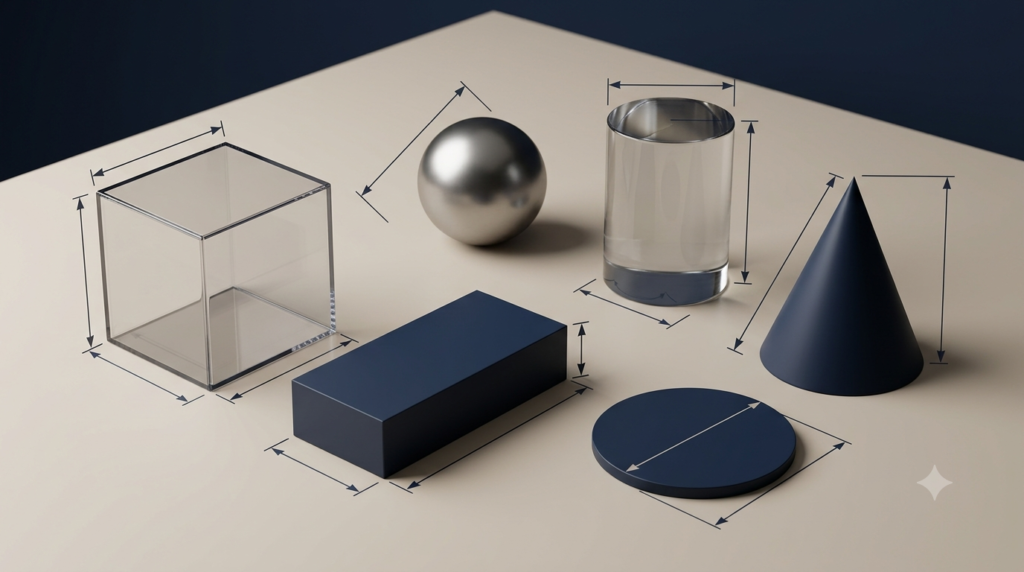
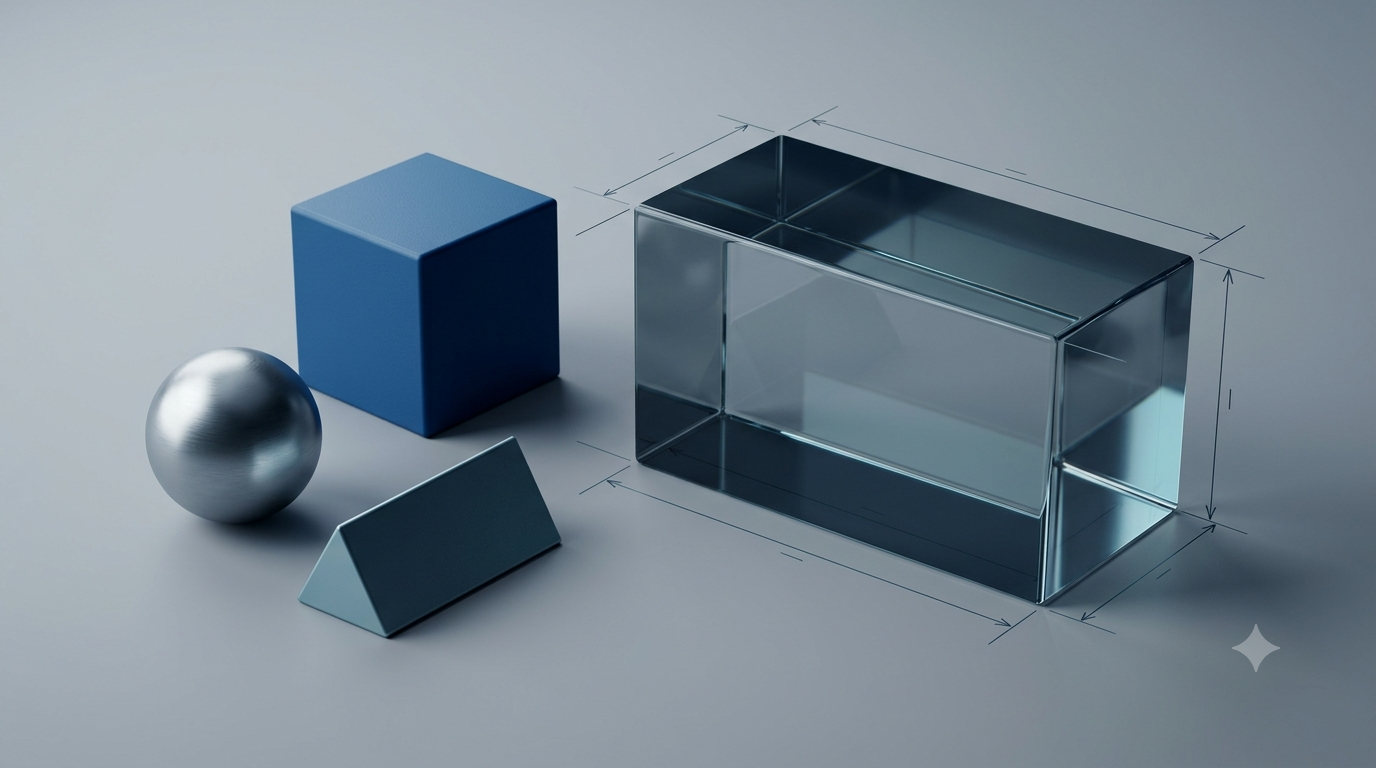
A three-dimensional object has length, width, and height. It occupies space and has volume.
Examples include cubes, cuboids, spheres, cylinders, cones, and pyramids.
A cardboard box is a familiar example of a three-dimensional object. Its length, width, and height describe its overall dimensions.
The volume of a cuboid can be calculated using the following formula:
V = l × w × h
Here, V represents volume, l represents length, w represents width, and h represents height.
Suppose a box is 5 cm long, 3 cm wide, and 2 cm high.
V = 5 × 3 × 2 = 30 cm³
Therefore, the volume of the box is 30 cubic centimetres.
Three-dimensional measurements are essential when calculating the capacity of containers, the amount of material needed to manufacture objects, and the space occupied by furniture or machinery.
Understanding Length, Width, and Height
Length, width, and height are three common dimensions used to describe the size of objects. Although their meanings may vary depending on the object and its orientation, each provides a different measurement.
Length
Length usually describes how long an object is. It may represent the longest side of a rectangle or the distance between two endpoints.
Length is measured in units such as millimetres, centimetres, metres, and kilometres.
For example, the length of a table may be 120 cm, while the length of a road may be measured in kilometres.
Width
Width describes how broad an object is, often across its shorter horizontal direction.
For example, a rectangular garden might have a length of 15 metres and a width of 8 metres.
Width is important when calculating areas and determining whether an object can fit within a particular space.
Height
Height describes the vertical measurement of an object, from its base to its top, according to the chosen orientation.
For example, the height of a cupboard may be 180 cm, while the height of a building may be measured in metres.
Height is especially important in three-dimensional geometry because it helps determine the volume of objects such as cuboids, cylinders, cones, and pyramids.
Together, length, width, and height provide the basic measurements needed to describe many everyday objects.
Dimensions and Geometrical Measurements
Dimensions provide the measurements used in geometrical calculations. Depending on the object, these measurements can be used to determine perimeter, area, surface area, or volume.
Dimensions and Perimeter
Perimeter is the total distance around a two-dimensional shape. It is calculated by adding the lengths of all its boundary sides.
For a rectangle, the perimeter formula is:
P = 2 × (l + w)
For example, if a rectangle has a length of 7 cm and a width of 3 cm:
P = 2 × (7 + 3) = 20 cm
The perimeter is 20 cm.
Perimeter is useful when determining the length of fencing needed around a garden, the border required for a picture frame, or the material needed to outline a shape.
Although perimeter describes a boundary, its measurement is expressed in ordinary length units, such as centimetres or metres.
Dimensions and Area
Area measures the amount of surface enclosed by a two-dimensional shape. It depends on the dimensions of the figure and is expressed in square units.
The area of a rectangle is calculated as:
A = l × w
The area of a triangle is calculated as:
A = ½ × b × h
Here, b represents the base and h represents the perpendicular height.
For a circle, the area formula is:
A = π × r²
Here, r represents the radius and π is approximately 3.14159.
These formulas demonstrate how dimensions are used to calculate the amount of surface covered by a shape.
Area measurements are important in construction, agriculture, interior design, painting, and land measurement.
Dimensions and Surface Area
Surface area measures the total area of the outer surfaces of a three-dimensional object.
For example, a cuboid has six rectangular faces. Its total surface area depends on its length, width, and height.
The formula is:
SA = 2 × (l × w + l × h + w × h)
If a cuboid has a length of 4 cm, a width of 3 cm, and a height of 2 cm:
SA = 2 × (12 + 8 + 6)
SA = 52 cm²
Therefore, its total surface area is 52 square centimetres.
Surface area is useful when calculating the amount of paint needed to cover an object, the material required to manufacture a box, or the outer area of a storage container.
Dimensions and Volume
Volume measures the space occupied by a three-dimensional object. It is expressed in cubic units, such as cm³ or m³.
The volume of a cube is calculated using:
V = a³
Here, a represents the length of one side of the cube.
For a cylinder, the volume formula is:
V = π × r² × h
Here, r represents the radius of the circular base and h represents the perpendicular height.
Volume calculations are useful for determining the space inside containers, the amount of liquid a tank can hold, and the quantity of material required to produce solid objects.
Understanding Units and Dimensions
A dimension and its unit are related, but they are not the same thing.
A dimension describes the kind of measurement being considered, while a unit specifies the standard used to express its numerical value.
For example, length is a measurable quantity, while centimetre and metre are units used to measure it.
Common units include:
Length: millimetre (mm), centimetre (cm), metre (m), kilometre (km)
Area: square centimetre (cm²), square metre (m²)
Volume: cubic centimetre (cm³), cubic metre (m³)
Choosing the correct unit is important because different quantities require different forms of measurement.
For example, the length of a pencil may be measured in centimetres, the area of a room in square metres, and the volume of a water tank in cubic metres.
When converting units, the relationship between the units must be considered carefully.
For instance:
1 m = 100 cm
Therefore:
1 m² = 10,000 cm²
And:
1 m³ = 1,000,000 cm³
The difference occurs because area involves two dimensions and volume involves three dimensions. Unit conversions for area and volume must account for every dimension involved.
The Difference Between Dimensions and Dimensionality
The words dimension and dimensionality are related, but they are not always used in exactly the same way.
In elementary geometry, dimensions often refer to measurements such as length, width, and height. Dimensionality describes the number of independent directions or coordinates needed to represent positions within a space.
For example, a point on a line can be located using one coordinate. A point on a flat plane requires two coordinates, while a point in ordinary three-dimensional space requires three coordinates.
This distinction becomes important in coordinate geometry, physics, computer graphics, and advanced mathematics.
A physical object may have three dimensions even when a particular measurement problem considers only one or two of them. For example, the length of a wire may be the only measurement needed for a specific calculation, even though the wire has a physical thickness.
Understanding the context helps prevent confusion between the number of dimensions an object has and the specific measurements required to solve a problem.
Dimensions in Coordinate Geometry
Coordinate geometry uses numbers to describe the positions of points in a geometrical space.
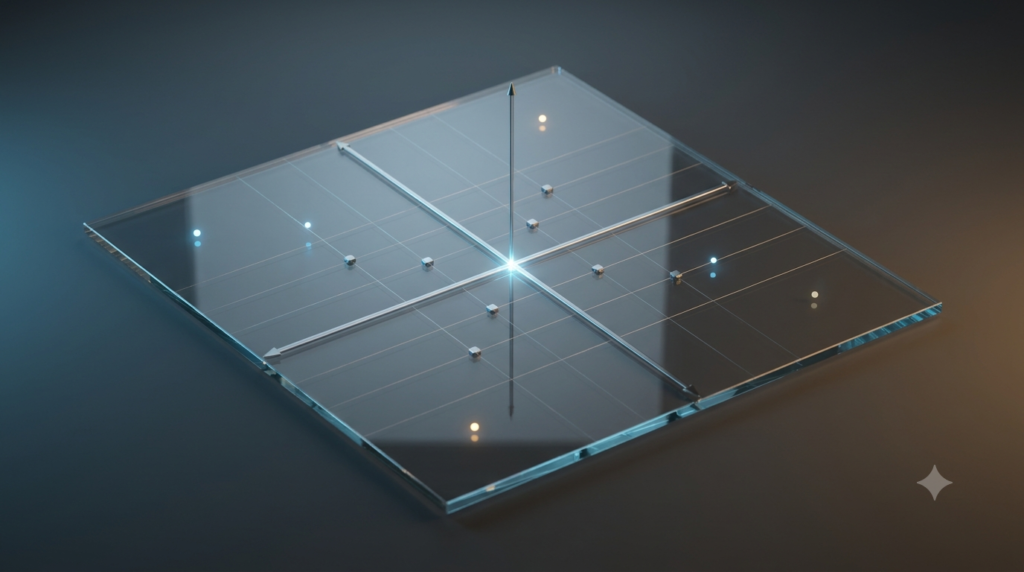
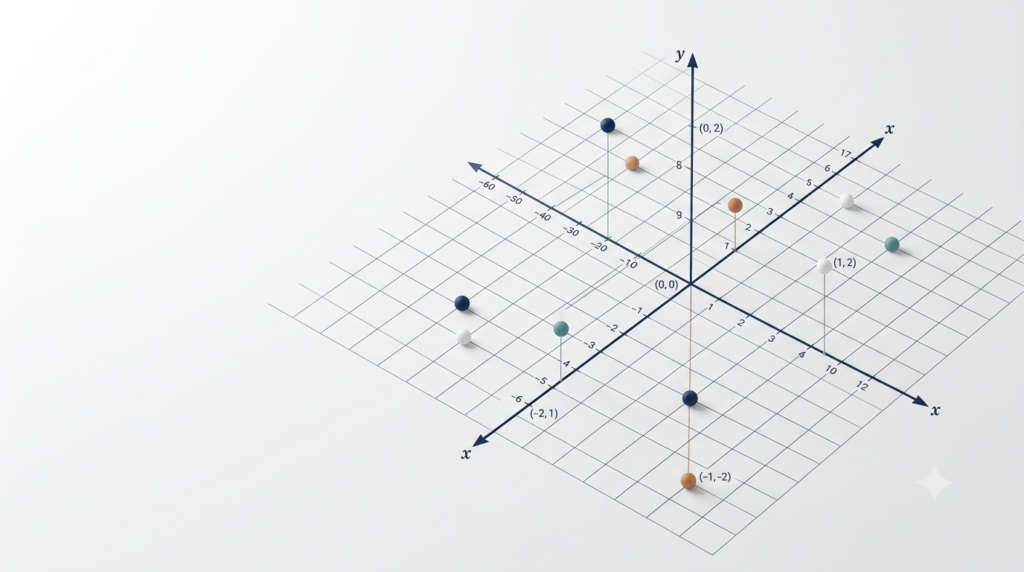
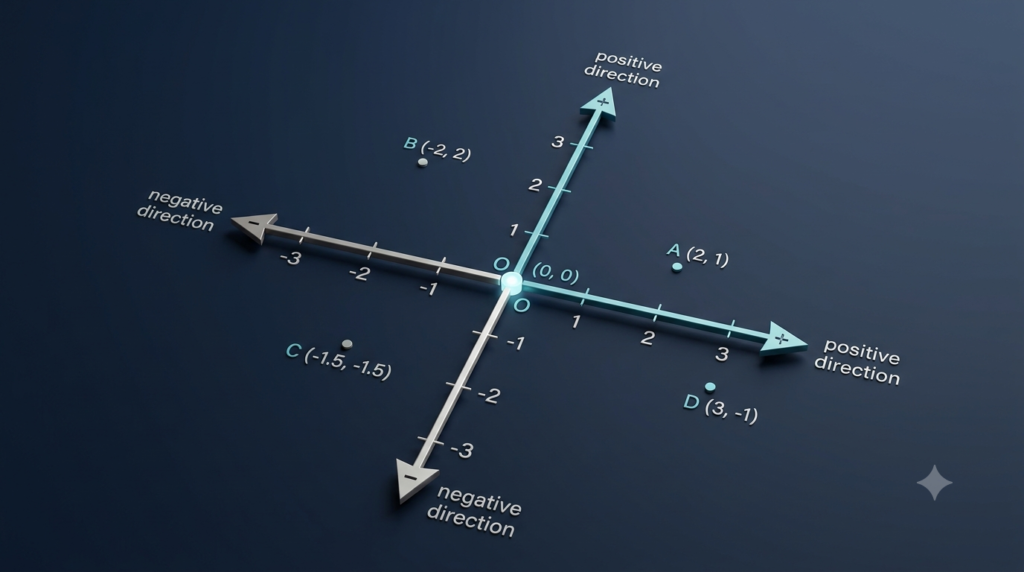
On a two-dimensional coordinate plane, two perpendicular axes are used. The horizontal axis is called the x-axis, and the vertical axis is called the y-axis.
A point is located using two coordinates, one for each axis. These coordinates indicate its horizontal and vertical position relative to the origin.
For example, a point located 4 units to the right and 3 units above the origin has coordinates (4, 3).
In three-dimensional coordinate geometry, a third axis is added, commonly called the z-axis. A point is then described using three coordinates representing its position along the three axes.
Coordinate geometry makes it possible to study distances, slopes, shapes, and spatial relationships using algebraic methods.
It is widely used in mapping, architecture, engineering, animation, computer-aided design, and scientific modelling.
Real-Life Applications of Dimensions
Understanding dimensions is useful in many practical situations. It helps people measure objects accurately, compare sizes, and calculate the materials or space required for different tasks.
Construction and Architecture
Architects and construction professionals use dimensions to prepare building plans, determine room sizes, measure walls, and calculate floor areas.
Length, width, and height are necessary for designing rooms and ensuring that doors, windows, and furniture fit correctly.
Accurate measurements also help estimate the quantities of materials required for construction.
Packaging and Manufacturing
Manufacturers use dimensions to design packages, containers, tools, and machine components.
The dimensions of a package determine how much space it occupies and whether it can accommodate a particular product.
Surface area and volume calculations also help reduce material waste and improve storage efficiency.
Agriculture and Land Measurement
Farmers and land surveyors use geometrical measurements to estimate the area of fields and determine the boundaries of plots.
Area measurements help calculate seed requirements, irrigation coverage, and the amount of fertiliser needed for a given area.
Education and Scientific Research
Dimensions form the foundation of many mathematical and scientific concepts.
Students use them when studying geometry, mensuration, physics, and coordinate systems. Scientists and engineers use measurements to describe objects, build models, and analyse physical systems.
Learning dimensions early makes more advanced topics easier to understand.
Common Mistakes When Working With Dimensions
Students sometimes make mistakes when identifying dimensions or applying geometrical formulas. Understanding these errors can improve accuracy.
Confusing area with perimeter: Perimeter measures the boundary of a shape, while area measures the surface enclosed by it.
Using incorrect units: Length is expressed in units such as metres, whereas area and volume require square and cubic units, respectively.
Forgetting a dimension: The volume of a cuboid requires length, width, and height. Omitting one of these measurements produces an incorrect result.
Mixing units in a calculation: Measurements should be converted to compatible units before being used together in a formula.
Confusing radius and diameter: The diameter of a circle is twice its radius. Using the diameter in a formula that requires the radius without converting it can lead to an incorrect answer.
Assuming every physical object is perfectly two-dimensional or three-dimensional: Mathematical models often simplify real objects. A sheet of paper may be treated as a two-dimensional surface for some calculations, even though it has a small thickness.
Careful identification of the shape, its dimensions, the appropriate formula, and the correct units helps prevent these common mistakes.
Conclusion
Dimensions are a fundamental part of geometry because they describe the measurements and spatial properties of geometrical objects. A point is considered zero-dimensional, a line segment is one-dimensional, a plane figure is two-dimensional, and a solid object is three-dimensional. Each type of object requires different measurements to describe its size and structure.
Understanding length, width, height, and other measurements helps us calculate perimeter, area, surface area, and volume. These concepts are useful in everyday activities as well as in construction, manufacturing, agriculture, engineering, and scientific research.
By learning how dimensions relate to geometrical shapes and measurement units, students can develop a strong foundation in geometry and mensuration. This knowledge also prepares them for more advanced mathematical topics, including coordinate geometry and the study of higher-dimensional spaces. With regular practice and careful attention to units, geometrical measurements become easier to understand and apply accurately.
FAQs
1. What are dimensions in geometry?
Dimensions in geometry describe the measurements or directions needed to represent the size or position of a geometrical object. In everyday measurements, length, width, and height are common dimensions. A line segment has one dimension, a flat shape such as a rectangle has two dimensions, and a solid object such as a box has three dimensions. Understanding dimensions helps us calculate perimeter, area, surface area, and volume. Dimensions are also important in coordinate geometry, where coordinates describe the positions of points in different spaces. They form a basic foundation for studying geometry and mensuration.
2. What are the different types of dimensions in geometry?
Geometry commonly classifies objects as zero-dimensional, one-dimensional, two-dimensional, and three-dimensional. A point is considered zero-dimensional because it has no length, width, or height. A line segment is one-dimensional because it has length. A rectangle or circle is two-dimensional because it has length and width. A cube, sphere, or cuboid is three-dimensional because it occupies space. Each type represents a different geometrical structure. These classifications help students understand the properties of shapes and determine which measurements are needed for different calculations. Higher-dimensional spaces are also studied in advanced mathematics.
3. What is the difference between one-dimensional, two-dimensional, and three-dimensional objects?
One-dimensional objects have only one dimension, which is length. A line segment is a common example. Two-dimensional objects have length and width but no thickness in ideal plane geometry. Examples include squares, triangles, and circles. Three-dimensional objects have length, width, and height, and they occupy space. Examples include cubes, cylinders, and spheres. These differences determine how objects are measured. A line segment is measured by its length, a flat shape can be measured by its area, and a solid object can be measured by its volume. Understanding these distinctions makes geometrical calculations easier.
4. Why are length, width, and height important in geometrical measurements?
Length, width, and height are important because they describe the size of many everyday objects. Length usually represents how long an object is, width describes how broad it is, and height measures its vertical extent. These dimensions are particularly useful when measuring rectangular objects, rooms, furniture, and containers. They also help calculate area and volume. For example, the area of a rectangle is found by multiplying its length by its width. The volume of a cuboid is calculated by multiplying its length, width, and height. Accurate measurements are essential for obtaining correct results in geometry and practical applications.
5. How are dimensions related to perimeter, area, and volume?
Dimensions provide the measurements required to calculate perimeter, area, and volume. Perimeter is the total distance around a two-dimensional shape, while area measures the surface enclosed by that shape. Volume measures the space occupied by a three-dimensional object. For example, the perimeter of a rectangle is P = 2 × (l + w), and its area is A = l × w. The volume of a cuboid is V = l × w × h. Here, l represents length, w represents width, and h represents height. These relationships demonstrate how dimensions are used to solve practical measurement problems.
6. What is the difference between dimensions and units of measurement?
Dimensions and units of measurement are related but have different meanings. A dimension describes a measurable aspect, such as length, area, or volume. A unit is a standard used to express the value of that measurement. For example, length can be measured in metres or centimetres, area in square metres, and volume in cubic metres. If a table is 2 metres long, length is the measured quantity and metre is the unit. Choosing the correct unit is important because different quantities require different units. Understanding this distinction helps prevent errors when performing geometrical calculations and converting measurements.
7. How do you calculate the area and volume using dimensions?
Area and volume are calculated using formulas based on the dimensions of a geometrical object. For a rectangle, the area is A = l × w, where l is length and w is width. For a cuboid, the volume is V = l × w × h, where h represents height. Suppose a rectangular box measures 5 cm in length, 3 cm in width, and 2 cm in height. Its volume is V = 5 × 3 × 2 = 30 cm³. Area is expressed in square units, whereas volume is expressed in cubic units. Always use compatible measurement units.
8. What are the applications of dimensions in everyday life?
Dimensions are used in many everyday activities that require accurate measurements. In construction, they help determine room sizes, wall lengths, and building heights. In packaging, dimensions help manufacturers design boxes and containers that accommodate products correctly. Farmers use area measurements to estimate field sizes and plan the use of seeds and fertilisers. Interior designers measure furniture and rooms to ensure that objects fit within available spaces. Dimensions are also important in engineering, architecture, scientific research, and computer graphics. Understanding length, width, height, area, and volume helps people solve practical problems and make better decisions involving size and space.
9. What are common mistakes when measuring geometrical dimensions?
Common mistakes include confusing perimeter with area, using incorrect units, forgetting a required dimension, and applying the wrong formula. For example, calculating the volume of a cuboid requires length, width, and height. Omitting one measurement leads to an incorrect answer. Another common mistake is confusing a circle’s radius with its diameter. The diameter is twice the radius, so the correct value must be used in the formula. Mixing centimetres and metres without converting them can also produce errors. To avoid these problems, identify the shape, record every required measurement, select the correct formula, and check the units before calculating.
10. Why is understanding dimensions important for learning mathematics?
Understanding dimensions is important because it provides a foundation for geometry, mensuration, coordinate geometry, and many other mathematical topics. Students learn how to describe shapes, measure distances, calculate areas, and determine volumes. These skills also support the study of physics, engineering, architecture, and computer graphics. For example, coordinate geometry uses dimensions to describe positions on a plane or in three-dimensional space. Learning dimensions also improves spatial awareness and logical thinking. When students understand the relationship between measurements, formulas, and units, they can solve mathematical problems more accurately and apply their knowledge to real-world situations.