Hydrogen is the first element in the periodic table and has the lowest atomic number of all known elements. Its atomic number is 1, which means that every hydrogen atom contains one proton in its nucleus. A neutral hydrogen atom also contains one electron. Despite having the simplest atomic structure, hydrogen is one of the most interesting and important elements in chemistry.
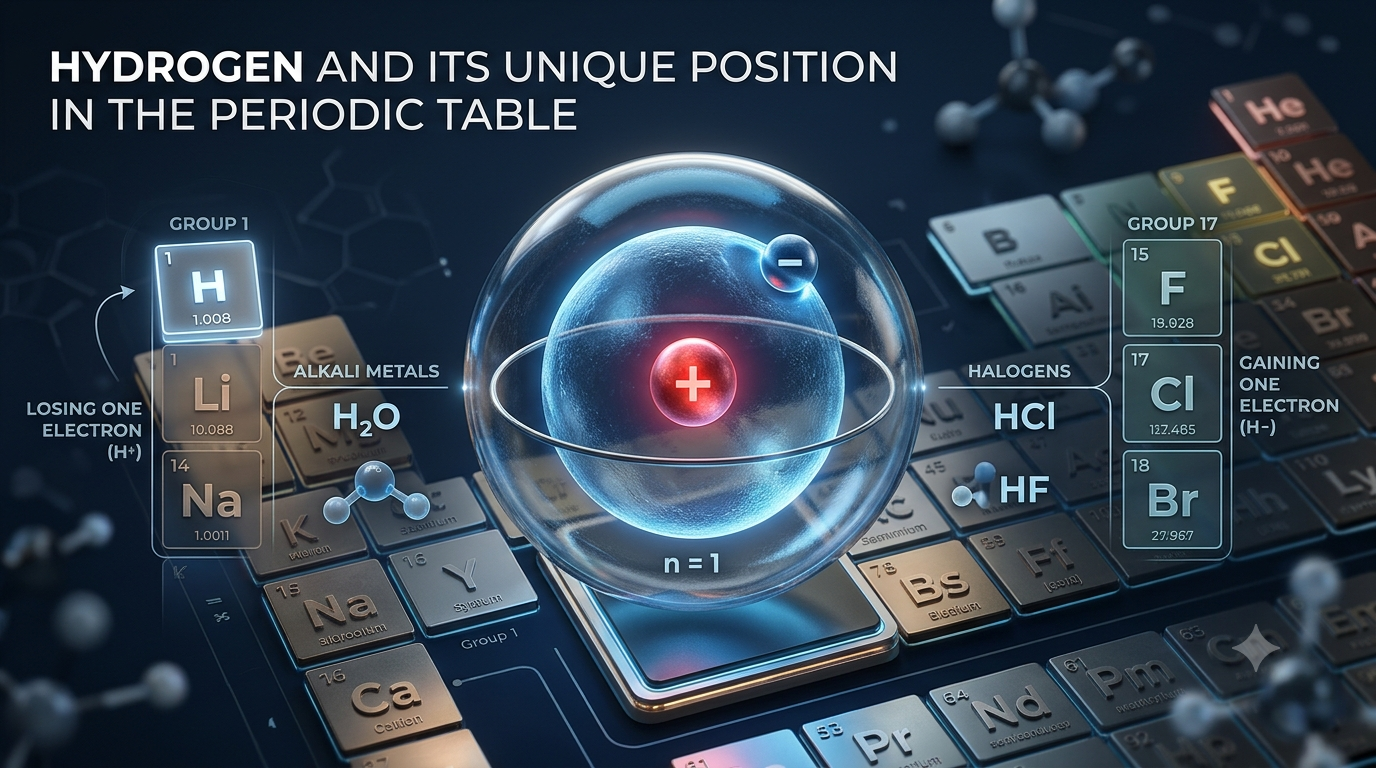
Hydrogen occupies a unique position in the periodic table because its properties do not fit perfectly into any single group. It is commonly placed in Group 1, above the alkali metals, because it has one electron in its outermost shell. However, it also shares certain characteristics with Group 17 elements, known as halogens. In some chemical reactions, hydrogen can even exist as a negatively charged ion, making its behaviour different from both groups.
This unusual combination of properties makes hydrogen an exceptional element. Understanding its position helps explain the organisation of the periodic table, chemical bonding, atomic structure, and periodic trends.
1. What Is Hydrogen?
Hydrogen is a chemical element represented by the symbol H. It is the lightest and simplest element in the periodic table. Under normal conditions, hydrogen exists as a colourless, odourless, and highly flammable gas.
Unlike most elements, which contain several protons and electrons, the most common hydrogen atom contains only one proton and one electron. It has no neutron in its most abundant isotope.
Some important properties of hydrogen include:
Chemical symbol: H
Atomic number: 1
Relative atomic mass: Approximately 1.008 u
Electronic configuration: 1s¹
Group: 1 (commonly displayed)
Period: 1
Block: s-block
State at room temperature: Gas
Nature: Non-metal
Valency: Usually 1
Hydrogen is the most abundant element in the universe. It is a major component of stars and is the primary fuel involved in the nuclear fusion reactions that power the Sun.
On Earth, hydrogen is commonly found combined with other elements. For example, water contains hydrogen and oxygen, while many organic compounds contain hydrogen bonded to carbon.
2. Atomic Structure of Hydrogen
The atomic structure of hydrogen is extremely simple compared with that of other elements. Its simplicity makes it an important element for understanding basic atomic theory.
A typical hydrogen atom consists of:
One proton in its nucleus.
One electron surrounding the nucleus.
No neutron in its most common isotope.
The proton carries a positive electrical charge, while the electron carries a negative electrical charge. Since these charges are equal in magnitude and opposite in sign, a neutral hydrogen atom has no overall electrical charge.
Hydrogen’s electron occupies the first and only occupied energy level in its ground state. This electron is represented by the electronic configuration 1s¹.
The electronic configuration is particularly important because an element’s chemical behaviour is strongly influenced by the arrangement of its electrons.
Hydrogen has only one electron, so it needs one additional electron to achieve the stable electron configuration of helium. This explains why hydrogen commonly forms one covalent bond or loses one electron during certain chemical reactions.
3. Why Is Hydrogen Placed in Group 1?
Hydrogen is generally placed at the top of Group 1 in the periodic table. The main reason is its electronic configuration.
The elements of Group 1 have one electron in their outermost electron shell. Hydrogen also has one electron, making its electronic configuration similar in this particular respect.
For example:
Hydrogen: 1s¹
Lithium: 1s² 2s¹
Sodium: 1s² 2s² 2p⁶ 3s¹
Potassium: [Ar] 4s¹
All these elements have one electron in their outermost occupied shell.
Group 1 elements, except hydrogen, are known as alkali metals. They generally lose their outermost electron to form positively charged ions with a +1 charge.
Hydrogen can also lose its only electron and form a positively charged hydrogen ion (H⁺).
However, there is an important difference. Alkali metals are metallic solids under normal conditions, whereas hydrogen is a non-metallic gas.
Therefore, hydrogen is placed in Group 1 mainly because of its electronic configuration, not because it shares all the physical and chemical properties of alkali metals.
4. Why Does Hydrogen Show Similarities with Group 17?
Hydrogen also shares certain characteristics with Group 17 elements, known as halogens.
Halogens have seven electrons in their outermost electron shell. They generally need one additional electron to complete their outer shell and achieve a stable electron configuration.
Hydrogen has one electron in its only occupied shell. Its first energy level can hold a maximum of two electrons, so hydrogen also needs one additional electron to complete this shell.
This creates an important similarity between hydrogen and halogens.
For example:
Hydrogen has one electron and needs one more to complete its first shell.
Fluorine has seven valence electrons and needs one more to complete its outer shell.
Chlorine has seven valence electrons and also needs one more electron.
Hydrogen can gain one electron to form the hydride ion (H⁻), just as halogens commonly gain one electron to form negatively charged ions.
However, hydrogen and halogens are not identical. Hydrogen has a much smaller atomic size, different ionisation energy characteristics, and different physical properties.
This is why hydrogen cannot be considered a typical halogen.
5. Why Is Hydrogen Considered a Unique Element?
Hydrogen is considered unique because it does not completely match the chemical and physical characteristics of any other group in the periodic table.
Its unusual position is mainly due to the following reasons.
5.1 It Has Only One Electron
Hydrogen is the only element whose most common atom contains just one proton and one electron, without any neutron.
Its single electron determines most of its chemical behaviour.
5.2 It Can Lose an Electron
Hydrogen can lose its only electron to form a positively charged hydrogen ion.
H → H⁺ + e⁻
This behaviour resembles the electron-loss behaviour of Group 1 elements.
5.3 It Can Gain an Electron
Hydrogen can also gain one electron to form a negatively charged hydride ion.
H + e⁻ → H⁻
This behaviour resembles the electron-gain behaviour of Group 17 elements.
5.4 It Forms Covalent Bonds
Hydrogen frequently shares its electron with other atoms to form covalent bonds.
For example, two hydrogen atoms share their electrons to form a hydrogen molecule (H₂).
Hydrogen also forms covalent bonds with oxygen in water (H₂O) and with carbon in many organic compounds.
5.5 It Exists as a Diatomic Molecule
Under normal conditions, hydrogen exists mainly as H₂ molecules rather than individual hydrogen atoms.
This property is also observed in several non-metallic elements, including nitrogen, oxygen, and halogens.
These characteristics explain why hydrogen cannot be classified as a typical alkali metal or halogen.
6. Hydrogen’s Position in the Periodic Table
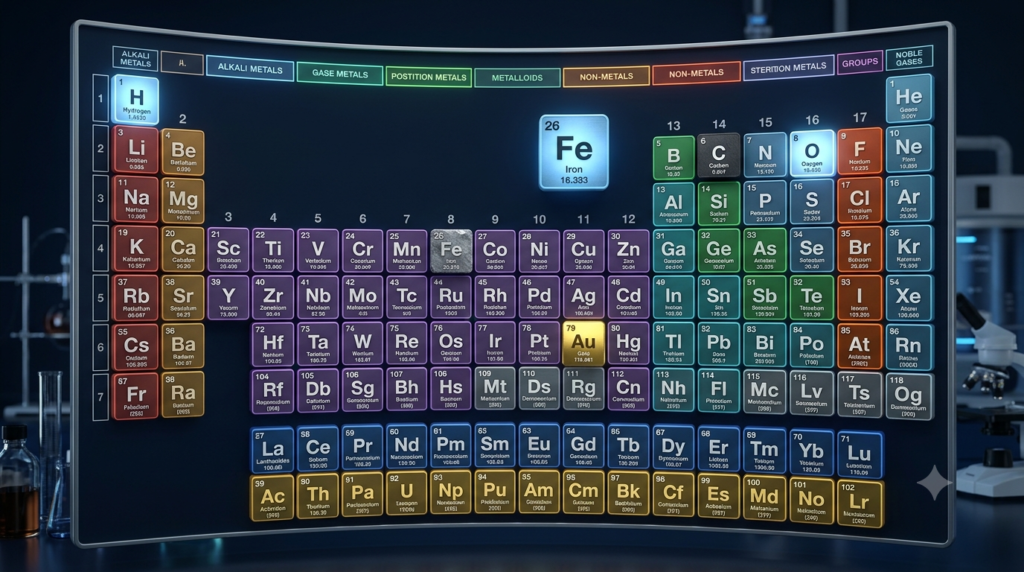
Hydrogen is located in Period 1 of the periodic table because its electrons occupy only the first principal energy level.
It is commonly shown above Group 1 because it has one valence electron.
However, its placement is sometimes shown separately or discussed as a special case in advanced periodic table representations.
The periodic table is arranged according to increasing atomic number and repeating chemical properties. Hydrogen’s position reflects its atomic structure, but its chemical properties make its classification more complicated.
There are three important ways to understand its position:
Period 1: Hydrogen belongs to the first period because it has only one occupied electron shell.
Group 1: It is commonly placed in Group 1 because its electronic configuration ends in 1s¹.
s-block: Its only electron occupies an s orbital, so hydrogen belongs to the s-block according to its electronic configuration.
Although these classifications are useful, hydrogen remains chemically different from the other elements placed in Group 1.
7. Chemical Properties of Hydrogen
Hydrogen participates in many chemical reactions and forms compounds with a wide variety of elements.
Its chemical properties are closely related to its single electron.
7.1 Reaction with Oxygen
Hydrogen reacts with oxygen to produce water. This reaction releases a large amount of energy.
2H₂ + O₂ → 2H₂O
This reaction is highly exothermic, meaning that it releases heat.
Because hydrogen can react rapidly with oxygen, mixtures of hydrogen and air can be explosive under suitable conditions.
7.2 Reaction with Halogens
Hydrogen reacts with halogens to form hydrogen halides.
For example, hydrogen reacts with chlorine to produce hydrogen chloride.
H₂ + Cl₂ → 2HCl
Hydrogen chloride dissolves in water to form hydrochloric acid.
7.3 Reaction with Metals
Hydrogen can react with certain reactive metals to form metal hydrides.
For example, sodium reacts with hydrogen to form sodium hydride.
2Na + H₂ → 2NaH
In sodium hydride, hydrogen exists as a negatively charged hydride ion (H⁻).
7.4 Reaction with Nitrogen
Hydrogen reacts with nitrogen under suitable industrial conditions to produce ammonia.
N₂ + 3H₂ ⇌ 2NH₃
This reaction is the basis of the Haber process, which is widely used to manufacture ammonia for fertilisers and other industrial applications.
8. Different Oxidation States of Hydrogen
One of the most interesting features of hydrogen is its ability to show different oxidation states depending on the compound in which it is present.
Hydrogen commonly exhibits two oxidation states: +1 and −1.
8.1 Positive Oxidation State (+1)
Hydrogen generally has an oxidation state of +1 when bonded to non-metals.
For example:
H₂O: Hydrogen has an oxidation state of +1.
HCl: Hydrogen has an oxidation state of +1.
NH₃: Hydrogen has an oxidation state of +1.
In these compounds, hydrogen is generally assigned a positive oxidation state.
8.2 Negative Oxidation State (−1)
Hydrogen has an oxidation state of −1 in many metal hydrides.
For example:
NaH: Hydrogen has an oxidation state of −1.
CaH₂: Hydrogen has an oxidation state of −1.
LiH: Hydrogen has an oxidation state of −1.
In these compounds, hydrogen is more electronegative than the metal with which it is bonded.
The ability to show both positive and negative oxidation states is another reason for hydrogen’s unusual chemical behaviour.
9. Isotopes of Hydrogen
Hydrogen has three naturally occurring isotopes: protium, deuterium, and tritium.
Isotopes are atoms of the same element that have the same number of protons but different numbers of neutrons.
All three isotopes have one proton, but their neutron numbers are different.
9.1 Protium (¹H)
Protium is the most common isotope of hydrogen. It contains one proton and no neutron.
It accounts for approximately 99.985% of naturally occurring hydrogen.
9.2 Deuterium (²H or D)
Deuterium contains one proton and one neutron.
It is also known as heavy hydrogen because it has approximately twice the mass of protium.
Deuterium is naturally present in water in small quantities and is used in scientific research and nuclear applications.
9.3 Tritium (³H or T)
Tritium contains one proton and two neutrons.
Unlike protium and deuterium, tritium is radioactive. It undergoes radioactive decay and has a half-life of approximately 12.3 years.
Tritium is used in certain scientific research applications, specialised lighting systems, and nuclear fusion research.
The existence of these isotopes demonstrates that hydrogen can have different nuclear structures while remaining the same chemical element.
10. Comparison Between Hydrogen, Alkali Metals, and Halogens
Hydrogen shares some properties with both Group 1 and Group 17 elements, but it also has several characteristics that make it different.
| Property | Hydrogen | Alkali Metals | Halogens |
|---|---|---|---|
| Group | Commonly placed in Group 1 | Group 1 | Group 17 |
| Valence electrons | 1 | 1 | 7 |
| Nature | Non-metal | Metals | Non-metals |
| Physical state | Gas | Solids | Gases, liquid, or solids |
| Common ion | H⁺ or H⁻ | M⁺ | X⁻ |
| Typical bonding | Covalent and ionic | Mainly metallic and ionic compounds | Covalent and ionic compounds |
| Reactivity | Varies with reaction conditions | Generally highly reactive | Generally highly reactive |
This comparison shows that hydrogen has similarities with both groups but cannot be completely classified as either an alkali metal or a halogen.
11. Why Is Hydrogen Not Classified as an Alkali Metal?
Although hydrogen is positioned above Group 1, it does not share the typical properties of alkali metals.
There are several important differences.
Physical state: Hydrogen is a gas at room temperature, whereas alkali metals are solid metals.
Electrical conductivity: Hydrogen gas does not conduct electricity under ordinary conditions, while alkali metals are good electrical conductors.
Metallic character: Hydrogen is a non-metal, whereas lithium, sodium, potassium, and other alkali metals are metallic elements.
Chemical bonding: Hydrogen commonly forms covalent bonds, while alkali metals frequently form ionic compounds by losing their outermost electrons.
Density: Hydrogen is extremely light, whereas alkali metals are much denser than hydrogen gas.
Therefore, hydrogen is not considered an alkali metal even though it shares the same number of valence electrons.
12. Why Is Hydrogen Not Classified as a Halogen?
Hydrogen also shares similarities with halogens, but there are important differences.
Halogens have seven valence electrons and belong to Group 17. Hydrogen has only one electron in its first shell.
Halogens generally have high electron affinities and electronegativities. Hydrogen has different values and does not show exactly the same chemical behaviour.
Additionally, halogens commonly form diatomic molecules such as F₂, Cl₂, Br₂, and I₂. Hydrogen also exists as a diatomic molecule (H₂), but its bonding and chemical properties are different.
Hydrogen can form both positive and negative ions, while halogens commonly form negative ions in ionic compounds.
These differences explain why hydrogen is not classified as a typical halogen.
13. Importance of Hydrogen in Nature
Hydrogen is one of the most important elements in the universe and plays a major role in many natural processes.
13.1 Abundance in the Universe
Hydrogen is the most abundant element in the observable universe by mass. It forms a major part of stars and interstellar gas clouds.
Stars generate energy through nuclear fusion processes in which hydrogen nuclei combine to form helium.
13.2 Presence in Water
Water has the chemical formula H₂O, meaning that each water molecule contains two hydrogen atoms and one oxygen atom.
Water is essential for life and supports many biological and environmental processes.
13.3 Presence in Living Organisms
Hydrogen is present in carbohydrates, proteins, fats, and nucleic acids.
It also plays an important role in maintaining the structure of biological molecules and participating in chemical reactions within living cells.
13.4 Role in the Environment
Hydrogen participates in several atmospheric and environmental chemical reactions. It is also involved in the water cycle through its presence in water molecules.
14. Applications and Uses of Hydrogen
Hydrogen has many industrial, scientific, and technological applications.
14.1 Fuel Cells
Hydrogen can be used in fuel cells to produce electricity through an electrochemical reaction involving oxygen.
The main products of a hydrogen fuel cell are water, heat, and electrical energy.
Fuel cells are used in certain vehicles, backup power systems, and specialised energy applications.
14.2 Ammonia Production
Hydrogen is an important raw material in the manufacture of ammonia.
Ammonia is widely used in the production of nitrogen-based fertilisers, which support modern agriculture.
14.3 Petroleum Refining
Hydrogen is used in petroleum refining processes, including hydrocracking and hydrodesulfurisation.
These processes help produce useful fuels and reduce the sulphur content of petroleum products.
14.4 Metal Processing
Hydrogen can be used as a reducing agent in certain metal-processing operations.
It is also being investigated as a potential alternative to carbon-based reducing agents in some industrial processes.
14.5 Space Exploration
Liquid hydrogen is used as a rocket propellant, generally in combination with liquid oxygen.
The combustion of hydrogen and oxygen produces water vapour and releases substantial energy, making this combination useful in certain rocket engines.
14.6 Energy Storage
Hydrogen can store energy produced from renewable sources such as solar and wind power.
Electricity can be used to produce hydrogen through water electrolysis. The hydrogen can then be stored and used later in fuel cells or industrial processes.
However, hydrogen production, compression, storage, and transportation require energy and specialised infrastructure.
15. The Importance of Hydrogen in Understanding the Periodic Table
Hydrogen provides an important example of how the periodic table is organised according to atomic structure while also showing that chemical classification is not always straightforward.
The periodic table is based primarily on increasing atomic number and repeating patterns in electron configurations and chemical properties.
Hydrogen has only one electron, so it naturally fits the electronic pattern of Group 1. However, its non-metallic nature and ability to gain an electron create similarities with other groups.
Studying hydrogen helps explain several important chemical concepts:
The relationship between atomic number and electron configuration.
The importance of valence electrons in chemical reactions.
The formation of positive and negative ions.
The differences between metals and non-metals.
The role of electron sharing in covalent bonding.
The limitations of classifying elements using only one property.
Hydrogen demonstrates that the periodic table is a scientific system for organising elements, but the behaviour of individual elements can be more complex than their group position suggests.
Conclusion
Hydrogen is one of the most remarkable elements in the periodic table. Although it has the simplest atomic structure, its chemical behaviour is unusually diverse. It contains one proton and one electron, has an electronic configuration of 1s¹, and is commonly placed in Group 1 because of its single valence electron.
However, hydrogen differs significantly from alkali metals because it is a non-metallic gas. It also shares certain characteristics with Group 17 elements because it can gain one electron to complete its first electron shell. Its ability to form both positive and negative ions further demonstrates its unique nature.
Hydrogen is essential to the universe, life, industrial chemistry, and modern energy technologies. Its unusual position in the periodic table makes it an important element for understanding atomic structure, chemical bonding, and periodic classification.
In short, hydrogen is a special element that connects several important chemical concepts while maintaining a distinct identity of its own.
FAQs
1. Why is hydrogen considered a unique element in the periodic table?
Hydrogen is considered unique because its properties do not completely match those of any single group in the periodic table. It has one valence electron, similar to Group 1 elements, and can lose this electron to form H⁺. However, it can also gain one electron to form H⁻, showing similarities with Group 17 elements. Unlike alkali metals, hydrogen is a non-metallic gas. It also forms covalent bonds and exists as a diatomic molecule (H₂). These unusual characteristics make hydrogen different from other elements and give it a special position in the periodic table.
2. Why is hydrogen placed in Group 1 of the periodic table?
Hydrogen is commonly placed in Group 1 because its electronic configuration is 1s¹, meaning it has one electron in its outermost shell. Group 1 elements, such as lithium, sodium, and potassium, also have one valence electron. Hydrogen can lose this electron to form a positively charged ion (H⁺), similar to alkali metals. However, hydrogen is not an alkali metal because it is a non-metal and exists as a gas at room temperature. Its placement in Group 1 is mainly based on its electronic configuration rather than identical chemical and physical properties.
3. Does hydrogen belong to Group 1 or Group 17?
Hydrogen is generally placed in Group 1 because it has one valence electron. However, it also shares certain properties with Group 17 elements, known as halogens. Like halogens, hydrogen needs one additional electron to complete its outermost shell. It can gain an electron to form a negatively charged hydride ion (H⁻). Despite these similarities, hydrogen does not completely match either group. Therefore, most periodic tables display hydrogen above Group 1, while recognising it as a unique element with characteristics that connect it to both groups.
4. Why is hydrogen not considered an alkali metal?
Hydrogen is not considered an alkali metal because its physical and chemical properties are significantly different from those of typical Group 1 metals. Hydrogen is a colourless, non-metallic gas at room temperature, whereas alkali metals are solid metallic elements. Hydrogen does not conduct electricity under ordinary conditions and commonly forms covalent bonds. Although it has one valence electron and can form a positive ion (H⁺), these similarities are not sufficient to classify it as an alkali metal. Its position above Group 1 mainly represents its electronic configuration.
5. What is the electronic configuration of hydrogen?
The electronic configuration of hydrogen is 1s¹. This means that a hydrogen atom has only one electron, which occupies the 1s orbital of the first energy level. Hydrogen has an atomic number of 1, so its neutral atom contains one proton and one electron. The first energy level can hold a maximum of two electrons. Therefore, hydrogen needs one additional electron to complete its first shell and achieve the stable electronic configuration of helium. This simple electronic arrangement explains why hydrogen commonly forms one chemical bond and can participate in different types of chemical reactions.
6. Can hydrogen form both positive and negative ions?
Yes, hydrogen can form both positive and negative ions depending on the chemical environment. When hydrogen loses its only electron, it forms a positively charged hydrogen ion (H⁺). This behaviour is commonly observed in reactions involving acids and other chemical compounds. Hydrogen can also gain one electron to form a negatively charged hydride ion (H⁻), particularly in compounds with highly electropositive metals such as sodium and calcium. This ability to form ions with opposite charges is one of the main reasons hydrogen has a unique position in the periodic table.
7. What are the three isotopes of hydrogen?
The three naturally occurring isotopes of hydrogen are protium, deuterium, and tritium. Protium is the most common isotope and contains one proton with no neutron. Deuterium contains one proton and one neutron and is also called heavy hydrogen. Tritium contains one proton and two neutrons and is radioactive. All three isotopes have the same atomic number because each contains one proton. However, their mass numbers are different because they contain different numbers of neutrons. These isotopes are important in scientific research, nuclear applications, and the study of atomic structure.
8. What is the oxidation state of hydrogen in chemical compounds?
Hydrogen commonly shows two oxidation states: +1 and −1. It generally has an oxidation state of +1 when combined with non-metals such as oxygen, chlorine, and nitrogen. For example, hydrogen has an oxidation state of +1 in water (H₂O) and hydrogen chloride (HCl). However, when hydrogen combines with highly electropositive metals, it generally shows an oxidation state of −1. For example, hydrogen has an oxidation state of −1 in sodium hydride (NaH) and calcium hydride (CaH₂). These different oxidation states demonstrate the flexibility of hydrogen in chemical reactions.
9. Why does hydrogen exist as a diatomic molecule?
Hydrogen normally exists as a diatomic molecule (H₂) because two hydrogen atoms can share their electrons to form a stable covalent bond. Each hydrogen atom has one electron and needs one additional electron to complete its first energy level. When two hydrogen atoms combine, they share an electron pair, allowing each atom to achieve a stable two-electron arrangement. This shared electron pair holds the two atoms together. As a result, hydrogen gas is mainly composed of H₂ molecules rather than individual hydrogen atoms under ordinary conditions.
10. Why is hydrogen important in chemistry and everyday life?
Hydrogen is important because it is involved in many natural, biological, industrial, and technological processes. It is a major component of water and organic compounds found in living organisms. In industries, hydrogen is used to manufacture ammonia, refine petroleum, and process certain metals. It is also used in fuel cells to generate electricity and as a rocket propellant when combined with liquid oxygen. Additionally, hydrogen plays a major role in nuclear fusion reactions inside stars, including the Sun. Its wide range of applications makes it one of the most important elements in modern science and technology.