Chemistry is the study of matter, its properties, composition, and the changes it undergoes. To understand and communicate these ideas clearly, chemists need a simple and reliable language. Chemical formulas are an important part of that language. They allow us to represent substances using symbols and numbers instead of writing their complete names and descriptions every time.
A chemical formula can tell us which elements are present in a substance and, in many cases, how many atoms of each element are present. For example, H₂O represents water and shows that each water molecule contains two hydrogen atoms and one oxygen atom. Similarly, CO₂ represents carbon dioxide, while NaCl represents sodium chloride.
Chemical formulas are important not only for naming or identifying substances. They are used to understand composition, calculate quantities, write chemical equations, study reactions, determine molecular and formula masses, and connect microscopic particles with measurable amounts of matter. Understanding why chemical formulas matter provides a strong foundation for learning chemistry.
What Is a Chemical Formula?
A chemical formula is a symbolic representation of a chemical substance. It uses chemical symbols for elements and numbers called subscripts to show the relative number of atoms or ions present.
For example:
In H₂O, the subscript 2 applies to hydrogen, meaning there are two hydrogen atoms for every one oxygen atom. Because oxygen has no subscript, its number is understood to be one.
Different substances have different types of formulas. Molecular formulas show the actual number of atoms in a molecule, while empirical formulas show the simplest whole-number ratio of elements. Ionic compounds are commonly represented by formula units that show the simplest ratio of ions needed to make the compound electrically neutral.
Chemical Formulas Provide a Short Language for Chemistry
One of the biggest advantages of chemical formulas is that they make chemical information concise.
Writing the name “water” is already simple, but a chemical formula provides additional information. H₂O immediately shows that water contains hydrogen and oxygen in a 2:1 ratio.
Compare this with describing the composition in words:
“Water is a substance made from hydrogen and oxygen, with two hydrogen atoms associated with one oxygen atom.”
The formula H₂O communicates the same basic information much more efficiently.
This becomes even more useful for complex substances. Instead of repeatedly writing long chemical names or descriptions, chemists can use formulas to communicate information quickly and consistently.
Chemical Formulas Show the Composition of Substances
A chemical formula tells us which elements make up a substance.
For example, CO₂ contains:
The subscript 2 indicates that the formula contains two oxygen atoms for every one carbon atom.
Similarly, CaCO₃ contains calcium, carbon, and oxygen. The formula shows that one formula unit contains one calcium atom, one carbon atom, and three oxygen atoms.
This information is essential because the properties of a substance depend strongly on its composition and structure. Knowing which elements are present allows chemists to begin understanding how a substance may behave.
Chemical Formulas Help Identify Substances
Chemical formulas provide a convenient way to distinguish substances.
For example, H₂O represents water, while H₂O₂ represents hydrogen peroxide. Both substances contain hydrogen and oxygen, but their formulas are different.
H₂O → Water
H₂O₂ → Hydrogen peroxide
The difference in the number of oxygen atoms is significant. These substances have different properties and behave differently in chemical reactions.
This example shows why the numbers in chemical formulas are important. A small change in a formula can represent a completely different substance.
Chemical Formulas Help Explain Chemical Composition
Chemical formulas do more than identify elements. They also show the proportions in which those elements occur.
Consider carbon dioxide:
CO₂
The formula indicates a ratio of one carbon atom to two oxygen atoms.
Now consider carbon monoxide:
CO
Here, carbon and oxygen occur in a 1:1 ratio.
Although both substances contain carbon and oxygen, their different compositions give them different chemical properties.
Therefore, chemical formulas help chemists understand how elements are combined and how changes in composition can produce different substances.
Chemical Formulas Are Essential for Writing Chemical Equations
Chemical reactions involve substances changing into new substances. Chemical formulas make it possible to represent these changes using chemical equations.
For example, hydrogen reacts with oxygen to form water:
2H₂ + O₂ → 2H₂O
This equation communicates several pieces of information at once. It shows the reactants, the product, the formulas of the substances involved, and the relative amounts required in the reaction.
Without chemical formulas, writing chemical equations would become much longer and less convenient.
Chemical formulas therefore provide the basic building blocks for representing chemical reactions.
Chemical Formulas Help Balance Chemical Equations
A chemical equation must obey the law of conservation of mass. Atoms are not created or destroyed during an ordinary chemical reaction, so the same number of atoms of each element must appear on both sides of the equation.
Chemical formulas make it possible to count these atoms.
For example:
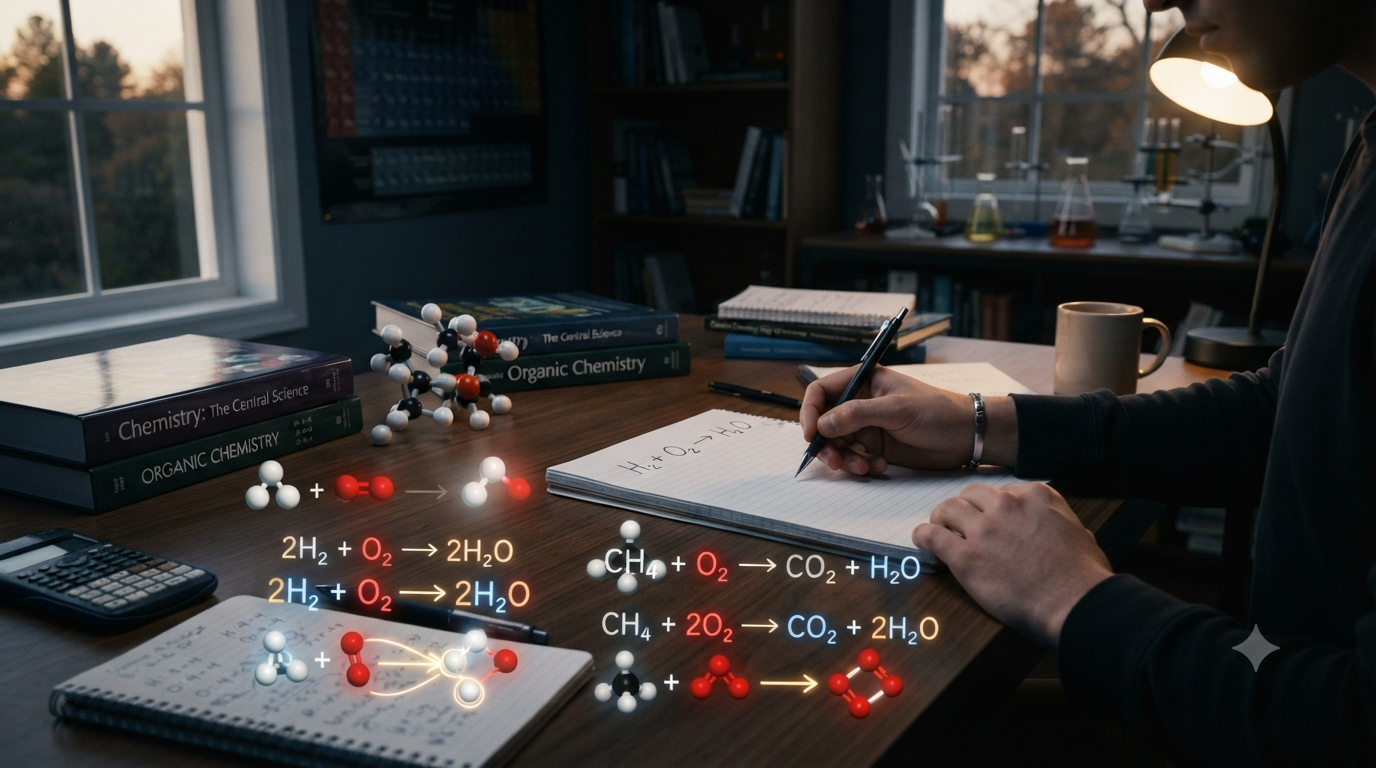
H₂ + O₂ → H₂O
This equation is not balanced because there are two oxygen atoms on the left but only one oxygen atom on the right.
The balanced equation is:
2H₂ + O₂ → 2H₂O
Now there are four hydrogen atoms and two oxygen atoms on both sides.
Chemical formulas therefore help chemists track atoms during chemical reactions and ensure that equations correctly represent the conservation of matter.
Chemical Formulas Help Calculate Molecular and Formula Mass
Another important use of chemical formulas is calculating the mass of substances.
For example, the formula H₂O tells us that water contains two hydrogen atoms and one oxygen atom. Using the relative atomic masses from the periodic table, we can calculate its molecular mass.
Approximately:
H₂O = 2(1) + 16 = 18
Therefore, the molecular mass of water is approximately 18 atomic mass units.
For ionic compounds, a similar calculation gives the formula mass. For example:
NaCl = 23 + 35.5 = 58.5
These calculations are important in laboratory work, chemical analysis, and quantitative chemistry.
Chemical Formulas Are Important in Stoichiometry
Stoichiometry is the part of chemistry concerned with quantitative relationships between substances in chemical reactions.
Chemical formulas are fundamental to stoichiometric calculations because they provide the information needed to determine the composition and ratios of substances.
Consider:
N₂ + 3H₂ → 2NH₃
The equation shows that one molecule of nitrogen reacts with three molecules of hydrogen to produce two molecules of ammonia.
At the mole level, the same equation represents:
1 mol N₂ + 3 mol H₂ → 2 mol NH₃
These ratios allow chemists to calculate how much reactant is required or how much product can be formed.
Without accurate chemical formulas and balanced equations, such calculations would not be possible.
Chemical Formulas Connect Atoms With Measurable Quantities
Chemistry connects the microscopic world of atoms and molecules with quantities that can be measured in a laboratory.
Chemical formulas provide an important link between these two levels.
For example, H₂O represents individual water molecules at the microscopic level. The same formula is used when discussing moles and masses of water at the macroscopic level.
If we know the formula of a compound, we can determine its molar mass and use that information to convert between mass, moles, and numbers of particles.
This connection is one of the reasons chemical formulas are so important in practical chemistry.
Chemical Formulas Help Determine Elemental Composition
A chemical formula can also be used to determine the percentage of each element present in a compound by mass.
For example, water contains hydrogen and oxygen. Because the formula is H₂O, we know the relative number of hydrogen and oxygen atoms. Their atomic masses can then be used to calculate their contribution to the total mass.
This type of calculation is called percentage composition.
The general relationship is:
Percentage of an element = (Mass contributed by the element ÷ Molar mass of the compound) × 100
Such calculations are useful in chemical analysis and in determining the composition of unknown substances.
Chemical Formulas Help Distinguish Molecular and Ionic Substances
Chemical formulas also help us understand how different types of substances are represented.
Molecular compounds are made of molecules. For example:
H₂O
CO₂
CH₄
Ionic compounds consist of positive and negative ions arranged in a repeating structure. Their formulas represent the simplest whole-number ratio of ions.
For example:
NaCl
CaCl₂
Al₂O₃
CaCl₂ indicates that calcium ions and chloride ions occur in a 1:2 ratio. This ratio is necessary for electrical neutrality because calcium forms Ca²⁺ ions while chloride forms Cl⁻ ions.
Thus, chemical formulas can also provide information about the relationships between ions in ionic compounds.
Chemical Formulas Help Predict Chemical Relationships
A formula can provide clues about how atoms are combined within a compound.
For example, the formula CaCl₂ suggests that calcium and chlorine are present in a 1:2 ratio. Understanding common ionic charges helps explain why this formula is correct.
Similarly, formulas of molecular compounds can provide information about the atoms present and their proportions.
Although a chemical formula does not always show the complete three-dimensional structure of a substance, it provides an essential starting point for understanding its composition and chemical behavior.
Chemical Formulas Are Used in Laboratory Work
Chemical formulas are a regular part of laboratory chemistry.
Chemists use them when:
Preparing chemical solutions
Measuring reactants
Calculating required quantities
Identifying chemicals
Writing reaction equations
Recording experimental observations
Calculating concentrations
Interpreting chemical tests
For example, if a laboratory procedure requires sodium hydroxide, the formula NaOH allows the chemist to identify the substance and use its molar mass in calculations.
Accurate formulas are especially important because confusing two substances with similar names or compositions can lead to incorrect calculations or experimental results.
Chemical Formulas Are Important in Everyday Chemistry
Chemical formulas are not limited to laboratories and textbooks. They appear in many areas of everyday life.
The formula CO₂ is associated with carbon dioxide in discussions of respiration, combustion, and the atmosphere. NaCl represents sodium chloride, commonly known as table salt. CaCO₃ occurs in materials such as limestone and chalk.
Chemical formulas are also used in medicine, agriculture, food science, environmental science, materials science, and industrial chemistry.
Whenever scientists need to identify or describe a chemical substance precisely, chemical formulas provide a compact and standardized method.
Chemical Formulas Make Scientific Communication Universal
Science involves communication between people from different countries, languages, and educational backgrounds. Chemical formulas help reduce language barriers because chemical symbols are internationally recognized.
For example, a scientist seeing H₂O can understand that the formula represents water regardless of whether the accompanying text is written in English, Marathi, Hindi, French, or another language.
This universal nature makes chemical formulas especially valuable in scientific publications, laboratories, education, and international research.
Chemical Formulas Are Different From Chemical Names
A chemical name and a chemical formula provide related but different information.
For example:
Water → H₂O
Carbon dioxide → CO₂
Calcium carbonate → CaCO₃
The name identifies the substance verbally, while the formula provides information about its elemental composition and ratio.
Learning both names and formulas is therefore important in chemistry. Knowing only the name may not tell you how many atoms or ions are present, while knowing only the formula may not always be enough to communicate easily in ordinary language.
Chemical Formulas Have Limitations
Although chemical formulas are extremely useful, they do not provide every detail about a substance.
For example, H₂O tells us that water contains hydrogen and oxygen in a 2:1 atomic ratio. However, the formula alone does not show the bent shape of a water molecule, the exact bond angles, or all of its physical properties.
Structural formulas, Lewis structures, molecular models, and other representations are used when more detailed information is needed.
Therefore, chemical formulas should be viewed as an essential starting point rather than a complete description of every aspect of a substance.
Why Learning Chemical Formulas Is Important for Chemistry Students and Curious Learners
Learning chemical formulas provides a foundation for many areas of chemistry.
Once you understand formulas, it becomes easier to learn:
Chemical equations
Balancing equations
Stoichiometry
Molar mass
Mole calculations
Concentration
Acids and bases
Ionic compounds
Organic compounds
Chemical reactions
Percentage composition
Chemical formulas are therefore not an isolated topic. They connect many different concepts throughout chemistry.
A strong understanding of chemical symbols, subscripts, coefficients, valency, ionic charges, and formula writing makes later chemistry topics easier to understand.
Conclusion
Chemical formulas are important in chemistry because they provide a concise and universal way to represent substances. They show which elements are present and, depending on the type of formula, how those elements are related in a substance.
Chemical formulas help identify compounds, describe composition, write and balance chemical equations, calculate molecular and formula masses, perform stoichiometric calculations, determine percentage composition, and communicate scientific information clearly. They also connect the microscopic world of atoms and molecules with measurable quantities such as moles and grams.
From simple substances such as H₂O and CO₂ to complex compounds used in medicine, technology, and industry, chemical formulas are at the heart of chemical communication. Learning to read and write them is therefore one of the most important steps toward understanding how chemistry describes the world around us.