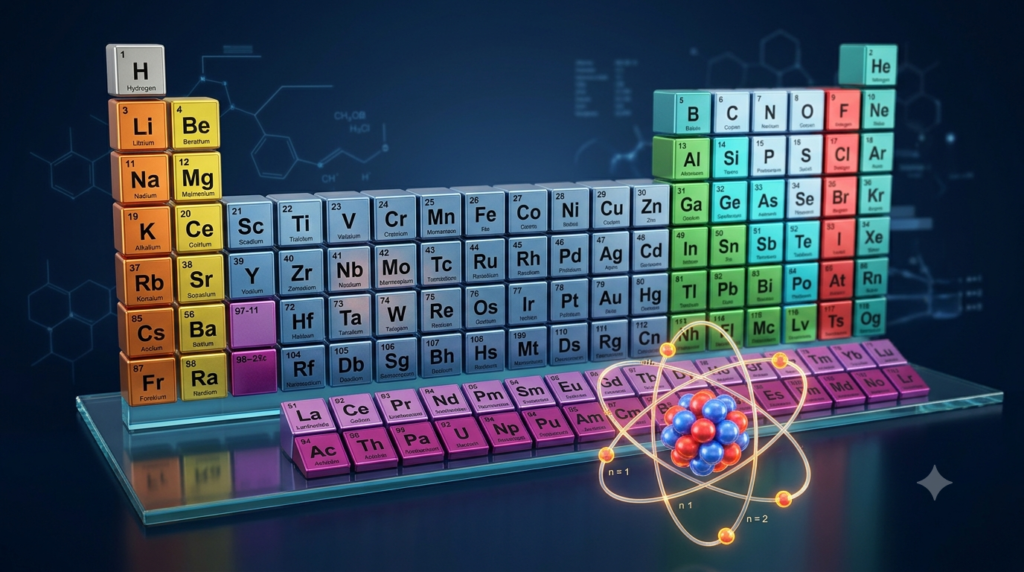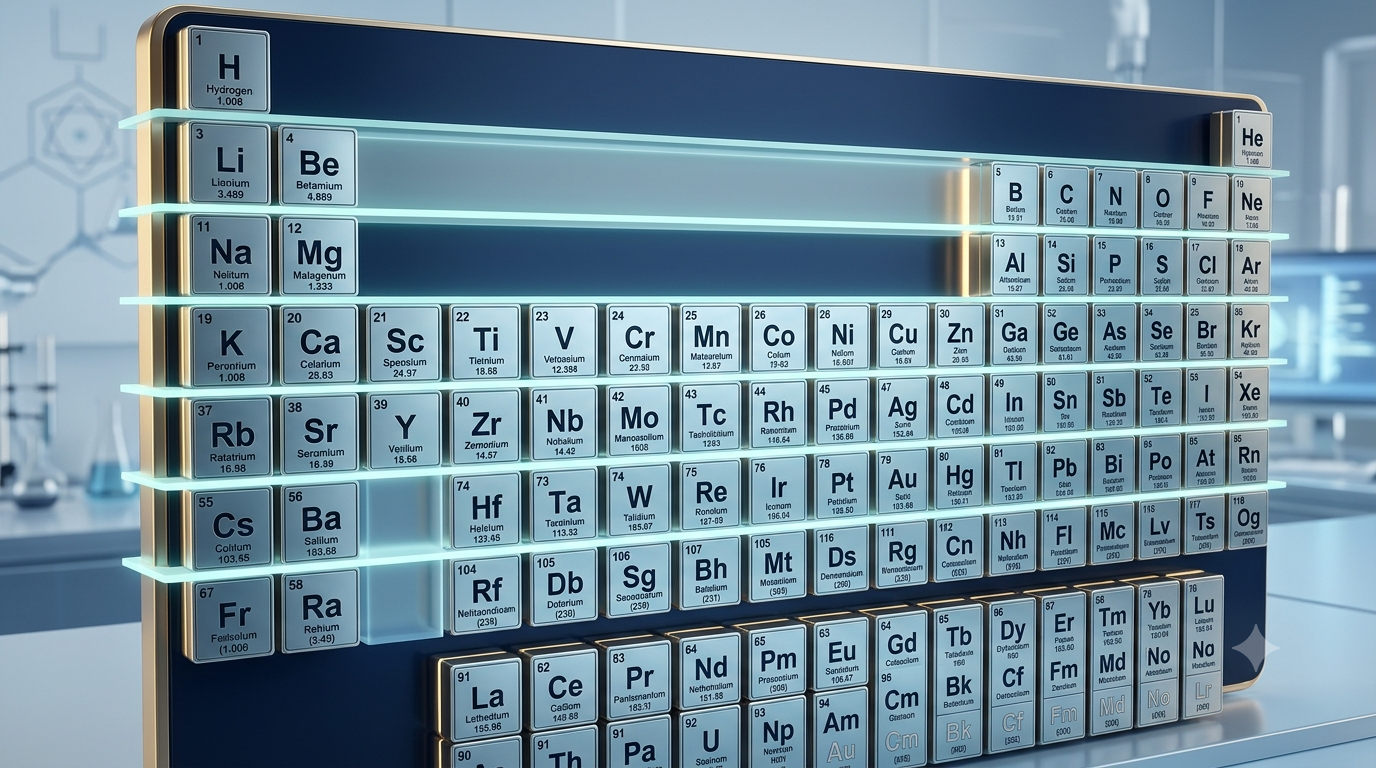
The periodic table is one of the most important tools in chemistry. It organizes all known chemical elements according to their atomic numbers and recurring chemical properties. Each element has a specific position in the table, and this position provides valuable information about its atomic structure, electron arrangement, and chemical behaviour.
The horizontal rows of the periodic table are called periods. There are seven periods in the modern periodic table, and each one represents a particular stage in the arrangement of electrons around an atom’s nucleus. Understanding periods helps explain why elements have different properties and how their behaviour changes across the periodic table.
Periods also help us understand the relationship between atomic number, electron configuration, atomic size, metallic character, and other periodic properties. By studying the arrangement of elements in periods, we can recognize important patterns in the structure and behaviour of matter.
What Are Periods in the Periodic Table?
Periods are the seven horizontal rows of elements in the modern periodic table. Elements are arranged from left to right in increasing order of atomic number.
Each period begins with an element that generally has one electron in its outermost shell, except the first period, and ends with a noble gas. As we move from left to right across a period, the atomic number increases by one for each successive element.
The elements in the same period have the same number of occupied principal electron shells in their ground-state atoms. However, they do not have the same number of valence electrons or identical chemical properties.
For example, all elements in Period 2 have two occupied electron shells. These elements include lithium, beryllium, boron, carbon, nitrogen, oxygen, fluorine, and neon.
The number of elements in each period is different because different electron subshells are filled as we move through the periodic table.
How Many Periods Are There in the Periodic Table?
The modern periodic table contains seven periods. Each period has a different number of elements depending on the electron subshells involved in that row.
The seven periods are:
| Period | Number of Elements | First Element | Last Element |
|---|---|---|---|
| 1 | 2 | Hydrogen (H) | Helium (He) |
| 2 | 8 | Lithium (Li) | Neon (Ne) |
| 3 | 8 | Sodium (Na) | Argon (Ar) |
| 4 | 18 | Potassium (K) | Krypton (Kr) |
| 5 | 18 | Rubidium (Rb) | Xenon (Xe) |
| 6 | 32 | Caesium (Cs) | Radon (Rn) |
| 7 | 32 | Francium (Fr) | Oganesson (Og) |
The total number of elements represented in these seven periods is 118.
Each period has a characteristic electron-filling pattern. The first three periods are relatively short, while the fourth through seventh periods are longer because they include additional electron subshells.
Explanation of the Seven Periods
Each period has a specific arrangement of elements and electron configurations. Understanding the individual periods makes it easier to learn how the periodic table is organized.
1. First Period
The first period is the shortest period in the periodic table. It contains only two elements: hydrogen and helium.
Hydrogen (H) – Atomic number 1
Helium (He) – Atomic number 2
Both elements have only one occupied electron shell.
Hydrogen has one electron in its first shell, while helium has two electrons in the same shell. The first electron shell can hold a maximum of two electrons, so it becomes completely filled with helium.
Hydrogen has unique chemical properties and does not fit perfectly into any single group. Helium is a noble gas because its outermost shell is completely filled, making it very unreactive under normal conditions.
2. Second Period
The second period contains eight elements, beginning with lithium and ending with neon.
The elements are:
Lithium (Li) – Atomic number 3
Beryllium (Be) – Atomic number 4
Boron (B) – Atomic number 5
Carbon (C) – Atomic number 6
Nitrogen (N) – Atomic number 7
Oxygen (O) – Atomic number 8
Fluorine (F) – Atomic number 9
Neon (Ne) – Atomic number 10
All these elements have two occupied electron shells.
As we move from lithium to neon, the number of electrons in the second shell increases. Lithium has one electron in its outermost shell, while neon has eight.
This period contains metals, a metalloid, and nonmetals. Lithium and beryllium are metals, boron is a metalloid, and the remaining elements are nonmetals.
Neon is a noble gas with a completely filled outermost shell.
3. Third Period
The third period also contains eight elements, beginning with sodium and ending with argon.
The elements are:
Sodium (Na) – Atomic number 11
Magnesium (Mg) – Atomic number 12
Aluminium (Al) – Atomic number 13
Silicon (Si) – Atomic number 14
Phosphorus (P) – Atomic number 15
Sulfur (S) – Atomic number 16
Chlorine (Cl) – Atomic number 17
Argon (Ar) – Atomic number 18
All elements in this period have three occupied electron shells.
The third period shows a gradual change in properties from metals to nonmetals.
Sodium and magnesium are metals with high chemical reactivity. Aluminium is also a metal and is widely used in construction and manufacturing.
Silicon is a metalloid that plays an important role in electronic devices and semiconductor technology. Phosphorus, sulfur, and chlorine are nonmetals with different chemical properties.
Argon is a noble gas with a completely filled outermost shell, making it chemically stable under normal conditions.
4. Fourth Period
The fourth period contains 18 elements, beginning with potassium and ending with krypton.
It includes the following elements:
Potassium (K), Calcium (Ca), Scandium (Sc), Titanium (Ti), Vanadium (V), Chromium (Cr), Manganese (Mn), Iron (Fe), Cobalt (Co), Nickel (Ni), Copper (Cu), Zinc (Zn), Gallium (Ga), Germanium (Ge), Arsenic (As), Selenium (Se), Bromine (Br), and Krypton (Kr).
All elements in this period have four occupied electron shells.
An important feature of the fourth period is the appearance of the first transition series. Transition elements occupy the central part of the periodic table and involve the filling of the 3d subshell.
Iron, copper, nickel, chromium, and zinc are examples of elements found in this period.
Many fourth-period elements are important in everyday life. Iron is used in steel production, copper is used in electrical wiring, and titanium is valued for its strength and resistance to corrosion.
The period ends with krypton, a noble gas.
5. Fifth Period
The fifth period contains 18 elements, beginning with rubidium and ending with xenon.
It includes rubidium, strontium, yttrium, zirconium, niobium, molybdenum, technetium, ruthenium, rhodium, palladium, silver, cadmium, indium, tin, antimony, tellurium, iodine, and xenon.
All these elements have five occupied electron shells.
Like the fourth period, the fifth period contains a transition series. In this period, the 4d subshell is progressively filled.
Several elements in this period have important industrial applications. Silver is used in jewellery and electronics, tin is used in coatings and alloys, and iodine is important in biological processes.
Xenon is a noble gas that appears at the end of this period.
6. Sixth Period
The sixth period contains 32 elements, beginning with caesium and ending with radon.
It includes two important sections: the main elements of the period and the lanthanide series.
The lanthanide series contains 15 elements, from lanthanum to lutetium. These elements are associated with the filling of the 4f subshell.
The sixth period includes caesium, barium, lanthanum, the lanthanides, hafnium, tantalum, tungsten, rhenium, osmium, iridium, platinum, gold, mercury, thallium, lead, bismuth, polonium, astatine, and radon.
All elements in this period have six occupied electron shells.
Several elements have significant applications. Gold and platinum are used in jewellery and specialized industrial applications. Tungsten is known for its high melting point, while lead is used in certain batteries and radiation shielding applications.
The period ends with radon, a radioactive noble gas.
7. Seventh Period
The seventh period is the last period of the modern periodic table. It contains 32 elements, beginning with francium and ending with oganesson.
It includes the actinide series, which contains 15 elements from actinium to lawrencium. These elements are associated with the filling of the 5f subshell.
The seventh period includes francium, radium, actinium, the actinides, rutherfordium, dubnium, seaborgium, bohrium, hassium, meitnerium, darmstadtium, roentgenium, copernicium, nihonium, flerovium, moscovium, livermorium, tennessine, and oganesson.
All elements in this period have seven occupied electron shells.
Many seventh-period elements are radioactive. Several of them are synthetic, meaning they are produced artificially in laboratories or nuclear research facilities rather than occurring naturally in significant quantities.
Uranium and plutonium are well-known actinides that have important applications in nuclear science and technology.
Oganesson, with atomic number 118, is currently the last element in the modern periodic table.
Why Do Periods Have Different Numbers of Elements?
Not all periods contain the same number of elements because electron shells contain different subshells, and each subshell has a specific electron capacity.
An electron shell can contain one or more subshells, commonly identified as s, p, d, and f.
Their maximum electron capacities are:
| Subshell | Maximum Number of Electrons |
|---|---|
| s | 2 |
| p | 6 |
| d | 10 |
| f | 14 |
The number of elements in a period is related to the number of electrons added while the relevant subshells are being filled.
For example:
The first period contains 2 elements because the 1s subshell can hold 2 electrons.
The second and third periods contain 8 elements because the s and p subshells are filled.
The fourth and fifth periods contain 18 elements because they include the filling of s, d, and p subshells.
The sixth and seventh periods contain 32 elements because they also involve f-subshell filling.
This electron-filling pattern explains why the lengths of the periods are different.
Relationship Between Periods and Electron Shells
One of the most important characteristics of periods is their relationship with electron shells.
An atom consists of a central nucleus containing protons and neutrons, surrounded by electrons arranged in different energy levels.
These energy levels are commonly represented by the shell numbers 1, 2, 3, 4, 5, 6, and 7.
The period number generally indicates the highest occupied principal energy level in the ground-state electron configuration of an element.
For example:
Lithium is in Period 2 because its electron configuration is 2, 1.
Sodium is in Period 3 because its electron configuration is 2, 8, 1.
Potassium is in Period 4 because its electron configuration is 2, 8, 8, 1.
Calcium is in Period 4 because its electron configuration is 2, 8, 8, 2.
This relationship makes it easier to determine the period of an element when its electron configuration is known.
Difference Between Periods and Groups
Periods and groups are two important ways of organizing elements in the periodic table. Although both describe the position of elements, they represent different directions and patterns.
Periods are horizontal rows, while groups are vertical columns.
| Basis | Periods | Groups |
|---|---|---|
| Arrangement | Horizontal rows | Vertical columns |
| Number | 7 | 18 |
| Direction | Left to right | Top to bottom |
| Main relationship | Occupied electron shells | Similar outer-electron configurations and chemical properties |
| Example | Lithium and neon are in Period 2 | Lithium and sodium are in Group 1 |
Elements in the same period have the same number of occupied principal electron shells, whereas elements in the same main-group column generally have the same number of valence electrons.
For example, lithium and sodium belong to Group 1. Both have one valence electron, although they belong to different periods.
Understanding this difference is essential for reading and interpreting the periodic table correctly.
Trends in Properties Across a Period
As we move from left to right across a period, several physical and chemical properties of elements change in a regular pattern. These changes are known as periodic trends.
1. Atomic Radius
Atomic radius generally decreases from left to right across a period.
This happens because the number of protons in the nucleus increases as atomic number increases. The added electrons enter the same principal energy level, so the increasing nuclear attraction generally pulls the electron cloud closer to the nucleus.
As a result, atoms generally become smaller across a period.
2. Metallic Character
Metallic character generally decreases from left to right across a period.
Elements on the left side of a period are usually metals. They tend to lose electrons more easily and form positive ions.
As we move towards the right, elements become less metallic. Nonmetallic elements become more common.
For example, sodium is a highly reactive metal, while chlorine is a reactive nonmetal. Both belong to Period 3.
3. Ionization Energy
Ionization energy generally increases from left to right across a period.
Ionization energy is the energy required to remove an electron from an isolated gaseous atom.
As nuclear charge increases and atomic radius generally decreases, electrons are held more strongly. Therefore, more energy is usually needed to remove an electron.
However, there are some exceptions because of electron subshell arrangements and electron pairing.
4. Electronegativity
Electronegativity generally increases from left to right across a period.
It describes the ability of an atom to attract shared electrons in a chemical bond.
Nonmetals on the right side of a period generally have higher electronegativity values than metals on the left.
Fluorine is the most electronegative element.
Noble gases are commonly excluded from basic electronegativity comparisons because many of them do not normally form chemical bonds.
5. Valence Electrons
For main-group elements, the number of valence electrons generally increases from left to right across a period.
For example, the elements of Period 2 have the following valence-electron counts:
Lithium: 1
Beryllium: 2
Boron: 3
Carbon: 4
Nitrogen: 5
Oxygen: 6
Fluorine: 7
Neon: 8
This pattern helps explain why elements in the same period can have very different chemical properties.
Importance of Periods in Chemistry
Periods are important because they provide a systematic way to understand the arrangement and behaviour of elements.
Some major reasons why periods are useful include:
1. Understanding electron configuration: Periods help identify the number of occupied principal electron shells in an atom.
2. Predicting chemical properties: The position of an element across a period provides information about its metallic character, electronegativity, and ionization energy.
3. Studying atomic structure: Periods help explain how electrons are arranged around the nucleus.
4. Understanding periodic trends: They make it easier to identify changes in atomic size, ionization energy, and other properties.
5. Comparing elements: By examining elements in the same period, chemists can understand how their properties change with increasing atomic number.
6. Learning chemical bonding: The arrangement of valence electrons across a period helps explain how elements form ionic and covalent bonds.
How to Identify the Period of an Element
Identifying the period of an element is relatively simple when you know its electron configuration.
The general method is to identify the highest occupied principal energy level in the ground-state electron configuration.
Follow these steps:
Find the atomic number of the element.
Write its ground-state electron configuration.
Identify the highest principal energy level that contains electrons.
The corresponding period number gives the element’s position in the periodic table.
For example, consider magnesium.
Magnesium has atomic number 12, and its shell-wise electron configuration is 2, 8, 2.
Its electrons occupy three shells. Therefore, magnesium belongs to Period 3.
Similarly, calcium has the electron configuration 2, 8, 8, 2. It has four occupied shells, so it belongs to Period 4.
This method works for elements across the periodic table, including transition elements and inner transition elements, when their complete electron configurations are considered.
Conclusion
Periods are the seven horizontal rows of the modern periodic table. They organize elements according to increasing atomic number and provide important information about their electron arrangements and chemical properties.
Each period represents a particular pattern of electron-shell occupancy, which helps explain why the number of elements differs from one period to another. The first period contains only two elements, while the sixth and seventh periods contain 32 elements each.
Understanding periods also makes it easier to study periodic trends such as atomic radius, metallic character, ionization energy, and electronegativity. Together with groups, periods provide the foundation for understanding the structure of the periodic table and predicting the behaviour of chemical elements.
FAQs
1. What are periods in the periodic table?
Periods are the seven horizontal rows in the modern periodic table. Elements are arranged in these rows according to increasing atomic number. Each period represents a particular pattern of electron-shell occupancy in the ground-state atoms of its elements. Elements in the same period have the same number of occupied principal electron shells. For example, all elements in Period 2 have two occupied electron shells. There are seven periods in total, and they contain 118 elements. Studying periods helps us understand electron configurations, atomic structure, and changes in chemical properties across the periodic table.
2. How many periods are there in the modern periodic table?
The modern periodic table contains seven periods. These are numbered from 1 to 7, starting with the shortest period at the top. The first period contains 2 elements, the second and third contain 8 elements each, the fourth and fifth contain 18 elements each, and the sixth and seventh contain 32 elements each. Together, these periods include all 118 officially recognized chemical elements. Each period represents a different pattern of electron-shell occupancy and subshell filling. The arrangement makes it easier to study the relationship between atomic structure and the chemical properties of elements.
3. Why are periods called horizontal rows?
Periods are called horizontal rows because elements are arranged from left to right across the periodic table. Their atomic numbers increase by one as we move from one element to the next. Each horizontal row represents elements with the same number of occupied principal electron shells in their ground-state atoms. For example, lithium, carbon, oxygen, and neon are all located in Period 2 because their atoms have two occupied electron shells. This horizontal arrangement also helps us observe periodic trends, including changes in atomic radius, metallic character, ionization energy, and electronegativity.
4. Why do different periods contain different numbers of elements?
Different periods contain different numbers of elements because electron shells have different subshells, and each subshell has a specific electron capacity. The s subshell holds a maximum of 2 electrons, the p subshell holds 6, the d subshell holds 10, and the f subshell holds 14. The first period contains 2 elements, while the second and third contain 8 each. The fourth and fifth contain 18 each, and the sixth and seventh contain 32 each. These differences are explained by the order in which electron subshells are filled.
5. What is the relationship between periods and electron shells?
Periods are directly related to the occupied principal electron shells of atoms. The period number generally indicates the highest occupied principal energy level in the ground-state electron configuration of an element. For example, sodium belongs to Period 3 because its electron configuration is 2, 8, 1. Its electrons occupy three shells. Similarly, potassium belongs to Period 4 because its electrons occupy four shells. This relationship helps students identify the period of an element by examining its electron configuration. It also explains why elements in the same period have the same number of occupied principal electron shells.
6. What is the difference between periods and groups in the periodic table?
Periods and groups represent two different arrangements of elements in the periodic table. Periods are the seven horizontal rows, whereas groups are the 18 vertical columns. Elements in the same period have the same number of occupied principal electron shells. In contrast, elements in the same main-group column generally have the same number of valence electrons and similar chemical properties. For example, lithium and sodium belong to Group 1 but different periods. Lithium is in Period 2, while sodium is in Period 3. Both arrangements help chemists understand and predict the behaviour of elements.
7. What happens to atomic radius across a period?
Atomic radius generally decreases as we move from left to right across a period. This happens because the number of protons in the nucleus increases, while the added electrons generally enter the same principal energy level. The increasing positive nuclear charge attracts the electrons more strongly towards the nucleus. Consequently, the size of the atoms generally becomes smaller across the period. For example, in Period 3, sodium has a larger atomic radius than chlorine. This trend is useful for understanding atomic structure, chemical bonding, and the physical and chemical behaviour of elements.
8. What happens to metallic character across a period?
Metallic character generally decreases from left to right across a period. Elements on the left side of a period are usually metals that tend to lose electrons and form positive ions. As we move towards the right, elements generally become less metallic and more nonmetallic. For example, sodium and magnesium are metals in Period 3, while sulfur and chlorine are nonmetals. Silicon, located between metals and nonmetals, is a metalloid. This gradual change in properties is an important periodic trend and helps explain why elements in the same period can behave differently during chemical reactions.
9. Which period contains the maximum number of elements?
The sixth and seventh periods contain the maximum number of elements in the modern periodic table, with 32 elements each. The sixth period includes the lanthanide series, while the seventh period includes the actinide series. These additional elements are associated with the filling of f subshells, which increases the total number of elements in these periods. The sixth period begins with caesium and ends with radon, while the seventh begins with francium and ends with oganesson. Both periods are important for understanding transition elements, inner transition elements, and the arrangement of electrons in larger atoms.
10. How can we identify the period of an element using its electron configuration?
We can identify the period of an element by examining its ground-state electron configuration and finding the highest occupied principal energy level. The corresponding principal energy level generally gives the period number. For example, magnesium has the shell-wise electron configuration 2, 8, 2. Its electrons occupy three shells, so it belongs to Period 3. Calcium has the configuration 2, 8, 8, 2, meaning that its electrons occupy four shells. Therefore, it belongs to Period 4. This method is useful for understanding the relationship between atomic structure and the arrangement of elements in the periodic table.