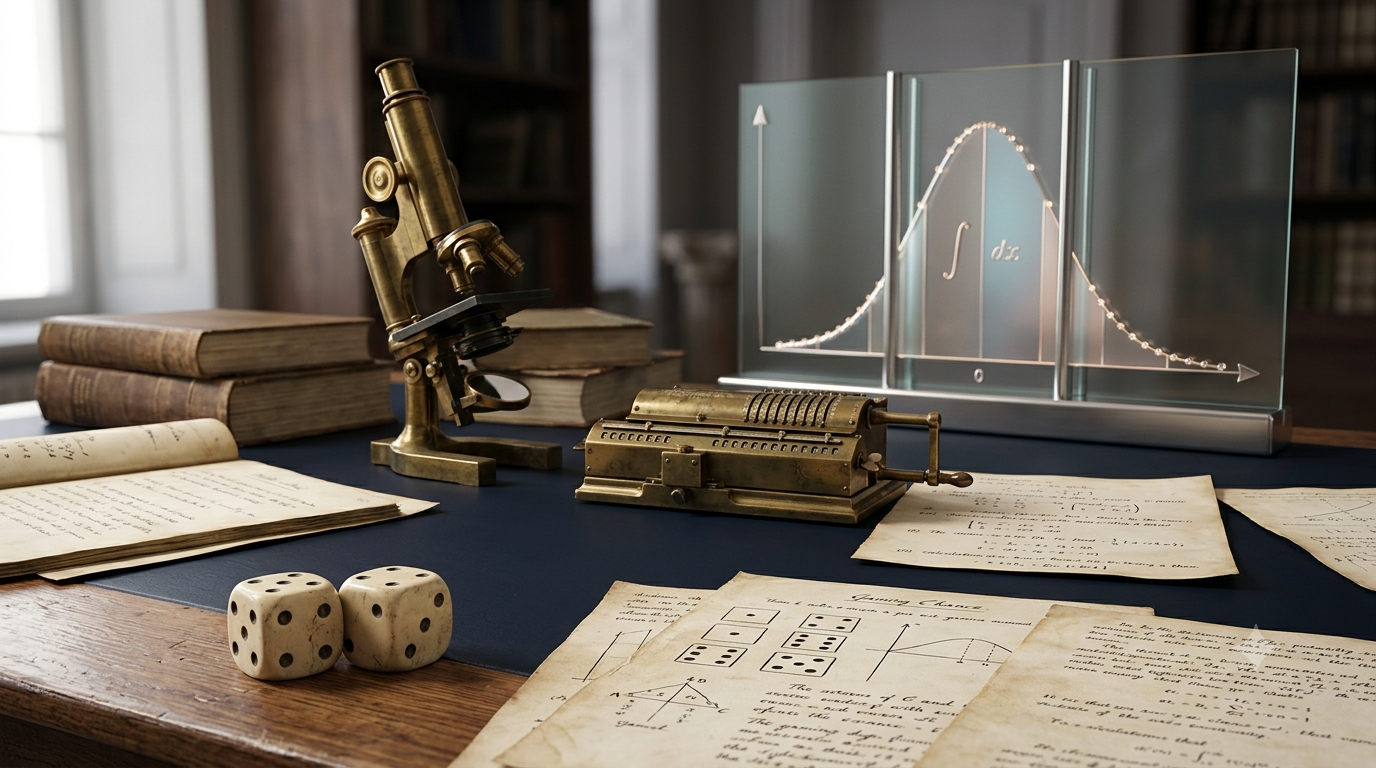
Probability is an important branch of mathematics that helps us understand uncertainty and estimate how likely an event is to happen. From predicting the weather and studying diseases to playing games and analyzing scientific experiments, probability plays a major role in everyday life. Today, it is used in mathematics, statistics, physics, economics, computer science, artificial intelligence, and many other fields. However, probability did not develop into a scientific discipline overnight. Its history began with simple questions about games of chance and gradually expanded into a powerful mathematical framework for understanding uncertain events. Over several centuries, mathematicians developed new methods, theories, and applications that transformed probability into one of the foundations of modern science. Learning about the history and development of probability helps us understand not only how mathematical ideas evolve but also how people have learned to make better decisions in situations where the outcome is uncertain.
1. What Is Probability?
Probability is the branch of mathematics concerned with measuring the likelihood that an event will occur. It provides a numerical way to describe uncertainty, allowing us to compare different possible outcomes and make informed predictions.
For example, when a fair coin is tossed, there are two possible outcomes: heads and tails. Assuming both outcomes are equally likely, the probability of obtaining heads is one-half. Similarly, when a fair six-sided die is rolled, each number has an equal chance of appearing.
Probability values range from 0 to 1. A probability of 0 represents an impossible event, while a probability of 1 represents a certain event. Values between these limits describe different degrees of likelihood.
The basic formula for classical probability is:
Text block — Probability Formula
Probability of an event = Number of favorable outcomes ÷ Total number of equally likely outcomes
For example, a fair six-sided die has six possible outcomes. Only one of these outcomes is the number 4.
Probability of rolling a 4 = 1 ÷ 6
This simple idea forms the foundation of many probability calculations. However, modern probability includes much more than games of chance. It also provides tools for analyzing random processes, scientific observations, financial risks, and complex systems.
2. The Early Origins of Probability
2.1 Probability Before It Became a Mathematical Subject
The earliest roots of probability can be traced to ancient human activities involving uncertainty. People in different civilizations encountered uncertain outcomes while hunting, trading, making decisions, and participating in games.
Ancient dice and dice-like objects have been discovered in archaeological sites, demonstrating that games of chance existed thousands of years ago. These objects were made from materials such as bones, stones, and other natural substances.
Although people understood that certain outcomes occurred more frequently than others, they did not initially have a systematic mathematical theory for measuring chance.
Many early societies interpreted uncertain events through religious, philosophical, or supernatural beliefs. The idea of calculating probability mathematically developed much later, when thinkers began investigating patterns in games and examining whether uncertainty could be described using numbers.
2.2 Ancient Games of Chance
Games involving dice, lots, and other random mechanisms were important in the early history of probability. These activities created practical questions about which outcomes were more likely and whether some strategies were better than others.
For example, players might have wondered whether a particular combination of dice appeared more frequently than another or whether one game offered better chances of winning.
Such questions required careful observation and eventually encouraged mathematical reasoning about possible outcomes.
However, the existence of games of chance did not automatically produce a formal theory. A major challenge was learning how to count possible outcomes correctly and distinguish equally likely outcomes from those that were not equally likely.
These questions became central to the later development of probability.
3. The Development of Probability During the Middle Ages
During the Middle Ages, mathematical knowledge continued to develop through the work of scholars in different parts of the world. Mathematics from ancient Greek, Indian, Persian, and other traditions was preserved, studied, and expanded through scholarly exchanges.
Although probability had not yet become an independent mathematical discipline, several developments helped prepare the way for it.
3.1 The Growth of Arithmetic and Combinatorics
Combinatorics is the branch of mathematics concerned with counting, arranging, and selecting objects. It later became essential to probability because calculating the likelihood of an event often requires counting possible outcomes.
For example, to determine the probability of obtaining two heads when tossing two fair coins, we must identify the possible combinations of results.
The possible outcomes are:
Heads and heads
Heads and tails
Tails and heads
Tails and tails
Only one of these four equally likely outcomes contains two heads.
Therefore:
Text block — Example Formula
Probability of two heads = 1 ÷ 4 = ¼
The development of counting techniques made it easier to solve such problems systematically.
3.2 Contributions From Different Mathematical Traditions
Scholars working in India, the Islamic world, China, and Europe contributed to the development of arithmetic, algebra, and counting methods. These subjects later provided important tools for probability theory.
For example, mathematical work on combinations and arrangements helped establish techniques for determining the number of possible outcomes in complicated situations.
It is important to distinguish these early contributions from the formal birth of probability theory. Although the mathematical foundations developed over many centuries, the systematic study of probability as a separate subject emerged primarily in seventeenth-century Europe through investigations into gambling problems.
4. The Seventeenth Century: The Birth of Modern Probability
The seventeenth century marks a major turning point in the history of probability. Mathematicians began to investigate games of chance using organized mathematical reasoning rather than relying only on intuition or experience.
Two figures played especially important roles in this development: Blaise Pascal and Pierre de Fermat.
4.1 The Problem of Points
One of the most famous early probability problems is known as the problem of points.
Imagine two players participating in a game in which each round gives one player a point. The first player to reach a predetermined score wins the game. However, suppose the game must stop before either player reaches that score.
How should the players divide the prize fairly?
The answer cannot simply be based on the number of points each player currently has. The players’ chances of winning if the game continued must also be considered.
This problem encouraged mathematicians to think about possible future outcomes and calculate the chances associated with them.
4.2 Blaise Pascal
Blaise Pascal was a French mathematician, physicist, and philosopher who made important contributions to the early development of probability.
In 1654, Pascal corresponded with Pierre de Fermat about problems involving games of chance, particularly the problem of points. Their exchange helped establish systematic mathematical methods for calculating probabilities.
Pascal also contributed to combinatorics through work associated with what is now known as Pascal’s triangle. This triangular arrangement of numbers helps determine binomial coefficients and is useful for counting combinations.
These counting methods later became important in probability calculations involving repeated trials and multiple possible outcomes.
4.3 Pierre de Fermat
Pierre de Fermat was a French mathematician whose work helped establish the foundations of modern probability.
In his correspondence with Pascal, Fermat developed methods for examining possible sequences of future outcomes and determining how a prize should be divided fairly when a game ended early.
Their work demonstrated that uncertainty could be analyzed through mathematical reasoning. Rather than simply guessing which player deserved the prize, it was possible to consider all relevant outcomes and calculate the players’ chances of success.
The correspondence between Pascal and Fermat is widely recognized as a foundational event in the history of probability theory.
5. Christiaan Huygens and the First Probability Textbook
In 1657, Dutch mathematician Christiaan Huygens published De ratiociniis in ludo aleae, a work commonly translated as On Reasoning in Games of Chance.
This publication is generally regarded as the first printed book devoted specifically to probability.
Huygens developed mathematical methods for analyzing games of chance and calculating expected gains. His work helped turn the ideas explored by Pascal and Fermat into a more organized body of knowledge.
5.1 The Idea of Expected Value
Expected value is one of the most important concepts in probability. It represents the average outcome that would be expected over many repetitions of a random experiment, assuming the probabilities and outcomes remain stable.
For example, suppose a game pays ₹100 with a probability of one-half and ₹0 with a probability of one-half. Ignoring any cost to play, its expected payout is ₹50.
Text block — Expected Value Formula
Expected value = Sum of (Outcome × Probability of that outcome)
For the example:
Expected payout = (₹100 × ½) + (₹0 × ½) = ₹50
This does not mean the player will receive ₹50 in a single round. The actual payout will be either ₹100 or ₹0. The expected value describes the probability-weighted average, not a guaranteed result.
The concept became useful far beyond gambling. Today, expected value is applied in insurance, economics, scientific decision-making, and risk analysis.
6. The Eighteenth Century: Probability Becomes More Powerful
During the eighteenth century, probability expanded beyond the analysis of gambling. Mathematicians began applying its principles to statistics, population studies, astronomy, insurance, and scientific observations.
Several important thinkers contributed to this expansion.
6.1 Jacob Bernoulli and the Law of Large Numbers
Jacob Bernoulli was a Swiss mathematician whose work helped establish a connection between probability and long-term observations.
His influential book Ars Conjectandi, published posthumously in 1713, presented important ideas about probability and combinatorics.
One of the major concepts associated with Bernoulli is the law of large numbers.
The law of large numbers explains that, under suitable conditions, the observed proportion of an outcome tends to approach its theoretical probability as the number of independent trials increases.
Consider a fair coin. The theoretical probability of heads is one-half. If the coin is tossed only four times, the proportion of heads could be very different from one-half. If it is tossed thousands of times, the observed proportion will generally tend to become closer to one-half.
This principle is important because it connects mathematical probability with actual observations.
However, it does not guarantee that every short sequence will be balanced or that the next toss becomes more likely to produce heads after a series of tails.
6.2 Abraham de Moivre and the Normal Distribution
Abraham de Moivre was a mathematician known for important contributions to probability and statistics.
In his 1733 work on approximating probabilities associated with the binomial distribution, he developed results that contributed to the later understanding of the normal distribution.
The normal distribution is a continuous probability distribution with a characteristic bell-shaped curve. Many measurement errors and naturally occurring quantities can be modeled approximately using this distribution, although not every real-world dataset follows it.
For example, repeated measurements of a physical quantity may cluster around an average value, with fewer measurements appearing far from the center.
The normal distribution later became an essential tool in statistical analysis, experimental science, and quality control.
6.3 Thomas Bayes and Conditional Probability
Thomas Bayes was an English mathematician and minister whose work contributed to the development of conditional probability.
His essay on the subject was published posthumously in 1763. It presented a method for reasoning about an unknown probability using observed evidence.
The resulting framework is associated with Bayes’ theorem.
Text block — Bayes’ Theorem
P(A | B) = [P(B | A) × P(A)] ÷ P(B)
Here:
P(A | B) means the probability of event A given that event B has occurred.
P(B | A) means the probability of observing B if A is true.
P(A) is the prior probability of A.
P(B) is the overall probability of observing B.
Bayes’ theorem is useful when new evidence changes how plausible an explanation appears.
For example, doctors may use test results alongside information about how common a disease is to estimate the likelihood that a patient actually has the condition. The result depends on factors such as the test’s accuracy and the disease’s prevalence.
Today, Bayesian methods are used in scientific research, machine learning, medical analysis, and decision-making under uncertainty.
7. Pierre-Simon Laplace and the Expansion of Probability
Pierre-Simon Laplace was a French mathematician and astronomer who made major contributions to probability theory during the late eighteenth and early nineteenth centuries.
Laplace developed and organized many probability methods, demonstrating how they could be used to analyze problems involving astronomy, scientific measurements, and human affairs.
His influential work Théorie analytique des probabilités, published in 1812, helped establish probability as a broad mathematical discipline.
7.1 Probability in Scientific Research
Scientists frequently make observations that contain uncertainty. Instruments have measurement errors, experiments produce variable results, and predictions cannot always be perfectly accurate.
Probability provides methods for describing and analyzing this uncertainty.
For example, astronomers can use statistical methods to study observational errors, compare competing explanations, and estimate uncertain quantities.
Laplace helped demonstrate that probability was not merely a mathematical curiosity associated with games. It could also support the systematic investigation of natural phenomena.
7.2 The Development of Statistical Inference
Statistical inference involves using observed data to draw conclusions about a larger population or an underlying process.
Suppose researchers examine a sample of plants to estimate the average height of all plants in a field. The sample may not represent the entire field perfectly, so the estimate contains uncertainty.
Probability provides a framework for understanding how sampling variation affects conclusions.
The development of probability and statistics gradually created many of the methods now used in scientific experiments, surveys, medical studies, and economic research.
8. The Nineteenth Century: Probability Becomes More Mathematical
During the nineteenth century, probability continued to develop through work on distributions, errors of measurement, and the mathematical structure of random events.
8.1 Carl Friedrich Gauss and Measurement Errors
Carl Friedrich Gauss was a German mathematician and scientist who contributed to the study of measurement errors and the normal distribution.
Scientific measurements often differ slightly even when researchers attempt to measure the same quantity repeatedly. Such differences may result from instrument limitations, environmental conditions, or other sources of variation.
Mathematical models help scientists distinguish ordinary measurement variation from potentially meaningful differences.
The normal distribution became closely associated with the analysis of errors, although its use depends on the assumptions and characteristics of the situation being studied.
These developments strengthened the relationship between probability, astronomy, physics, and experimental science.
8.2 Siméon Denis Poisson and the Poisson Distribution
Siméon Denis Poisson was a French mathematician who contributed to probability and mathematical physics.
The Poisson distribution, named after him, models the number of times an event occurs within a specified interval under suitable assumptions.
It is commonly used when events occur independently at a stable average rate and individual events are relatively rare within small intervals.
Examples may include the number of calls received by a service center in a short period or the number of defects found in a defined length of material, provided the model’s assumptions are reasonable.
The Poisson distribution became an important tool in statistics, reliability analysis, and many applied sciences.
8.3 The Importance of Probability Distributions
A probability distribution describes how probabilities are assigned to the possible values of a random variable.
A random variable is a numerical representation of the outcome of a random process.
For example, when rolling a fair die, the random variable may represent the number appearing on its upper face. Its possible values are 1, 2, 3, 4, 5, and 6, each with probability one-sixth.
Different situations require different probability distributions. The binomial distribution is useful for counting successes across a fixed number of independent trials, while the normal distribution describes continuous quantities under appropriate conditions.
These mathematical models allow researchers to analyze complicated patterns of uncertainty in a structured way.
9. The Twentieth Century: Probability Gains a Rigorous Foundation
By the beginning of the twentieth century, probability was already widely used in mathematics and science. However, mathematicians still needed a clear and consistent foundation that could support more advanced theories.
A major breakthrough came through the work of Russian mathematician Andrey Kolmogorov.
9.1 Andrey Kolmogorov and Axiomatic Probability
In 1933, Kolmogorov published Grundbegriffe der Wahrscheinlichkeitsrechnung, commonly translated as Foundations of the Theory of Probability.
This work established an axiomatic framework for probability using the mathematical language of measure theory.
An axiomatic approach begins with a small number of basic principles and develops further results through logical reasoning.
In Kolmogorov’s framework, probability is assigned to events within a mathematical structure called a probability space. The probability measure follows three fundamental rules.
Text block — Kolmogorov’s Three Axioms
Non-negativity: P(A) ≥ 0
Normalization: P(S) = 1
Additivity: For mutually exclusive events A₁, A₂, A₃, …, the probability of their union equals the sum of their probabilities, with countable additivity applying to countably many such events.
Here, S represents the sample space, which contains all possible outcomes, and P(A) represents the probability of event A.
These principles provide a rigorous foundation for modern probability theory. They allow mathematicians to analyze both simple random experiments and complex processes involving infinitely many possible outcomes.
Kolmogorov’s work remains one of the most influential achievements in the mathematical development of probability.
9.2 Probability and Stochastic Processes
A stochastic process is a collection of random variables used to describe how a system changes over time or across space.
Examples include the changing price of a financial asset, the movement of particles, fluctuations in population size, and the arrival of customers at a service center.
During the twentieth century, the mathematical study of stochastic processes expanded considerably.
These methods became important in physics, engineering, economics, telecommunications, operations research, and other fields involving systems that change unpredictably.
10. Probability in the Modern World
Today, probability is used in nearly every field that involves uncertain information. Computers and large datasets have further expanded its applications, allowing researchers to analyze problems that would once have been extremely difficult.
10.1 Probability in Weather Forecasting
Weather forecasting involves analyzing atmospheric conditions and estimating the likelihood of future events.
A forecast may indicate a 60% chance of rain under specified conditions. This percentage expresses a probability estimate, not a guarantee that rain will occur at every location in the forecast area.
Meteorologists use observations, physical models, and statistical methods to improve their predictions.
Probability helps communicate uncertainty so that individuals, businesses, and governments can make informed decisions.
10.2 Probability in Medicine
Medical researchers use probability to evaluate treatments, analyze clinical trials, and estimate health risks.
For example, a clinical study may compare outcomes between people receiving a treatment and those receiving a comparison treatment. Statistical methods help researchers determine whether observed differences provide convincing evidence of an effect.
Probability is also used to interpret diagnostic tests, assess disease risks, and understand the uncertainty surrounding medical estimates.
However, a probability estimate is not the same as a certain diagnosis. Medical decisions require appropriate evidence and professional judgment.
10.3 Probability in Computer Science and Artificial Intelligence
Modern computer systems often work with incomplete information, uncertain predictions, and large amounts of data.
Probability supports many machine-learning methods by providing tools for estimating uncertainty and identifying patterns.
Applications include spam filtering, speech recognition, image classification, language processing, recommendation systems, and anomaly detection.
For example, an email filtering system may estimate the probability that a message is spam based on its features and patterns learned from previous examples.
Such systems do not necessarily know the correct answer with certainty. Instead, they use available evidence to make predictions that can be evaluated and improved.
10.4 Probability in Economics and Finance
Businesses, economists, and financial analysts use probability to understand uncertain outcomes.
Insurance companies estimate the likelihood of claims, while businesses use probability-based forecasts to plan inventory and assess operational risks.
Financial models may use probability distributions to examine potential returns and losses. These estimates can support decisions, but they depend on assumptions and the quality of the available data.
Unexpected events and changing conditions can make real-world outcomes differ significantly from model predictions.
10.5 Probability in Everyday Decision-Making
Probability also helps people make ordinary decisions.
When checking a weather forecast before travelling, comparing the reliability of products, or considering the possible outcomes of a plan, people use ideas related to uncertainty.
Even without calculating exact numerical probabilities, understanding likelihood can improve decision-making.
For example, knowing that an event is unlikely does not mean it is impossible. Similarly, knowing that an event is highly likely does not mean it is guaranteed to happen.
A basic understanding of probability encourages more careful thinking about risk, evidence, and expectations.
11. How Probability Has Changed Over Time
The history of probability shows a gradual transformation from practical questions about games of chance into a rigorous mathematical theory with applications across modern society.
Several major developments illustrate this progress.
Ancient times: People participated in games of chance and encountered uncertain outcomes, but a general mathematical theory had not yet developed.
Seventeenth century: Pascal, Fermat, and Huygens helped establish systematic methods for calculating probabilities and expected gains.
Eighteenth century: Bernoulli, de Moivre, Bayes, and Laplace expanded probability through the study of long-term frequencies, distributions, and conditional reasoning.
Nineteenth century: Mathematicians strengthened the relationship between probability, measurement errors, scientific research, and statistical models.
Twentieth century: Kolmogorov provided a rigorous axiomatic foundation, supporting further advances in modern probability theory.
Twenty-first century: Probability continues to support data science, artificial intelligence, climate modeling, medical research, engineering, and many other fields.
This development demonstrates how mathematical ideas can grow when researchers investigate practical problems, discover general principles, and create more powerful methods.
12. Why the History of Probability Matters
Understanding the history of probability is useful because it reveals how mathematical thinking develops and why probability has become so important.
First, it shows that mathematics often grows from real-world problems. Early questions about games of chance encouraged the development of methods that eventually became useful in scientific research and decision-making.
Second, the history of probability demonstrates the value of evidence and logical reasoning. Instead of treating uncertain events as completely mysterious, probability allows people to describe uncertainty mathematically.
Third, historical developments help explain modern concepts. Ideas such as expected value, the law of large numbers, probability distributions, and Bayesian reasoning did not appear all at once. They developed through contributions from different mathematicians over several centuries.
Finally, learning this history encourages critical thinking. Probability is powerful, but it does not eliminate uncertainty or guarantee accurate predictions. Its conclusions depend on the information available, the assumptions being used, and the quality of the mathematical model.
Conclusion
The history and development of probability reflect humanity’s continuing effort to understand uncertainty. What began with practical questions about games of chance gradually became a systematic branch of mathematics through the contributions of Blaise Pascal, Pierre de Fermat, Christiaan Huygens, Jacob Bernoulli, Thomas Bayes, Pierre-Simon Laplace, Andrey Kolmogorov, and many others. Their work established concepts and methods that now support scientific experiments, statistical analysis, weather forecasting, medical research, artificial intelligence, and everyday decision-making. Modern probability provides a precise language for describing how likely events are to occur, while recognizing that uncertain outcomes cannot always be predicted perfectly. By understanding its historical development, beginners can appreciate both the mathematical foundations of probability and its continuing importance in a world increasingly shaped by data, scientific discovery, and informed decisions.
FAQs
1. What is the history of probability?
The history of probability is the story of how people developed mathematical methods to understand uncertain events. Its earliest roots can be traced to ancient games of chance involving dice and other objects. However, probability became a systematic mathematical subject during the seventeenth century. Mathematicians Blaise Pascal and Pierre de Fermat made important contributions by studying problems related to gambling and fair prize distribution. Later, scholars such as Jacob Bernoulli, Thomas Bayes, and Pierre-Simon Laplace expanded the field. In the twentieth century, Andrey Kolmogorov established a rigorous mathematical foundation that continues to support modern probability theory.
2. Who is considered the father of probability?
Blaise Pascal and Pierre de Fermat are widely recognized as the founders of modern probability theory because their correspondence in 1654 helped establish systematic methods for solving probability problems. They investigated questions involving games of chance, particularly how to divide a prize fairly when a game ended before a winner was determined. Their work demonstrated that uncertain situations could be analyzed mathematically. However, probability developed through contributions from many mathematicians rather than one individual alone. Christiaan Huygens, Jacob Bernoulli, Thomas Bayes, and Pierre-Simon Laplace also played important roles in transforming probability into a structured mathematical discipline.
3. When was probability first developed as a mathematical subject?
Probability began developing as a formal mathematical subject during the seventeenth century. Before this period, people had participated in games of chance for centuries, but they lacked a widely established mathematical framework for calculating likelihood systematically. In 1654, Blaise Pascal and Pierre de Fermat exchanged letters about gambling problems, helping establish important principles of probability. In 1657, Christiaan Huygens published a book on mathematical reasoning in games of chance, generally regarded as the first printed book devoted specifically to probability. These developments marked the beginning of probability as an organized area of mathematical study.
4. What was the problem of points in probability?
The problem of points was an early mathematical question about how to divide a prize fairly when a game ended before either player reached the required winning score. The players needed to receive shares reflecting their chances of winning if the game had continued. Blaise Pascal and Pierre de Fermat investigated this problem in their correspondence during 1654. Their approach involved examining possible future outcomes rather than simply dividing the prize according to the current scores. This problem became historically important because it encouraged mathematicians to develop systematic methods for calculating probabilities and making fair decisions under uncertainty.
5. What was Christiaan Huygens’ contribution to probability?
Christiaan Huygens made an important contribution to probability by publishing De ratiociniis in ludo aleae in 1657. The title is commonly translated as On Reasoning in Games of Chance. This work is generally considered the first printed book devoted specifically to probability theory. Huygens developed mathematical approaches for evaluating games of chance and calculating expected gains. His work helped organize early probability ideas into a more systematic framework that other mathematicians could study and expand. The concept of expected value, which is widely used today in statistics, economics, insurance, and risk analysis, is closely connected to this early development.
6. How did Jacob Bernoulli contribute to probability theory?
Jacob Bernoulli was a Swiss mathematician who made significant contributions to probability and combinatorics. His influential work Ars Conjectandi, published after his death in 1713, helped advance the mathematical study of chance. Bernoulli is particularly associated with the law of large numbers, which explains that the observed proportion of an outcome tends to approach its theoretical probability as the number of suitable independent trials increases. For example, repeated tosses of a fair coin generally produce a proportion of heads closer to one-half over a large number of trials. His work helped connect theoretical probability with observations and practical statistical analysis.
7. What is Thomas Bayes known for in probability?
Thomas Bayes is known for work that contributed to conditional probability and the development of Bayesian reasoning. His essay on probability was published after his death in 1763 and presented a method for reasoning about an unknown probability using observed evidence. The mathematical principle associated with this work is called Bayes’ theorem. It explains how an initial probability can be updated when new information becomes available. Today, Bayesian methods are used in medical research, scientific investigations, machine learning, and decision-making. For example, they can help researchers interpret diagnostic test results while accounting for how common a particular disease is.
8. What was Andrey Kolmogorov’s contribution to modern probability?
Andrey Kolmogorov was a Russian mathematician who established a rigorous mathematical foundation for modern probability theory. In 1933, he published Foundations of the Theory of Probability, presenting an axiomatic approach based on measure theory. His framework defined probability through fundamental rules, including non-negativity, the probability of the entire sample space being one, and additivity for mutually exclusive events. These principles provided a consistent foundation for analyzing both simple experiments and complex random processes. Kolmogorov’s work remains essential in modern mathematics and supports applications in statistics, physics, economics, computer science, and numerous other scientific fields.
9. How is probability used in modern science and technology?
Probability is widely used in modern science and technology to analyze uncertainty and make predictions. Meteorologists use probability when estimating the likelihood of rain, while medical researchers apply it to clinical trials, diagnostic tests, and health risks. Engineers use probability to assess reliability and understand the possibility of system failures. In computer science, probability supports machine learning, spam detection, pattern recognition, and artificial intelligence. Economists and financial analysts also use probability to evaluate risks and compare possible outcomes. These applications demonstrate that probability is much more than the mathematics of games of chance; it is an essential tool for understanding complex real-world situations.
10. Why is learning the history of probability important?
Learning the history of probability helps beginners understand how mathematical ideas develop and become useful in everyday life. It explains how early questions about games of chance led to important concepts such as expected value, the law of large numbers, conditional probability, and probability distributions. Studying the contributions of mathematicians such as Pascal, Fermat, Bernoulli, Bayes, Laplace, and Kolmogorov also shows how knowledge develops through investigation and collaboration. Furthermore, this history highlights the importance of evidence, logical reasoning, and careful interpretation of uncertainty. Understanding these foundations helps learners appreciate how probability supports modern science, technology, statistics, and informed decision-making.