Trigonometry Calculator
Calculate trigonometric ratios, inverse functions, and missing sides or angles of a right triangle.
Enter any two known values for a right triangle. For side calculations, enter one acute angle and one side. For angle calculations, enter two sides.
sin θ = opposite ÷ hypotenuse
cos θ = adjacent ÷ hypotenuse
tan θ = opposite ÷ adjacent
Note: cosec, sec, and cot are reciprocals of sin, cos, and tan. Some angles make these functions undefined.
A Trigonometry Calculator is an online tool that helps you calculate trigonometric values, solve right-triangle problems, and find unknown angles or side lengths using trigonometric functions. It makes calculations involving sine, cosine, tangent, and their reciprocal and inverse functions faster and easier. Whether you are a student, teacher, engineer, or someone learning mathematics, a trigonometry calculator can help you solve problems accurately and understand how trigonometric ratios work.
Trigonometry is an important branch of mathematics that studies the relationships between angles and sides of triangles. It is widely used in geometry, physics, engineering, architecture, astronomy, navigation, and many other fields. Although trigonometric calculations can be performed manually using formulas and scientific calculators, an online calculator provides a convenient way to obtain results without performing every calculation by hand.
This Trigonometry Calculator allows you to calculate common trigonometric functions, work with degrees or radians, evaluate inverse trigonometric functions, and solve basic right-triangle problems. It is designed to make trigonometry more accessible to beginners while remaining useful for everyday mathematical calculations.
What Is a Trigonometry Calculator?
A Trigonometry Calculator is a mathematical tool used to calculate trigonometric functions and solve problems involving angles and sides of triangles. It uses mathematical formulas to determine values such as the sine, cosine, and tangent of an angle.
For example, if you want to calculate the sine of 30 degrees, you can enter the angle, select the sine function, and obtain the result immediately.
For this calculation:
sin 30° = 0.5
Similarly, you can calculate cosine, tangent, cosecant, secant, and cotangent values. Depending on the calculator’s features, you can also find an angle from a known trigonometric ratio or calculate missing sides of a right-angled triangle.
The main purpose of this tool is to simplify calculations and reduce the time required to solve trigonometry problems. It is particularly helpful when working with decimal values, unfamiliar angles, or multiple calculations in a single problem.
How to Use the Trigonometry Calculator
Using the Trigonometry Calculator is straightforward. Select the calculation you want to perform, enter the required values, and calculate the result.
Step 1: Select the Calculation Mode
The calculator provides different modes for different types of problems.
Trig Functions: Calculate sine, cosine, tangent, cosecant, secant, and cotangent.
Inverse Functions: Find an angle using inverse sine, inverse cosine, or inverse tangent.
Right Triangle: Calculate missing side lengths or determine an unknown acute angle using known triangle measurements.
Choose the mode that matches your problem.
Step 2: Enter the Required Values
For trigonometric functions, enter the angle you want to calculate. For example, enter 45 if you want to calculate a trigonometric value for 45 degrees.
For inverse functions, enter the known ratio. For example, enter 0.5 to calculate the angle whose sine is 0.5.
For right-triangle calculations, enter the known angle or side lengths as required by the selected calculation.
Step 3: Select Degrees or Radians
Trigonometric functions can use either degrees or radians to measure angles.
Select degrees when your angle is expressed using the degree symbol, such as 30°. Select radians when the angle is given in radian form, such as π/6.
Choosing the correct angle unit is essential because the same numerical input produces different results in degree and radian modes.
Step 4: Choose Decimal Precision
Select the number of decimal places you want in your result. A smaller number of decimal places makes the answer easier to read, while greater precision can be useful for detailed calculations.
Remember that displaying more decimal places does not necessarily make an original measurement more accurate.
Step 5: Calculate and Review the Result
Click the Calculate button to obtain the answer. The calculator displays the result along with the corresponding function or calculation details.
You can use the Copy Result button to copy the displayed answer and its explanation. If you want to perform another calculation, clear the previous inputs and enter new values.
Trigonometric Functions Explained
Trigonometric functions describe the relationships between the angles and sides of a right-angled triangle. The three primary functions are sine, cosine, and tangent.
Consider a right triangle with an acute angle represented by θ. Relative to this angle, the triangle has an opposite side, an adjacent side, and a hypotenuse.
The hypotenuse is the longest side and lies opposite the right angle. The opposite side lies across from angle θ, while the adjacent side is next to θ but is not the hypotenuse.
1. Sine Function
The sine function compares the length of the opposite side with the hypotenuse.
sin θ = Opposite ÷ Hypotenuse
For example, suppose the opposite side is 3 units and the hypotenuse is 6 units.
sin θ = 3 ÷ 6 = 0.5
Therefore, the sine ratio is 0.5. If the angle is acute, this ratio corresponds to an angle of 30 degrees.
The sine function is commonly used to calculate heights, vertical distances, and components of forces.
2. Cosine Function
The cosine function compares the adjacent side with the hypotenuse.
cos θ = Adjacent ÷ Hypotenuse
Suppose the adjacent side measures 4 units and the hypotenuse measures 5 units.
cos θ = 4 ÷ 5 = 0.8
The cosine ratio is 0.8.
Cosine is useful when calculating horizontal distances, resolving forces into components, and determining unknown sides in right-triangle problems.
3. Tangent Function
The tangent function compares the opposite side with the adjacent side.
tan θ = Opposite ÷ Adjacent
For example, if the opposite side measures 6 units and the adjacent side measures 3 units:
tan θ = 6 ÷ 3 = 2
The tangent ratio is 2.
Tangent is frequently used to calculate the height of buildings, slopes, angles of elevation, and angles of depression.
Reciprocal Trigonometric Functions
In addition to sine, cosine, and tangent, trigonometry includes three reciprocal functions: cosecant, secant, and cotangent.
1. Cosecant Function
Cosecant is the reciprocal of sine.
cosec θ = 1 ÷ sin θ
It can also be expressed as:
cosec θ = Hypotenuse ÷ Opposite
For example, if sin θ = 0.5, then cosec θ = 2.
Cosecant is undefined whenever the sine of the angle is zero because division by zero is not possible.
2. Secant Function
Secant is the reciprocal of cosine.
sec θ = 1 ÷ cos θ
It can also be expressed as:
sec θ = Hypotenuse ÷ Adjacent
For example, if cos θ = 0.5, then sec θ = 2.
Secant is undefined whenever the cosine of the angle is zero.
3. Cotangent Function
Cotangent is the reciprocal of tangent wherever the reciprocal is defined.
cot θ = 1 ÷ tan θ
It can also be expressed as:
cot θ = Adjacent ÷ Opposite
For example, if tan θ = 2, then cot θ = 0.5.
Cotangent is undefined when the tangent is zero, which occurs at integer multiples of 180 degrees.
What Are Inverse Trigonometric Functions?
Inverse trigonometric functions help you find an angle when a trigonometric ratio is already known. They are especially useful when the sides of a triangle are available but the angle is unknown.
The three common inverse functions are inverse sine, inverse cosine, and inverse tangent.
Inverse Sine
Inverse sine, written as sin⁻¹ or arcsin, returns an angle whose sine equals a specified value.
θ = sin⁻¹(x)
For example:
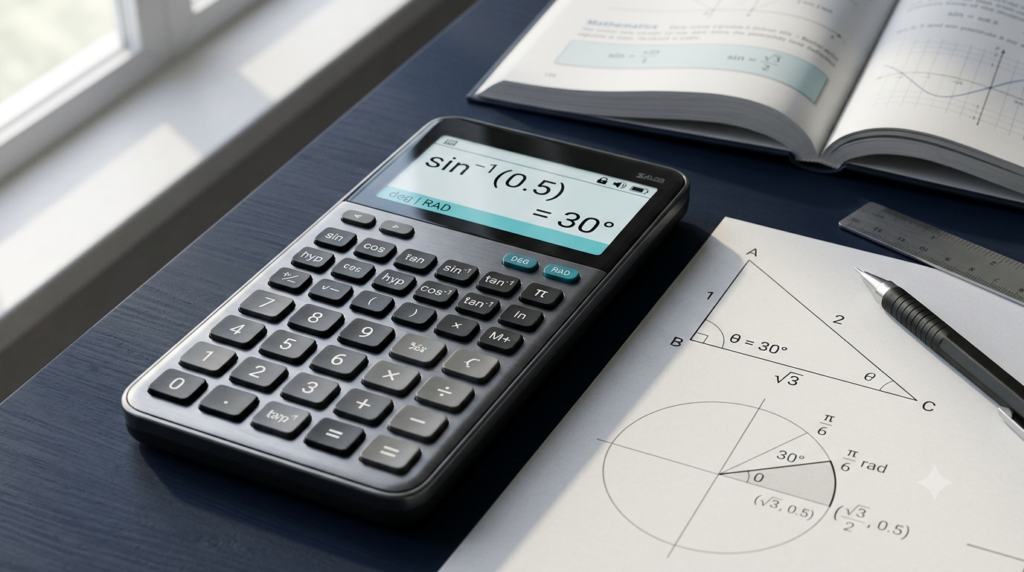
θ = sin⁻¹(0.5) = 30°
Inverse sine accepts real inputs from −1 to 1. Its principal output angle lies between −90° and 90°.
Inverse Cosine
Inverse cosine, written as cos⁻¹ or arccos, returns an angle whose cosine equals a specified value.
θ = cos⁻¹(x)
For example:
θ = cos⁻¹(0.5) = 60°
Inverse cosine accepts real inputs from −1 to 1. Its principal output angle lies between 0° and 180°.
Inverse Tangent
Inverse tangent, written as tan⁻¹ or arctan, returns an angle whose tangent equals a specified value.
θ = tan⁻¹(x)
For example:
θ = tan⁻¹(1) = 45°
Inverse tangent accepts every real number as its input. Its principal output angle lies between −90° and 90°, excluding the endpoints.
Important: The notation sin⁻¹(x) represents the inverse sine function, not the reciprocal of sine. The reciprocal of sine is cosecant, written as cosec(x) or csc(x).
Degrees and Radians in Trigonometry
Degrees and radians are two different units used to measure angles. A full rotation is 360 degrees or 2π radians.
The relationship between the two units is:
180° = π radians
To convert degrees into radians, multiply the angle by π/180.
Radians = Degrees × π ÷ 180
For example, to convert 90 degrees into radians:
90 × π ÷ 180 = π/2 radians
To convert radians into degrees, multiply the angle by 180/π.
Degrees = Radians × 180 ÷ π
For example:
π radians × 180 ÷ π = 180°
Degrees are common in school mathematics and everyday angle measurements. Radians are widely used in calculus, advanced mathematics, physics, and scientific calculations.
When using the calculator, always check the selected angle unit before calculating. Entering 30 in radian mode is not the same as entering 30 degrees.
How to Calculate Missing Sides of a Right Triangle
A right triangle contains one angle measuring 90 degrees. If you know an acute angle and at least one side length, you can use trigonometric ratios to calculate the remaining sides.
Finding the Opposite Side
If the angle and hypotenuse are known, use the sine ratio.
Opposite = Hypotenuse × sin θ
For example, suppose the hypotenuse is 10 cm and the angle is 30 degrees.
Opposite = 10 × sin 30°
Opposite = 10 × 0.5 = 5 cm
The opposite side measures 5 cm.
Finding the Adjacent Side
If the angle and hypotenuse are known, use the cosine ratio.
Adjacent = Hypotenuse × cos θ
Suppose the hypotenuse is 10 cm and the angle is 60 degrees.
Adjacent = 10 × cos 60°
Adjacent = 10 × 0.5 = 5 cm
The adjacent side measures 5 cm.
Finding a Side Using Tangent
If the opposite side and angle are known, the adjacent side can be calculated using tangent.
Adjacent = Opposite ÷ tan θ
For example, if the opposite side is 6 cm and the angle is 45 degrees:
Adjacent = 6 ÷ tan 45°
Adjacent = 6 ÷ 1 = 6 cm
The adjacent side measures 6 cm.
These relationships allow you to solve many basic triangle problems without measuring every side directly.
How to Find a Missing Angle in a Right Triangle
When two side lengths of a right triangle are known, inverse trigonometric functions can be used to determine an unknown acute angle.
For example, suppose the opposite side measures 3 cm and the adjacent side measures 3 cm.
tan θ = Opposite ÷ Adjacent
tan θ = 3 ÷ 3 = 1
Therefore:
θ = tan⁻¹(1) = 45°
The unknown angle is 45 degrees.
If the opposite side and hypotenuse are known, use inverse sine. If the adjacent side and hypotenuse are known, use inverse cosine.
In every right triangle, the two acute angles add up to 90 degrees. Therefore, once one acute angle is known, the other can be found by subtracting it from 90 degrees.
Common Trigonometric Values
Some angles have familiar trigonometric values that are useful to memorize.
| Angle | sin θ | cos θ | tan θ |
|---|---|---|---|
| 0° | 0 | 1 | 0 |
| 30° | 0.5 | √3/2 | 1/√3 |
| 45° | √2/2 | √2/2 | 1 |
| 60° | √3/2 | 0.5 | √3 |
| 90° | 1 | 0 | Undefined |
These values are frequently used in school mathematics, geometry, physics, and trigonometric identities.
For example, knowing that sin 30° = 0.5 makes it easy to calculate the opposite side when the hypotenuse is known. Similarly, tan 45° = 1 indicates that the opposite and adjacent sides are equal in a 45°–45°–90° triangle.
The calculator can help you verify these values and explore how trigonometric functions change at different angles.
Important Trigonometric Identities
Trigonometric identities are mathematical relationships that remain true for all angles within their applicable domains. They are useful for simplifying expressions and solving equations.
Pythagorean Identity
sin² θ + cos² θ = 1
This identity connects the sine and cosine functions. If one of these values is known, the square of the other can be calculated from the equation.
Tangent Identity
tan θ = sin θ ÷ cos θ
This relationship shows that tangent can be calculated by dividing sine by cosine, provided cosine is not zero.
Reciprocal Identities
cosec θ = 1 ÷ sin θ
sec θ = 1 ÷ cos θ
cot θ = 1 ÷ tan θ
These identities explain how the reciprocal functions are related to the primary trigonometric functions. They are often used to simplify expressions and check mathematical results.
Practical Applications of Trigonometry
Trigonometry is not limited to textbook exercises. It is used in many real-world situations where angles, distances, heights, and directions need to be calculated.
Architecture and Construction
Architects and construction professionals use trigonometry to calculate roof slopes, determine structural angles, estimate heights, and measure distances that are difficult to access directly.
Physics and Engineering
Trigonometric functions are used to resolve forces into horizontal and vertical components. They also appear in the study of waves, oscillations, circular motion, and alternating electrical signals.
Astronomy
Astronomers use angular measurements and trigonometric relationships to study celestial objects and estimate distances. Related geometric techniques are important in observing planets, stars, and other astronomical bodies.
Navigation and Surveying
Navigation and land surveying involve bearings, angles, and distances. Trigonometry helps determine locations, calculate elevations, and measure distances using angular observations.
Computer Graphics and Game Development
Computer graphics uses sine and cosine to represent rotations, circular movement, and periodic motion. Trigonometry also supports animation, simulations, and calculations involving directions and positions in two-dimensional and three-dimensional environments.
These applications demonstrate why trigonometry remains an essential part of mathematics and applied science.
Benefits of Using an Online Trigonometry Calculator
An online Trigonometry Calculator offers several advantages for students and other users.
Faster calculations: It calculates trigonometric values in seconds, reducing the need for repeated manual calculations.
Convenient angle conversion: Switching between degrees and radians helps you work with different mathematical problems.
Support for inverse functions: You can find angles from known ratios without manually solving inverse trigonometric expressions.
Help with triangle problems: The right-triangle mode can calculate missing sides or angles from suitable known values.
Reduced calculation errors: Automated calculations reduce common arithmetic mistakes, although inputs and results should still be checked.
Useful for learning: Comparing calculator results with formulas and worked examples can help you understand how trigonometric relationships operate.
Accessible across devices: A mobile-friendly calculator allows you to perform calculations on a smartphone, tablet, or computer.
The calculator is especially useful for checking homework, practicing mathematical concepts, and verifying intermediate results in longer problems.
Common Mistakes to Avoid
Although trigonometric calculations are straightforward once the formulas are understood, a few common mistakes can produce incorrect answers.
Using the Wrong Angle Unit
One of the most common errors is entering a degree measurement while the calculator is set to radians, or the other way around. Always verify the selected unit before calculating.
Confusing Inverse Functions with Reciprocals
Inverse sine and cosecant are different functions. The expression sin⁻¹(x) finds an angle, while cosec(x) calculates the reciprocal of sine.
Using Incorrect Triangle Sides
The opposite and adjacent sides depend on the angle being considered. The hypotenuse is always opposite the right angle. Identify these sides correctly before applying a trigonometric ratio.
Dividing by Zero
Some trigonometric functions are undefined at particular angles. For example, tan 90° is undefined because cosine is zero. Similarly, cosecant is undefined wherever sine is zero.
Rounding Too Early
Rounding intermediate values can introduce small errors into later calculations. When working through several steps, retain sufficient precision until the final answer.
Assuming Every Triangle Is a Right Triangle
The basic SOH–CAH–TOA ratios apply directly to right triangles. Other triangles may require the sine rule, cosine rule, or additional geometric relationships.
Limitations of a Trigonometry Calculator
An online calculator can simplify mathematical work, but it does not replace an understanding of the underlying concepts.
The accuracy of the result depends on entering the correct values, choosing the appropriate angle unit, and selecting a suitable function. In right-triangle calculations, the supplied measurements must describe a mathematically possible triangle.
The right-triangle mode is intended for basic problems involving acute angles and side lengths. It is not a complete triangle solver for every type of triangle, nor does it automatically solve all trigonometric equations or prove trigonometric identities.
For advanced problems involving multiple solutions, restricted domains, or symbolic expressions, additional mathematical reasoning may be necessary. In practical engineering and scientific work, the number of decimal places displayed should also be considered in relation to the precision of the original measurements.
Use the calculator as a tool for obtaining and checking numerical results while continuing to understand the formulas behind each calculation.
Conclusion
A Trigonometry Calculator is a useful online tool for calculating sine, cosine, tangent, reciprocal trigonometric functions, and inverse trigonometric values. It can also help solve basic right-triangle problems by finding missing angles and side lengths from known measurements.
By supporting both degrees and radians, the calculator makes a wide range of trigonometric calculations easier to perform. It is valuable for students learning the fundamentals of mathematics, teachers preparing examples, and anyone who needs to verify a trigonometric result.
Understanding the formulas remains important because it helps you select the correct function, interpret the answer, and recognize when a result is undefined. With regular practice and a reliable calculator, you can build confidence in solving trigonometry problems and applying mathematical relationships to real-world situations.
FAQs
1. What is a Trigonometry Calculator?
A Trigonometry Calculator is an online mathematical tool used to calculate trigonometric functions and solve problems involving angles and triangle sides. It can calculate sine, cosine, tangent, cosecant, secant, and cotangent values. Depending on its features, it can also find angles using inverse trigonometric functions and calculate missing sides of right-angled triangles. Users enter the required values, select the appropriate function, and obtain the result quickly. This tool is useful for students, teachers, engineers, and anyone learning mathematics. It helps reduce manual calculations and makes checking trigonometric answers easier.
2. How do you use a Trigonometry Calculator?
To use a Trigonometry Calculator, first select the calculation mode that matches your problem. Choose a trigonometric function such as sine, cosine, or tangent, and enter the required angle. Select degrees or radians according to the given measurement. For inverse functions, enter the known ratio to find the corresponding angle. For right-triangle calculations, provide the known angle or side lengths required by the calculator. Click the Calculate button to display the result. You can adjust decimal precision, copy the result, or clear the previous values before starting another calculation.
3. What is the difference between degrees and radians?
Degrees and radians are two units used to measure angles. A complete rotation equals 360 degrees or 2π radians, while a straight angle equals 180 degrees or π radians. Degrees are commonly used in school mathematics and everyday measurements. Radians are frequently used in calculus, physics, and advanced mathematics. Both units can represent the same angle, but their numerical values differ. For example, 90 degrees equals π/2 radians. When using a Trigonometry Calculator, always select the correct angle unit. Entering an angle in the wrong mode can produce an unexpected result.
4. What are sine, cosine, and tangent?
Sine, cosine, and tangent are the three primary trigonometric functions used to describe relationships between angles and sides of a right triangle. Sine equals the opposite side divided by the hypotenuse. Cosine equals the adjacent side divided by the hypotenuse. Tangent equals the opposite side divided by the adjacent side. These ratios help calculate unknown angles and side lengths when sufficient information is available. They are commonly used in geometry, physics, engineering, construction, and surveying. A Trigonometry Calculator evaluates these functions quickly, making it easier to check answers and solve mathematical problems involving different angles.
5. What are inverse trigonometric functions?
Inverse trigonometric functions are used to find an angle when a trigonometric ratio is known. The three common inverse functions are inverse sine, inverse cosine, and inverse tangent, also called arcsine, arccosine, and arctangent. For example, if the sine of an angle is 0.5, inverse sine gives the principal angle of 30 degrees. These functions are useful for determining unknown angles in right triangles and solving practical geometry problems. A Trigonometry Calculator can perform these calculations automatically. Remember that inverse functions are different from reciprocal functions, such as cosecant and secant.
6. Can a Trigonometry Calculator find missing sides of a triangle?
Yes, a Trigonometry Calculator with a right-triangle mode can calculate missing side lengths when enough information is provided. For example, if an acute angle and the hypotenuse are known, sine can determine the opposite side, while cosine can determine the adjacent side. If the angle and opposite side are known, tangent can help calculate the adjacent side. The calculator may also determine a missing angle when two suitable side lengths are provided. These calculations apply to right-angled triangles. For triangles without a right angle, additional methods, such as the sine rule or cosine rule, may be necessary.
7. Why is the tangent of 90 degrees undefined?
The tangent of an angle is calculated by dividing its sine by its cosine. At 90 degrees, sine equals 1 and cosine equals 0. Therefore, tan 90° would require division by zero, which is mathematically undefined. A Trigonometry Calculator should display an error or indicate that the result is undefined rather than provide a finite numerical answer. Similar restrictions apply to reciprocal functions. For example, secant is undefined when cosine equals zero, while cosecant is undefined when sine equals zero. Understanding these restrictions helps users interpret calculator results correctly and avoid mistakes when working with trigonometric functions.
8. What are the practical applications of trigonometry?
Trigonometry has many practical applications in science, engineering, construction, astronomy, navigation, and computer graphics. Architects and construction professionals use trigonometric relationships to calculate roof slopes, heights, and structural angles. Engineers apply sine and cosine to resolve forces and analyze periodic motion. Surveyors use angles and distances to estimate elevations and map land. Astronomers use angular measurements in studying celestial objects, while computer graphics uses trigonometric functions to calculate rotations and circular movement. A Trigonometry Calculator helps perform these numerical calculations efficiently. However, practical applications may require additional formulas, accurate measurements, and professional judgment.
9. How accurate is an online Trigonometry Calculator?
An online Trigonometry Calculator can provide accurate numerical results when the correct inputs, function, and angle unit are selected. However, the displayed result may be rounded to a chosen number of decimal places. Increasing decimal precision can show more digits, but it does not improve the accuracy of the original measurements. Some functions are also undefined at particular angles, and invalid inputs can produce errors. For reliable results, check the entered values, confirm whether the angle is measured in degrees or radians, and avoid rounding intermediate calculations too early. For scientific or engineering work, consider measurement uncertainty and required precision.
10. Can I use a Trigonometry Calculator on a mobile phone?
Yes, a mobile-friendly Trigonometry Calculator can be used on smartphones, tablets, and desktop computers through a web browser. A responsive design adjusts the calculator’s layout to different screen sizes, making fields, menus, and buttons easier to use on smaller displays. You can enter angles, select trigonometric functions, calculate results, and review answers without installing a separate application. Some calculators also provide inverse functions, triangle calculations, decimal precision settings, and options to copy results. For the best experience, use a modern browser and check that the calculator’s controls display correctly on your device.