Mensuration is an important branch of mathematics that deals with measuring the length, perimeter, area, surface area, and volume of different shapes and objects. It helps us understand how much space a shape covers, how far its boundary extends, and how much space a three-dimensional object occupies. From calculating the amount of paint needed for a wall to determining the capacity of a water tank, mensuration has many practical applications in everyday life.
For beginners, learning mensuration formulas is not enough. It is equally important to understand the basic terms used in these formulas. Words such as radius, diameter, perimeter, area, height, and volume describe different measurements, and confusing them can lead to incorrect answers. This article explains the essential mensuration terms in simple language, with examples and formulas, to help beginners build a strong foundation in mathematics.
What Is Mensuration?
Mensuration is the branch of mathematics concerned with measuring geometric shapes and solid objects. It involves finding the dimensions, boundaries, areas, surface areas, and volumes of different figures.
Mensuration is generally divided into two main parts:
Plane mensuration: Deals with two-dimensional shapes, such as squares, rectangles, triangles, circles, and other flat figures.
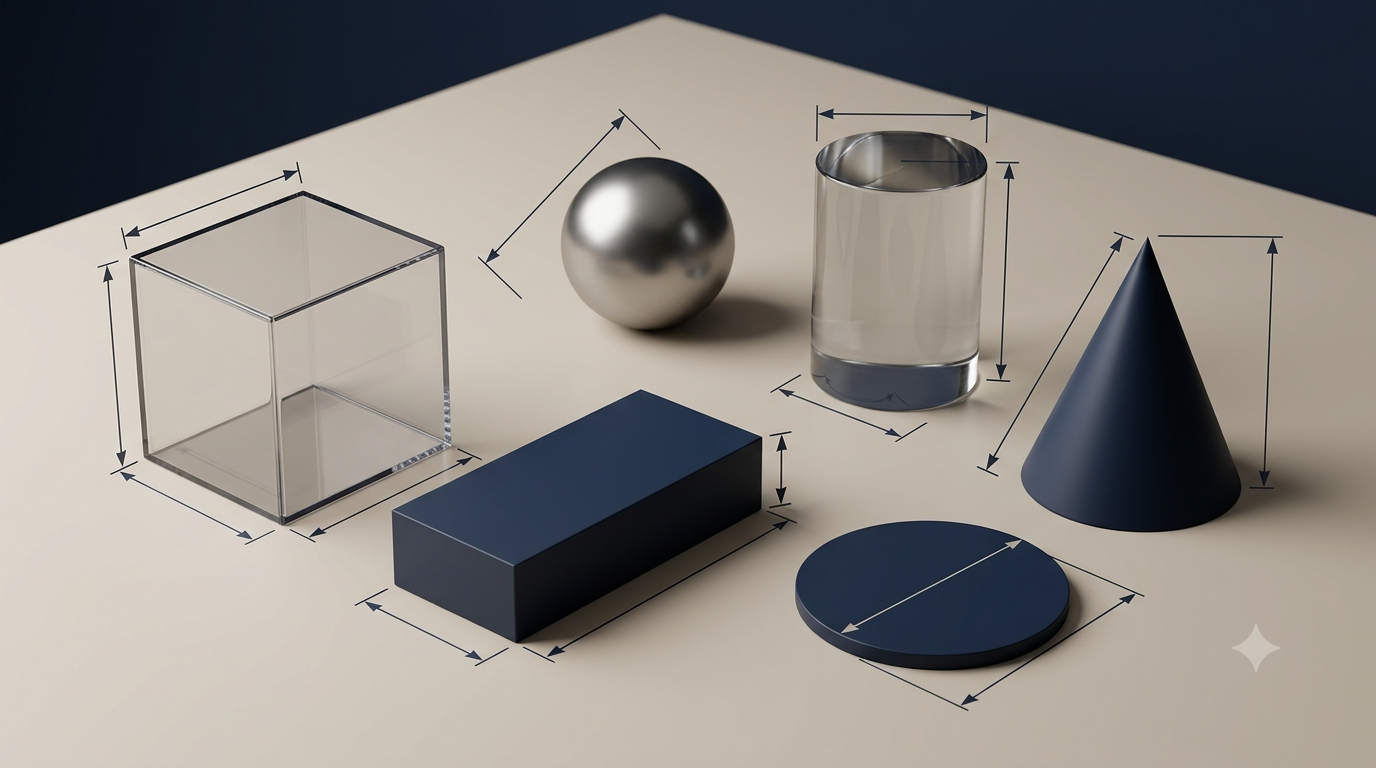
Solid mensuration: Deals with three-dimensional objects, such as cubes, cuboids, cylinders, cones, spheres, and pyramids.
Plane mensuration mainly focuses on perimeter and area, while solid mensuration focuses on surface area and volume. Understanding these differences makes it easier to select the correct formula for a particular problem.
Essential Mensuration Terms for Beginners
1. Length
Length is the measurement of the distance between two points or the longest dimension of an object in a particular direction. It is one of the most basic measurements used in mensuration.
For example, the length of a rectangular table may be 120 cm. This measurement tells us how long the table is.
Length is commonly represented by the letter l. However, other letters may be used depending on the shape and the formula.
Common units of length:
Millimetre (mm)
Centimetre (cm)
Metre (m)
Kilometre (km)
Length is used when calculating perimeter, area, surface area, and volume.
2. Breadth or Width
Breadth, also called width, is the measurement across an object, usually perpendicular to its length. It is commonly used when describing rectangles and cuboids.
For example, a rectangular garden may have a length of 20 m and a breadth of 12 m.
Breadth is often represented by b, while width may be represented by w. The notation depends on the formula being used.
In a rectangle, length and breadth are two important dimensions used to calculate its area and perimeter.
3. Height
Height is the perpendicular distance between a base and the opposite side, surface, or vertex of a shape. It is particularly important when calculating the area of triangles and the volume of solid objects.
For example, if a triangle has a base of 10 cm and a perpendicular height of 6 cm, these two measurements can be used to calculate its area.
Height is often represented by h.
It is important to remember that height usually refers to a perpendicular measurement, not necessarily the sloping side of a shape.
4. Side
A side is a straight boundary segment of a polygon. Squares, rectangles, triangles, and other polygons have sides.
For example, a square has four equal sides, while a rectangle has opposite sides equal in length.
The length of a side is used to calculate the perimeter and area of many plane figures. In a square, if each side measures 5 cm, its perimeter is 20 cm.
A side should not be confused with an edge of a three-dimensional object, although both describe boundaries between surfaces or parts of a geometric figure.
5. Radius
The radius is the distance from the centre of a circle or sphere to its boundary. Every radius of the same circle has the same length.
The radius is usually represented by r.
For example, if a circular plate has a radius of 7 cm, the distance from its centre to its edge is 7 cm.
The radius is essential when calculating the circumference and area of a circle. It is also used to calculate the surface area and volume of a sphere.
Important formula:
Radius = Diameter ÷ 2
6. Diameter
The diameter is a straight line passing through the centre of a circle and connecting two points on its boundary. It is the longest straight-line distance across a circle.
The diameter is commonly represented by d.
For example, if a circular wheel has a diameter of 28 cm, its radius is 14 cm.
Important formulas:
Diameter = 2 × Radius
Radius = Diameter ÷ 2
The diameter is useful when measuring circular objects such as plates, pipes, wheels, and circular containers.
7. Circumference
Circumference is the total distance around the boundary of a circle. It is the circular equivalent of the perimeter of a polygon.
For example, the circumference of a circular track describes the distance around one complete lap of its boundary.
The circumference is commonly represented by C.
Formula:
C = 2 × π × r
Alternatively:
C = π × d
Here, π (pi) is a mathematical constant approximately equal to 3.14159.
If a circle has a radius of 7 cm and π is taken as 22/7, its circumference is 44 cm.
Circumference is measured in linear units, such as centimetres or metres, not square units.
8. Perimeter
Perimeter is the total length of the boundary of a two-dimensional shape. It is calculated by adding the lengths of all the sides of a polygon.
For example, a rectangle with a length of 8 cm and a breadth of 5 cm has a perimeter of 26 cm.
Formula for a rectangle:
Perimeter = 2 × (Length + Breadth)
Formula for a square:
Perimeter = 4 × Side
Perimeter is useful when calculating the fencing required around a garden, the border around a field, or the trim needed around a rectangular frame.
Remember that perimeter measures the boundary, not the space enclosed by it.
9. Area
Area is the amount of surface covered by a two-dimensional shape. It tells us how much space lies inside the boundary of a flat figure.
For example, the area of a floor helps determine how many tiles are required to cover it.
Area is commonly represented by A.
Formula for a rectangle:
A = Length × Breadth
Formula for a square:
A = Side × Side
Formula for a triangle:
A = ½ × Base × Height
Formula for a circle:
A = π × r²
Area is measured in square units, such as cm², m², and km².
For instance, a rectangle with a length of 8 cm and a breadth of 5 cm has an area of 40 cm².
Area and perimeter are different measurements. A shape’s area describes its surface, while its perimeter describes its boundary.
10. Base
The base is the side or surface chosen as the reference for measuring a shape. It is especially important when calculating the area of triangles, parallelograms, and other figures.
In a triangle, any side can be selected as the base, provided the corresponding perpendicular height is used.
Formula for the area of a triangle:
A = ½ × Base × Height
For example, if the base of a triangle is 12 cm and its perpendicular height is 5 cm, its area is 30 cm².
In solid figures such as cylinders and pyramids, the base is the bottom or reference face used to describe the solid’s dimensions.
The base does not always have to be horizontal. It is the chosen reference side or surface for the calculation.
11. Diagonal
A diagonal is a line segment connecting two non-adjacent vertices of a polygon. It passes across the interior of a polygon rather than following its boundary.
A rectangle has two diagonals, and both have equal lengths. A square also has two equal diagonals.
Formula for the diagonal of a rectangle:
d = √(Length² + Breadth²)
For example, a rectangle with a length of 3 cm and a breadth of 4 cm has a diagonal of 5 cm.
Diagonals are useful in geometry, construction, design, and problems involving distances across rectangular shapes.
12. Slant Height
Slant height is the distance measured along the sloping surface of a solid object. It is commonly used when studying cones and pyramids.
In a right circular cone, the slant height is measured from the vertex to a point on the circular boundary of its base along the sloping surface.
The slant height is commonly represented by l.
For a right circular cone:
l = √(r² + h²)
Here, r is the radius of the base and h is the perpendicular height.
Slant height and perpendicular height are not the same. Slant height follows the inclined surface, whereas perpendicular height measures the straight vertical distance from the vertex to the base.
This distinction is essential when calculating the curved surface area of a cone.
13. Face
A face is a flat surface that forms part of the boundary of a three-dimensional solid. Faces are particularly important when studying cubes, cuboids, and pyramids.
For example, a cube has six square faces, while a cuboid has six rectangular faces.
Faces can have different shapes depending on the solid. A square pyramid, for example, has one square base and four triangular side faces.
Understanding faces helps beginners identify the surfaces that must be measured when calculating the total surface area of a solid.
14. Edge
An edge is the line segment where two faces of a three-dimensional solid meet.
For example, a cube has 12 edges. Each edge connects two vertices and forms part of the boundary between two square faces.
Edges are different from faces. A face is a surface, while an edge is a line along which two surfaces meet.
The lengths of edges are used when calculating the dimensions, surface area, and volume of solids such as cubes and cuboids.
15. Vertex
A vertex is a point where two or more edges meet. The plural form of vertex is vertices.
For example, a cube has eight vertices, while a cuboid also has eight vertices.
In a triangle, each corner is a vertex. In a pyramid, the point at the top is called the apex, which is a special vertex.
Vertices help identify the corners and structure of geometric shapes. They are also useful when understanding polygons, polyhedra, and three-dimensional models.
16. Surface Area
Surface area is the total area covering the outside of a three-dimensional object. It measures the amount of material needed to cover the object’s exterior.
Surface area is generally divided into two types:
Lateral or curved surface area: The area of the side surfaces, excluding the base or bases as defined for the solid.
Total surface area: The combined area of all the external surfaces, including the base or bases.
For a cube:
Total Surface Area = 6 × Side²
For a cuboid:
Total Surface Area = 2 × (Length × Breadth + Breadth × Height + Height × Length)
Surface area is measured in square units, such as cm² or m².
It is useful when calculating the amount of paint required to cover a box, the material needed to make a container, or the exterior area of a solid structure.
17. Volume
Volume is the amount of three-dimensional space occupied by an object. It is used to measure the space inside solid objects and containers.
For example, the volume of a water tank indicates the amount of space available to hold water.
Formula for a cube:
Volume = Side³
Formula for a cuboid:
Volume = Length × Breadth × Height
Formula for a cylinder:
V = π × r² × h
Volume is measured in cubic units, such as cm³, m³, and mm³.
For instance, a cuboid with a length of 4 cm, a breadth of 3 cm, and a height of 2 cm has a volume of 24 cm³.
Volume should not be confused with surface area. Surface area measures the outside covering of a solid, while volume measures the space it occupies.
18. Pi (π)
Pi, represented by the Greek letter π, is a mathematical constant used in calculations involving circles and many circular solids.
It is defined as the ratio of a circle’s circumference to its diameter.
π = Circumference ÷ Diameter
Its approximate value is 3.14159. In some school-level calculations, π is taken as 22/7 or 3.14 to make calculations easier.
Pi appears in formulas for the circumference and area of a circle, as well as the surface area and volume of cylinders, cones, and spheres.
For example:
A = π × r²
This formula calculates the area of a circle when its radius is known.
Although 22/7 is a useful approximation, it is not the exact value of π.
19. Units of Measurement
Units of measurement describe the size or quantity represented by a numerical answer. Choosing the correct unit is an essential part of mensuration.
Different quantities require different types of units.
Length: mm, cm, m, km
Perimeter and circumference: cm, m, km
Area and surface area: cm², m², km²
Volume: cm³, m³, mm³
For example, the perimeter of a garden may be 40 m, while its area may be 100 m².
The units are different because perimeter measures length, whereas area measures a two-dimensional surface.
Common conversions include:
1 m = 100 cm
1 m² = 10,000 cm²
1 m³ = 1,000,000 cm³
When converting measurements, remember to square the conversion factor for area and cube it for volume.
20. Two-Dimensional Shapes
A two-dimensional shape has two measurable dimensions, usually length and breadth. It has length and width but no thickness as a mathematical plane figure.
Common two-dimensional shapes include:
Square
Rectangle
Triangle
Circle
Parallelogram
Rhombus
Trapezium
These shapes are studied in plane mensuration. Their perimeter and area are calculated using different formulas depending on their properties.
For example, the area of a rectangle is found by multiplying its length by its breadth, while the area of a circle depends on its radius.
Understanding two-dimensional shapes is the first step toward learning more advanced mensuration concepts.
21. Three-Dimensional Solids
A three-dimensional solid has length, breadth, and height. Unlike a flat shape, it occupies space and has volume.
Common three-dimensional solids include:
Cube
Cuboid
Cylinder
Cone
Sphere
Hemisphere
Pyramid
Prism
Each solid has specific properties and formulas for calculating its surface area and volume.
For example, a cube has six equal square faces, while a cylinder has two circular bases and one curved surface.
Three-dimensional mensuration is useful for measuring containers, storage tanks, buildings, packaging boxes, and many other objects found in daily life.
Difference Between Important Mensuration Terms
Some mensuration terms sound similar but represent different measurements. The following comparison helps clarify their meanings.
| Term | Meaning | Common unit |
|---|---|---|
| Length | Distance between two points | m, cm |
| Perimeter | Total boundary length of a plane shape | m, cm |
| Circumference | Boundary length of a circle | m, cm |
| Area | Surface covered by a plane shape | m², cm² |
| Surface area | Total area of the exterior of a solid | m², cm² |
| Volume | Space occupied by a solid | m³, cm³ |
| Radius | Distance from a circle’s centre to its boundary | m, cm |
| Diameter | Distance across a circle through its centre | m, cm |
| Height | Perpendicular distance from a base to the opposite point or surface | m, cm |
| Slant height | Distance measured along an inclined surface | m, cm |
The most important distinction is between perimeter, area, surface area, and volume. Perimeter and circumference measure boundaries, area measures flat surfaces, surface area measures the outside of solids, and volume measures the space occupied by solids.
Why Is It Important to Learn Mensuration Terms?
Learning mensuration terminology helps beginners understand mathematical problems more accurately. When a question mentions radius, height, or diameter, knowing the meaning of each term makes it easier to identify the required information and choose the correct formula.
These terms also have practical applications. Architects use dimensions and surface area when designing buildings. Farmers calculate the area of fields, while construction workers measure lengths, surfaces, and volumes to estimate materials. Manufacturers use volume and surface area when designing containers and packaging.
A clear understanding of basic terms also makes advanced topics easier. Once students understand the difference between a side and a diagonal, or between perpendicular height and slant height, they can solve more complicated problems with greater confidence.
Common Mistakes Beginners Should Avoid
Confusing Area with Perimeter
Area and perimeter measure different things. A shape may have a large perimeter but a relatively small area. Always check whether a question asks for the boundary length or the surface covered.
Using the Diameter Instead of the Radius
Many circle formulas require the radius. If the diameter is given, divide it by 2 before using a radius-based formula.
Forgetting Units
Every final answer should include the appropriate unit. Use linear units for length, perimeter, and circumference; square units for area and surface area; and cubic units for volume.
Confusing Height with Slant Height
The perpendicular height and slant height of a cone or pyramid are different. Check which measurement the formula requires before substituting values.
Using Incorrect Measurements
Make sure all dimensions use compatible units before performing calculations. Convert centimetres to metres or other units when necessary.
Avoiding these mistakes helps improve accuracy and makes mensuration problems easier to solve.
Conclusion
Mensuration is an essential part of mathematics that helps us measure shapes, surfaces, boundaries, and solid objects. For beginners, understanding basic terms such as length, breadth, height, radius, diameter, circumference, perimeter, area, surface area, and volume is the foundation for learning mensuration formulas.
Each term describes a specific measurement, and using the correct one is important for obtaining accurate results. Learning the difference between two-dimensional shapes and three-dimensional solids also makes it easier to understand which formulas apply to a particular problem.
With regular practice, clear definitions, and simple examples, anyone can develop confidence in mensuration. A strong understanding of these essential terms will make future topics, including the formulas for different geometric shapes, much easier to learn and apply in everyday life.
FAQs
1. What is mensuration in mathematics?
Mensuration is a branch of mathematics that deals with measuring geometric shapes and solid objects. It helps us calculate length, perimeter, circumference, area, surface area, and volume. For example, mensuration can be used to find the area of a rectangular floor, the circumference of a circular wheel, or the volume of a water tank. It includes two-dimensional shapes, such as squares and circles, and three-dimensional solids, such as cubes, cylinders, and spheres. Understanding mensuration is useful in mathematics, construction, engineering, architecture, and many everyday measurement activities.
2. What are the most important mensuration terms for beginners?
The most important mensuration terms for beginners include length, breadth, height, side, radius, diameter, circumference, perimeter, area, base, diagonal, slant height, face, edge, vertex, surface area, and volume. Each term describes a particular measurement or part of a geometric shape. For example, radius is the distance from the centre of a circle to its boundary, while diameter is the distance across the circle through its centre. Learning these terms helps students understand mathematical questions, choose appropriate formulas, and solve mensuration problems accurately. Beginners should study the definitions alongside simple diagrams and practical examples.
3. What is the difference between perimeter and area?
Perimeter and area describe two different properties of a two-dimensional shape. Perimeter is the total distance around the boundary of a shape, whereas area measures the surface enclosed within that boundary. For example, the perimeter of a rectangle is calculated using 2 × (Length + Breadth), while its area is calculated using Length × Breadth. Perimeter is measured in linear units, such as centimetres or metres, whereas area is measured in square units, such as cm² or m². Perimeter is useful for estimating fencing requirements, while area helps determine how much flooring or paint coverage a surface may need.
4. What is the difference between radius and diameter?
Radius and diameter are measurements associated with a circle. The radius is the distance from the centre of the circle to any point on its boundary. The diameter is a straight line that passes through the centre and connects two points on the circle’s boundary. The diameter is always twice the radius. The relationship can be expressed as Diameter = 2 × Radius. For example, if a circle has a radius of 5 cm, its diameter is 10 cm. Both measurements are important when calculating the circumference and area of a circle, and the radius is also used in formulas for circular solids.
5. What is circumference, and how is it calculated?
Circumference is the total distance around the boundary of a circle. It is similar to perimeter, but the term circumference is specifically used for circles. The circumference can be calculated using the formula C = 2 × π × r, where C represents circumference, π is approximately 3.14159, and r represents radius. Another formula is C = π × d, where d is the diameter. For example, a circle with a radius of 7 cm has a circumference of 44 cm when π is approximated as 22/7. Circumference is measured in linear units, such as centimetres or metres.
6. What is the difference between area and surface area?
Area measures the amount of surface enclosed by a two-dimensional shape, such as a triangle, rectangle, or circle. Surface area measures the combined area of the outer surfaces of a three-dimensional object, such as a cube, cuboid, cylinder, or sphere. For example, the area of a rectangular floor describes the space covered by the floor, while the total surface area of a cuboid includes all its exterior faces. Both measurements use square units, including cm² and m². Area is mainly studied in plane mensuration, whereas surface area is an important concept in solid mensuration.
7. What is volume in mensuration?
Volume is the amount of three-dimensional space occupied by a solid object. It is used to calculate the capacity of containers and the space occupied by objects such as boxes, cylinders, and spheres. For a cuboid, volume is calculated by multiplying length, breadth, and height. The formula is Volume = Length × Breadth × Height. For a cube, the formula is Volume = Side³. Volume is measured in cubic units, such as cm³ and m³. For example, a cuboid measuring 4 cm in length, 3 cm in breadth, and 2 cm in height has a volume of 24 cm³.
8. What are two-dimensional and three-dimensional shapes?
Two-dimensional shapes have two measurable dimensions: length and width. Examples include squares, rectangles, triangles, and circles. These shapes are generally studied by calculating their perimeter and area. Three-dimensional solids have length, breadth, and height, and they occupy space. Examples include cubes, cuboids, cylinders, cones, and spheres. Their measurements include surface area and volume. Understanding the difference between these two groups is essential for learning mensuration because each group uses different formulas. For example, the area of a circle measures its flat surface, while the volume of a sphere measures the three-dimensional space it occupies.
9. Why are units important in mensuration?
Units are essential in mensuration because they identify what a measurement represents and help ensure that calculations are accurate. Length, perimeter, and circumference use linear units such as millimetres, centimetres, and metres. Area and surface area use square units, such as cm² and m², while volume uses cubic units, such as cm³ and m³. When measurements are given in different units, they should be converted to compatible units before calculations begin. For example, metres and centimetres should not be combined incorrectly in a single calculation. Always include the appropriate unit in the final answer to communicate the result clearly.
10. Where is mensuration used in everyday life?
Mensuration is used in many everyday activities involving measurement, construction, design, and planning. People use area to determine how much flooring is needed for a room and perimeter to estimate the fencing required around a garden. Builders calculate surface areas when estimating materials for walls and roofs. Volume helps determine the capacity of water tanks, containers, and storage boxes. Farmers use area measurements to calculate the size of fields, while manufacturers apply mensuration when designing packaging and other products. Understanding basic mensuration terms makes these calculations easier and helps people estimate materials, space, and costs more accurately.