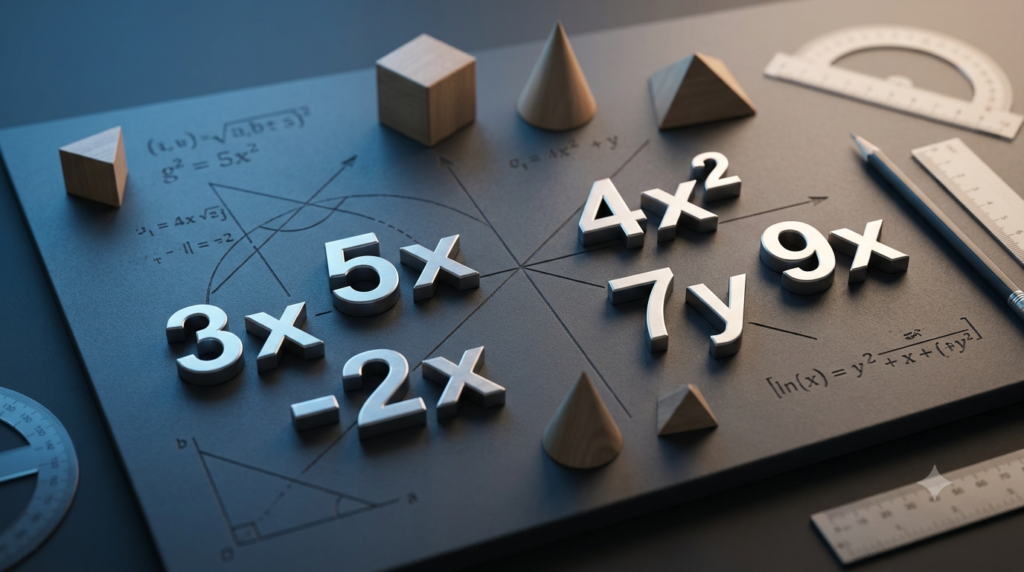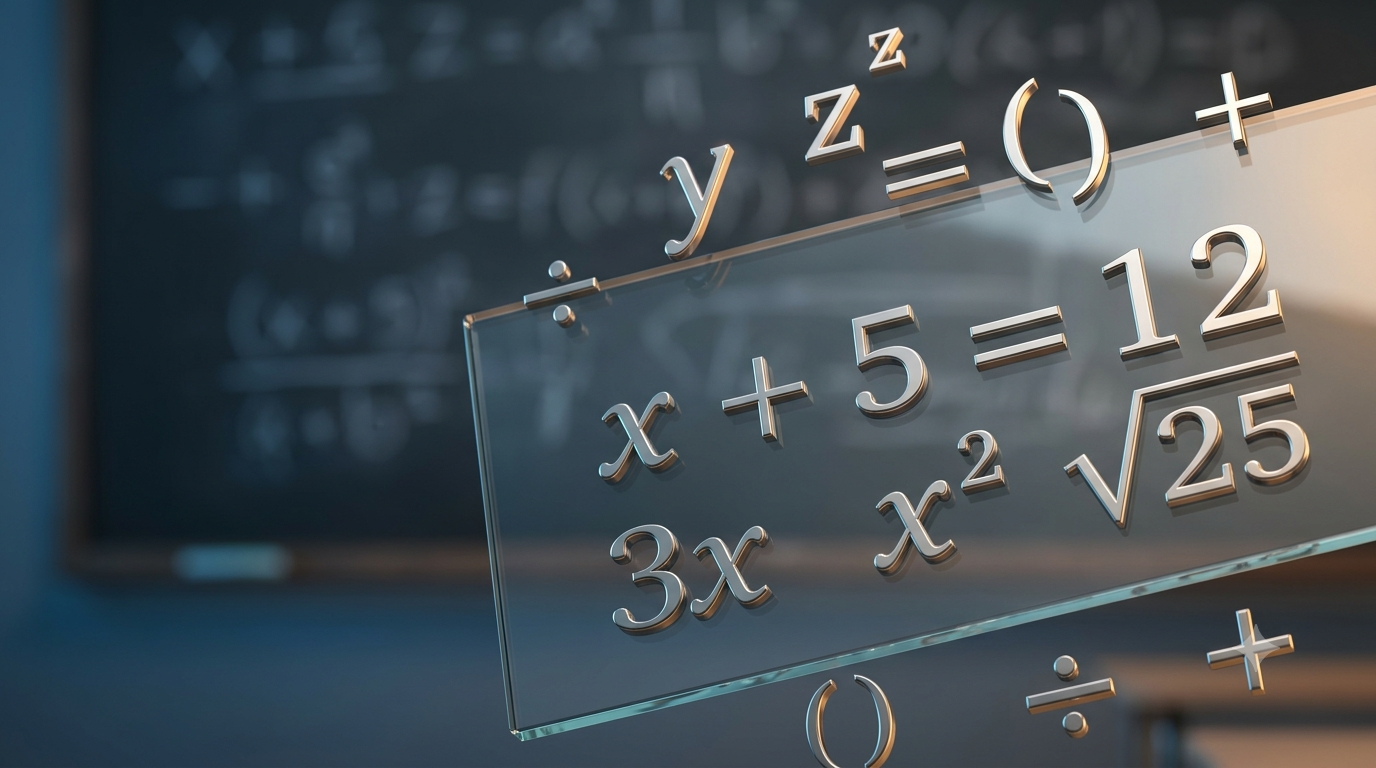
Algebra is an important branch of mathematics that helps us understand relationships between numbers and solve problems using letters, numbers, and mathematical symbols. At first, algebra may seem confusing because it uses letters such as x, y, and a instead of only numerical values. However, these letters have a simple purpose: they represent unknown numbers or quantities that can change.
We use algebra in many situations, including calculating expenses, comparing prices, identifying patterns, and solving scientific problems. Learning algebra begins with understanding its language and symbols. Once you become familiar with variables, constants, coefficients, expressions, equations, and mathematical signs, you can understand algebraic problems more easily.
This beginner’s guide explains the fundamental language of algebra, introduces common mathematical symbols, and demonstrates how to read and write basic algebraic expressions. With simple examples and regular practice, you can develop a strong foundation for learning more advanced mathematical concepts.
What Is the Language of Algebra?
The language of algebra is a system of letters, numbers, symbols, and mathematical rules used to represent quantities and describe relationships between them.
In arithmetic, we generally work with known numbers. For example, we can calculate 5 + 3 = 8 because both numbers are known. In algebra, one or more quantities may be unknown. Letters allow us to represent these quantities and perform calculations without knowing their exact values.
For example, suppose you have some money and receive ₹50 more. If the amount you originally had is unknown, we can represent it using the letter x.
Formula (Text Block):
Original amount = x
The expression x + 50 represents the total amount without requiring us to know the original amount.
If x = 100, the total is ₹150. If x = 200, the total is ₹250. The same algebraic expression works for different values of x.
This is one of the main advantages of algebra. It allows us to describe general relationships rather than solving only one numerical example.
Why Are Algebraic Symbols Important?
Algebraic symbols make mathematical statements shorter, clearer, and more flexible. Instead of writing long descriptions in ordinary language, we can represent mathematical relationships using a few symbols.
For example, the statement “a number increased by seven” can be written as an algebraic expression.
Formula (Text Block):
Unknown number = x
Similarly, “three times a number” can be represented as 3x, while “a number divided by four” can be represented as x/4.
Algebraic symbols are useful because they help us:
Represent unknown quantities.
Describe mathematical patterns.
Express relationships between quantities.
Write equations and solve problems.
Develop formulas used in science, engineering, economics, and technology.
Understand how changing one quantity affects another.
Learning these symbols is like learning the vocabulary of a new language. Once you understand their meanings, you can begin reading and creating more complicated mathematical statements.
Variables in Algebra
A variable is a letter or symbol that represents a number. Common algebraic variables include x, y, a, b, m, and n.
Variables may represent unknown numbers that we need to find or quantities that can take different values.
For example, suppose one notebook costs ₹20 and you buy x notebooks. The total cost depends on the number of notebooks purchased.
Formula (Text Block):
Cost of one notebook = ₹20
If you buy two notebooks, the total cost is ₹40. If you buy five notebooks, the total cost is ₹100.
In this example, x represents the number of notebooks, while 20x represents their total cost.
Can Variables Have Different Values?
Yes. A variable can take different values depending on the situation. For example, the equation y = 2x describes a relationship in which y is twice the value of x.
Formula (Text Block):
If x = 2, then y = 2 × 2 = 4
Variables are especially useful when studying patterns, functions, graphs, and relationships between quantities.
Constants in Algebra
A constant is a fixed numerical value that does not change within the mathematical expression or situation being considered.
For example, in the expression x + 9, the number 9 is a constant. It remains fixed even when the value of x changes.
Formula (Text Block):
Expression = x + 9
Consider another expression.
Formula (Text Block):
5x + 12
Here, 5 is the coefficient of the variable x, while 12 is the constant term.
A constant may appear alone or as part of a larger expression. Recognizing constants helps you identify which parts of an expression can change and which remain fixed.
Coefficients in Algebra
A coefficient is a number that multiplies a variable. It tells us how many times the variable is being taken.
For example, in 4x, the coefficient of x is 4. This means four times the value of x.
Formula (Text Block):
3x → Coefficient = 3
Notice that x has an implied coefficient of 1. Similarly, -x has a coefficient of -1, even though the number is not written explicitly.
Coefficients can also be negative or fractional. For example, in -5y, the coefficient is -5. In x/3, the coefficient of x is 1/3.
Understanding coefficients is essential when simplifying expressions, combining like terms, and solving equations.
Basic Mathematical Symbols Used in Algebra
Algebra uses familiar arithmetic symbols along with additional symbols that express relationships between quantities.
Addition (+)
The plus sign represents addition. In algebra, it indicates that quantities are being added together.
Formula (Text Block):
x + 5
For example, x + 5 means a number x increased by five.
Subtraction (−)
The minus sign represents subtraction or the removal of one quantity from another.
Formula (Text Block):
x - 4
For example, x – 4 means four less than x.
Be careful with the order of subtraction. The expression x – 4 is generally different from 4 – x.
Multiplication (×, ·, or implied multiplication)
Multiplication indicates repeated addition or the product of quantities. In algebra, multiplication is often written without a multiplication sign.
Formula (Text Block):
3 × x = 3x
For example, 4x means 4 multiplied by x. It does not mean the two symbols are separate quantities being added.
A number written immediately before a variable usually indicates multiplication.
Division (÷, /, or a fraction bar)
Division represents splitting a quantity into equal parts or comparing one quantity with another.
Formula (Text Block):
x ÷ 2 = x/2
Division by zero is undefined. Therefore, whenever a variable appears in a denominator, its value must not make that denominator zero.
For example, x/5 is defined for every real value of x, but x/(x – 2) is undefined when x = 2.
Equals Sign (=)
The equals sign indicates that two mathematical expressions have the same value.
Formula (Text Block):
x + 3 = 8
The statement x + 3 = 8 means that the value of x + 3 is equal to 8.
The equals sign does not simply mean “write the answer.” It expresses equality between the two sides of a mathematical statement.
Greater Than (>) and Less Than (<)
These symbols compare two quantities.
Formula (Text Block):
x > 5 → x is greater than 5
For example, if x = 8, then x > 5 is true. If x = 3, then x < 5 is true.
A useful memory trick is that the open side of the symbol faces the greater quantity, while the pointed end faces the smaller quantity.
Greater Than or Equal To (≥) and Less Than or Equal To (≤)
These symbols include equality as well as comparison.
Formula (Text Block):
x ≥ 10 → x is greater than or equal to 10
For example, x ≥ 10 allows values such as 10, 11, and 15. The value 10 is included because the symbol contains an equality component.
These symbols are commonly used in inequalities, limits, constraints, and mathematical models.
Not Equal To (≠)
The not-equal symbol indicates that two quantities have different values.
Formula (Text Block):
x ≠ 0
For example, x ≠ 0 means that x can be any allowed value except zero.
This symbol is particularly important when working with fractions, equations, and restrictions on variables.
Algebraic Expressions
An algebraic expression is a combination of numbers, variables, and mathematical operations. It does not contain an equals sign that states equality between two sides.
Examples include x + 4, 3y – 2, and 5a + 2b.
Formula (Text Block):
x + 4
An expression represents a mathematical quantity. Its value may depend on the values assigned to its variables.
For example, consider the expression 2x + 3. If x = 4, we substitute 4 for x and calculate the result.
Formula (Text Block):
Expression = 2x + 3
The value of the expression is 11 when x = 4.
Terms in an Algebraic Expression
A term is a part of an expression separated by plus or minus signs. A term may contain a number, a variable, or a product of numbers and variables.
For example, the expression 4x + 3y – 7 contains three terms.
Formula (Text Block):
Expression = 4x + 3y - 7
The negative sign belongs to the term -7. Similarly, in 4x – 3y + 2, the terms are 4x, -3y, and 2.
Identifying terms helps you simplify expressions and understand how their parts are connected.
Like Terms and Unlike Terms
Like terms have the same variables raised to the same powers. Their coefficients may be different.
Formula (Text Block):
3x and 7x → Like terms
Like terms can be combined by adding or subtracting their coefficients.
Formula (Text Block):
3x + 7x = 10x
However, unlike terms generally cannot be combined into a single term.
Formula (Text Block):
3x + 4yThis expression remains 3x + 4y because x and y represent different variables.
Recognizing like terms is one of the first skills needed to simplify algebraic expressions correctly.
Equations and Inequalities
Equations and inequalities are mathematical statements that describe relationships between quantities. Although they are related to expressions, they have different purposes.
What Is an Equation?
An equation states that two expressions are equal. It contains an equals sign and may include one or more unknown values.
Formula (Text Block):
x + 5 = 12
For example, to solve x + 5 = 12, we subtract 5 from both sides.
Formula (Text Block):
x + 5 = 12
The solution is x = 7, because substituting 7 into the original equation makes both sides equal.
What Is an Inequality?
An inequality compares two expressions and indicates that one is greater than, less than, greater than or equal to, or less than or equal to the other.
Formula (Text Block):
x + 2 > 6
For example, solving x + 2 > 6 gives x > 4. Every value greater than 4 satisfies the inequality.
When multiplying or dividing both sides of an inequality by a negative number, the inequality sign must be reversed.
Formula (Text Block):
-2x > 6
This rule is important because it preserves the correct relationship between the quantities.
Exponents and Powers
An exponent indicates how many times a base is multiplied by itself. Exponents allow us to write repeated multiplication in a compact form.
For example, x³ means x multiplied by itself three times.
Formula (Text Block):
x² = x × x
In x³, the number x is the base and 3 is the exponent.
Some important exponent rules are listed below.
Formula (Text Block):
xᵃ × xᵇ = xᵃ⁺ᵇ
For example, x² × x³ = x⁵ because the factors have the same base and their exponents are added.
Exponents are used throughout algebra, geometry, physics, computing, and many other areas of mathematics.
Parentheses and the Order of Operations
Parentheses, brackets, and braces help organize mathematical expressions. They indicate which operations belong together and can change how an expression is evaluated.
Common grouping symbols include:
Formula (Text Block):
Parentheses: ( )
For example, 2(3 + 4) means that the sum inside the parentheses is multiplied by 2.
Formula (Text Block):
2(3 + 4)
Without the parentheses, 2 × 3 + 4 equals 10 because multiplication is performed before addition.
To evaluate algebraic expressions correctly, follow the standard order of operations:
Evaluate expressions inside grouping symbols.
Calculate exponents and roots.
Perform multiplication and division from left to right.
Perform addition and subtraction from left to right.
For example:
Formula (Text Block):
3 + 2 × 4
Multiplication comes before addition, so the answer is 11 rather than 20.
The Distributive Property
The distributive property explains how multiplication works with addition and subtraction inside parentheses. It allows us to remove parentheses by multiplying the outside factor by each term inside.
Formula (Text Block):
a(b + c) = ab + ac
For example:
Formula (Text Block):
3(x + 4)
Similarly:
Formula (Text Block):
5(2x - 3)
The distributive property is useful for expanding expressions, simplifying calculations, and solving equations. It also works in reverse, allowing us to factor expressions by identifying a common factor.
Translating Words into Algebraic Expressions
One of the most useful beginner skills is translating ordinary language into algebraic notation. Mathematical phrases often contain clues about which operations are required.
Consider these common examples.
Formula (Text Block):
A number increased by 6 = x + 6
Pay attention to the order of words. “Five less than a number” means the number minus five, not five minus the number.
Similarly, “the quotient of a number and three” means the number divided by three.
Translating a Sentence into an Equation
Some word problems describe a relationship that can be represented by an equation.
For example, “A number increased by eight equals twenty.”
Formula (Text Block):
Unknown number = x
The unknown number is 12.
A good approach is to identify the unknown quantity first, represent it with a variable, translate the mathematical relationship into symbols, and then solve the resulting equation.
Common Algebra Symbols at a Glance
The following reference summarizes several important symbols that beginners should recognize.
| Symbol | Meaning | Example |
|---|---|---|
| + | Addition | x + 3 |
| − | Subtraction | x − 3 |
| ×, · | Multiplication | 3 · x = 3x |
| /, ÷ | Division | x/4 |
| = | Equal to | x = 5 |
| ≠ | Not equal to | x ≠ 0 |
| > | Greater than | x > 4 |
| < | Less than | x < 4 |
| ≥ | Greater than or equal to | x ≥ 4 |
| ≤ | Less than or equal to | x ≤ 4 |
| x² | Square of x | x × x |
| √x | Square root of x | √25 = 5 |
| ( ), [ ], { } | Grouping symbols | 2(x + 3) |
| ± | Plus or minus | x = ±2 |
These symbols appear frequently in algebra, but their meaning should always be understood in context. For example, the square root symbol usually represents the principal square root. However, solving an equation involving a square may produce both positive and negative solutions.
Common Mistakes Beginners Should Avoid
Learning algebra becomes easier when you understand the mistakes that commonly occur and how to avoid them.
Confusing Multiplication with Addition
The expression 3x means three multiplied by x, not 3 + x.
Formula (Text Block):
3x = 3 × x
These expressions are different and generally produce different results.
Combining Unlike Terms
You can combine 2x and 5x, but you cannot generally combine 2x and 5y into a single term.
Formula (Text Block):
2x + 5x = 7x
Always check whether the variable parts match before combining terms.
Ignoring Negative Signs
Negative signs affect the value of a term and must be handled carefully.
Formula (Text Block):
5x - 2x = 3x
Pay attention to the sign attached to each term.
Misusing Parentheses
A factor outside parentheses must multiply every term inside when using the distributive property.
Formula (Text Block):
2(x + 3) = 2x + 6Writing 2x + 3 would be incorrect because the factor 2 has not been applied to the second term.
Treating an Equation as an Expression
An expression such as x + 4 does not state that the quantity equals a particular value. An equation such as x + 4 = 10 makes that additional claim.
Recognizing the difference helps you understand whether a question asks you to simplify an expression, evaluate it, or solve an equation.
How to Practise the Language of Algebra
The best way to learn algebraic symbols is to practise using them in simple, meaningful situations.
Start by choosing a variable for an unknown quantity. Then translate short sentences into mathematical expressions. Practise identifying coefficients, constants, and terms before moving on to equations and inequalities.
Try these examples.
Formula (Text Block):
1. Write "a number plus nine" algebraically.
Answers (Text Block):
1. x + 9
After mastering these examples, try expressions with two variables, negative coefficients, exponents, and parentheses. Gradually increase the difficulty as your confidence improves.
Conclusion
The language and symbols of algebra form the foundation for understanding more advanced mathematics. Variables represent unknown or changing quantities, constants represent fixed values, coefficients indicate multiplication by variables, and terms combine to form algebraic expressions. Mathematical symbols such as plus, minus, equals, greater than, and less than help describe operations and relationships between quantities.
By learning the difference between expressions, equations, and inequalities, you can begin translating ordinary sentences into mathematical statements and solving problems systematically. Exponents, parentheses, and the distributive property provide additional tools for working with algebraic expressions.
The most effective way to develop these skills is through regular practice. Start with simple expressions, learn the meaning of each symbol, and check your calculations carefully. With time and patience, algebra becomes a logical and useful language that helps you understand mathematical patterns and solve problems in everyday life, science, and technology.