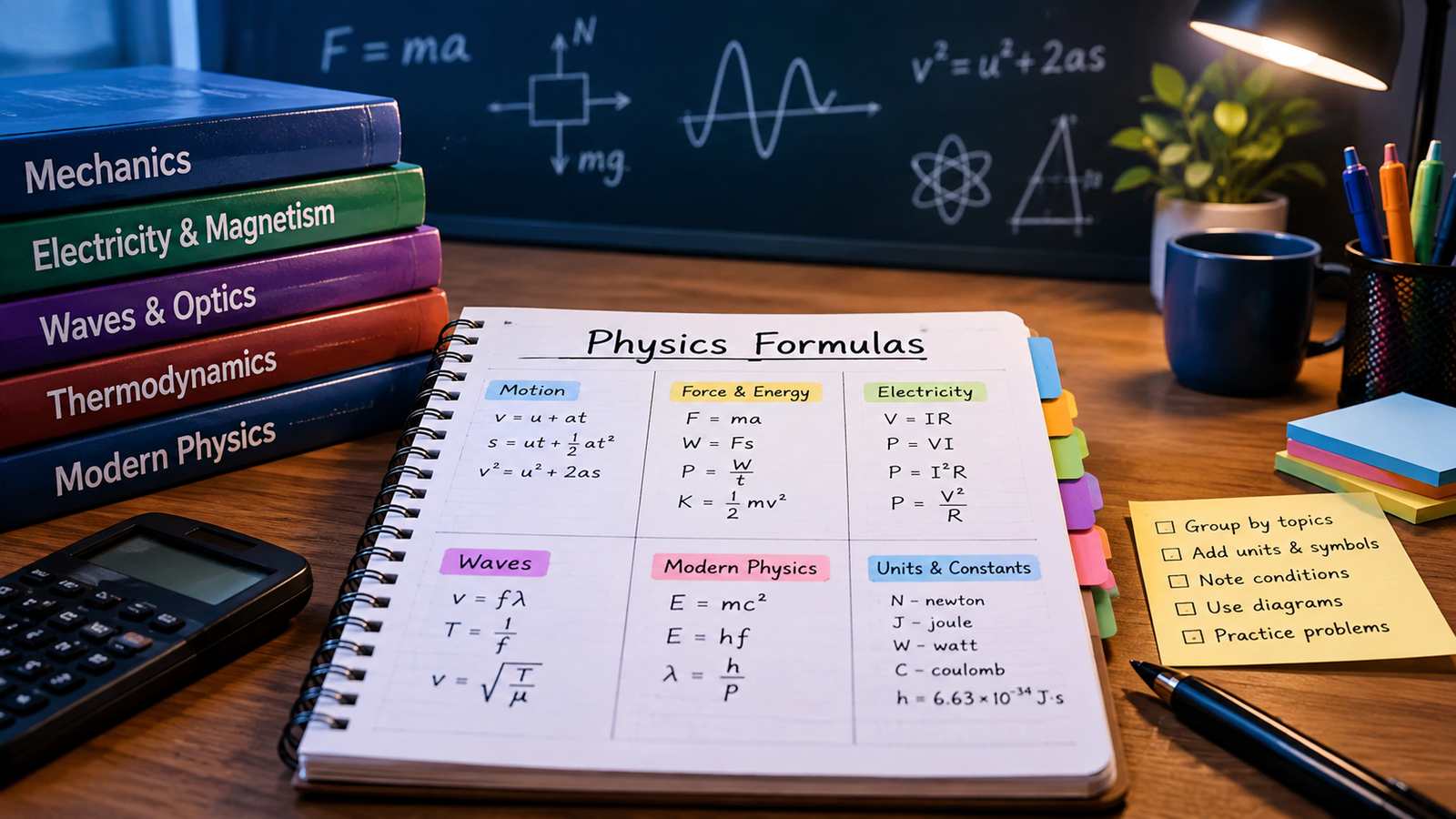
Physics is the study of how the natural world works, from the motion of objects to the behavior of light, heat, electricity, and matter. To describe these phenomena clearly, physicists use formulas. A physics formula is more than a mathematical expression. It represents a relationship between physical quantities and shows how changing one quantity can affect another. By reading formulas carefully, we can understand patterns in nature, make predictions, and solve practical problems.
What Is a Physical Relationship?
A physical relationship describes how two or more measurable quantities are connected. For example, speed describes the relationship between distance and time. If an object travels a certain distance in a certain amount of time, its speed can be calculated using the formula:
v = s/t
Here, v represents speed, s represents distance, and t represents time. The formula tells us that speed depends on both distance and time. If the distance increases while the time remains the same, the speed increases. If the same distance takes more time, the speed decreases.
This is how formulas turn observations about the physical world into precise mathematical relationships.
How Formulas Show Connections Between Quantities
One of the most useful features of a physics formula is that it shows how quantities are connected.
Consider Newton’s second law:
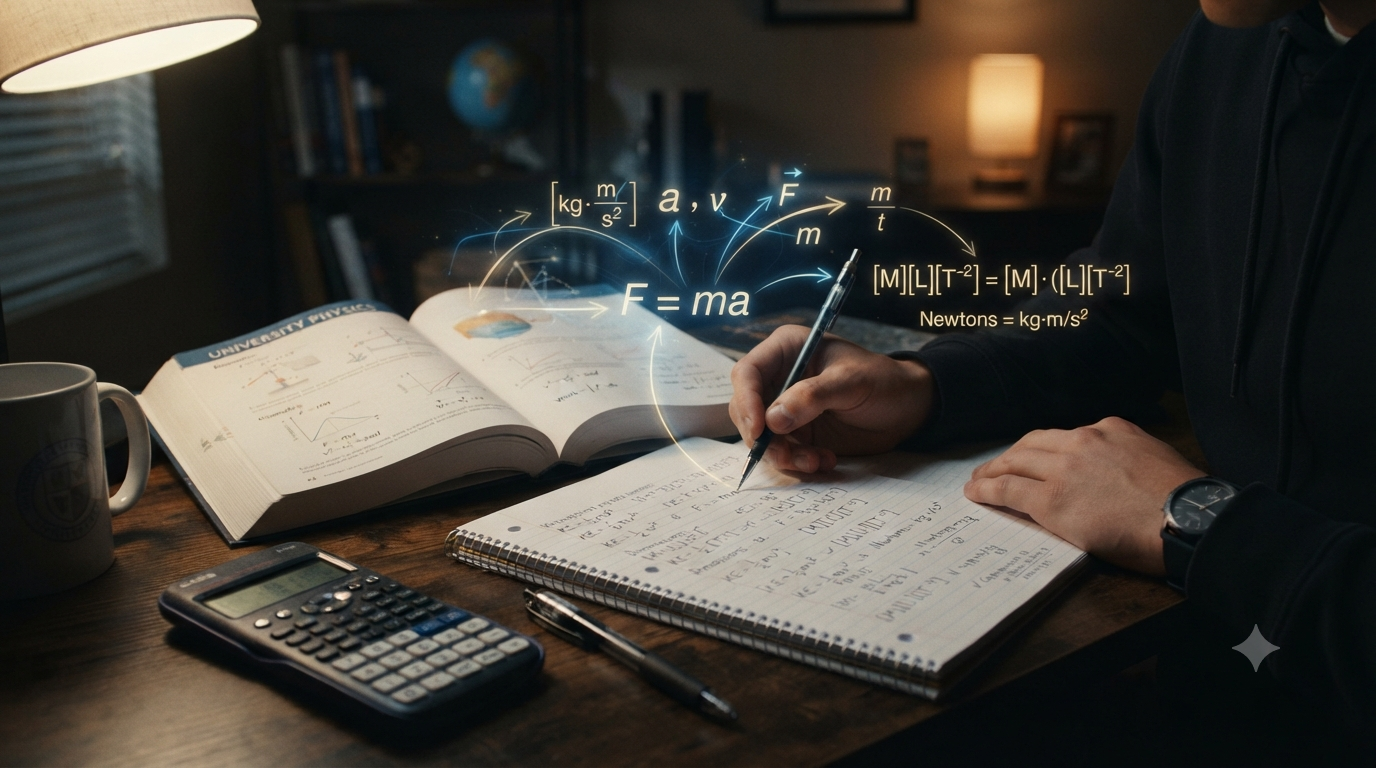
F = ma
This formula describes the relationship between force, mass, and acceleration. It tells us that the force acting on an object depends on its mass and acceleration.
If the mass remains constant and acceleration increases, the required force also increases. Similarly, if acceleration remains constant but mass increases, the force increases.
A formula therefore allows us to understand not only the values of quantities but also how they change relative to one another.
Direct Relationships in Physics
Some formulas describe a direct relationship between quantities. In a direct relationship, increasing one quantity causes another quantity to increase when the other factors remain constant.
For example:
F = ma
If mass is constant, force is directly related to acceleration. Doubling the acceleration doubles the force.
Another example is the relationship between distance and time when an object moves at constant speed:
s = vt
If speed remains constant, increasing the time allows the object to travel a greater distance. Doubling the time doubles the distance traveled.
These relationships help physicists predict what will happen when a physical condition changes.
Inverse Relationships in Physics
Not every physical relationship is direct. Some quantities have an inverse relationship, meaning that when one quantity increases, another decreases under fixed conditions.
A simple example is:
v = s/t
If the distance is fixed, increasing the time taken to travel that distance causes the average speed to decrease.
For example, suppose an object travels 100 meters. If it takes 10 seconds, its speed is 10 m/s. If it takes 20 seconds, its speed becomes 5 m/s.
The formula makes this relationship clear. It allows us to predict the result without performing the physical experiment every time.
Formulas Can Show Multiple Relationships
Many physics formulas contain more than two quantities. This allows one formula to describe several relationships at once.
Consider the kinetic energy formula:
KE = ½mv²
Kinetic energy depends on both mass and velocity. Increasing the mass increases the kinetic energy. However, velocity has an even stronger effect because it is squared.
If the velocity doubles, the kinetic energy becomes four times greater, assuming the mass remains constant.
This shows why understanding the mathematical structure of a formula is important. The powers, multiplication, and division symbols are not just mathematical details. They tell us how strongly different quantities influence one another.
Formulas Help Explain Changes
Physics is often concerned with changes. A formula can show how one physical quantity responds when another changes.
For example, acceleration is given by:
a = Δv/Δt
This means acceleration describes how quickly velocity changes with time.
A large change in velocity over a short period produces greater acceleration. A smaller change in velocity over a longer period produces less acceleration.
The formula therefore provides a mathematical way to describe motion that changes over time.
Formulas Connect Mathematics With Physical Reality
A physics formula becomes meaningful only when its mathematical symbols represent real physical quantities.
For example:
P = F/A
This formula describes pressure as force acting over an area. If the same force acts over a smaller area, the pressure increases. If the force is spread over a larger area, the pressure decreases.
This relationship explains many everyday situations. A sharp object can produce a large pressure because its force is concentrated over a small area. A wide surface distributes the force over a larger area and produces less pressure.
The formula connects an abstract mathematical relationship with something that can be observed in the real world.
Formulas Allow Predictions
One of the greatest strengths of physics formulas is their ability to make predictions.
Suppose we want to determine how far an object travels when it moves at a constant velocity. We can use:
s = vt
If the velocity is 5 m/s and the time is 8 seconds:
s = 5 × 8 = 40 m
The formula allows us to predict that the object will travel 40 meters.
This predictive ability is essential in science and technology. Engineers, researchers, and scientists use physical relationships to design systems, test ideas, and predict how objects and processes will behave.
Formulas Can Be Rearranged to Reveal Different Relationships
A physics formula can often be rearranged to find different quantities.
Starting with:
v = s/t
We can rearrange it to find distance:
s = vt
Or time:
t = s/v
The physical relationship has not changed. Only the mathematical form has been rearranged to make a different quantity the subject.
Learning to rearrange formulas is therefore an important physics skill. It helps us see that the same physical relationship can be used in different ways.
Units Help Confirm Physical Relationships
Units provide another important clue about the relationship represented by a formula.
For example:
v = s/t
Distance is measured in meters and time in seconds, so velocity has the unit:
m/s
Similarly, from:
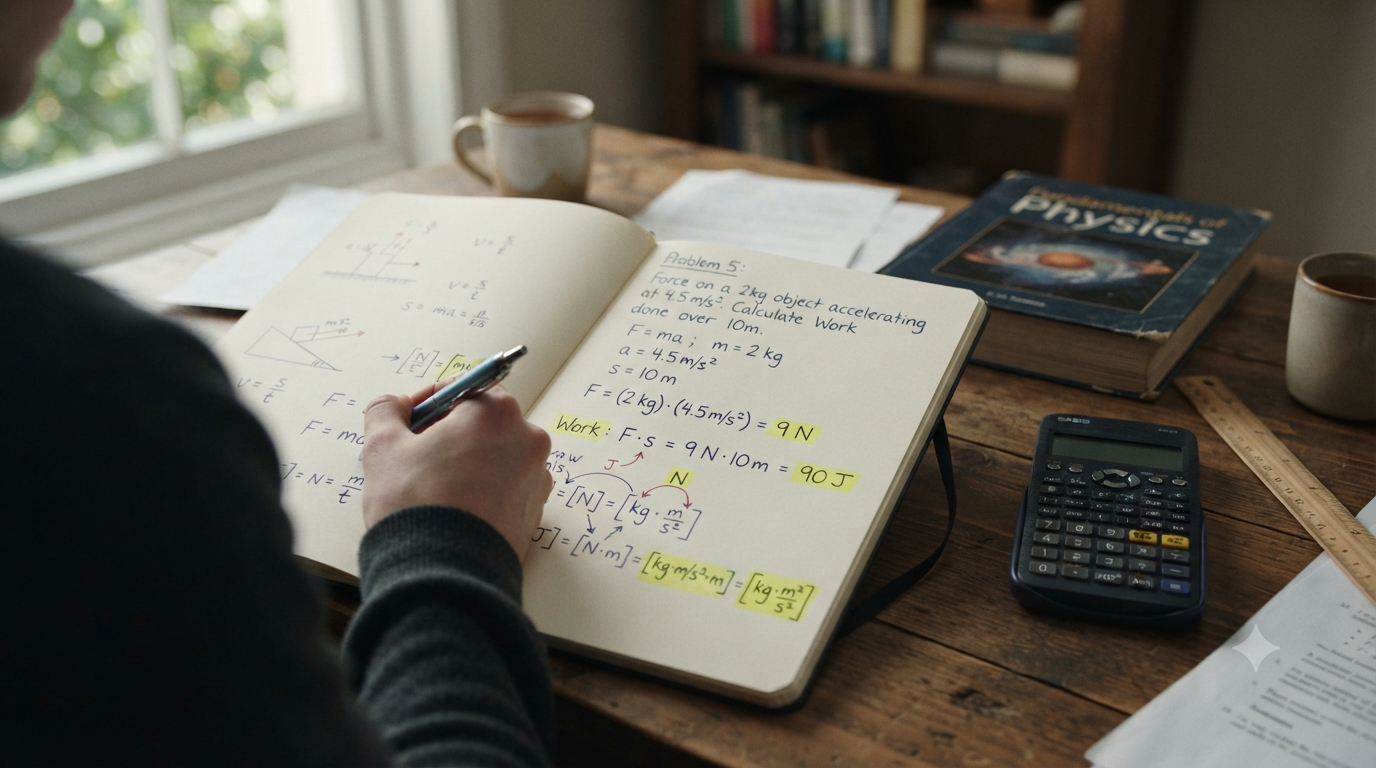
F = ma
mass is measured in kilograms and acceleration in meters per second squared. Therefore, force has the unit:
kg·m/s²
which is called the newton (N).
Checking units can help identify mistakes and confirm whether a formula is physically meaningful.
Formulas Are Models of Nature
A physics formula is a mathematical model of a physical relationship. It does not simply provide an answer to a numerical problem. It represents a pattern that has been observed, tested, and expressed mathematically.
For example, Newton’s laws describe relationships involving motion and force, while equations for electrical circuits describe relationships between quantities such as voltage, current, and resistance.
These mathematical models allow scientists to describe complicated physical behavior in a concise form.
How to Read a Physics Formula
When you encounter a physics formula, do not immediately substitute numbers. First understand the relationship.
Start by identifying what each symbol represents. Then determine which quantities are multiplied or divided, and check whether any quantity is raised to a power.
Next, ask how changing one quantity would affect the others. Finally, check the units.
For example, when reading:
E = mc²
you should notice that energy depends on mass and that the speed of light is squared. Even without calculating a value, the formula communicates an important physical relationship between mass and energy.
Conclusion
Physics formulas provide a powerful language for describing relationships in nature. They show how physical quantities depend on one another, whether the relationship is direct, inverse, or influenced by a power. Formulas also allow scientists to calculate unknown quantities, make predictions, test physical models, and connect mathematical ideas with real-world observations. Learning physics formulas effectively is therefore not about memorizing equations alone. It is about understanding what each formula means, how its quantities are connected, and what happens when those quantities change. Once this way of thinking becomes familiar, physics formulas become much more than mathematical expressions—they become tools for understanding how the physical world works.