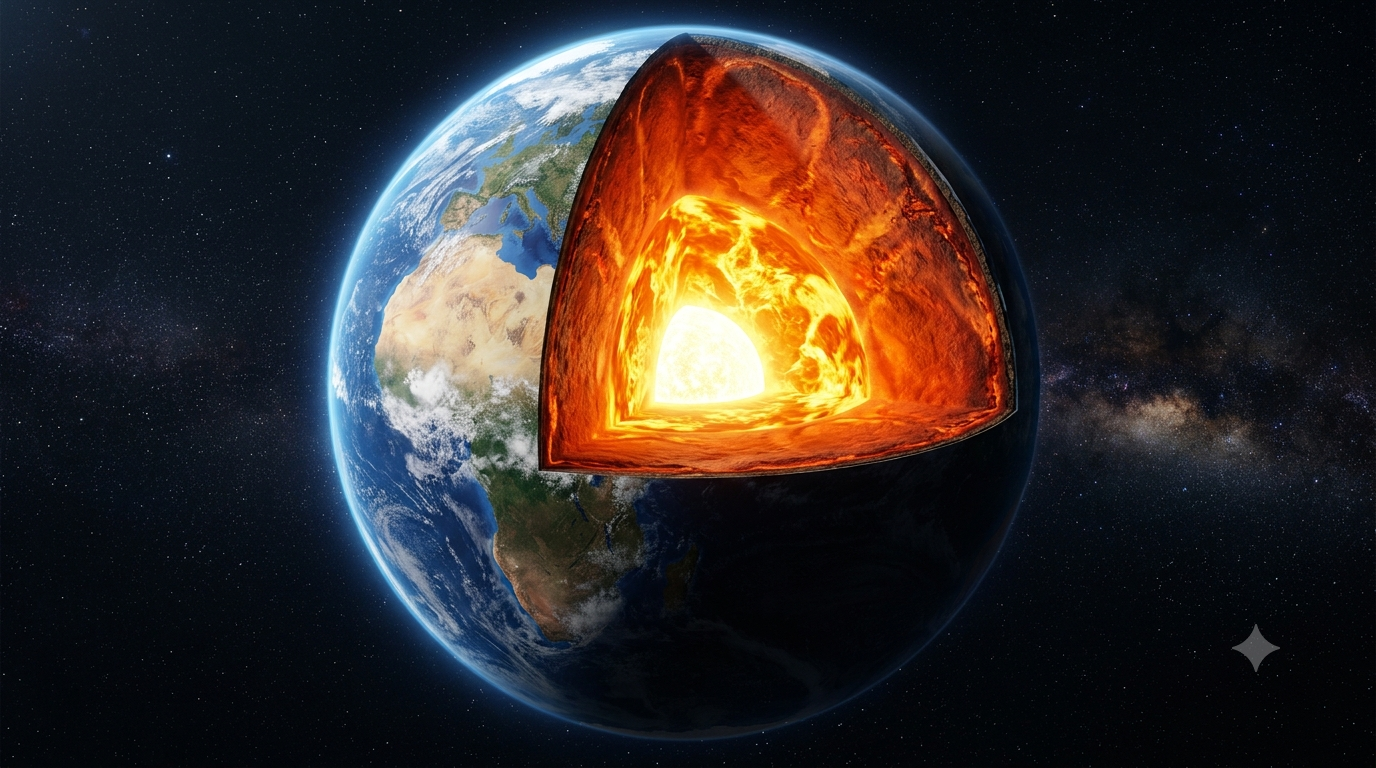
Earth may look like a solid ball from space, but its interior is far more complex than its surface suggests. Beneath the oceans, mountains, forests, and cities lies a series of layers with different compositions, temperatures, densities, and physical properties. These layers work together to influence earthquakes, volcanic eruptions, the movement of continents, and the magnetic field that protects our planet. Scientists have studied Earth’s interior using earthquake waves, laboratory experiments, rock samples, and measurements of gravity and Earth’s magnetic field. Their findings reveal that Earth is made up of four major compositional layers: the crust, mantle, outer core, and inner core. Each layer has a distinct role in shaping the planet. Understanding Earth’s structure helps us explain not only what happens beneath our feet but also how our planet formed and continues to change.
What Is Earth’s Internal Structure?
Earth’s internal structure refers to the arrangement of materials inside the planet, from its thin outer surface to its extremely hot central region. These materials differ in chemical composition, temperature, pressure, density, and physical state.
Earth has an average radius of approximately 6,371 kilometres. However, humans have directly explored only a tiny fraction of this distance. The deepest borehole ever drilled, the Kola Superdeep Borehole in Russia, reached about 12.3 kilometres below the surface. Compared with Earth’s radius, this is an extremely small depth.
Scientists therefore rely on indirect methods to understand the planet’s interior. One of the most important methods is the study of seismic waves produced by earthquakes. As these waves travel through Earth, their speed and direction change depending on the materials they encounter. By analysing these changes, scientists can identify boundaries between different internal layers.
Earth’s interior is commonly explained through two classifications:
Compositional layers: The crust, mantle, and core, classified according to their chemical composition.
Mechanical layers: The lithosphere, asthenosphere, mesosphere, outer core, and inner core, classified according to their physical behaviour.
Both classifications are important because they describe different aspects of the same planet.
1. Earth’s Crust
The crust is Earth’s outermost solid layer. It forms the surface on which humans, animals, and plants live. Oceans, continents, mountain ranges, plains, and many other familiar geographical features are associated with this layer.
Although the crust appears enormous when viewed from the surface, it is very thin compared with the deeper layers of Earth.
Thickness of the Crust
The thickness of Earth’s crust varies depending on its location.
Oceanic crust: Generally about 5–10 kilometres thick.
Continental crust: Usually about 30–70 kilometres thick, with some variation beneath major mountain ranges.
Oceanic crust is generally thinner and denser than continental crust. Continental crust is usually thicker and less dense.
Composition of the Crust
The crust consists mainly of solid rocks and minerals. Common elements include oxygen, silicon, aluminium, iron, calcium, sodium, potassium, and magnesium.
Oceanic crust is composed largely of basaltic rocks, which are relatively rich in iron and magnesium. Continental crust contains a wider variety of rocks, including granite, which is generally rich in silica and aluminium-bearing minerals.
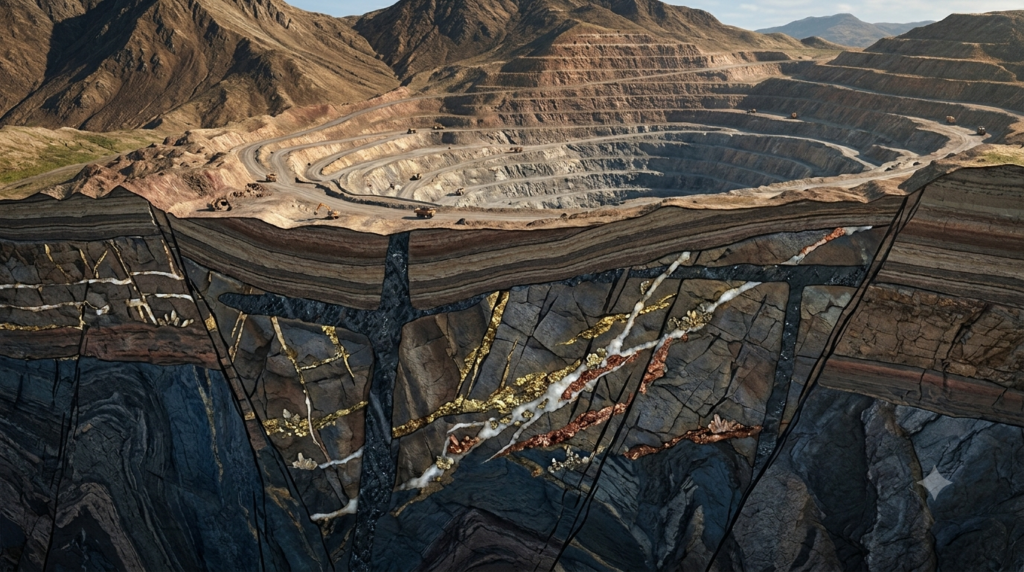
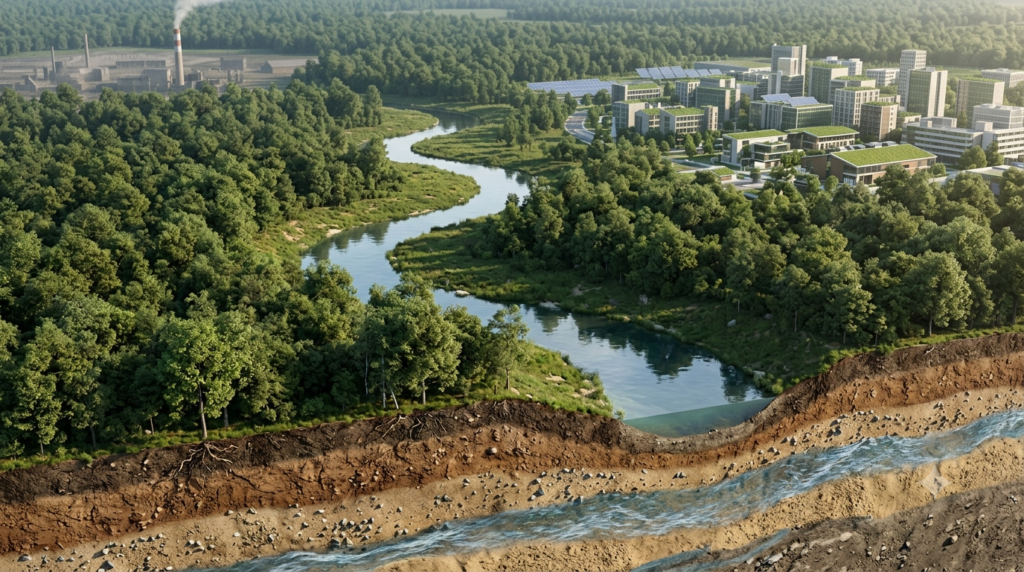
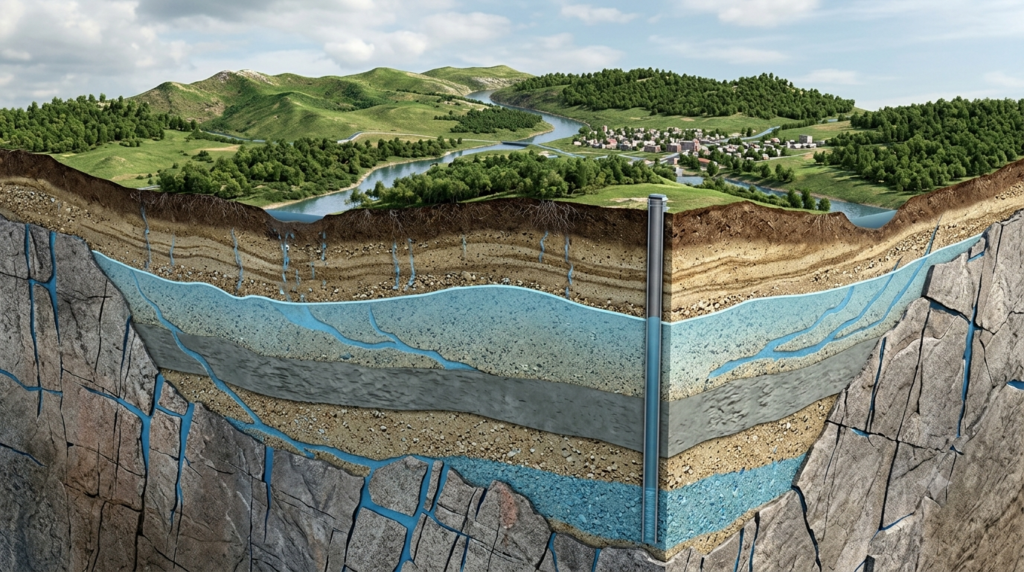
The crust also contains soil, sediment, groundwater, and valuable natural resources. Many metals, industrial minerals, and fossil fuels are found within or beneath it.
Oceanic and Continental Crust
Oceanic crust lies beneath the oceans and is generally younger than continental crust because it is continually formed at mid-ocean ridges and recycled into the mantle at subduction zones.
Continental crust forms the foundations of the continents. Some parts contain rocks that are billions of years old, preserving evidence of Earth’s ancient history.
The difference in density between these two types of crust helps explain why ocean basins are generally deeper than continental regions.
Why Is the Crust Important?
The crust is important because it provides the environment in which most surface processes occur. Weathering breaks down rocks, erosion transports sediments, and geological processes create mountains, valleys, and ocean basins.
The crust is also divided into tectonic plates. Their movements produce earthquakes, volcanic activity, and continental drift. Although the crust itself is rigid, it forms part of a larger mechanical layer called the lithosphere.
2. Earth’s Mantle
Beneath the crust lies the mantle, the thickest major compositional layer of Earth. It extends to a depth of approximately 2,900 kilometres and makes up most of Earth’s volume.
The mantle is often misunderstood as a vast ocean of liquid rock. In reality, most of the mantle is solid. However, mantle rocks can deform and flow very slowly over geological timescales because of the enormous temperatures and pressures present at depth.
Composition of the Mantle
The mantle is composed mainly of silicate minerals rich in magnesium and iron. Important minerals include olivine and pyroxene, along with other minerals that become stable under different pressure conditions.
Mantle rocks are generally denser than crustal rocks. As depth increases, pressure rises dramatically, causing minerals to change their structures and physical properties.
The mantle’s composition is not perfectly uniform. Its upper and lower regions differ in mineral structure, temperature, pressure, and behaviour.
Upper Mantle
The upper mantle extends from beneath the crust to a depth of approximately 660 kilometres. Its uppermost part, together with the crust, forms the lithosphere.
Below the lithosphere lies a region of the upper mantle known as the asthenosphere. In this region, some rocks are close to their melting point, and small amounts of partial melting may occur in certain locations. Much of the asthenosphere remains solid but can deform more easily than the rigid lithosphere.
The asthenosphere is particularly important because tectonic plates can move over this relatively weak region.
Lower Mantle
The lower mantle extends from approximately 660 kilometres to 2,900 kilometres below Earth’s surface.
Pressure in this region is extremely high. Mantle minerals undergo structural changes that allow them to remain stable under these conditions.
Although the lower mantle is solid, its material can move slowly through processes involving heat transfer and long-term deformation. These movements contribute to the transport of heat from Earth’s interior toward the surface.
Mantle Convection
One of the mantle’s most important processes is convection. Heat from Earth’s interior causes temperature differences within the mantle, while variations in density and other forces influence the movement of mantle material.
Warmer material tends to be more buoyant, while cooler material tends to become denser and sink. However, actual mantle circulation is complex and is influenced by temperature, pressure, composition, and the movement of tectonic plates.
Over millions of years, mantle dynamics help drive plate tectonics. At divergent boundaries, plates move apart and new oceanic crust forms. At convergent boundaries, one plate may sink beneath another in a process called subduction.
Mantle processes also contribute to volcanic activity, mountain building, and the recycling of Earth’s surface materials.
3. Earth’s Outer Core
The outer core lies beneath the mantle and extends from approximately 2,900 kilometres to 5,150 kilometres below Earth’s surface. Unlike the crust and mantle, the outer core is liquid.
It consists mainly of iron and nickel, along with smaller amounts of lighter elements. Its temperature is extremely high, and the pressure is enormous. Despite this pressure, the material in the outer core remains liquid because the temperature is above the melting range of its composition under those conditions.
Why Is the Outer Core Liquid?
Whether a material is solid or liquid depends on both temperature and pressure, as well as its chemical composition.
The outer core is hot enough for its iron-rich material to remain molten under the conditions found there. This liquid state has a major influence on Earth’s magnetic field.
Scientists have identified the liquid nature of the outer core by studying seismic waves. Shear waves, also known as S-waves, cannot travel through ordinary liquids. Their absence through the outer core provides strong evidence that this layer is liquid.
Changes in the speed and direction of compressional waves, or P-waves, also reveal the boundary between the mantle and outer core.
Earth’s Magnetic Field
One of the outer core’s most important functions is generating Earth’s magnetic field through a process called the geodynamo.
Heat escaping from the core and the release of lighter elements as the inner core grows help drive the movement of electrically conducting liquid iron in the outer core. Earth’s rotation influences these fluid motions.
The combination of fluid movement, electrical conductivity, and magnetic effects sustains the magnetic field.
Earth’s magnetic field extends into space and forms the magnetosphere. It helps deflect many charged particles from the solar wind and influences how these particles interact with our planet.
The magnetic field is not perfectly constant. Its strength and direction change over time, and Earth’s magnetic poles have reversed their relative positions many times in geological history.
Without the processes occurring in the outer core, Earth would not have its present geodynamo-generated magnetic field.
4. Earth’s Inner Core
At the centre of Earth lies the inner core, a solid sphere composed primarily of iron and nickel. It begins at a depth of approximately 5,150 kilometres and extends to Earth’s centre, about 6,371 kilometres below the surface.
The inner core has a radius of roughly 1,220 kilometres. Although it is surrounded by the liquid outer core, the inner core remains solid.
Why Is the Inner Core Solid?
The inner core is extremely hot, with estimates commonly reaching several thousand degrees Celsius. However, temperature alone does not determine whether a material melts.
Pressure at Earth’s centre is immense. This enormous pressure raises the melting temperature of the iron-rich material, allowing the inner core to remain solid despite its high temperature.
This is an important example of how pressure and temperature work together to determine the physical state of a material.
Composition of the Inner Core
The inner core consists mainly of iron, with nickel and smaller amounts of other elements. Its exact composition and internal structure remain subjects of scientific investigation.
The inner core is denser than the outer core because solid iron-rich material is packed more closely under the enormous pressure.
Scientists study seismic waves passing through the inner core to investigate its properties. These observations suggest that the inner core has complex elastic behaviour and may exhibit differences in seismic wave speeds depending on the direction of travel.
How Does the Inner Core Grow?
Earth has been cooling gradually since its formation. As the core loses heat, some of the liquid iron-rich material in the outer core solidifies onto the surface of the inner core.
This process allows the inner core to grow over time.
When material freezes onto the inner core, lighter elements are preferentially left in the surrounding liquid. Their movement helps drive convection in the outer core, contributing to the geodynamo that generates Earth’s magnetic field.
The inner core therefore plays an indirect but important role in maintaining the magnetic environment around our planet.
5. The Lithosphere and Asthenosphere
Besides the four major compositional layers, geologists use mechanical layers to describe how Earth’s materials respond to forces.
The lithosphere is Earth’s rigid outer shell. It consists of the crust and the uppermost solid mantle. It is broken into tectonic plates that move relative to one another.
The asthenosphere lies beneath the lithosphere within the upper mantle. Although it is mostly solid, its rocks can deform slowly under sustained stress. This behaviour allows tectonic plates to move over geological timescales.
The boundary between the lithosphere and asthenosphere is not the same everywhere. Their mechanical properties depend on temperature, composition, pressure, and geological conditions.
These layers help explain why Earth’s surface is divided into moving plates rather than forming one unbroken, immobile shell.
6. The Mesosphere and Other Mechanical Layers
In the mechanical classification, the term mesosphere refers to the stronger, deeper mantle beneath the asthenosphere. It broadly corresponds to the lower mantle, although the boundaries used in different descriptions may vary.
The mesosphere remains solid but can deform over long periods. Its behaviour differs from that of the weaker asthenosphere because of changes in temperature, pressure, mineral structure, and viscosity.
The outer core is a liquid mechanical layer, while the inner core is solid. These differences in physical state help scientists understand how seismic waves travel through Earth and how the planet transfers heat from its interior.
It is important to remember that the compositional and mechanical classifications describe the same internal structure from different perspectives. The crust, mantle, and core describe what Earth is made of, while the lithosphere, asthenosphere, mesosphere, outer core, and inner core describe how its materials behave.
7. How Do Scientists Study Earth’s Interior?
Because humans cannot directly reach the deep mantle or core, scientists use several methods to investigate Earth’s interior.
Seismic Waves
Seismic waves are among the most valuable sources of information about Earth’s internal structure. Earthquakes generate different types of waves that travel through the planet.
P-waves can travel through solids and liquids, although their speeds change when they cross different materials. S-waves travel through solids but do not propagate through ordinary liquids.
By measuring how seismic waves change speed, bend, reflect, or disappear, scientists can identify boundaries between layers and estimate their properties.
Gravity Measurements
Earth’s gravitational field provides information about the distribution of mass inside the planet. Variations in gravity can reveal differences in density and help scientists study the structure of the crust and mantle.
Earth’s Magnetic Field
Measurements of Earth’s magnetic field provide evidence about processes within the core. Changes in the field help scientists investigate the movement of electrically conducting liquid material in the outer core.
Meteorites and Laboratory Experiments
Some meteorites contain materials that provide clues about the early solar system and the formation of rocky planets. Their composition helps scientists develop models of Earth’s formation and internal structure.
Laboratory experiments reproduce the extreme pressures and temperatures found deep inside Earth. By observing how minerals and metals behave under these conditions, researchers can test models of the mantle and core.
Together, these methods provide a detailed picture of Earth’s interior without requiring direct access to its deepest regions.
8. Temperature and Pressure Inside Earth
Temperature and pressure generally increase with depth inside Earth, although their rates of change vary between regions.
Near the surface, temperature changes are influenced by climate, groundwater, and local geological conditions. Deeper underground, heat from Earth’s interior becomes increasingly important.
Earth’s internal heat comes from several sources, including heat retained from its formation, energy released during the separation of dense materials toward the centre, and heat produced by the radioactive decay of certain elements.
Pressure increases with depth because the weight of the overlying material becomes greater. At the centre of Earth, pressure reaches several million times atmospheric pressure at sea level.
These extreme conditions influence mineral structures, rock deformation, melting temperatures, and the physical states of the outer and inner cores.
Understanding temperature and pressure is essential for explaining why the mantle remains mostly solid, why the outer core is liquid, and why the inner core is solid.
9. Why Is Earth’s Internal Structure Important?
Earth’s internal structure affects many processes that shape the planet and influence life on its surface.
Plate tectonics: Heat-driven mantle dynamics and forces associated with moving and sinking plates contribute to the movement of Earth’s lithosphere. This movement changes the positions of continents and ocean basins.
Earthquakes: Earthquakes commonly occur when stress causes rocks to break or slip along faults, especially near tectonic plate boundaries. Studying Earth’s layers helps scientists understand how seismic waves travel and how earthquakes affect different regions.
Volcanic eruptions: Magma can form through partial melting in the mantle or crust. It may rise through fractures and eventually erupt at the surface, creating new rock and releasing gases.
Magnetic protection: The geodynamo in the liquid outer core generates Earth’s magnetic field, which influences the interaction between the solar wind and our planet.
Long-term geological change: The transfer of heat through Earth’s interior influences the evolution of continents, ocean floors, mountain ranges, and volcanic regions.
The planet’s internal structure also provides evidence about Earth’s origin, its gradual cooling, and the processes that have shaped it over billions of years.
Conclusion
Earth is a layered planet whose internal structure extends from the thin, rocky crust to the solid inner core. The crust forms the surface, the mantle transfers heat and participates in the processes that drive plate tectonics, the liquid outer core generates Earth’s magnetic field, and the solid inner core occupies the planet’s centre. Each layer has distinctive properties determined by its composition, temperature, and pressure. Although scientists cannot directly explore most of Earth’s interior, seismic waves, gravity measurements, magnetic observations, meteorites, and laboratory experiments provide valuable evidence about its structure. Learning about these layers helps explain earthquakes, volcanic activity, continental movement, and Earth’s magnetic environment. More importantly, it reveals that our planet is not a static ball of rock but a dynamic system that continues to evolve beneath the surface.
FAQs
1. What are the four main layers of Earth?
Earth has four main compositional layers: the crust, mantle, outer core, and inner core. The crust is the thin, solid outermost layer where continents and ocean floors are located. Beneath it lies the mantle, a thick layer of mostly solid rock that moves slowly over geological timescales. The outer core consists mainly of liquid iron and nickel, while the inner core is a solid, dense region at the planet’s centre. Each layer has different temperatures, pressures, compositions, and physical properties. Together, these layers influence Earth’s magnetic field, volcanic activity, earthquakes, and long-term geological development.
2. Which is the thinnest layer of Earth?
The crust is the thinnest of Earth’s four main compositional layers. Its thickness varies depending on its location. Oceanic crust is generally about 5–10 kilometres thick, while continental crust is usually around 30–70 kilometres thick. Despite its relatively small thickness, the crust supports ecosystems, human settlements, and many geological processes. It contains rocks, minerals, soil, and valuable natural resources. The crust is also part of the lithosphere, which includes the rigid uppermost mantle and is divided into moving tectonic plates. These plates influence earthquakes, mountain formation, volcanic activity, and the gradual movement of continents.
3. What is Earth’s mantle made of?
Earth’s mantle consists mainly of silicate rocks rich in magnesium and iron. Minerals such as olivine and pyroxene are important components of mantle rocks. The mantle extends from beneath the crust to approximately 2,900 kilometres deep, making it Earth’s thickest compositional layer. Although temperatures are extremely high, most of the mantle remains solid because of the pressure present at depth. However, mantle rocks can deform and flow very slowly over millions of years. These movements help transfer heat from Earth’s interior and contribute to the forces and processes associated with tectonic plate movement and volcanic activity.
4. Is Earth’s mantle liquid or solid?
Earth’s mantle is predominantly solid, not a vast ocean of molten rock. However, mantle materials can deform slowly under sustained pressure and temperature, allowing them to flow over geological timescales. In some regions, particularly beneath volcanic areas and at certain mid-ocean ridges, partial melting produces magma. The asthenosphere, a relatively weak region of the upper mantle, can deform more easily than the rigid lithosphere above it. This behaviour helps tectonic plates move over time. Understanding the mantle’s physical state is important for explaining plate tectonics, heat transfer, magma formation, and the geological changes that continuously reshape Earth’s surface.
5. Why is Earth’s outer core liquid?
Earth’s outer core remains liquid because its temperature is high enough to keep its iron-rich material molten under the pressure conditions found there. It extends from approximately 2,900 to 5,150 kilometres below Earth’s surface and consists mainly of iron and nickel, with smaller amounts of lighter elements. Scientists have strong evidence for its liquid state from seismic waves. S-waves cannot travel through ordinary liquids, and their absence through the outer core supports this conclusion. The movement of electrically conducting liquid metal within this layer is also essential for generating Earth’s magnetic field through a process known as the geodynamo.
6. Why is Earth’s inner core solid despite its high temperature?
Earth’s inner core remains solid because the enormous pressure at the planet’s centre raises the melting temperature of its iron-rich material. Although the inner core is extremely hot, the pressure is sufficient to keep most of its material solid under present conditions. It begins at a depth of approximately 5,150 kilometres and extends to Earth’s centre, about 6,371 kilometres below the surface. The inner core consists mainly of iron and nickel. Scientists study seismic waves passing through this region to investigate its properties. As Earth gradually loses heat, additional material freezes onto the inner core, allowing it to grow over time.
7. How do scientists know what Earth’s interior looks like?
Scientists study Earth’s interior mainly by analysing seismic waves produced by earthquakes. P-waves travel through solids and liquids, while S-waves travel through solids but cannot propagate through ordinary liquids. Changes in wave speed, direction, and behaviour reveal boundaries between internal layers. Researchers also use gravity measurements to investigate density variations, magnetic observations to study the core, and laboratory experiments to understand how rocks and metals behave under extreme pressure and temperature. Meteorites provide additional clues about the materials involved in Earth’s formation. By combining these methods, scientists can develop reliable models of Earth’s interior without directly visiting its deepest regions.
8. What is the difference between the crust and the lithosphere?
The crust is Earth’s outermost compositional layer, made mainly of solid rocks and minerals. The lithosphere is a mechanical layer that includes the entire crust and the rigid uppermost portion of the mantle. It is divided into tectonic plates that move relative to one another. The distinction matters because the crust and lithosphere do not have identical boundaries. The lithosphere extends deeper than the crust, and its thickness varies from place to place. Beneath it lies the asthenosphere, a relatively weak region of the upper mantle. The movement of lithospheric plates contributes to earthquakes, volcanic activity, and mountain formation.
9. How does Earth’s internal structure create its magnetic field?
Earth’s magnetic field is generated mainly by the movement of electrically conducting liquid iron-rich material in the outer core. Heat escaping from the core and the release of lighter elements as the inner core grows help drive convection within this liquid layer. Earth’s rotation influences these movements, allowing the geodynamo to sustain a magnetic field. The resulting field extends into space and forms the magnetosphere, which helps deflect many charged particles from the solar wind. The magnetic field changes over time, and its poles have reversed their relative positions many times throughout geological history. The solid inner core indirectly supports this process by releasing heat and lighter elements as it grows.
10. Why is studying Earth’s internal structure important?
Studying Earth’s internal structure helps scientists understand the natural processes that shape our planet. Mantle dynamics and tectonic plate movements explain continental drift, mountain building, and many earthquakes and volcanic eruptions. Investigating the outer core helps researchers understand the origin and behaviour of Earth’s magnetic field, which influences how our planet interacts with the solar wind. Internal temperature and pressure also explain why different layers behave as solids or liquids. In addition, geological studies reveal information about Earth’s formation, cooling, and long-term evolution. This knowledge improves our understanding of natural hazards and provides a scientific foundation for investigating the planet’s past, present, and future.