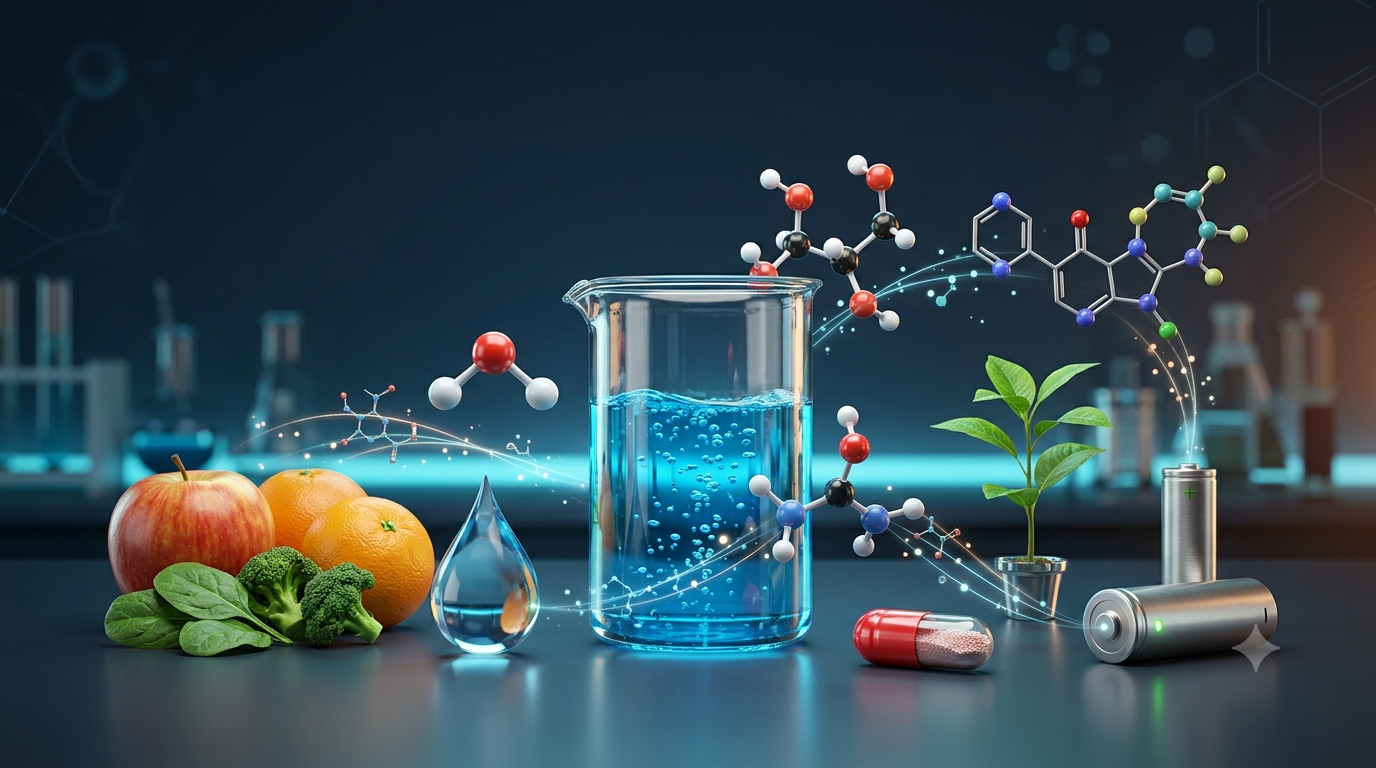
Chemistry is the branch of science that studies matter, its composition, structure, properties, and the changes it undergoes. Everything around us, including the air we breathe, the water we drink, the food we eat, and the materials we use, involves chemistry. Even the processes taking place inside our bodies depend on chemical reactions. Although chemistry is often associated with laboratories, chemicals in bottles, and scientific experiments, it is actually a part of our everyday lives.
From cooking food and washing clothes to using medicines, charging batteries, and growing plants, chemistry helps explain how the world works. It also plays an important role in developing new materials, improving healthcare, protecting the environment, and producing energy. Understanding the basic principles of chemistry allows us to make better decisions about health, food, household products, and the environment. This article introduces chemistry, explains its main concepts, and explores its importance in everyday life.
What Is Chemistry?
Chemistry is the scientific study of matter and the changes that matter undergoes. Matter is anything that has mass and occupies space. Air, water, rocks, metals, plants, and human beings are all examples of matter.
Chemistry helps us understand what substances are made of, how their particles are arranged, and how they interact with one another. It also explains why some substances react when mixed, why metals can rust, why food changes during cooking, and why certain materials conduct electricity while others do not.
For example, water is made of hydrogen and oxygen chemically bonded together. Table salt contains sodium and chlorine in an ionic structure. Although these substances contain different elements and have different properties, chemistry explains their composition and behavior.
Chemistry is not limited to identifying substances. It also investigates how new substances form during chemical reactions and how factors such as temperature, pressure, and concentration affect those reactions.
What Is Matter and What Is It Made Of?
Matter is the foundation of chemistry. To understand chemical processes, we first need to understand the basic particles that make up matter.
Atoms
An atom is the smallest unit of a chemical element that retains the identity of that element. Atoms contain a nucleus made of protons and usually neutrons, surrounded by electrons.
Protons have a positive electric charge, electrons have a negative charge, and neutrons have no electric charge. The number of protons determines which element an atom represents.
For example, every carbon atom has six protons, while every oxygen atom has eight protons.
Atoms are extremely small, but their interactions determine the properties of the materials we see and use.
Elements
An element is a pure substance made up of atoms with the same number of protons. Examples include hydrogen, oxygen, carbon, iron, copper, and gold.
Each element has its own chemical symbol. Hydrogen is represented by H, oxygen by O, and carbon by C.
Elements are organized in the periodic table according to their atomic numbers and other properties. The periodic table helps scientists understand similarities between elements and predict how they may behave in chemical reactions.
Molecules and Compounds
A molecule consists of two or more atoms chemically bonded together. The atoms may belong to the same element or to different elements.
For example, an oxygen molecule contains two oxygen atoms, represented by O₂. A water molecule contains two hydrogen atoms and one oxygen atom, represented by H₂O.
A compound is a substance containing two or more different elements chemically combined in fixed proportions. Water and carbon dioxide are examples of compounds.
These concepts help explain why substances have different properties and how chemical reactions produce new materials.
The Three Common States of Matter
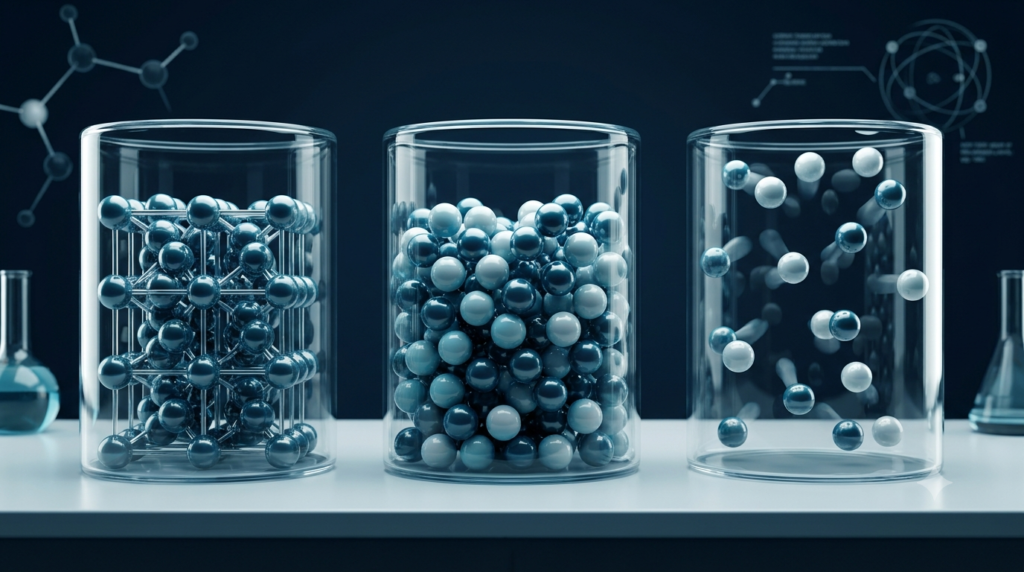
Matter commonly exists as a solid, liquid, or gas under everyday conditions. These states differ mainly in how their particles are arranged and how freely they move.
Solids
In a solid, particles are closely packed and generally remain around fixed positions, although they vibrate. Solids have a definite shape and a definite volume.
Examples include ice, wood, iron, and salt. The arrangement and bonding of particles help determine whether a solid is hard, soft, brittle, or flexible.
Liquids
In a liquid, particles remain close together but can move past one another. Liquids have a definite volume but take the shape of their container.
Water, milk, cooking oil, and petrol are familiar examples of liquids.
Gases
In a gas, particles are much farther apart on average and move freely. Gases do not have a definite shape or volume and can expand to fill their containers.
Air, oxygen, and carbon dioxide are examples of gases.
Matter can change from one state to another through physical processes such as melting, freezing, evaporation, condensation, and sublimation. These changes are important in cooking, refrigeration, weather, and industrial processes.
Physical Changes and Chemical Changes
One of the most important ideas in chemistry is the difference between physical changes and chemical changes.
Physical Changes
A physical change affects the form, size, or state of a substance without changing its chemical identity.
For example, when ice melts, solid water becomes liquid water. The substance remains H₂O.
Other examples include cutting paper, crushing a can, dissolving sugar in water, and boiling water. Some physical changes can be reversed easily, although reversibility alone does not determine whether a change is physical.
Chemical Changes
A chemical change occurs when substances are transformed into new substances through chemical reactions.
Rusting iron, burning wood, baking a cake, and digesting food are examples of chemical changes.
During a chemical reaction, atoms are rearranged as chemical bonds break and new bonds form. The atoms themselves are conserved in ordinary chemical reactions, even though the substances they form may have very different properties.
Recognizing the difference between these changes helps explain many everyday observations. For instance, melting butter is mainly a physical change, while browning food during cooking involves chemical reactions.
The Role of Chemistry in Food and Cooking
Chemistry plays an essential role in preparing, preserving, and digesting food. The taste, texture, color, smell, and nutritional properties of food are influenced by its chemical composition and the reactions that occur during preparation.
Chemical Reactions During Cooking
When food is heated, its molecules may undergo physical changes and chemical reactions. For example, proteins in eggs change their structure when heated, causing the liquid egg white to become solid.
The browning of bread and roasted foods often involves the Maillard reaction, a complex set of reactions between certain sugars and amino compounds. These reactions produce many of the colors and flavors associated with cooked foods.
Caramelization, another important process, occurs when sugars undergo chemical changes under suitable heating conditions.
Chemistry in Food Preservation
Chemistry also helps prevent food spoilage. Salt and sugar can reduce the availability of water for microbial growth under suitable conditions. Acids such as vinegar lower pH and help preserve certain foods.
Refrigeration slows many chemical reactions and the growth of microorganisms. Food packaging can also reduce exposure to oxygen, moisture, and other factors that contribute to spoilage.
Understanding these processes helps food producers develop safer preservation methods and maintain food quality.
Nutrients and Digestion
Food contains nutrients such as carbohydrates, proteins, fats, vitamins, and minerals. During digestion, enzymes help break large food molecules into smaller substances that the body can absorb.
For example, digestive enzymes break down starch into smaller sugars, while proteins are broken down into amino acids and smaller peptides.
These substances provide energy, support growth, and help maintain essential body functions. Chemistry helps scientists understand how nutrients behave in the body and how food composition affects health.
Chemistry in the Human Body
The human body is a complex chemical system. Thousands of chemical reactions take place continuously to provide energy, build tissues, regulate body functions, and remove waste.
Respiration and Energy Production
Cells use chemical processes to release usable energy from nutrients. During aerobic cellular respiration, glucose reacts with oxygen through several biochemical pathways, producing carbon dioxide, water, and energy that cells capture in the form of ATP.
The overall reaction can be represented in a simplified form.
Text block:
C₆H₁₂O₆ + 6O₂ → 6CO₂ + 6H₂O + EnergyThis equation summarizes the overall reaction for the complete aerobic oxidation of glucose. Actual cellular respiration takes place through multiple steps rather than one single reaction.
Digestion and Enzymes
Enzymes are biological catalysts that speed up chemical reactions without being consumed in the overall process. Digestive enzymes help break down food into smaller molecules that the body can absorb.
Different enzymes act on different substances. Amylases help break down starch, proteases act on proteins, and lipases help digest fats.
Without these biochemical processes, the body would struggle to obtain the nutrients needed for normal functioning.
Maintaining Chemical Balance
The body must regulate the concentrations of substances such as glucose, electrolytes, and hydrogen ions. For example, blood pH is maintained within a narrow range through chemical buffer systems, breathing, and kidney function.
Chemistry helps explain how these systems operate and why maintaining the correct chemical balance is essential for life.
Chemistry in Medicines and Healthcare
Modern healthcare depends heavily on chemistry. Medicines contain active substances that interact with biological systems to prevent, manage, or treat diseases.
Pharmaceutical chemists study the structures and properties of molecules to understand how they may affect the human body. They also investigate how medicines dissolve, how they are absorbed, and how their structures influence their activity.
For example, antacids contain substances that neutralize excess stomach acid. Many disinfectants work through chemical interactions that damage or inactivate microorganisms. Oral rehydration solutions contain carefully selected amounts of salts and glucose to help replace fluids and electrolytes lost during dehydration.
Chemistry also supports the development of diagnostic tests, medical imaging agents, vaccines, and materials used in medical devices.
However, medicines and household chemicals must be used according to appropriate instructions. A substance that is useful in one concentration or application may be harmful in another. Scientific understanding helps healthcare professionals evaluate safety, dosage, effectiveness, and potential side effects.
Chemistry in Cleaning and Personal Hygiene
Many everyday cleaning products work because of chemical properties and reactions.
Soaps and Detergents
Soap and detergent molecules help remove grease and dirt from surfaces. Their structures allow them to interact with both water and oily substances.
When washing hands or clothes, these molecules help loosen dirt and suspend oily material so that it can be rinsed away with water.
Detergents are especially useful in situations where ordinary soap performs poorly, including some hard-water conditions.
Acids and Bases in Household Products
Acids and bases have different chemical properties. Vinegar contains acetic acid, while many drain cleaners contain strongly alkaline substances.
Mild acidic products can help remove certain mineral deposits, while alkaline cleaning agents can help remove grease. The effectiveness of a product depends on its formulation and the type of dirt being removed.
Household chemicals must never be mixed casually. For example, mixing bleach with acidic cleaners can release dangerous chlorine gas, while mixing bleach with ammonia-containing products can produce hazardous gases. Always follow product labels and use appropriate ventilation.
Chemistry helps us understand why cleaning products work and how to use them more safely.
Chemistry in Agriculture and Plant Growth
Agriculture relies on chemistry to maintain soil fertility, support plant growth, and protect crops from pests and diseases.
Plants require essential elements such as nitrogen, phosphorus, potassium, magnesium, and iron. These elements support processes including protein formation, energy transfer, photosynthesis, and chlorophyll production.
Fertilizers supply selected nutrients when the soil cannot provide enough of them naturally. However, the correct type and quantity depend on soil conditions, crop requirements, and environmental factors.
Chemistry is also used to measure soil pH, investigate nutrient availability, and develop methods for controlling pests and plant diseases.
Excessive fertilizer or pesticide use can contaminate water, damage ecosystems, and affect human health. Therefore, agricultural chemistry aims not only to increase productivity but also to improve efficiency and reduce environmental harm.
Chemistry in Technology and Modern Materials
Many technologies depend on chemical knowledge to develop materials with specific properties.
Batteries and Electrical Energy
Batteries store energy in chemical form and convert it into electrical energy through electrochemical reactions. When a battery powers a device, reactions involving its electrodes and electrolyte help move electrons through an external circuit.
Rechargeable batteries can reverse important chemical processes during charging, within the limits of their design.
Chemistry is essential for improving battery capacity, charging performance, lifespan, cost, and safety. It is especially important in smartphones, laptops, electric vehicles, and energy storage systems.
Plastics and Polymers
Plastics are commonly made from polymers, which are large molecules consisting of repeating structural units. Different polymers have different properties, making them suitable for packaging, clothing, construction materials, medical equipment, and electronic devices.
Some plastics are lightweight and flexible, while others are rigid, heat-resistant, or chemically resistant.
Chemists develop new polymers and investigate ways to improve recycling, reduce waste, and create materials with lower environmental impacts.
Electronics and Semiconductor Materials
Electronic devices depend on materials with carefully controlled electrical properties. Silicon, for example, is a semiconductor widely used in computer chips and other electronic components.
Chemistry helps scientists purify materials, control their composition, and develop specialized substances for batteries, displays, solar cells, and electronic manufacturing.
Chemistry and Environmental Protection
Chemistry plays an important role in understanding pollution and developing methods to protect the environment.
Air Pollution
Air pollutants include substances such as particulate matter, nitrogen oxides, sulfur dioxide, and ground-level ozone. Some pollutants are released directly from sources such as vehicles and industrial processes, while others form through chemical reactions in the atmosphere.
Chemists analyze air samples, investigate how pollutants react, and develop methods to reduce harmful emissions.
Water Treatment
Water treatment often involves several physical and chemical processes. Depending on the source and intended use, treatment may include filtration, disinfection, coagulation, and the removal of unwanted dissolved substances.
For example, chlorine or other suitable disinfectants may be used to inactivate harmful microorganisms in drinking water systems. The treatment process must be carefully controlled to ensure safety and effectiveness.
Climate Change
Chemistry helps explain the behavior of greenhouse gases such as carbon dioxide, methane, and nitrous oxide. These gases absorb infrared radiation and contribute to the warming of Earth’s climate system.
Chemical research supports the development of cleaner fuels, improved batteries, carbon capture technologies, and materials designed to reduce energy consumption.
Although chemistry cannot solve environmental problems alone, it provides essential tools for measuring pollution, understanding chemical processes, and evaluating possible solutions.
Major Branches of Chemistry
Chemistry is a broad scientific discipline divided into several connected branches. Each branch focuses on particular aspects of matter and chemical behavior.
Organic Chemistry
Organic chemistry mainly studies carbon-containing compounds, including fuels, plastics, medicines, and many substances found in living organisms.
Inorganic Chemistry
Inorganic chemistry investigates many substances that are not primarily classified as organic compounds, including metals, minerals, salts, and coordination compounds.
Physical Chemistry
Physical chemistry uses principles from physics and mathematics to study energy changes, reaction rates, chemical equilibrium, and the physical behavior of chemical systems.
Analytical Chemistry
Analytical chemistry focuses on identifying substances and measuring their amounts. It is important in medical testing, food quality control, environmental monitoring, and industrial laboratories.
Biochemistry
Biochemistry studies the chemical substances and reactions associated with living organisms. It helps explain metabolism, enzymes, DNA, proteins, and other biological processes.
These branches often overlap. For example, developing a new medicine may require organic chemistry to design molecules, analytical chemistry to test purity, and biochemistry to understand its effects on living cells.
Why Is Chemistry Important for the Future?
Chemistry will remain important as society faces challenges involving energy, health, food production, clean water, and environmental sustainability.
Researchers are developing improved batteries for renewable energy systems, materials that can be recycled more effectively, and processes that use fewer hazardous substances. Chemical research also contributes to drug discovery, advanced medical technologies, and methods for producing fertilizers more efficiently.
Green chemistry is an approach that aims to design chemical products and processes that reduce or eliminate the use and generation of hazardous substances. It encourages scientists and industries to consider safety, energy use, waste prevention, and resource efficiency from the beginning of product development.
Understanding chemistry also helps people evaluate scientific claims, read product labels, and make informed decisions about everyday materials and environmental issues.
Conclusion
Chemistry is much more than the study of substances in a laboratory. It is a fundamental science that explains the composition of matter, the changes substances undergo, and the chemical processes that support life and modern technology.
From cooking and cleaning to digestion, medicine, agriculture, batteries, and environmental protection, chemistry influences nearly every aspect of everyday life. It helps scientists develop useful products, understand natural processes, and find solutions to practical problems.
Learning the basics of chemistry provides a foundation for understanding other sciences, including biology, physics, environmental science, and materials science. More importantly, it encourages us to look at ordinary experiences with curiosity and ask why things happen the way they do. By recognizing chemistry in the world around us, we can better appreciate its value and its role in building a healthier, safer, and more sustainable future.
FAQs
1. What is chemistry, and what does it study?
Chemistry is the branch of science that studies matter, including its composition, structure, properties, and the changes it undergoes. Matter includes everything that has mass and occupies space, such as air, water, food, metals, and living organisms. Chemistry explains how atoms and molecules interact, why substances have different properties, and how chemical reactions produce new substances. It also helps scientists understand processes such as combustion, digestion, rusting, and the production of medicines. By studying chemistry, we can better understand the natural world and develop materials, technologies, and products that improve everyday life.
2. Why is chemistry important in everyday life?
Chemistry is important because many everyday activities depend on chemical substances and reactions. Cooking food, washing clothes, using medicines, charging batteries, and cleaning household surfaces all involve chemical principles. Our bodies also rely on chemistry to digest food, release energy, and maintain essential functions. Chemistry supports agriculture by improving fertilizers and soil management, while environmental chemistry helps monitor pollution and treat water. It also contributes to developing plastics, cosmetics, fuels, and electronic materials. Understanding basic chemistry helps people use products safely, make informed decisions about health and nutrition, and appreciate the scientific processes behind familiar daily activities.
3. What are atoms, elements, and compounds in chemistry?
Atoms are the basic units of chemical elements and contain protons, neutrons, and electrons, except that ordinary hydrogen-1 atoms have no neutrons. An element is a pure substance consisting of atoms with the same number of protons. Examples include oxygen, carbon, iron, and gold. A compound contains two or more different elements chemically combined in definite proportions. Water, for example, contains hydrogen and oxygen, with the chemical formula H₂O. These concepts help explain the composition of matter and how substances form. Understanding atoms, elements, and compounds provides a foundation for learning chemical reactions and the properties of materials.
4. What is the difference between a physical change and a chemical change?
A physical change alters a substance’s form, size, or state without changing its chemical identity. Examples include melting ice, cutting paper, and boiling water. A chemical change produces new substances through chemical reactions. Examples include iron rusting, wood burning, and food browning during cooking. During a chemical reaction, atoms are rearranged as chemical bonds break and new bonds form. Some physical changes can be reversed easily, but reversibility alone does not determine the type of change. Recognizing these differences helps explain everyday processes and understand how substances behave under different conditions.
5. How does chemistry help in cooking and food preservation?
Chemistry explains how heating, cooling, mixing, and preserving food affect its taste, texture, color, and safety. When eggs are cooked, their proteins change structure. Browning in roasted foods can involve the Maillard reaction, while heating sugars can cause caramelization. Chemistry also helps prevent spoilage through refrigeration, suitable packaging, and preservation methods involving salt, sugar, or acids. These methods work in different ways, such as slowing microbial growth or reducing the availability of water. Understanding food chemistry helps food producers maintain quality and develop safer products. It also explains why ingredients react differently during preparation and storage.
6. What role does chemistry play in the human body?
Chemistry is essential for nearly every process in the human body. Digestion uses enzymes to break food into smaller molecules that can be absorbed. Cells carry out chemical reactions to release energy from nutrients and produce ATP, which powers many biological activities. Proteins, carbohydrates, fats, vitamins, minerals, and water all contribute to normal body functions. Chemical processes also help maintain blood pH, regulate electrolyte concentrations, and support communication between cells. Biochemistry studies these reactions and the molecules involved. Understanding body chemistry helps researchers investigate diseases, develop treatments, improve nutrition, and explain how living organisms grow, function, and respond to their surroundings.
7. How is chemistry used in medicines and healthcare?
Chemistry supports the discovery, development, testing, and production of medicines. Pharmaceutical scientists study the structures of chemical compounds to understand how they interact with biological systems. For example, antacids help neutralize stomach acid, while disinfectants use chemical mechanisms to reduce or inactivate microorganisms on suitable surfaces. Chemistry also contributes to diagnostic tests, medical imaging materials, vaccines, and medical devices. Analytical chemistry helps laboratories measure substances in blood and other samples. These applications improve disease detection and treatment. However, medicines and chemical products must be used according to appropriate instructions because their effects and safety depend on factors such as dosage, concentration, and intended use.
8. What are the main branches of chemistry?
The major branches of chemistry include organic chemistry, inorganic chemistry, physical chemistry, analytical chemistry, and biochemistry. Organic chemistry mainly studies carbon-containing compounds, including many medicines, fuels, and plastics. Inorganic chemistry investigates substances such as metals, minerals, salts, and coordination compounds. Physical chemistry examines energy changes, reaction rates, equilibrium, and the physical behavior of chemical systems. Analytical chemistry focuses on identifying substances and measuring their amounts. Biochemistry studies chemical processes in living organisms, including metabolism and enzyme activity. These branches often overlap, allowing scientists to solve complex problems in healthcare, agriculture, environmental protection, materials science, and industrial manufacturing.
9. How does chemistry help protect the environment?
Environmental chemistry helps scientists understand pollutants, investigate their effects, and develop methods to reduce environmental damage. It is used to analyze air pollution, test water quality, study soil contamination, and improve wastewater treatment. Chemistry also explains how greenhouse gases such as carbon dioxide and methane contribute to global warming by absorbing infrared radiation. Researchers use chemical knowledge to develop cleaner fuels, improved batteries, recyclable materials, and processes that produce less hazardous waste. Green chemistry encourages the design of products and manufacturing methods that reduce harmful substances and waste. These applications support more responsible resource use and help protect human health and ecosystems.
10. Why should students and beginners learn chemistry?
Learning chemistry helps students and beginners understand the materials, reactions, and processes they encounter every day. It develops scientific thinking by encouraging observation, evidence-based reasoning, and problem-solving. Basic chemistry knowledge helps explain why metals rust, how soap removes grease, why food changes during cooking, and how batteries produce electricity. It also provides a foundation for studying biology, physics, medicine, environmental science, and engineering. Beyond education, chemistry encourages safer decisions when handling household products, medicines, and cleaning agents. By learning its fundamental concepts, anyone can develop a deeper appreciation of science and understand how chemical discoveries contribute to modern life.