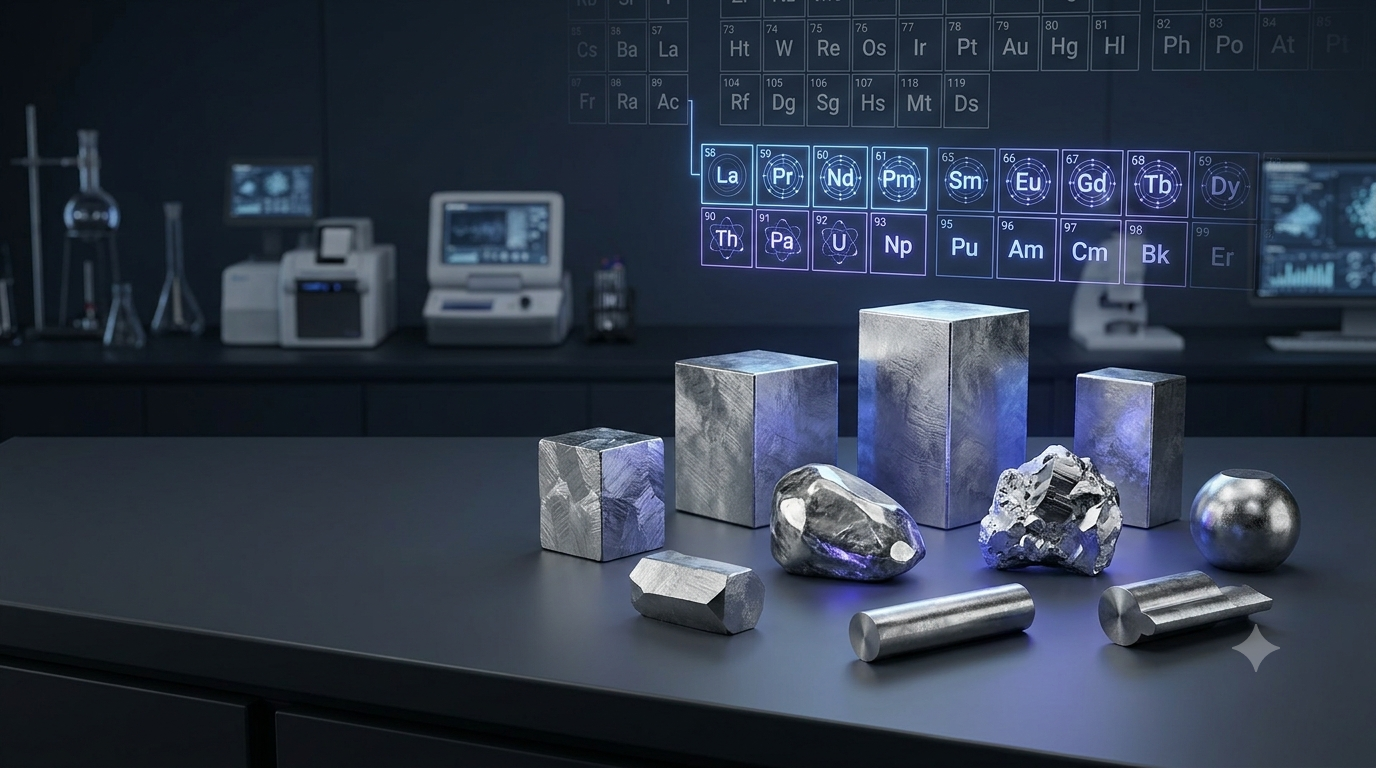
Lanthanides are a group of 15 metallic chemical elements found in the periodic table, ranging from Lanthanum (La) with atomic number 57 to Lutetium (Lu) with atomic number 71. These elements are located in the f-block of the periodic table and are commonly known as rare earth elements. They are particularly important because of their unique electronic configurations, similar chemical properties, and wide range of applications in modern technology.
The lanthanides are characterized by the gradual filling of the 4f orbitals. This gives them several common physical and chemical properties, including metallic character, relatively high melting points, and a strong tendency to form compounds with a +3 oxidation state.
Although they are often called rare earth elements, most lanthanides are not particularly rare in the Earth’s crust. However, they are usually found together in minerals, making their separation and purification difficult. Today, lanthanides are widely used in electronics, magnets, glass manufacturing, lighting, medical equipment, and renewable energy technologies.
Understanding lanthanides and their general characteristics helps explain the importance of f-block elements in chemistry and their role in modern scientific developments.
What Are Lanthanides?
Lanthanides are a series of 15 chemical elements in which the 4f orbitals are progressively filled. They are generally considered part of the f-block of the periodic table.
The series begins with Lanthanum (La) and ends with Lutetium (Lu). The elements have closely related electronic configurations and exhibit many similar chemical properties.
The name lanthanide comes from the element Lanthanum. The term refers to elements that follow or are associated with Lanthanum in the periodic table.
The lanthanides include:
| Atomic Number | Element | Symbol |
|---|---|---|
| 57 | Lanthanum | La |
| 58 | Cerium | Ce |
| 59 | Praseodymium | Pr |
| 60 | Neodymium | Nd |
| 61 | Promethium | Pm |
| 62 | Samarium | Sm |
| 63 | Europium | Eu |
| 64 | Gadolinium | Gd |
| 65 | Terbium | Tb |
| 66 | Dysprosium | Dy |
| 67 | Holmium | Ho |
| 68 | Erbium | Er |
| 69 | Thulium | Tm |
| 70 | Ytterbium | Yb |
| 71 | Lutetium | Lu |
These elements are usually displayed in a separate row below the main body of the periodic table to keep its overall structure compact.
Position of Lanthanides in the Periodic Table
Lanthanides belong to the sixth period of the periodic table. They are placed in the f-block because the 4f subshell is progressively filled across the series.
They are positioned between the alkaline earth metals and the transition elements in the extended periodic table.
Lanthanides are sometimes called inner transition elements because the differentiating electrons enter an inner f-orbital rather than an outermost d-orbital.
The first element of the series, Lanthanum, has the atomic number 57, while the last element, Lutetium, has the atomic number 71.
Their position in the periodic table explains several of their properties, particularly their similar chemical behaviour and gradual changes in atomic and ionic size.
Electronic Configuration of Lanthanides
One of the most important characteristics of lanthanides is their electronic configuration.
In general, the electronic configuration of lanthanides can be represented as:
[Xe] 4fⁿ 5d⁰–¹ 6s²
Here, [Xe] represents the electronic configuration of Xenon, while the 4f orbitals are progressively filled across the series.
The number of 4f electrons generally increases from one element to the next. However, some exceptions occur because certain electronic arrangements are relatively stable.
For example:
Lanthanum (La): [Xe] 5d¹ 6s²
Cerium (Ce): [Xe] 4f¹ 5d¹ 6s²
Neodymium (Nd): [Xe] 4f⁴ 6s²
Europium (Eu): [Xe] 4f⁷ 6s²
Gadolinium (Gd): [Xe] 4f⁷ 5d¹ 6s²
Ytterbium (Yb): [Xe] 4f¹⁴ 6s²
Lutetium (Lu): [Xe] 4f¹⁴ 5d¹ 6s²
The exact electronic configuration may differ slightly from the general pattern due to the stability of half-filled and completely filled subshells.
The gradual filling of 4f orbitals is responsible for many characteristic properties of lanthanides, including their magnetic behaviour, colour in certain compounds, and lanthanide contraction.
General Characteristics of Lanthanides
Lanthanides possess several common physical and chemical characteristics. Although their properties are similar, small differences occur because of changes in their atomic number and electronic configuration.
1. Metallic Nature
All lanthanides are metals. They generally have a silvery-white appearance when freshly prepared and polished.
They are relatively soft metals, although their hardness varies across the series. Many lanthanides can be cut with a knife, particularly the lighter members.
Like other metals, they generally conduct heat and electricity.
When exposed to air, many lanthanides gradually develop an oxide coating on their surfaces. This occurs because they react with oxygen.
2. Electropositive Character
Lanthanides are highly electropositive elements. They have a strong tendency to lose electrons and form positive ions.
This behaviour is related to their relatively low ionization energies and metallic nature.
Most lanthanides readily lose their two 6s electrons and one additional electron to form trivalent ions (Ln³⁺).
For this reason, their compounds are predominantly ionic in nature.
3. Oxidation States
The most common oxidation state of lanthanides is +3.
In this oxidation state, lanthanides lose two electrons from the 6s orbital and one electron from the 4f or 5d orbital.
However, some lanthanides also show +2 and +4 oxidation states.
Examples include:
Cerium (Ce): +3 and +4
Europium (Eu): +2 and +3
Samarium (Sm): +2 and +3
Ytterbium (Yb): +2 and +3
Terbium (Tb): +3 and +4
The stability of these additional oxidation states is often related to the electronic configuration of the resulting ions.
For example, Eu²⁺ has a half-filled 4f⁷ configuration, while Yb²⁺ has a completely filled 4f¹⁴ configuration. These arrangements provide additional electronic stability.
4. Lanthanide Contraction
Lanthanide contraction is one of the most important characteristics of lanthanides.
It refers to the gradual decrease in the atomic and ionic radii of lanthanides as the atomic number increases from Lanthanum to Lutetium.
This happens because the nuclear charge increases across the series. However, the 4f electrons do not shield the outer electrons effectively from the increasing nuclear attraction.
As a result, the electrons are pulled closer to the nucleus, causing a gradual reduction in atomic and ionic size.
Important effects of lanthanide contraction:
The ionic radii of lanthanides decrease gradually.
The chemical properties of lanthanides become increasingly similar in certain respects.
The separation of individual lanthanides becomes difficult.
The elements following the lanthanide series show changes in atomic size and chemical behaviour.
Zirconium and Hafnium have very similar atomic and ionic sizes partly because of lanthanide contraction.
Lanthanide contraction is important for understanding the periodic trends and chemical properties of these elements.
5. Similar Chemical Properties
Lanthanides have very similar chemical properties because their outer electronic configurations are almost identical.
Most of them form stable +3 ions and react with oxygen, water, acids, and other non-metals.
Their similar ionic charges and relatively small differences in ionic radii make them chemically difficult to separate.
However, small differences in their ionic sizes and electronic configurations allow certain separation techniques to distinguish between individual lanthanides.
6. Formation of Coloured Ions
Many lanthanide ions and their compounds show characteristic colours.
These colours are mainly associated with electronic transitions within the 4f orbitals.
For example:
Praseodymium compounds may appear green.
Neodymium compounds may appear pink or violet.
Samarium compounds may appear pale yellow.
Europium compounds may appear pink.
Erbium compounds may appear pink.
Not all lanthanide ions are coloured. Some ions, such as La³⁺ and Lu³⁺, are generally colourless because they have no partially filled 4f orbitals.
The colour of lanthanide compounds is useful in optical materials, display technologies, and scientific applications.
7. Magnetic Properties
Lanthanides exhibit interesting magnetic properties because of their unpaired 4f electrons.
The presence of unpaired electrons produces magnetic moments, making many lanthanide ions paramagnetic.
Some lanthanides have particularly strong magnetic properties.
For example, Gadolinium is strongly magnetic and is used in various technological and scientific applications.
The magnetic behaviour of lanthanides depends on their electronic configurations, the number of unpaired electrons, and temperature.
Lanthanide-based materials are important in the development of powerful permanent magnets and advanced magnetic devices.
8. High Density and Melting Points
Lanthanides generally have relatively high densities compared with many common metals.
Their densities and melting points vary across the series. They do not follow a perfectly regular trend because of differences in atomic structure and metallic bonding.
Many lanthanides have relatively high melting points, although some, such as Ytterbium, have comparatively low melting points.
Their physical properties make them useful in specialised alloys and high-performance materials.
9. Reaction with Oxygen
Most lanthanides react with oxygen when exposed to air.
They form metal oxides, which generally have the formula Ln₂O₃ for elements in the +3 oxidation state.
For example:
4La + 3O₂ → 2La₂O₃
The oxide layer formed on the surface may provide some protection, but many lanthanides continue to oxidise under suitable conditions.
Their tendency to react with oxygen is one reason why some lanthanide metals are stored under protective conditions.
10. Reaction with Water
Lanthanides react with water to produce metal hydroxides and hydrogen gas.
The general reaction can be represented as:
2Ln + 6H₂O → 2Ln(OH)₃ + 3H₂
The reactivity generally varies among individual elements.
Many lanthanides react slowly with cold water, while their reaction becomes faster with hot water.
This reaction demonstrates their electropositive and metallic nature.
11. Formation of Complex Compounds
Lanthanide ions can form complex compounds with different ligands.
Their +3 ions generally have relatively large ionic radii and high coordination numbers.
They commonly form complexes with oxygen-containing and nitrogen-containing ligands.
Unlike many transition metals, lanthanide complexes generally show limited directional bonding because their 4f orbitals are shielded by the outer 5s and 5p orbitals.
These complexes are important in chemical research, medical imaging, analytical chemistry, and material science.
12. Radioactive Nature
Most naturally occurring lanthanides have at least one stable isotope. However, Promethium is an exception because all its isotopes are radioactive.
Promethium has no stable isotopes and occurs naturally only in extremely small quantities.
Radioactive isotopes of other lanthanides can also be produced or occur in particular nuclear processes.
Some radioactive lanthanide isotopes have specialised applications in scientific research and nuclear technology.
Chemical Properties of Lanthanides
Lanthanides show several characteristic chemical reactions. Their chemical behaviour is mainly influenced by their electropositive nature and tendency to form +3 ions.
Reaction with Acids
Lanthanides react with many dilute acids to produce salts and hydrogen gas.
For example, their reaction with hydrochloric acid can be represented as:
2Ln + 6HCl → 2LnCl₃ + 3H₂
This reaction demonstrates the ability of lanthanides to lose electrons and form positive ions.
Reaction with Halogens
Lanthanides react with halogens to form halides.
For example:
2La + 3Cl₂ → 2LaCl₃
Most lanthanides form trihalides because the +3 oxidation state is particularly stable.
Formation of Hydroxides
Lanthanide ions react with hydroxide ions to form insoluble metal hydroxides.
The general reaction is:
Ln³⁺ + 3OH⁻ → Ln(OH)₃
These hydroxides are generally basic in nature.
Formation of Sulphides
Lanthanides can react with sulphur to form sulphide compounds.
For example:
2La + 3S → La₂S₃
These reactions further demonstrate the metallic and electropositive characteristics of lanthanides.
Occurrence of Lanthanides in Nature
Lanthanides are commonly found together in different minerals and mineral deposits.
Although they are traditionally called rare earth elements, several lanthanides are relatively abundant in the Earth’s crust.
They are not usually found as pure metals in nature because of their chemical reactivity. Instead, they occur mainly in mineral compounds.
Some important minerals containing lanthanides include:
1. Monazite
Monazite is a phosphate mineral containing several rare earth elements, particularly Cerium, Lanthanum, and Neodymium. It may also contain Thorium.
2. Bastnäsite
Bastnäsite is a carbonate-fluoride mineral that is an important commercial source of light rare earth elements.
It commonly contains Cerium, Lanthanum, and Neodymium.
3. Xenotime
Xenotime is a phosphate mineral that is particularly rich in Yttrium and can contain heavier rare earth elements, including several lanthanides.
The extraction of lanthanides from these minerals involves several processes, including crushing, concentration, chemical treatment, separation, and purification.
Separation of Lanthanides
Separating individual lanthanides is challenging because they have very similar chemical properties.
Most lanthanides form +3 ions with similar ionic charges and closely related ionic radii.
Several techniques are used to separate and purify them.
1. Fractional Crystallisation
This method uses differences in the solubility of lanthanide compounds.
By repeatedly crystallising and separating compounds, individual elements can be enriched.
2. Ion-Exchange Method
Ion-exchange chromatography is an important technique for separating lanthanides.
The lanthanide ions pass through a column containing an ion-exchange resin. Differences in their interactions with the resin and eluting agents allow individual elements to be separated.
3. Solvent Extraction
Solvent extraction separates lanthanides based on differences in their distribution between two immiscible liquid phases.
It is widely used in modern industrial processing because it can provide efficient separation on a large scale.
Applications of Lanthanides
Lanthanides are essential in several modern technologies because of their unique optical, magnetic, electronic, and chemical properties.
1. Permanent Magnets
Neodymium and Samarium are important in the production of powerful permanent magnets.
Neodymium-iron-boron magnets are widely used in:
Electric motors
Wind turbines
Computer hard drives
Speakers and headphones
Electric vehicles
Samarium-cobalt magnets are known for their excellent magnetic performance at relatively high temperatures.
2. Glass Manufacturing
Cerium oxide is widely used in glass polishing and manufacturing.
It helps remove surface imperfections and produces smooth, polished glass surfaces.
Lanthanide compounds are also used to modify the optical properties of specialised glass.
3. Lighting and Display Technology
Several lanthanides are used in phosphors, which are materials that emit light when exposed to suitable energy sources.
Europium compounds produce red emission, while Terbium compounds are used in green-emitting phosphors.
These materials have applications in display screens, fluorescent lamps, and other lighting technologies.
4. Medical Applications
Certain lanthanide compounds have important medical applications.
Gadolinium-based contrast agents are used in magnetic resonance imaging (MRI) to improve the visibility of certain tissues and structures.
However, these agents are specialised medical products and are used under appropriate medical supervision.
5. Catalysts
Lanthanide compounds are used in various catalytic processes.
Cerium oxide is particularly important in automotive catalytic converters, where it helps manage oxygen availability during exhaust treatment.
Some lanthanide-containing materials are also used in petroleum refining and industrial chemical processes.
6. Batteries and Energy Storage
Lanthanum is used in certain nickel-metal hydride (NiMH) batteries.
These batteries have been used in hybrid vehicles and rechargeable electronic devices.
Lanthanide-containing materials also have potential applications in advanced energy technologies.
7. Nuclear Technology
Certain lanthanides are used in nuclear research and specialised nuclear applications.
For example, Gadolinium has a high ability to absorb neutrons, making it useful in some neutron-absorbing materials.
Some radioactive lanthanide isotopes are also studied for nuclear science and medical research.
Difference Between Lanthanides and Actinides
Lanthanides and actinides are two important series of inner transition elements. Both are located in the f-block of the periodic table, but they differ in several characteristics.
| Basis | Lanthanides | Actinides |
|---|---|---|
| Atomic numbers | 57–71 | 89–103 |
| Orbital filling | 4f orbitals | 5f orbitals |
| Series | 4f series | 5f series |
| Common oxidation state | +3 | Variable |
| Radioactivity | Mostly non-radioactive, except Promethium has no stable isotopes | All are radioactive |
| Chemical behaviour | Generally similar | More variable |
| Complex formation | Generally less extensive | Generally more extensive |
| Examples | Cerium, Neodymium, Europium | Thorium, Uranium, Plutonium |
Both groups are important in understanding the chemistry of inner transition elements and their applications in science and technology.
Importance of Lanthanides in Modern Technology
The importance of lanthanides has increased significantly with the development of advanced technology.
Their magnetic properties make them essential for efficient electric motors, renewable energy systems, and electronic devices.
Their optical properties are useful in lasers, lighting systems, display screens, and specialised glass.
Their catalytic properties support industrial chemical processes and environmental technologies.
Furthermore, lanthanides are increasingly important in the development of advanced materials used in communication systems, medical equipment, and energy storage.
As modern technologies continue to develop, the demand for certain lanthanides is expected to remain significant.
However, their extraction and processing also present environmental challenges. Mining, chemical separation, and waste management must be carried out responsibly to reduce environmental damage.
Conclusion
Lanthanides are a group of 15 inner transition elements that occupy an important position in the f-block of the periodic table. They are characterised by the progressive filling of 4f orbitals and share several common physical and chemical properties.
Their most important characteristics include metallic nature, electropositive behaviour, the predominance of the +3 oxidation state, lanthanide contraction, coloured ions, and interesting magnetic properties.
Although their chemical properties are very similar, differences in ionic size and electronic configuration influence their individual behaviour and applications.
Lanthanides play an essential role in modern technology, including permanent magnets, electric vehicles, renewable energy systems, lighting, glass manufacturing, and medical imaging.
Therefore, understanding lanthanides is important for studying inorganic chemistry, periodic trends, inner transition elements, and the scientific materials used in everyday life.
FAQs
1. What are lanthanides?
Lanthanides are a group of 15 metallic chemical elements in the f-block of the periodic table, ranging from Lanthanum (La), atomic number 57, to Lutetium (Lu), atomic number 71. They are also known as inner transition elements because their 4f orbitals are progressively filled. Lanthanides have similar chemical properties, including metallic character, electropositive nature, and a strong tendency to form +3 oxidation states. They are commonly called rare earth elements and are widely used in modern technologies such as permanent magnets, electronic devices, lighting systems, and medical equipment.
2. Why are lanthanides called rare earth elements?
Lanthanides are traditionally called rare earth elements because they were originally discovered in relatively uncommon mineral deposits and were difficult to extract in pure form. However, most lanthanides are not particularly rare in the Earth’s crust. Some are more abundant than commonly known metals such as silver. Their main difficulty is that they usually occur together in minerals and have very similar chemical properties. This makes their separation and purification challenging. Their historical name has remained in scientific use despite the fact that several lanthanides are relatively abundant in nature.
3. How many elements are present in the lanthanide series?
The lanthanide series consists of 15 elements, beginning with Lanthanum (La), atomic number 57, and ending with Lutetium (Lu), atomic number 71. These elements include Cerium, Praseodymium, Neodymium, Promethium, Samarium, Europium, Gadolinium, Terbium, Dysprosium, Holmium, Erbium, Thulium, and Ytterbium. They belong to the sixth period of the periodic table and are generally placed in a separate row below the main body of the table. Their common electronic characteristics and similar chemical properties make them an important group of inner transition elements.
4. What is the general electronic configuration of lanthanides?
The general electronic configuration of lanthanides is [Xe] 4f⁰–¹⁴ 5d⁰–¹ 6s². In this configuration, [Xe] represents the electronic configuration of Xenon, while the 4f orbitals are progressively filled across the series. The number of 4f electrons generally increases as the atomic number increases. However, some elements show variations because half-filled and completely filled subshells provide additional stability. This electronic arrangement is responsible for several important properties of lanthanides, including their magnetic behaviour, characteristic colours, and gradual decrease in atomic and ionic radii.
5. What is the most common oxidation state of lanthanides?
The most common oxidation state of lanthanides is +3. In this state, lanthanide atoms generally lose two electrons from the 6s orbital and one additional electron to form positively charged ions. These trivalent ions are relatively stable and occur in many lanthanide compounds. However, some elements also exhibit +2 and +4 oxidation states. For example, Europium and Ytterbium commonly show +2 states, while Cerium can show a +4 state. The stability of these oxidation states is influenced by electronic configurations, particularly half-filled and completely filled 4f subshells.
6. What is lanthanide contraction?
Lanthanide contraction refers to the gradual decrease in the atomic and ionic radii of lanthanide elements as their atomic numbers increase from Lanthanum to Lutetium. This occurs because the nuclear charge increases across the series, while 4f electrons provide relatively poor shielding. Consequently, the outer electrons experience a stronger effective nuclear attraction and are pulled closer to the nucleus. Lanthanide contraction has several important effects, including similarities in the properties of certain elements, difficulty in separating individual lanthanides, and similarities in the atomic sizes of some elements such as Zirconium and Hafnium.
7. Why do some lanthanide compounds show different colours?
Some lanthanide compounds show characteristic colours because of electronic transitions within their partially filled 4f orbitals. When electrons absorb energy, they can move between different electronic energy levels, resulting in the absorption of particular wavelengths of visible light. The remaining transmitted or reflected light produces the observed colour. For example, some Neodymium compounds appear pink or violet, while certain Erbium compounds appear pink. However, not all lanthanide ions are coloured. Lanthanum (La³⁺) and Lutetium (Lu³⁺) are generally colourless because they have empty and completely filled 4f subshells, respectively.
8. What are the important physical properties of lanthanides?
Lanthanides are generally silvery-white metals with metallic lustre. Most are relatively soft, although their hardness varies across the series. They conduct heat and electricity and generally possess relatively high densities. Their melting points also vary depending on their individual atomic structures and metallic bonding. Many lanthanides exhibit paramagnetic behaviour because of unpaired 4f electrons. Some compounds show characteristic colours, while freshly prepared lanthanide metals can gradually react with oxygen in the atmosphere. These physical properties make lanthanides valuable in specialised magnets, optical materials, electronic components, and advanced technological applications.
9. What are the major applications of lanthanides?
Lanthanides have many applications in modern science and technology because of their unique magnetic, optical, and chemical properties. Neodymium is used in powerful permanent magnets found in electric motors, wind turbines, and electronic devices. Cerium oxide is used in glass polishing and catalytic converters. Europium and Terbium compounds are important in lighting and display technologies because of their light-emitting properties. Gadolinium compounds are used in certain MRI contrast agents, while Lanthanum is used in some nickel-metal hydride batteries. These applications make lanthanides important materials in electronics, healthcare, renewable energy, and industrial manufacturing.
10. What is the difference between lanthanides and actinides?
Lanthanides and actinides are two series of inner transition elements located in the f-block of the periodic table. Lanthanides have atomic numbers 57–71 and involve the progressive filling of 4f orbitals, whereas actinides have atomic numbers 89–103 and involve the filling of 5f orbitals. Lanthanides commonly show the +3 oxidation state, while actinides exhibit a wider range of oxidation states. Most lanthanides have stable isotopes, although Promethium has no stable isotopes. All actinides are radioactive. Both groups are important in inorganic chemistry, nuclear science, and advanced material development.