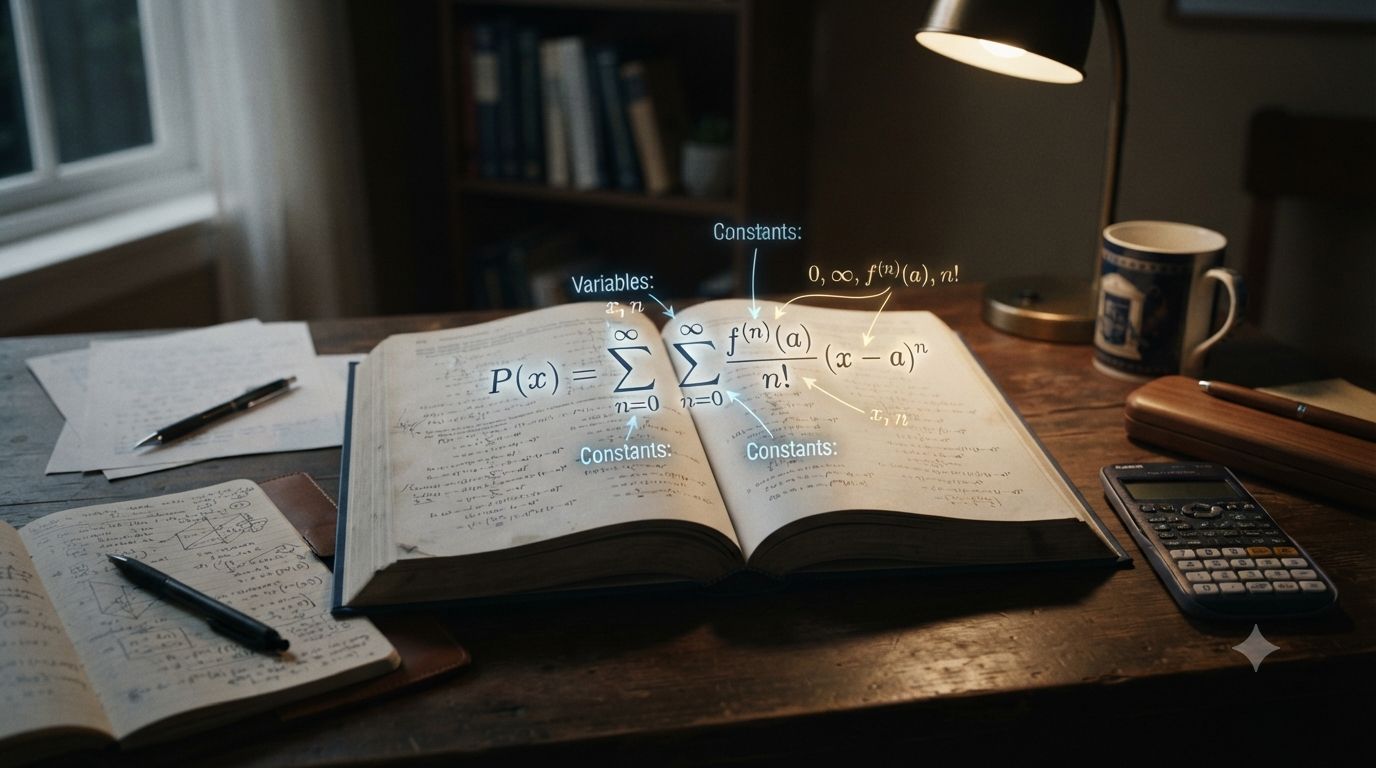

Understanding Terms in Mathematical Formulas

Understanding terms in mathematical formulas including variables constants coefficients and exponents

Mathematical formulas are used to describe relationships between numbers, quantities, shapes, measurements, and many other ideas. A formula may look simple at first, but understanding what each part means is essential for using it correctly. Every symbol, number, letter, operation, and expression in a formula has a specific role. These individual parts are commonly called terms or components of a mathematical expression.

For example, consider the formula for the area of a rectangle:

A = l × w

Here, A, l, and w represent different quantities, while the multiplication sign shows the relationship between the length and width. If you understand the meaning of these parts, using the formula becomes much easier.

Learning how terms work in mathematical formulas also helps you rearrange formulas, substitute values, simplify expressions, and solve mathematical problems. This understanding becomes increasingly important as mathematics moves from basic arithmetic to algebra, geometry, trigonometry, calculus, statistics, and advanced mathematics.

What Is a Term in Mathematics?

A term is a mathematical part that can consist of a number, a variable, or a combination of numbers and variables connected by multiplication or division.

For example:

5x

is one term.

Similarly:

3a²

is one term, and:

7xy

is also one term.

However, in an expression such as:

5x + 3y − 8

there are three terms:

  • 5x

  • 3y

  • −8

Terms in an expression are usually separated by addition or subtraction signs.

It is important to distinguish between a term and the entire formula. A formula can contain several terms, but the formula itself represents a complete mathematical relationship.

Terms in a Mathematical Formula

A mathematical formula can contain several different components. Depending on the formula, these may include:

  • Constants

  • Variables

  • Coefficients

  • Exponents

  • Mathematical operators

  • Parentheses

  • Fractions

  • Functions

  • Equal signs

  • Units

Each component provides information about how the formula should be interpreted.

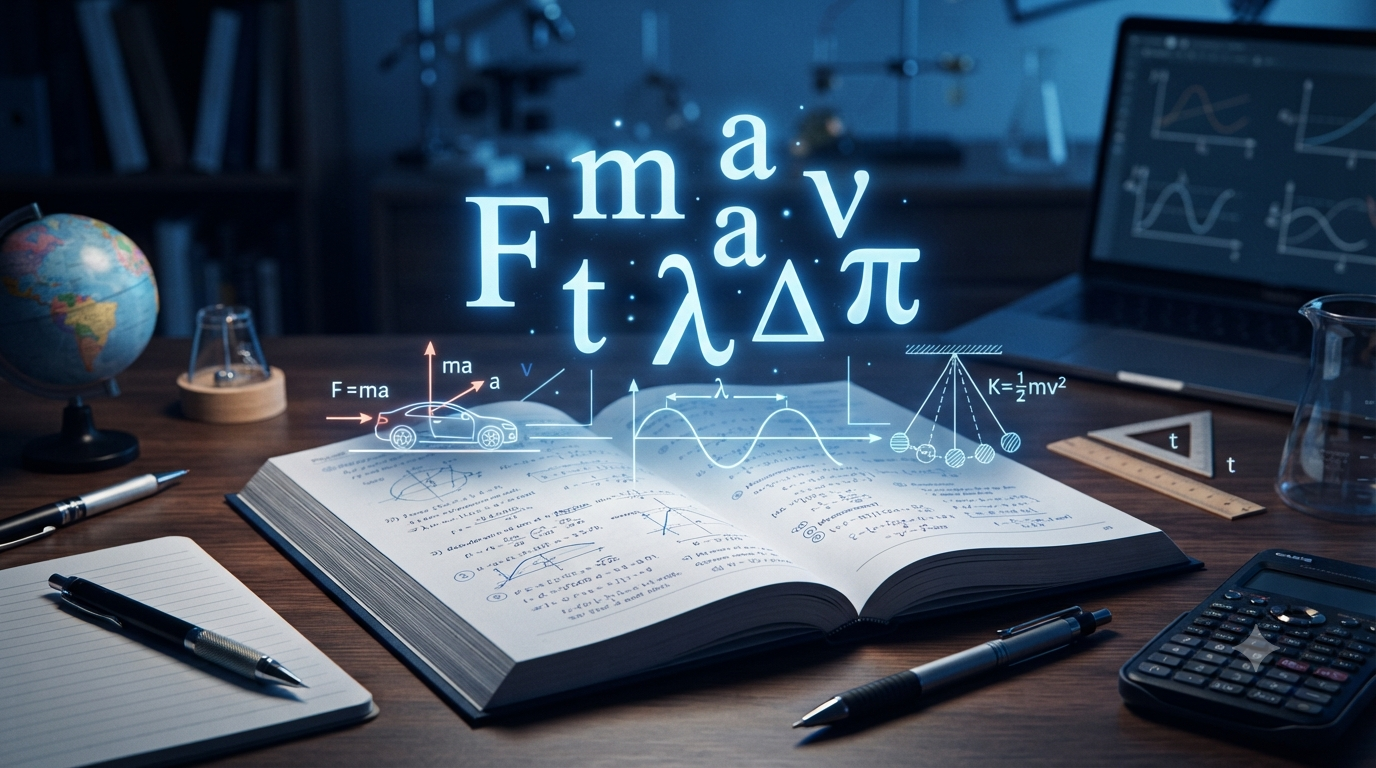
Consider the formula:

F = ma

This formula contains:

  • F — force

  • m — mass

  • a — acceleration

  • = — equality

  • The implied multiplication between m and a

Understanding these components allows us to interpret the formula rather than simply memorize it.

Constants

A constant is a value that does not change within a particular mathematical expression or situation.

For example:

y = 3x + 5

Here, 5 is a constant because its value remains fixed.

Some mathematical constants have special names and symbols. For example:

π ≈ 3.14159

The value of π is a mathematical constant used extensively in geometry and trigonometry.

Other examples include:

2, 5, 10, 100

when they represent fixed values in a particular formula.

Constants provide fixed quantities against which variables can be calculated or compared.

Variables

A variable is a symbol, usually a letter, that represents a quantity whose value can change.

Common variables include:

x, y, a, b, t, n

For example:

y = 2x + 3

Here, x and y are variables. If the value of x changes, the corresponding value of y may also change.

Variables are particularly important in formulas because they allow one mathematical relationship to describe many different situations.

For example, the formula for the area of a circle is:

A = πr²

The radius r can have many different values. The formula remains the same even though the actual area changes.

Coefficients

A coefficient is a numerical factor that multiplies a variable.

For example:

7x

has a coefficient of 7.

In:

−4y

the coefficient is −4.

In:

3ab

the coefficient is 3.

When no number is written before a variable, the coefficient is understood to be 1.

For example:

x = 1x

Similarly:

−x = −1x

Understanding coefficients becomes especially useful when simplifying algebraic expressions or comparing similar terms.

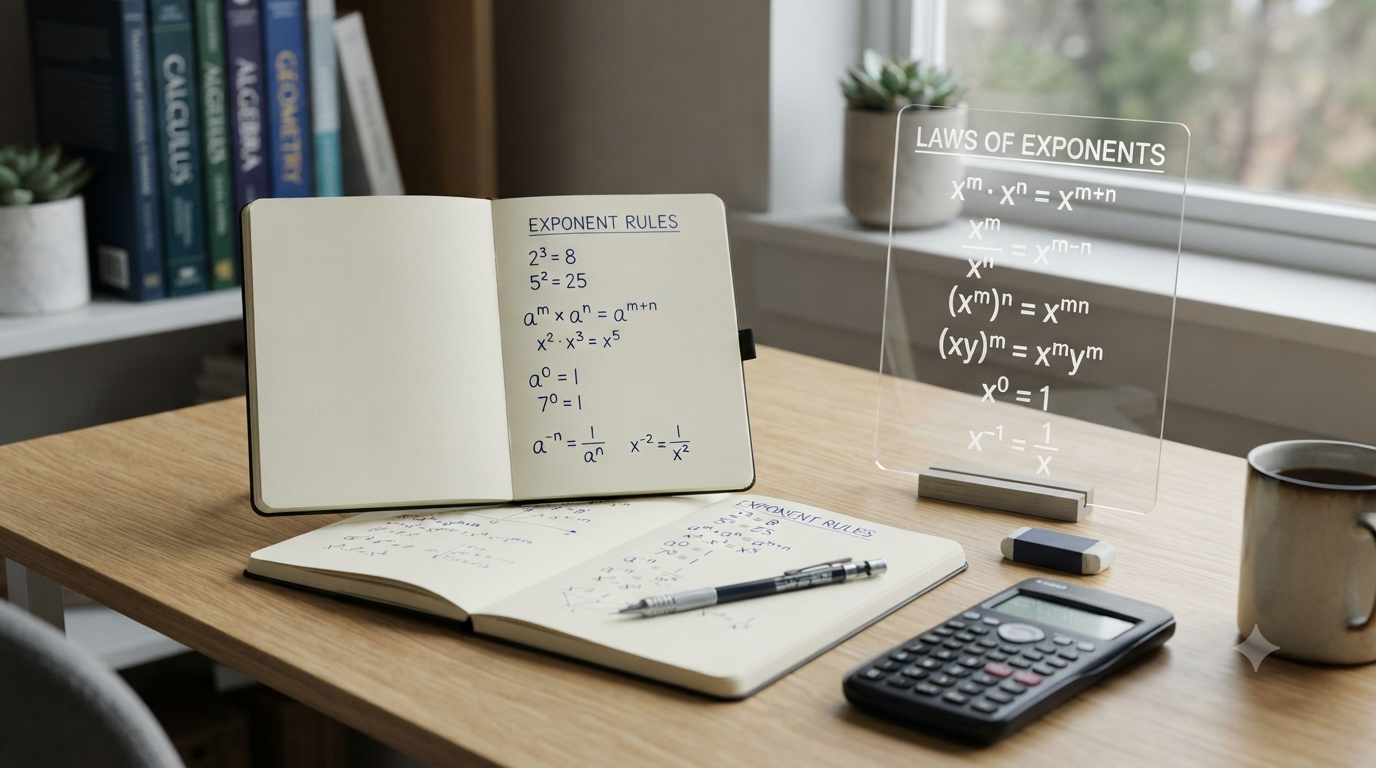
Exponents

An exponent indicates how many times a number or variable is multiplied by itself.

For example:

x² = x × x

and:

x³ = x × x × x

In x², the number 2 is the exponent and x is the base.

Exponents are common in mathematical formulas.

For example, the area of a circle is:

A = πr²

The exponent 2 indicates that the radius is squared.

The volume of a cube is:

V = a³

Here, the exponent 3 indicates that the side length is cubed.

Exponents can significantly affect the value of a quantity, so reading them correctly is important.

Operators in Formulas

Mathematical operators tell us what operation should be performed.

Common operators include:

+ — addition
− — subtraction
× — multiplication
÷ — division
= — equality
< — less than
> — greater than

Other mathematical symbols may represent more advanced operations.

For example:

√x

represents the square root of x.

The operator or symbol helps define the relationship between the terms in a formula.

Addition and Subtraction Terms

Terms separated by addition or subtraction are treated as separate terms.

Consider:

4x + 7y − 9

This expression contains three terms:

4x

7y

−9

The plus and minus signs indicate how the terms are connected.

The negative sign belongs to the term that follows it. Therefore, in:

5x − 3

the second term is −3, not simply 3.

This distinction becomes important when simplifying or substituting values into expressions.

Multiplication Between Terms

Multiplication is sometimes shown explicitly using a multiplication sign:

3 × x

But in algebra, multiplication is often written without the symbol:

3x

Both expressions mean the same thing.

Similarly:

ab

means:

a × b

and:

2xy

means:

2 × x × y

Recognizing implied multiplication is an important part of reading mathematical formulas.

Division and Fractions

Division can be represented using a division symbol or a fraction.

For example:

a ÷ b

and:

a/b

represent the same basic relationship.

A fraction contains two important parts:

a/b

Here, a is the numerator and b is the denominator.

Many formulas use fractions.

For example, the formula for average speed is:

Average speed = Total distance / Total time

A fraction can also contain an entire expression in the numerator or denominator.

For example:

(a + b)/c

Here, the numerator is a + b, not just a.

This is why parentheses and fraction boundaries must be read carefully.

Parentheses and Grouped Terms

Parentheses are used to group mathematical terms and indicate which parts should be treated together.

Consider:

2(x + 3)

The expression inside the parentheses is:

x + 3

The 2 multiplies the entire group.

Without the parentheses, the meaning can be different.

For example:

2x + 3

is not the same as:

2(x + 3)

Expanding the second expression gives:

2x + 6

This demonstrates why grouping symbols are important when interpreting formulas.

Like Terms and Unlike Terms

Two terms are called like terms when they contain the same variables raised to the same powers.

For example:

3x and 7x

are like terms.

Similarly:

4a² and 9a²

are like terms.

They can be combined:

3x + 7x = 10x

However:

3x and 7y

are unlike terms because they contain different variables.

Likewise:

4x and 4x²

are unlike terms because the powers of the variable are different.

Understanding like and unlike terms is essential when simplifying algebraic expressions.

Terms in a Formula With Multiple Quantities

Many formulas contain several variables.

For example:

P = 2(l + w)

This formula gives the perimeter of a rectangle.

The terms and symbols represent:

  • P — perimeter

  • l — length

  • w — width

  • 2 — constant multiplier

  • + — addition

  • Parentheses — grouping

The formula is more than a collection of symbols. It describes a relationship between the perimeter, length, and width.

Understanding Terms Through Substitution

One of the most useful skills in mathematics is substituting known values into a formula.

Consider:

A = lw

Suppose:

l = 8 m

and:

w = 5 m

Substitute these values:

A = 8 × 5

Therefore:

A = 40 m²

The variables l and w have been replaced by their known values.

The structure of the formula remains unchanged. Only the variable values are substituted.

Reading Formulas Step by Step

When you encounter an unfamiliar formula, it is useful to read it systematically.

First, identify what the formula calculates.

Next, identify each variable and determine what quantity it represents.

Then, identify constants and coefficients.

After that, look for exponents, fractions, parentheses, and mathematical operators.

Finally, check whether units are associated with the quantities.

For example:

v = u + at

This formula can be read as:

The final velocity v equals the initial velocity u plus the product of acceleration a and time t.

Breaking the formula into parts makes it easier to understand and apply.

Terms and Units

Mathematical formulas used in science often involve physical quantities with units.

For example:

d = vt

If velocity is measured in metres per second and time is measured in seconds, then:

m/s × s = m

Therefore, the resulting distance is measured in metres.

Units are not usually considered mathematical terms in the same way as variables and constants, but they provide important information about the quantities represented by the formula.

Checking units can also help identify mistakes in calculations.

Common Mistakes When Reading Mathematical Terms

Several mistakes can occur when interpreting formulas.

Ignoring Negative Signs

In:

x − 5

the second term is −5, not simply 5.

Misreading Exponents

x² is different from 2x.

The first means x multiplied by itself, while the second means two times x.

Forgetting Implied Multiplication

3x means:

3 × x

It does not mean a three-digit number or another unrelated operation.

Ignoring Parentheses

2(x + 4) is different from:

2x + 4

Parentheses can change the result significantly.

Confusing Variables With Constants

A letter usually represents a variable, but its exact meaning depends on the formula and context. Some letters may represent fixed constants in specific formulas.

Why Understanding Terms Matters

Memorizing formulas can help with short-term problem solving, but understanding their terms provides a stronger mathematical foundation.

When you understand each component of a formula, you can:

  • Substitute values correctly.

  • Rearrange formulas.

  • Simplify expressions.

  • Check calculations.

  • Understand mathematical relationships.

  • Identify errors.

  • Apply formulas to new situations.

  • Learn more advanced mathematics more easily.

For example, someone who understands:

s = ut + ½at²

can recognize the roles of initial velocity, time, acceleration, and squared time rather than treating the formula as a collection of symbols to memorize.

This type of understanding becomes increasingly valuable when working with physics formulas, geometry, algebra, statistics, and calculus.

How to Analyze Any Mathematical Formula

A simple method can be used for almost any formula.

Step 1: Identify the quantity being calculated.

Look at the left side of the equation or the main expression.

Step 2: Identify every variable.

Determine what each letter represents.

Step 3: Identify constants and coefficients.

Look for fixed numbers and numerical factors.

Step 4: Identify operations.

Determine where addition, subtraction, multiplication, division, powers, roots, or other operations are used.

Step 5: Check grouping symbols.

Look carefully at parentheses, brackets, and fraction boundaries.

Step 6: Check units if applicable.

Make sure the quantities and final result have appropriate units.

Step 7: Substitute values carefully.

Replace variables with known values while preserving the original mathematical structure.

Step 8: Calculate in the correct order.

Follow the appropriate order of operations.

This method makes unfamiliar formulas much easier to approach.

Conclusion

Understanding the terms in mathematical formulas is an important foundation for learning mathematics. A formula is not simply a combination of letters and numbers. Each term and symbol has a specific purpose, whether it represents a variable, constant, coefficient, exponent, operation, or grouped expression.

By learning how these components work together, you can read formulas more confidently and use them accurately. Instead of memorizing a formula without understanding it, try to identify what every part represents and how the parts are connected.

This approach makes mathematical formulas easier to interpret, simplify, rearrange, and apply. It also creates a strong foundation for more advanced topics such as algebra, geometry, trigonometry, calculus, statistics, and scientific formulas.

FAQs

1. What is a term in mathematics?

A term is a mathematical part of an expression that can be a number, variable, or a combination of numbers and variables. Terms are generally separated by addition or subtraction signs. For example, in 5x + 3y − 7, there are three terms: 5x, 3y, and −7. A term can contain a coefficient, variable, and exponent. For example, 4x² is one term because the number 4, variable x, and exponent 2 are connected through multiplication. Understanding terms makes it easier to simplify expressions, substitute values, and work with mathematical formulas accurately.

2. What are the main parts of a mathematical formula?

A mathematical formula can contain several important components, including variables, constants, coefficients, exponents, operators, and grouping symbols. Variables represent quantities that can change, while constants usually represent fixed values. Coefficients multiply variables, and exponents indicate powers. Operators such as +, −, ×, and ÷ describe mathematical operations. Parentheses group parts of an expression. For example, in A = πr², A and r are variables, π is a mathematical constant, and 2 is an exponent. Recognizing these components helps you understand what a formula means instead of simply memorizing it.

3. What is a variable in a mathematical formula?

A variable is a symbol, usually a letter, that represents a quantity whose value can change. Common variables include x, y, a, b, t, and n. For example, in y = 3x + 2, both x and y are variables. If the value of x changes, the value of y may also change. Variables allow a single formula to represent many different situations. In the formula A = πr², the radius r can have different values, producing different areas. Understanding variables is essential for algebra and for using formulas in mathematics and science.

4. What is a constant in a mathematical expression?

A constant is a value that remains fixed within a particular mathematical expression or situation. Examples include numbers such as 2, 5, and 10 when they represent fixed quantities. Mathematics also contains special constants such as π, which has an approximate value of 3.14159. For example, in y = 4x + 7, the numbers 4 and 7 are fixed numerical values in the expression. Constants can also appear in scientific formulas. Understanding constants helps distinguish fixed quantities from variables, whose values may change. However, whether a quantity is constant can depend on the mathematical context.

5. What is a coefficient in a mathematical formula?

A coefficient is a number that multiplies a variable or another mathematical quantity. In the term 6x, the coefficient is 6. In −3y, the coefficient is −3. When no numerical coefficient is written, the coefficient is usually understood to be 1. For example, x means 1x, while −x means −1x. Coefficients are important when simplifying expressions and solving equations. In a formula such as F = ma, no numerical coefficient is explicitly written before m or a, so their implied coefficients are 1. Recognizing coefficients makes algebraic expressions easier to interpret.

6. What is an exponent in a mathematical formula?

An exponent tells you how many times a number or variable is multiplied by itself. In x², the number 2 is the exponent, meaning x × x. In x³, the exponent 3 means x × x × x. The number or variable being raised to a power is called the base. Exponents appear frequently in mathematical formulas. For example, the area of a circle is A = πr², where the exponent 2 shows that the radius is squared. Understanding exponents is important for algebra, geometry, scientific formulas, powers, roots, exponential functions, and many advanced mathematical concepts.

7. How are terms separated in a mathematical expression?

Terms in a mathematical expression are generally separated by addition or subtraction signs. For example, 4x + 7y − 5 contains three terms: 4x, 7y, and −5. The negative sign belongs to the third term. Multiplication and division within a term do not normally separate it into multiple terms. For example, 3xy² is one term because its components are connected through multiplication. Identifying terms correctly is important when simplifying expressions. You can usually locate separate terms by looking for the main addition or subtraction operations that divide the expression into individual mathematical parts.

8. Why are parentheses important in mathematical formulas?

Parentheses are used to group mathematical expressions and show which quantities should be treated together. For example, 2(x + 3) means that 2 multiplies both x and 3. Expanding it gives 2x + 6. This is different from 2x + 3, where only x is multiplied by 2. Parentheses can therefore change the meaning and result of a formula. They are especially important when substituting values, simplifying expressions, and following the order of operations. When reading a formula, always check whether parentheses, brackets, or other grouping symbols are present before performing calculations.

9. How can I understand an unfamiliar mathematical formula?

Start by identifying what the formula is designed to calculate. Then examine every symbol and determine what each variable represents. Identify constants, coefficients, exponents, and mathematical operations. Next, look carefully at fractions and parentheses to understand how different parts are grouped. If the formula is used in science, check the units of each quantity. For example, in v = u + at, identify v, u, a, and t before substituting values. Breaking a formula into smaller components makes it much easier to understand. This approach is generally more useful than trying to memorize the formula without understanding its structure.

10. Why is it important to understand terms in mathematical formulas?

Understanding terms helps you use formulas accurately instead of simply memorizing them. When you know what variables, constants, coefficients, exponents, and operators mean, you can substitute values correctly and recognize mathematical relationships. This understanding also helps when simplifying expressions, rearranging formulas, checking calculations, and identifying mistakes. For example, knowing the meaning of each part of s = ut + ½at² makes it easier to understand how distance depends on initial velocity, time, and acceleration. A strong understanding of mathematical terms provides a foundation for algebra, geometry, trigonometry, calculus, statistics, and formulas used throughout science and engineering.

Related Posts

Leave a Comment

Your email address will not be published. Required fields are marked *

Scroll to Top