
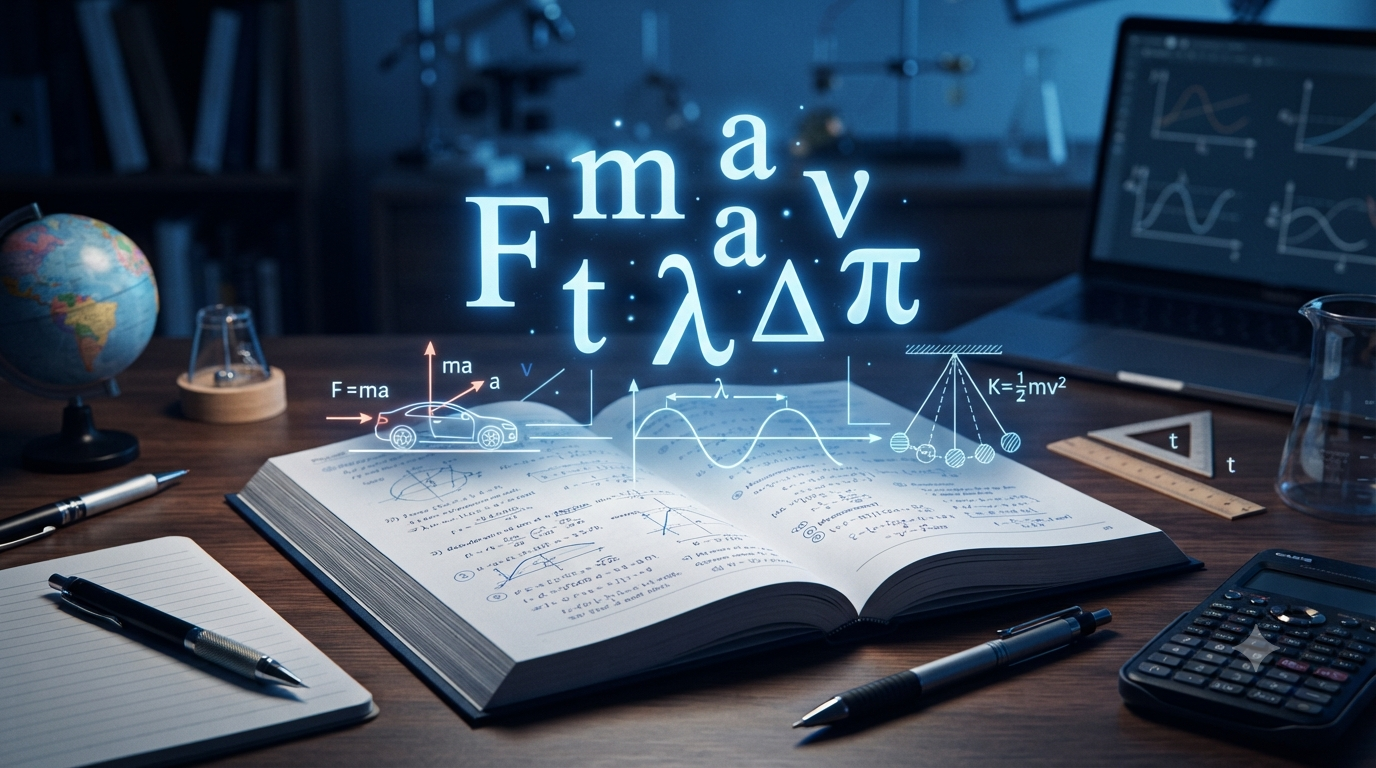
Mathematics is often described as the language of numbers, patterns, quantities, and relationships. One of the most useful tools in this language is the mathematical formula. From calculating the area of a room to understanding the motion of a spacecraft, formulas help us express mathematical relationships in a short, clear, and precise form.
A mathematical formula is more than a collection of symbols. It represents a relationship between different quantities and tells us how those quantities are connected. Once we understand what a formula means and how its parts work, many mathematical problems become easier to understand and solve.
Mathematical formulas are used throughout arithmetic, algebra, geometry, trigonometry, calculus, statistics, physics, chemistry, engineering, economics, computer science, and many other fields. Understanding formulas is therefore an important part of developing mathematical thinking and applying mathematics to real-world situations.
What Is a Mathematical Formula?
A mathematical formula is a concise expression that shows a relationship between two or more mathematical quantities. It usually uses numbers, variables, constants, and mathematical operations to describe that relationship.
For example, the formula for the area of a rectangle is:
A = l × w
Here, A represents the area, l represents the length, and w represents the width. The formula tells us that the area of a rectangle can be found by multiplying its length by its width.
Another familiar example is the formula for the perimeter of a rectangle:
P = 2(l + w)
This formula shows that the perimeter depends on both the length and the width.
A formula allows a general mathematical relationship to be written in a compact form. Instead of explaining the same relationship with words every time, we can represent it using symbols.
What Are the Main Parts of a Mathematical Formula?
Although formulas can look very different depending on the topic, many contain several common elements.
Variables
A variable is a symbol that represents a quantity whose value can change.
For example:
A = l × w
The length and width can have different values, so l and w are variables.
Variables are commonly represented by letters such as x, y, a, b, r, t, and v.
Constants
A constant is a value that remains fixed within a particular formula or situation.
For example, in the circle formula:
C = 2πr
The number 2 is a constant, while π is a mathematical constant with an approximately fixed value of 3.14159.
Mathematical Operations
Formulas use operations such as addition, subtraction, multiplication, division, powers, and roots.
For example:
y = 3x + 5
This formula contains multiplication, addition, and variables.
Symbols
Mathematical symbols make formulas shorter and easier to understand. Symbols such as =, +, −, ×, ÷, and √ communicate specific mathematical relationships or operations.
Understanding these symbols is essential for reading formulas correctly.
How Do Mathematical Formulas Work?
A formula works by describing a relationship between quantities. When we know some of the values in the formula, we can use them to find an unknown value.
Consider the formula for speed:
v = d/t
Here, v represents speed, d represents distance, and t represents time.
Suppose an object travels 100 metres in 20 seconds. We can substitute these values into the formula:
v = 100/20
Therefore:
v = 5 m/s
The formula provides a general rule that can be used for many different situations. The numbers may change, but the relationship represented by the formula remains the same.
Why Are Mathematical Formulas Important?
Mathematical formulas are important because they make mathematical relationships easier to represent, understand, calculate, and apply.
1. They Simplify Complex Ideas
Some mathematical relationships can be difficult to explain using words alone. A formula can represent the same relationship in a much shorter form.
For example, the area of a circle can be expressed as:
A = πr²
Instead of explaining that the area depends on the square of the radius multiplied by pi every time, we can use this compact formula.
Formulas therefore provide an efficient way to communicate mathematical ideas.
2. They Help Solve Problems
Formulas provide a systematic method for finding unknown quantities.
For example, the formula for the distance travelled at constant speed is:
d = vt
If an object moves at 10 m/s for 8 seconds, we can calculate its distance:
d = 10 × 8
d = 80 m
Without the formula, we would need to reconstruct the relationship each time. The formula gives us a reliable starting point for solving the problem.
3. They Show Relationships Between Quantities
A formula does not simply give an answer. It shows how quantities are connected.
Consider:
F = ma
This formula shows the relationship between force, mass, and acceleration. It tells us that force depends on both mass and acceleration.
Changing one quantity can affect another. This makes formulas useful for understanding how mathematical systems behave.
4. They Make Calculations More Efficient
Imagine calculating the area of many circles without knowing the area formula. You would need to develop the method repeatedly.
With:
A = πr²
you can calculate the area of any circle when its radius is known.
This makes mathematical work faster and more consistent.
5. They Help Make Predictions
Formulas can be used to predict unknown values.
For example, compound interest can be represented by a formula such as:
A = P(1 + r/n)ⁿᵗ
This relationship can be used to estimate how an investment may grow over time when the relevant assumptions and values are known.
Similarly, scientific formulas can help predict motion, energy, temperature changes, population growth, and many other measurable quantities.
Mathematical Formulas in Different Areas of Mathematics
Mathematical formulas are found throughout nearly every major branch of mathematics.
Arithmetic
Arithmetic uses formulas for basic calculations and numerical relationships.
For example:
Average = Sum of values / Number of values
This formula helps calculate the arithmetic mean of a group of numbers.
Algebra
Algebra uses formulas to represent relationships involving variables.
For example:
y = mx + c
This is the equation of a straight line in slope-intercept form, where m represents the slope and c represents the y-intercept.
Geometry
Geometry contains many formulas for lengths, areas, volumes, and angles.
For example, the area of a triangle is:
A = ½bh
where b is the base and h is the perpendicular height.
The volume of a rectangular cuboid is:
V = lwh
Trigonometry
Trigonometric formulas describe relationships between angles and sides of triangles.
One fundamental relationship is:
sin θ = Opposite/Hypotenuse
Other important relationships include cosine and tangent.
These formulas are widely used in geometry, physics, engineering, navigation, and other applications.
Calculus
Calculus uses formulas to describe rates of change, slopes, accumulation, and many other concepts.
For example:
d/dx(xⁿ) = nxⁿ⁻¹
This is a basic differentiation rule that helps determine the derivative of a power function.
Statistics
Statistics uses formulas to analyze and interpret data.
For example, the mean can be written as:
x̄ = Σx/n
where Σx represents the sum of all observations and n represents the number of observations.
Mathematical Formulas in Science and Technology
The importance of mathematical formulas extends far beyond mathematics itself. Science depends heavily on formulas to describe natural phenomena.
In physics, formulas describe motion, force, energy, electricity, waves, pressure, and many other concepts.
For example:
E = mc²
relates mass and energy.
In chemistry, formulas are used to represent relationships involving quantities of substances and chemical reactions.
In engineering, mathematical formulas are used to design structures, machines, electrical systems, and technological devices.
Computer science also relies on mathematical formulas and algorithms to process information, analyze data, model systems, and solve computational problems.
Mathematical Formulas in Everyday Life
People use mathematical formulas more often than they may realize.
When calculating the amount of paint needed for a wall, determining the area of a floor, comparing prices, calculating travel time, working out discounts, or estimating expenses, mathematical relationships are involved.
For example, a simple discount calculation can be represented by:
Discount = Original Price × Discount Rate
If an item costs 1,000 units of currency and the discount rate is 20%, the discount is:
Discount = 1000 × 0.20 = 200
The final price is therefore:
Final Price = Original Price − Discount
Final Price = 1000 − 200 = 800
Formulas help turn everyday problems into structured mathematical calculations.
Why Understanding a Formula Is More Important Than Memorizing It
Memorizing formulas can sometimes be useful, especially when solving problems quickly. However, understanding what a formula represents is much more valuable.
Suppose you remember:
A = πr²
but do not understand what A, π, or r represent. It may be difficult to use the formula correctly.
A better approach is to understand that:
A represents the area.
r represents the radius.
π is a mathematical constant.
The radius is squared.
The result represents the area of the circle.
Once the meaning is understood, the formula becomes easier to remember and apply.
Understanding also helps when a formula needs to be rearranged.
For example, from:
v = d/t
we can obtain:
d = vt
and:
t = d/v
The same relationship can therefore be used to find different unknown quantities.
How to Read a Mathematical Formula Correctly
Reading a formula carefully is an important mathematical skill.
First, identify what each symbol represents. Then determine which operations are being performed and in what order.
For example:
A = ½bh
means that the area is equal to one-half multiplied by the base and the perpendicular height.
Before substituting values, it is also important to check that the quantities use compatible units.
For example, if the base is measured in metres, the height should also be expressed in metres when calculating area.
Careful reading reduces calculation errors and helps ensure that the formula is applied correctly.
How to Use Mathematical Formulas Effectively
A simple process can make formula-based problems easier to solve.
Step 1: Identify the Required Quantity
Determine what the problem is asking you to find.
Step 2: Choose the Appropriate Formula
Find the formula that relates the known quantities to the unknown quantity.
Step 3: Identify the Known Values
Write down the values given in the problem.
Step 4: Check the Units
Convert units when necessary so that the quantities are compatible.
Step 5: Substitute the Values
Place the known values into the formula.
Step 6: Perform the Calculation
Follow the correct mathematical order of operations.
Step 7: Check the Result
Consider whether the answer is reasonable and whether the unit is correct.
This approach is useful across many areas of mathematics and science.
Formulas Help Build Mathematical Thinking
Learning formulas is not only about obtaining answers. It also develops the ability to recognize patterns and relationships.
When learners study formulas, they begin to notice how changing one quantity affects another. They learn to identify known and unknown values, rearrange relationships, interpret symbols, and apply general rules to specific situations.
This type of thinking is useful well beyond mathematics. It supports logical reasoning, problem-solving, scientific analysis, and quantitative decision-making.
Conclusion
Mathematical formulas are concise ways of expressing relationships between quantities. They use numbers, variables, constants, symbols, and mathematical operations to describe general rules that can be applied to many different situations.
From simple formulas for area and averages to advanced equations used in physics, engineering, statistics, and computer science, formulas make complex relationships easier to represent and work with. They help us solve problems, perform calculations, understand patterns, and make predictions.
The most effective way to learn formulas is not simply to memorize them. Understanding what each symbol means, why the relationship works, and when the formula should be used makes mathematical knowledge much more useful. Once formulas are understood as meaningful relationships rather than collections of symbols, mathematics becomes clearer, more connected, and easier to apply in both academic and everyday situations.
FAQs
1. What is a mathematical formula?
A mathematical formula is a concise way of representing a relationship between two or more quantities. It uses numbers, variables, constants, and mathematical symbols to show how different values are connected. For example, A = l × w is the formula for finding the area of a rectangle. Here, A represents area, while l and w represent length and width. Formulas allow us to solve problems efficiently because the same relationship can be applied to many different situations. They are used throughout mathematics and also play an important role in science, engineering, economics, technology, and many everyday calculations.
2. Why are mathematical formulas important?
Mathematical formulas are important because they provide a clear and efficient way to represent relationships between quantities. They help us solve problems, perform calculations, identify patterns, and understand how different values affect one another. For example, the formula v = d/t allows us to calculate speed when distance and time are known. Formulas are also widely used outside mathematics in subjects such as physics, chemistry, engineering, statistics, economics, and computer science. Instead of explaining a mathematical relationship repeatedly in words, a formula expresses it using a compact set of symbols that can be applied to many different situations.
3. What are the main parts of a mathematical formula?
The main parts of a mathematical formula can include variables, constants, numbers, mathematical operations, and symbols. A variable represents a quantity that can change, such as x, y, or r. A constant represents a fixed value, such as 2 or π. Operations such as addition, subtraction, multiplication, division, powers, and roots show how quantities are related. For example, in A = πr², A is the area, r is the radius, and π is a mathematical constant. Understanding each part helps you read, interpret, and apply a formula correctly.
4. What is the difference between a formula and an equation?
A formula generally expresses a specific mathematical relationship that can be used to calculate one quantity from others. For example, A = πr² is a formula for the area of a circle. An equation, more broadly, states that two mathematical expressions are equal and may involve finding unknown values. For example, 2x + 5 = 15 is an equation that can be solved for x. The terms formula and equation can sometimes overlap because formulas are written as equations. However, formulas are usually associated with established relationships used for calculations, while equations can also represent problems that need to be solved.
5. Is it better to memorize mathematical formulas or understand them?
Understanding mathematical formulas is generally more useful than simply memorizing them. When you understand what each symbol represents and why the relationship works, you can apply the formula correctly in different situations. For example, knowing that A = πr² represents the area of a circle makes it easier to remember and use than memorizing the symbols without understanding them. Understanding also helps when a formula needs to be rearranged to find a different quantity. Memorization can still be useful for frequently used formulas, but combining memorization with conceptual understanding makes mathematical problem-solving more reliable and meaningful.
6. How are mathematical formulas used to solve problems?
Mathematical formulas provide a structured method for solving problems. First, identify what the problem asks you to find. Then choose a formula that connects the known quantities with the unknown quantity. Write down the given values, check their units, and substitute them into the formula. After performing the calculation, check whether the answer and its unit are reasonable. For example, using d = vt, you can calculate distance when speed and time are known. This process reduces guesswork and provides a consistent method for approaching mathematical problems in subjects ranging from basic arithmetic to advanced science.
7. Where are mathematical formulas used in everyday life?
Mathematical formulas are used in many everyday situations, even when people may not recognize them as formulas. They can help calculate discounts, expenses, travel time, distance, areas, volumes, averages, interest, and quantities of materials. For example, the area formula can help determine how much flooring is required for a room. Speed and time relationships can help estimate travel duration. Percentage formulas are useful when comparing prices or calculating discounts. Formulas are also used in construction, cooking, finance, shopping, planning, and measurements. They provide practical methods for turning everyday quantities and relationships into clear numerical calculations.
8. How are mathematical formulas used in science?
Mathematical formulas are fundamental to science because they allow scientists to describe and analyze relationships in the natural world. Physics uses formulas to study motion, force, energy, pressure, electricity, waves, and gravity. Chemistry uses mathematical relationships to work with quantities, concentrations, reactions, and measurements. Biology uses formulas in areas such as population growth, genetics, and statistics. Astronomy uses mathematical models to study planetary motion, stars, and galaxies. Scientific formulas allow researchers to calculate measurable quantities, compare observations, develop models, and make predictions. In this way, mathematics provides an important language for describing scientific phenomena.
9. Can mathematical formulas be rearranged?
Yes, many mathematical formulas can be rearranged to find different unknown quantities. Rearranging a formula means using mathematical operations to isolate the variable you need. For example, the speed formula is v = d/t. If distance is unknown, it can be rearranged to d = vt. If time is unknown, it can be rearranged to t = d/v. The underlying relationship remains the same; only its form changes depending on the required quantity. Learning to rearrange formulas is an important algebraic skill because it allows one formula to be used to solve several related types of problems.
10. How can I learn mathematical formulas effectively?
To learn mathematical formulas effectively, focus on understanding their meaning rather than memorizing symbols alone. Start by identifying what each variable and constant represents. Learn why the relationship works and understand when the formula should be used. Practice applying it to different types of problems and check the units of your answers. Try rearranging formulas to find different quantities when appropriate. Creating connections between related formulas can also make them easier to remember. Regular practice is important because it helps you recognize which formula to use in a particular situation and improves your confidence in solving mathematical problems.
Related Posts
What Do Symbols Mean in Physics Formulas?
Physics formulas are written using mathematical symbols, letters, and numbers. These symbols help scientists describe motion, force, energy, time, temperature,...
Read MoreHow Chemical Formulas Help Calculate Composition

Chemical formulas are much more than short combinations of element symbols. They provide a compact way to describe what a...
Read MoreThe Seven SI Base Units Explained with Examples

Every measurement in science needs a standard unit. Without standard units, it would be difficult to compare measurements made by...
Read MoreHow to Solve Physics Formula Based Problems

Physics formula-based problems become much easier when you understand what a formula means and how to use it correctly. Many...
Read MoreMass and Weight: What Is the Difference?
Have you ever wondered why an object can have the same amount of matter but weigh differently in different places?...
Read MoreHow Valency Helps in Writing Chemical Formulas

Writing a chemical formula is not simply a matter of putting element symbols together. A correct formula must show how...
Read MoreHow can you identify the elements present in a formula?

A chemical formula is a short way of showing what a substance is made of. Instead of writing the complete...
Read MoreSpeed and Velocity: Understanding the Difference
When we describe how fast something is moving, we often use the word “speed.” In everyday conversation, speed and velocity...
Read MoreHow Are Work and Energy Connected?

Work and energy are two of the most important ideas in physics. We use the word “work” in everyday life...
Read MoreHow to Write Chemical Formulas From Chemical Names

Writing a chemical formula from a chemical name is one of the most useful basic skills in chemistry. A chemical...
Read MoreWhat Is Rest and How Is It Defined in Physics?
When we look at an object that appears to be stationary, we naturally say that it is at rest. A...
Read MoreScientific Notation in Physics: A Beginner’s Guide
Physics deals with quantities that can be extremely large or incredibly small. The distance between stars, the mass of planets,...
Read MoreWhat Is a Reference Frame in Physics?
When we describe the motion of an object, we usually say whether it is moving, how fast it is moving,...
Read MoreWhat Are SI Units and Why Are They Important?
Imagine trying to measure the length of a table without using centimeters or meters. One person might say the table...
Read MoreHow can you count atoms from a chemical formula?

A chemical formula tells us much more than the name of a substance. It also gives information about the types...
Read MoreHow to Check Whether a Chemical Formula Is Correct
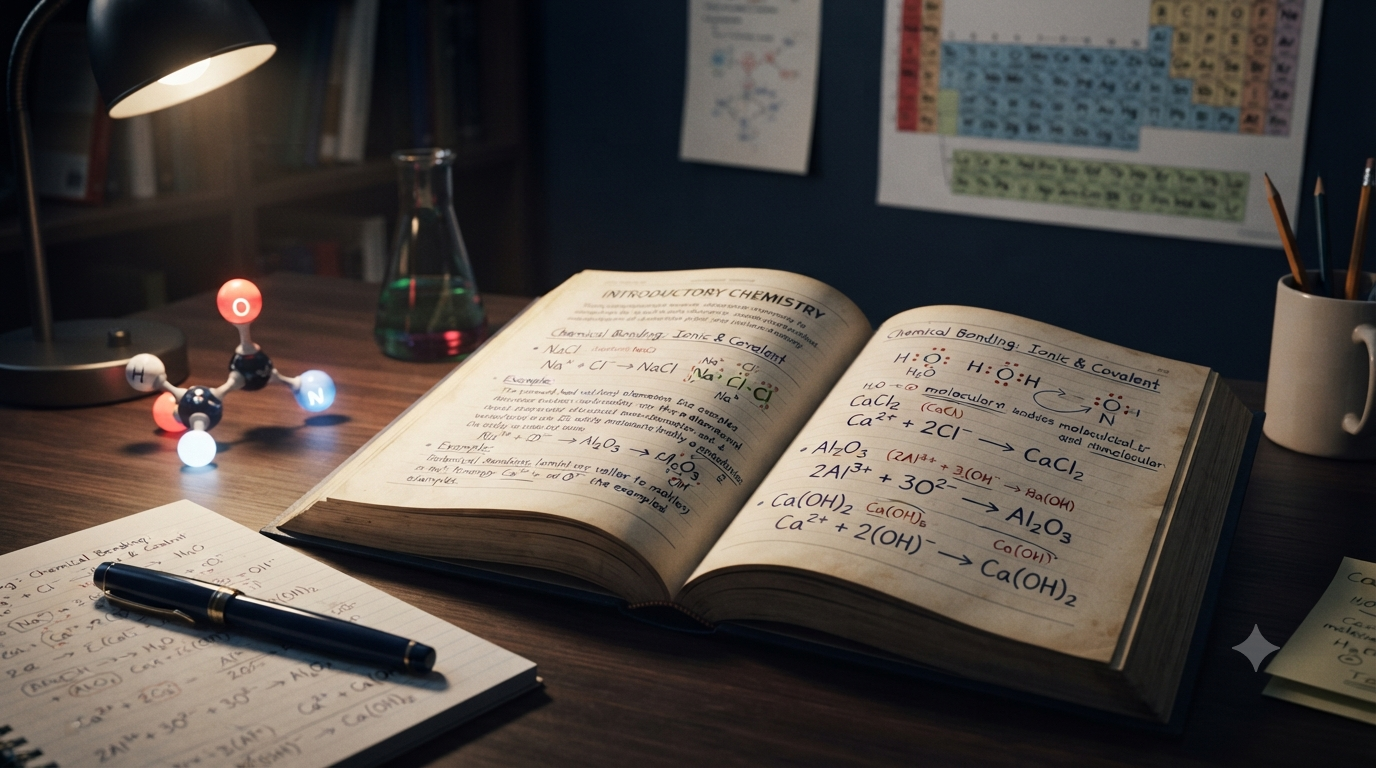
A chemical formula is a short way of representing a substance using chemical symbols and numbers. It tells us which...
Read MoreHow to Study Physics Formulas Step by Step

Physics formulas are an important part of learning physics, but simply memorizing them is not enough. A formula represents a...
Read MoreCommon Mistakes When Using Physics Formulas

Physics formulas help us describe motion, forces, energy, electricity, heat, waves, and many other phenomena using mathematical relationships. A formula...
Read MoreWhat does a coefficient mean in a chemical equation?

A chemical equation is a compact way of representing a chemical reaction. It tells us which substances take part in...
Read MoreHow to Find the Elemental Composition of a Compound
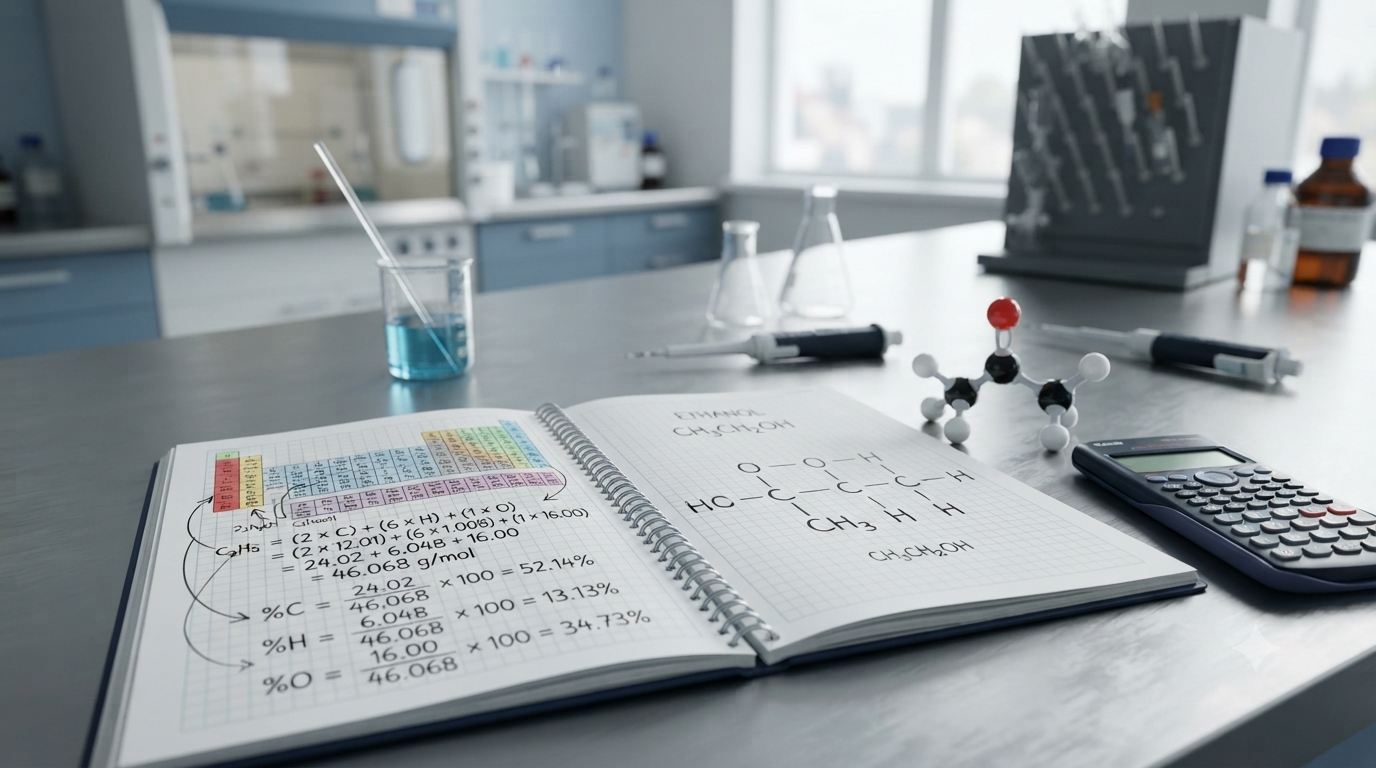
Every chemical compound is made from two or more elements combined in definite proportions. Knowing which elements are present and...
Read MoreHow to Organize Physics Formulas for Easy Revision
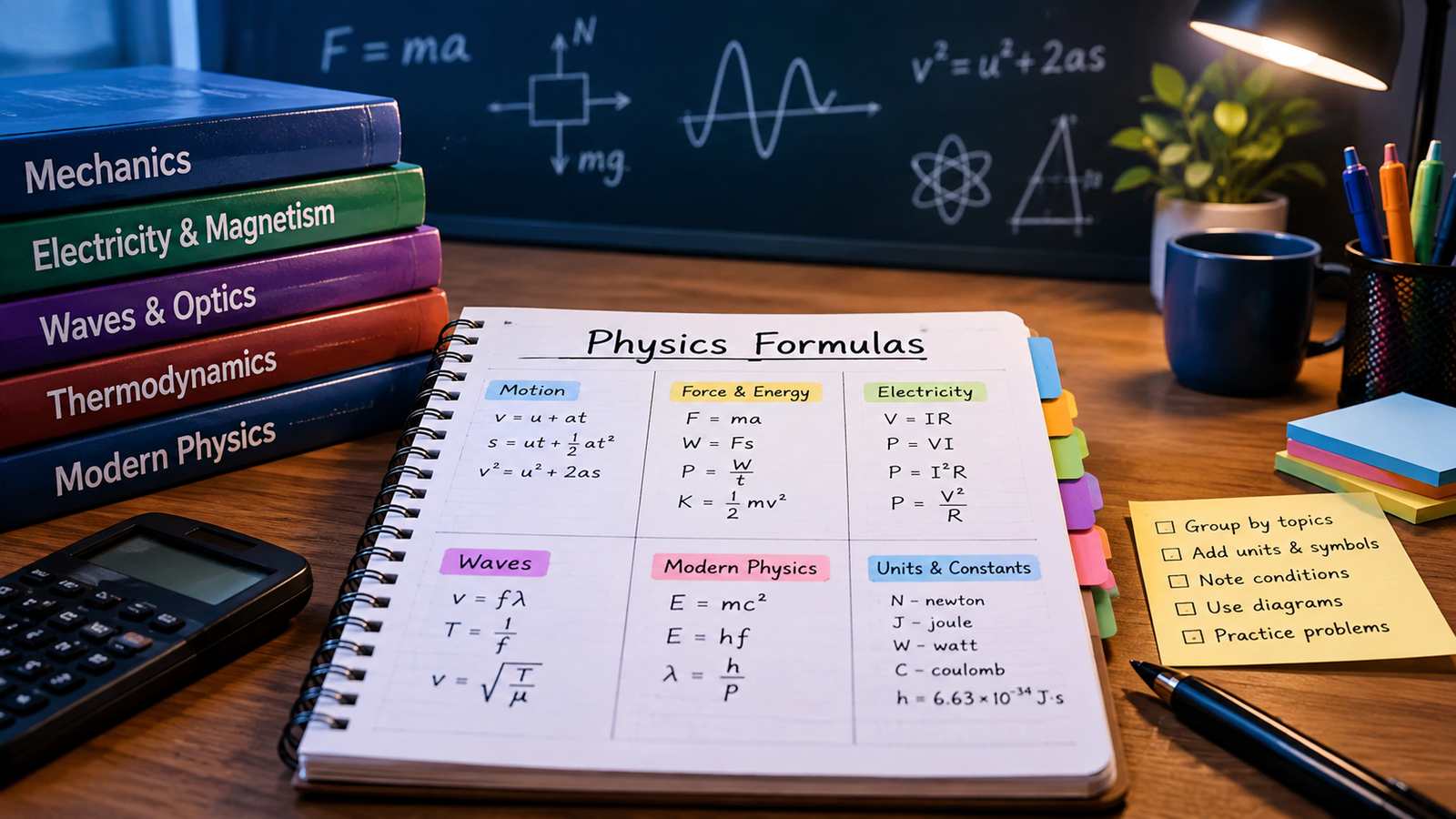
Physics becomes much easier when formulas are organized in a clear and meaningful way. Many learners struggle not because they...
Read MoreWhy Does Momentum Matter in Collisions?
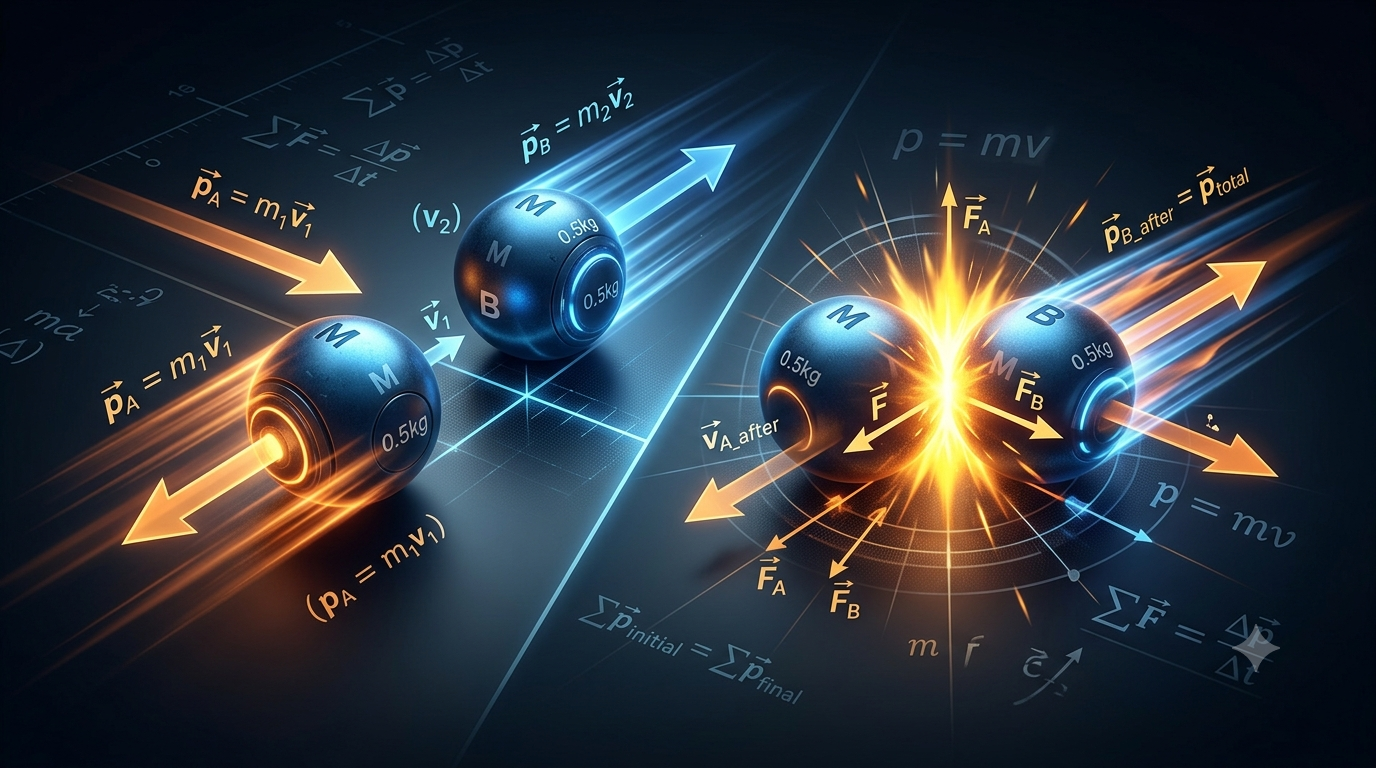
When two objects collide, many things can happen. A moving ball can hit another ball and send it in a...
Read MoreWhich chemistry formulas are essential for beginners to learn first?

Chemistry becomes much easier when you understand the formulas used to represent substances, reactions, quantities, and relationships between different chemical...
Read MoreSI Unit of Length Metre and Its Modern Definition

Length is one of the most basic quantities measured in science. Whether we measure the distance between two cities, the...
Read MoreHow Chemical Formula Ratios Describe Compound Composition

A chemical formula is much more than a short way of naming a compound. It provides important information about what...
Read MoreHow to Build a Physics Formula Sheet
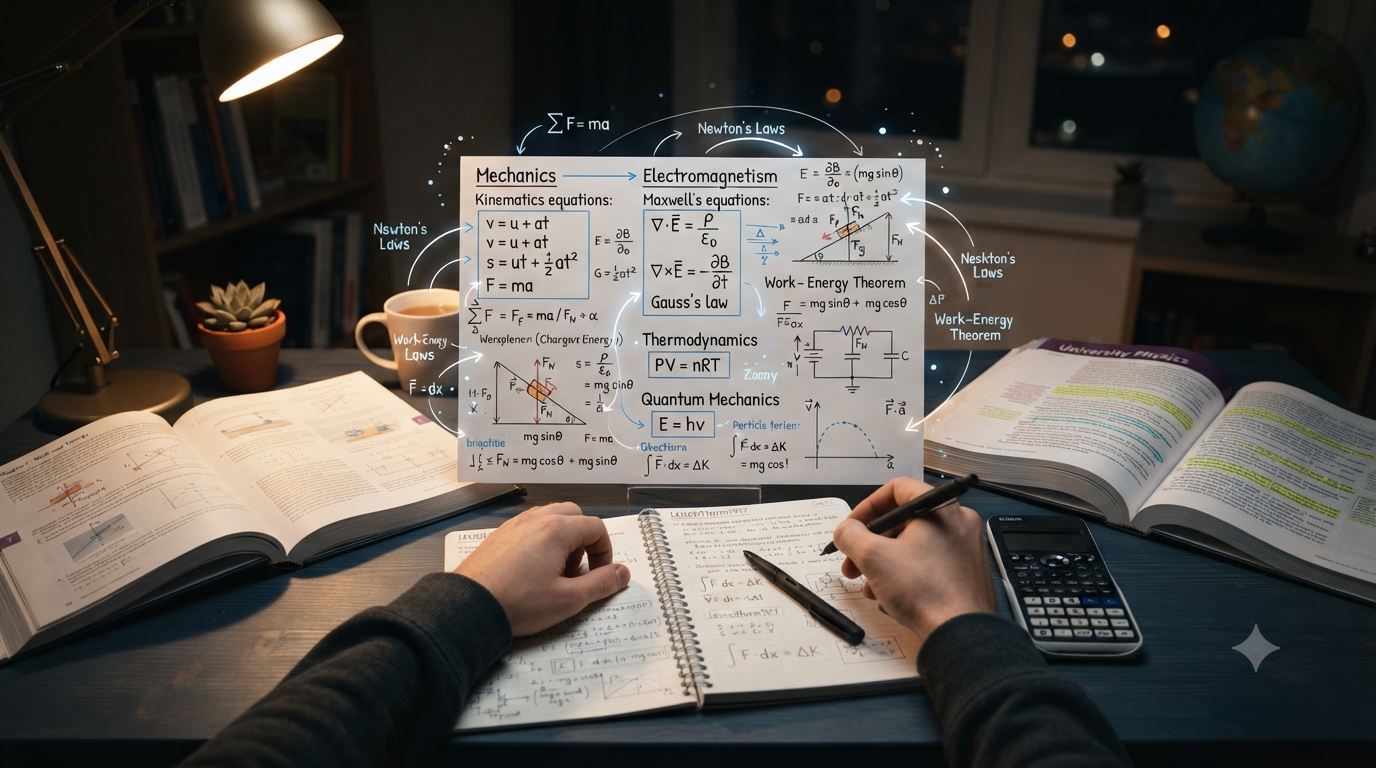
Physics involves many formulas, and remembering all of them can become difficult as you move from basic concepts to more...
Read MoreWhy are graphs so useful for understanding motion?

Motion is one of the most important ideas in physics. We see motion everywhere around us. A car travels along...
Read MoreWhy do some physical quantities have no units?
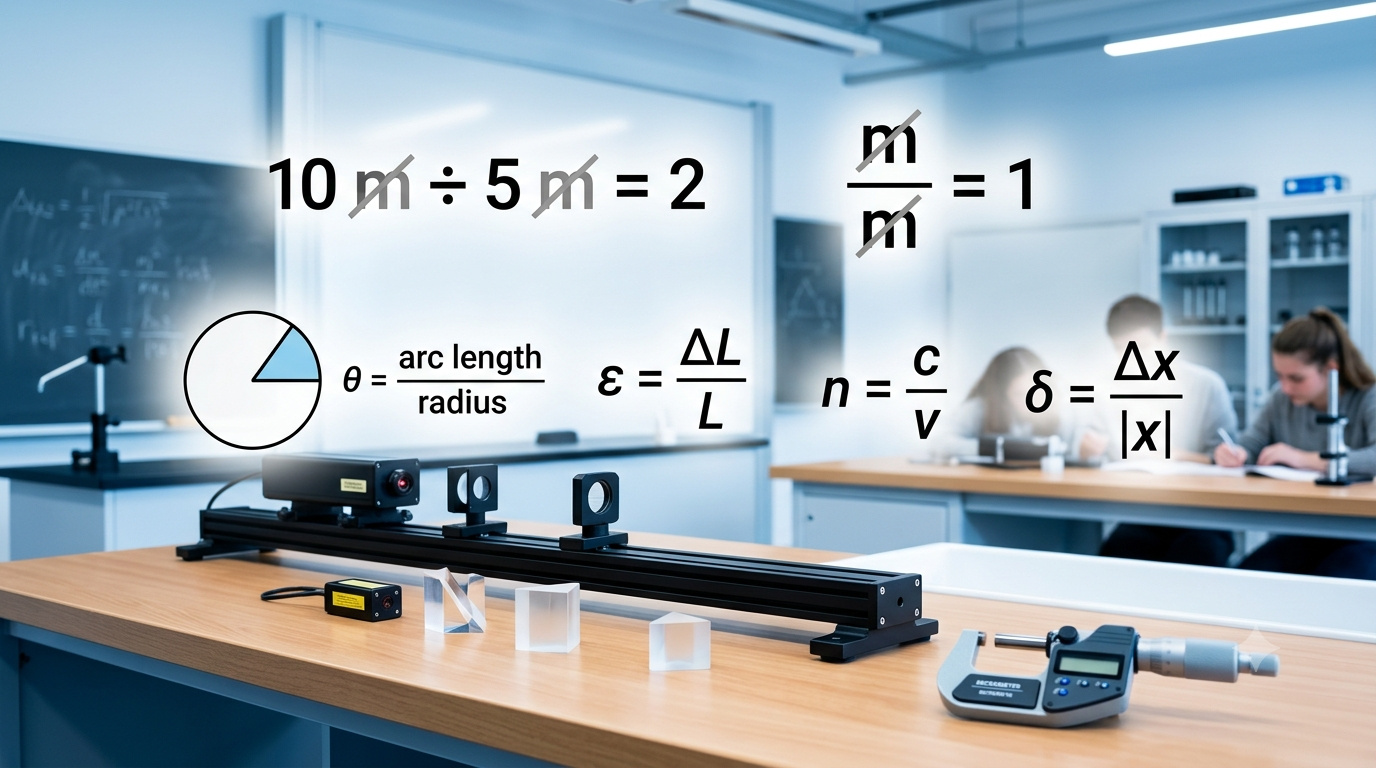
When we study physics, we usually encounter quantities such as length, mass, time, speed, force, and energy. Each of these...
Read MoreWhat Is the Meaning of Formula Units in Chemistry?
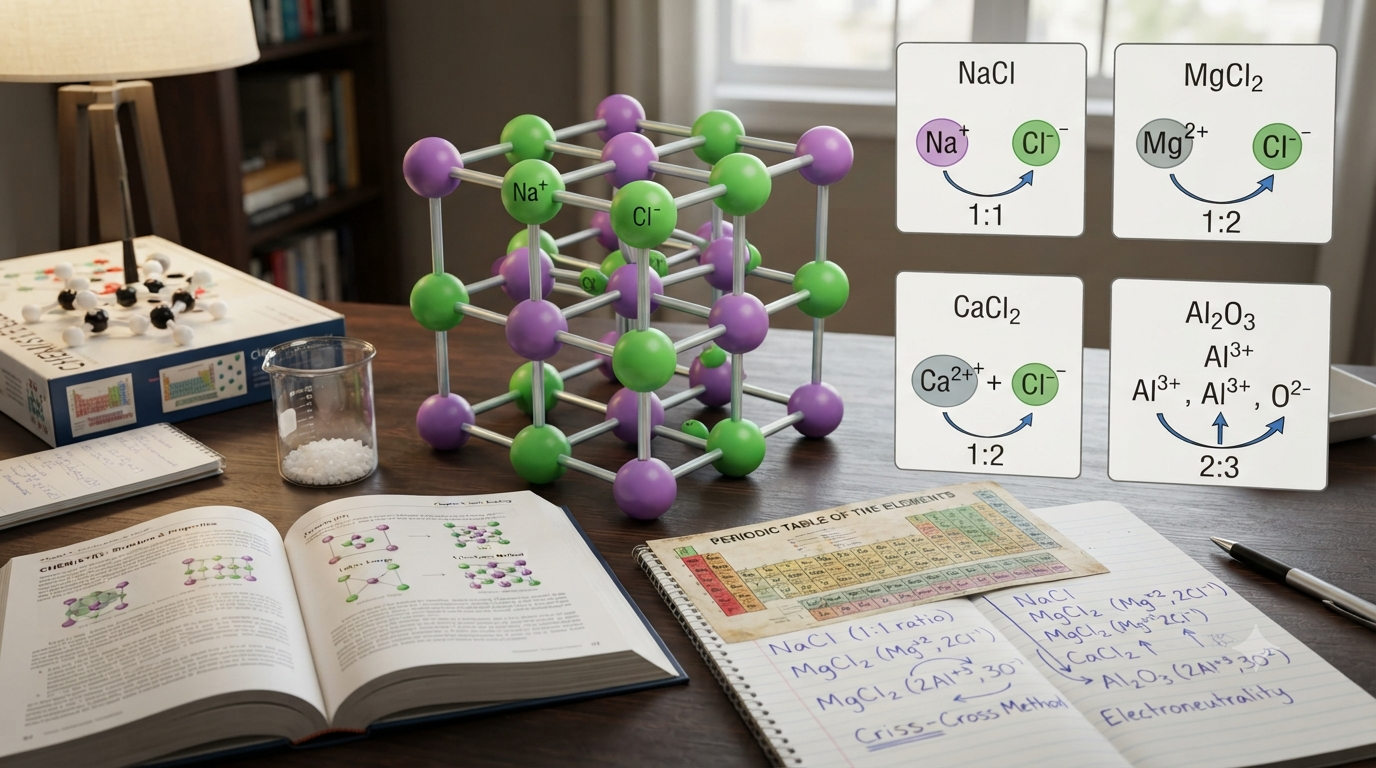
In chemistry, substances are often represented using chemical formulas. A chemical formula tells us which elements are present and, in...
Read MoreHow Chemical Formulas Represent Fixed Composition
A chemical formula is much more than a short name for a substance. It gives important information about what a...
Read More