
What information can be obtained from a chemical formula?

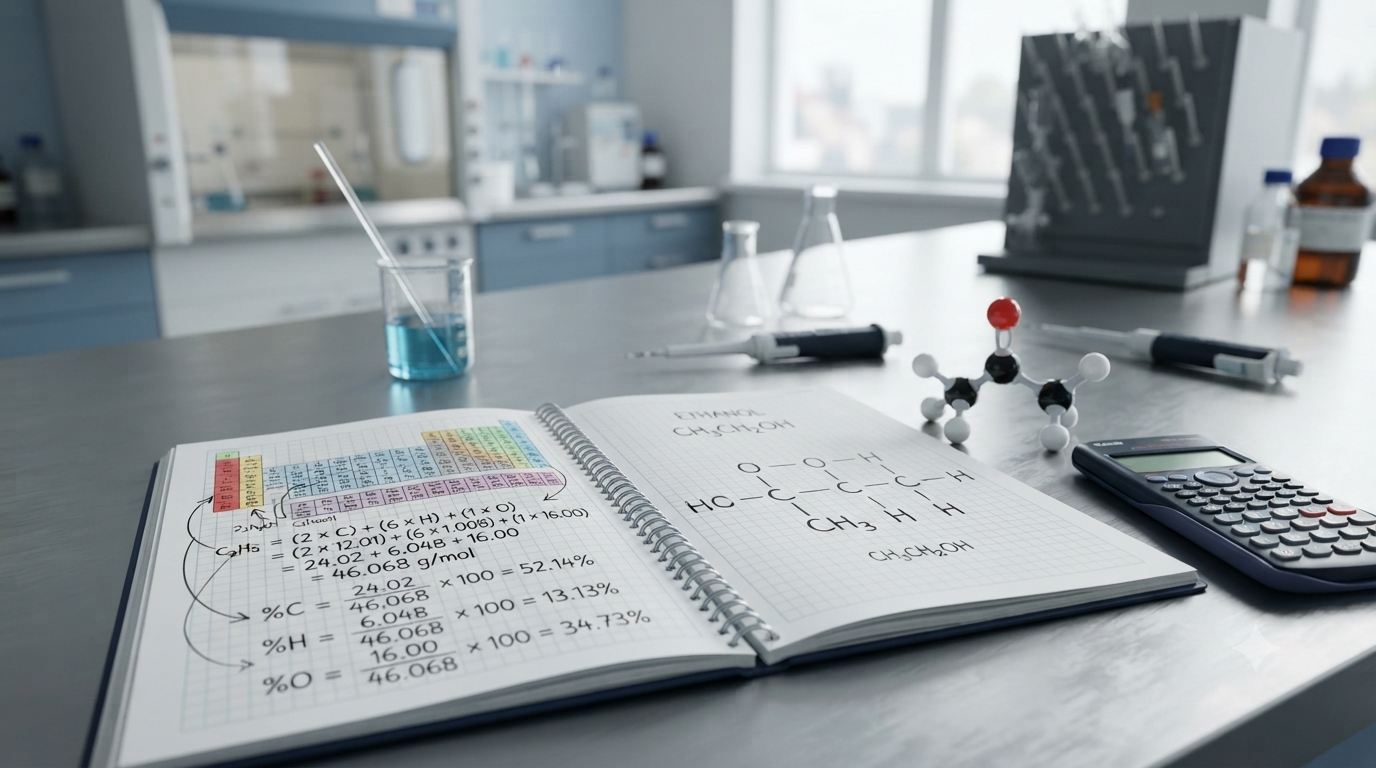
Chemical formulas showing elements, atom ratios, molecular composition, and mass information in chemistry

A chemical formula is a short and powerful way of representing a substance. It uses chemical symbols and numbers to show which elements are present and how their atoms are related. Although a formula may look simple, it can provide a surprising amount of information about a compound. For example, the formula H₂O immediately tells us that water contains hydrogen and oxygen, while the subscripts tell us the relative number of atoms of each element.

Learning how to read a chemical formula is an important part of chemistry because formulas are used to describe substances, chemical reactions, molecular composition, and quantitative relationships. By carefully examining a chemical formula, we can identify the elements present, determine the ratio of their atoms, calculate the number of atoms in a molecule or formula unit, find the relative molecular or formula mass, and obtain useful information about the composition of a substance.

What Is a Chemical Formula?

A chemical formula is a symbolic representation of a substance using the chemical symbols of its constituent elements and numbers called subscripts. It tells us which elements make up the substance and the relative number of atoms or ions involved.

For example, the formula for carbon dioxide is CO₂. It contains the symbols C and O, representing carbon and oxygen. The subscript ₂ after O indicates that there are two oxygen atoms for every one carbon atom.

Similarly, the formula H₂SO₄ represents sulfuric acid. It contains hydrogen, sulfur, and oxygen. The subscripts show that the substance contains two hydrogen atoms, one sulfur atom, and four oxygen atoms in each molecule.

A chemical formula does not normally tell us every property of a substance. However, it provides essential information about its chemical composition and helps us understand its structure and quantitative relationships.

Information About the Elements Present

One of the first things we can learn from a chemical formula is which elements are present in a substance.

Each chemical symbol represents an element. By identifying the symbols in the formula, we can determine the elements that make up the compound.

For example:

  • H₂O contains hydrogen and oxygen.

  • CO₂ contains carbon and oxygen.

  • NaCl contains sodium and chlorine.

  • CaCO₃ contains calcium, carbon, and oxygen.

  • NH₃ contains nitrogen and hydrogen.

This information is useful because the identity of the elements gives us the basic chemical composition of the substance.

The Number of Atoms of Each Element

Subscripts in a chemical formula provide information about the relative number of atoms of each element.

Consider the formula H₂O. The subscript ₂ belongs to hydrogen, so there are two hydrogen atoms. Oxygen has no written subscript, which means its subscript is understood to be 1.

Therefore:

H₂O = 2 hydrogen atoms + 1 oxygen atom

Another example is CO₂:

CO₂ = 1 carbon atom + 2 oxygen atoms

For a more complex formula such as C₆H₁₂O₆, we can identify:

  • 6 carbon atoms

  • 12 hydrogen atoms

  • 6 oxygen atoms

The subscripts therefore provide important information about the atomic composition of the substance.

The Ratio of Atoms in a Compound

A chemical formula also tells us the simplest whole-number ratio of atoms or ions present in a compound.

For example, H₂O shows that hydrogen and oxygen are present in a ratio of 2:1.

In CO₂, carbon and oxygen occur in a ratio of 1:2.

For C₆H₁₂O₆, the ratio of carbon, hydrogen, and oxygen atoms is:

6:12:6

This can be simplified to:

1:2:1

The ratio represented by a formula is important because compounds contain elements in definite proportions.

The Total Number of Atoms in a Molecule

When a chemical formula represents a molecular substance, we can use its subscripts to calculate the total number of atoms in one molecule.

For example, methane has the formula CH₄.

It contains:

1 carbon atom + 4 hydrogen atoms = 5 atoms

Therefore, one methane molecule contains a total of five atoms.

Consider glucose, C₆H₁₂O₆:

6 + 12 + 6 = 24 atoms

Thus, one glucose molecule contains 24 atoms in total.

This method is useful when studying molecular composition and chemical reactions.

Information About Polyatomic Ions and Groups

Some chemical formulas contain groups of atoms that behave as a unit. These groups are called polyatomic ions when they carry an overall charge.

For example, calcium nitrate has the formula Ca(NO₃)₂.

The parentheses show that the nitrate group, NO₃, occurs twice.

Therefore, Ca(NO₃)₂ contains:

  • 1 calcium atom

  • 2 nitrogen atoms

  • 6 oxygen atoms

The subscript outside the parentheses multiplies every atom inside the brackets.

This is an important feature of chemical formulas because it allows us to understand the composition of compounds containing repeated groups.

The Number of Formula Units in Ionic Compounds

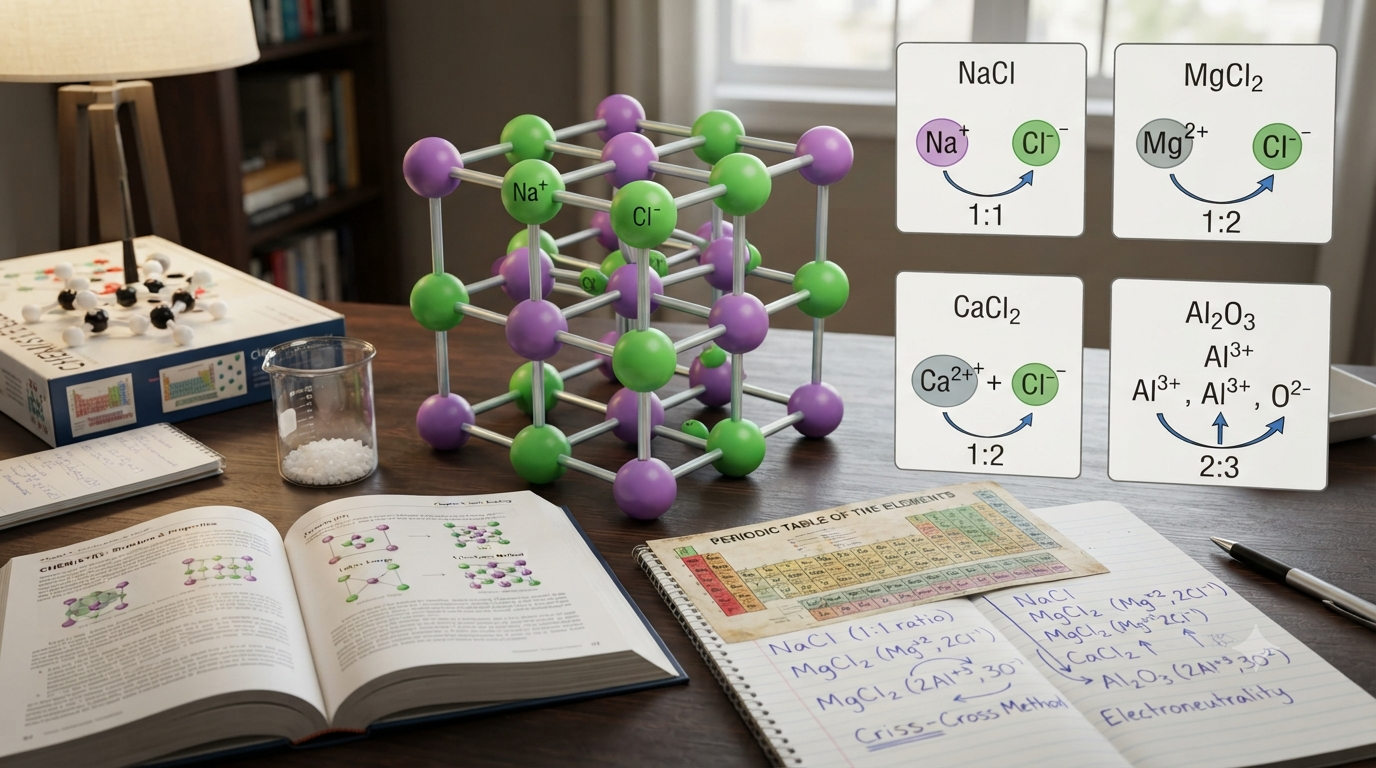
Not every chemical formula represents a separate molecule. Ionic compounds such as sodium chloride are made of ions arranged in a crystal lattice. Their formulas represent formula units rather than individual molecules.

For example, NaCl represents a 1:1 ratio of sodium ions to chloride ions.

CaCl₂ represents:

1 calcium ion : 2 chloride ions

Similarly, Al₂(SO₄)₃ represents:

  • 2 aluminum ions

  • 3 sulfate ions

The formula therefore gives the simplest whole-number ratio of ions present in the ionic compound.

Relative Molecular Mass

A chemical formula can be used to calculate the relative molecular mass of a molecular substance.

To calculate it, we add the relative atomic masses of all the atoms represented in the formula.

For water, H₂O:

Relative molecular mass = 2 × relative atomic mass of H + relative atomic mass of O

Using approximate atomic masses:

H = 1
O = 16

Therefore:

Relative molecular mass of H₂O = 2(1) + 16 = 18

So, the relative molecular mass of water is 18.

The same approach can be used for other molecular substances.

Relative Formula Mass

For ionic compounds, we generally use the term relative formula mass rather than relative molecular mass because ionic compounds do not consist of separate molecules.

For example, sodium chloride is NaCl.

Using approximate atomic masses:

Na = 23
Cl = 35.5

Therefore:

Relative formula mass of NaCl = 23 + 35.5 = 58.5

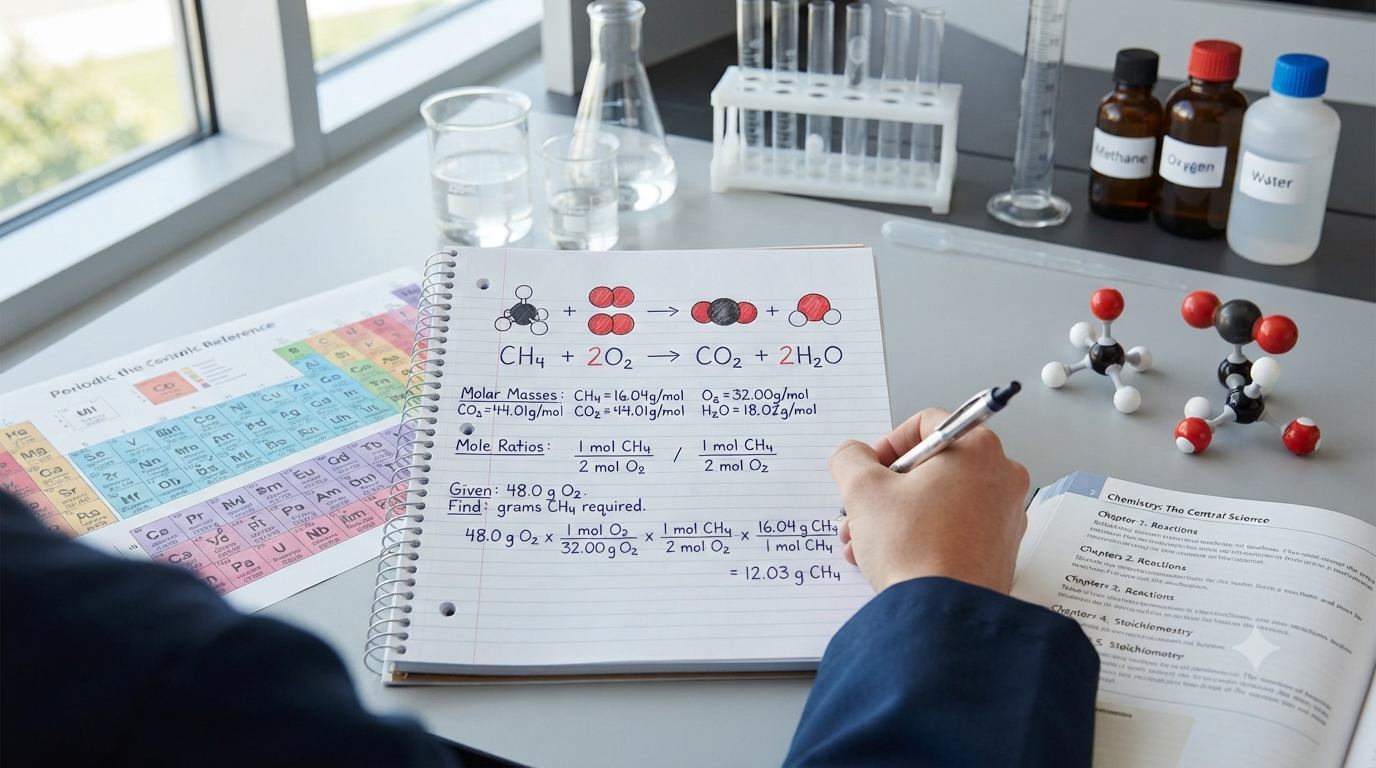
This information is particularly useful in quantitative chemistry and mole calculations.

Molar Mass

A chemical formula can also help us determine the molar mass of a substance.

The numerical value of molar mass in grams per mole is equal to the relative molecular mass or relative formula mass.

For example, the relative molecular mass of water is 18. Therefore, the molar mass of water is approximately:

18 g/mol

Similarly, the relative formula mass of NaCl is 58.5, so its molar mass is approximately:

58.5 g/mol

Molar mass is widely used in calculations involving mass, moles, and chemical reactions.

Mass Contribution of Each Element

A chemical formula can also be used to determine how much each element contributes to the total mass of a compound.

For example, consider H₂O.

The atomic mass contribution of hydrogen is:

2 × 1 = 2

The atomic mass contribution of oxygen is:

1 × 16 = 16

Total = 18

Therefore, hydrogen contributes 2 out of 18 relative mass units, while oxygen contributes 16 out of 18.

This information can be used to calculate the percentage composition of a compound.

Percentage Composition

A chemical formula allows us to calculate the percentage by mass of each element in a compound.

The general formula is:

Percentage of an element = (Mass contributed by the element ÷ Total formula mass) × 100

For water, H₂O:

Total relative molecular mass = 18

Hydrogen contribution = 2

Percentage of hydrogen:

(2 ÷ 18) × 100 ≈ 11.11%

Oxygen contribution:

(16 ÷ 18) × 100 ≈ 88.89%

Therefore, the chemical formula provides the information needed to determine the mass percentage of each element.

Information About Valency and Charge Relationships

Chemical formulas can also provide clues about how ions combine to form electrically neutral compounds.

For example, MgCl₂ contains one magnesium ion and two chloride ions. Magnesium commonly forms Mg²⁺ ions, while chloride forms Cl⁻ ions. Two chloride ions are therefore needed to balance the charge of one magnesium ion.

Similarly, Al₂O₃ contains aluminum and oxygen in a ratio that balances their common ionic charges.

A formula itself does not always explicitly state the charges, but the subscripts can reflect the charge relationship required to produce a neutral compound.

Distinguishing Elements From Compounds

A chemical formula can help us determine whether a substance contains one element or more than one element.

For example:

O₂ contains only oxygen atoms. It is a molecular form of the element oxygen.

N₂ contains only nitrogen atoms.

H₂O contains hydrogen and oxygen, so it is a compound.

CO₂ contains carbon and oxygen, so it is also a compound.

The presence of more than one chemical symbol generally indicates that the formula represents a compound.

Understanding Chemical Reactions

Chemical formulas are essential for writing and interpreting chemical equations.

For example:

2H₂ + O₂ → 2H₂O

The formulas tell us which substances participate in the reaction and which substance is produced.

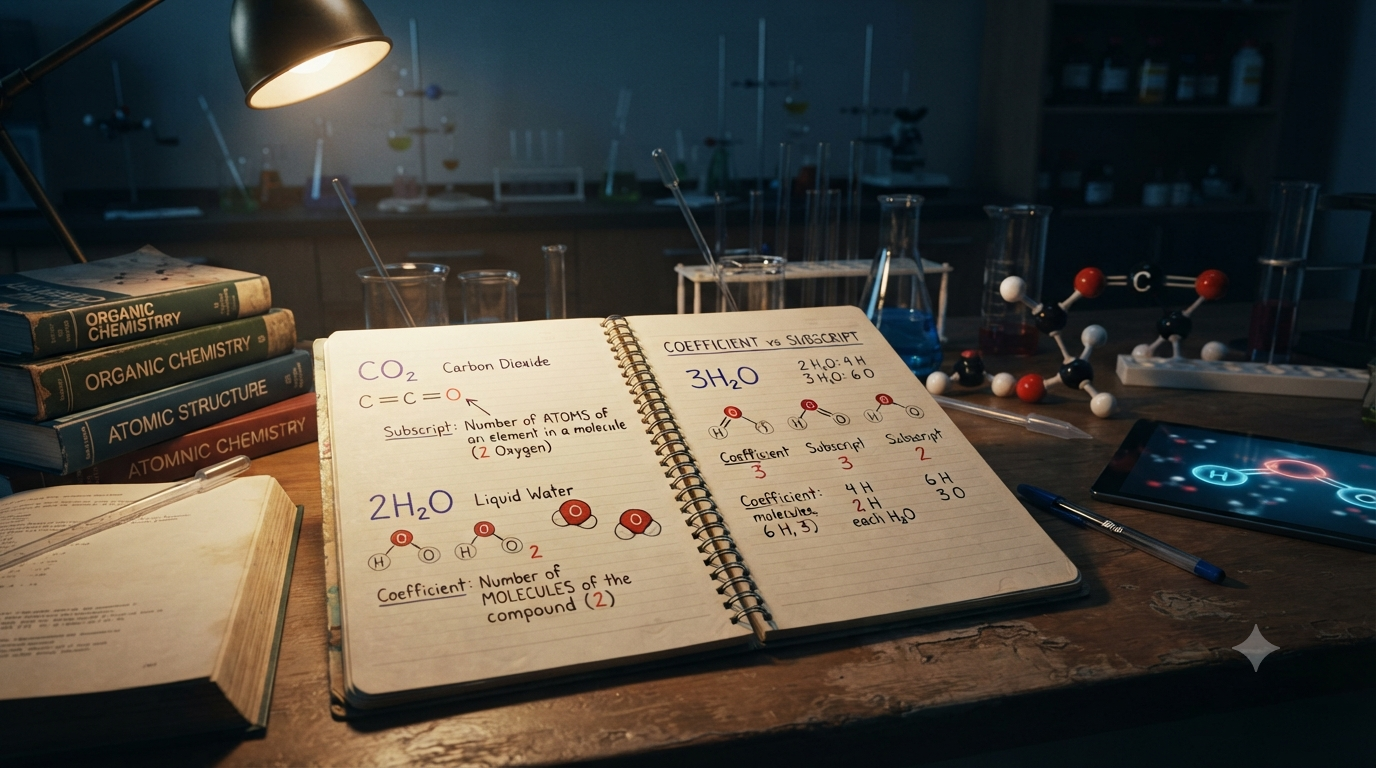
The coefficients in front of the formulas show the relative amounts involved in the reaction, while the subscripts inside the formulas describe the composition of each substance.

This distinction is important:

  • Subscripts describe the composition of a substance.

  • Coefficients describe the number of molecules or formula units involved.

Changing a subscript changes the substance itself, while changing a coefficient changes the amount of the substance involved.

Information About Empirical Composition

A chemical formula can represent the simplest whole-number ratio of elements in a compound when it is an empirical formula.

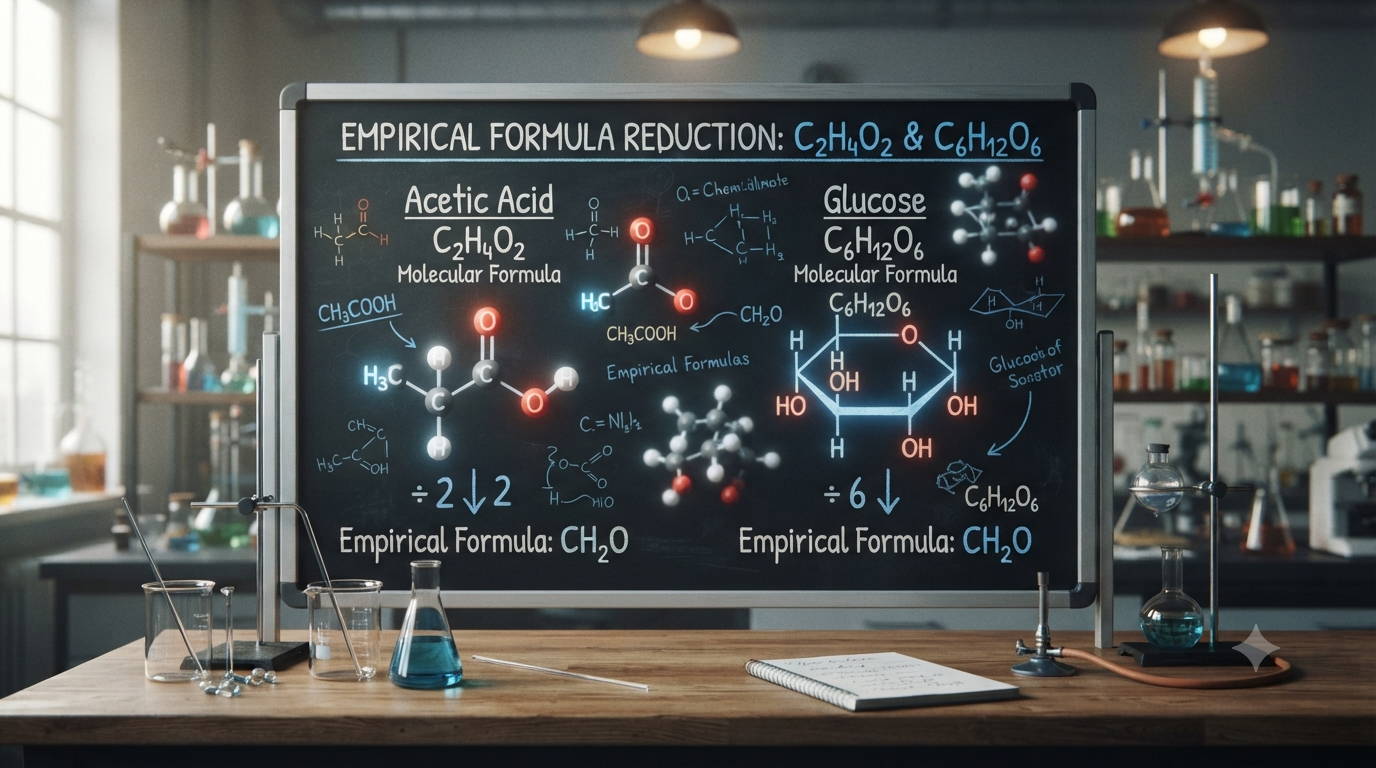
For example, the molecular formula of glucose is C₆H₁₂O₆. Its empirical formula is CH₂O because the subscripts can be divided by 6.

The empirical formula therefore provides the simplest ratio of the elements.

However, the empirical formula does not always tell us the actual number of atoms in one molecule. For example, CH₂O and C₆H₁₂O₆ have the same simplest ratio but represent different molecular formulas.

What a Chemical Formula Does Not Tell Us

Although chemical formulas provide a lot of information, they do not tell us everything about a substance.

A basic chemical formula generally does not directly tell us:

  • The physical appearance of the substance

  • Its color

  • Its smell

  • Its melting point

  • Its boiling point

  • Its density

  • Its state under particular conditions

  • The complete three-dimensional arrangement of atoms

  • How quickly it reacts

  • All of its chemical and physical properties

For structural information, chemists may use structural formulas, Lewis structures, molecular models, or other representations.

Therefore, a chemical formula should be understood as a concise representation of composition rather than a complete description of every property of a substance.

Why Reading Chemical Formulas Is Important

Being able to interpret chemical formulas is one of the foundations of chemistry. Formulas appear throughout chemical equations, laboratory work, stoichiometry, molecular calculations, materials science, biochemistry, and many other areas of science.

Once we understand symbols, subscripts, coefficients, parentheses, and ratios, even complex formulas become easier to interpret.

For example, the formula Al₂(SO₄)₃ may initially look complicated. However, it can be broken down systematically:

  • Al₂ means 2 aluminum atoms.

  • SO₄ represents one sulfate group.

  • The subscript 3 outside the parentheses means three sulfate groups.

  • Therefore, there are 2 aluminum atoms, 3 sulfur atoms, and 12 oxygen atoms.

This step-by-step approach makes chemical formulas much easier to understand.

Conclusion

A chemical formula is much more than a collection of chemical symbols and numbers. It provides a concise description of the composition of a substance and can reveal which elements are present, the ratio of their atoms or ions, the number of atoms in a molecule or formula unit, and the presence of repeated groups such as polyatomic ions.

From a chemical formula, we can also calculate relative molecular mass, relative formula mass, molar mass, mass contribution, and percentage composition. Formulas help us understand ionic relationships and interpret chemical equations and stoichiometric calculations.

At the same time, a formula has limitations. It mainly describes chemical composition and does not by itself provide every physical, chemical, or structural property of a substance. Learning to read formulas carefully is therefore an essential skill for understanding how matter is represented and how chemical substances interact.

FAQs

1. What information can be obtained from a chemical formula?

A chemical formula provides important information about the composition of a substance. It shows which elements are present and the relative number of atoms of each element. Subscripts indicate how many atoms of an element are represented. A formula can also reveal the simplest ratio of elements or ions in a compound. From the formula, we can calculate relative molecular mass, relative formula mass, molar mass, and percentage composition by mass. In ionic compounds, the formula indicates the ratio of positive and negative ions. However, a chemical formula does not normally describe all physical properties or the complete three-dimensional structure of a substance.

2. How does a chemical formula show the elements present in a compound?

A chemical formula uses chemical symbols to identify the elements present in a substance. Each different symbol represents a particular element. For example, H₂O contains the symbols H and O, showing that water contains hydrogen and oxygen. Similarly, CO₂ contains carbon and oxygen, while CaCO₃ contains calcium, carbon, and oxygen. By reading the symbols carefully, we can identify the elements without needing to see the substance itself. The periodic table can be used to identify unfamiliar symbols. Therefore, the chemical symbols in a formula provide the basic information needed to determine the elemental composition of a compound.

3. What do subscripts tell us in a chemical formula?

Subscripts tell us the relative number of atoms of an element in a chemical formula. For example, in H₂O, the subscript 2 means there are two hydrogen atoms for every one oxygen atom. If an element has no written subscript, its subscript is understood to be 1. In C₆H₁₂O₆, the subscripts show six carbon atoms, twelve hydrogen atoms, and six oxygen atoms. Subscripts are therefore essential for understanding the composition of a substance. They should not be confused with coefficients, which are placed before formulas and indicate the number of molecules or formula units involved in a chemical equation.

4. What does the ratio of elements in a chemical formula mean?

The ratio of elements tells us how many atoms or ions of each element are present relative to one another. For example, H₂O represents a hydrogen-to-oxygen ratio of 2:1. CO₂ represents a carbon-to-oxygen ratio of 1:2. In C₆H₁₂O₆, the ratio is 6:12:6, which simplifies to 1:2:1. In ionic compounds, the formula represents the simplest whole-number ratio of ions. These ratios are important because compounds have definite compositions. Understanding the ratio helps us calculate quantities, determine composition, interpret chemical equations, and perform stoichiometric calculations involving the substances represented by chemical formulas.

5. Can a chemical formula tell us the total number of atoms?

Yes, when a formula represents a molecule, its subscripts can be used to determine the total number of atoms in one molecule. For example, CH₄ contains one carbon atom and four hydrogen atoms, giving a total of five atoms. Similarly, C₂H₅OH contains two carbon atoms, six hydrogen atoms, and one oxygen atom, giving nine atoms in total. Parentheses must also be considered when calculating atom numbers. For example, Ca(NO₃)₂ contains one calcium atom, two nitrogen atoms, and six oxygen atoms. This information helps us understand molecular composition and interpret chemical formulas accurately.

6. Can a chemical formula be used to calculate molecular mass?

Yes, a chemical formula can be used to calculate the relative molecular mass of a molecular substance. We first identify the number of atoms of each element and then multiply each number by the element’s relative atomic mass. Finally, we add the results. For example, H₂O contains two hydrogen atoms and one oxygen atom. Using approximate atomic masses of 1 for hydrogen and 16 for oxygen, its relative molecular mass is 2(1) + 16 = 18. This calculation is useful for comparing substances and is also important in mole calculations and many areas of quantitative chemistry.

7. What is the difference between molecular mass and formula mass?

Relative molecular mass is generally used for substances made up of molecules, while relative formula mass is commonly used for ionic compounds. A molecular substance such as water, H₂O, consists of individual molecules, so we can calculate its relative molecular mass. Sodium chloride, NaCl, is an ionic compound and does not consist of separate NaCl molecules in its crystal structure. Therefore, its relative formula mass is used instead. The calculation is similar in both cases: we add the relative atomic masses represented by the formula. The terminology reflects the different ways these substances are structurally organized.

8. Can a chemical formula tell us the percentage composition of a compound?

Yes, a chemical formula provides the information needed to calculate the percentage by mass of each element in a compound. First, we calculate the total relative molecular mass or formula mass. Then, we calculate the mass contribution of the element being considered. The percentage is found using: Percentage of an element = (mass contributed by the element ÷ total formula mass) × 100. For example, in H₂O, hydrogen contributes 2 relative mass units and oxygen contributes 16, giving a total of 18. Therefore, the formula can be used to determine the approximate mass percentage of hydrogen and oxygen.

9. What do parentheses mean in a chemical formula?

Parentheses in a chemical formula usually indicate that a group of atoms or ions is repeated. The subscript outside the parentheses applies to every atom inside them. For example, Ca(NO₃)₂ contains one calcium atom and two nitrate groups. Each nitrate group contains one nitrogen atom and three oxygen atoms. Therefore, the formula contains one calcium atom, two nitrogen atoms, and six oxygen atoms. Parentheses make complex formulas easier to represent and read. When interpreting such formulas, it is important to multiply every element inside the parentheses by the subscript outside them rather than applying the number to only one element.

10. What information cannot normally be obtained from a chemical formula?

A chemical formula mainly provides information about the chemical composition and relative proportions of a substance. It does not normally tell us every physical or structural property. For example, a basic formula does not directly reveal the color, smell, density, melting point, boiling point, or complete three-dimensional arrangement of atoms. It also does not necessarily show how atoms are connected unless a structural formula is used. Different forms of chemical representation provide additional information. Therefore, a chemical formula is a concise description of composition rather than a complete description of all the properties and behavior of a substance.

Related Posts

Leave a Comment

Your email address will not be published. Required fields are marked *

Scroll to Top