Have you ever looked at the night sky and wondered how many stars exist beyond what your eyes can see? Or thought about where Earth came from, how the universe began, and whether life exists somewhere beyond our planet? These questions have inspired human curiosity for thousands of years. Astronomy, the scientific study of celestial objects and phenomena beyond Earth’s atmosphere, helps us explore these mysteries and understand our place in the universe.
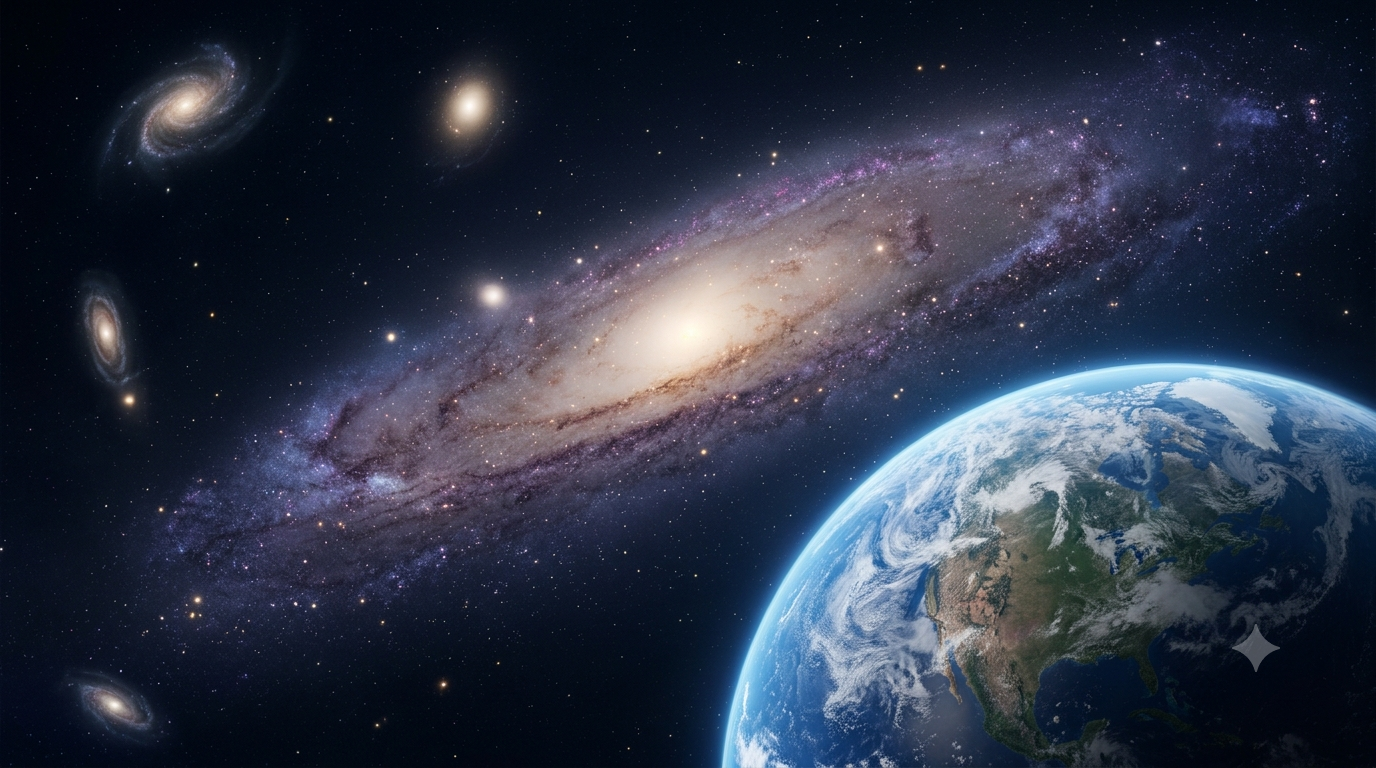
By studying stars, planets, galaxies, black holes, and the evolution of the cosmos, astronomers have revealed that Earth is part of a much larger and more complex system. Our planet belongs to the solar system, the solar system lies within the Milky Way galaxy, and the Milky Way is one of countless galaxies in the observable universe. Astronomy does more than explain distant objects. It helps us understand Earth’s origins, our relationship with nature, the possibility of life elsewhere, and the limits of human knowledge.
What Is Astronomy and Why Is It Important?
Astronomy is one of the oldest natural sciences. Early civilizations observed the Sun, Moon, stars, and planets to understand seasonal changes, measure time, navigate across land and sea, and develop calendars. Over time, these observations became more systematic, leading to scientific explanations of celestial movements.
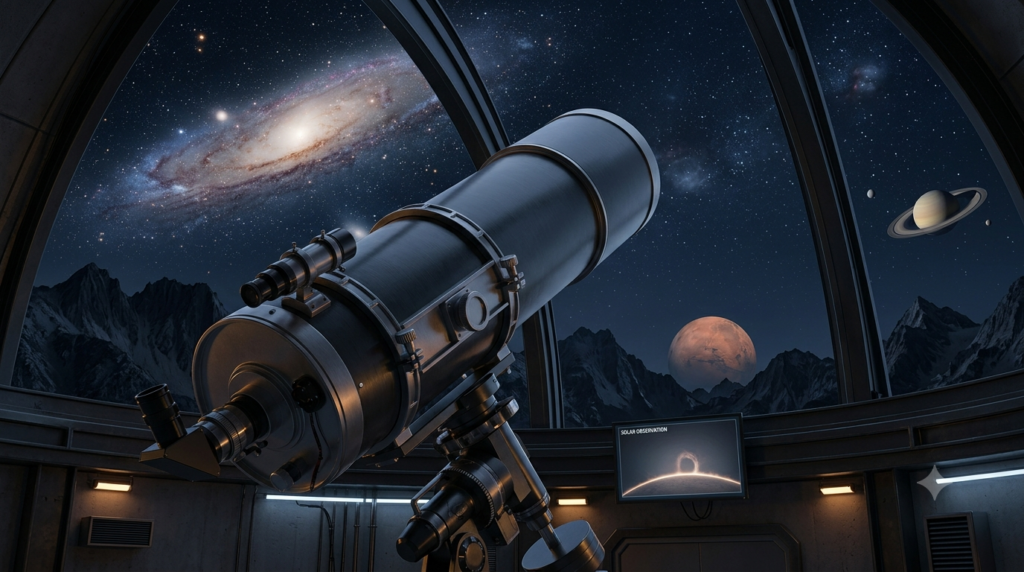
Modern astronomy uses telescopes, satellites, space probes, mathematical models, and computer simulations to investigate the universe. Astronomers collect information about the brightness, temperature, chemical composition, movement, and distance of celestial objects. This evidence helps them understand how the universe works.
Astronomy is important because it connects events happening across enormous distances and timescales. Studying distant galaxies allows scientists to investigate conditions that existed billions of years ago. Examining stars reveals how elements form, while studying planets helps researchers understand the processes that make worlds different from one another.
Most importantly, astronomy places human life within a broader cosmic context. It shows that Earth is not an isolated object but part of a vast universe governed by physical laws that can be studied and understood.
Understanding Our Place in the Cosmic Structure
To understand our position in the universe, it is helpful to examine the different structures to which Earth belongs. Each level reveals how our planet fits into a much larger cosmic environment.
Earth as Our Home Planet
Earth is the planet on which all known life exists. It has liquid water on its surface, an atmosphere that supports living organisms, and a magnetic field that helps protect the planet from charged particles arriving from space.
Its distance from the Sun allows temperatures suitable for liquid water across much of the surface. Earth’s atmosphere regulates temperature, supplies essential gases, and protects life from much of the harmful radiation arriving from space.
Astronomy helps scientists understand why Earth has these conditions by comparing it with other planets and moons. Venus, for example, has an extremely hot surface because of its dense atmosphere and powerful greenhouse effect. Mars is colder and has a thin atmosphere, although evidence suggests that liquid water existed on its surface in the distant past.
These comparisons reveal that Earth is one member of a diverse family of worlds. Understanding other planets helps scientists identify the conditions that make Earth suitable for life and recognize how carefully interconnected its environmental systems are.
The Solar System and Our Place Within It
Earth belongs to the solar system, which consists of the Sun and all the objects gravitationally bound to it. These include eight planets, dwarf planets, natural satellites, asteroids, comets, and smaller bodies.
The Sun contains most of the solar system’s mass and provides the energy that drives Earth’s climate and supports photosynthesis. Its gravitational influence keeps the planets and many smaller objects in their orbits.
Astronomical research has shown that the solar system formed approximately 4.6 billion years ago from a cloud of gas and dust. Gravity caused this material to collapse, eventually forming the Sun and a surrounding disk from which planets developed.
Space missions have helped scientists study the surfaces, atmospheres, magnetic fields, and internal structures of other worlds. These discoveries demonstrate that planetary systems can develop in different ways and that our solar system is only one example of how planets form around stars.
The Milky Way Galaxy
Beyond the solar system lies the Milky Way, a barred spiral galaxy containing hundreds of billions of stars, along with gas, dust, planets, and dark matter. Our solar system is located in a region called the Orion Arm, several tens of thousands of light-years from the galactic center.
A light-year is the distance light travels in one year, approximately 9.46 trillion kilometres. This unit is necessary because the distances between stars and galaxies are far too large to describe conveniently using kilometres alone.
The Milky Way is so enormous that light takes roughly 100,000 years to cross its disk. The Sun orbits the galactic center, completing one revolution in roughly 225–250 million years.
This perspective changes how we think about our position in space. Earth is not at the center of the galaxy, and the Sun is not unique among stars. Our solar system is one of many planetary systems within a vast stellar community.
Astronomy also helps researchers investigate the supermassive black hole at the Milky Way’s center, the birth and death of stars, and the processes that shape galaxies over billions of years.
The Universe Beyond Our Galaxy
The Milky Way is only one galaxy among an enormous number of galaxies in the observable universe. Galaxies vary in size, shape, brightness, and composition. Some have elegant spiral arms, while others are elliptical or irregular.
Galaxies also interact through gravity. When they pass close to one another, their structures can become distorted, and collisions may trigger new periods of star formation. Over long timescales, smaller galaxies can merge into larger systems.
The observable universe refers to the region of the universe from which light or other signals have had time to reach us since the early universe. Because the universe is expanding, the observable region extends much farther than the distance light could travel through a static universe over the same period.
Astronomy reveals that our planet, solar system, and galaxy occupy only a small part of this vast cosmic structure. Although this may make humanity seem physically insignificant, it also demonstrates how much can be learned through observation and scientific reasoning.
Astronomy Reveals the History of the Universe
One of astronomy’s greatest contributions is its ability to investigate the past. Unlike many events on Earth, astronomical observations often allow scientists to examine objects as they existed long ago.
Looking Back in Time Through Light
Light travels at a finite speed. Sunlight takes about eight minutes and twenty seconds to reach Earth. When we observe the Sun, we see it as it was slightly more than eight minutes earlier.
Light from more distant stars takes years, centuries, or thousands of years to arrive. When astronomers observe distant galaxies, they often see them as they were billions of years ago.
This principle allows telescopes to act as instruments for studying cosmic history. By observing galaxies at different distances, scientists can compare different stages of their development and investigate how the universe has changed.
Astronomers use this information to understand how galaxies formed, how stars evolved, and how large cosmic structures developed over time.
The Big Bang and the Origin of the Universe
Modern cosmology describes the universe as having expanded from an extremely hot, dense early state approximately 13.8 billion years ago. This model is known as the Big Bang theory.
The Big Bang was not an ordinary explosion into pre-existing empty space. Rather, it describes the expansion of space itself from an early hot and dense condition.
Several important observations support this model. These include the expansion of the universe, the cosmic microwave background radiation, and the observed abundance of light elements such as hydrogen and helium.
The cosmic microwave background is radiation released when the early universe cooled enough for light to travel freely through space, about 380,000 years after the beginning of cosmic expansion.
Astronomy continues to investigate what happened during the earliest stages of the universe, how the first stars formed, and what physical processes shaped its development. Some questions about the ultimate origin of the universe remain unresolved, reminding us that scientific understanding grows as new evidence becomes available.
The Life Cycle of Stars
Stars are essential to understanding cosmic history because they create many of the elements required for planets and living organisms.
Stars form when gravity causes clouds of gas and dust to collapse. As the central region becomes sufficiently hot and dense, nuclear fusion begins. During most of a star’s lifetime, this process releases energy that balances the inward pull of gravity.
A star’s later development depends largely on its mass. Some stars eventually become white dwarfs, while massive stars can explode as supernovae and leave behind neutron stars or black holes.
These processes distribute elements into surrounding space. Many elements heavier than helium are produced through stellar processes and energetic cosmic events. The material can later become part of new stars, planets, and other celestial bodies.
This means that the elements found in rocks, oceans, air, and living organisms have a long cosmic history. Astronomy connects the formation of stars with the origin of the materials that make life possible.
Astronomy Helps Us Understand the Origins of Life
One of the most fascinating questions in science is whether life exists beyond Earth. Astronomy cannot yet confirm the existence of extraterrestrial life, but it helps scientists identify places where life might be possible.
The Search for Exoplanets
Exoplanets are planets that orbit stars beyond our Sun. Thousands have been confirmed, and researchers continue to discover more using ground-based telescopes and space observatories.
Some exoplanets are rocky, while others are gas giants or planets with properties unlike those found in our solar system. Their diversity shows that planetary systems can develop under many different conditions.
Astronomers often investigate whether an exoplanet lies within its star’s habitable zone, where temperatures could permit liquid water on a suitable planetary surface. However, being in this zone does not automatically mean a planet is habitable or inhabited. Its atmosphere, geology, radiation environment, and other conditions also matter.
By studying exoplanets, scientists can better understand how common planetary systems are and whether Earth-like environments may exist elsewhere.
Could Life Exist Beyond Earth?
The search for extraterrestrial life involves astronomy, biology, chemistry, geology, and planetary science. Researchers investigate planets and moons that may contain liquid water, suitable chemical ingredients, and energy sources.
Within our solar system, Mars is studied for evidence of ancient habitable environments. Jupiter’s moon Europa and Saturn’s moon Enceladus are especially interesting because evidence suggests that they contain subsurface oceans beneath icy crusts.
Scientists also examine the atmospheres of distant planets for possible biosignatures, which are features or substances that might provide evidence of life. Such signals require careful interpretation because non-biological processes can sometimes produce similar results.
So far, no confirmed evidence of life beyond Earth has been found. Nevertheless, astronomy helps transform the question from pure speculation into a scientific investigation based on measurable evidence.
Astronomy Changes Our Understanding of Humanity
Astronomy has influenced human thinking for centuries. Each major discovery has encouraged people to reconsider assumptions about the universe and their position within it.
Moving Beyond an Earth-Centred View
For much of recorded history, many societies interpreted the sky through Earth-centred models. Observations by astronomers, including Nicolaus Copernicus, Galileo Galilei, and Johannes Kepler, contributed to the development of the modern understanding that Earth orbits the Sun.
These changes were important not simply because they corrected a model of planetary motion, but because they demonstrated the value of questioning established ideas when evidence points in another direction.
The scientific revolution showed that human intuition is not always a reliable guide to the structure of the universe. Careful observation, mathematics, experimentation, and debate provide stronger foundations for understanding nature.
Astronomy continues this tradition by testing existing theories and searching for evidence that might reveal where current explanations are incomplete.
Our Physical Significance and Cosmic Perspective
The enormous size and age of the universe can make humanity appear small in comparison. Earth is a tiny planet orbiting an ordinary star in one galaxy among many.
However, physical size does not determine meaning, value, or the importance of scientific understanding. Astronomy gives us a broader perspective on our existence while showing that humans can investigate phenomena far beyond their immediate surroundings.
The same physical laws that govern distant stars and galaxies can be studied from Earth. Through scientific tools and collective effort, humans have measured stellar distances, detected planets around other stars, and reconstructed major stages of cosmic history.
This ability to understand the universe is itself remarkable. Astronomy encourages curiosity, intellectual humility, and an appreciation of the natural world without requiring us to assume that every cosmic question already has an answer.
How Astronomy Benefits Life on Earth
Although astronomy studies objects far beyond our planet, its benefits extend into everyday life.
Advances in Science and Technology
Astronomical research has encouraged the development of sensitive detectors, advanced imaging systems, data-processing methods, and precise measurement techniques. Technologies created for space research can sometimes find applications in medicine, communications, environmental monitoring, and other fields.
Space-based observatories and satellites also contribute to observing Earth’s atmosphere, oceans, land surfaces, and changing environmental conditions. While these activities involve several scientific disciplines, astronomy and space science have helped develop many of the tools used to study our planet.
Astronomy also supports progress in mathematics, physics, engineering, and computer science. Analysing astronomical data requires sophisticated algorithms and powerful computing systems, creating opportunities for new methods and discoveries.
Understanding the Sun and Space Weather
The Sun is essential to life, but it can also produce events that affect modern technology. Solar flares and coronal mass ejections release energy and charged particles into space. When directed toward Earth, these events can disturb Earth’s magnetic environment.
Strong space-weather events may interfere with radio communications, affect satellite operations, increase radiation risks for some space missions, and induce currents in electrical power systems.
By monitoring the Sun and studying its activity, scientists can improve space-weather forecasts and help operators prepare for possible disruptions.
Astronomy therefore contributes to understanding both the distant universe and the space environment immediately surrounding Earth.
Protecting Earth from Asteroid Impacts
Asteroids and comets preserve clues about the early solar system, but some objects can also pose impact hazards to Earth.
Astronomers use telescopes and radar observations to discover, track, and calculate the orbits of near-Earth objects. These observations help researchers determine whether an object could approach Earth closely enough to require further investigation.
Planetary defence research also examines whether a dangerous asteroid’s trajectory could be changed. NASA’s Double Asteroid Redirection Test, or DART, demonstrated that a spacecraft impact could alter the orbital motion of a small asteroid moon.
Discovering potentially hazardous objects early is an important part of assessing and reducing long-term impact risks.
The Role of Modern Astronomy in Future Discoveries
Astronomy is developing rapidly as new instruments allow scientists to observe the universe in greater detail.
Space telescopes, including the James Webb Space Telescope, study distant galaxies, star-forming regions, and planetary atmospheres. Their observations help researchers investigate the early stages of galaxy development and examine the chemical properties of exoplanet atmospheres.
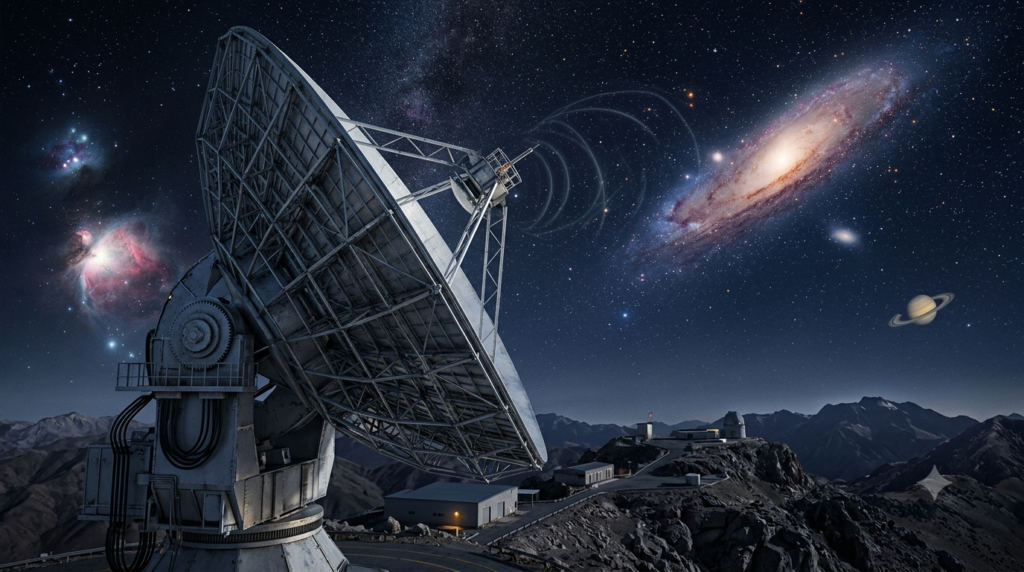
Radio telescopes detect signals that are invisible to optical instruments, while gravitational-wave observatories detect ripples in spacetime produced by some of the universe’s most energetic events. Neutrino observatories provide another way to investigate extreme cosmic environments.
These different methods allow scientists to study the universe using more than visible light alone.
Future research may improve our understanding of dark matter, dark energy, black holes, planetary formation, and the possibility of life elsewhere. Dark matter is inferred from its gravitational effects, while dark energy is the name given to whatever drives the observed accelerated expansion of the universe. Their fundamental nature remains uncertain.
New discoveries may challenge existing theories or reveal phenomena that scientists have not yet imagined. This uncertainty is not a weakness of astronomy. It is a central feature of a scientific field that continues to expand the boundaries of human knowledge.
How Anyone Can Explore Astronomy
Astronomy is accessible to people with different levels of scientific knowledge. You do not need an expensive telescope or advanced mathematics to begin exploring the night sky.
Start by observing the Moon and noticing how its visible shape changes throughout the month. Learn to identify bright planets, major constellations, and prominent stars. A pair of binoculars can reveal lunar craters and some star clusters under suitable conditions.
You can also explore astronomy through planetarium software, public observatories, educational websites, and images from space missions. These resources make it possible to investigate distant galaxies and planetary surfaces from home.
Reading about astronomical discoveries can help develop an understanding of gravity, light, planetary motion, and the life cycle of stars. Joining an astronomy club or attending a public observing session can provide opportunities to learn from others.
Most importantly, remain curious and ask questions. Astronomy begins with observation, but it grows through evidence, careful reasoning, and a willingness to revise ideas when new information becomes available.
Conclusion
Astronomy helps us understand our place in the universe by connecting Earth to the solar system, the Milky Way, and the vast observable cosmos. It reveals the history of the universe, explains how stars and planets develop, and investigates the origins of the elements that make life possible. It also supports practical advances in technology, space-weather forecasting, and planetary defence.
Perhaps its greatest contribution is the perspective it provides. Astronomy shows that Earth is a small part of a much larger universe, yet it is a world where complex life has developed and where intelligent beings can investigate the cosmos. Many questions remain unanswered, including whether life exists elsewhere and what dark matter and dark energy truly are.
By continuing to study the universe, we deepen our understanding of nature and recognize both the limits and the extraordinary potential of human knowledge. Every discovery reminds us that the universe is far larger than our immediate experience and that there is still much to learn.
FAQs
1. What is the role of astronomy in understanding our place in the universe?
Astronomy helps us understand where Earth fits within the vast universe and how celestial objects interact. By studying planets, stars, galaxies, and cosmic phenomena, scientists learn about the structure, origin, and evolution of the universe. Astronomy reveals that Earth is part of the solar system, which lies within the Milky Way galaxy. It also helps researchers investigate the origins of planets, the formation of stars, and the possibility of life beyond Earth. These discoveries provide a broader perspective on human existence and demonstrate how scientific observations can answer fundamental questions about our place in the cosmos.
2. How does astronomy explain the position of Earth in the universe?
Astronomy explains Earth’s position by examining the different cosmic structures to which our planet belongs. Earth is the third planet from the Sun in the solar system. The solar system is located in the Orion Arm of the Milky Way, a spiral galaxy containing hundreds of billions of stars. The Milky Way is one of an enormous number of galaxies in the observable universe. Astronomical observations show that Earth does not occupy a central position in the solar system or galaxy. Instead, it is one small part of a much larger cosmic environment governed by physical laws.
3. Why is studying the universe important for humans?
Studying the universe helps humans understand the origins of Earth, the development of stars and planets, and the physical laws governing nature. Astronomy also encourages scientific curiosity and critical thinking by teaching people to question assumptions and rely on evidence. Its practical benefits include improvements in observational technology, data analysis, satellite systems, and space-weather monitoring. Research into asteroids also supports efforts to identify potential impact hazards. Beyond these applications, astronomy provides a broader perspective on human existence. It demonstrates that although Earth occupies a small region of the universe, humans can investigate distant objects and uncover the history of the cosmos.
4. How does astronomy help us understand the origin of the universe?
Astronomy helps scientists investigate the universe’s origin and development through observations of distant galaxies, cosmic radiation, and the distribution of matter. According to the Big Bang theory, the universe expanded from an extremely hot, dense early state approximately 13.8 billion years ago. Evidence supporting this model includes the expansion of the universe and the cosmic microwave background radiation. By studying galaxies at different distances, astronomers can observe earlier stages of cosmic history. These findings help researchers reconstruct how the universe evolved. However, questions about the earliest moments of cosmic history and the ultimate origin of the universe remain unresolved.
5. What is the connection between astronomy and the origin of life?
Astronomy helps scientists investigate the cosmic conditions that made life on Earth possible. Stars produce many of the chemical elements that later become part of planets and living organisms. Astronomical observations also help researchers study planets outside our solar system and identify environments that might support liquid water. Scientists investigate the atmospheres of exoplanets for possible signs of biological activity and examine potentially habitable worlds within our solar system. However, suitable conditions do not guarantee that life exists. Although researchers continue to search for extraterrestrial life, no confirmed evidence of life beyond Earth has been discovered so far.
6. How does astronomy help us understand the Milky Way galaxy?
Astronomy reveals the Milky Way’s structure, composition, and evolution by studying its stars, gas, dust, and gravitational effects. The Milky Way is a barred spiral galaxy containing hundreds of billions of stars, including our Sun. Astronomers use telescopes operating at different wavelengths to investigate regions that visible light cannot easily penetrate. They also measure stellar movements to understand how stars orbit the galactic center. These observations help researchers investigate star formation, the distribution of dark matter, and the supermassive black hole at the galaxy’s center. Studying the Milky Way shows that our solar system is one of many planetary systems within a much larger structure.
7. How does astronomy contribute to scientific and technological development?
Astronomy contributes to scientific and technological development by creating challenges that require advanced instruments, precise measurements, and powerful computing systems. Researchers develop and improve imaging devices, detectors, data-processing techniques, and methods for analysing complex signals. These technologies can also find applications in fields such as medicine, communications, and environmental monitoring. Astronomy strengthens knowledge in physics, mathematics, engineering, and computer science. Space-based observations also help scientists monitor the Sun and study Earth’s environment. Although not every astronomical invention has a direct everyday application, the field regularly advances measurement techniques and scientific methods that support research across multiple disciplines.
8. What is the importance of astronomy in searching for life beyond Earth?
Astronomy is essential to the search for life beyond Earth because it helps scientists discover planets, examine their environments, and identify possible conditions suitable for living organisms. Researchers study exoplanets to determine their sizes, orbits, temperatures, and atmospheric compositions. They also investigate locations such as Mars and the icy moons Europa and Enceladus for evidence of past or present habitable environments. Scientists search for possible biosignatures, which may indicate biological activity but can sometimes arise through non-biological processes. Astronomy cannot yet confirm that extraterrestrial life exists, but it provides the observations and evidence needed to investigate this important scientific question.
9. How does astronomy help protect Earth from space hazards?
Astronomy helps protect Earth by identifying and tracking near-Earth asteroids and comets that could potentially pose impact hazards. Scientists use telescopes and radar observations to calculate the orbits of these objects and estimate their future positions. Early detection provides valuable time to assess risks and investigate possible responses. Planetary defence research also explores ways to change the motion of a hazardous asteroid. NASA’s DART mission demonstrated that a spacecraft impact could alter the orbital motion of an asteroid moon. Astronomy also supports space-weather monitoring by studying solar activity that can affect satellites, communication systems, and electrical infrastructure on Earth.
10. How can beginners start learning astronomy?
Beginners can learn astronomy by observing the night sky and exploring basic concepts about the Moon, planets, stars, and galaxies. Starting with the Moon’s changing appearance is a simple way to understand celestial motion. Beginners can use sky maps, astronomy applications, binoculars, and public observatories to identify visible objects. Educational websites and space mission images provide opportunities to explore distant planets and galaxies without expensive equipment. Learning basic physics concepts, such as gravity and light, also makes astronomical discoveries easier to understand. Most importantly, beginners should ask questions, compare explanations with scientific evidence, and develop their knowledge gradually through observation and reading.