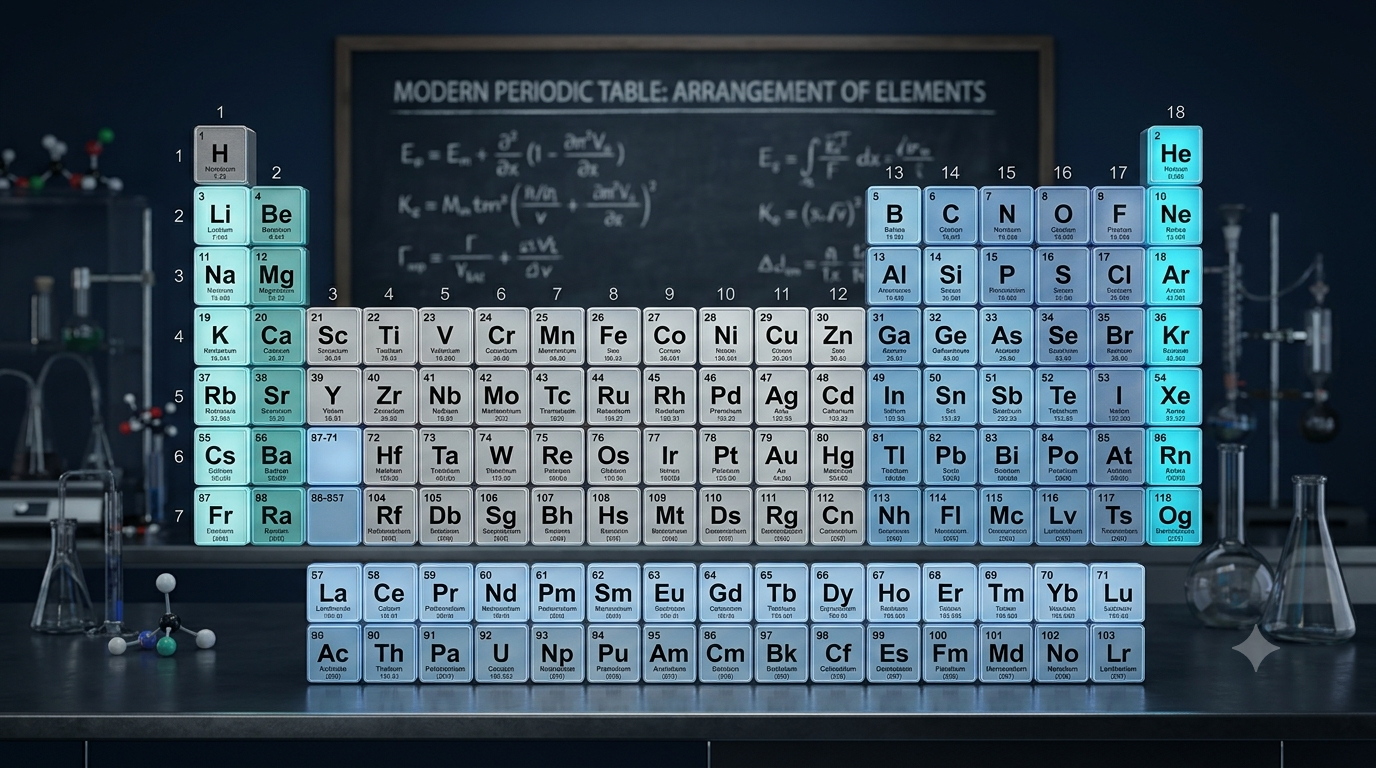
The modern periodic table is one of the most important tools in chemistry. It organizes all known chemical elements in a systematic way, making it easier to understand their properties, similarities, and differences. From hydrogen, the lightest element, to oganesson, one of the heaviest known elements, every element has a specific position in the periodic table.
The arrangement of elements is not random. It is based mainly on their atomic numbers, which represent the number of protons present in the nucleus of an atom. Elements are arranged in increasing order of atomic number, forming horizontal rows called periods and vertical columns called groups.
This arrangement helps scientists identify patterns in chemical and physical properties. It also explains why elements belonging to the same group often behave similarly during chemical reactions.
In this article, we will learn how elements are arranged in the modern periodic table, understand its periods, groups, blocks, and major sections, and explore why this arrangement is important in chemistry.
1. What Is the Modern Periodic Table?
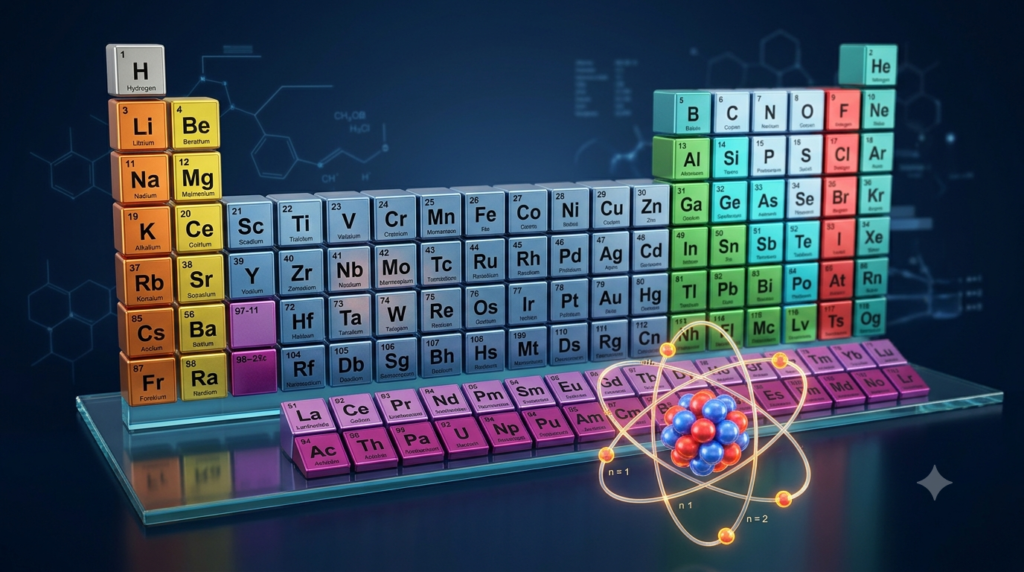
The modern periodic table is a systematic arrangement of chemical elements in increasing order of their atomic numbers.
It is based on the modern periodic law, which states:
The physical and chemical properties of elements are periodic functions of their atomic numbers.
This means that when elements are arranged according to increasing atomic number, their properties repeat in a regular pattern after certain intervals.
The modern periodic table contains 118 officially recognized elements. Each element occupies a particular position according to its atomic number and electronic configuration.
For example:
Hydrogen (H) has atomic number 1.
Helium (He) has atomic number 2.
Lithium (Li) has atomic number 3.
Carbon (C) has atomic number 6.
Oxygen (O) has atomic number 8.
Iron (Fe) has atomic number 26.
The arrangement makes it possible to study elements in an organized way instead of memorizing their properties individually.
2. Basis of Arrangement of Elements
The most important principle behind the modern periodic table is the increasing order of atomic number.
Atomic number is the number of protons present in the nucleus of an atom. It is represented by the letter Z.
For a neutral atom, the number of electrons is equal to the number of protons.
For example, sodium has an atomic number of 11. This means that every sodium atom contains 11 protons and, in its neutral state, 11 electrons.
Similarly, magnesium has an atomic number of 12, so it contains 12 protons and 12 electrons in a neutral atom.
Therefore, sodium is placed before magnesium in the modern periodic table.
The atomic number determines the electronic configuration of an element, which plays an important role in its chemical behaviour. This is why arranging elements according to atomic number produces a meaningful pattern in their properties.
3. Horizontal Rows Called Periods
The modern periodic table contains seven horizontal rows. These rows are known as periods.
Elements in a period are arranged from left to right in increasing order of atomic number.
As we move across a period, the atomic number increases by one from one element to the next.
The seven periods contain different numbers of elements.
| Period | Number of Elements | First Element | Last Element |
|---|---|---|---|
| 1st Period | 2 | Hydrogen | Helium |
| 2nd Period | 8 | Lithium | Neon |
| 3rd Period | 8 | Sodium | Argon |
| 4th Period | 18 | Potassium | Krypton |
| 5th Period | 18 | Rubidium | Xenon |
| 6th Period | 32 | Caesium | Radon |
| 7th Period | 32 | Francium | Oganesson |
Each period represents the filling of a new principal electron shell in the general electronic structure of elements.
3.1 First Period
The first period is the shortest period and contains only two elements:
Hydrogen (H)
Helium (He)
These elements have electrons in the first and innermost shell.
Hydrogen has one electron, while helium has two electrons. The first shell can hold a maximum of two electrons, which explains why the first period contains only two elements.
3.2 Second Period
The second period contains eight elements, from lithium (Li) to neon (Ne).
These elements have electrons occupying the second principal shell.
The period begins with lithium, an alkali metal, and ends with neon, a noble gas.
3.3 Third Period
The third period also contains eight elements, from sodium (Na) to argon (Ar).
It includes metals, a metalloid, and non-metals.
Sodium and magnesium are metals, silicon is a metalloid, and phosphorus, sulfur, chlorine, and argon belong to the non-metallic side of the periodic table.
3.4 Fourth Period
The fourth period contains 18 elements, from potassium (K) to krypton (Kr).
It includes the first series of transition elements, such as scandium, titanium, iron, copper, and zinc.
These elements show a wide variety of physical and chemical properties.
3.5 Fifth Period
The fifth period also contains 18 elements, from rubidium (Rb) to xenon (Xe).
It includes elements such as silver, tin, iodine, and several transition metals.
3.6 Sixth Period
The sixth period contains 32 elements, from caesium (Cs) to radon (Rn).
It includes the lanthanide series, which is usually displayed separately at the bottom of the periodic table to make the table more compact.
3.7 Seventh Period
The seventh period also contains 32 positions, from francium (Fr) to oganesson (Og).
It includes the actinide series, which is also displayed separately below the main body of the table.
Many elements in this period are radioactive, and several are produced artificially in laboratories.
4. Vertical Columns Called Groups
The modern periodic table contains 18 vertical columns, known as groups.
Elements in the same group often have similar chemical properties because they generally have similar outermost electron configurations.
For example, lithium, sodium, and potassium belong to Group 1. These elements are highly reactive metals and commonly form ions with a positive charge of +1.
Similarly, fluorine, chlorine, and bromine belong to Group 17. They are known as halogens and commonly form ions with a negative charge of −1.
The 18 groups are numbered from 1 to 18.
4.1 Group 1 – Alkali Metals
Group 1 contains hydrogen, lithium, sodium, potassium, rubidium, caesium, and francium.
Hydrogen is placed in Group 1 because it has one electron in its outermost shell. However, it is a non-metal and does not have the same chemical properties as alkali metals.
The other elements in this group are known as alkali metals.
They are generally soft, highly reactive metals and tend to lose one electron to form positive ions.
Examples: Lithium (Li), Sodium (Na), and Potassium (K).
4.2 Group 2 – Alkaline Earth Metals
Group 2 contains beryllium, magnesium, calcium, strontium, barium, and radium.
These elements have two electrons in their outermost shell and commonly form ions with a +2 charge.
They are metallic elements and are generally less reactive than Group 1 alkali metals.
Examples: Magnesium (Mg) and Calcium (Ca).
4.3 Groups 3 to 12 – Transition Metals
Groups 3 to 12 mainly contain transition metals.
These elements are generally hard, strong, and good conductors of heat and electricity.
Many transition metals show variable oxidation states and form coloured compounds.
Examples include:
Iron (Fe)
Copper (Cu)
Nickel (Ni)
Chromium (Cr)
Silver (Ag)
Gold (Au)
Transition metals are widely used in construction, electrical equipment, machinery, jewellery, and industrial manufacturing.
4.4 Group 13 – Boron Group
Group 13 contains boron, aluminium, gallium, indium, thallium, and nihonium.
These elements have three electrons in their outermost p and s orbitals combined.
Aluminium is one of the most widely used elements in this group. It is used in aircraft, vehicles, packaging, and construction materials.
4.5 Group 14 – Carbon Group
Group 14 contains carbon, silicon, germanium, tin, lead, and flerovium.
These elements have four electrons in their outermost shell.
Carbon is essential for life because it forms the backbone of many organic compounds. Silicon is important in electronics and semiconductor technology.
4.6 Group 15 – Nitrogen Group
Group 15 contains nitrogen, phosphorus, arsenic, antimony, bismuth, and moscovium.
These elements have five electrons in their outermost shell.
Nitrogen is a major component of Earth’s atmosphere, while phosphorus is important for living organisms and agricultural fertilizers.
4.7 Group 16 – Oxygen Group
Group 16 is also known as the oxygen family or chalcogens.
It contains oxygen, sulfur, selenium, tellurium, polonium, and livermorium.
These elements generally have six electrons in their outermost shell.
Oxygen is essential for respiration in many living organisms, while sulfur is used in several industrial and chemical processes.
4.8 Group 17 – Halogens
Group 17 contains fluorine, chlorine, bromine, iodine, astatine, and tennessine.
These elements are known as halogens.
They generally have seven electrons in their outermost shell and tend to gain one electron to achieve a stable electronic configuration.
Halogens are highly reactive non-metals, although their reactivity varies within the group.
Examples: Fluorine (F), Chlorine (Cl), and Iodine (I).
4.9 Group 18 – Noble Gases
Group 18 contains helium, neon, argon, krypton, xenon, radon, and oganesson.
These elements are called noble gases.
They have filled outer electron shells, making them generally very unreactive compared with most other elements.
Helium is used in balloons, neon is used in lighting, and argon is commonly used in welding.
5. Four Blocks of the Modern Periodic Table
Another important way to understand the arrangement of elements is by dividing the periodic table into four blocks.
These blocks are named according to the type of atomic orbital into which the last electron enters.
The four blocks are:
s-block
p-block
d-block
f-block
This classification is based on the electronic configuration of elements.
5.1 s-Block Elements
The s-block is located on the left side of the periodic table.
It mainly includes Groups 1 and 2, along with helium based on its electronic configuration.
In these elements, the last electron enters an s-orbital.
The general electronic configuration of the s-block is:
ns¹–²
Examples:
Hydrogen (H)
Lithium (Li)
Sodium (Na)
Magnesium (Mg)
Calcium (Ca)
The s-block contains highly reactive metals, except for hydrogen and helium, which have different chemical characteristics.
5.2 p-Block Elements
The p-block is located on the right side of the periodic table.
It includes Groups 13 to 18, except that helium is classified by its electronic configuration as an s-block element.
The last electron enters a p-orbital.
The general electronic configuration is:
ns² np¹–⁶
Examples:
Carbon (C)
Nitrogen (N)
Oxygen (O)
Fluorine (F)
Neon (Ne)
Chlorine (Cl)
The p-block contains metals, non-metals, metalloids, and noble gases.
5.3 d-Block Elements
The d-block is located in the middle of the periodic table and includes Groups 3 to 12.
The last electron generally enters a d-orbital.
The general electronic configuration is:
(n−1)d¹–¹⁰ ns⁰–²
Examples:
Iron (Fe)
Copper (Cu)
Zinc (Zn)
Silver (Ag)
Gold (Au)
Most d-block elements are transition metals. They are important in industrial applications, construction, electrical equipment, and chemical reactions.
5.4 f-Block Elements
The f-block is displayed in two separate rows at the bottom of the periodic table.
It contains two series:
Lanthanides
Actinides
The last electron generally enters an f-orbital.
The general electronic configuration is:
(n−2)f¹–¹⁴ (n−1)d⁰–¹ ns²
Examples of lanthanides include cerium, neodymium, and europium.
Examples of actinides include thorium, uranium, and plutonium.
Many actinides are radioactive, and several are important in nuclear science and technology.
6. Lanthanides and Actinides
The lanthanides and actinides are two special series of elements placed separately below the main body of the periodic table.
They are known as inner transition elements because their differentiating electrons generally enter f-orbitals.
6.1 Lanthanide Series
The lanthanide series is commonly shown as the first separate row at the bottom of the periodic table.
It extends from lanthanum (La) to lutetium (Lu) in the conventional 15-element series.
Lanthanides are often called rare-earth elements, although some are relatively abundant in Earth’s crust.
They have similar chemical properties and are used in:
Electronic devices
Powerful permanent magnets
Glass manufacturing
Special lighting systems
Modern technological equipment
6.2 Actinide Series
The actinide series is displayed in the second separate row below the main periodic table.
It extends from actinium (Ac) to lawrencium (Lr).
Most actinides are radioactive, and several are produced artificially.
Important actinides include uranium and plutonium, which are used in nuclear technology.
The separate placement of these two series keeps the periodic table compact and easier to read.
7. Metals, Non-Metals, and Metalloids
The modern periodic table can also be divided into three broad categories based on the physical and chemical properties of elements.
These categories are metals, non-metals, and metalloids.
7.1 Metals
Most elements in the periodic table are metals.
They are mainly located on the left side and in the centre of the table.
Common properties of metals include:
Good electrical conductivity
Good thermal conductivity
Metallic lustre
Malleability
Ductility
Examples include iron, copper, aluminium, gold, and silver.
Metals are widely used in buildings, vehicles, electrical equipment, tools, and machinery.
7.2 Non-Metals
Non-metals are mainly located on the upper right side of the periodic table, along with hydrogen.
They generally have properties different from metals.
Common characteristics include:
Poor electrical conductivity in many cases
Lack of metallic lustre
Brittle nature when solid
A tendency to gain or share electrons in chemical reactions
Examples include oxygen, nitrogen, carbon, sulfur, and chlorine.
Non-metals are essential in biological processes, environmental systems, and chemical industries.
7.3 Metalloids
Metalloids are elements that show a mixture of metallic and non-metallic properties.
They are generally found along the zigzag or staircase boundary separating metals and non-metals.
Commonly recognized metalloids include:
Boron (B)
Silicon (Si)
Germanium (Ge)
Arsenic (As)
Antimony (Sb)
Tellurium (Te)
Their electrical properties make some of them useful in semiconductor technology.
Silicon, for example, is widely used in computer chips, solar cells, and electronic devices.
8. How Electronic Configuration Determines the Position of an Element
The electronic configuration of an element describes how its electrons are distributed among different shells and orbitals.
It plays a major role in determining the position of an element in the modern periodic table.
Three important features help identify an element’s position:
1. Period number: Generally, the period number corresponds to the highest occupied principal electron shell.
2. Group number: For many main-group elements, the number of valence electrons helps identify the group.
3. Block: The block is determined by the type of orbital receiving the differentiating electron.
For example, consider sodium.
Its atomic number is 11, and its electronic configuration is:
1s² 2s² 2p⁶ 3s¹
From this configuration:
The highest occupied shell is the third shell, so sodium belongs to Period 3.
It has one outermost electron, so it belongs to Group 1.
Its last electron enters an s-orbital, so it belongs to the s-block.
Now consider chlorine.
Its atomic number is 17, and its electronic configuration is:
1s² 2s² 2p⁶ 3s² 3p⁵
From this configuration:
The highest occupied shell is the third shell, so chlorine belongs to Period 3.
It has seven valence electrons, so it belongs to Group 17.
Its last electron enters a p-orbital, so it belongs to the p-block.
Thus, electronic configuration provides a scientific explanation for the arrangement of elements.
9. Why Do Elements in the Same Group Have Similar Properties?
Elements in the same group often have similar chemical properties because they generally have similar outermost electron configurations.
The outermost electrons, called valence electrons, play an important role in chemical bonding and reactions.
For example, lithium, sodium, and potassium all belong to Group 1.
Each has one electron in its outermost shell. They commonly lose this electron during chemical reactions and form ions with a +1 charge.
Similarly, fluorine, chlorine, and bromine belong to Group 17.
Each has seven valence electrons and commonly gains one electron to form a negative ion with a −1 charge.
This similarity in valence electron arrangement explains many of the repeating chemical properties observed within groups.
However, the properties of elements are not exactly identical. They change gradually as we move down a group.
10. Periodic Trends in the Modern Periodic Table
The arrangement of elements reveals several important patterns known as periodic trends.
These trends describe how particular properties change across periods and down groups.
10.1 Atomic Radius
Atomic radius refers to the approximate size of an atom.
Across a period, atomic radius generally decreases from left to right because the nuclear charge increases while electrons are added to the same principal shell.
Down a group, atomic radius generally increases because additional electron shells are added.
10.2 Ionization Energy
Ionization energy is the energy required to remove an electron from an isolated gaseous atom.
Across a period, ionization energy generally increases.
Down a group, it generally decreases because the outermost electrons are farther from the nucleus and experience greater shielding.
10.3 Electronegativity
Electronegativity describes the ability of an atom to attract shared electrons in a chemical bond.
It generally increases from left to right across a period and decreases down a group.
Fluorine is the most electronegative element.
10.4 Metallic Character
Metallic character describes the tendency of an element to lose electrons and form positive ions.
It generally decreases from left to right across a period.
It generally increases from top to bottom within a group.
These periodic trends help scientists predict the behaviour of elements and understand chemical reactions.
11. Why Is the Modern Periodic Table Important?
The modern periodic table is more than a chart containing the names and symbols of elements. It is an important scientific tool that helps organize and explain chemical information.
Its major advantages include:
1. Systematic classification: It arranges all known elements according to their atomic numbers, making the study of chemistry more organized.
2. Understanding chemical properties: Elements with similar electronic configurations are placed in the same groups, helping us identify similarities in their behaviour.
3. Predicting properties: The position of an element helps scientists estimate its chemical and physical properties.
4. Understanding electronic configuration: The table provides information about electron shells, valence electrons, and orbital filling.
5. Identifying periodic trends: It makes it easier to understand changes in atomic size, ionization energy, electronegativity, and metallic character.
6. Supporting scientific research: Chemists use the periodic table in material science, medicine, environmental science, industrial chemistry, and the development of new substances.
The modern periodic table is therefore essential for both basic chemistry education and advanced scientific research.
12. Difference Between Periods and Groups
Periods and groups are the two main ways in which elements are arranged in the modern periodic table.
Although both describe the positions of elements, they have different characteristics.
| Basis | Periods | Groups |
|---|---|---|
| Arrangement | Horizontal rows | Vertical columns |
| Number | 7 | 18 |
| Direction | Left to right | Top to bottom |
| Main significance | Highest occupied principal shell | Similar outer electron configurations |
| Atomic number | Increases across a period | Increases down a group |
| Chemical properties | Change gradually across a period | Often show similarities within a group |
| Examples | Period 2: Li to Ne | Group 17: F, Cl, Br |
Understanding the difference between periods and groups makes it easier to locate elements and study their properties.
Conclusion
The modern periodic table arranges all known chemical elements in increasing order of atomic number. Its structure consists of seven horizontal periods and eighteen vertical groups, along with four major blocks: s-block, p-block, d-block, and f-block.
The position of an element is closely related to its electronic configuration, especially the arrangement of its outermost electrons. This explains why elements in the same group often show similar chemical properties and why several physical and chemical properties change regularly across periods and down groups.
By understanding how elements are arranged, we can identify their positions, compare their properties, and predict their chemical behaviour. The modern periodic table therefore provides a strong foundation for understanding chemistry and the relationships between different elements.
FAQs
1. What is the modern periodic table?
The modern periodic table is a systematic arrangement of chemical elements in increasing order of their atomic numbers. It contains 118 officially recognized elements arranged into seven horizontal rows called periods and eighteen vertical columns called groups. This arrangement helps scientists understand the similarities and differences between elements. Elements with similar outermost electron configurations are generally placed in the same group and often show similar chemical properties. The modern periodic table also provides information about atomic numbers, element symbols, electronic configurations, and periodic trends, making it an essential tool for studying chemistry.
2. On what basis are elements arranged in the modern periodic table?
Elements in the modern periodic table are arranged according to increasing atomic number. The atomic number represents the number of protons present in the nucleus of an atom. For example, hydrogen has atomic number 1, helium has atomic number 2, and lithium has atomic number 3. This arrangement follows the modern periodic law, which states that the physical and chemical properties of elements are periodic functions of their atomic numbers. Arranging elements in this way produces repeating patterns in their properties and helps explain their chemical behaviour and electronic configurations.
3. How many periods and groups are present in the modern periodic table?
The modern periodic table contains seven horizontal rows called periods and eighteen vertical columns called groups. Periods are numbered from 1 to 7, while groups are numbered from 1 to 18. The first period contains two elements, the second and third periods contain eight elements each, and the fourth and fifth periods contain eighteen elements each. The sixth and seventh periods have thirty-two positions each. Elements belonging to the same group generally have similar outermost electron configurations, while elements in the same period have electrons occupying the same highest principal shell.
4. Why do elements in the same group have similar chemical properties?
Elements in the same group generally have similar chemical properties because they have similar electronic configurations in their outermost shells. These outermost electrons are known as valence electrons and play an important role in chemical bonding and reactions. For example, lithium, sodium, and potassium belong to Group 1 and each has one valence electron. They commonly lose this electron to form positive ions with a +1 charge. Similarly, Group 17 elements generally have seven valence electrons and tend to gain one electron. However, chemical properties are not exactly identical and change gradually down a group.
5. What are the four blocks of the modern periodic table?
The modern periodic table is divided into four blocks based on the type of atomic orbital into which the differentiating electron enters. These are the s-block, p-block, d-block, and f-block. The s-block mainly includes Groups 1 and 2, while the p-block includes Groups 13 to 18, except helium. The d-block contains Groups 3 to 12 and mainly consists of transition metals. The f-block contains lanthanides and actinides, which are displayed separately at the bottom of the table. This classification helps explain the electronic configurations and chemical properties of different elements.
6. What is the difference between periods and groups?
Periods and groups represent the horizontal and vertical arrangements of elements in the modern periodic table. There are seven periods and eighteen groups. Elements in a period are arranged from left to right in increasing order of atomic number. The period generally indicates the highest occupied principal electron shell. Groups are vertical columns, and elements within the same group often have similar valence electron configurations and chemical properties. For example, sodium and potassium belong to Group 1, while fluorine and chlorine belong to Group 17. Both arrangements help classify elements and understand periodic trends.
7. What are transition elements in the periodic table?
Transition elements are generally the elements found in the d-block, located in the middle of the modern periodic table. They mainly occupy Groups 3 to 12. These elements are generally metals and often show variable oxidation states, form coloured compounds, and act as catalysts in chemical reactions. Examples include iron, copper, nickel, chromium, and silver. Transition elements have important applications in construction, electrical equipment, manufacturing, and industrial processes. Their special properties are mainly related to the involvement of d-electrons in chemical bonding and reactions.
8. Why are lanthanides and actinides placed separately at the bottom of the periodic table?
Lanthanides and actinides are placed separately at the bottom of the periodic table to keep its overall structure compact and easy to read. These two series belong to the f-block and are known as inner transition elements. The lanthanide series contains fifteen elements, commonly extending from lanthanum to lutetium, while the actinide series extends from actinium to lawrencium. Lanthanides are widely used in magnets, electronics, and specialised materials. Most actinides are radioactive, and some, such as uranium and plutonium, have important applications in nuclear science and technology.
9. How does electronic configuration determine the position of an element?
Electronic configuration helps determine the position of an element in the modern periodic table. The highest occupied principal electron shell generally identifies its period, while the number and arrangement of valence electrons help determine its group, particularly for main-group elements. The type of orbital receiving the differentiating electron determines its block. For example, sodium has the electronic configuration 1s² 2s² 2p⁶ 3s¹. Its highest occupied shell is the third shell, placing it in Period 3. It has one valence electron and belongs to Group 1 and the s-block.
10. Why is the modern periodic table important in chemistry?
The modern periodic table is important because it organizes chemical elements systematically and helps scientists understand their properties and behaviour. It makes it easier to identify elements, compare their characteristics, and predict how they may react with other substances. Its arrangement also helps explain periodic trends such as atomic radius, ionization energy, electronegativity, and metallic character. By studying an element’s position, scientists can understand important aspects of its electronic configuration and chemical properties. The periodic table is widely used in chemistry education, scientific research, material development, medicine, and various industrial applications.