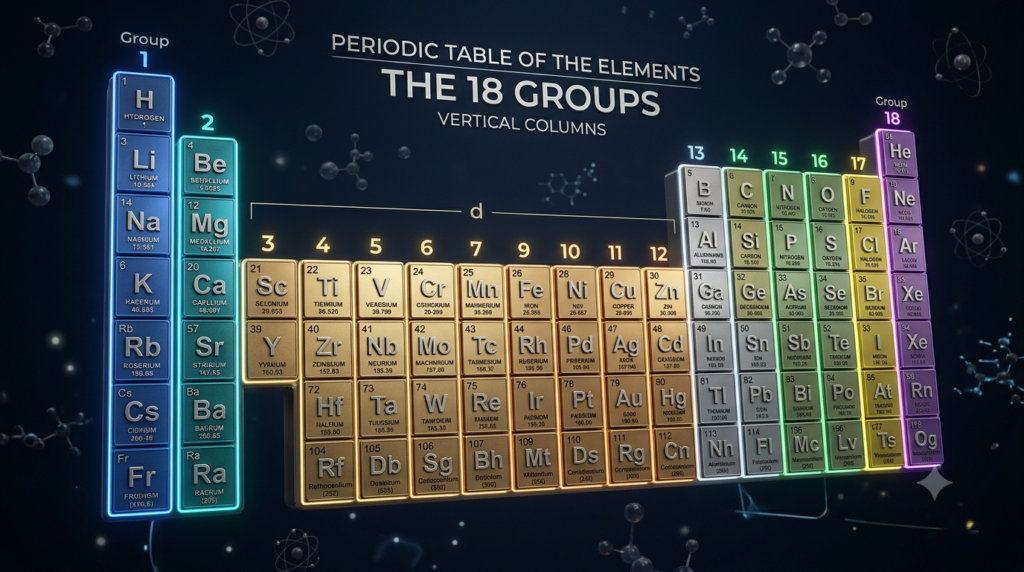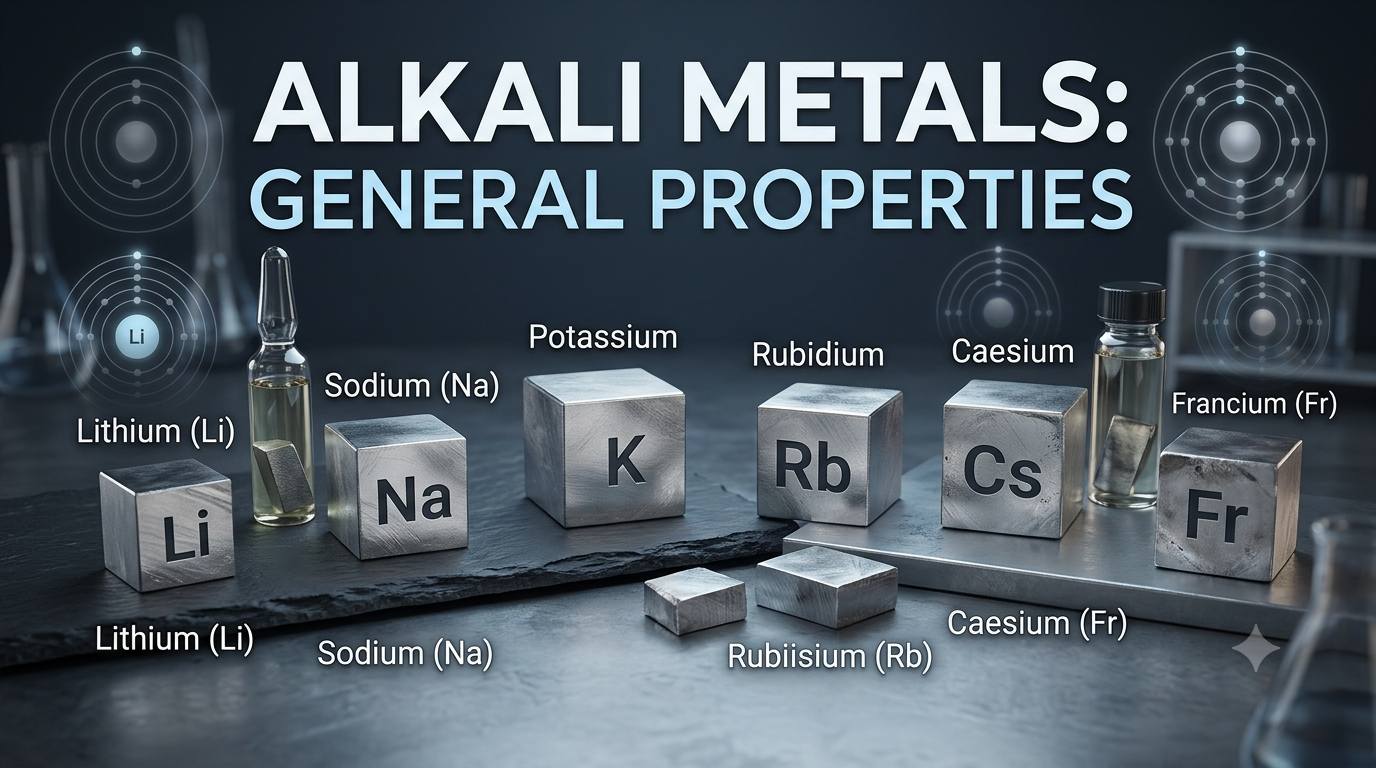
Alkali metals are a group of highly reactive metallic elements found in Group 1 of the periodic table. They include lithium, sodium, potassium, rubidium, caesium, and francium. These elements are known for their soft texture, low densities, relatively low melting points, and strong tendency to react with other substances, particularly water and oxygen.
Alkali metals play an important role in chemistry as well as in everyday life. Sodium and potassium are essential for the proper functioning of living organisms, lithium is widely used in rechargeable batteries, and caesium has applications in atomic clocks. Although these elements share several chemical properties, their reactivity and physical characteristics change gradually down the group.
Understanding alkali metals helps explain periodic trends, chemical bonding, the formation of ionic compounds, and the behaviour of elements in the periodic table.
What Are Alkali Metals?
Alkali metals are the chemical elements placed in Group 1 of the periodic table, excluding hydrogen. They are called alkali metals because they react with water to produce alkaline substances, also known as bases.
The six alkali metals are:
Lithium (Li)
Sodium (Na)
Potassium (K)
Rubidium (Rb)
Caesium (Cs)
Francium (Fr)
All alkali metals have one electron in their outermost electron shell. They readily lose this electron to form positively charged ions with a +1 charge.
For example:
Na → Na⁺ + e⁻
This tendency to lose their outermost electron is responsible for many of their common chemical properties.
Hydrogen is also placed in Group 1 because it has one electron in its outermost shell. However, it is a non-metal and does not normally behave like alkali metals. Therefore, it is not classified as an alkali metal.
Position of Alkali Metals in the Periodic Table
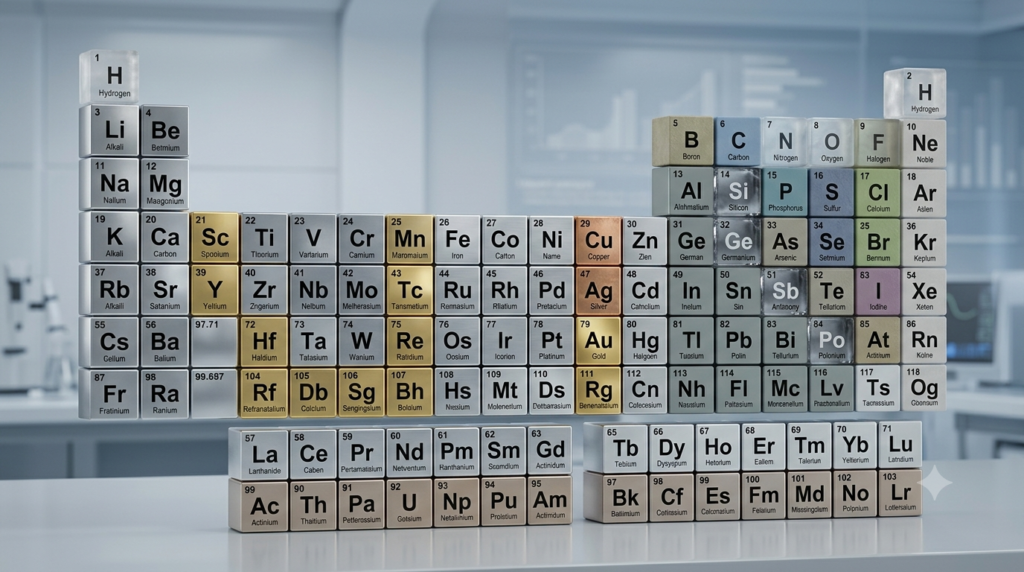
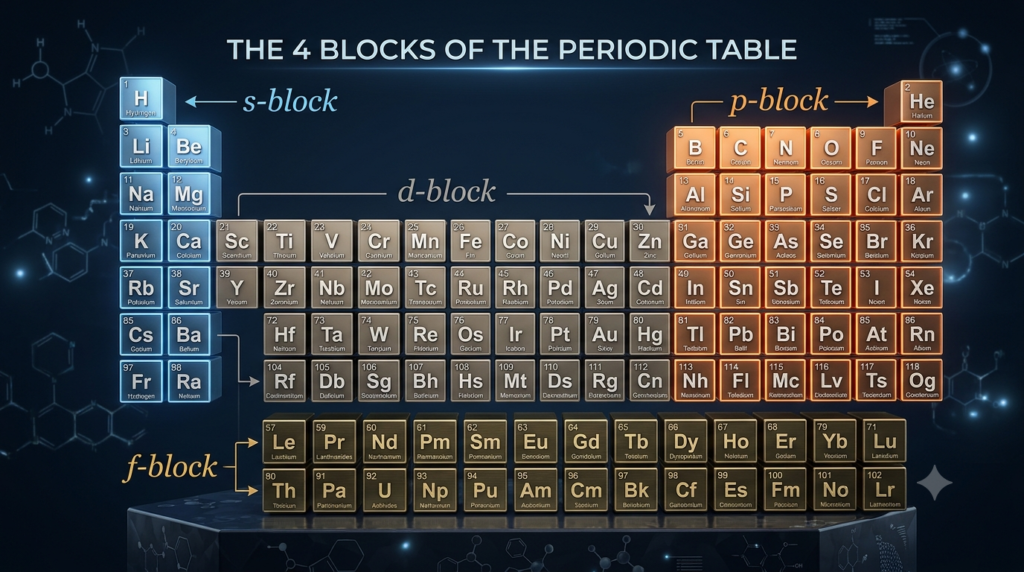
Alkali metals occupy the first column of the periodic table, immediately to the left of the alkaline earth metals in Group 2.
Their position is closely related to their electronic configuration. Each alkali metal has one electron in its outermost shell, which makes it relatively easy to lose that electron during chemical reactions.
Their general outer electronic configuration is:
ns¹
Here, n represents the principal energy level or outermost electron shell.
| Element | Symbol | Atomic Number | Electronic Configuration |
|---|---|---|---|
| Lithium | Li | 3 | 1s² 2s¹ |
| Sodium | Na | 11 | 1s² 2s² 2p⁶ 3s¹ |
| Potassium | K | 19 | [Ar] 4s¹ |
| Rubidium | Rb | 37 | [Kr] 5s¹ |
| Caesium | Cs | 55 | [Xe] 6s¹ |
| Francium | Fr | 87 | [Rn] 7s¹ |
The presence of a single valence electron explains why alkali metals generally form +1 ions and show similar chemical behaviour.
General Physical Properties of Alkali Metals
Alkali metals share several physical characteristics. However, some of these properties change regularly as we move down Group 1.
1. Softness
Alkali metals are generally soft metals. Unlike iron or copper, they can be cut easily with a knife.
Lithium, sodium, and potassium are particularly soft and can be cut to expose a fresh metallic surface.
Their softness is related to the relatively weak metallic bonding between their atoms. Each atom contributes only one valence electron to the metallic structure, resulting in comparatively weaker metallic bonding than in many other metals.
Softness generally increases down the group.
2. Low Density
Most alkali metals have relatively low densities compared with many other metals.
Lithium, sodium, and potassium are less dense than water and can float on its surface. However, this does not mean that they are safe to handle in water because they react vigorously with it.
The density of alkali metals does not increase perfectly regularly down the group. For example, potassium is less dense than sodium.
3. Low Melting and Boiling Points
Alkali metals have relatively low melting and boiling points compared with most other metals.
For example, lithium melts at approximately 180.5°C, while caesium melts at approximately 28.4°C.
Melting points generally decrease as we move down Group 1.
This happens because the metallic bonding becomes weaker as the size of the atoms increases. Less energy is therefore required to separate the atoms from their metallic structure.
4. Silvery Appearance
Freshly cut alkali metals usually have a shiny, silvery appearance.
However, their surfaces quickly become dull when exposed to air because they react with oxygen and moisture.
Lithium, sodium, and potassium are commonly stored under suitable mineral oil or another protective medium to reduce their contact with air and moisture.
5. Good Conductors of Heat and Electricity
Like other metals, alkali metals conduct heat and electricity.
Their ability to conduct electricity is due to the presence of mobile electrons within their metallic structure.
These electrons can move through the metal and carry electrical charge.
6. Relatively Large Atomic Size
Alkali metals have relatively large atomic sizes compared with other elements in the same period.
Their atomic radius increases down the group because each successive element has an additional electron shell.
For example, lithium has fewer electron shells than sodium, while potassium has more than sodium.
As the number of electron shells increases, the outermost electron becomes farther from the nucleus.
General Chemical Properties of Alkali Metals
Alkali metals are among the most reactive metallic elements. Their chemical behaviour is mainly determined by their single valence electron.
1. Formation of Positive Ions
Every alkali metal has one electron in its outermost shell.
They tend to lose this electron to achieve a more stable electronic configuration.
As a result, they form positively charged ions called cations.
General reaction:
M → M⁺ + e⁻
Here, M represents an alkali metal.
For example:
Li → Li⁺ + e⁻
Na → Na⁺ + e⁻
K → K⁺ + e⁻
The formation of +1 ions is one of the most important chemical characteristics of alkali metals.
2. Reaction with Water
Alkali metals react with water to produce metal hydroxides and hydrogen gas.
The general reaction is:
2M + 2H₂O → 2MOH + H₂
For example, sodium reacts with water to form sodium hydroxide and hydrogen gas.
2Na + 2H₂O → 2NaOH + H₂
The metal hydroxides produced are soluble in water and form alkaline solutions.
The reaction becomes increasingly vigorous as we move down the group.
Lithium reacts relatively slowly with cold water, sodium reacts more vigorously, and potassium reacts even more violently. The heavier alkali metals react extremely vigorously.
These reactions can release enough heat to ignite the hydrogen gas produced.
3. Reaction with Oxygen
Alkali metals react readily with oxygen in the air.
However, the type of oxide formed depends on the metal.
Lithium generally forms lithium oxide:
4Li + O₂ → 2Li₂O
Sodium commonly forms sodium peroxide:
2Na + O₂ → Na₂O₂
Potassium, rubidium, and caesium can form superoxides under suitable conditions.
For example:
K + O₂ → KO₂
These differences demonstrate how the chemical behaviour of alkali metals changes down the group.
4. Reaction with Halogens
Alkali metals react readily with halogens to form ionic compounds called metal halides.
Halogens include fluorine, chlorine, bromine, iodine, and astatine.
For example, sodium reacts with chlorine to form sodium chloride, commonly known as table salt.
2Na + Cl₂ → 2NaCl
Similarly, lithium reacts with chlorine to produce lithium chloride.
2Li + Cl₂ → 2LiCl
These compounds contain positively charged alkali metal ions and negatively charged halide ions.
5. Reaction with Hydrogen
Alkali metals react with hydrogen under suitable conditions to form metal hydrides.
For example:
2Na + H₂ → 2NaH
Sodium hydride is an ionic compound containing sodium ions and hydride ions.
Similarly, lithium reacts with hydrogen to form lithium hydride.
LiH is an important example of an alkali metal hydride.
6. Reaction with Acids
Alkali metals can react with acids to produce salts and hydrogen gas.
For example:
2Na + 2HCl → 2NaCl + H₂
However, these reactions can be extremely violent and dangerous. Alkali metals are not normally tested with acids in ordinary laboratory demonstrations because of the risk of fire and explosions.
Trends in Alkali Metals Down the Group
The physical and chemical properties of alkali metals show several important periodic trends.
1. Atomic Radius Increases
Atomic radius increases from lithium to francium.
This happens because each successive element has an additional electron shell. The outermost electron is located farther from the nucleus.
2. Ionisation Energy Decreases
Ionisation energy is the energy required to remove an electron from an isolated gaseous atom.
As we move down Group 1, the outermost electron becomes farther from the nucleus and experiences greater shielding from inner electrons.
Therefore, less energy is generally required to remove it.
This is why ionisation energy decreases down the group.
3. Reactivity Increases
The reactivity of alkali metals generally increases down the group.
Because the outermost electron becomes easier to remove, heavier alkali metals lose their valence electron more readily.
Consequently, they react more vigorously with substances such as water and halogens.
The general order of increasing reactivity is:
Li < Na < K < Rb < Cs < Fr
Francium is extremely rare and radioactive, so its chemical properties are not as extensively studied as those of the other alkali metals.
4. Melting Points Decrease
The melting points of alkali metals generally decrease down the group.
As atomic size increases, metallic bonding becomes weaker, making it easier to melt the metal.
5. Electropositive Character Increases
Electropositive character refers to the tendency of an element to lose electrons and form positive ions.
Alkali metals are highly electropositive, and this tendency generally increases down the group.
This is closely related to the decrease in ionisation energy.
6. Hydration Enthalpy Decreases in Magnitude
Hydration enthalpy is the energy released when gaseous ions become surrounded by water molecules.
As the size of alkali metal ions increases down the group, their charge density decreases.
Consequently, the magnitude of their hydration enthalpy generally decreases.
Why Are Alkali Metals Highly Reactive?
The high reactivity of alkali metals is mainly due to their electronic configuration.
Each alkali metal has only one electron in its outermost shell. Losing this electron allows the atom to achieve a more stable electronic configuration.
The energy required to remove this electron is relatively low compared with many other elements.
As a result, alkali metals readily participate in chemical reactions.
Their reactivity also increases down the group because the outermost electron becomes farther from the nucleus and is more easily removed.
This explains why potassium reacts more vigorously with water than sodium, while sodium reacts more vigorously than lithium.
Occurrence of Alkali Metals in Nature
Alkali metals are highly reactive, so they are generally not found in nature in their pure metallic form.
Instead, they occur mainly as compounds in minerals, rocks, and natural deposits.
Some important examples include:
Lithium: Found in minerals such as spodumene and in certain underground brines.
Sodium: Found in common salt deposits, seawater, and minerals such as halite.
Potassium: Found in minerals such as sylvite and carnallite.
Rubidium: Found in certain minerals, including lepidolite.
Caesium: Found mainly in the mineral pollucite.
Francium: Occurs naturally in extremely small quantities as a radioactive decay product in certain uranium and actinium decay series.
Because of their high reactivity, alkali metals are generally extracted from their compounds using suitable chemical and electrochemical methods.
Uses and Applications of Alkali Metals
Alkali metals have many important applications in science, industry, medicine, and modern technology.
1. Lithium
Lithium is widely used in rechargeable lithium-ion batteries.
These batteries power mobile phones, laptops, electric vehicles, and many portable electronic devices.
Lithium compounds are also used in glass and ceramic manufacturing and in certain industrial applications.
2. Sodium
Sodium has several industrial applications.
Metallic sodium is used as a reducing agent in certain chemical processes and in some specialized heat-transfer systems.
Sodium compounds are even more widely used. Sodium chloride is common table salt, sodium bicarbonate is used in baking, and sodium hydroxide is important in soap and paper manufacturing.
3. Potassium
Potassium is essential for plant growth and is a major component of many agricultural fertilizers.
Potassium compounds are also used in glass manufacturing, chemical industries, and laboratory applications.
Potassium ions are important for nerve signalling, muscle contraction, and maintaining normal cellular functions in living organisms.
4. Rubidium
Rubidium has specialized applications in scientific research and electronics.
Rubidium atomic clocks are used in certain timing and frequency-control systems.
Rubidium is also used in research involving atomic physics and quantum technologies.
5. Caesium
Caesium is especially important in timekeeping technology.
Caesium atomic clocks provide highly accurate measurements of time and are used in scientific and technological systems.
Caesium compounds also have applications in specialized industrial and research processes.
6. Francium
Francium has very limited practical applications because it is extremely rare and highly radioactive.
Its short-lived isotopes make it difficult to collect and use in ordinary industrial applications.
It is mainly important for scientific research into atomic structure and radioactive decay.
Biological Importance of Alkali Metals
Some alkali metals are essential for living organisms.
Sodium and potassium are particularly important because they help maintain the balance of fluids and electrical activity in cells.
Role of Sodium in the Human Body
Sodium ions help regulate fluid balance and blood volume.
They also play an important role in nerve impulse transmission and muscle function.
The movement of sodium ions across cell membranes helps generate electrical signals that allow nerve cells to communicate.
Role of Potassium in the Human Body
Potassium is the major positively charged ion inside most human cells.
It is essential for maintaining normal cell function, supporting nerve signals, and controlling muscle contractions.
It also contributes to maintaining a normal heartbeat.
Although sodium and potassium are necessary for the body, maintaining an appropriate balance is important for good health.
Differences Between Alkali Metals and Alkaline Earth Metals
Alkali metals and alkaline earth metals are two important groups of the periodic table. Although both are reactive metals, they differ in several ways.
| Property | Alkali Metals | Alkaline Earth Metals |
|---|---|---|
| Group | Group 1 | Group 2 |
| Valence electrons | 1 | 2 |
| General configuration | ns¹ | ns² |
| Common ionic charge | +1 | +2 |
| Reactivity | Generally very high | Generally lower than Group 1 |
| Hardness | Usually very soft | Generally harder |
| Melting points | Generally low | Generally higher |
| Reaction with water | Usually vigorous | Varies considerably |
| Examples | Lithium, Sodium, Potassium | Beryllium, Magnesium, Calcium |
The main difference is the number of valence electrons. Alkali metals have one valence electron, while alkaline earth metals have two.
This difference influences their ion formation, bonding, and chemical reactivity.
Important Safety Precautions
Alkali metals require careful handling because of their high chemical reactivity.
Some important precautions include:
Never touch alkali metals with bare hands.
Never add alkali metals to water as an ordinary experiment.
Keep them away from moisture and incompatible substances.
Store them under suitable protective conditions, such as mineral oil when appropriate.
Handle them only in properly equipped laboratories under trained supervision.
Use suitable protective equipment when conducting authorized laboratory work.
The heavier alkali metals are particularly dangerous because of their vigorous reactions with water and air.
Conclusion
Alkali metals are an important group of elements in the periodic table, known for their single valence electron, high reactivity, softness, and tendency to form +1 ions. The group includes lithium, sodium, potassium, rubidium, caesium, and francium.
Although these elements share similar chemical properties, their characteristics change systematically down the group. Atomic size increases, ionisation energy decreases, melting points generally decrease, and chemical reactivity increases.
Alkali metals also have significant practical importance. Lithium is used in rechargeable batteries, sodium and potassium are essential for living organisms, and caesium plays an important role in precise timekeeping. Studying their general properties provides a useful foundation for understanding chemical reactions and periodic trends.
FAQs
1. What are alkali metals?
Alkali metals are the chemical elements found in Group 1 of the periodic table, excluding hydrogen. They include lithium, sodium, potassium, rubidium, caesium, and francium. These elements are highly reactive metals with one electron in their outermost shell. They readily lose this electron to form positively charged ions with a +1 charge. Alkali metals are generally soft, have relatively low melting points, and react with water to produce metal hydroxides and hydrogen gas. They are important in various applications, including rechargeable batteries, fertilizers, chemical manufacturing, and scientific research.
2. Why are they called alkali metals?
They are called alkali metals because they react with water to produce metal hydroxides, which are alkaline substances. These hydroxides dissolve in water and form basic solutions. For example, sodium reacts with water to produce sodium hydroxide and hydrogen gas. Sodium hydroxide is a strong base that gives the resulting solution alkaline properties. Similarly, potassium reacts with water to form potassium hydroxide. This characteristic reaction is the reason these elements are known as alkali metals.
3. Which elements belong to the alkali metal group?
There are six elements classified as alkali metals: lithium (Li), sodium (Na), potassium (K), rubidium (Rb), caesium (Cs), and francium (Fr). All these elements are located in Group 1 of the periodic table. They share similar chemical properties because each has one electron in its outermost shell. Hydrogen is also positioned in Group 1, but it is a non-metal and is not classified as an alkali metal. These six elements show different levels of reactivity, atomic size, and melting points as we move down the group.
4. Why are alkali metals highly reactive?
Alkali metals are highly reactive because they have only one electron in their outermost shell. They can easily lose this electron to achieve a more stable electronic configuration. The energy required to remove this electron is relatively low, making these elements highly reactive. They readily react with substances such as water, oxygen, and halogens. Their reactivity generally increases down Group 1 because the outermost electron becomes farther from the nucleus and is easier to remove. This explains why potassium reacts more vigorously with water than sodium and lithium.
5. Why do alkali metals form +1 ions?
Alkali metals form +1 ions because each element has one electron in its outermost shell. During chemical reactions, they tend to lose this electron to achieve a more stable electronic configuration. Losing one negatively charged electron leaves the atom with one more proton than electrons, resulting in a positive charge of +1. For example, sodium loses one electron to form a sodium ion (Na⁺), while lithium forms a lithium ion (Li⁺). This common tendency explains why alkali metals generally form ionic compounds with a +1 oxidation state.
6. What happens when alkali metals react with water?
When alkali metals react with water, they produce metal hydroxides and hydrogen gas. The metal hydroxides dissolve in water to form alkaline solutions. For example, sodium reacts with water to produce sodium hydroxide and hydrogen gas. The general chemical equation is 2M + 2H₂O → 2MOH + H₂. The reaction becomes increasingly vigorous down Group 1. Lithium reacts relatively slowly, sodium reacts more vigorously, and potassium reacts very violently. These reactions can release enough heat to ignite hydrogen gas, making alkali metals extremely dangerous to experiment with near water.
7. Why are alkali metals stored under oil?
Alkali metals are generally stored under suitable protective liquids, such as mineral oil, to prevent direct contact with air and moisture. They react readily with oxygen and water vapour present in the atmosphere. Exposure can cause their surfaces to become dull due to the formation of reaction products. More importantly, contact with moisture can cause vigorous reactions and may result in fire. Storing these metals under protective oil reduces their exposure to air and water, helping maintain their metallic properties and improving storage safety.
8. What happens to the reactivity of alkali metals down the group?
The reactivity of alkali metals generally increases as we move down Group 1 of the periodic table. This happens because atomic size increases and the outermost electron becomes farther from the nucleus. The attraction between the nucleus and this electron decreases, making it easier for the atom to lose its electron during chemical reactions. Therefore, lithium is less reactive than sodium, while potassium is more reactive than sodium. The general order of increasing reactivity is Li < Na < K < Rb < Cs < Fr. Francium’s properties are less extensively studied because of its extreme rarity and radioactivity.
9. What are the important uses of alkali metals?
Alkali metals have several important applications in modern technology and industry. Lithium is widely used in rechargeable batteries for mobile phones, laptops, and electric vehicles. Sodium is used in certain industrial chemical processes and specialized heat-transfer systems. Potassium compounds are important ingredients in agricultural fertilizers because potassium supports plant growth. Rubidium is used in scientific research and atomic clocks, while caesium is particularly important in highly accurate timekeeping systems. Francium has very limited practical applications because it is extremely rare and radioactive. These uses demonstrate the importance of alkali metals in science and technology.
10. What is the difference between alkali metals and alkaline earth metals?
Alkali metals belong to Group 1 of the periodic table, whereas alkaline earth metals belong to Group 2. Alkali metals have one valence electron and generally form +1 ions. Alkaline earth metals have two valence electrons and generally form +2 ions. Alkali metals are usually softer and more reactive than alkaline earth metals. They also tend to have lower melting points. Examples of alkali metals include lithium, sodium, and potassium, while magnesium, calcium, and beryllium are alkaline earth metals. Both groups are reactive metals, but their electronic configurations produce different chemical properties.