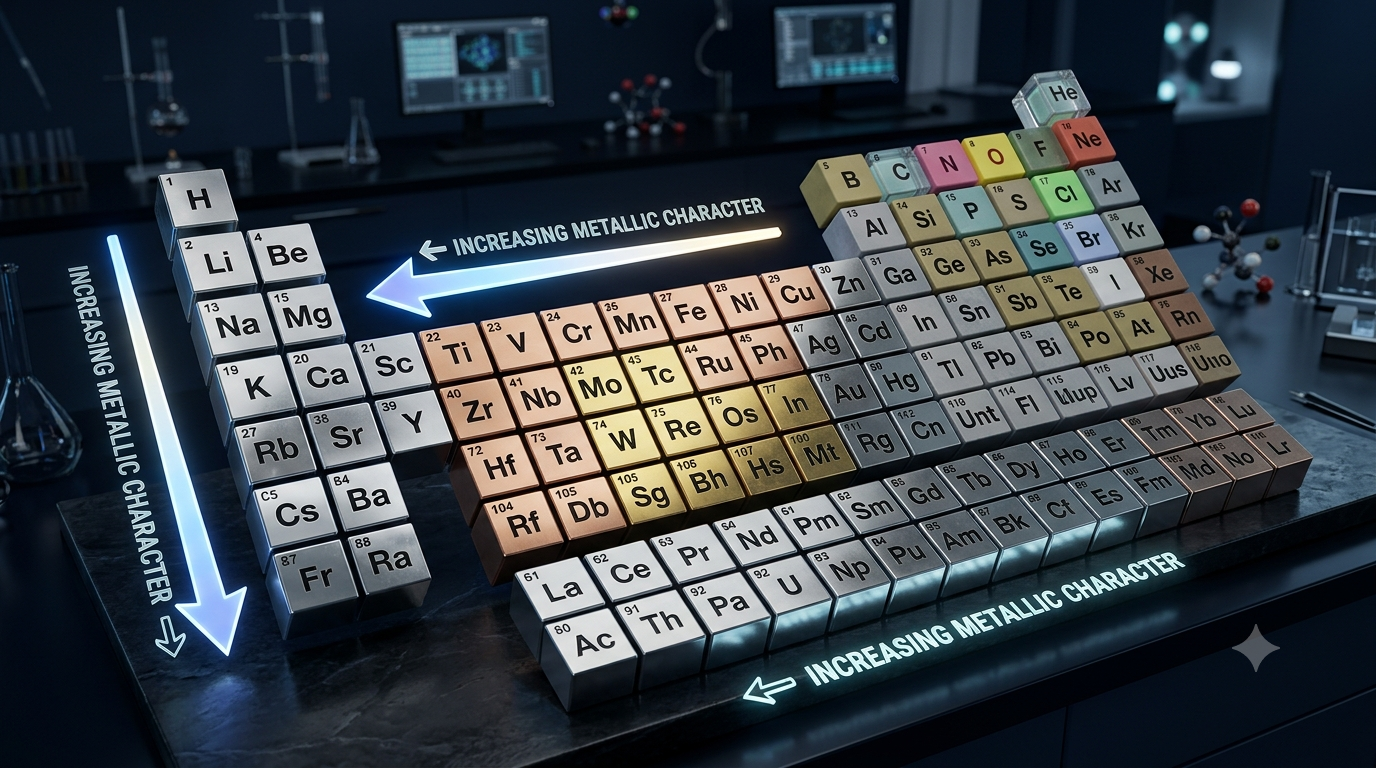
The periodic table organizes elements according to their atomic numbers and chemical properties. One of the important properties used to understand the behaviour of elements is metallic character. It explains how readily an atom loses electrons to form positive ions, also known as cations.
Metallic character is an essential concept in chemistry because it helps explain why some elements behave like metals while others behave like non-metals. It also helps us understand the chemical reactivity of elements, the formation of ionic compounds, and the periodic trends observed across the periodic table.
Elements such as sodium, potassium, magnesium, calcium, and iron show metallic properties because they can lose electrons relatively easily. In contrast, elements such as oxygen, nitrogen, chlorine, and fluorine generally tend to gain or share electrons rather than lose them.
Metallic character does not remain the same throughout the periodic table. It changes in a predictable manner as we move across a period and down a group. Understanding these changes makes it easier to study the relationship between atomic structure and chemical properties.
What Is Metallic Character?
Metallic character refers to the tendency of an element’s atoms to lose electrons and form positively charged ions (cations) during chemical reactions.
Metals generally have fewer electrons in their outermost shell and can lose these electrons to achieve a more stable electronic configuration.
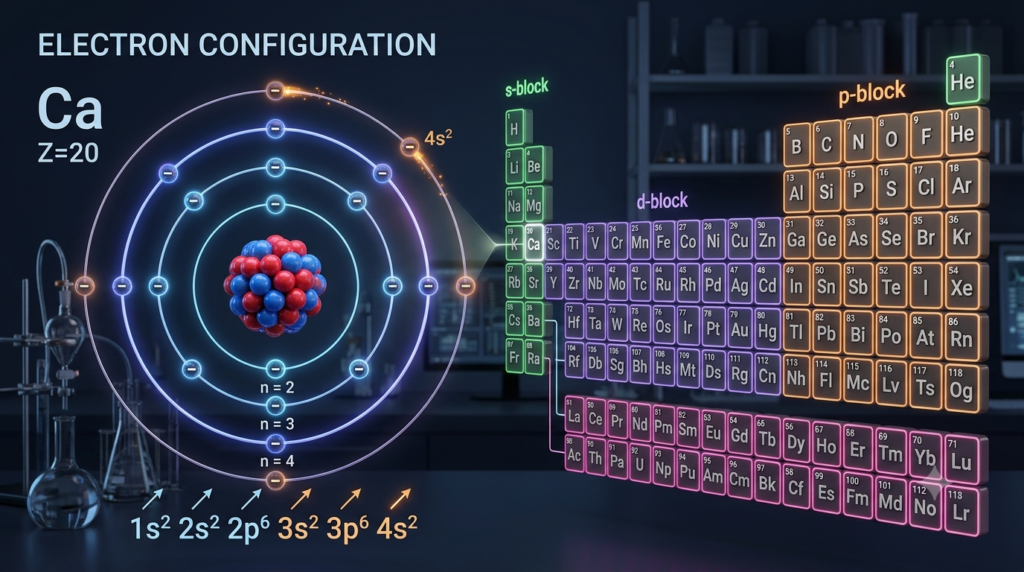
For example, sodium (Na) has an atomic number of 11 and the electronic configuration 2, 8, 1. It contains one electron in its outermost shell. Sodium can easily lose this electron to form a positively charged sodium ion.
Na → Na⁺ + e⁻
Similarly, magnesium (Mg) has the electronic configuration 2, 8, 2. It can lose two electrons to form a magnesium ion.
Mg → Mg²⁺ + 2e⁻
These examples demonstrate that metals generally show a tendency to lose electrons. The greater the tendency of an atom to lose electrons, the greater its metallic character.
Characteristics of Metallic Elements
Metallic elements possess several physical and chemical properties that distinguish them from non-metals.
1. Tendency to Lose Electrons
The most important chemical characteristic of metals is their tendency to lose electrons and form positive ions.
For example, potassium loses one electron to form K⁺, while calcium loses two electrons to form Ca²⁺.
2. Formation of Positive Ions
When a metal loses electrons, it becomes positively charged. Such positively charged particles are called cations.
For example:
Na → Na⁺ + e⁻
K → K⁺ + e⁻
Ca → Ca²⁺ + 2e⁻
3. Low Ionisation Energy
Most metals have relatively low ionisation energies. This means that less energy is generally required to remove an electron from their outermost shell.
As a result, metals can lose electrons more easily than many non-metals.
4. Good Conductors of Heat and Electricity
Most metals conduct heat and electricity efficiently because they contain mobile or delocalised electrons that can move through their metallic structure.
Copper, aluminium, silver, and gold are common examples of good electrical conductors.
5. Metallic Lustre
Many metals have a shiny surface known as metallic lustre. This property is particularly noticeable in freshly polished metal surfaces.
6. Malleability and Ductility
Most metals are malleable, meaning they can be beaten into thin sheets. They are also ductile, meaning they can be drawn into thin wires.
These physical properties are associated with metallic bonding and the arrangement of atoms in metallic structures.
Factors Affecting Metallic Character
Metallic character mainly depends on how easily an atom can lose its valence electrons. Several atomic properties influence this tendency.
1. Atomic Size
Atomic size refers to the distance between the nucleus and the outermost electron shell.
When atomic size increases, the outermost electrons are generally located farther from the nucleus. Therefore, the attractive force between the nucleus and these electrons becomes weaker.
As a result, electrons can be removed more easily, increasing metallic character.
For example, potassium has a larger atomic size than sodium. Therefore, potassium loses its outermost electron more easily under comparable conditions.
2. Ionisation Energy
Ionisation energy is the minimum energy required to remove the most loosely held electron from an isolated gaseous atom in its ground state.
A lower ionisation energy generally indicates a greater tendency to lose electrons.
Therefore:
Lower ionisation energy = Greater metallic character.
Higher ionisation energy = Lower metallic character.
For example, sodium has a lower first ionisation energy than chlorine. Hence, sodium shows greater metallic character.
3. Effective Nuclear Charge
Effective nuclear charge is the net positive charge experienced by an electron in an atom after considering the shielding effect of other electrons.
When effective nuclear charge increases, the nucleus attracts the electrons more strongly.
This makes electron removal more difficult and generally decreases metallic character.
4. Shielding Effect
The shielding effect occurs when inner-shell electrons reduce the attractive force exerted by the nucleus on outermost electrons.
A greater shielding effect generally makes valence electrons easier to remove.
This is one of the important reasons why metallic character increases down a group.
Periodic Trend of Metallic Character
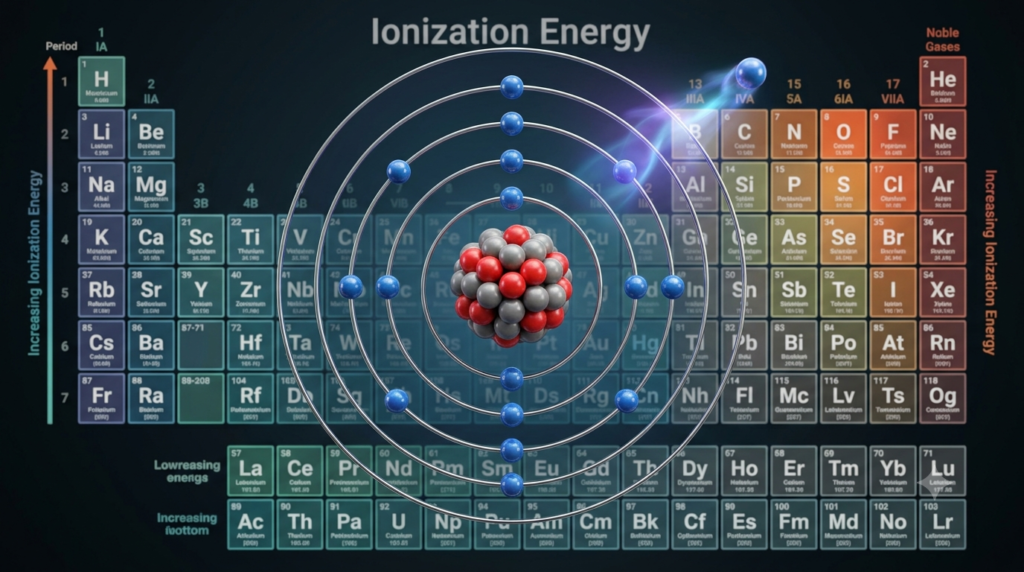
Metallic character follows a predictable pattern in the periodic table. It generally increases down a group and decreases from left to right across a period.
These trends are closely related to changes in atomic size, effective nuclear charge, and ionisation energy.
1. Metallic Character Across a Period
As we move from left to right across a period, metallic character generally decreases.
This happens because the nuclear charge increases as the atomic number increases. However, the additional electrons enter the same principal energy level.
The effective nuclear charge generally increases, causing the nucleus to attract the outermost electrons more strongly.
Consequently, atomic size generally decreases, and ionisation energy generally increases.
Therefore, atoms become less willing to lose electrons as we move from left to right across a period.
Consider the third period of the periodic table:
Na → Mg → Al → Si → P → S → Cl → Ar
Sodium is a highly electropositive metal, while magnesium and aluminium are also metals. Silicon is a metalloid, and phosphorus, sulphur, and chlorine are non-metals. Argon is a noble gas.
Thus, metallic character generally decreases from sodium towards chlorine.
General trend:
Metallic character decreases from left to right across a period.
2. Metallic Character Down a Group
As we move from top to bottom in a group, metallic character generally increases.
This happens because each successive element has an additional electron shell. Consequently, atomic size increases.
The outermost electrons become farther away from the nucleus and experience greater shielding from inner-shell electrons.
As a result, the attraction between the nucleus and the valence electrons generally becomes weaker. These electrons can be removed more easily.
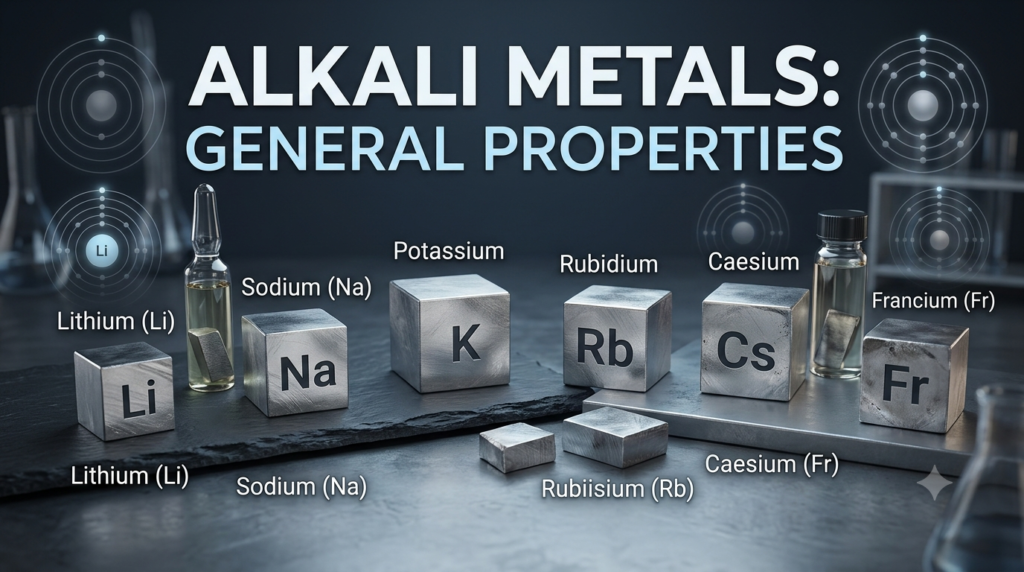
Consider Group 1 elements:
Li → Na → K → Rb → Cs → Fr
Lithium is a metal, but its metallic character is lower than that of sodium and potassium. As we move down the group, metallic character generally increases.
General trend:
Metallic character increases from top to bottom in a group.
Metallic Character in Different Regions of the Periodic Table
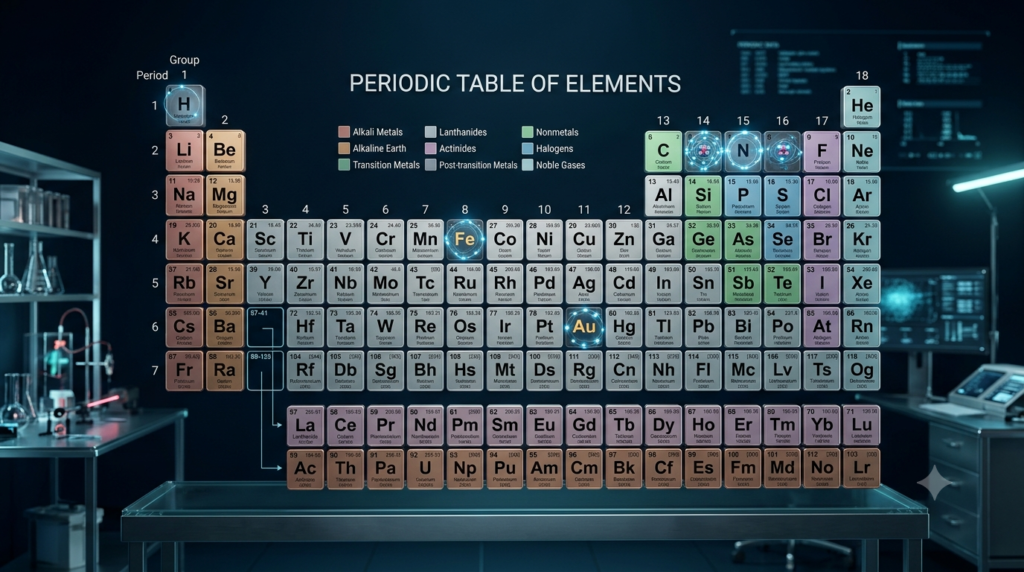
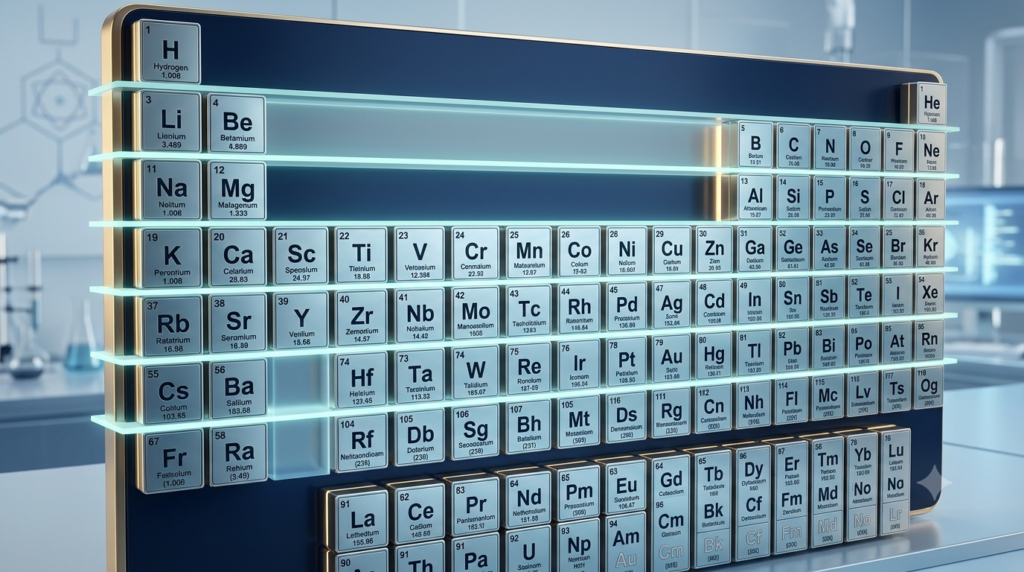
The periodic table contains metals, non-metals, and metalloids. Their positions help us understand the overall distribution of metallic character.
1. Metals
Metals are mainly found on the left side and in the centre of the periodic table.
They generally have a strong tendency to lose electrons and form positive ions.
Examples include:
Sodium (Na)
Potassium (K)
Magnesium (Mg)
Calcium (Ca)
Aluminium (Al)
Iron (Fe)
Copper (Cu)
Alkali metals and alkaline earth metals are particularly important groups of metallic elements.
2. Non-Metals
Non-metals are mainly found on the upper right side of the periodic table, with hydrogen as an exception because it is located on the left.
They generally have a lower tendency to lose electrons compared with metals.
Many non-metals tend to gain or share electrons during chemical reactions.
Examples include:
Oxygen (O)
Nitrogen (N)
Fluorine (F)
Chlorine (Cl)
Sulphur (S)
Carbon (C)
3. Metalloids
Metalloids are elements that show properties intermediate between metals and non-metals.
They are generally located along the zigzag or staircase boundary separating metals and non-metals.
Examples include:
Boron (B)
Silicon (Si)
Germanium (Ge)
Arsenic (As)
Antimony (Sb)
Tellurium (Te)
Metalloids are particularly important in semiconductor technology. Silicon and germanium, for example, are widely used in electronic devices.
Metallic Character and Non-Metallic Character
Metallic character and non-metallic character are generally opposite trends in the periodic table.
Metallic character describes the tendency to lose electrons, whereas non-metallic character describes the tendency to accept electrons or attract shared electrons in chemical bonding.
The major differences are:
| Property | Metallic Character | Non-Metallic Character |
|---|---|---|
| Electron behaviour | Tendency to lose electrons | Tendency to gain or attract electrons |
| Ion formation | Forms positive ions | Often forms negative ions |
| Ionisation energy | Generally low | Generally high |
| Electronegativity | Generally low | Generally high |
| Periodic trend across a period | Decreases | Generally increases |
| Periodic trend down a group | Increases | Generally decreases |
| Common examples | Na, Mg, Ca | O, F, Cl |
These are general trends, and exceptions can occur depending on the element and the chemical property being considered.
Relationship Between Metallic Character and Reactivity
Metallic character is closely related to the chemical reactivity of metals.
Metals generally react by losing electrons. Therefore, elements that can lose their valence electrons more easily often show greater metallic reactivity.
For example, alkali metals have one electron in their outermost shell. They can lose this electron to form stable positive ions.
The reactivity of alkali metals generally increases down Group 1:
Li < Na < K < Rb < Cs
Potassium is more reactive than sodium, while caesium is more reactive than potassium.
This trend is related to the increasing atomic size and decreasing first ionisation energy down the group.
However, metallic character and chemical reactivity are not exactly the same thing. Metallic character describes the tendency to lose electrons, while reactivity depends on several factors, including the type of reaction and the conditions involved.
Examples of Metallic Character Trends
Understanding examples makes periodic trends easier to remember.
Example 1: Sodium and Chlorine
Sodium and chlorine belong to the third period.
Sodium is located on the extreme left side, while chlorine is located towards the right side.
Sodium readily loses one electron to form Na⁺, whereas chlorine tends to gain one electron to form Cl⁻.
Therefore, sodium has greater metallic character than chlorine.
Example 2: Lithium and Potassium
Lithium and potassium belong to Group 1.
Potassium is located below lithium and has more electron shells.
Its outermost electron is farther from the nucleus and can be removed more easily.
Therefore, potassium has greater metallic character than lithium.
Example 3: Magnesium and Aluminium
Magnesium and aluminium are neighbouring elements in Period 3.
Metallic character generally decreases from left to right across a period.
Therefore, magnesium is generally considered more metallic than aluminium.
Example 4: Calcium and Magnesium
Calcium and magnesium belong to Group 2.
Calcium is located below magnesium. Its larger atomic size and lower first ionisation energy make it easier to remove its first electron.
Therefore, calcium generally shows greater metallic character than magnesium.
Importance of Metallic Character
Metallic character is an important concept in understanding the periodic table and chemical behaviour of elements.
1. Understanding Chemical Bonding
Metallic character helps explain why metals lose electrons and form positive ions.
These positive ions can combine with negative ions to form ionic compounds.
For example, sodium and chlorine react to form sodium chloride (NaCl).
2. Predicting Chemical Reactivity
The metallic character of an element helps predict its general tendency to participate in electron-transfer reactions.
Elements with greater metallic character often lose electrons more readily.
3. Understanding Periodic Trends
Metallic character helps explain the systematic changes in atomic properties across periods and down groups.
It provides a connection between atomic structure and the chemical properties of elements.
4. Industrial Applications
Metallic elements are widely used in construction, electrical equipment, transportation, manufacturing, and engineering.
Understanding their chemical behaviour helps in selecting suitable metals for different industrial applications.
5. Understanding the Formation of Ions
Metallic character explains how atoms form positive ions by losing electrons.
This concept is particularly useful when studying ionic compounds, oxidation states, and electrochemical reactions.
Common Misconceptions About Metallic Character
There are several misconceptions associated with metallic character.
1. Metallic Character and Metallic Lustre Are the Same
Metallic character is a chemical property describing the tendency to lose electrons. Metallic lustre is a physical property describing the shiny appearance of a material.
Both terms are related to metals but do not mean the same thing.
2. All Metals Have the Same Metallic Character
Different metals have different tendencies to lose electrons.
For example, alkali metals generally lose their outermost electrons more easily than many transition metals.
Therefore, metallic character varies among elements.
3. Metallic Character Always Increases With Atomic Size
Larger atomic size often favours electron removal, but metallic character depends on several atomic properties, including effective nuclear charge and ionisation energy.
Atomic size alone cannot explain every periodic trend.
4. Metallic Character and Reactivity Are Identical
Although metallic character influences the chemical behaviour of metals, reactivity also depends on other factors, such as the reaction conditions, bonding, and thermodynamic stability of the products.
Conclusion
Metallic character is an important periodic property that describes the tendency of an element to lose electrons and form positively charged ions. It is mainly influenced by atomic size, ionisation energy, effective nuclear charge, and shielding effect.
In the periodic table, metallic character generally decreases from left to right across a period because the effective nuclear charge increases and electrons become more strongly attracted to the nucleus. In contrast, it generally increases from top to bottom in a group because atomic size and shielding effect increase, making electron removal easier.
Understanding metallic character helps explain the chemical properties of elements, their reactivity, the formation of ions, and the overall organization of the periodic table.
FAQs
1. What is metallic character?
Metallic character refers to the tendency of an element’s atoms to lose electrons and form positively charged ions called cations. Elements with high metallic character can generally lose their outermost electrons more easily. Metals such as sodium, potassium, calcium, and magnesium show metallic character. This property is mainly influenced by atomic size, ionisation energy, effective nuclear charge, and shielding effect. Metallic character helps explain the chemical behaviour of metals and their position in the periodic table.
2. What is the periodic trend of metallic character?
Metallic character generally decreases from left to right across a period and increases from top to bottom within a group in the periodic table. Across a period, effective nuclear charge increases, making it more difficult for atoms to lose electrons. Down a group, atomic size and shielding effect increase, so outermost electrons can be removed more easily. These changes explain why elements on the left and lower regions of the periodic table generally show stronger metallic properties.
3. Why does metallic character decrease across a period?
Metallic character decreases across a period because the effective nuclear charge generally increases as the atomic number increases. The additional electrons enter the same principal energy level, while the nuclear attraction becomes stronger. Consequently, atomic size generally decreases, and the outermost electrons become more strongly attracted to the nucleus. This makes electron removal more difficult and increases ionisation energy. Therefore, elements become less likely to lose electrons as we move from left to right across a period.
4. Why does metallic character increase down a group?
Metallic character increases down a group because each successive element contains an additional electron shell. This increases atomic size and the shielding effect. As a result, the outermost electrons experience weaker attraction from the nucleus and can be removed more easily. The ionisation energy generally decreases down a group. Therefore, elements develop a greater tendency to lose electrons. For example, potassium has greater metallic character than sodium because potassium is located below sodium in Group 1.
5. Which elements have the highest metallic character?
Francium is traditionally considered the element with the greatest metallic character because it is located at the bottom of Group 1, where metallic character is expected to be highest. However, its extreme rarity and radioactivity make experimental measurements difficult. Caesium is often considered the most electropositive stable element. Alkali metals generally show very strong metallic character because they have only one electron in their outermost shell and can lose it relatively easily.
6. What is the relationship between metallic character and ionisation energy?
Metallic character and ionisation energy generally have an inverse relationship. Ionisation energy is the energy required to remove an electron from an isolated gaseous atom. Elements with low ionisation energy can lose electrons more easily and therefore generally show greater metallic character. In contrast, elements with high ionisation energy hold their electrons more strongly and show lower metallic character. This relationship helps explain why metallic character increases down a group and decreases across a period.
7. What is the difference between metallic character and non-metallic character?
Metallic character describes the tendency of an element to lose electrons and form positive ions, whereas non-metallic character describes the tendency to gain electrons or attract shared electrons during chemical bonding. Metals generally have lower ionisation energies and electronegativities, while non-metals generally have higher values. In the periodic table, metallic character generally increases towards the bottom-left region, whereas non-metallic character increases towards the upper-right region. These properties help distinguish metals from non-metals.
8. How does atomic size affect metallic character?
Atomic size plays an important role in determining metallic character. When atomic size increases, the outermost electrons are generally located farther from the nucleus. Therefore, the attractive force between the nucleus and these electrons becomes weaker, making electron removal easier. This increases the tendency of an atom to form positive ions. For example, potassium has a larger atomic size and greater metallic character than sodium. This explains why metallic character generally increases as we move down a group.
9. What is the difference between metallic character and metallic lustre?
Metallic character and metallic lustre are two different properties. Metallic character is a chemical property that describes how easily an atom loses electrons to form positive ions. Metallic lustre is a physical property that refers to the shiny appearance of a metal’s surface. For example, sodium shows metallic character because it can lose an electron to form Na⁺. Copper displays metallic lustre because of its shiny surface. Therefore, metallic character explains chemical behaviour, while metallic lustre describes physical appearance.
10. Why is metallic character important in chemistry?
Metallic character is important because it helps explain the chemical behaviour and periodic properties of elements. It allows us to predict the general tendency of atoms to lose electrons and form positive ions. This concept is useful for understanding ionic bonding, chemical reactions, oxidation states, and the reactivity of metals. It also explains why metallic properties change across periods and down groups. By studying metallic character, students can better understand the relationship between atomic structure, electron configuration, and the organization of the periodic table.