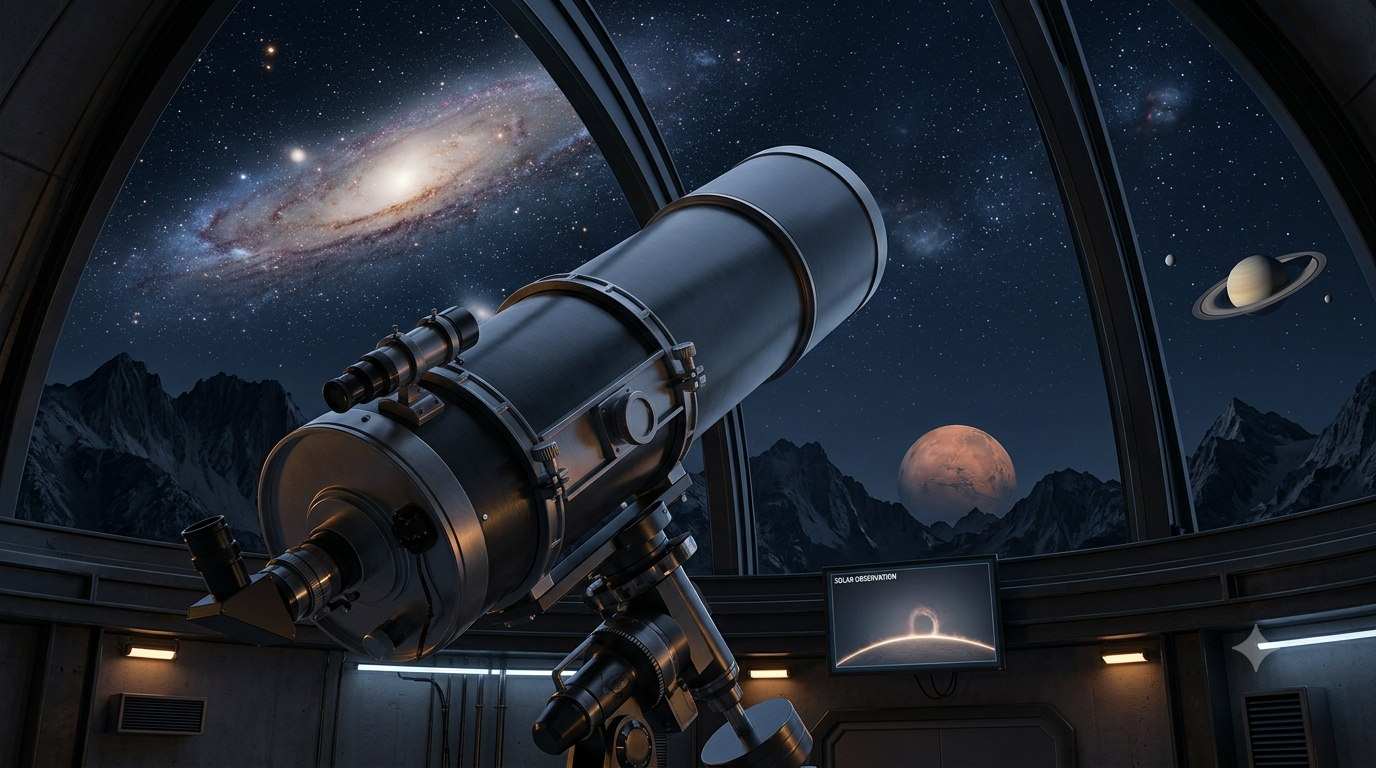
Astronomy is the scientific study of the universe and everything that exists beyond Earth’s atmosphere. It explores planets, stars, galaxies, nebulae, black holes, and many other celestial objects. Astronomy also investigates the origin, structure, evolution, and possible future of the universe. By observing objects in space and analyzing the light and other signals they produce, astronomers discover how the universe works and how different celestial bodies interact.
Astronomy is a broad scientific field, so it is divided into several branches, each focusing on particular objects, processes, or methods of investigation. Some branches study the planets and their moons, while others examine distant galaxies, the birth and death of stars, or the universe as a whole. Certain branches focus on collecting observations, whereas others use physics, mathematics, and computer simulations to explain astronomical phenomena. Understanding the main branches of astronomy helps us explore the universe systematically and appreciate the different approaches scientists use to answer questions about space.
What Are the Main Branches of Astronomy?
The main branches of astronomy are specialized areas of study that investigate different aspects of the universe. They often overlap because celestial objects and astronomical processes are connected.
For example, studying a distant planet may require observations from observational astronomy, calculations from celestial mechanics, and atmospheric analysis from planetary science. Similarly, understanding a black hole may involve astrophysics, high-energy astronomy, and computational modeling.
The major branches of astronomy include:
Observational astronomy
Theoretical astronomy
Astrophysics
Planetary astronomy
Stellar astronomy
Galactic astronomy
Extragalactic astronomy
Cosmology
Astrometry and celestial mechanics
Solar astronomy
Radio astronomy
Optical and infrared astronomy
High-energy astronomy
These branches are not completely separate disciplines. Some classify astronomy according to the objects being studied, while others describe the methods used to observe or understand them.
1. Observational Astronomy
Observational astronomy studies celestial objects and astronomical events by collecting and analyzing information from the universe. It is one of the most fundamental branches of astronomy because scientific explanations must be supported by evidence.
Astronomers use telescopes, cameras, detectors, and other instruments to observe planets, stars, galaxies, and distant cosmic phenomena. They collect information about brightness, position, motion, temperature, and the radiation emitted or reflected by astronomical objects.
Observations can be made from Earth’s surface, high-altitude observatories, aircraft, and space-based telescopes. Space telescopes are particularly useful for studying forms of radiation that Earth’s atmosphere absorbs.
For example, astronomers may observe a star becoming dimmer when a planet passes in front of it. By carefully measuring this change in brightness, they can identify a possible exoplanet and estimate some of its properties.
Observational astronomy provides the evidence needed to test scientific theories and improve our understanding of the universe.
2. Theoretical Astronomy
Theoretical astronomy uses mathematical equations, physical principles, and computer models to explain astronomical phenomena. Instead of depending only on direct observation, theoretical astronomers develop explanations and predictions that can be tested against available evidence.
This branch helps scientists understand processes that are difficult to observe directly. For example, astronomers cannot travel to the center of a distant star to examine its interior. However, they can use mathematical models of gravity, pressure, temperature, and nuclear reactions to predict how the star behaves.
Theoretical astronomy also investigates black holes, galaxy formation, the evolution of the universe, and the movement of celestial bodies.
Computer simulations are important tools in this field. They allow researchers to model complex systems, such as the collision of galaxies or the formation of planetary systems over millions or billions of years.
Theoretical astronomy and observational astronomy work together. Theoretical models make predictions, and observations help determine whether those predictions accurately describe the universe.
3. Astrophysics
Astrophysics applies the principles of physics to understand the nature and behavior of celestial objects. It investigates the physical processes responsible for the formation, structure, energy production, and evolution of objects throughout the universe.
Astrophysicists study gravity, motion, temperature, radiation, magnetic fields, nuclear reactions, and the behavior of matter under extreme conditions.
For example, astrophysics explains how stars produce energy through nuclear fusion. It also helps scientists understand how matter behaves near black holes, why neutron stars are extremely dense, and how magnetic fields influence cosmic objects.
This branch uses information gathered from telescopes alongside theories from physics and mathematical models. It draws on several areas of physics, including thermodynamics, electromagnetism, quantum mechanics, and relativity.
Astrophysics is especially important because many astronomical objects cannot be understood simply by observing their appearance. Scientists must investigate the physical processes taking place within and around them.
4. Planetary Astronomy
Planetary astronomy studies planets and other bodies associated with planetary systems. These objects include moons, dwarf planets, asteroids, comets, and planetary rings.
Researchers investigate the physical characteristics, orbital motions, surfaces, atmospheres, and internal structures of these bodies. They also examine how planetary systems form and change over time.
For example, planetary astronomers study the atmosphere of Venus to understand its extreme surface temperatures. They investigate the geology of Mars to reconstruct its environmental history and examine the icy moons of Jupiter and Saturn for evidence of subsurface oceans.
Spacecraft, orbiters, landers, and robotic rovers provide valuable information about objects in our Solar System. Ground-based and space-based telescopes also allow astronomers to study planets around other stars.
Planetary astronomy contributes to our understanding of Earth’s place in the Solar System. It also helps scientists investigate whether conditions suitable for life may exist elsewhere.
5. Stellar Astronomy
Stellar astronomy focuses on stars, including their formation, structure, properties, evolution, and eventual fate. Stars are major building blocks of galaxies, and their life cycles influence the development of planetary systems and the chemical composition of the universe.
Stellar astronomers examine properties such as mass, luminosity, temperature, size, age, and chemical composition. They use these measurements to classify stars and determine their stages of evolution.
Stars generally form when regions of gas and dust collapse under gravity. As the central region becomes sufficiently hot and dense, nuclear fusion can begin. During much of a star’s lifetime, fusion provides energy that balances the inward pull of gravity.
The fate of a star depends strongly on its mass. Some stars eventually become white dwarfs, while sufficiently massive stars may undergo supernova explosions and leave behind neutron stars or black holes.
Stellar astronomy helps explain where many chemical elements originate and how the materials needed to form planets become distributed throughout space.
6. Galactic Astronomy
Galactic astronomy studies galaxies, including their structure, composition, movement, and evolution. A galaxy is a large system containing stars, gas, dust, and dark matter held together by gravity.
Our Solar System belongs to the Milky Way, a barred spiral galaxy containing enormous numbers of stars. Galactic astronomers examine its spiral arms, central region, stellar populations, and surrounding halo.
They also investigate how stars form within galaxies, how gas moves between different regions, and how gravitational interactions influence galactic structure.
Some galaxies experience intense periods of star formation, while others contain mostly older stars. Interactions and collisions between galaxies can reshape their structures and trigger new episodes of star formation.
Researchers also study the relationship between galaxies and the supermassive black holes found at the centers of many of them.
Galactic astronomy helps scientists understand how galaxies develop over billions of years and how our own galaxy fits into the larger universe.
7. Extragalactic Astronomy
Extragalactic astronomy investigates astronomical objects and structures beyond the Milky Way. Although it overlaps with galactic astronomy, its main focus is other galaxies and the large-scale relationships between them.
Extragalactic astronomers study spiral galaxies, elliptical galaxies, irregular galaxies, galaxy groups, and galaxy clusters. They compare galaxies at different distances to investigate how their properties change over cosmic time.
Because light takes time to travel, observing distant galaxies allows scientists to see them as they were in the past. A galaxy billions of light-years away may appear to us in a much earlier stage of its development.
This branch also examines active galactic nuclei, quasars, and powerful jets produced by material near supermassive black holes.
By studying distant galaxies, astronomers investigate how matter assembled into large cosmic structures and how galaxies have changed since the early universe.
8. Cosmology
Cosmology is the branch of astronomy concerned with the universe as a whole. It studies the universe’s origin, large-scale structure, evolution, and possible future.
Modern cosmology investigates evidence that the universe has expanded from an early hot, dense state. It examines the cosmic microwave background, the abundance of light elements, the distribution of galaxies, and the expansion of space.
Cosmologists also investigate dark matter and dark energy. Dark matter is inferred from its gravitational effects on visible matter and cosmic structures. Dark energy is the name given to the component or process associated with the observed accelerated expansion of the universe, although its fundamental nature remains uncertain.
Scientists use observations, mathematical models, and computer simulations to test different explanations of cosmic evolution.
Cosmology addresses some of the biggest questions in science: How did the universe evolve? What determines its large-scale structure? What might happen to it in the distant future?
9. Astrometry and Celestial Mechanics
Astrometry measures the positions and movements of celestial objects with high precision. It helps astronomers determine the locations, distances, and motions of stars and other bodies across the sky.
One important technique is stellar parallax. When Earth moves around the Sun, a nearby star appears to shift slightly against the background of more distant stars. Measuring this apparent shift allows astronomers to calculate the star’s distance.
Celestial mechanics focuses on the motion of celestial bodies under the influence of gravity. It uses mathematical principles to explain and predict the orbits of planets, moons, asteroids, comets, and artificial satellites.
For example, celestial mechanics helps scientists calculate planetary orbits, predict eclipses, plan spacecraft trajectories, and assess the future paths of near-Earth asteroids.
These fields are closely connected. Precise measurements from astrometry help improve models of celestial motion, while celestial mechanics explains the gravitational processes responsible for those movements.
10. Solar Astronomy
Solar astronomy is the study of the Sun, the star at the center of our Solar System. The Sun provides most of the energy that supports life and drives many processes on Earth.
Solar astronomers investigate the Sun’s interior, visible surface, atmosphere, magnetic fields, sunspots, solar flares, and coronal mass ejections.
The Sun produces energy through nuclear fusion in its core, where hydrogen nuclei combine to form helium. Energy gradually travels outward and eventually escapes into space as radiation.
Solar activity can influence Earth’s space environment. Solar flares and coronal mass ejections may disturb Earth’s magnetic field and contribute to geomagnetic storms. These events can affect satellites, radio communications, navigation systems, and electrical infrastructure.
Scientists observe the Sun using specialized ground-based observatories and space missions. Studying solar activity improves our understanding of stars and helps researchers forecast potentially disruptive space weather.
11. Radio Astronomy
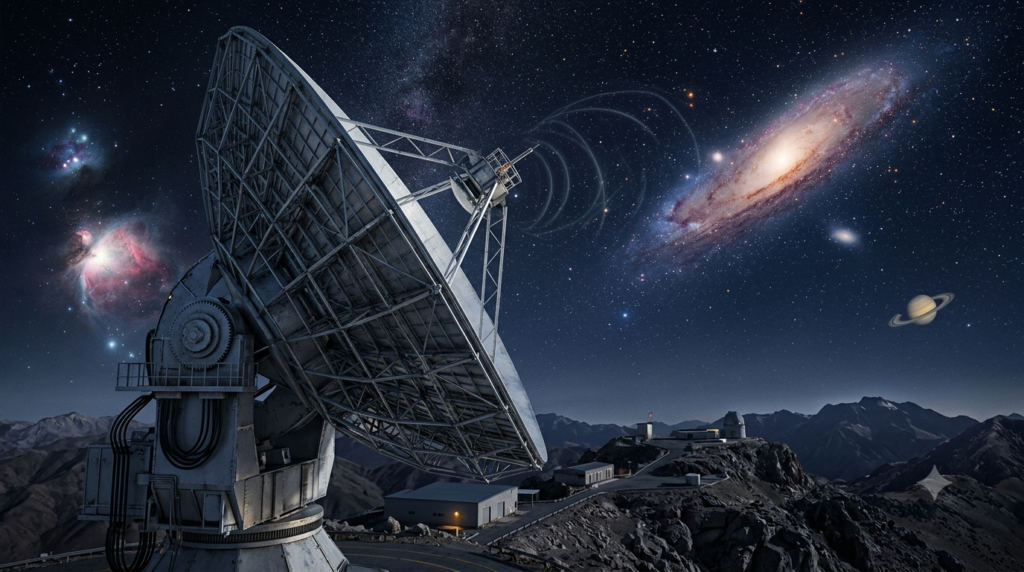
Radio astronomy studies celestial objects by detecting radio waves emitted by or associated with them. Radio waves are a form of electromagnetic radiation with wavelengths longer than those of visible light.
Radio telescopes use antennas and sensitive receivers to collect these signals. Unlike ordinary optical telescopes, radio telescopes can reveal structures and processes that may be difficult to observe in visible light.
Radio astronomy has contributed to the study of pulsars, interstellar gas, molecular clouds, magnetic fields, and the regions surrounding black holes.
For example, radio observations can detect hydrogen gas across galaxies. This information helps astronomers map galactic structures and investigate how gas moves through space.
Radio telescopes can also work together as an array. By combining observations from multiple instruments, astronomers can achieve much greater resolving power than a single antenna could provide.
Radio astronomy expands our view of the universe beyond what human eyes can see.
12. Optical and Infrared Astronomy
Optical astronomy studies the universe using visible light, the part of the electromagnetic spectrum that human eyes can detect. Optical telescopes collect and focus this light to produce images and measurements of stars, planets, nebulae, and galaxies.
Astronomers use optical observations to measure brightness, identify celestial objects, study stellar populations, and examine the structure of distant galaxies.
Infrared astronomy detects infrared radiation, which has longer wavelengths than visible light. Many cool objects emit strongly in infrared wavelengths, and infrared observations can reveal regions hidden by clouds of cosmic dust.
For example, infrared telescopes can investigate the formation of stars inside dusty clouds and examine the atmospheres of some exoplanets.
Different infrared wavelengths provide information about different temperatures and physical processes. Some infrared observations must be conducted from space because Earth’s atmosphere absorbs much of this radiation.
Together, optical and infrared astronomy provide complementary views of celestial objects and help scientists investigate both visible structures and otherwise obscured regions.
13. High-Energy Astronomy
High-energy astronomy studies energetic forms of radiation, particularly X-rays and gamma rays. These signals are often produced by extreme environments involving very high temperatures, powerful magnetic fields, fast-moving particles, or strong gravitational forces.
Astronomers use specialized detectors and space observatories to study sources such as supernova remnants, neutron stars, black holes, and active galactic nuclei.
For example, gas falling toward a black hole can become extremely hot and emit X-rays before crossing the event horizon. Observing this radiation allows researchers to investigate the environment around the black hole.
Gamma-ray observations can reveal some of the most energetic events in the universe, including certain stellar explosions and powerful bursts of radiation.
High-energy astronomy is important because it reveals physical processes that cannot be fully understood through visible-light observations alone.
Why Are the Different Branches of Astronomy Important?
Each branch of astronomy contributes a different kind of evidence or explanation. Together, they create a more complete understanding of the universe.
The major benefits of studying these branches include:
Understanding the universe: Astronomy explains how stars, planets, galaxies, and other cosmic structures form and evolve.
Advancing scientific knowledge: Astronomical research tests fundamental theories about gravity, matter, energy, space, and time.
Developing technology: Astronomical research encourages advances in detectors, imaging systems, data processing, computing, and communication technologies.
Protecting Earth: Solar astronomy and studies of near-Earth objects help scientists understand space weather and assess certain hazards from space.
Searching for life beyond Earth: Planetary science and exoplanet research investigate environments where life might be possible.
Understanding our origins: Studies of stars and galaxies help explain how many of the chemical elements found on Earth were produced and distributed through the universe.
The branches of astronomy also demonstrate how scientific disciplines work together. A single discovery may require observations across several wavelengths, calculations based on physics, and computer models that explain the results.
Conclusion
Astronomy is a diverse scientific field that explores the universe through observation, mathematical analysis, and physical explanations. Its branches investigate everything from the Sun and planets to distant galaxies and the evolution of the cosmos. Observational astronomy gathers evidence, theoretical astronomy develops models, and astrophysics explains the physical processes behind celestial phenomena. Other specialized fields focus on stars, galaxies, planetary systems, cosmic radiation, and the motion of objects in space.
Although each branch has its own focus, they are closely connected and often work together to solve complex scientific problems. Understanding the main branches of astronomy provides a foundation for exploring space and appreciating how scientists discover the universe’s structure, history, and behavior. As telescopes, spacecraft, and analytical techniques continue to improve, these branches will help answer new questions about the cosmos and our place within it.
FAQs
1. What are the main branches of astronomy?
The main branches of astronomy include observational astronomy, theoretical astronomy, astrophysics, planetary astronomy, stellar astronomy, galactic astronomy, extragalactic astronomy, and cosmology. Other important fields include solar astronomy, astrometry, celestial mechanics, radio astronomy, optical astronomy, infrared astronomy, and high-energy astronomy. Each branch focuses on particular celestial objects, scientific methods, or physical processes. For example, planetary astronomy studies planets and their moons, while cosmology investigates the origin and evolution of the universe. These branches frequently overlap, allowing scientists to combine different methods and perspectives to understand astronomical phenomena more accurately.
2. What is the difference between astronomy and astrophysics?
Astronomy is the broader scientific study of celestial objects, space, and the universe. It includes observing planets, stars, galaxies, and other astronomical phenomena. Astrophysics is a specialized branch of astronomy that applies the principles of physics to understand how these objects work. For example, astronomy may involve observing a distant star and measuring its brightness, while astrophysics investigates its temperature, energy production, internal structure, and evolution. Both fields are closely connected because astronomical observations provide evidence, while physics helps explain that evidence. Together, they allow scientists to develop a deeper understanding of the universe.
3. What does observational astronomy study?
Observational astronomy studies the universe by collecting and analyzing data from celestial objects and astronomical events. Astronomers use optical telescopes, radio telescopes, space observatories, cameras, and specialized detectors to gather information. They measure properties such as brightness, position, motion, temperature, and electromagnetic radiation. These observations help researchers investigate planets, stars, galaxies, black holes, and other cosmic phenomena. For example, observing changes in a star’s brightness can help scientists identify a planet passing in front of it. Observational astronomy is essential because it provides the evidence needed to test theories and improve scientific explanations about the universe.
4. What is theoretical astronomy, and why is it important?
Theoretical astronomy uses mathematical equations, physical laws, and computer simulations to explain astronomical phenomena. Instead of relying entirely on direct observations, theoretical astronomers develop models that describe how celestial objects behave and evolve. These models help scientists investigate processes that cannot be observed directly, such as conditions inside stars or the behavior of matter near black holes. Theoretical astronomy is important because it allows researchers to make predictions that can later be tested through observations. When predictions agree with evidence, scientific models become more reliable. This branch works closely with observational astronomy to improve our understanding of the universe.
5. What does planetary astronomy investigate?
Planetary astronomy investigates planets and other bodies within planetary systems. These objects include natural satellites, dwarf planets, asteroids, comets, and planetary rings. Scientists study their surfaces, atmospheres, internal structures, orbital movements, and formation histories. They also investigate planets outside our Solar System, known as exoplanets, to understand how planetary systems develop around other stars. Spacecraft, orbiters, landers, rovers, and telescopes provide important information for this research. Planetary astronomy helps scientists understand Earth’s place in the Solar System and investigate whether other worlds may have conditions suitable for life. It also supports future robotic and human space exploration.
6. What is the difference between stellar astronomy and galactic astronomy?
Stellar astronomy focuses on individual stars, including their formation, composition, temperature, energy production, and life cycles. It investigates how stars develop and what happens when they reach the end of their lives. Galactic astronomy, in contrast, studies entire galaxies and their structures, including stars, gas, dust, and dark matter. It examines how galaxies form, evolve, interact, and produce new generations of stars. For example, stellar astronomers may investigate how a massive star becomes a black hole, while galactic astronomers may study how millions of stars are distributed throughout the Milky Way. Both branches contribute to understanding cosmic evolution.
7. What is cosmology, and what questions does it answer?
Cosmology is the branch of astronomy that studies the universe as a whole, including its origin, evolution, large-scale structure, and possible future. Modern cosmology investigates evidence for the universe’s expansion, the cosmic microwave background, and the distribution of galaxies. It also examines dark matter and dark energy, which are important to current models of cosmic evolution. Cosmologists use observations, mathematical equations, and computer simulations to understand how the universe developed from its early hot, dense state. They investigate fundamental questions about the history and structure of the cosmos, although some questions about its earliest moments and ultimate fate remain unresolved.
8. What is the role of radio astronomy in studying space?
Radio astronomy studies radio waves from celestial objects to investigate processes that may not be visible through ordinary optical telescopes. Radio telescopes detect these signals using antennas and sensitive receivers. Astronomers use radio observations to study pulsars, interstellar gas, molecular clouds, magnetic fields, and regions surrounding black holes. Radio waves can also reveal the distribution of hydrogen gas within galaxies, helping researchers understand galactic structure and movement. Some radio telescopes operate together in large arrays to achieve greater resolving power. This branch is important because different wavelengths carry different information, allowing scientists to discover structures and processes that visible-light observations may miss.
9. How does solar astronomy help protect Earth?
Solar astronomy studies the Sun’s structure, activity, magnetic fields, and changing behavior. It helps scientists understand solar flares and coronal mass ejections, which can release energy and charged particles into space. When these events interact with Earth’s magnetic field, they may produce geomagnetic storms. Such storms can affect satellites, navigation systems, radio communications, and electrical power infrastructure. By monitoring the Sun and improving space-weather forecasts, scientists can provide warnings about potentially disruptive solar activity. Solar astronomy also helps researchers understand the behavior of other stars because the Sun is the closest star to Earth and can be studied in exceptional detail.
10. Which branch of astronomy studies black holes?
Black holes are studied through several branches of astronomy, especially astrophysics, high-energy astronomy, and theoretical astronomy. Astrophysics investigates their gravitational effects and the behavior of matter around them. High-energy astronomy detects X-rays and other energetic radiation that may be produced when hot material falls toward a black hole. Theoretical astronomy uses mathematical models and physical theories to investigate black holes, including their gravity and properties. Radio astronomy can also reveal jets and structures associated with some black holes. Since black holes do not emit light that can escape from within their event horizons, scientists study their effects on surrounding matter, radiation, and nearby objects.