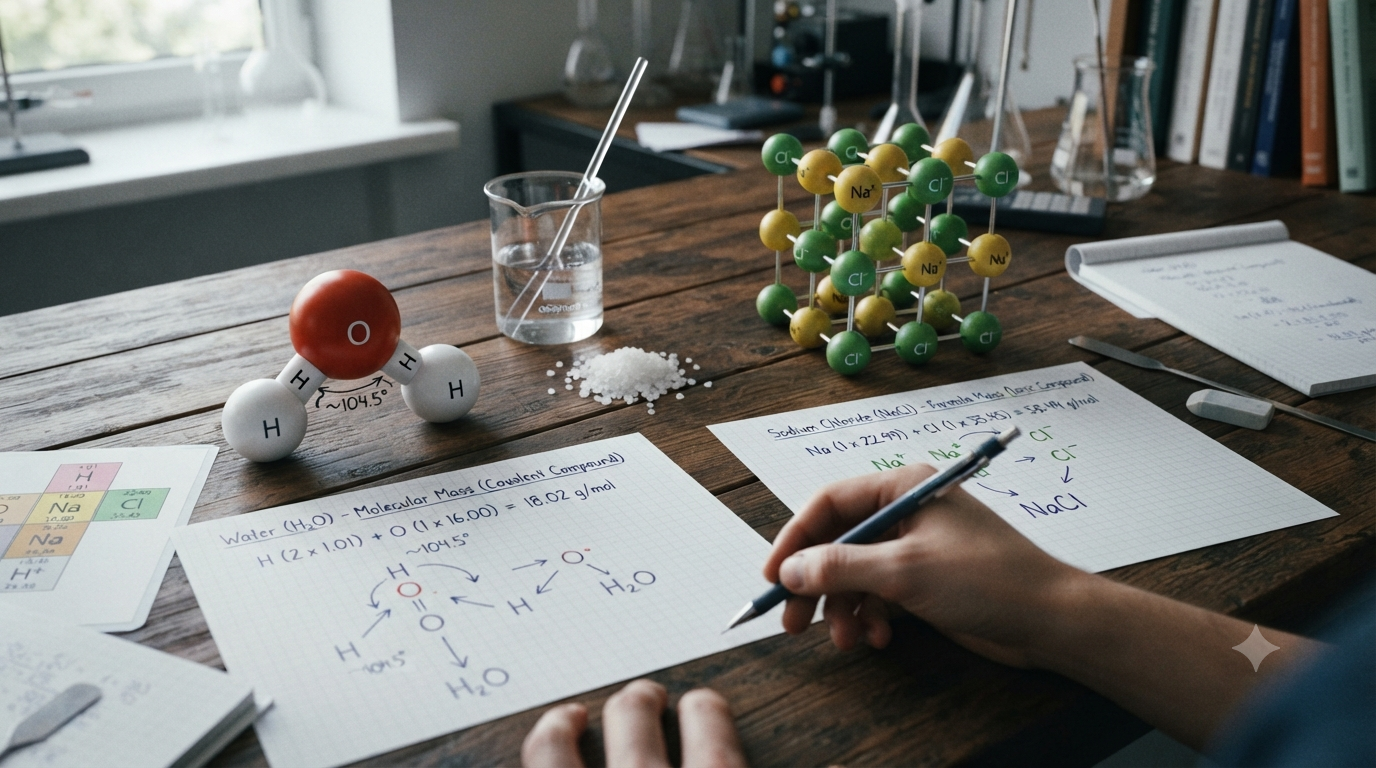

When studying chemistry, you often come across terms such as atomic mass, molecular mass, and formula mass. These terms may look similar because all of them involve the masses of atoms present in a chemical substance. However, molecular mass and formula mass are not always used for the same types of substances. Understanding the difference between them makes chemical calculations easier and helps you describe substances more accurately.
Both molecular mass and formula mass are calculated by adding the relative atomic masses of the atoms represented in a chemical formula. The important difference is what that formula represents. Molecular mass is generally used for substances that exist as individual molecules, while formula mass is commonly used for ionic compounds and other substances that are represented by formula units rather than separate molecules.
What Is Molecular Mass?
Molecular mass is the total relative mass of all the atoms present in one molecule of a substance. It is calculated by adding the relative atomic masses of every atom shown in the molecular formula.
For example, water has the molecular formula H₂O. One water molecule contains two hydrogen atoms and one oxygen atom. If the relative atomic mass of hydrogen is approximately 1 and that of oxygen is approximately 16, then:
Molecular mass of H₂O = (2 × 1) + (1 × 16) = 18
Therefore, the molecular mass of water is 18.
Molecular mass does not mean the actual mass of a single molecule in grams. It is a relative value based on the atomic mass scale. The SI-related unit used for molar mass is g/mol, while molecular mass itself is commonly treated as a unitless relative quantity.
What Is Formula Mass?
Formula mass is the total relative mass of all the atoms represented by the chemical formula of a substance. The term is especially useful for ionic compounds, which do not normally exist as separate molecules.
For example, sodium chloride has the formula NaCl. In solid sodium chloride, sodium ions and chloride ions form a large crystal lattice. There are no separate NaCl molecules arranged independently throughout the solid. Therefore, it is more accurate to refer to the mass represented by one NaCl formula unit.
Using approximate relative atomic masses:
Formula mass of NaCl = 23 + 35.5 = 58.5
Therefore, the formula mass of sodium chloride is 58.5.
The formula unit NaCl represents the simplest whole-number ratio of sodium ions to chloride ions in the ionic structure.
Molecular Mass and Formula Mass Have a Similar Calculation
Although their meanings are different, the mathematical procedure used to calculate molecular mass and formula mass is very similar.
The general process is:
Write the correct chemical formula.
Identify the number of atoms of each element.
Find the relative atomic mass of each element.
Multiply each atomic mass by the number of atoms present.
Add all the values together.
For example, consider carbon dioxide, CO₂.
Carbon has a relative atomic mass of approximately 12, while oxygen has a relative atomic mass of approximately 16.
Molecular mass of CO₂ = 12 + (2 × 16) = 44
Since carbon dioxide exists as individual molecules, the term molecular mass is appropriate.
Now consider calcium chloride, CaCl₂.
Calcium has a relative atomic mass of approximately 40, and chlorine has a relative atomic mass of approximately 35.5.
Formula mass of CaCl₂ = 40 + (2 × 35.5) = 111
Calcium chloride is an ionic compound, so formula mass is the appropriate term.
Why Is the Difference Important?
At first glance, molecular mass and formula mass may seem interchangeable because both calculations involve adding atomic masses. The distinction becomes important when describing the structure of a substance.
A molecular substance consists of discrete molecules. Each molecule has a definite group of atoms bonded together. Examples include water, carbon dioxide, oxygen, methane, and ammonia.
An ionic compound usually forms a repeating three-dimensional lattice of positive and negative ions. It does not consist of separate molecules in the same way molecular substances do. Its chemical formula represents the simplest ratio of ions in the compound.
This is why chemistry uses different terms.
Molecular mass refers to the relative mass of a molecule.
Formula mass refers to the relative mass represented by a chemical formula, particularly when the substance is not made of individual molecules.
Examples of Molecular Mass
Several common substances exist as molecular substances. Their molecular masses can be calculated directly from their molecular formulas.
Water H₂O
Water contains two hydrogen atoms and one oxygen atom.
Molecular mass = (2 × 1) + 16 = 18
Therefore, the molecular mass of H₂O is 18.
Ammonia NH₃
Ammonia contains one nitrogen atom and three hydrogen atoms.
Using N = 14 and H = 1:
Molecular mass = 14 + (3 × 1) = 17
Therefore, the molecular mass of ammonia is 17.
Methane CH₄
Methane contains one carbon atom and four hydrogen atoms.
Molecular mass = 12 + (4 × 1) = 16
Therefore, the molecular mass of methane is 16.
Sulfur Dioxide SO₂
Sulfur dioxide contains one sulfur atom and two oxygen atoms.
Using S = 32 and O = 16:
Molecular mass = 32 + (2 × 16) = 64
Therefore, the molecular mass of SO₂ is 64.
Examples of Formula Mass
Formula mass is commonly used for ionic compounds.
Sodium Chloride NaCl
Formula mass = 23 + 35.5 = 58.5
The value 58.5 represents the relative mass of one formula unit of NaCl.
Magnesium Oxide MgO
Magnesium has a relative atomic mass of approximately 24 and oxygen has a relative atomic mass of 16.
Formula mass = 24 + 16 = 40
Therefore, the formula mass of MgO is 40.
Calcium Oxide CaO
Calcium has a relative atomic mass of approximately 40 and oxygen has a relative atomic mass of 16.
Formula mass = 40 + 16 = 56
Therefore, the formula mass of CaO is 56.
Aluminium Oxide Al₂O₃
Aluminium has a relative atomic mass of approximately 27 and oxygen has a relative atomic mass of 16.
Formula mass = (2 × 27) + (3 × 16)
Formula mass = 54 + 48 = 102
Therefore, the formula mass of Al₂O₃ is 102.
Molecular Mass vs Formula Mass
The key difference can be understood by looking at what the chemical formula represents.
| Feature | Molecular Mass | Formula Mass |
|---|---|---|
| Meaning | Relative mass of one molecule | Relative mass represented by one formula unit |
| Commonly used for | Molecular substances | Ionic compounds |
| Structure involved | Individual molecules | Formula units in an ionic lattice |
| Calculation | Sum of atomic masses in a molecule | Sum of atomic masses represented by the formula |
| Example | H₂O = 18 | NaCl = 58.5 |
The calculation may produce a number in both cases, but the structural meaning behind that number is different.
Are Molecular Mass and Formula Mass Numerically Different?
Not necessarily.
For many substances, the numerical calculation follows exactly the same process. The difference is mainly in how the chemical formula should be interpreted.
For example, the calculation for H₂O gives 18, and the calculation for NaCl gives 58.5. Both values come from adding the relative atomic masses represented by their formulas.
The important point is that H₂O represents an actual molecule containing two hydrogen atoms bonded to one oxygen atom. NaCl, on the other hand, represents the simplest ratio of sodium ions and chloride ions in an ionic lattice.
Therefore, using the correct term provides information about the structure of the substance.
What About Covalent Compounds?
Covalent compounds commonly exist as molecules, so molecular mass is usually the appropriate term when their particles are discrete molecules.
For example, carbon dioxide contains separate CO₂ molecules. Each molecule has one carbon atom bonded to two oxygen atoms.
Similarly, methane consists of individual CH₄ molecules, and ammonia consists of individual NH₃ molecules.
In such cases, the molecular formula identifies the actual number of atoms present in one molecule.
However, not every covalent substance exists as separate molecules. Some substances form giant covalent structures. For example, diamond and silicon dioxide have extended structures rather than simple individual molecules. In such cases, the terminology can depend on the type of formula and the context in which the substance is being described.
What About Ionic Compounds?
Ionic compounds are generally described using formula units.
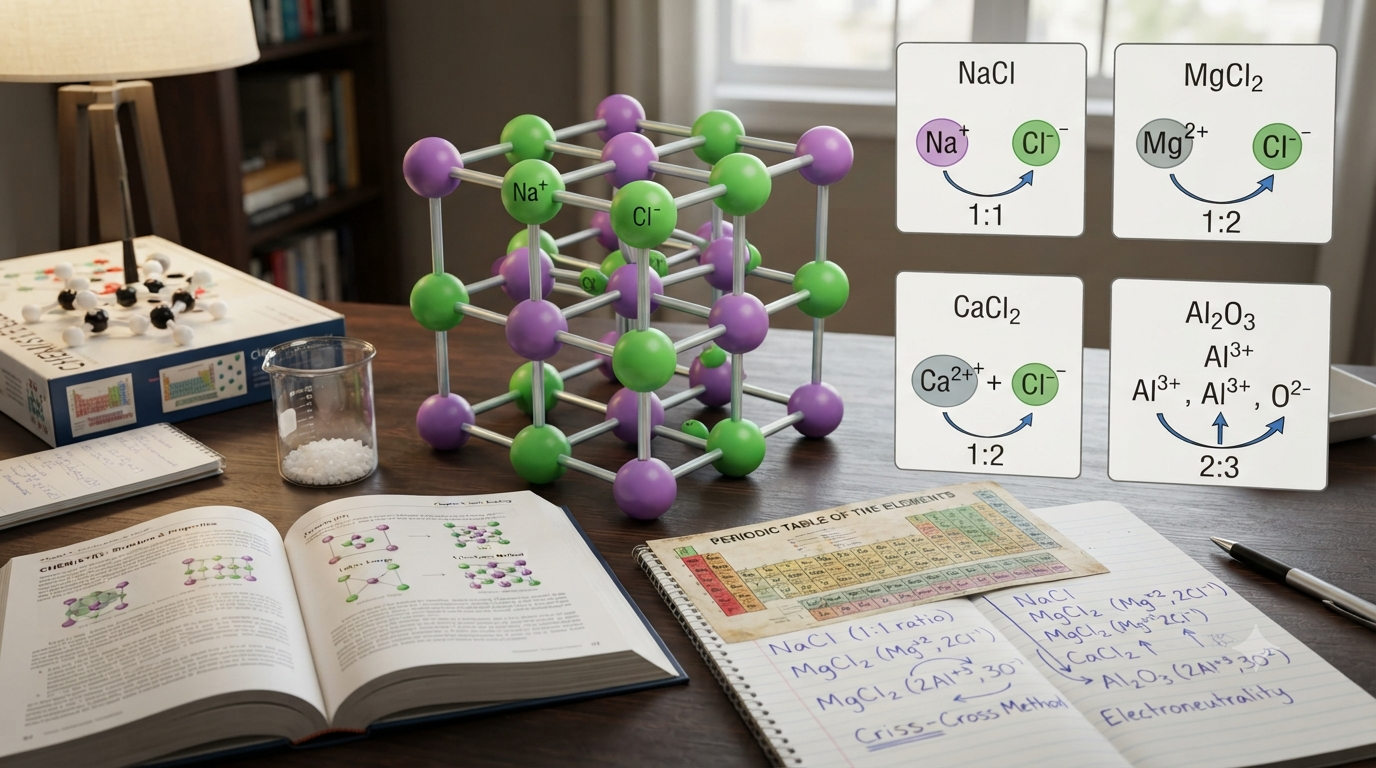
For example, sodium chloride contains Na⁺ and Cl⁻ ions arranged in a repeating lattice. The formula NaCl tells us that sodium ions and chloride ions occur in a 1:1 ratio.
It does not mean that a solid sodium chloride crystal consists of isolated NaCl molecules.
Similarly, MgCl₂ represents the ratio of magnesium ions to chloride ions in the ionic structure. One Mg²⁺ ion is balanced by two Cl⁻ ions, giving the simplest ratio MgCl₂.
Therefore, formula mass is generally preferred for ionic compounds.
Molecular Mass, Formula Mass, and Molar Mass
Another term that often causes confusion is molar mass.
Molecular mass and formula mass are relative quantities calculated from atomic masses. Molar mass, however, refers to the mass of one mole of a substance and is expressed in g/mol.
For example, water has a molecular mass of approximately 18. Its molar mass is approximately 18 g/mol.
Sodium chloride has a formula mass of approximately 58.5. Its molar mass is approximately 58.5 g/mol.
The numerical values are often the same, but their meanings and units are different.
Molecular mass → relative mass of a molecule
Formula mass → relative mass represented by a formula unit
Molar mass → mass of one mole of the substance, expressed in g/mol
Keeping these definitions separate prevents many common mistakes in chemical calculations.
Common Mistakes Students Make
One common mistake is calling every chemical formula a molecular formula. A chemical formula does not always represent a molecule. For ionic compounds, it generally represents the simplest ratio of ions.
Another mistake is adding atomic masses without considering subscripts. In H₂O, the subscript 2 means there are two hydrogen atoms. Ignoring it would give an incorrect result.
A third mistake is confusing molecular mass with molar mass. Although their numerical values may be identical in many cases, molecular mass is a relative quantity, whereas molar mass has units of g/mol.
It is also important to use consistent atomic masses. The exact values may vary slightly depending on the periodic table being used, so calculations should follow the atomic masses provided in the question when applicable.
A Simple Way to Remember the Difference
A useful way to remember the distinction is to focus on the word “molecular.”
If the substance consists of separate molecules, think about molecular mass.
If the chemical formula represents the simplest ratio of ions or particles rather than a separate molecule, formula mass is generally the appropriate term.
For example:
H₂O → molecule → molecular mass
CO₂ → molecule → molecular mass
CH₄ → molecule → molecular mass
NaCl → formula unit → formula mass
MgO → formula unit → formula mass
CaCl₂ → formula unit → formula mass
This simple distinction can make many chemistry questions easier to understand.
Conclusion
Molecular mass and formula mass are closely related concepts, but they describe different structural ideas. Molecular mass is the relative mass of the atoms present in one molecule and is commonly used for molecular substances such as water, carbon dioxide, and methane. Formula mass is the relative mass represented by a chemical formula and is especially useful for ionic compounds such as sodium chloride, magnesium oxide, and calcium chloride.
In both cases, the calculation involves adding the relative atomic masses of the atoms represented by the chemical formula. The main difference is whether the formula represents an individual molecule or a formula unit within a larger structure. Understanding this distinction makes chemical formulas easier to interpret and helps prevent errors when solving problems involving mass and composition.
FAQs
1. What is molecular mass?
Molecular mass is the total relative mass of all the atoms present in one molecule of a substance. It is calculated by adding the relative atomic masses of each atom shown in the molecular formula. For example, water has the formula H₂O. It contains two hydrogen atoms and one oxygen atom. Using H = 1 and O = 16, its molecular mass is (2 × 1) + 16 = 18. Molecular mass is commonly used for substances that exist as individual molecules, such as water, carbon dioxide, methane, and ammonia. It is a relative quantity and should not be confused with molar mass, which is expressed in g/mol.
2. What is formula mass?
Formula mass is the total relative mass of all the atoms represented by a chemical formula. It is particularly used for ionic compounds, which usually do not consist of separate molecules. For example, sodium chloride has the formula NaCl. Its formula mass is calculated by adding the relative atomic masses of sodium and chlorine: 23 + 35.5 = 58.5. The value 58.5 represents the relative mass of one formula unit of NaCl. Formula mass can also be determined for other compounds by multiplying each element’s relative atomic mass by its subscript and then adding all the resulting values together.
3. What is the main difference between molecular mass and formula mass?
The main difference is what the chemical formula represents. Molecular mass refers to the relative mass of one molecule of a molecular substance. Formula mass refers to the relative mass represented by one formula unit, especially for ionic compounds. For example, H₂O represents an individual water molecule, so its relative mass is called molecular mass. NaCl represents the simplest ratio of sodium and chloride ions in an ionic lattice, so its relative mass is called formula mass. Although both are calculated by adding the relative atomic masses represented by a formula, the structural meaning of the formula is different.
4. How do you calculate molecular mass?
To calculate molecular mass, first write the molecular formula and identify the number of atoms of every element. Then find the relative atomic mass of each element from the periodic table. Multiply each atomic mass by the number of atoms indicated by its subscript and add the results. For example, CO₂ contains one carbon atom and two oxygen atoms. Using C = 12 and O = 16, the molecular mass is 12 + (2 × 16) = 44. Therefore, the molecular mass of carbon dioxide is 44. The same basic calculation can be applied to other molecular substances.
5. How do you calculate formula mass?
Formula mass is calculated by adding the relative atomic masses of all atoms represented in a chemical formula. First, identify the elements and their subscripts. Multiply the relative atomic mass of each element by its number of atoms, then add the values. For example, CaCl₂ contains one calcium atom and two chlorine atoms. Using Ca = 40 and Cl = 35.5, its formula mass is 40 + (2 × 35.5) = 111. Therefore, the formula mass of calcium chloride is 111. This method works for ionic compounds and other substances described using a formula unit.
6. Is molecular mass the same as formula mass?
Molecular mass and formula mass are calculated using a similar mathematical method, but they do not always describe the same structural unit. Molecular mass refers specifically to the relative mass of a molecule. Formula mass refers to the relative mass represented by a formula unit, particularly in ionic compounds. For example, the molecular mass of H₂O is 18, while the formula mass of NaCl is 58.5. The numbers are calculated by adding atomic masses, but the terms are chosen according to the structure represented by the chemical formula. Therefore, they are related concepts but should not automatically be treated as identical terms.
7. Why is formula mass used for ionic compounds?
Formula mass is commonly used for ionic compounds because these substances generally form large, repeating crystal lattices rather than separate molecules. For example, solid sodium chloride contains Na⁺ and Cl⁻ ions arranged throughout an extended structure. The formula NaCl represents the simplest whole-number ratio of sodium ions to chloride ions rather than an individual NaCl molecule. Therefore, the relative mass calculated from NaCl is called formula mass. The same idea applies to compounds such as MgO, CaCl₂, and Al₂O₃. Using the term formula mass correctly reflects the way the particles are arranged in an ionic compound.
8. What is the difference between molecular mass and molar mass?
Molecular mass and molar mass describe different quantities. Molecular mass is the relative mass of one molecule and is normally treated as a unitless value. Molar mass is the mass of one mole of a substance and is expressed in grams per mole (g/mol). For example, water has a molecular mass of approximately 18, while its molar mass is approximately 18 g/mol. Similarly, NaCl has a formula mass of approximately 58.5 and a molar mass of approximately 58.5 g/mol. Their numerical values can be the same, but their meanings, measurement scales, and units are different.
9. Is H₂O molecular mass or formula mass?
H₂O is generally described using molecular mass because water is a molecular substance made up of individual H₂O molecules. Each molecule contains two hydrogen atoms and one oxygen atom. Using H = 1 and O = 16, the molecular mass is calculated as (2 × 1) + 16 = 18. Therefore, the molecular mass of water is 18. When discussing the mass of one mole of water, the appropriate term is molar mass, which is approximately 18 g/mol. This distinction helps separate the relative mass of an individual molecule from the mass associated with a mole of molecules.
10. Why is understanding molecular mass and formula mass important?
Understanding molecular mass and formula mass helps you interpret chemical formulas correctly and perform calculations accurately. It allows you to distinguish between substances made of individual molecules and compounds represented by formula units. These concepts are also important when studying molar mass, chemical equations, stoichiometry, and quantitative chemistry. Knowing which term applies prevents confusion when describing the particles in a substance. For example, molecular mass is appropriate for H₂O and CO₂, while formula mass is commonly used for NaCl and MgO. Once the difference is understood, calculating relative masses from chemical formulas becomes a straightforward process.
Related Posts
How to Determine Atomic Ratios From Chemical Formulas
Chemical formulas provide much more information than simply telling us which elements are present in a substance. The symbols and […]
Read MoreHow Atomic Ratios Differ From Mass Ratios in Compounds

When we study chemical compounds, we often use ratios to describe how their elements are combined. Two important types of […]
Read MoreWhy Chemical Formulas Use Whole Number Subscripts

Chemical formulas are one of the simplest ways scientists communicate information about substances. A formula such as H₂O tells us […]
Read MoreHow Whole Number Ratios Are Used in Chemical Formulas

Chemical formulas are a simple way of showing what a substance is made of. A formula tells us which elements […]
Read MoreHow to Identify the Simplest Ratio in a Chemical Formula

Chemical formulas do more than identify substances. They also show how atoms of different elements are combined. By looking carefully […]
Read MoreFormula Units vs Molecules in Chemistry

Chemistry uses formulas to describe the substances that make up the world around us. When we see formulas such as […]
Read MoreWhat Is the Meaning of Formula Units in Chemistry?
In chemistry, substances are often represented using chemical formulas. A chemical formula tells us which elements are present and, in […]
Read MoreHow Chemical Formulas Represent Fixed Composition
A chemical formula is much more than a short name for a substance. It gives important information about what a […]
Read MoreHow to Interpret the Ratio of Elements in a Compound

When a chemical compound is represented by a chemical formula, the symbols and numbers in that formula contain important information […]
Read MoreHow Chemical Formula Ratios Describe Compound Composition

A chemical formula is much more than a short way of naming a compound. It provides important information about what […]
Read MoreHow are chemical formulas used in stoichiometric calculations?

Chemical formulas are one of the most important tools used in chemistry. They tell us which elements are present in […]
Read MoreHow can chemical formulas be used to understand chemical reactions?

Chemical reactions are processes in which substances change into new substances. We can observe some reactions through changes in color, […]
Read MoreWhy do some substances have simple formulas while others have complex formulas?
Chemical formulas are one of the simplest ways to describe what a substance is made of. A formula such as […]
Read MoreHow can beginners memorize important chemical formulas without confusion?

Learning chemical formulas can feel confusing when you are just starting chemistry. There may be many formulas to remember, different […]
Read MoreWhich chemistry formulas are essential for beginners to learn first?

Chemistry becomes much easier when you understand the formulas used to represent substances, reactions, quantities, and relationships between different chemical […]
Read MoreHow should a student organize chemistry formulas for easy revision?

Chemistry involves many formulas, symbols, equations, ions, compounds, and numerical relationships. As the syllabus grows, simply memorizing formulas one after […]
Read MoreWhat is the difference between molecular and empirical formulas?
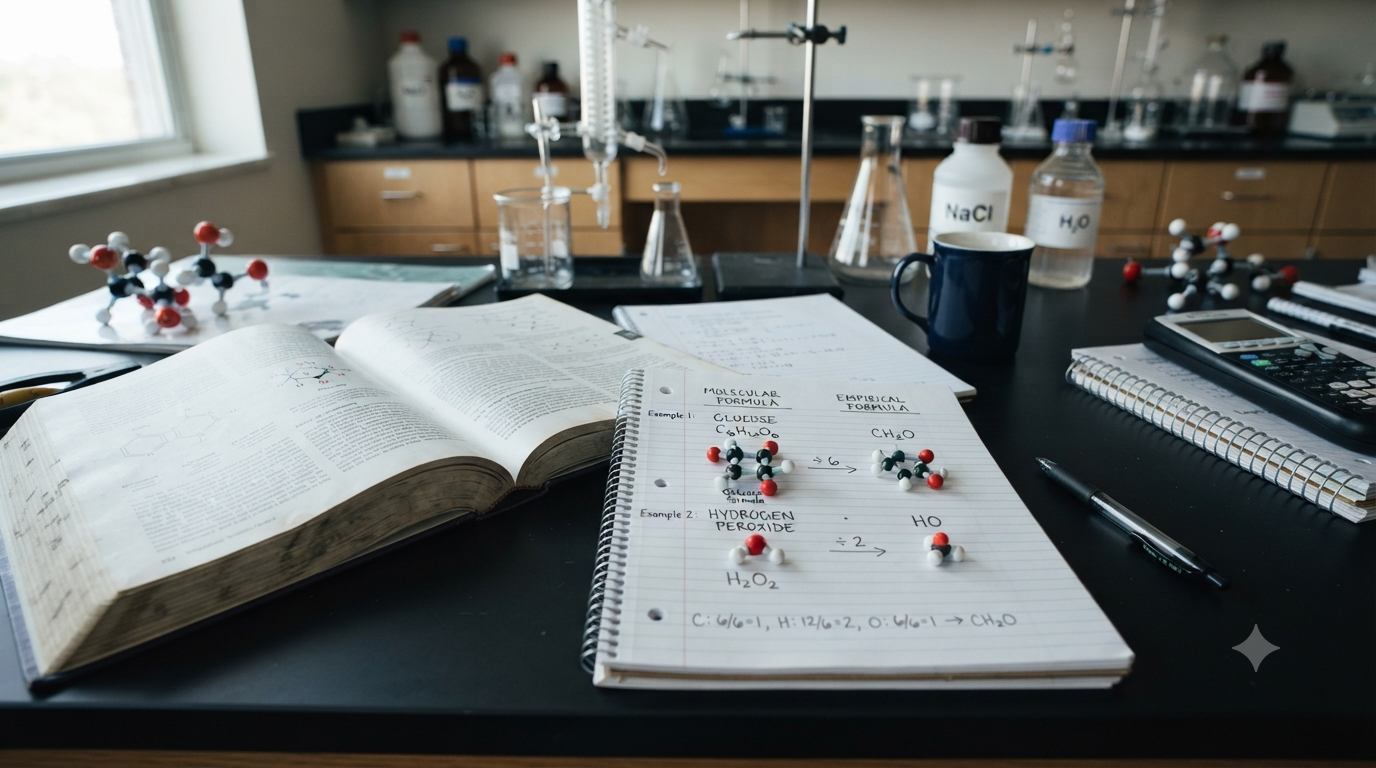
Chemical formulas give us a compact way to describe the composition of substances. Instead of writing the names and numbers […]
Read MoreWhy can different compounds have the same empirical formula?
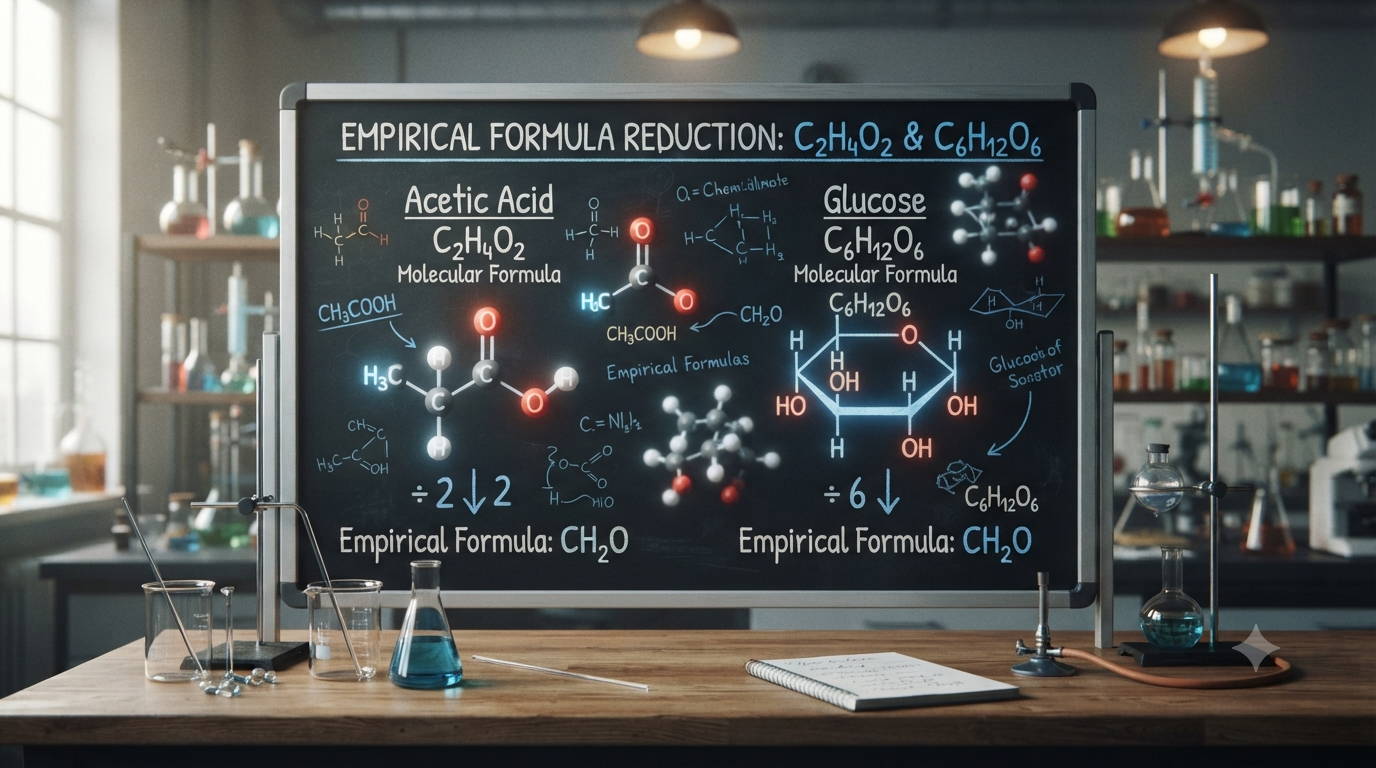
An empirical formula gives the simplest whole-number ratio of atoms present in a compound. It is useful because it tells […]
Read MoreHow do parentheses affect the number of atoms in a formula?
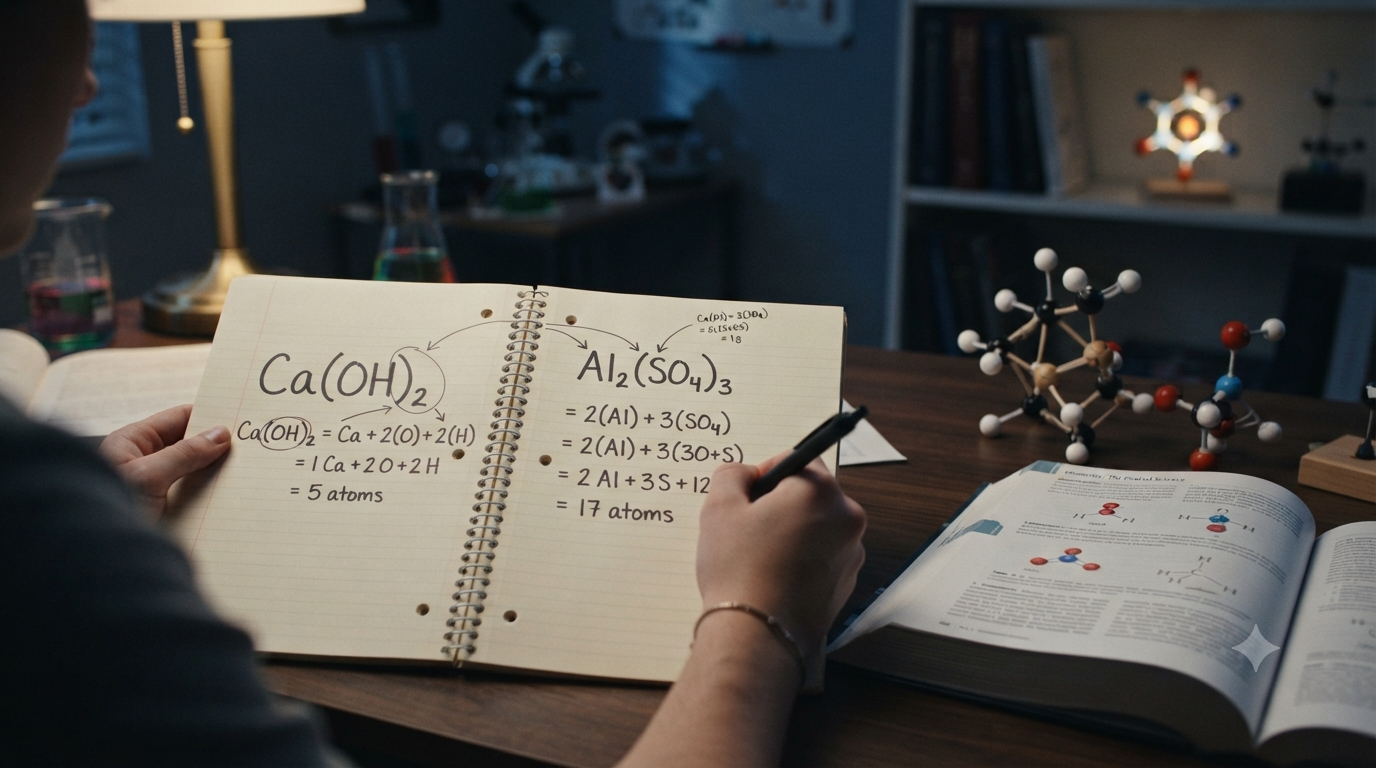
Chemical formulas tell us which elements are present in a substance and how many atoms of each element are included. […]
Read MoreHow can you count atoms from a chemical formula?

A chemical formula tells us much more than the name of a substance. It also gives information about the types […]
Read MoreWhy is a subscript different from a coefficient?
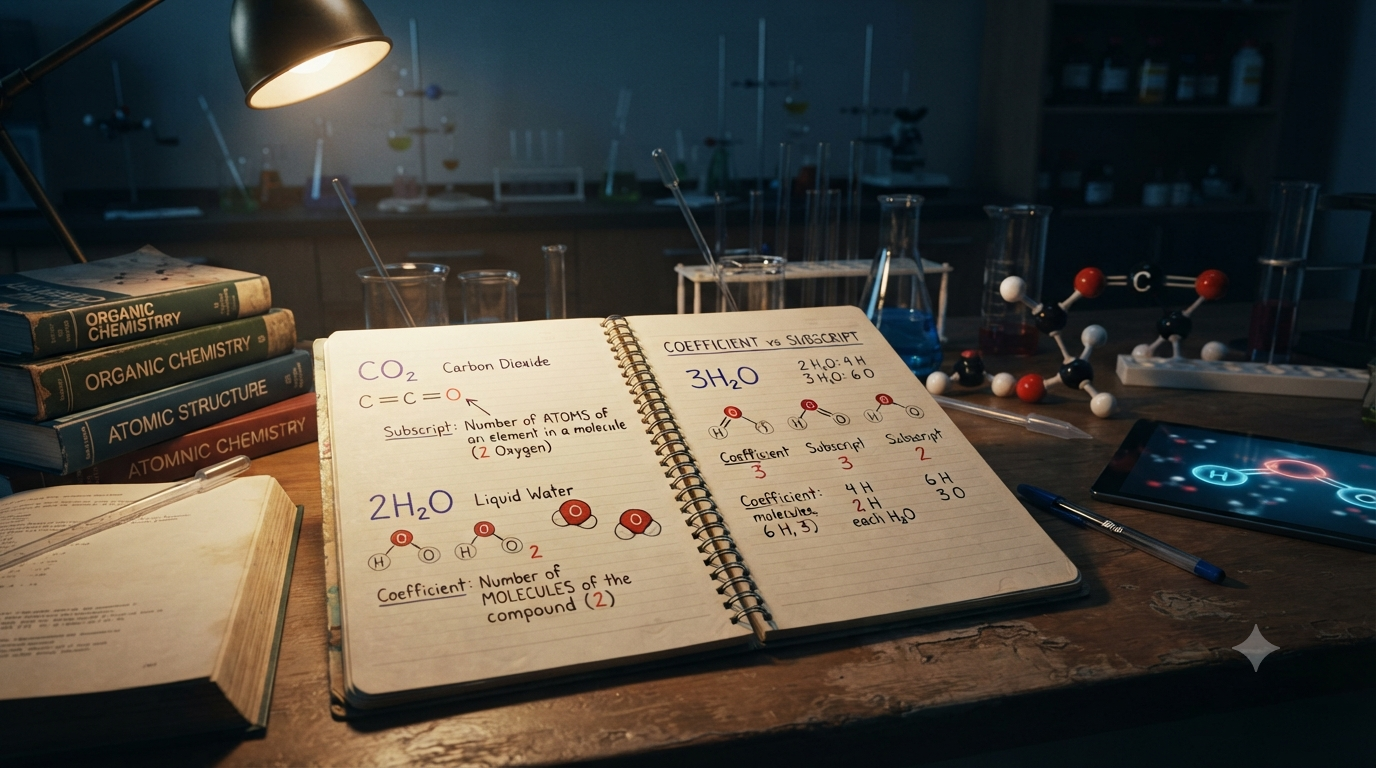
When learning chemical formulas, two small numbers can appear next to chemical symbols and look surprisingly similar. One is called […]
Read MoreWhat does a coefficient mean in a chemical equation?

A chemical equation is a compact way of representing a chemical reaction. It tells us which substances take part in […]
Read MoreWhat does a subscript mean in a chemical formula?

A chemical formula is a short way of showing what a substance is made of. Instead of writing the names […]
Read MoreHow can you identify the elements present in a formula?

A chemical formula is a short way of showing what a substance is made of. Instead of writing the complete […]
Read MoreHow are element symbols used to write chemical formulas?

Chemical formulas are one of the simplest and most useful ways to represent substances in chemistry. Instead of writing the […]
Read MoreWhat is the difference between a chemical symbol and a chemical formula?

Chemistry uses a special language to describe elements, atoms, compounds, and chemical substances. Two of the most basic parts of […]
Read MoreWhat information can be obtained from a chemical formula?

A chemical formula is a short and powerful way of representing a substance. It uses chemical symbols and numbers to […]
Read MoreHow does a chemical formula represent a substance?

A chemical formula is a short and precise way of representing a substance using chemical symbols and numbers. Instead of […]
Read MoreWhy are chemical formulas important in chemistry?

Chemistry is the study of matter, its properties, composition, and the changes it undergoes. To understand and communicate these ideas […]
Read MoreWhat exactly is a chemical formula?

A chemical formula is a short way of representing a chemical substance using symbols and numbers. Instead of writing the […]
Read More