
Common Formulas of Oxides in Chemistry

Common oxide formulas in chemistry including Na₂O, MgO, Al₂O₃, CO₂, SO₂, and Fe₂O₃

Oxides are among the most common compounds found in chemistry. They are formed when oxygen combines with another element, such as a metal or a non-metal. Oxides occur naturally in rocks, minerals, soil, water, and the atmosphere, and they are also widely used in industries and everyday products. Learning the common formulas of oxides helps us understand how elements combine with oxygen and how chemical compounds are represented.

The formula of an oxide depends mainly on the valency or oxidation state of the element combined with oxygen. Oxygen generally has an oxidation state of −2 in ordinary oxides. By balancing the positive and negative charges, we can determine the correct chemical formula. For example, sodium has a valency of +1, while oxygen has a valency of −2. Therefore, two sodium atoms combine with one oxygen atom to form sodium oxide, Na₂O.

Understanding these basic rules makes it much easier to write and remember oxide formulas.

What Are Oxides?

An oxide is a binary compound in which oxygen is chemically combined with another element. The other element may be a metal, non-metal, or, in some cases, another element with different oxidation states.

Some simple examples are:

  • Sodium oxide — Na₂O

  • Magnesium oxide — MgO

  • Aluminium oxide — Al₂O₃

  • Carbon dioxide — CO₂

  • Sulfur dioxide — SO₂

  • Iron(III) oxide — Fe₂O₃

Oxides can have very different properties. Some are basic, some are acidic, some are amphoteric, and others are neutral. Their properties depend on the element bonded with oxygen and the nature of the chemical bonding.

How Are Oxide Formulas Written?

Writing an oxide formula usually involves knowing the valency or oxidation state of the element and the oxidation state of oxygen.

In most common oxides:

Oxygen = −2

Suppose an element X has a valency of +2. One X atom provides a charge of +2, while one oxygen atom provides −2. The charges balance in a 1:1 ratio:

X²⁺ + O²⁻ → XO

Therefore, an element with valency +2 commonly forms an oxide with the formula XO.

If an element has a valency of +3, three positive charges must be balanced by three negative charges. Two atoms of the element give +6, while three oxygen atoms give −6:

X³⁺ + O²⁻ → X₂O₃

Thus, the oxide formula is X₂O₃.

Common Formulas of Metal Oxides

Metal oxides are generally formed when metals react with oxygen. Many metal oxides are basic, although some show amphoteric or other behavior.

Sodium Oxide

Sodium forms a +1 ion, while oxygen has a −2 oxidation state. Therefore, two sodium atoms are required for every oxygen atom.

Formula: Na₂O

Sodium oxide is a basic oxide and reacts with water to form sodium hydroxide.

Potassium Oxide

Potassium commonly has a +1 oxidation state.

Formula: K₂O

Potassium oxide is a basic metal oxide.

Magnesium Oxide

Magnesium commonly has a +2 oxidation state, which balances oxygen’s −2 oxidation state in a 1:1 ratio.

Formula: MgO

Magnesium oxide is a widely used basic oxide and is also known as magnesia.

Calcium Oxide

Calcium has a +2 oxidation state.

Formula: CaO

Calcium oxide is commonly called quicklime. It is an important industrial compound and is used in the manufacture of cement and other materials.

Aluminium Oxide

Aluminium commonly has a +3 oxidation state. Balancing Al³⁺ with O²⁻ gives:

Formula: Al₂O₃

Aluminium oxide is an important material and occurs naturally as a major component of several minerals.

Zinc Oxide

Zinc commonly has a +2 oxidation state.

Formula: ZnO

Zinc oxide is an amphoteric oxide and has several industrial and technological applications.

Common Iron Oxides

Iron can form more than one oxide because it commonly shows different oxidation states. This makes iron oxides particularly useful for understanding how oxidation states affect formulas.

Iron(II) Oxide

Iron in the +2 oxidation state combines with oxygen in the −2 oxidation state.

Formula: FeO

Iron(II) oxide contains iron in the +2 oxidation state.

Iron(III) Oxide

Iron in the +3 oxidation state combines with oxygen.

Formula: Fe₂O₃

Iron(III) oxide is commonly associated with the reddish-brown color of rust-related materials, although rust itself is a mixture of hydrated iron oxides and hydroxides rather than a single pure compound.

Iron(II,III) Oxide

Iron can also form a mixed-valence oxide containing both Fe²⁺ and Fe³⁺.

Formula: Fe₃O₄

Iron(II,III) oxide is commonly known as magnetite and has magnetic properties.

Common Formulas of Copper Oxides

Copper also commonly forms two oxides because it can have +1 and +2 oxidation states.

Copper(I) Oxide

Copper in the +1 oxidation state forms:

Formula: Cu₂O

Copper(I) oxide contains two copper atoms for every oxygen atom.

Copper(II) Oxide

Copper in the +2 oxidation state forms:

Formula: CuO

Copper(II) oxide is a black solid and is an important copper compound.

Common Formulas of Non-Metal Oxides

Non-metal oxides are formed when oxygen combines with non-metal elements. Many non-metal oxides are acidic or can form acids when they react with water.

Carbon Monoxide

Carbon monoxide contains one carbon atom and one oxygen atom.

Formula: CO

It is a neutral oxide and is produced during incomplete combustion of carbon-containing substances.

Carbon Dioxide

Carbon dioxide contains one carbon atom and two oxygen atoms.

Formula: CO₂

Carbon dioxide is produced during respiration and combustion and is an important component of the carbon cycle.

Sulfur Dioxide

Sulfur dioxide contains one sulfur atom and two oxygen atoms.

Formula: SO₂

Sulfur dioxide is an acidic oxide and is produced naturally by volcanic activity as well as by the combustion of sulfur-containing fuels.

Sulfur Trioxide

Sulfur can form another important oxide containing three oxygen atoms.

Formula: SO₃

Sulfur trioxide is an important compound in the manufacture of sulfuric acid.

Nitrogen Monoxide

Nitrogen monoxide, also called nitric oxide, contains one nitrogen atom and one oxygen atom.

Formula: NO

It is commonly classified as a neutral oxide.

Nitrogen Dioxide

Nitrogen dioxide contains one nitrogen atom and two oxygen atoms.

Formula: NO₂

It is a reddish-brown gas and is an important nitrogen oxide involved in atmospheric chemistry.

Dinitrogen Monoxide

Dinitrogen monoxide contains two nitrogen atoms and one oxygen atom.

Formula: N₂O

It is also commonly known as nitrous oxide.

Dinitrogen Trioxide

Dinitrogen trioxide contains two nitrogen atoms and three oxygen atoms.

Formula: N₂O₃

It is associated with nitrogen in the +3 oxidation state.

Dinitrogen Pentoxide

Dinitrogen pentoxide contains two nitrogen atoms and five oxygen atoms.

Formula: N₂O₅

It represents nitrogen in the +5 oxidation state and is an important nitrogen oxide in chemical studies.

Common Oxides of Other Elements

Several other elements form important oxides that are frequently encountered in chemistry.

Silicon Dioxide

Silicon dioxide contains silicon and oxygen in a 1:2 ratio.

Formula: SiO₂

Silicon dioxide is a major component of sand, quartz, and many types of glass.

Phosphorus Pentoxide

The molecular form of phosphorus pentoxide is commonly represented as P₄O₁₀, although the empirical formula P₂O₅ is widely used in chemical contexts.

Formula: P₄O₁₀

It is an acidic oxide and is a powerful dehydrating substance.

Lead(II) Oxide

Lead commonly forms a +2 oxide.

Formula: PbO

Lead(II) oxide is also called lead monoxide.

Lead(IV) Oxide

Lead can also show a +4 oxidation state.

Formula: PbO₂

Lead(IV) oxide contains lead in the +4 oxidation state.

Oxides With Different Oxidation States

One of the most important ideas when learning oxide formulas is that some elements can form multiple oxides. This happens because the element can have more than one oxidation state.

For example, iron can form:

  • FeO — iron(II) oxide

  • Fe₂O₃ — iron(III) oxide

  • Fe₃O₄ — iron(II,III) oxide

Copper can form:

  • Cu₂O — copper(I) oxide

  • CuO — copper(II) oxide

Nitrogen forms several oxides because it can exist in different oxidation states:

  • N₂O

  • NO

  • N₂O₃

  • NO₂

  • N₂O₅

Therefore, simply knowing the element is not always enough to determine its oxide formula. Its oxidation state must also be considered.

A Simple Method to Find the Formula of an Oxide

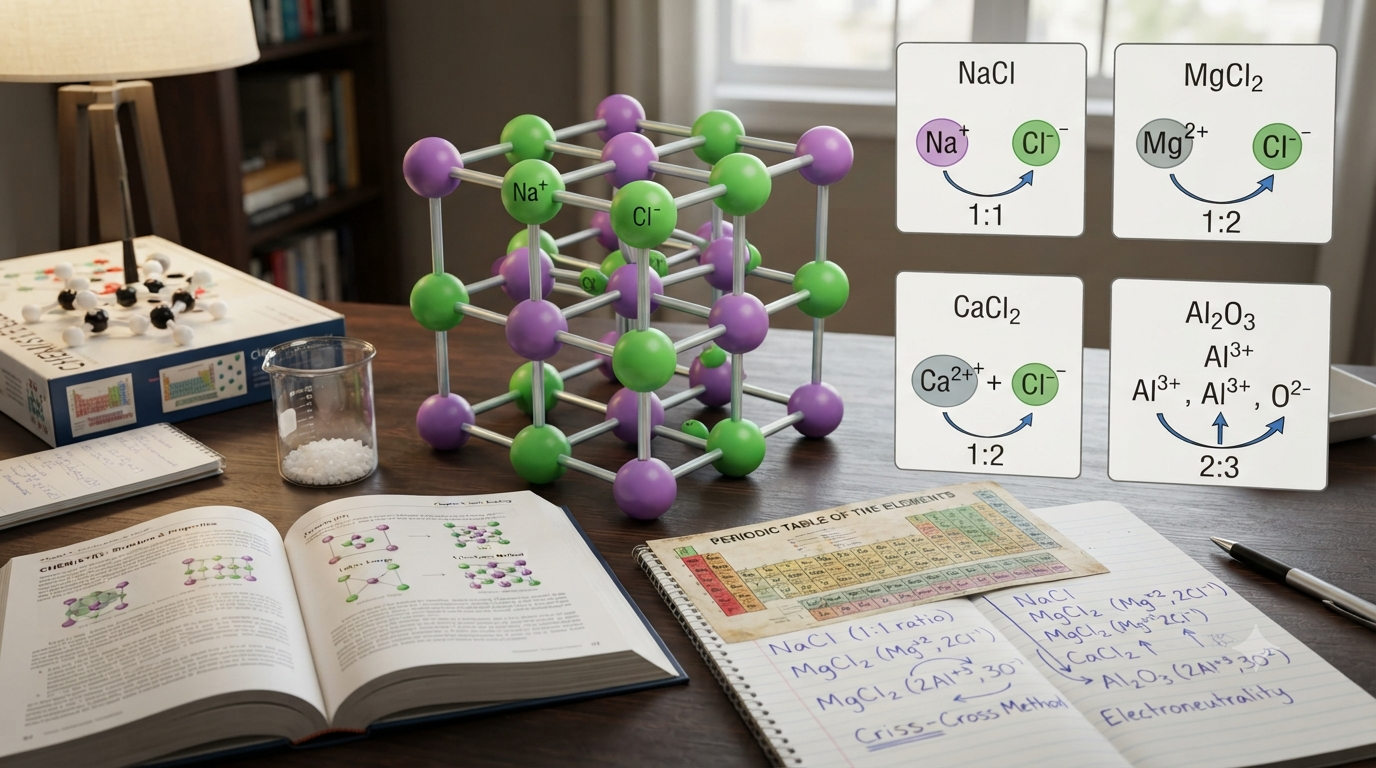
The criss-cross method is commonly used as a quick way to write formulas.

Suppose aluminium forms an oxide. Aluminium has valency 3 and oxygen has valency 2.

Write the valencies:

Al³⁺ O²⁻

Cross the numerical values:

Al₂O₃

The resulting formula is Al₂O₃.

Another example is calcium oxide. Calcium has valency 2 and oxygen has valency 2:

Ca²⁺ O²⁻

The ratio simplifies to 1:1:

CaO

It is important to simplify the ratio whenever both numbers have a common factor.

Common Oxides and Their Formulas at a Glance

Element or CompoundCommon OxideFormula
SodiumSodium oxideNa₂O
PotassiumPotassium oxideK₂O
MagnesiumMagnesium oxideMgO
CalciumCalcium oxideCaO
AluminiumAluminium oxideAl₂O₃
ZincZinc oxideZnO
Iron(II)Iron(II) oxideFeO
Iron(III)Iron(III) oxideFe₂O₃
Iron(II,III)Iron(II,III) oxideFe₃O₄
Copper(I)Copper(I) oxideCu₂O
Copper(II)Copper(II) oxideCuO
CarbonCarbon monoxideCO
CarbonCarbon dioxideCO₂
SulfurSulfur dioxideSO₂
SulfurSulfur trioxideSO₃
NitrogenNitric oxideNO
NitrogenNitrogen dioxideNO₂
NitrogenDinitrogen monoxideN₂O
NitrogenDinitrogen trioxideN₂O₃
NitrogenDinitrogen pentoxideN₂O₅
SiliconSilicon dioxideSiO₂
Lead(II)Lead(II) oxidePbO
Lead(IV)Lead(IV) oxidePbO₂

Why Learning Oxide Formulas Is Important

Learning common oxide formulas provides a foundation for understanding many other areas of chemistry. Oxides appear in chemical reactions, mineral composition, metallurgy, environmental chemistry, industrial processes, and laboratory experiments.

Knowing oxide formulas also makes it easier to understand chemical equations. For example, when magnesium reacts with oxygen, the reaction can be represented as:

2Mg + O₂ → 2MgO

Similarly, carbon reacts with oxygen to produce carbon dioxide under complete combustion:

C + O₂ → CO₂

Once the formulas of the substances are known, balancing chemical equations becomes much easier.

Basic Patterns to Remember

Some common patterns can make oxide formulas easier to learn.

For a +1 element:

X₂O

For a +2 element:

XO

For a +3 element:

X₂O₃

For a +4 element:

XO₂

For a +5 element:

X₂O₅

For a +6 element:

XO₃

For a +7 element:

X₂O₇

These patterns are based on balancing the oxidation state of the element with oxygen’s usual −2 oxidation state. However, actual compounds can involve exceptions, unusual oxidation states, or different oxygen-containing species, so the oxidation state and compound type should always be checked.

Conclusion

Common oxide formulas are an important part of basic chemistry because they show how oxygen combines with different elements. Formulas such as Na₂O, MgO, CaO, Al₂O₃, Fe₂O₃, CO₂, SO₂, and SiO₂ appear frequently in chemistry and in real-world materials. The key to writing these formulas is understanding oxidation states and balancing the total positive and negative charges. Once this principle is understood, many oxide formulas become easier to derive rather than simply memorize. Learning common examples and recognizing patterns can also make chemical equations, compound naming, and further study of acids, bases, minerals, and chemical reactions much easier.

FAQs

1. What are oxides in chemistry?

Oxides are chemical compounds formed when oxygen combines with another element. The other element may be a metal or a non-metal. Examples include sodium oxide (Na₂O), magnesium oxide (MgO), carbon dioxide (CO₂), and sulfur dioxide (SO₂). Oxides can have different chemical properties depending on the element combined with oxygen. Some oxides are basic, some are acidic, some are amphoteric, and some are neutral. Their formulas are determined mainly by considering the oxidation state of the element and the usual −2 oxidation state of oxygen. Understanding oxides is important for learning chemical reactions, compound formation, minerals, and many industrial processes.

2. How are formulas of oxides determined?

The formula of an oxide is generally determined by balancing the oxidation state of the element with the oxidation state of oxygen. Oxygen usually has an oxidation state of −2 in ordinary oxides. For example, magnesium has an oxidation state of +2. One Mg²⁺ balances one O²⁻, giving MgO. Aluminium commonly has an oxidation state of +3. Two Al³⁺ ions provide +6, while three O²⁻ ions provide −6, giving Al₂O₃. The criss-cross method can also be used as a quick way to determine formulas. The final ratio should always be simplified when possible.

3. What is the formula of sodium oxide?

The chemical formula of sodium oxide is Na₂O. Sodium commonly has an oxidation state of +1, while oxygen generally has an oxidation state of −2. Therefore, two sodium atoms are needed to balance the charge of one oxygen atom. The resulting compound is Na₂O. Sodium oxide is a basic oxide and can react with water to form sodium hydroxide. Learning Na₂O is useful because it demonstrates a simple example of how oxidation states are balanced when writing an ionic compound formula. The subscript 2 indicates that two sodium atoms are present for every one oxygen atom in the formula.

4. What is the formula of magnesium oxide?

The formula of magnesium oxide is MgO. Magnesium commonly has an oxidation state of +2, while oxygen has an oxidation state of −2. Because the positive and negative charges are equal in magnitude, one magnesium ion combines with one oxide ion. Therefore, the formula is MgO rather than Mg₂O₂, because the simplest whole-number ratio is 1:1. Magnesium oxide is a common basic oxide and is widely used in different applications. This compound is also a useful example for learning how equal oxidation states can produce a simple one-to-one chemical formula.

5. What are the common formulas of iron oxides?

Iron can form several oxides because it commonly shows more than one oxidation state. The important examples include iron(II) oxide, FeO, and iron(III) oxide, Fe₂O₃. Iron can also form iron(II,III) oxide, Fe₃O₄, which contains both Fe²⁺ and Fe³⁺ ions. The different formulas demonstrate why the oxidation state of an element must be known before writing the formula of its oxide. Fe₂O₃ is commonly associated with iron(III), while Fe₃O₄ is known as magnetite. These examples are particularly useful for understanding variable oxidation states in transition-metal chemistry.

6. What is the formula of carbon dioxide?

The chemical formula of carbon dioxide is CO₂. Carbon dioxide contains one carbon atom and two oxygen atoms. Carbon commonly has an oxidation state of +4 in carbon dioxide, while each oxygen atom has an oxidation state of −2. The two oxygen atoms therefore provide a total oxidation state of −4, balancing carbon’s +4 state. Carbon dioxide is an important oxide of carbon and is produced during processes such as complete combustion and cellular respiration. It also plays an important role in Earth’s carbon cycle and atmosphere. Its simple formula makes CO₂ one of the most familiar non-metal oxides.

7. What are the common formulas of nitrogen oxides?

Nitrogen forms several oxides because nitrogen can exist in different oxidation states. Common nitrogen oxides include dinitrogen monoxide (N₂O), nitric oxide (NO), dinitrogen trioxide (N₂O₃), nitrogen dioxide (NO₂), and dinitrogen pentoxide (N₂O₅). These compounds have different structures and chemical properties. Their formulas demonstrate how the same element can combine with oxygen in different proportions. For example, NO contains one nitrogen and one oxygen atom, while NO₂ contains one nitrogen and two oxygen atoms. Learning these formulas helps explain variable oxidation states and the diversity of compounds formed by nitrogen and oxygen.

8. What is the difference between acidic and basic oxides?

Basic oxides are generally formed by metals and can react with acids to produce salts and water. Examples include sodium oxide (Na₂O), magnesium oxide (MgO), and calcium oxide (CaO). Acidic oxides are commonly formed by non-metals and can react with bases or water to produce acidic substances. Examples include carbon dioxide (CO₂) and sulfur dioxide (SO₂). However, oxide classification is not determined solely by whether the element is a metal or non-metal. Some oxides, such as aluminium oxide (Al₂O₃) and zinc oxide (ZnO), are amphoteric and can react with both acids and bases.

9. What is the formula of aluminium oxide?

The formula of aluminium oxide is Al₂O₃. Aluminium commonly has an oxidation state of +3, while oxygen has an oxidation state of −2. To balance the charges, two aluminium atoms contribute a total of +6 and three oxygen atoms contribute a total of −6. Therefore, the formula is Al₂O₃. Aluminium oxide is an important compound found in minerals and is widely used in materials and industrial applications. It is also an amphoteric oxide, meaning it can react with both acids and bases under suitable conditions. Its formula is a common example used when learning oxidation-state balancing.

10. Why is it important to learn common oxide formulas?

Learning common oxide formulas helps build a strong foundation in chemistry. Formulas such as Na₂O, MgO, CaO, Al₂O₃, Fe₂O₃, CO₂, SO₂, and SiO₂ appear frequently in chemical equations, laboratory studies, minerals, industrial processes, and environmental chemistry. Understanding how these formulas are formed is more useful than simply memorizing them. By learning oxidation states and charge balancing, you can determine the formula of many compounds systematically. Knowledge of oxide formulas also makes it easier to understand acids, bases, chemical reactions, compound naming, oxidation-reduction processes, and the composition of naturally occurring materials.

Related Posts

Leave a Comment

Your email address will not be published. Required fields are marked *

Scroll to Top