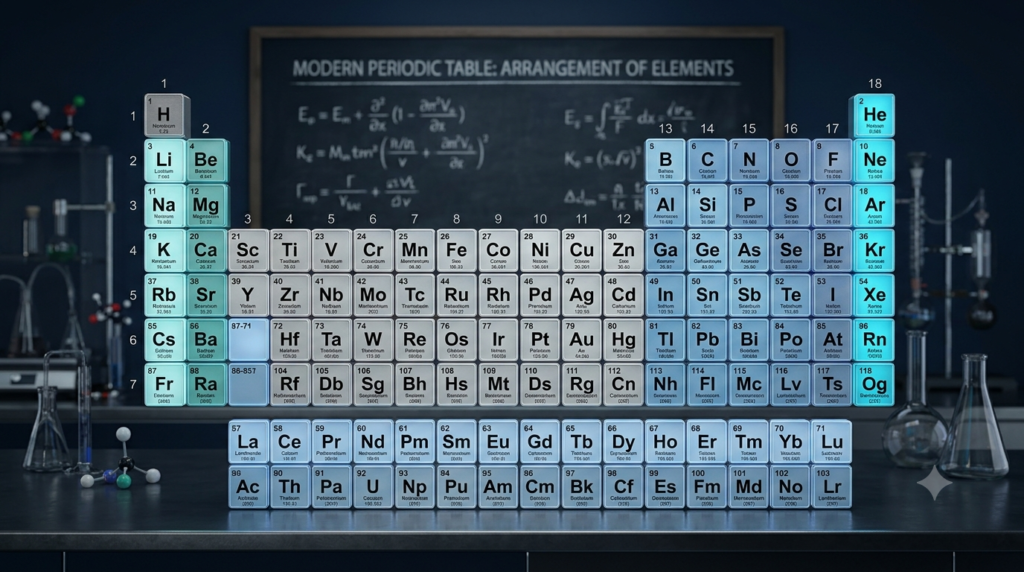
The periodic table is one of the most important tools in chemistry. It organizes all known chemical elements according to their atomic numbers and helps scientists understand their properties and relationships. However, the modern periodic table did not develop all at once. Several scientists contributed to its development, and one of the most important contributions came from the English physicist Henry Moseley.
Before Moseley’s research, scientists mainly arranged elements according to their atomic masses. Although this arrangement helped establish the early periodic table, it created certain problems because some elements did not fit properly into the expected order. Moseley solved this problem through his experiments with X-rays and demonstrated that elements should be arranged according to their atomic numbers rather than their atomic masses.
His discovery established the scientific foundation of the modern periodic table and changed the way scientists understood the structure of atoms.
Who Was Henry Moseley?
Henry Gwyn Jeffreys Moseley was an English physicist born on 23 November 1887 in Weymouth, Dorset, England. He came from a family with strong scientific interests. His father, Henry Nottidge Moseley, was a professor of natural history and had participated in scientific expeditions.
Moseley developed an interest in science at an early age. He studied at Eton College and later attended the University of Oxford, where he studied physics.
After completing his studies, Moseley worked with Ernest Rutherford at the University of Manchester. During this period, he became interested in atomic structure and the relationship between X-rays and the properties of chemical elements.
His research focused on understanding how the internal structure of atoms could be investigated through X-ray radiation. This work eventually led to one of the most important discoveries in the history of chemistry.
Although his scientific career was very short, his contribution had a lasting influence on the development of modern chemistry and physics.
The Periodic Table Before Henry Moseley
Before Moseley’s discovery, scientists had already made significant progress in organizing chemical elements.
In 1869, Russian chemist Dmitri Mendeleev developed a periodic table in which elements were arranged mainly according to increasing atomic mass. He also considered the chemical properties of elements while organizing them.
Mendeleev’s periodic table was a major scientific achievement because it revealed repeating patterns in the properties of elements. It also allowed him to predict the existence and properties of elements that had not yet been discovered.
However, the arrangement based on atomic mass was not completely accurate.
Some elements appeared in an incorrect order when arranged strictly according to their atomic masses. For example:
Argon has a greater atomic mass than potassium, but it must appear before potassium.
Cobalt has a slightly greater atomic mass than nickel, but cobalt must appear before nickel.
Tellurium has a greater atomic mass than iodine, but tellurium appears before iodine.
These irregularities created an important question: Why did some elements not follow the expected order of increasing atomic mass?
Scientists needed a more fundamental property that could explain the correct arrangement of elements.
Henry Moseley’s research provided the answer.
Henry Moseley’s X-Ray Experiments
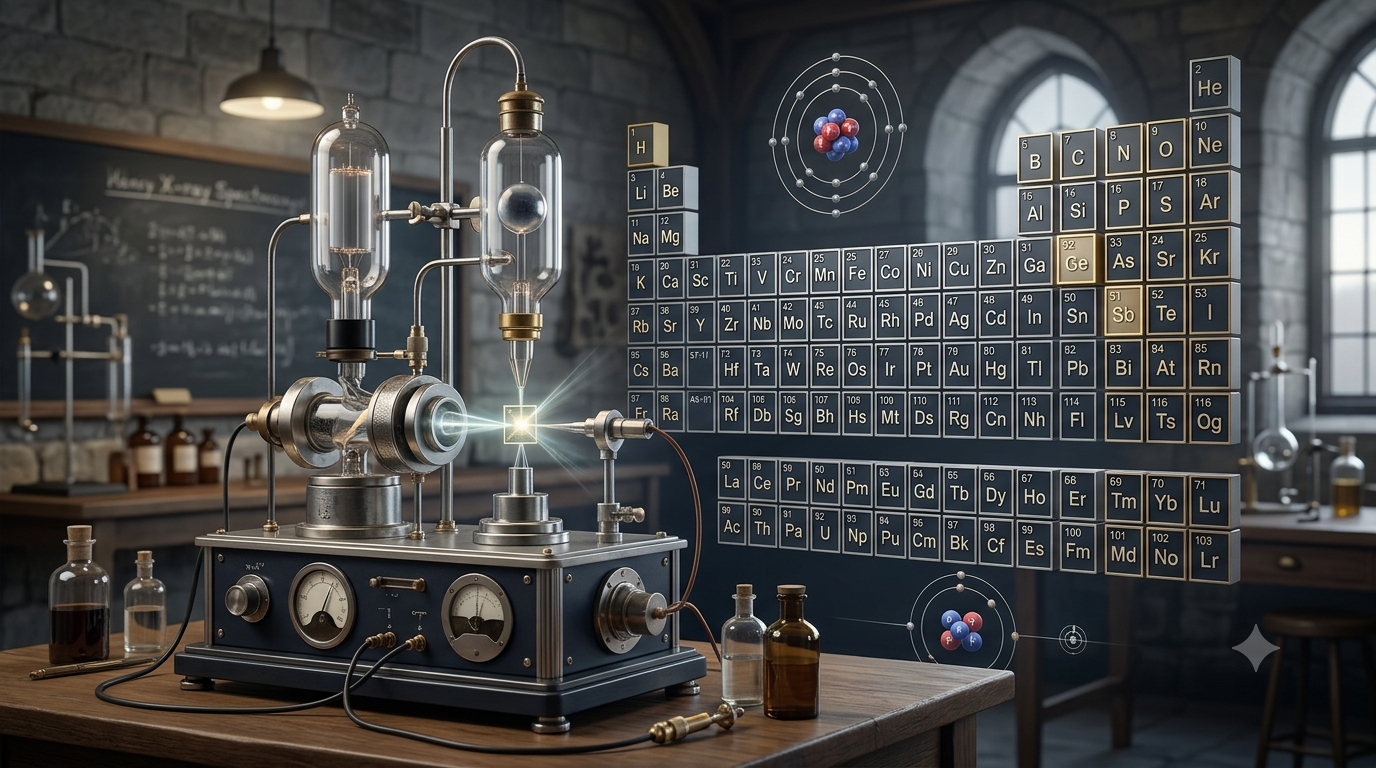
In 1913, Henry Moseley began conducting experiments to investigate the relationship between chemical elements and the X-rays they produced.
He used a technique known as X-ray spectroscopy. This technique allowed him to study the characteristic X-ray radiation emitted by different elements.
During his experiments, Moseley directed high-energy electrons at samples of different elements. When these electrons struck the atoms, they could remove electrons from the inner electron shells.
Electrons from higher energy levels then moved into the empty positions in the inner shells. During this process, energy was released in the form of X-rays.
The emitted X-rays had characteristic frequencies that depended on the element being studied.
Moseley carefully measured these X-ray frequencies for several elements and compared the results.
He discovered that the frequencies followed a systematic mathematical relationship with the positions of the elements in the periodic table.
This observation provided strong evidence that each element possesses a unique fundamental number that determines its identity.
What Did Henry Moseley Discover?
Henry Moseley’s most important discovery was that the atomic number of an element determines its position in the periodic table.
He demonstrated that the frequency of characteristic X-rays emitted by an element is related to its atomic number.
His experiments showed that the square root of the frequency of a particular characteristic X-ray line is approximately proportional to the atomic number of the element.
This relationship is known as Moseley’s Law.
In simplified form:
√ν ∝ (Z − b)
Where:
ν = Frequency of the characteristic X-ray radiation
Z = Atomic number of the element
b = A constant related to the X-ray series being studied
A more complete form of the relationship is:
√ν = a(Z − b)
Where:
a = A proportionality constant
Z = Atomic number
b = A screening constant
Moseley’s findings established that the atomic number is not simply an arbitrary position assigned to an element. It represents a fundamental property of the atom.
Today, the atomic number is understood as the number of protons present in the nucleus of an atom.
For example:
Hydrogen has atomic number 1.
Carbon has atomic number 6.
Oxygen has atomic number 8.
Sodium has atomic number 11.
Iron has atomic number 26.
Each element has a unique atomic number, which distinguishes it from every other element.
What Is Atomic Number?
Atomic number is the number of protons present in the nucleus of an atom. It is represented by the symbol Z.
Every chemical element has a specific atomic number.
For example, a carbon atom contains 6 protons in its nucleus. Therefore, its atomic number is 6.
Similarly, an oxygen atom contains 8 protons, so its atomic number is 8.
In a neutral atom, the number of electrons is equal to the number of protons. However, the number of neutrons can vary, resulting in different isotopes of the same element.
For example, carbon has several isotopes, including carbon-12 and carbon-14. Both have 6 protons, so both have the same atomic number.
This shows why atomic number is a reliable way to identify chemical elements.
Moseley’s research helped establish the importance of this fundamental property in organizing the periodic table.
How Did Moseley Improve the Periodic Table?
Before Moseley’s discovery, the periodic table was mainly organized according to increasing atomic mass. This arrangement worked for most elements but created some exceptions.
Moseley demonstrated that these exceptions could be explained by arranging elements according to their atomic numbers.
This corrected several problems in the earlier periodic table.
1. Correct Arrangement of Elements
Moseley’s discovery established that elements should be arranged in increasing order of atomic number.
This provided a consistent basis for organizing elements and removed the confusion caused by irregularities in atomic masses.
2. Correct Position of Argon and Potassium
Argon has an atomic mass of approximately 39.95 u, while potassium has an atomic mass of approximately 39.10 u.
If elements were arranged strictly according to atomic mass, potassium would appear before argon.
However, argon has atomic number 18, while potassium has atomic number 19.
Therefore, argon correctly appears before potassium in the modern periodic table.
3. Correct Position of Cobalt and Nickel
Cobalt has an atomic number of 27, while nickel has an atomic number of 28.
Although cobalt has a slightly greater atomic mass than nickel, it must appear before nickel because its atomic number is lower.
Moseley’s discovery explained why this arrangement is scientifically correct.
4. Correct Position of Tellurium and Iodine
Tellurium has atomic number 52, while iodine has atomic number 53.
Although tellurium has a greater atomic mass than iodine, it appears before iodine in the modern periodic table.
The atomic number provides the correct order for both elements.
These examples demonstrate why atomic number is a more reliable basis for organizing chemical elements than atomic mass.
Discovery of Missing Elements
Moseley’s experiments also helped scientists identify gaps in the periodic table.
By measuring the X-ray frequencies of known elements, he established a sequence of atomic numbers. This sequence revealed that certain atomic numbers did not correspond to any known element at that time.
These missing atomic numbers indicated that some elements had not yet been discovered.
For example, Moseley’s work helped identify gaps associated with atomic numbers 43 and 61, which were later filled by technetium and promethium, respectively.
His research also helped clarify the correct positions of other elements and strengthened the scientific basis of the periodic table.
This was an important development because it showed that the periodic table was not simply an arrangement based on chemical similarities. It followed an underlying numerical order connected to atomic structure.
Moseley’s Law and Its Importance
Moseley’s Law is one of the most significant results of his research.
It describes the relationship between the atomic number of an element and the frequency of its characteristic X-ray radiation.
The law showed that the X-ray frequencies of different elements increase systematically with atomic number.
This finding provided experimental evidence that atomic number is a fundamental property of elements.
Moseley’s Law is important for several reasons:
It established the scientific basis for arranging elements according to atomic number.
It explained irregularities in the atomic-mass-based periodic table.
It helped identify missing elements.
It demonstrated a connection between atomic structure and X-ray radiation.
It contributed to the development of modern atomic physics.
The relationship discovered by Moseley also became an important foundation for X-ray spectroscopy and elemental analysis.
Difference Between Atomic Number and Atomic Mass
Moseley’s discovery becomes easier to understand when we distinguish between atomic number and atomic mass.
These two properties are related to the structure of an atom, but they represent different things.
Atomic number (Z):
Atomic number is the total number of protons present in the nucleus of an atom. It determines the identity of a chemical element.
Atomic mass:
Atomic mass is related to the masses of the protons, neutrons, and electrons in an atom. The atomic mass of an element shown in the periodic table is generally the weighted average of the masses of its naturally occurring isotopes.
The main differences are:
| Atomic Number | Atomic Mass |
|---|---|
| Represents the number of protons | Represents the average atomic mass of an element’s isotopes |
| Represented by Z | Commonly expressed in atomic mass units (u) |
| Determines the identity of an element | Depends on the masses and natural abundances of isotopes |
| Always a whole number | Often a decimal value in the periodic table |
| Determines the order of elements in the modern periodic table | Does not determine the order of elements |
This distinction explains why elements with unusual atomic-mass relationships can still be arranged correctly in the modern periodic table.
Henry Moseley’s Contribution to Modern Chemistry
Henry Moseley’s work transformed the understanding of the periodic table.
Before his experiments, scientists knew that elements displayed repeating chemical properties. However, they did not have a complete explanation for the correct numerical order of elements.
Moseley provided experimental evidence that atomic number was the fundamental property responsible for this order.
His discovery contributed to several important developments in chemistry and physics.
1. Foundation of the Modern Periodic Table
The modern periodic table is arranged according to increasing atomic number. This arrangement is based on the principle established through Moseley’s experiments.
2. Better Understanding of Atomic Structure
Moseley’s research connected the properties of elements with their atomic structure. It helped scientists understand that the identity of an element is determined by its atomic number.
3. Development of X-Ray Spectroscopy
His work demonstrated that characteristic X-ray frequencies could be used to identify elements. This became an important principle in analytical techniques used in scientific laboratories.
4. Improved Identification of Elements
The relationship between atomic number and X-ray frequency provided a reliable method for identifying elements and studying their atomic properties.
5. Progress in Nuclear Science
Moseley’s work helped establish the importance of atomic number in understanding the structure of atoms. Later developments in nuclear physics provided a deeper explanation of the relationship between atomic number and the number of protons in the nucleus.
Why Was Henry Moseley’s Life So Short?
Henry Moseley’s scientific career was tragically cut short by World War I.
When the war began in 1914, Moseley joined the British Army as a communications officer.
He served during the Gallipoli Campaign in 1915. On 10 August 1915, he was killed in action at the age of just 27.
His death was a major loss to the scientific community. Many scientists believed that he could have made further important contributions to physics and chemistry if he had lived longer.
Following his death, his research continued to influence scientific studies of atomic structure and the periodic table.
His short life remains an example of how a single important discovery can have a lasting impact on science.
Legacy of Henry Moseley
Henry Moseley’s contribution is considered one of the major milestones in the history of chemistry.
His discovery helped establish the modern arrangement of the periodic table and provided a scientific explanation for the order of chemical elements.
Today, every element is identified by its atomic number, from hydrogen (1) to the currently recognized heaviest element, oganesson (118).
The atomic number is essential in chemistry because it determines the number of protons in an atom and helps explain its electron arrangement and chemical behavior.
Moseley’s experiments also demonstrated how physical techniques can solve important problems in chemistry.
His work connected X-ray physics with the classification of chemical elements, showing that discoveries in one scientific field can significantly advance another.
Although he lived for only 27 years, his research continues to be an essential part of modern scientific education.
Conclusion
Henry Moseley played a crucial role in the development of the modern periodic table. Through his X-ray experiments in 1913, he demonstrated that the atomic number, rather than atomic mass, determines the correct order of chemical elements.
His discovery explained the irregular positions of elements such as argon, potassium, cobalt, nickel, tellurium, and iodine. It also helped scientists identify missing elements and understand the fundamental relationship between atomic number and atomic structure.
Moseley’s Law established an important connection between atomic number and characteristic X-ray frequency, making his research significant in both chemistry and physics.
Although his life ended tragically during World War I, his scientific contribution remains extremely important. The modern periodic table, which organizes elements according to increasing atomic number, stands as a lasting reminder of Henry Moseley’s remarkable discovery.
FAQs
1. Who was Henry Moseley?
Henry Moseley was an English physicist born on 23 November 1887 in Weymouth, England. He is best known for discovering the relationship between atomic number and the frequency of characteristic X-rays emitted by elements. His research in 1913 established that elements should be arranged according to increasing atomic number rather than atomic mass. This discovery provided the scientific foundation for the modern periodic table. Moseley worked with Ernest Rutherford at the University of Manchester and made significant contributions to atomic physics. Although his scientific career was short, his discovery permanently changed the organization and understanding of chemical elements.
2. What did Henry Moseley discover?
Henry Moseley discovered that the atomic number of an element is related to the frequency of its characteristic X-ray radiation. Through his experiments in 1913, he demonstrated that elements should be arranged according to increasing atomic number rather than increasing atomic mass. His discovery explained several irregularities in the earlier periodic table, including the positions of argon and potassium, cobalt and nickel, and tellurium and iodine. It also helped scientists identify gaps representing undiscovered elements. His research established atomic number as the fundamental property used to determine the position of an element in the modern periodic table.
3. What is Moseley’s Law?
Moseley’s Law describes the relationship between the atomic number of an element and the frequency of its characteristic X-ray radiation. According to this law, the square root of the frequency is approximately proportional to the difference between the atomic number and a screening constant. It can be represented as √ν = a(Z − b), where ν represents X-ray frequency, Z represents atomic number, and a and b are constants. This relationship demonstrated that atomic number is a fundamental property of elements. Moseley’s Law became an important contribution to atomic physics and helped establish the modern arrangement of the periodic table.
4. Why did Henry Moseley arrange elements according to atomic number?
Henry Moseley demonstrated that arranging elements according to atomic mass created certain irregularities in the periodic table. Some elements appeared in an incorrect order because their atomic masses did not match their chemical relationships. For example, argon has a greater atomic mass than potassium but must appear before it. Moseley discovered that these problems disappeared when elements were arranged according to increasing atomic number. Atomic number represents the number of protons in an atom’s nucleus and determines the identity of an element. His discovery provided a more accurate and scientifically reliable foundation for organizing chemical elements.
5. How did Henry Moseley conduct his experiments?
Henry Moseley conducted experiments using X-ray spectroscopy. He directed high-energy electrons at different elemental samples, causing them to emit characteristic X-rays. He then measured the frequencies of these X-rays and compared them with the positions of the corresponding elements in the periodic table. His observations revealed a systematic mathematical relationship between X-ray frequency and atomic number. The results showed that each element has a characteristic X-ray frequency associated with its atomic number. These experiments provided experimental evidence that atomic number, rather than atomic mass, determines the correct sequence of elements.
6. How did Moseley’s discovery improve Mendeleev’s periodic table?
Mendeleev arranged elements mainly according to increasing atomic mass and similarities in their chemical properties. Although his periodic table was highly successful, some elements did not fit perfectly into this arrangement. Henry Moseley solved this problem by demonstrating that elements should be arranged according to increasing atomic number. His discovery explained the correct positions of elements such as cobalt, nickel, tellurium, and iodine. It also provided a scientific explanation for the order of elements. Moseley’s work did not replace Mendeleev’s achievement; instead, it improved the scientific foundation of the periodic table and established its modern arrangement.
7. What is the difference between atomic number and atomic mass?
Atomic number is the number of protons present in the nucleus of an atom, whereas atomic mass is related to the combined masses of its subatomic particles. The atomic number determines the identity of an element and is represented by the symbol Z. Atomic mass is commonly expressed in atomic mass units (u). The atomic number is always a whole number, while the average atomic mass shown in the periodic table is often a decimal because it accounts for naturally occurring isotopes. Henry Moseley’s discovery established atomic number as the correct property for arranging elements in the periodic table.
8. How did Moseley’s experiments help discover missing elements?
Moseley’s experiments established a systematic sequence of atomic numbers for chemical elements. When he compared the atomic numbers with the elements already known, he identified gaps in the sequence. These gaps indicated that certain elements had not yet been discovered. His research helped identify missing atomic numbers, including 43 and 61, which were later assigned to technetium and promethium, respectively. This was an important achievement because it provided scientists with a reliable way to recognize missing elements. It also strengthened the periodic table by showing that its arrangement followed a definite numerical order.
9. Why is Henry Moseley’s discovery important in modern chemistry?
Henry Moseley’s discovery is important because it established atomic number as the fundamental basis of the modern periodic table. His research explained why elements must be arranged according to the number of protons rather than atomic mass. This corrected earlier irregularities and improved the classification of chemical elements. His experiments also established a relationship between atomic number and characteristic X-ray frequencies, contributing to the development of X-ray spectroscopy. Today, atomic number is essential for identifying elements, understanding atomic structure, and studying chemical properties. His discovery remains one of the most significant developments in the history of chemistry.
10. How did Henry Moseley die?
Henry Moseley died on 10 August 1915 during World War I at the age of 27. He joined the British Army and served as a communications officer during the Gallipoli Campaign. He was killed in action while serving at Gallipoli. His death was a major loss to the scientific community because he had already made an important contribution to physics and chemistry through his discovery of the relationship between atomic number and X-ray frequency. Despite his short scientific career, his research continues to influence modern chemistry. His work remains essential to understanding the organization of the periodic table.