Ionization energy is one of the most important concepts in chemistry because it helps explain how atoms lose electrons and form positive ions. It also provides valuable information about the electronic structure of an element and its chemical behaviour. Different elements require different amounts of energy to remove an electron from their atoms. For example, removing an electron from an alkali metal is generally easier than removing one from a noble gas.
Ionization energy is closely related to atomic size, nuclear charge, electron shielding, and electronic configuration. These factors explain why ionization energy changes in a regular pattern across periods and down groups of the periodic table. Understanding these trends makes it easier to compare elements and predict their chemical properties.
In this article, we will learn what ionization energy is, how it is measured, the different types of ionization energy, the factors affecting it, and how it changes across the periodic table.
What Is Ionization Energy?
Ionization energy is the minimum amount of energy required to remove an electron from an isolated gaseous atom in its ground state.
When an electron is removed from a neutral atom, the atom becomes a positively charged ion called a cation.
For example, when a sodium atom loses one electron, it forms a sodium ion:
Na(g) + Energy → Na⁺(g) + e⁻
In this process, a sodium atom absorbs energy to remove one electron from its outermost shell. As a result, it becomes a positively charged sodium ion.
Ionization energy is generally expressed in kilojoules per mole (kJ/mol) or electronvolts (eV).
A higher ionization energy means that more energy is required to remove an electron. Therefore, the electron is held more strongly by the nucleus.
Similarly, a lower ionization energy means that less energy is needed to remove an electron, indicating that the electron is relatively easier to remove.
First Ionization Energy
First ionization energy is the energy required to remove the first electron from one mole of isolated gaseous atoms, forming one mole of gaseous positive ions.
The process can be represented by the following general equation:
X(g) + Energy → X⁺(g) + e⁻
Here:
X represents a neutral gaseous atom.
X⁺ represents a positively charged ion.
e⁻ represents the removed electron.
For example, the first ionization of magnesium is represented as:
Mg(g) + Energy → Mg⁺(g) + e⁻
The first ionization energy depends on how strongly the outermost electron is attracted to the positively charged nucleus.
Elements with loosely held outer electrons generally have lower first ionization energies, while elements with strongly held electrons have higher values.
Successive Ionization Energies
An atom can lose more than one electron. The energy required to remove additional electrons is called successive ionization energy.
These energies are divided into first, second, third, and higher ionization energies.
Second Ionization Energy
Second ionization energy is the energy required to remove the second electron from a gaseous singly charged positive ion.
X⁺(g) + Energy → X²⁺(g) + e⁻
For example:
Na⁺(g) + Energy → Na²⁺(g) + e⁻
Third Ionization Energy
Third ionization energy is the energy required to remove the third electron from a gaseous doubly charged positive ion.
X²⁺(g) + Energy → X³⁺(g) + e⁻
Each successive ionization energy is generally greater than the previous one because removing electrons makes the remaining electrons experience a stronger effective attraction from the nucleus.
Therefore:
First Ionization Energy < Second Ionization Energy < Third Ionization Energy
This relationship is important for understanding the stability of electronic configurations.
Factors Affecting Ionization Energy
Ionization energy is influenced by several factors related to the structure of an atom. The most important factors are nuclear charge, atomic size, shielding effect, penetration effect, and electronic configuration.
1. Nuclear Charge
Nuclear charge refers to the total positive charge of the nucleus, which depends on the number of protons present in an atom.
As nuclear charge increases, the attraction between the nucleus and electrons generally becomes stronger.
Consequently, more energy is required to remove an electron, resulting in higher ionization energy.
For example, when moving across a period, the number of protons increases. This generally causes ionization energy to increase because the outer electrons experience a greater effective nuclear attraction.
2. Atomic Size
Atomic size refers to the distance between the nucleus and the outermost electrons.
When an atom has a larger atomic radius, its outermost electrons are generally farther away from the nucleus. As a result, the attractive force between the nucleus and the outer electrons becomes weaker.
Therefore, less energy is usually required to remove an electron from a larger atom.
In contrast, smaller atoms generally have higher ionization energies because their outermost electrons are closer to the nucleus and experience stronger attraction.
3. Shielding Effect
The shielding effect, also called the screening effect, occurs when inner-shell electrons reduce the attractive force of the nucleus on the outermost electrons.
Inner electrons partially block the attraction between the positively charged nucleus and the valence electrons.
As the number of occupied inner electron shells increases, the shielding effect generally becomes stronger.
This makes the outermost electrons easier to remove and reduces ionization energy.
For example, potassium has a lower first ionization energy than sodium because potassium has an additional electron shell. Its outermost electron is farther from the nucleus and experiences greater shielding.
4. Penetration Effect
The penetration effect describes how effectively an electron in an orbital can approach the nucleus.
Electrons in different types of orbitals experience different levels of attraction from the nucleus.
For orbitals belonging to the same principal energy level, the general order of penetration is:
s > p > d > f
An electron in an s-orbital can penetrate closer to the nucleus than an electron in a p-orbital of the same principal energy level.
Greater penetration generally means stronger attraction to the nucleus and higher ionization energy.
This effect helps explain some irregularities in the periodic trend of ionization energy.
5. Electronic Configuration
The electronic configuration of an atom describes how its electrons are distributed among different shells and subshells.
Certain electronic configurations are relatively stable, particularly completely filled and half-filled subshells.
Because of this additional stability, removing an electron from these configurations may require more energy.
For example, nitrogen has a half-filled 2p subshell, which provides additional stability. Oxygen has one paired set of electrons in its 2p orbitals, resulting in some electron-electron repulsion.
Therefore, the first ionization energy of nitrogen is slightly higher than that of oxygen, even though oxygen comes after nitrogen in the periodic table.
Periodic Trend of Ionization Energy
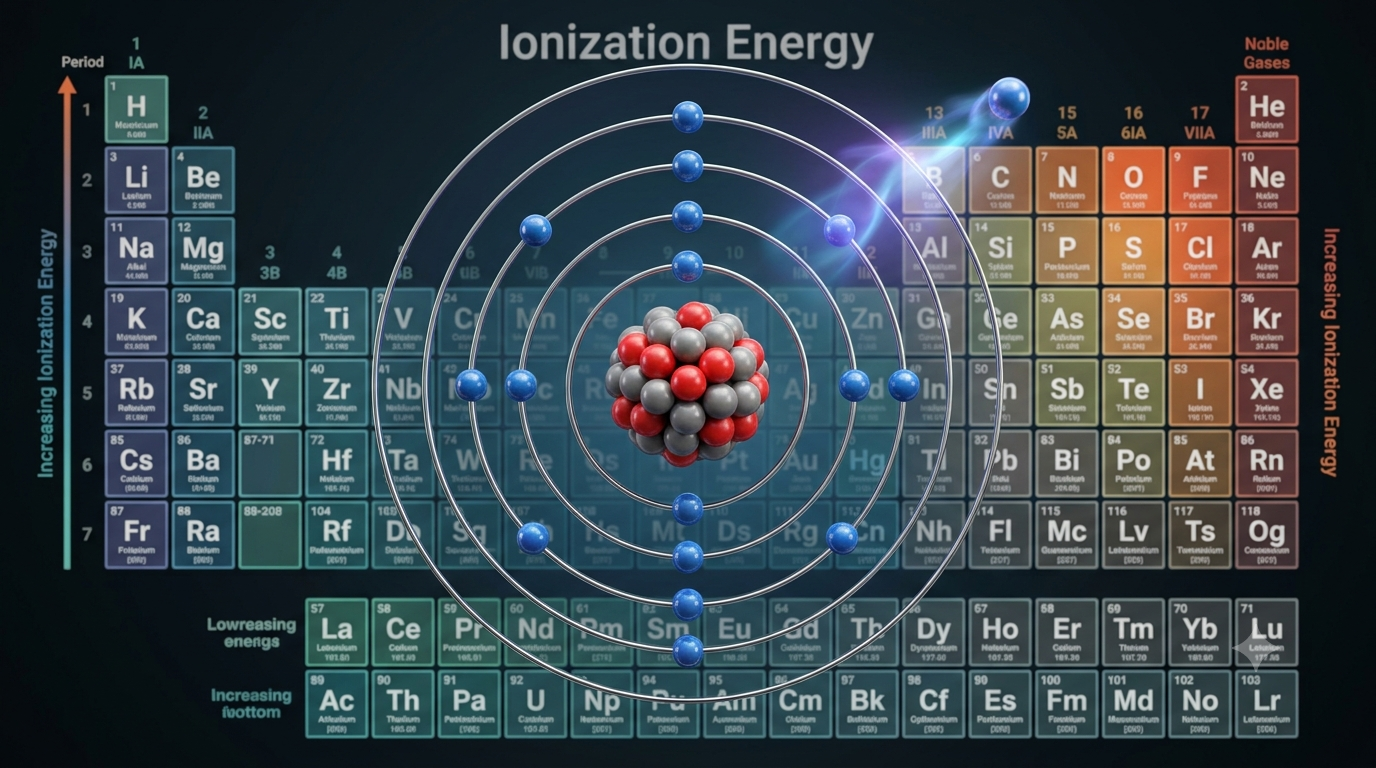
Ionization energy follows a general pattern in the periodic table. It usually increases from left to right across a period and decreases from top to bottom down a group.
These trends are mainly explained by changes in effective nuclear charge, atomic size, and shielding effect.
1. Ionization Energy Across a Period
As we move from left to right across a period, ionization energy generally increases.
This happens because the number of protons in the nucleus increases while the added electrons generally enter the same principal energy level.
The effective nuclear charge experienced by the outermost electrons generally increases. Consequently, the electrons are attracted more strongly towards the nucleus.
Atomic size also generally decreases across a period, making the outermost electrons more difficult to remove.
Therefore, more energy is required to remove an electron.
For example, consider the general trend across Period 3:
Na < Mg > Al < Si < P > S < Cl < Ar
The sequence shows the broad increase in ionization energy, but it also includes two important exceptions: magnesium to aluminium and phosphorus to sulfur.
These exceptions occur because of differences in subshell energies and electron pairing.
In general, noble gases have very high ionization energies because of their stable electronic configurations.
2. Ionization Energy Down a Group
As we move from top to bottom in a group, ionization energy generally decreases.
This happens because each successive element has an additional electron shell.
The outermost electrons become farther away from the nucleus, increasing atomic size. The shielding effect also becomes stronger because more inner-shell electrons are present.
Although nuclear charge increases down a group, the combined effects of increased distance and shielding generally reduce the attraction experienced by the outermost electrons.
As a result, less energy is required to remove an electron.
For example, consider the alkali metals:
Li > Na > K > Rb > Cs
The first ionization energy generally decreases as we move down Group 1.
Lithium has a relatively small atomic size, so its outermost electron is held more strongly than the outermost electron of cesium.
3. Ionization Energy Across the Periodic Table
The overall periodic trend can be summarised as follows:
Across a period: Ionization energy generally increases from left to right.
Down a group: Ionization energy generally decreases from top to bottom.
Alkali metals: Generally have low first ionization energies.
Noble gases: Generally have high first ionization energies.
These trends help chemists understand why some elements lose electrons easily while others resist electron removal.
Exceptions to the General Periodic Trend
Although ionization energy generally increases across a period, there are some important exceptions.
These exceptions occur mainly because of differences in orbital energies, subshell stability, and electron-electron repulsion.
1. Beryllium and Boron
Beryllium has a higher first ionization energy than boron, even though boron comes after beryllium in Period 2.
The electronic configurations are:
Beryllium (Be): 1s² 2s²
Boron (B): 1s² 2s² 2p¹
In beryllium, the outermost electrons occupy the completely filled 2s subshell.
In boron, the first electron removed comes from the 2p subshell, which is higher in energy and less penetrating than the 2s subshell.
Therefore, removing an electron from boron is easier than removing one from beryllium.
As a result, the first ionization energy of boron is lower than that of beryllium.
2. Nitrogen and Oxygen
Nitrogen has a higher first ionization energy than oxygen, although oxygen comes after nitrogen in Period 2.
Their electronic configurations are:
Nitrogen (N): 1s² 2s² 2p³
Oxygen (O): 1s² 2s² 2p⁴
Nitrogen has three electrons distributed singly among its three 2p orbitals. This half-filled configuration is relatively stable.
Oxygen has four electrons in its 2p orbitals, meaning that one orbital contains a pair of electrons.
The repulsion between these paired electrons makes it slightly easier to remove one of them.
Therefore, oxygen has a lower first ionization energy than nitrogen.
These two examples demonstrate why ionization energy does not increase perfectly across every period.
Ionization Energy of Different Groups
Different groups of the periodic table show characteristic ionization energy patterns because of their electronic configurations.
Group 1: Alkali Metals
Alkali metals include lithium, sodium, potassium, rubidium, and cesium.
These elements have one electron in their outermost shell.
They generally have low first ionization energies because their outermost electron can be removed relatively easily.
After losing this electron, they achieve a more stable electronic configuration.
This is why alkali metals commonly form +1 ions.
Group 2: Alkaline Earth Metals
Alkaline earth metals include beryllium, magnesium, calcium, strontium, and barium.
They have two electrons in their outermost s-orbital.
Their first ionization energies are generally higher than those of the alkali metals in the same period.
They commonly lose two outermost electrons to form +2 ions.
Group 17: Halogens
Halogens include fluorine, chlorine, bromine, iodine, and astatine.
They have seven electrons in their outermost shell.
Their relatively high ionization energies indicate that their electrons are strongly attracted to the nucleus.
Halogens generally tend to gain one electron rather than lose electrons during common chemical reactions.
Group 18: Noble Gases
Noble gases include helium, neon, argon, krypton, xenon, and radon.
They have stable outer electronic configurations.
Helium has a completely filled 1s orbital, while the other noble gases generally have completely filled valence shells.
Because of these stable configurations, removing an electron requires a relatively large amount of energy.
Noble gases therefore generally have the highest first ionization energies within their respective periods.
Successive Ionization Energy and Electronic Configuration
Successive ionization energies provide useful information about the number of valence electrons in an atom.
When electrons are removed one after another, the energy required generally increases.
However, a particularly large increase may occur after all the valence electrons have been removed.
This happens because the next electron must be removed from an inner shell, where it experiences a much stronger attraction from the nucleus.
For example, magnesium has the electronic configuration:
Mg: 1s² 2s² 2p⁶ 3s²
Magnesium has two valence electrons in its outermost shell.
The first two electrons can be removed relatively easily compared with the third electron.
After losing two electrons, magnesium forms Mg²⁺, which has the stable electronic configuration of neon.
Removing the third electron requires breaking into this stable inner-shell configuration. Therefore, the third ionization energy is much higher than the second.
This large jump in successive ionization energies can help identify the number of valence electrons in an element.
Relationship Between Ionization Energy and Chemical Reactivity
Ionization energy is closely connected to the chemical behaviour of elements.
Elements with low ionization energies can lose electrons relatively easily. They are more likely to form positive ions during chemical reactions.
For example, sodium loses one electron to form Na⁺, while magnesium loses two electrons to form Mg²⁺.
On the other hand, elements with high ionization energies resist losing electrons.
This is one reason why noble gases are generally less reactive than many other elements.
However, ionization energy alone does not determine the complete chemical reactivity of an element. Electron affinity, electronegativity, bonding behaviour, and other factors also play important roles.
Applications of Ionization Energy
Ionization energy is useful in several areas of chemistry and science.
1. Understanding Chemical Bond Formation
Ionization energy helps explain why certain elements form positive ions and participate in ionic bonding.
2. Predicting Chemical Reactivity
Elements with relatively low ionization energies often lose electrons more easily, helping chemists understand their chemical behaviour.
3. Identifying Elements
Ionization energy measurements can provide information about the electronic structure of unknown atoms and ions.
4. Studying Atomic Structure
Ionization energy helps scientists understand the attraction between the nucleus and electrons, as well as the arrangement of electrons in different orbitals.
5. Understanding Periodic Trends
Comparing ionization energies helps explain the similarities and differences between elements in the same period or group.
6. Spectroscopic Analysis
Ionization processes are important in atomic spectroscopy and analytical techniques such as mass spectrometry, where atoms or molecules are converted into ions for analysis.
Difference Between Ionization Energy and Electron Affinity
Ionization energy and electron affinity are two important properties related to the transfer of electrons, but they describe different processes.
| Ionization Energy | Electron Affinity |
|---|---|
| Energy required to remove an electron from an isolated gaseous atom. | Energy change when an isolated gaseous atom gains an electron. |
| Produces a positive ion. | Produces a negative ion. |
| Removal of an electron requires energy. | Electron addition may release energy or, in some cases, require energy. |
| Generally increases across a period. | Generally becomes more favourable across a period, with exceptions. |
| Generally decreases down a group. | Shows more irregular changes down a group. |
Both properties help explain how elements behave during chemical reactions and why they form different types of ions.
Conclusion
Ionization energy is an important periodic property that describes how strongly an atom holds its electrons. It is influenced by nuclear charge, atomic size, shielding effect, penetration effect, and electronic configuration.
In general, ionization energy increases from left to right across a period and decreases from top to bottom down a group. However, exceptions such as beryllium and boron, and nitrogen and oxygen, occur because of differences in subshell stability and electron repulsion.
Understanding ionization energy makes it easier to explain the formation of positive ions, compare the chemical behaviour of elements, and understand the relationship between atomic structure and periodic properties. It is therefore an essential concept for studying chemical bonding, electronic configurations, and the periodic table.
FAQs
1. What is ionization energy?
Ionization energy is the minimum amount of energy required to remove an electron from an isolated gaseous atom in its ground state. When an electron is removed, the neutral atom becomes a positively charged ion called a cation. Ionization energy indicates how strongly an atom holds its electrons. A higher ionization energy means that more energy is needed to remove an electron, while a lower ionization energy means that the electron can be removed more easily. It is commonly measured in kilojoules per mole (kJ/mol) or electronvolts (eV).
2. What is first ionization energy?
First ionization energy is the energy required to remove the first electron from one mole of isolated gaseous atoms in their ground state. This process produces one mole of singly charged positive ions. For example, when a gaseous sodium atom loses one electron, it forms a sodium ion (Na⁺). First ionization energy helps determine how easily an element can lose its outermost electron. Elements with low first ionization energies generally lose electrons more easily than elements with high first ionization energies.
3. What are successive ionization energies?
Successive ionization energies are the energies required to remove electrons one after another from a gaseous atom or its positive ions. They include first, second, third, and higher ionization energies. Each successive ionization energy is generally greater than the previous one because the remaining electrons experience stronger attraction from the nucleus. A particularly large increase occurs when an electron must be removed from an inner shell after all the outermost electrons have been removed. These large increases help identify the number of valence electrons in an atom.
4. Why does ionization energy increase across a period?
Ionization energy generally increases from left to right across a period because the nuclear charge increases as the number of protons increases. The added electrons generally enter the same principal energy level, so shielding does not increase enough to cancel the stronger nuclear attraction. Consequently, the effective nuclear charge increases, and the atomic radius generally decreases. The outermost electrons become more strongly attracted to the nucleus, making them harder to remove. Therefore, more energy is generally required to remove an electron as we move across a period.
5. Why does ionization energy decrease down a group?
Ionization energy generally decreases down a group because each successive element has an additional electron shell. This increases atomic size and the distance between the nucleus and the outermost electron. The shielding effect also becomes stronger because more inner-shell electrons are present. Although nuclear charge increases down a group, the increased distance and shielding generally reduce the attraction experienced by the outermost electron. As a result, less energy is required to remove an electron from an atom located lower in a group.
6. Which elements have the highest and lowest ionization energies?
Helium has the highest first ionization energy among all elements because its electrons occupy a very small and stable 1s orbital. Among the elements in a given period, noble gases generally have the highest first ionization energies. Cesium and francium are among the elements with the lowest first ionization energies. Their outermost electrons are relatively far from the nucleus and experience significant shielding. Therefore, these electrons can be removed more easily than those in elements with higher ionization energies.
7. What factors affect ionization energy?
Several factors influence the ionization energy of an atom. These include nuclear charge, atomic size, shielding effect, penetration effect, and electronic configuration. Greater effective nuclear charge generally increases ionization energy because electrons experience stronger attraction from the nucleus. Larger atomic size and stronger shielding generally reduce ionization energy. Penetration also affects how strongly electrons are attracted to the nucleus. Additionally, completely filled and half-filled subshells provide extra stability, which can make electron removal more difficult. These factors together explain the general periodic trends and their exceptions.
8. Why is the ionization energy of nitrogen higher than oxygen?
Nitrogen has a higher first ionization energy than oxygen because of the difference in their electronic configurations. Nitrogen has the configuration 1s² 2s² 2p³, which contains a relatively stable half-filled 2p subshell. Oxygen has the configuration 1s² 2s² 2p⁴, where one 2p orbital contains a pair of electrons. Repulsion between these paired electrons makes it slightly easier to remove one electron from oxygen. Therefore, oxygen has a lower first ionization energy than nitrogen, despite having a greater nuclear charge.
9. What is the difference between ionization energy and electron affinity?
Ionization energy and electron affinity describe two different electron-related processes. Ionization energy is the energy required to remove an electron from an isolated gaseous atom, producing a positive ion. Electron affinity refers to the energy change when an isolated gaseous atom gains an electron, producing a negative ion. Electron removal requires an input of energy, whereas electron addition may release energy or sometimes require energy. Both properties help explain the electronic behaviour of elements and their tendency to form positive or negative ions during chemical reactions.
10. Why is ionization energy important in chemistry?
Ionization energy is important because it helps explain the chemical behaviour and electronic structure of elements. It indicates how easily an atom can lose an electron and form a positive ion. This information is useful for understanding ionic bonding, chemical reactivity, and periodic trends. Successive ionization energies can also help determine the number of valence electrons in an atom. Furthermore, ionization energy measurements are useful in atomic spectroscopy and other analytical techniques. Studying this property helps chemists understand the relationship between atomic structure and the chemical properties of elements.