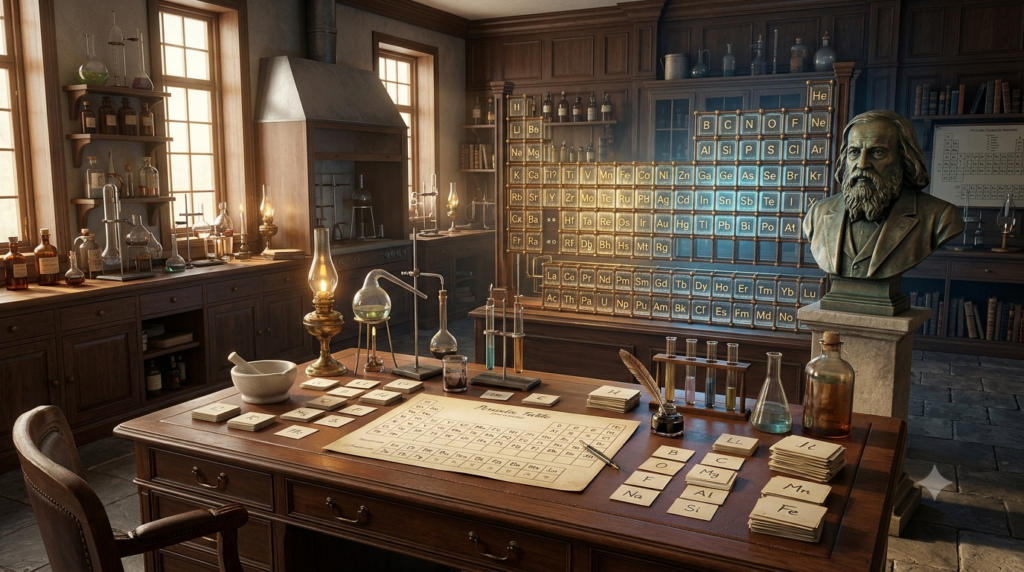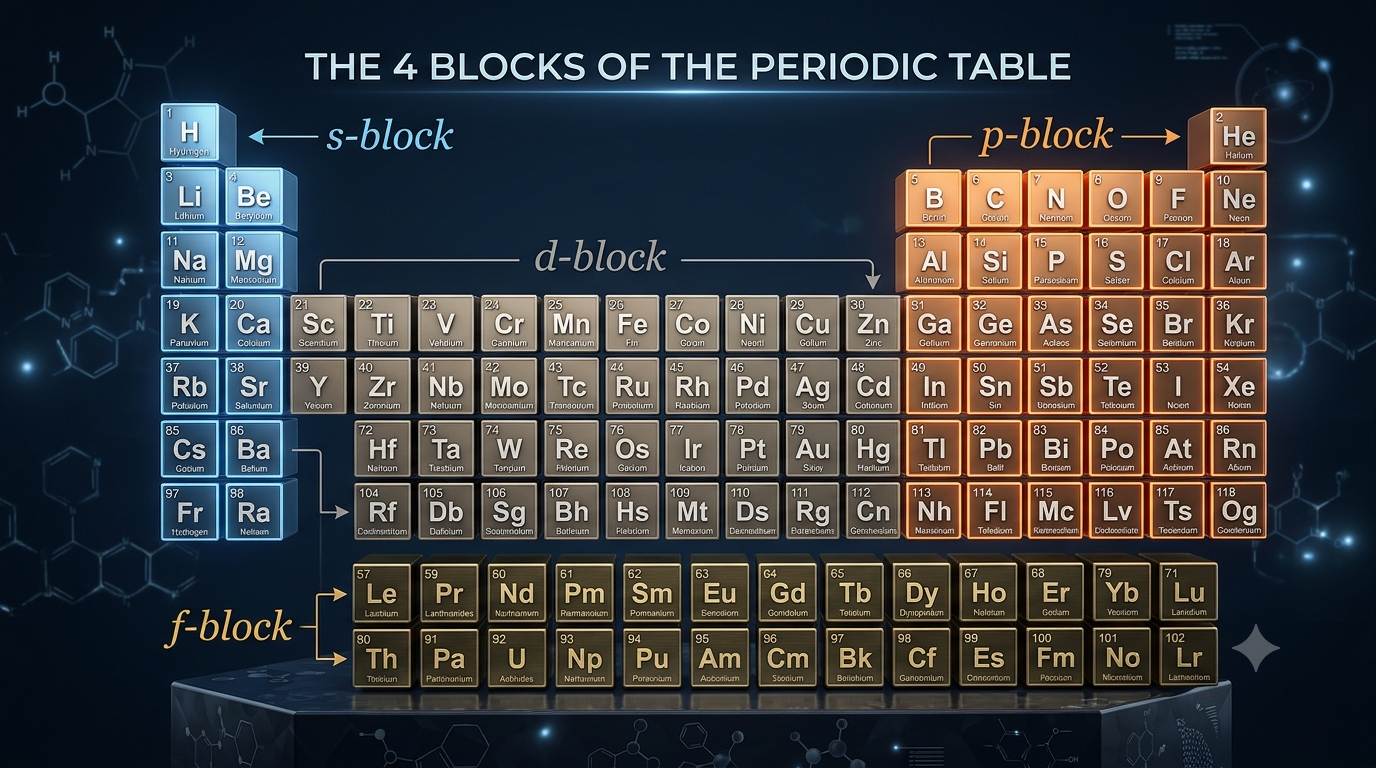
The periodic table is one of the most important tools in chemistry. It organizes all known chemical elements according to their atomic numbers and electronic properties. Although elements are usually arranged in rows called periods and columns called groups, the periodic table can also be divided into four major sections known as blocks.
The four blocks of the periodic table are the s-block, p-block, d-block, and f-block. These blocks are classified according to the type of atomic orbital into which the last electron of an element enters during its electron configuration.
Understanding periodic table blocks helps explain why elements have different chemical properties, how their electrons are arranged, and why certain elements behave similarly during chemical reactions.
In this article, you will learn what blocks are in the periodic table, why elements are divided into four blocks, the characteristics of each block, and how to identify the block of an element using its electronic configuration.
What Are Blocks in the Periodic Table?
Blocks in the periodic table are groups of elements classified according to the type of atomic orbital that receives the last electron during the process of building their electronic configurations.
In simple terms, a block tells us which type of orbital is being filled by the electrons of an element.
There are four types of atomic orbitals commonly involved in the classification of periodic table blocks:
s-orbital
p-orbital
d-orbital
f-orbital
Based on these orbitals, the periodic table is divided into four blocks:
s-block
p-block
d-block
f-block
Each block contains elements with particular electronic configurations and characteristic chemical properties.
For example, sodium (Na) belongs to the s-block because its last electron enters an s-orbital. Carbon (C) belongs to the p-block because its last electron enters a p-orbital.
Similarly, iron (Fe) belongs to the d-block, while uranium (U) belongs to the f-block.
Why Is the Periodic Table Divided into Blocks?
The periodic table is divided into blocks because the electronic configurations of elements follow a systematic pattern.
Every atom contains electrons arranged in different energy levels and orbitals around its nucleus. These electrons occupy orbitals according to specific rules.
The four types of orbitals differ in their shapes, electron capacities, and energy characteristics.
An s-orbital can hold a maximum of 2 electrons.
A p-orbital can hold a maximum of 6 electrons.
A d-orbital can hold a maximum of 10 electrons.
An f-orbital can hold a maximum of 14 electrons.
These differences in electron capacity help determine the arrangement of elements in the periodic table.
As electrons fill different types of orbitals, elements are placed into corresponding blocks.
The block classification also helps chemists understand similarities in electronic configurations, chemical bonding, oxidation states, and other properties of elements.
The Four Blocks of the Periodic Table
The periodic table contains four major blocks: s-block, p-block, d-block, and f-block. Each block has its own electronic configuration and characteristics.
1. s-Block Elements
The s-block consists of elements in which the last electron enters an s-orbital.
These elements are located on the left side of the periodic table. They mainly include Group 1 and Group 2 elements.
Hydrogen and helium are also classified as s-block elements based on their electronic configurations, even though helium is positioned in Group 18 because of its chemical properties.
General Electronic Configuration
The general electronic configuration of s-block elements is:
ns¹–²
Here, n represents the principal energy level, while the superscript indicates the number of electrons in the s-orbital.
Group 1 elements generally have one electron in their outermost s-orbital, while Group 2 elements have two.
Examples of s-Block Elements
Some common s-block elements include:
Hydrogen (H)
Lithium (Li)
Sodium (Na)
Potassium (K)
Magnesium (Mg)
Calcium (Ca)
Beryllium (Be)
Characteristics of s-Block Elements
The last electron enters an s-orbital.
Most s-block elements are highly reactive metals.
Group 1 elements are known as alkali metals.
Group 2 elements are known as alkaline earth metals.
They generally have low ionization energies compared with many other elements.
They commonly form positive ions by losing their outermost electrons.
Many of their compounds are ionic in nature.
Examples and Applications
Sodium is used in several chemical industries and is an essential component of many biological processes. Calcium is important for healthy bones and teeth. Magnesium is used in lightweight alloys and various industrial applications.
The s-block contains some of the most reactive metallic elements in the periodic table.
2. p-Block Elements
The p-block consists of elements in which the last electron enters a p-orbital.
These elements are located on the right side of the periodic table, mainly in Groups 13 to 18.
The p-block contains metals, nonmetals, and metalloids. Therefore, it includes elements with a wide variety of physical and chemical properties.
General Electronic Configuration
The general electronic configuration of p-block elements is:
ns² np¹–⁶
The outermost p-orbital can contain a maximum of six electrons.
Helium is an exception to the usual Group 18 electronic configuration because its electronic configuration is 1s². Therefore, although it is placed in Group 18, it belongs to the s-block.
Examples of p-Block Elements
Some common p-block elements include:
Boron (B)
Carbon (C)
Nitrogen (N)
Oxygen (O)
Fluorine (F)
Aluminium (Al)
Silicon (Si)
Phosphorus (P)
Sulfur (S)
Chlorine (Cl)
Neon (Ne)
Characteristics of p-Block Elements
The last electron enters a p-orbital.
The block includes metals, nonmetals, and metalloids.
Elements show a wide range of chemical properties.
They can form covalent as well as ionic compounds.
Some elements show multiple oxidation states.
Many p-block elements are essential for living organisms.
Their properties vary significantly across periods and groups.
Examples and Applications
Carbon is the basic element of organic chemistry and is found in all known forms of life. Oxygen is essential for respiration. Nitrogen is an important component of proteins and fertilizers.
Silicon is widely used in electronic devices and semiconductor technology. Aluminium is used in construction, transportation, and packaging.
The p-block is particularly important because it contains many elements essential for life, industry, and modern technology.
3. d-Block Elements
The d-block consists of elements in which the last differentiating electron enters a d-orbital.
These elements are located in the middle of the periodic table, between the s-block and p-block. They mainly occupy Groups 3 to 12.
Most d-block elements are metals and are commonly known as transition elements, although the terms d-block elements and transition elements are not completely interchangeable.
A transition element is generally defined as an element whose atom has an incomplete d-subshell or which can form a cation with an incomplete d-subshell.
General Electronic Configuration
The general electronic configuration of d-block elements is:
(n−1)d¹–¹⁰ ns⁰–²
The d-orbital can hold a maximum of ten electrons.
Some d-block elements have exceptional electronic configurations because half-filled and completely filled d-subshells can provide additional stability.
Examples of d-Block Elements
Some common d-block elements include:
Scandium (Sc)
Titanium (Ti)
Chromium (Cr)
Manganese (Mn)
Iron (Fe)
Cobalt (Co)
Nickel (Ni)
Copper (Cu)
Zinc (Zn)
Silver (Ag)
Gold (Au)
Characteristics of d-Block Elements
The differentiating electron generally enters a d-orbital.
Most d-block elements are hard and strong metals.
Many have high melting and boiling points.
They often show variable oxidation states.
Many form coloured ions and compounds.
Several act as catalysts in chemical reactions.
Many form complex coordination compounds.
Most are good conductors of heat and electricity.
Examples and Applications
Iron is widely used in construction, machinery, and steel manufacturing. Copper is commonly used in electrical wiring because of its excellent electrical conductivity.
Nickel is used in stainless steel and rechargeable batteries. Platinum is used as a catalyst in various industrial processes.
The d-block plays an important role in manufacturing, engineering, electronics, and chemical industries.
4. f-Block Elements
The f-block consists of elements in which the last differentiating electron enters an f-orbital.
These elements are generally displayed in two separate rows below the main body of the periodic table.
The f-block contains two important series:
Lanthanides
Actinides
The lanthanide series generally includes elements from lanthanum (La) to lutetium (Lu), while the actinide series includes elements from actinium (Ac) to lawrencium (Lr).
The f-block elements are also known as inner transition elements.
General Electronic Configuration
The general electronic configuration of f-block elements is:
(n−2)f¹–¹⁴ (n−1)d⁰–¹ ns²
The f-orbital can hold a maximum of fourteen electrons.
The actual electronic configurations of individual elements may vary because of differences in electron energy levels and electron stability.
Examples of f-Block Elements
Some common f-block elements include:
Cerium (Ce)
Neodymium (Nd)
Samarium (Sm)
Europium (Eu)
Gadolinium (Gd)
Thorium (Th)
Uranium (U)
Plutonium (Pu)
Characteristics of f-Block Elements
The differentiating electron generally enters an f-orbital.
They are known as inner transition elements.
They are divided into lanthanide and actinide series.
Many lanthanides have similar chemical properties.
Many actinides are radioactive.
They can show different oxidation states.
Several f-block elements have important magnetic and optical properties.
Examples and Applications
Neodymium is used to manufacture powerful permanent magnets found in electric motors, headphones, and electronic devices.
Cerium is used in glass polishing and other industrial applications. Uranium is used as nuclear fuel in certain nuclear reactors.
Some actinides, such as plutonium, also have applications in nuclear technology.
The f-block is particularly important in advanced materials, electronics, scientific research, and nuclear energy.
Difference Between the Four Blocks of the Periodic Table
The four blocks can be compared according to their positions, orbitals, electron capacities, and general characteristics.
| Feature | s-Block | p-Block | d-Block | f-Block |
|---|---|---|---|---|
| Last electron enters | s-orbital | p-orbital | d-orbital | f-orbital |
| Location | Left side | Right side | Middle | Bottom rows |
| Groups | 1 and 2 | 13–18 | 3–12 | Separate series |
| Maximum orbital capacity | 2 | 6 | 10 | 14 |
| General configuration | ns¹–² | ns²np¹–⁶ | (n−1)d¹–¹⁰ns⁰–² | (n−2)f¹–¹⁴ |
| Common classification | Representative elements | Representative elements | Transition elements | Inner transition elements |
This comparison makes it easier to understand how the four blocks differ from one another.
How to Identify the Block of an Element?
Identifying the block of an element is relatively simple when its electronic configuration is known.
The main rule is to identify the subshell into which the last differentiating electron enters.
Follow these steps:
Step 1: Find the Atomic Number
The atomic number tells you the total number of electrons in a neutral atom.
Step 2: Write the Electronic Configuration
Arrange the electrons in different shells and subshells according to the Aufbau principle, while considering the applicable exceptions.
Step 3: Identify the Differentiating Electron
Find the subshell that receives the last electron when moving from one element to the next in the periodic table.
Step 4: Determine the Block
Use the type of subshell to identify the block:
Last electron enters s-orbital → s-block
Last electron enters p-orbital → p-block
Last electron enters d-orbital → d-block
Last electron enters f-orbital → f-block
Examples of Block Identification
Let’s understand this process using a few elements.
Example 1: Sodium (Na)
Atomic number = 11
Electronic configuration = 1s² 2s² 2p⁶ 3s¹
The last electron enters the 3s-orbital.
Therefore, sodium belongs to the s-block.
Example 2: Chlorine (Cl)
Atomic number = 17
Electronic configuration = 1s² 2s² 2p⁶ 3s² 3p⁵
The last electron enters the 3p-orbital.
Therefore, chlorine belongs to the p-block.
Example 3: Iron (Fe)
Atomic number = 26
Electronic configuration = [Ar] 3d⁶ 4s²
The differentiating electron enters the 3d-subshell.
Therefore, iron belongs to the d-block.
Example 4: Uranium (U)
Atomic number = 92
Electronic configuration = [Rn] 5f³ 6d¹ 7s²
The differentiating electron is associated with the filling of the 5f-subshell.
Therefore, uranium belongs to the f-block.
These examples show how electronic configurations help determine the block of an element.
Relationship Between Blocks, Groups, and Periods
Blocks, groups, and periods are three important ways of organizing elements in the periodic table.
Although these terms are related, they describe different aspects of the periodic table.
Blocks
Blocks classify elements according to the type of subshell being filled by the differentiating electron. The four blocks are s, p, d, and f.
Groups
Groups are the vertical columns of the periodic table. There are 18 groups. Elements in the same group often have similar chemical properties because they have related outer electronic configurations.
Periods
Periods are the horizontal rows of the periodic table. There are seven periods. Elements in the same period have electrons occupying the same highest principal energy level in their ground-state electron configurations.
For example, sodium and magnesium belong to the same period but different blocks. Sodium belongs to the s-block, whereas magnesium also belongs to the s-block. Carbon and oxygen belong to the same period and both belong to the p-block.
Therefore, blocks, groups, and periods provide different but complementary information about the arrangement and properties of chemical elements.
Why Are Blocks Important in Chemistry?
The classification of elements into blocks is useful for understanding several fundamental concepts in chemistry.
1. Understanding Electronic Configuration
Blocks help identify which type of orbital is being filled by electrons. This makes it easier to study the electronic structure of atoms.
2. Predicting Chemical Properties
Elements belonging to similar blocks often show certain common chemical characteristics. Their electronic configurations help explain their reactivity and bonding behaviour.
3. Understanding Periodic Trends
The block arrangement helps students study trends such as atomic radius, ionization energy, electronegativity, and metallic character.
4. Studying Chemical Reactions
The electronic configurations of elements influence how they gain, lose, or share electrons during chemical reactions.
5. Understanding Element Classification
Blocks provide a systematic way to classify elements and understand the differences between representative elements, transition elements, and inner transition elements.
6. Learning Advanced Chemistry
Knowledge of periodic table blocks provides a foundation for studying chemical bonding, coordination chemistry, inorganic chemistry, and other advanced topics.
Common Misconceptions About Periodic Table Blocks
There are several common misunderstandings about the classification of elements into blocks.
1. Every Element in a Group Belongs to the Same Block
This is not always correct. Helium is placed in Group 18 but belongs to the s-block because its electronic configuration is 1s².
2. All d-Block Elements Are Transition Elements
Not necessarily. Some d-block elements, such as zinc, cadmium, and mercury, do not satisfy the usual definition of transition elements because their atoms and common ions have completely filled d-subshells.
3. The f-Block Is Not Part of the Periodic Table
The f-block is an integral part of the periodic table. It is displayed separately at the bottom mainly to keep the periodic table compact.
4. Blocks Are Classified According to Physical Properties
Blocks are not primarily classified according to whether elements are solid, liquid, or gas. Their classification is based on electronic configuration.
5. Each Block Contains the Same Number of Elements
The four blocks do not contain equal numbers of elements. Their widths are determined by the maximum electron capacities of the corresponding subshells.
Understanding these points helps avoid confusion while studying the periodic table.
Conclusion
Blocks in the periodic table are important classifications based on the type of atomic orbital that receives the last differentiating electron. The periodic table is divided into four blocks: s-block, p-block, d-block, and f-block.
The s-block contains elements whose differentiating electron enters an s-orbital, while the p-block contains elements with electrons entering p-orbitals. The d-block includes elements associated with d-orbital filling, and the f-block contains elements associated with f-orbital filling.
Each block has distinct electronic configurations and chemical characteristics. Understanding these blocks makes it easier to study electronic configurations, periodic trends, chemical properties, and the behaviour of elements.
Therefore, learning about periodic table blocks is an essential foundation for understanding the organization of chemical elements and the principles of modern chemistry.
FAQs
1. What are blocks in the periodic table?
Blocks in the periodic table are groups of chemical elements classified according to the type of atomic orbital that receives the last differentiating electron. There are four blocks: s-block, p-block, d-block, and f-block. Each block represents a different type of orbital being filled by electrons. This classification helps explain the electronic configurations and chemical properties of elements. It also makes it easier to understand the organization of the periodic table and the relationship between atomic structure and the behaviour of chemical elements.
2. How many blocks are there in the periodic table?
There are four major blocks in the periodic table: s-block, p-block, d-block, and f-block. These blocks are based on the four types of atomic orbitals into which electrons are filled. The s-block has a maximum capacity of 2 electrons per subshell, the p-block has 6, the d-block has 10, and the f-block has 14. Each block contains elements with different electronic configurations and chemical characteristics. Together, these four blocks provide a systematic way to classify all chemical elements according to their electronic structure.
3. What is the s-block in the periodic table?
The s-block consists of elements in which the last differentiating electron enters an s-orbital. It mainly includes elements from Groups 1 and 2, along with hydrogen and helium based on their electronic configurations. Its general electronic configuration is ns¹–². Most s-block elements are reactive metals. Group 1 elements are called alkali metals, while Group 2 elements are known as alkaline earth metals. Examples include lithium, sodium, potassium, magnesium, and calcium. These elements commonly lose electrons to form positive ions during chemical reactions.
4. What is the p-block in the periodic table?
The p-block contains elements in which the last differentiating electron enters a p-orbital. These elements are mainly located in Groups 13 to 18 of the periodic table, except helium, which belongs to the s-block. The general electronic configuration of p-block elements is ns² np¹–⁶. This block includes metals, nonmetals, and metalloids. Examples include carbon, nitrogen, oxygen, silicon, chlorine, and aluminium. P-block elements are important in biological processes, industrial manufacturing, electronics, and environmental chemistry because of their diverse chemical properties.
5. What is the d-block in the periodic table?
The d-block consists of elements in which the last differentiating electron enters a d-orbital. These elements occupy the middle section of the periodic table, mainly Groups 3 to 12. Their general electronic configuration is (n−1)d¹–¹⁰ ns⁰–². Most d-block elements are metals and are commonly associated with transition elements. They often show variable oxidation states, form coloured compounds, and act as catalysts in chemical reactions. Examples include iron, copper, nickel, chromium, silver, and gold. They are widely used in construction, electrical equipment, manufacturing, and industrial processes.
6. What is the f-block in the periodic table?
The f-block contains elements in which the last differentiating electron enters an f-orbital. These elements are displayed in two separate rows below the main periodic table. They are divided into the lanthanide and actinide series and are also called inner transition elements. The general electronic configuration involves the filling of the (n−2)f subshell. Examples include cerium, neodymium, uranium, and plutonium. Many actinides are radioactive, while several lanthanides have important magnetic and optical properties. These elements are used in electronics, advanced materials, magnets, and nuclear technology.
7. Why are elements divided into four blocks?
Elements are divided into four blocks because their electrons occupy different types of atomic orbitals. These orbitals are s, p, d, and f, and each has a different maximum electron capacity. The classification is based on the subshell receiving the last differentiating electron. This arrangement helps chemists understand the electronic configurations of atoms and identify similarities and differences between elements. It also makes it easier to study periodic trends, chemical bonding, oxidation states, and reactivity. Therefore, block classification provides an important foundation for understanding the structure and properties of the periodic table.
8. How can you identify the block of an element?
The block of an element can be identified by examining its electronic configuration. First, find the atomic number and write the electronic configuration of the element. Then identify the subshell receiving the last differentiating electron. If the electron enters an s-orbital, the element belongs to the s-block. If it enters a p-orbital, it belongs to the p-block. Similarly, electrons entering d-orbitals and f-orbitals indicate the d-block and f-block, respectively. For example, sodium belongs to the s-block, chlorine to the p-block, and iron to the d-block.
9. What is the difference between blocks, groups, and periods?
Blocks, groups, and periods describe three different ways of organizing elements in the periodic table. Blocks classify elements according to the type of orbital receiving the last differentiating electron. Groups are the 18 vertical columns, and elements in the same group often have similar chemical properties. Periods are the seven horizontal rows, indicating the highest occupied principal energy level in the ground-state electronic configuration. For example, sodium and magnesium belong to the same period but both are in the s-block. Understanding these three classifications makes studying the periodic table easier.
10. Why are periodic table blocks important in chemistry?
Periodic table blocks are important because they help explain the electronic structure and chemical behaviour of elements. By understanding the blocks, students can identify the type of orbital being filled and study the relationship between electronic configuration and chemical properties. Block classification also helps in understanding periodic trends, such as atomic radius, ionization energy, and electronegativity. It provides a foundation for learning chemical bonding, oxidation states, and chemical reactions. Additionally, it helps classify elements into representative elements, transition elements, and inner transition elements, making the study of chemistry more systematic and understandable.