Everything around us is made of matter. The air we breathe, the water we drink, the food we eat, and the objects we use every day are all examples of matter. Even the human body, plants, animals, rocks, and stars contain matter. In chemistry, matter is a fundamental concept because it helps us understand the composition, properties, structure, and changes of substances. By studying matter, we can explain why different materials behave differently, how substances interact, and how chemical reactions occur. Matter exists in different physical states, including solids, liquids, gases, and plasma. It also has important characteristics such as mass, volume, density, and a particle-based structure. Understanding these characteristics provides a strong foundation for learning other chemistry topics, including atoms, molecules, elements, compounds, mixtures, and chemical reactions.
What Is Matter in Chemistry?
Matter is anything that has mass and occupies space. This definition helps distinguish matter from other physical phenomena, such as light and sound, which are not classified as matter in the usual introductory chemistry model.
For example, a book is matter because it has mass and takes up space on a table. Water inside a glass is also matter because it has mass and occupies a measurable volume. Air is matter even though it is usually invisible because it contains particles that have mass and occupy space.
Matter exists in many forms. Iron, copper, wood, and ice are examples of solids under ordinary conditions. Water and cooking oil are liquids, while oxygen and nitrogen are gases at room temperature.
Although these substances have different properties, they share the fundamental characteristics of matter. Their behaviour depends on the particles they contain, the arrangement of those particles, their motion, and the interactions between them.
Fundamental Characteristics of Matter
Matter has several important characteristics that help scientists describe and understand substances. These characteristics include mass, volume, density, particle structure, particle motion, spaces between particles, and attractive interactions.
1. Matter Has Mass
Mass is a fundamental characteristic of matter. It refers to the amount of matter in an object or sample and is commonly measured in grams (g) and kilograms (kg).
For example, a small piece of chalk has less mass than a large brick. Similarly, a container filled with water generally has more mass than the same container when it contains only a small amount of water.
Mass should not be confused with weight. Mass describes the amount of matter, whereas weight is the gravitational force acting on an object. An object’s mass remains approximately constant when it moves from Earth to the Moon, but its weight changes because the gravitational force is different.
Measuring mass is important in chemistry because experiments often require precise quantities of substances. Chemists use balances to measure reactants, prepare solutions, and calculate the amounts of substances involved in chemical reactions.
2. Matter Occupies Space
Matter occupies space, meaning that it has volume. Volume is the amount of space occupied by an object or substance.
For example, water poured into a measuring cylinder occupies a measurable volume. A balloon expands when air enters it because the gas occupies space inside the balloon. Even a tiny grain of sand occupies a certain amount of space.
Common units of volume include cubic metres (m³), cubic centimetres (cm³), litres (L), and millilitres (mL).
Text Block – Volume Conversions
1 L = 1,000 mL
1 mL = 1 cm³
1 m³ = 1,000 L
These relationships are useful when measuring liquids, preparing chemical solutions, and converting between different units of volume.
The fact that matter occupies space can be demonstrated through a simple experiment. Place a stone in a container containing water and observe the water level. The level rises because the stone occupies space and displaces some of the water.
3. Matter Has Density
Density describes how much mass is contained in a given volume of a substance. It is an important physical property used to compare materials and, in some cases, help identify them.
Text Block – Density Formula
Density = Mass ÷ Volume
ρ = m ÷ V
Where:
ρ = Density
m = Mass
V = Volume
The SI unit of density is kilogram per cubic metre (kg/m³). Another commonly used unit is gram per cubic centimetre (g/cm³).
For example, suppose a metal sample has a mass of 200 g and a volume of 25 cm³.
Text Block – Density Calculation
Density = 200 g ÷ 25 cm³
Density = 8 g/cm³
Therefore, the density of the sample is 8 g/cm³.
Density explains several everyday observations. Many types of wood float on water because their average density is lower than that of water. A solid piece of iron usually sinks because its density is higher than that of water.
Density can change with temperature and pressure, particularly in gases. It is useful in laboratories, manufacturing, material identification, and the study of fluids.
4. Matter Is Made Up of Tiny Particles
Matter is made up of extremely small particles. Depending on the substance, these particles may be atoms, molecules, or ions.
An atom is the smallest unit of a chemical element that retains its chemical identity. A molecule consists of two or more atoms chemically bonded together. An ion is an atom or group of atoms that carries an electrical charge.
For example, helium consists of individual atoms under ordinary conditions. Oxygen gas mainly consists of molecules containing two oxygen atoms, represented by O₂. Water contains molecules made up of two hydrogen atoms and one oxygen atom, represented by H₂O.
These particles are generally too small to be seen individually with the naked eye. However, their existence and behaviour explain the properties of the substances around us.
The particle model of matter helps scientists understand diffusion, dissolving, changes of state, and chemical reactions.
5. There Are Spaces Between Particles of Matter
The particles that make up matter are separated by spaces. The arrangement and average separation of particles vary according to the physical state of a substance.
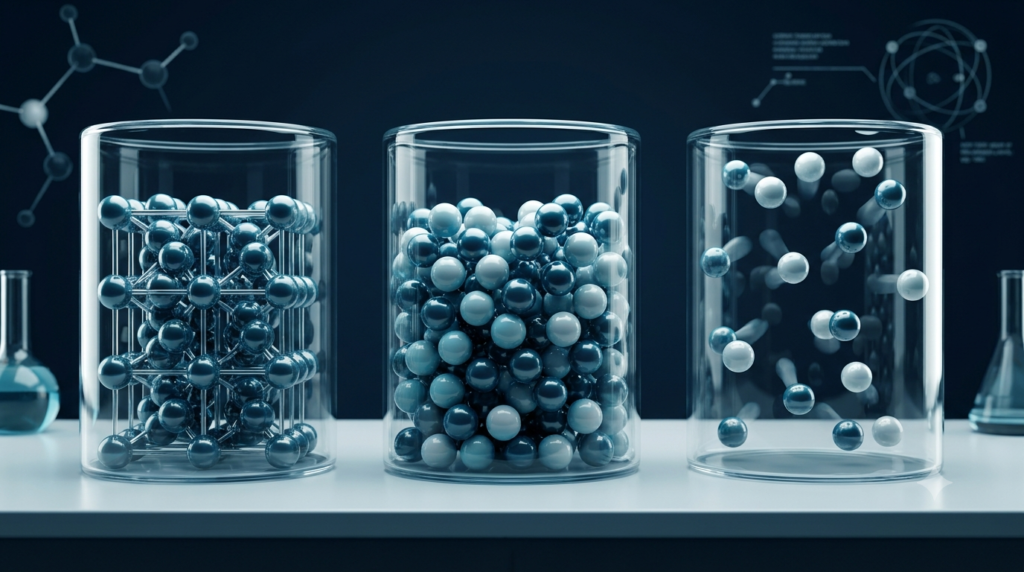
In most solids, particles are closely packed and occupy relatively fixed positions. In liquids, particles remain close together but can move past one another. In gases, particles are generally much farther apart compared with their size.
This difference explains why gases can be compressed much more easily than liquids and solids.
For example, when the opening of a syringe is closed, the air inside can be compressed by pushing the plunger. The gas particles move closer together because there is considerable space between them.
Liquids are much more difficult to compress because their particles are already relatively close together.
6. Particles of Matter Are in Constant Motion
Particles of matter are continuously moving. Their type of motion depends on the physical state and temperature of the substance.
In solids, particles mainly vibrate around relatively fixed positions. In liquids, particles move around one another while remaining close together. In gases, particles move rapidly and randomly in different directions.
Temperature affects the average kinetic energy of particles. When a substance is heated, its particles generally gain kinetic energy. When it is cooled, their average kinetic energy decreases.
Diffusion provides evidence of particle motion. Diffusion is the movement and spreading of particles from a region of higher concentration to a region of lower concentration due to their random motion.
For example, when perfume is sprayed in one corner of a room, its smell gradually spreads throughout the room. This occurs because perfume vapour particles move through the air and mix with the surrounding gas particles.
Diffusion usually occurs faster in gases than in liquids because gas particles move more freely and are generally farther apart.
7. Particles of Matter Attract One Another
Particles of matter interact through attractive and repulsive forces. The strength of these interactions varies among substances and influences their physical properties.
In solids, interactions help maintain the structure of the material. In liquids, particles remain close together but can move past one another. In gases, particles are usually farther apart, so intermolecular attractions often have a smaller influence under ordinary conditions.
These differences help explain why solids generally maintain a definite shape, liquids flow, and gases expand to fill their containers.
Particle interactions also influence melting points and boiling points. Substances with stronger attractions between their particles often require more energy to separate those particles during melting or boiling. However, the exact relationship depends on the substance’s bonding, structure, and physical state.
For example, water has a relatively high boiling point compared with many other small molecules because hydrogen bonding creates strong intermolecular attractions between water molecules.
Physical States of Matter
Matter can exist in different physical states. The three most familiar states are solids, liquids, and gases. Plasma is another important state found in stars and certain technological applications.
1. Solid State
A solid has a definite shape and a definite volume under ordinary conditions. Its particles are generally closely packed and vibrate around relatively fixed positions.
Solids usually resist compression because their particles cannot be brought much closer together without significantly changing their structure.
Examples include ice, iron, salt crystals, wood, and glass. Solids differ in hardness, strength, flexibility, and internal arrangement.
Crystalline solids, such as table salt, have particles arranged in an ordered structure. Amorphous solids, such as ordinary glass, do not have the same long-range regular arrangement.
2. Liquid State
A liquid has a definite volume but no definite shape. It takes the shape of the container in which it is placed.
Liquid particles are close together but can move past one another. This allows liquids to flow while remaining relatively difficult to compress.
Examples include water, milk, cooking oil, and mercury under ordinary room conditions.
Liquids also have properties such as viscosity and surface tension. Viscosity describes a liquid’s resistance to flow, while surface tension results from cohesive interactions between particles near its surface.
3. Gaseous State
A gas has neither a definite shape nor a definite volume. It expands to fill the available space in its container.
Gas particles move rapidly and randomly, and the distances between them are generally large compared with their sizes. Therefore, gases can be compressed much more easily than solids and liquids.
Examples include oxygen, nitrogen, carbon dioxide, and water vapour.
Gases exert pressure when their particles collide with the walls of a container. Their pressure, volume, and temperature are related through gas laws studied in chemistry and physics.
4. Plasma State
Plasma is an energetic state of matter containing free electrons and positively charged ions. It forms when a gas becomes sufficiently energetic for significant ionisation to occur.
Plasma is found in the Sun, other stars, and many astronomical environments. It can also be produced in fluorescent lamps and specialised industrial equipment.
Although plasma is sometimes described as an ionised gas, it has distinctive electrical and electromagnetic properties that distinguish it from an ordinary neutral gas.
Classification of Matter Based on Composition
Matter can also be classified according to its chemical composition. The two main categories are pure substances and mixtures.
1. Pure Substances
A pure substance has a fixed chemical composition and characteristic properties under specified conditions. Pure substances are classified as elements or compounds.
Elements
An element is a pure substance made up of one type of atom. It cannot be broken down into simpler substances by ordinary chemical reactions.
Examples include hydrogen, oxygen, carbon, iron, and copper.
Compounds
A compound is a pure substance formed when two or more different elements combine chemically in fixed proportions.
Water is a compound containing hydrogen and oxygen in a fixed ratio of atoms. Its chemical formula is H₂O. Sodium chloride, commonly known as table salt, consists of sodium and chloride ions in a characteristic ratio.
Compounds often have properties that differ significantly from those of the elements from which they are formed.
2. Mixtures
A mixture contains two or more substances physically combined. Its composition can vary, and its components can often be separated using physical methods.
Mixtures are classified as homogeneous or heterogeneous.
Homogeneous mixtures: These have a uniform composition throughout. Salt dissolved in water and air are common examples.
Heterogeneous mixtures: These do not have a uniform composition throughout. Soil, oil mixed with water, and mixtures containing visibly different solid particles are examples.
Mixtures can often be separated through filtration, evaporation, distillation, and chromatography. The appropriate method depends on the physical and chemical properties of the components.
Understanding this classification helps chemists distinguish pure substances with fixed compositions from materials containing multiple components.
Physical and Chemical Properties of Matter
The properties of matter can be divided into physical properties and chemical properties.
Physical Properties
Physical properties can be observed or measured without changing a substance into a different chemical substance.
Examples include:
Colour
Odour
Density
Melting point
Boiling point
Solubility
Electrical conductivity
Thermal conductivity
Hardness
For example, when ice melts into liquid water, its physical state changes, but its chemical identity remains the same. Both ice and liquid water consist of H₂O.
Physical properties help identify substances, compare materials, and determine their suitability for different applications.
Chemical Properties
Chemical properties describe how a substance behaves when it undergoes a chemical reaction and forms new substances.
Examples include flammability, reactivity with acids, tendency to oxidise, and chemical stability.
For instance, iron reacts with oxygen and moisture under suitable conditions to form rust. The formation of rust is a chemical change because new substances are produced.
Similarly, methane burns in sufficient oxygen to produce carbon dioxide and water when combustion is complete.
Chemical properties are important for understanding corrosion, combustion, digestion, industrial manufacturing, and numerous natural processes.
Physical and Chemical Changes in Matter
Matter can undergo physical changes or chemical changes.
A physical change affects a substance’s physical form, size, or state without changing its chemical identity. Examples include melting ice, boiling water, cutting paper, and dissolving sugar in water.
A chemical change involves the formation of one or more new substances with different chemical compositions. Examples include burning wood, rusting iron, and reacting an acid with a suitable base.
The distinction is important because a change in appearance alone does not necessarily indicate a chemical reaction.
For example, water evaporating from a surface is a physical change. The water molecules enter the gaseous state but remain chemically unchanged.
In contrast, when hydrogen reacts with oxygen to form water, chemical bonds are rearranged and a new substance is produced.
Conservation of Matter
In ordinary chemical reactions, matter follows the law of conservation of mass. This law states that the total mass of the reactants equals the total mass of the products in a closed system, assuming all relevant substances are included in the measurement.
For example, when a chemical reaction occurs in a sealed container, the total mass remains constant even though the original substances may be transformed into new substances.
During a chemical reaction, atoms are rearranged as chemical bonds break and form. Atoms are not ordinarily created or destroyed in chemical reactions.
The broader relationship between mass and energy is described by Einstein’s equation.
Text Block – Mass-Energy Relationship
E = mc²
Where:
E = Energy
m = Mass
c = Speed of light in a vacuum
This equation shows that mass and energy are related. In nuclear reactions, small changes in mass can correspond to significant amounts of released or absorbed energy. This differs from the usual treatment of mass conservation in ordinary chemical reactions.
Importance of Studying Matter in Chemistry
Studying matter is essential for understanding nearly every major area of chemistry. Its fundamental characteristics provide the basis for investigating substances, predicting their behaviour, and explaining chemical reactions.
In laboratories, scientists measure mass and volume to prepare accurate solutions and determine the quantities of reactants required for experiments. Density measurements can help identify materials, assess purity, and separate substances.
The particle model explains diffusion, changes of state, gas behaviour, and the dissolving of substances. Knowledge of physical and chemical properties helps engineers select suitable materials for buildings, electrical equipment, medicines, and manufacturing processes.
The study of matter is also important in environmental science. Scientists examine air, water, soil, and pollutants to understand environmental changes and develop methods for reducing contamination.
In medicine and biology, knowledge of atoms, molecules, and chemical interactions helps explain how nutrients, medicines, and biological substances behave in the body.
Therefore, studying matter is not simply about memorising definitions. It provides a scientific framework for understanding the natural world and developing practical solutions to real-life problems.
Conclusion
Matter is a fundamental concept in chemistry because it includes the substances that make up the physical world. Its defining characteristics include having mass and occupying space, while other important properties include density, particle structure, particle motion, and interactions between particles. Matter exists in different physical states, including solids, liquids, gases, and plasma, and can be classified according to its composition as pure substances or mixtures. Physical and chemical properties help scientists describe substances and understand how they behave under different conditions. Similarly, distinguishing physical changes from chemical changes explains how matter transforms. By understanding these fundamentals, readers can build a strong foundation for studying atoms, molecules, elements, compounds, chemical reactions, and more advanced principles of chemistry.
FAQs
1. What Is Matter in Chemistry?
Matter is anything that has mass and occupies space. It forms the physical substances found in our surroundings, including air, water, rocks, plants, animals, and the human body. Matter is made up of tiny particles, such as atoms, molecules, and ions. These particles determine the physical and chemical properties of substances. Matter can exist in different physical states, including solids, liquids, gases, and plasma. Studying matter helps chemists understand the composition, structure, behaviour, and transformations of substances. It also provides the foundation for learning about elements, compounds, mixtures, and chemical reactions.
2. What Are the Fundamental Characteristics of Matter?
The fundamental characteristics of matter include having mass and occupying space. Matter also has other important properties, such as density, particle structure, particle motion, and interactions between particles. Matter consists of tiny particles with spaces between them, and these particles are continuously moving. The strength of interactions between particles influences how substances behave in different physical states. For example, closely packed particles help solids maintain their shape, while the movement of particles allows liquids to flow. Understanding these characteristics helps explain everyday phenomena, including evaporation, diffusion, melting, boiling, and the compression of gases.
3. Why Is Mass an Important Property of Matter?
Mass is important because it measures the amount of matter in an object or sample. It is commonly expressed in grams or kilograms. In chemistry, accurate mass measurements are necessary for preparing solutions, conducting experiments, and calculating the quantities of reactants and products in chemical reactions. Mass is different from weight, which is the gravitational force acting on an object. An object’s mass remains approximately constant when it moves between locations with different gravitational fields, although its weight changes. Measuring mass accurately helps scientists obtain reliable experimental results and apply the law of conservation of mass to ordinary chemical reactions.
4. What Is Volume, and How Is It Related to Matter?
Volume is the amount of space occupied by an object or substance. Since matter occupies space, every sample of matter has a volume. Common units of volume include litres, millilitres, cubic centimetres, and cubic metres. For example, water inside a measuring cylinder occupies a measurable volume, while air inside a balloon occupies space and causes the balloon to expand. One millilitre is equal to one cubic centimetre, and one litre equals 1,000 millilitres. Volume measurements are essential in chemistry for preparing solutions, measuring liquids, determining density, and studying the behaviour of gases under different temperature and pressure conditions.
5. What Is Density, and How Is It Calculated?
Density is the mass of a substance per unit volume. It helps scientists compare materials and identify substances based on their physical properties. The formula for density is density = mass ÷ volume, commonly written as ρ = m/V. Here, ρ represents density, m represents mass, and V represents volume. The SI unit is kilogram per cubic metre, while gram per cubic centimetre is also widely used. For example, if a sample has a mass of 100 grams and a volume of 20 cubic centimetres, its density is 5 grams per cubic centimetre. Density can vary with temperature and pressure.
6. What Are the Three Common States of Matter?
The three common states of matter are solids, liquids, and gases. Solids have a definite shape and volume because their particles generally remain in relatively fixed positions. Liquids have a definite volume but take the shape of their containers because their particles can move past one another. Gases have neither a definite shape nor a definite volume because their particles move freely and spread throughout the available space. Ice, liquid water, and water vapour demonstrate these three states of the same substance. Their differences arise mainly from particle motion, arrangement, and interactions under different physical conditions.
7. How Do Particles of Matter Behave in Different States?
Particles behave differently in solids, liquids, and gases because their arrangements, motion, and interactions vary. In solids, particles generally vibrate around relatively fixed positions. In liquids, particles remain close together but move past one another, allowing the substance to flow. In gases, particles move rapidly and randomly, with relatively large spaces between them. Heating generally increases the average kinetic energy of particles, while cooling decreases it. These differences explain why solids maintain their shape, liquids flow, and gases expand to fill their containers. Particle behaviour also helps scientists understand diffusion, compression, melting, evaporation, and boiling.
8. What Is the Difference Between a Pure Substance and a Mixture?
A pure substance has a fixed chemical composition and characteristic properties under specified conditions. It may be an element, such as iron or oxygen, or a compound, such as water or sodium chloride. A mixture contains two or more substances physically combined, and its composition can vary. Examples include air, soil, and salt dissolved in water. Mixtures may be homogeneous, with a uniform composition, or heterogeneous, with a non-uniform composition. Unlike compounds, mixtures can often be separated using physical methods such as filtration, evaporation, distillation, and chromatography. Understanding this difference helps classify materials according to their composition.
9. What Is the Difference Between Physical and Chemical Properties of Matter?
Physical properties can be observed or measured without changing a substance into a different chemical substance. Examples include colour, density, melting point, boiling point, solubility, and electrical conductivity. Chemical properties describe how a substance behaves during chemical reactions that produce new substances. Examples include flammability, oxidation, and reactivity with acids. For instance, the melting of ice is a physical change because the substance remains water, H₂O. However, rusting iron is a chemical change because new substances form through reactions involving iron, oxygen, and moisture. Both types of properties are important for identifying substances and predicting their behaviour.
10. Why Is Studying Matter Important in Everyday Life?
Studying matter helps us understand the materials and processes involved in everyday life. It explains why ice melts, why perfume spreads through a room, why oil and water separate, and why certain objects float while others sink. In chemistry laboratories, understanding matter helps scientists measure substances, prepare solutions, and perform accurate experiments. In medicine, it supports the study of drugs and biological molecules. In environmental science, it helps researchers investigate air pollution, water quality, and soil contamination. Knowledge of matter is also important in engineering, manufacturing, and material science. It provides the foundation for understanding chemical reactions and developing useful technologies.