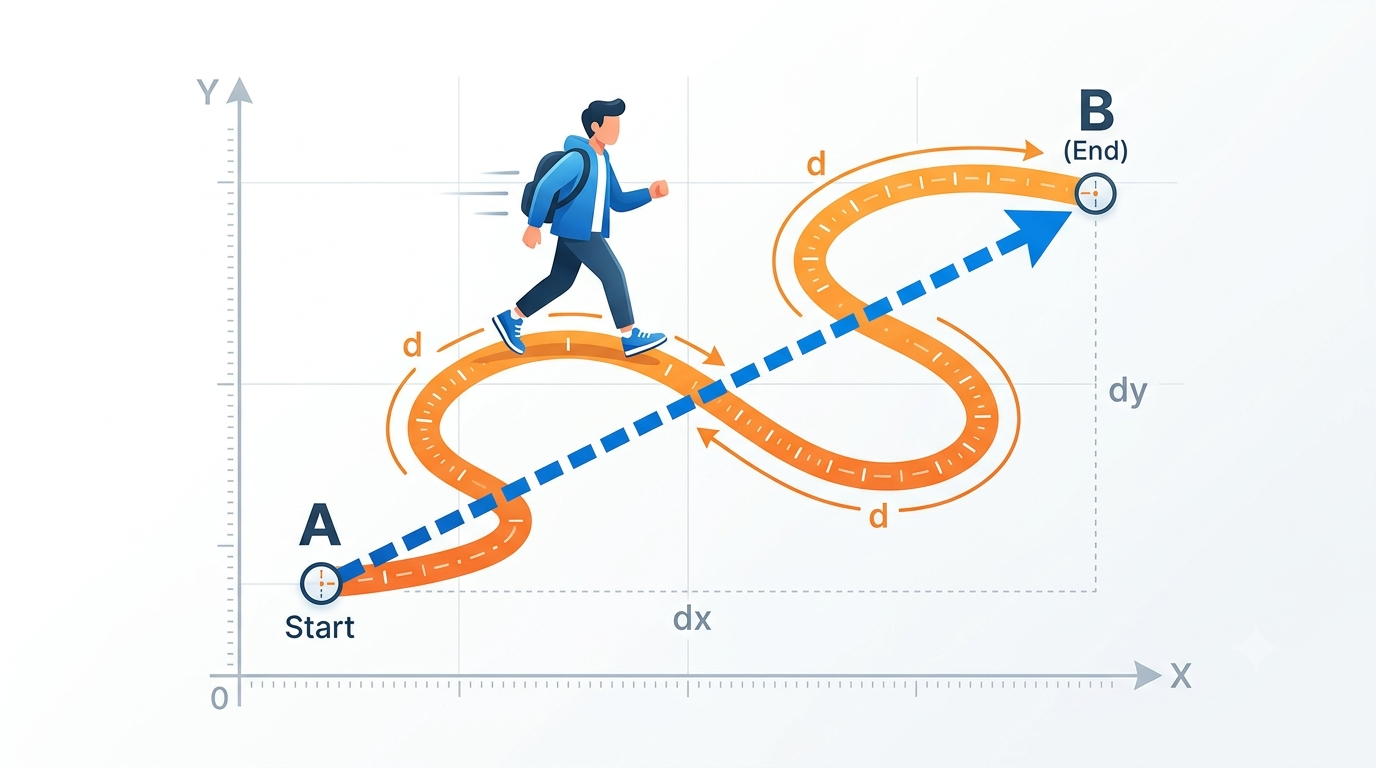
Mathematical formulas are a compact way of expressing relationships between numbers, quantities, and ideas. Instead of explaining a relationship in several sentences, mathematics can represent it using symbols, letters, numbers, and special notation. For example, the formula v = d/t expresses the relationship between speed, distance, and time in a simple form. However, understanding a formula requires more than knowing how to calculate with numbers. You also need to understand what its symbols and notation mean.
Mathematical symbols act like a language. Each symbol has a specific meaning, and the same symbol can sometimes have different meanings depending on the context. Letters may represent unknown values or variables, while signs such as +, −, ×, and ÷ describe operations. Other symbols communicate equality, comparison, approximation, functions, powers, roots, intervals, and relationships between quantities.
Learning mathematical symbols and notation makes formulas easier to read, interpret, rearrange, and apply. It also creates a strong foundation for topics such as algebra, geometry, calculus, probability, statistics, physics, and other scientific fields.
What Are Mathematical Symbols and Notation?
Mathematical symbols are special signs or characters used to represent numbers, operations, relationships, quantities, or mathematical concepts. Notation refers to the system used to write mathematical ideas in a clear and compact form.
For example:
a + b = c
In this expression, a, b, and c are symbols representing quantities. The + symbol represents addition, while = indicates that the expressions on both sides have the same value.
Similarly:
x² + y² = r²
uses letters, a superscript, addition, and an equality sign to describe a mathematical relationship.
Notation allows complicated ideas to be communicated efficiently. Once you understand the meaning of common symbols, formulas become much easier to read.
Numbers, Variables, and Constants
Three basic elements found in many formulas are numbers, variables, and constants.
Numbers
Numbers represent specific quantities. They may be whole numbers, integers, fractions, decimals, or other types of numbers.
Examples include:
5, −3, 2.5, 1/4, and 100
A number can appear directly in a formula as a known quantity or coefficient.
For example:
3x + 5 = 20
Here, 3, 5, and 20 are numerical values.
Variables
A variable is a letter or symbol used to represent a quantity that can change or whose value is unknown.
Common variables include:
x, y, z, a, b, and t
For example:
y = 2x + 3
The value of y depends on the value assigned to x.
Variables are especially important in algebra because they allow general relationships to be expressed without choosing one particular value.
Constants
A constant represents a fixed value within a particular formula or situation.
For example:
y = 3x + 7
The numbers 3 and 7 are constants in this equation.
Some mathematical constants have special names and symbols. For example, π represents the ratio of a circle’s circumference to its diameter, while e is an important constant used extensively in mathematics, especially in exponential and logarithmic functions.
Basic Arithmetic Symbols
Arithmetic symbols represent the most common mathematical operations.
Addition
The plus sign + means addition.
Example:
7 + 5 = 12
It indicates that two or more quantities are being combined.
Subtraction
The minus sign − represents subtraction.
Example:
10 − 4 = 6
It can also indicate a negative number, such as −8.
Multiplication
Multiplication may be represented by ×, a centered dot ·, or simply by placing quantities next to each other.
Examples:
4 × 5 = 20
4 · 5 = 20
3x means 3 × x.
In algebra, the multiplication sign is often omitted to make formulas more compact.
Division
Division can be written using ÷, a slash /, or a fraction bar.
Examples:
12 ÷ 3 = 4
12/3 = 4
a/b
A fraction is also a form of division. In a/b, a is the numerator and b is the denominator.
Equality and Comparison Symbols
Comparison symbols are essential for understanding mathematical relationships.
Equal Sign
The symbol = means that two expressions have the same value.
Example:
2 + 3 = 5
An equation may contain variables:
x + 4 = 10
This means the expression x + 4 has the same value as 10.
Not Equal
The symbol ≠ means “not equal to.”
Example:
x ≠ 0
This states that x cannot have a value of zero.
Greater Than and Less Than
The symbols > and < compare quantities.
8 > 5
means 8 is greater than 5.
3 < 7
means 3 is less than 7.
The related symbols ≥ and ≤ mean greater than or equal to and less than or equal to.
Examples:
x ≥ 4
y ≤ 10
These symbols are particularly important in inequalities and mathematical conditions.
Parentheses, Brackets, and Braces
Grouping symbols help show which parts of a formula belong together.
The most common grouping symbols are:
Parentheses ( )
Square brackets [ ]
Curly braces { }
For example:
2(x + 3)
means that both x and 3 are included inside the group before multiplication by 2.
Another example is:
[a + (b × c)]
Grouping symbols can change the order in which operations are performed.
They are therefore important when reading complicated formulas.
Exponents and Powers
A small number written above and to the right of another number or variable is called an exponent or power.
For example:
x²
means x × x.
Similarly:
x³ = x × x × x
The number 2 in x² is the exponent, while x is the base.
Exponents are widely used in algebra, geometry, scientific notation, physics, and calculus.
A negative exponent represents a reciprocal:
x⁻² = 1/x²
A fractional exponent can represent a root:
x¹ᐟ² = √x
Understanding exponent notation is essential for working with many mathematical formulas.
Roots and Radical Symbols
The radical symbol √ is used to represent roots.
For example:
√25 = 5
This is the square root of 25.
A cube root can be written as:
∛8 = 2
More generally, an nth root may be written using an index:
ⁿ√x
Radical notation is common in algebra, geometry, equations, and many scientific formulas.
Fractions and Fractional Notation
Fractions represent a relationship between two quantities.
For example:
a/b
means a divided by b.
A fraction can also represent a ratio or part of a whole.
In a formula such as:
A = πr²
there is no fraction, but in a formula such as:
v = d/t
the fraction-like notation shows that velocity is calculated by dividing distance by time.
The horizontal fraction bar is particularly useful because it clearly separates the numerator from the denominator.
Greek Letters in Mathematics
Greek letters are frequently used in mathematical notation. They often represent constants, angles, variables, or special quantities.
Some common examples include:
π — pi
θ — theta
α — alpha
β — beta
Δ — delta
λ — lambda
μ — mu
σ — sigma
Ω — omega
For example, θ is commonly used to represent an angle.
The symbol π is used in formulas involving circles, such as:
C = 2πr
where C is circumference and r is radius.
Greek letters do not always have one universal meaning. Their meaning depends on the mathematical context.
Subscripts and Superscripts
Subscripts are small characters written below and to the right of a symbol.
For example:
x₁, x₂, and x₃
These may represent different members of a sequence or different values of the same type.
Superscripts are written above and to the right.
Examples include:
x², a³, and 10⁵
A superscript may represent an exponent, while a subscript may identify a particular variable.
For example:
a₁, a₂, a₃, ...
can represent terms in a sequence.
It is important not to confuse subscripts with exponents because they serve different purposes.
Symbols for Approximation and Proportionality
Not every mathematical relationship is an exact equality.
The symbol ≈ means approximately equal to.
For example:
π ≈ 3.14
This indicates that 3.14 is an approximation of π.
The symbol ∝ means “proportional to.”
For example:
y ∝ x
means that y changes in proportion to x under the relevant conditions.
These symbols are useful when exact values are unavailable or when describing relationships rather than exact equations.
Percent, Ratio, and Proportion Notation
The percent symbol % means “per hundred.”
For example:
25% = 25/100
Ratios can be written using a colon:
2:3
This means that two quantities are being compared in the ratio 2 to 3.
Proportions express equality between ratios.
For example:
a/b = c/d
This indicates that the two ratios are equal.
These forms are commonly used in mathematics, science, finance, measurements, and everyday calculations.
Function Notation
Function notation provides a concise way to show how one quantity depends on another.
A common form is:
f(x)
This is read as “f of x.”
For example:
f(x) = 2x + 1
Here, f represents the function, while x is its input.
If x = 3, then:
f(3) = 2(3) + 1 = 7
Function notation becomes increasingly important when studying algebra, graphs, calculus, and advanced mathematics.
Summation and Product Symbols
The Greek letter sigma, Σ, is commonly used to represent summation.
For example:
Σx
means that a collection of values represented by x should be added together.
A more detailed notation is:
Σᵢ₌₁ⁿ xᵢ
This indicates that the values of xᵢ are added from i = 1 through i = n.
Similarly, the capital Greek letter pi, Π, can represent a product of several quantities.
These symbols make it possible to express long calculations in a compact form.
Absolute Value Notation
Vertical bars are used to represent absolute value.
For example:
|−5| = 5
The absolute value represents the distance of a number from zero on the number line, without considering its direction.
For a variable:
|x|
represents the non-negative magnitude of x.
Absolute value notation appears in algebra, equations, inequalities, coordinate geometry, and other areas of mathematics.
Interval Notation
Interval notation is used to describe a range of numbers.
For example:
[2, 5]
represents all values from 2 to 5, including both endpoints.
An interval such as:
(2, 5)
excludes both endpoints.
Mixed forms are also possible:
[2, 5)
includes 2 but excludes 5.
Understanding parentheses and brackets is especially important when working with inequalities, functions, and sets of numbers.
Set Notation
Sets are collections of objects or numbers.
Curly braces are commonly used to identify the members of a set.
For example:
A = {1, 2, 3, 4}
The symbol ∈ means “is an element of.”
For example:
2 ∈ A
means that 2 belongs to set A.
The symbol ∉ means “is not an element of.”
Set notation becomes useful when describing domains, ranges, number systems, probability, and many areas of advanced mathematics.
Mathematical Notation in Formulas
When several symbols are combined, their positions and relationships become important.
Consider:
A = πr²
This formula can be read as follows:
A represents area.
= means the two sides have equal value.
π is the mathematical constant pi.
r represents radius.
² means the radius is squared.
Reading a formula this way helps you understand what the formula means rather than simply memorizing it.
Another example is:
v = u + at
Here, the letters represent quantities, while the arrangement of the symbols shows how those quantities are related.
Why Understanding Mathematical Notation Matters
Mathematical notation makes formulas shorter, clearer, and more powerful. A single expression can communicate a relationship that might otherwise require several sentences.
Understanding notation helps you:
Read formulas correctly.
Identify known and unknown quantities.
Recognize mathematical operations.
Substitute values accurately.
Rearrange equations.
Avoid mistakes caused by misreading symbols.
Understand graphs and mathematical statements.
Connect formulas across different subjects.
Learn advanced mathematics more easily.
Notation also provides a common language. A mathematical expression can often be understood by people from different countries even when their spoken languages are different.
Common Mistakes When Reading Mathematical Symbols
One common mistake is assuming that a symbol always has the same meaning. In mathematics, meaning depends on context.
For example, x may represent a variable, multiplication may sometimes be implied by placing symbols together, and |x| can represent absolute value rather than ordinary parentheses.
Another mistake is ignoring the order of operations. Consider:
2 + 3 × 4
This is not the same as:
(2 + 3) × 4
Grouping symbols can therefore make a major difference.
Students and beginners may also confuse = with “the answer comes next.” The equality sign actually states that the expressions on both sides have the same value.
How to Read a Mathematical Formula Step by Step
A useful way to understand an unfamiliar formula is to break it into parts.
First, identify the main operation. Look for addition, subtraction, multiplication, division, powers, roots, or other operations.
Next, identify the variables and constants.
Then, examine grouping symbols such as parentheses and brackets.
After that, identify special symbols such as π, Σ, √, ≥, or ≈.
Finally, determine what each symbol represents in the particular context.
For example, when reading:
A = ½bh
you can identify A as the area, b as the base, h as the height, ½ as one-half, and multiplication as the relationship between these quantities.
This approach is more useful than trying to memorize formulas without understanding their notation.
Conclusion
Mathematical symbols and notation form the language used to express formulas, equations, relationships, and mathematical ideas. From basic symbols such as +, −, ×, and = to more advanced notation such as Σ, ∫, Greek letters, subscripts, superscripts, and function notation, each symbol provides specific information.
Learning what these symbols mean makes formulas easier to read and use. More importantly, it helps you understand the ideas behind mathematical expressions instead of treating formulas as collections of unfamiliar characters.
Once the basic notation becomes familiar, subjects such as algebra, geometry, calculus, probability, statistics, physics, and other sciences become easier to approach. The goal is not simply to memorize every symbol, but to learn how symbols work together to communicate mathematical meaning clearly and efficiently.