
How to Interpret the Ratio of Elements in a Compound

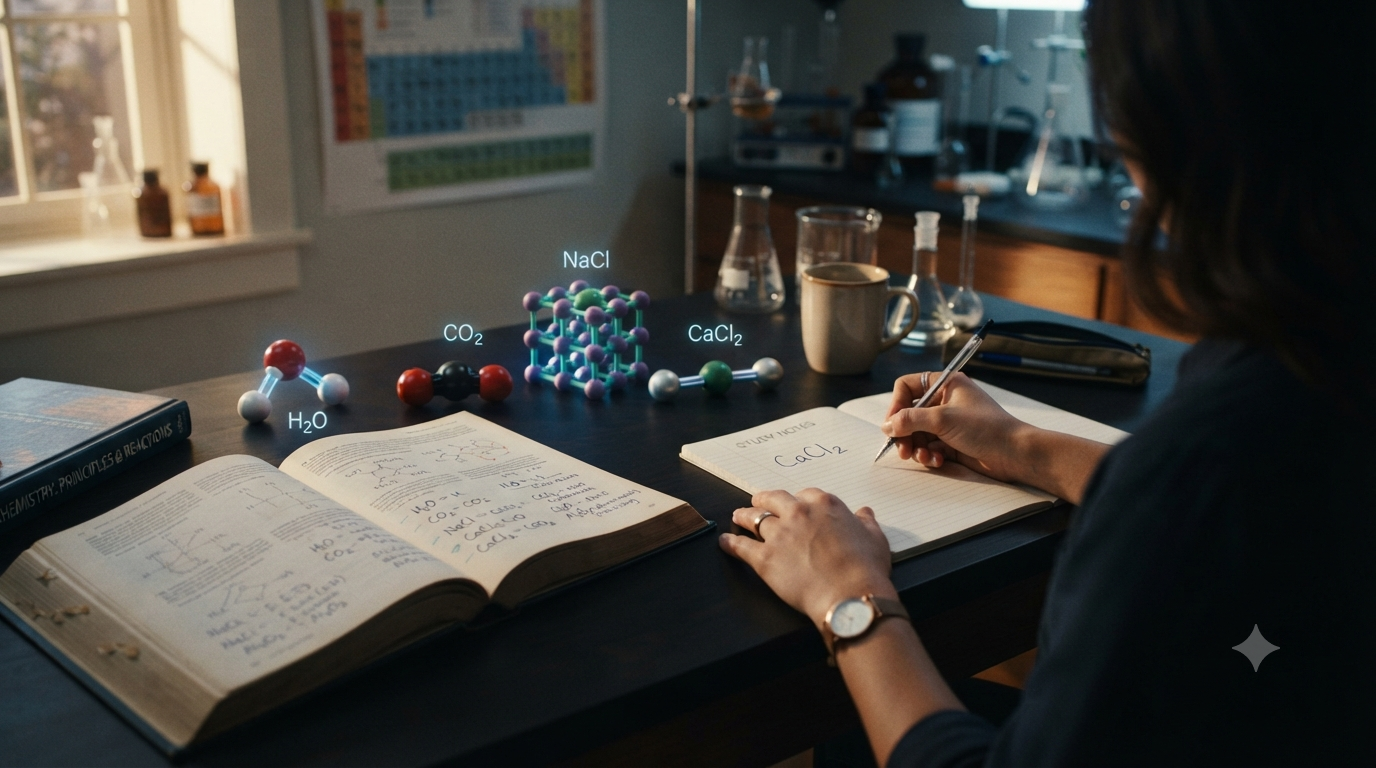
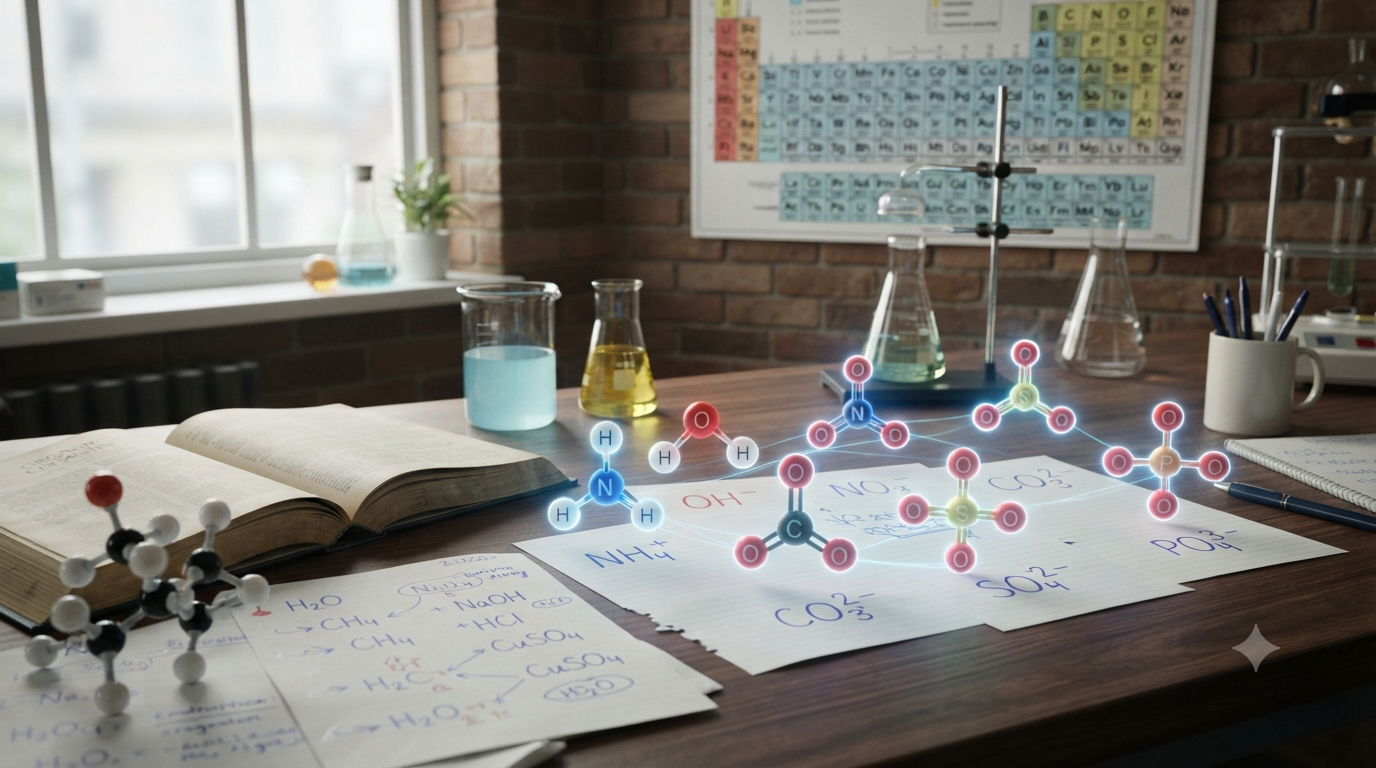
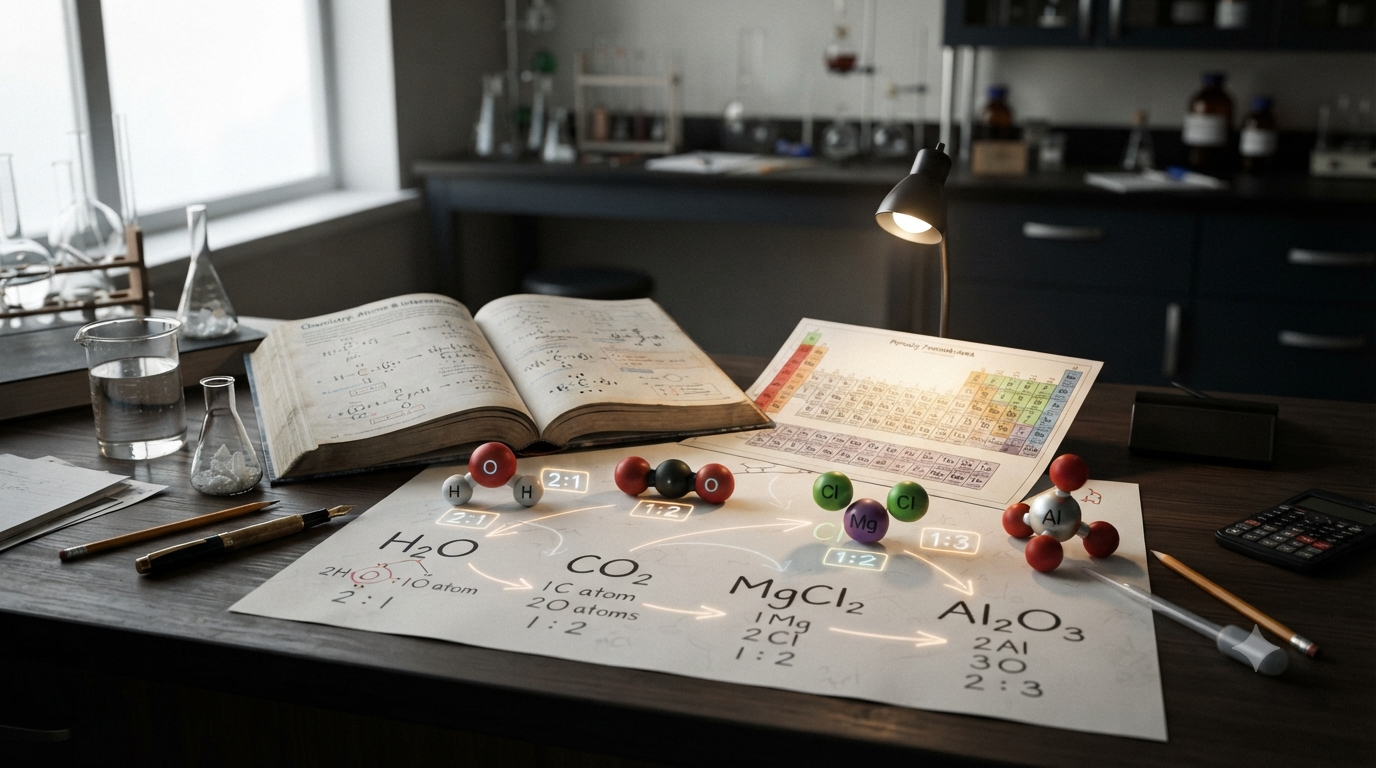
Chemical formulas showing how to interpret the ratio of elements in a compound using subscripts and atom counts

When a chemical compound is represented by a chemical formula, the symbols and numbers in that formula contain important information about its composition. One of the most useful pieces of information is the ratio of elements in the compound. This ratio tells us how many atoms of each element are represented relative to one another.

For example, the formula H₂O represents water. It contains two hydrogen atoms for every one oxygen atom, so the ratio of hydrogen to oxygen is 2:1. Similarly, CO₂ contains one carbon atom for every two oxygen atoms, giving a carbon-to-oxygen ratio of 1:2.

Understanding these ratios is an essential chemistry skill because it helps us read chemical formulas, compare compounds, calculate amounts of substances, understand composition, and solve stoichiometry problems. The process becomes much easier when we learn how to read subscripts correctly and distinguish between atom ratios, mass ratios, and ratios involving larger quantities of a substance.

What Does the Ratio of Elements Mean?

The ratio of elements in a compound describes the relative number of atoms of each element present in one formula unit or molecule of that compound.

Consider the formula:

H₂O

The subscript ₂ appears after H, meaning that there are two hydrogen atoms. Oxygen has no written subscript, which means its subscript is understood to be 1.

Therefore:

Hydrogen : Oxygen = 2 : 1

The ratio does not mean that a single sample of water must contain exactly two hydrogen atoms and one oxygen atom. Instead, it represents the fixed relationship between hydrogen and oxygen atoms in water. If there are 2,000 hydrogen atoms, there would be 1,000 oxygen atoms, assuming the sample is pure water.

This fixed ratio is one of the important characteristics of a chemical compound.

How Subscripts Show Element Ratios

The easiest way to interpret an element ratio is to examine the subscripts in the chemical formula.

For example:

CO₂

Carbon has no subscript, so its number is 1.

Oxygen has a subscript of 2.

Therefore:

Carbon : Oxygen = 1 : 2

Now consider:

NH₃

Nitrogen has an implied subscript of 1, while hydrogen has a subscript of 3.

Therefore:

Nitrogen : Hydrogen = 1 : 3

Another example is:

CH₄

Carbon = 1
Hydrogen = 4

So:

Carbon : Hydrogen = 1 : 4

The important rule is simple: a missing subscript is always treated as 1.

Why the Ratio Is Important

Chemical compounds are not formed by combining elements in completely random proportions. Their atoms are arranged in specific combinations determined by chemical bonding and the structure of the substance.

For example, sodium chloride has the formula NaCl. Sodium and chlorine occur in a 1:1 ratio of atoms.

Na : Cl = 1 : 1

Calcium chloride has the formula CaCl₂.

Ca : Cl = 1 : 2

These different ratios represent different compounds with different compositions and properties.

The ratio therefore gives us a quick way to understand how the elements are combined within a compound.

Reading Ratios Directly From Simple Formulas

For formulas containing individual elements without brackets or parentheses, the process is straightforward.

Example 1 H₂S

Hydrogen has a subscript of 2.

Sulfur has an implied subscript of 1.

Therefore:

H : S = 2 : 1

Example 2 CO

Carbon = 1
Oxygen = 1

Therefore:

C : O = 1 : 1

Example 3 SO₃

Sulfur = 1
Oxygen = 3

Therefore:

S : O = 1 : 3

Example 4 P₂O₅

Phosphorus = 2
Oxygen = 5

Therefore:

P : O = 2 : 5

The numbers in the formula directly provide the simplest whole-number ratio of atoms represented by that formula.

Interpreting Ratios in Compounds With More Than Two Elements

Some compounds contain three or more different elements. The same principle still applies.

Consider:

H₂SO₄

This formula contains:

Hydrogen = 2
Sulfur = 1
Oxygen = 4

Therefore:

H : S : O = 2 : 1 : 4

Another example is:

NaHCO₃

Sodium = 1
Hydrogen = 1
Carbon = 1
Oxygen = 3

Therefore:

Na : H : C : O = 1 : 1 : 1 : 3

The order of the elements in the ratio should normally follow the order in which they appear in the chemical formula.

How to Interpret Parentheses in Chemical Formulas

Some chemical formulas contain groups of atoms enclosed in parentheses. In these cases, the number outside the parentheses applies to every element inside the parentheses.

Consider:

Ca(OH)₂

The subscript 2 outside the parentheses applies to both O and H.

Therefore:

Calcium = 1
Oxygen = 2
Hydrogen = 2

The ratio is:

Ca : O : H = 1 : 2 : 2

This is different from simply reading the formula as Ca, O, H₂.

Another example is:

Al₂(SO₄)₃

First, consider the Al atoms:

Al = 2

The sulfate group SO₄ appears three times.

Therefore:

S = 1 × 3 = 3
O = 4 × 3 = 12

So the complete atom ratio is:

Al : S : O = 2 : 3 : 12

This method is especially important when interpreting formulas of ionic compounds containing polyatomic ions.

The Difference Between Atom Ratio and Mass Ratio

One of the most important points to understand is that the ratio of atoms is not the same as the ratio of masses.

Consider water:

H₂O

The atom ratio is:

H : O = 2 : 1

However, hydrogen and oxygen have different atomic masses. Hydrogen has an atomic mass of approximately 1 u, while oxygen has an atomic mass of approximately 16 u.

The approximate mass contribution is:

Hydrogen = 2 × 1 = 2
Oxygen = 1 × 16 = 16

So the mass ratio is approximately:

H : O = 2 : 16 = 1 : 8

Therefore, water has a 2:1 atom ratio of hydrogen to oxygen, but approximately a 1:8 mass ratio of hydrogen to oxygen.

This distinction is important in chemical calculations.

Ratio of Elements and Chemical Formula

A chemical formula provides information about the relative number of atoms in a compound.

For example:

C₂H₆

The formula represents:

Carbon = 2
Hydrogen = 6

Therefore:

C : H = 2 : 6

This ratio can be simplified mathematically:

2 : 6 = 1 : 3

However, there is an important distinction. The molecular formula C₂H₆ tells us that each molecule contains two carbon atoms and six hydrogen atoms. The simplest ratio of the elements is 1:3.

This simplest ratio is called the empirical ratio, and the formula representing the simplest whole-number ratio is called the empirical formula.

For C₂H₆, the empirical formula is:

CH₃

Thus, when interpreting ratios, it is useful to ask whether we need the actual atom counts represented by the formula or the simplest ratio.

Using Ratios to Compare Compounds

Element ratios can also help us compare different compounds.

Consider carbon monoxide:

CO

Carbon : Oxygen = 1 : 1

Now consider carbon dioxide:

CO₂

Carbon : Oxygen = 1 : 2

Both compounds contain carbon and oxygen, but the ratio of the elements is different.

This difference in composition is associated with different chemical substances and different properties.

Therefore, comparing element ratios can help us recognize that two formulas represent different compounds even when they contain the same elements.

Element Ratios in Ionic Compounds

Ionic compounds are formed from positively and negatively charged ions. Their formulas are written so that the overall compound is electrically neutral.

For example:

NaCl

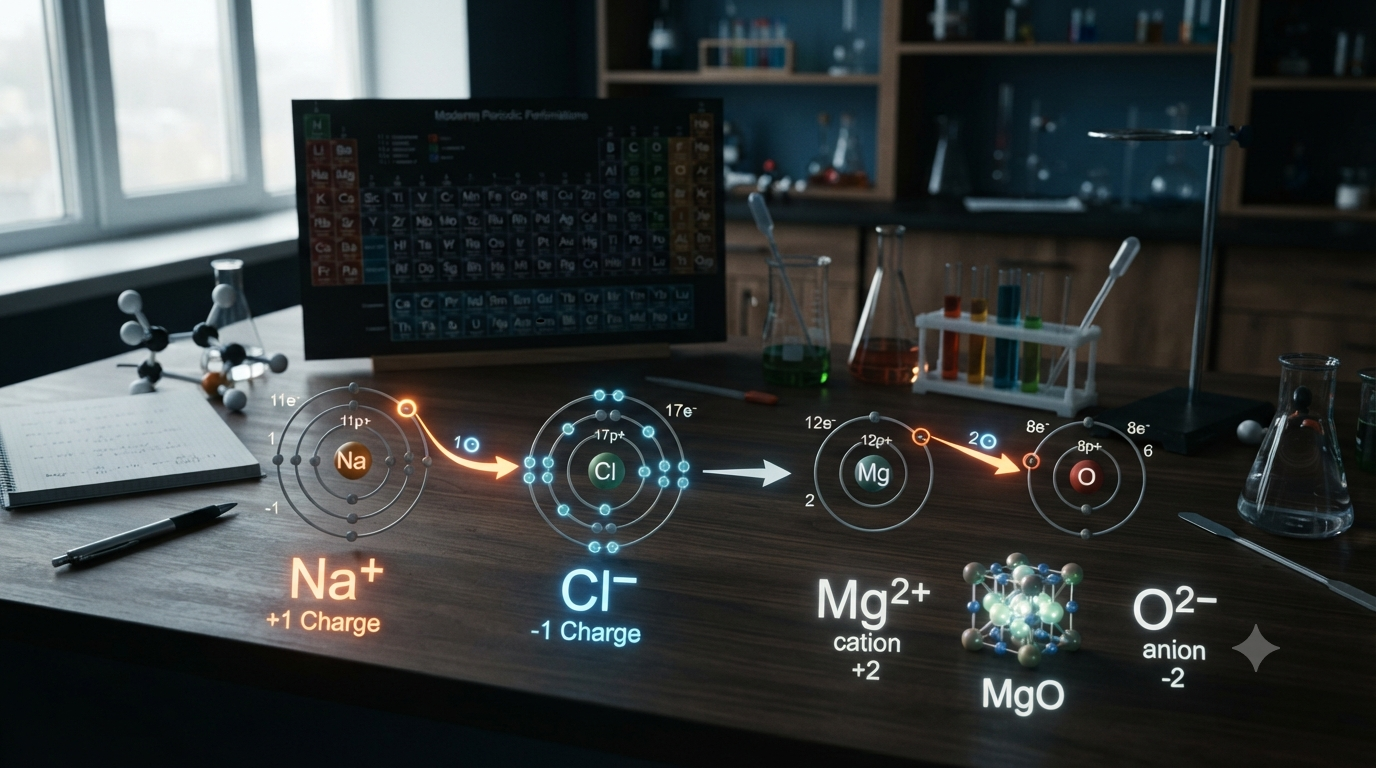
Sodium ions have a +1 charge and chloride ions have a −1 charge. One sodium ion combines with one chloride ion.

Na : Cl = 1 : 1

For magnesium chloride:

MgCl₂

One Mg²⁺ ion requires two Cl⁻ ions to balance the charge.

Mg : Cl = 1 : 2

For aluminum oxide:

Al₂O₃

Two Al³⁺ ions provide a total positive charge of +6, while three O²⁻ ions provide a total negative charge of −6.

Therefore:

Al : O = 2 : 3

The ratio in an ionic formula is therefore closely connected to charge balance.

Element Ratios in Molecular Compounds

Molecular compounds are formed when atoms share electrons through covalent bonds. Their formulas also show the relative number of atoms.

For example:

CO₂

C : O = 1 : 2

NH₃

N : H = 1 : 3

CH₄

C : H = 1 : 4

In these formulas, the subscripts indicate how many atoms of each element are present in one molecule.

A Step-by-Step Method for Finding Element Ratios

A reliable method can make these problems much easier.

Step 1 Identify Every Element

Look at the chemical formula and identify all the different element symbols.

For example:

Al₂(SO₄)₃

The elements are aluminum, sulfur, and oxygen.

Step 2 Read the Subscripts

Write down the number associated with each element.

Al = 2

S = 3

O = 12

Step 3 Apply Parentheses if Present

If a group is followed by a subscript, multiply every element inside the group by that subscript.

For SO₄ repeated three times:

S = 1 × 3 = 3

O = 4 × 3 = 12

Step 4 Write the Ratio

Al : S : O = 2 : 3 : 12

Step 5 Simplify Only When Appropriate

If the question asks for the simplest ratio, divide all numbers by their greatest common factor.

For example:

C₂H₆

2 : 6

Dividing by 2 gives:

1 : 3

But if the question asks for the number of atoms represented by the molecular formula, keep 2:6.

Common Mistakes When Reading Element Ratios

Several mistakes can occur when interpreting chemical formulas.

Ignoring an Implied Subscript

In CO₂, some learners may think carbon has no numerical value. It actually has a subscript of 1.

Therefore:

C : O = 1 : 2

Applying a Parenthesis Subscript to Only One Element

In Ca(OH)₂, the 2 applies to both O and H.

The correct atom counts are:

Ca = 1
O = 2
H = 2

Confusing Atom Ratio With Mass Ratio

The formula H₂O gives an atom ratio of 2:1, not a mass ratio of 2:1.

Simplifying When It Is Not Required

For C₂H₆, the formula itself represents 2 carbon atoms and 6 hydrogen atoms. Although the simplest ratio is 1:3, the molecular formula should not be changed to CH₃ unless the question specifically asks for the empirical formula.

Why Element Ratios Matter in Stoichiometry

Element ratios are fundamental to stoichiometry because chemical equations and formulas describe fixed relationships between substances.

For example, the formula H₂O tells us that hydrogen and oxygen atoms occur in a 2:1 ratio within water molecules.

When chemical equations are balanced, the coefficients establish relationships between larger numbers of particles or moles, while the subscripts describe the composition of individual compounds.

Understanding this difference prevents many common calculation errors.

For example:

2H₂ + O₂ → 2H₂O

The coefficient 2 before H₂ tells us that two molecules or two moles of hydrogen are involved relative to the equation.

The subscript 2 in H₂ tells us that each hydrogen molecule contains two hydrogen atoms.

Similarly, the subscript 2 in H₂O describes the composition of each water molecule, while the coefficient 2 describes how many water molecules or moles are represented.

Ratio of Elements in a Larger Sample

The ratio remains the same regardless of how much of a pure compound is present.

For water:

H : O = 2 : 1

If a sample contains 2 hydrogen atoms and 1 oxygen atom, the ratio is 2:1.

If it contains 2 million hydrogen atoms and 1 million oxygen atoms, the ratio is still 2:1.

The quantity changes, but the relative composition remains constant.

This is one reason chemical formulas are so useful. A short formula can represent the composition of a tiny particle or an enormous quantity of a substance.

Conclusion

Interpreting the ratio of elements in a compound begins with understanding the subscripts in its chemical formula. A subscript tells us the relative number of atoms of that element, while a missing subscript means 1. Parentheses require extra attention because an outside subscript applies to every element inside the group.

The ratio of elements can be written directly from the formula, such as 2:1 for H₂O or 1:2 for CO₂. However, it is important to distinguish an atom ratio from a mass ratio and to know when a ratio should be simplified. Once these ideas are clear, chemical formulas become much easier to read and use in stoichiometry, chemical calculations, and the study of compound composition.

FAQs

1. What is the ratio of elements in a compound?

The ratio of elements in a compound describes the relative number of atoms of each element present in its chemical formula. For example, H₂O contains two hydrogen atoms and one oxygen atom, so the ratio of hydrogen to oxygen is 2:1. Similarly, CO₂ has one carbon atom and two oxygen atoms, giving a ratio of 1:2. This ratio helps explain how elements are combined within a compound. It is determined mainly by the subscripts written after element symbols. If no subscript is shown, the number is understood to be 1. Element ratios are useful for understanding chemical composition and performing calculations.

2. How do you find the ratio of elements from a chemical formula?

To find the ratio of elements, first identify every element in the chemical formula. Then look at the subscript following each element symbol. A missing subscript is treated as 1. For example, in H₂SO₄, hydrogen has 2 atoms, sulfur has 1 atom, and oxygen has 4 atoms. Therefore, the ratio is H:S:O = 2:1:4. If parentheses appear, multiply the subscripts inside the parentheses by the number outside them. For example, Ca(OH)₂ contains one calcium, two oxygen, and two hydrogen atoms. Therefore, its element ratio is Ca:O:H = 1:2:2.

3. What does a subscript tell us in a chemical formula?

A subscript tells us the number of atoms of an element represented in a chemical formula. For example, in CO₂, the subscript 2 after oxygen means there are two oxygen atoms for every one carbon atom. Carbon has no visible subscript, so its number is 1. Therefore, the atom ratio is C:O = 1:2. Subscripts are important because changing them can change the compound itself. For example, CO and CO₂ are different compounds because their carbon-to-oxygen ratios are different. Subscripts should not be confused with coefficients, which describe the number of molecules or formula units involved in a chemical equation.

4. What does a missing subscript mean in a chemical formula?

A missing subscript means that only one atom of that element is represented in the formula. For example, in H₂O, hydrogen has a subscript of 2, while oxygen has no subscript. Therefore, oxygen has an implied subscript of 1. The element ratio is H:O = 2:1. Similarly, CO₂ contains one carbon atom and two oxygen atoms, giving C:O = 1:2. Remembering that an absent subscript means 1 is essential when reading chemical formulas. Without this rule, it would be difficult to correctly determine the number of atoms and the ratio of elements in many compounds.

5. How do parentheses affect the ratio of elements?

Parentheses indicate that a group of atoms is repeated according to the subscript written outside the parentheses. For example, Ca(OH)₂ contains one calcium atom and two hydroxide groups. Because the subscript 2 applies to both O and H, the compound contains one calcium, two oxygen, and two hydrogen atoms. Therefore, Ca:O:H = 1:2:2. Another example is Al₂(SO₄)₃. The sulfate group occurs three times, giving three sulfur atoms and twelve oxygen atoms. Together with two aluminum atoms, the ratio is Al:S:O = 2:3:12. Always apply the outside subscript to every element inside the parentheses.

6. Is the ratio of atoms the same as the ratio of masses?

No. The ratio of atoms and the ratio of masses are different because different elements have different atomic masses. For example, water has the formula H₂O, so its hydrogen-to-oxygen atom ratio is 2:1. However, hydrogen and oxygen have different atomic masses. Two hydrogen atoms contribute approximately 2 atomic mass units, while one oxygen atom contributes approximately 16 atomic mass units. Therefore, the mass ratio of hydrogen to oxygen is approximately 2:16, or 1:8. Chemical formulas directly provide atom ratios, not mass ratios. Mass ratios require additional calculations using the atomic masses of the elements involved.

7. What is the element ratio in H₂O?

The chemical formula H₂O represents water. It contains two hydrogen atoms and one oxygen atom in each water molecule. Therefore, the ratio of hydrogen to oxygen is H:O = 2:1. The subscript 2 after hydrogen shows that there are two hydrogen atoms. Oxygen has no visible subscript, so its number is understood to be 1. This ratio describes the relative number of atoms in water molecules. It does not mean that a large sample of water contains only three atoms. Instead, the same 2:1 relationship applies throughout pure water, regardless of how many water molecules are present.

8. What is the difference between a molecular formula and an empirical ratio?

A molecular formula shows the actual number of atoms of each element in a molecule, while an empirical ratio gives the simplest whole-number ratio of those elements. For example, C₂H₆ contains two carbon atoms and six hydrogen atoms, so its molecular formula represents a 2:6 atom ratio. This can be simplified to 1:3. Therefore, the simplest empirical ratio is 1:3, represented by the empirical formula CH₃. The molecular formula should not automatically be simplified because it provides information about the actual composition of the molecule. Whether simplification is appropriate depends on what the question is asking.

9. Why are element ratios important in chemistry?

Element ratios are important because they describe the composition of chemical compounds. They help scientists understand how atoms are combined and allow chemical formulas to communicate this information efficiently. Element ratios are also essential in stoichiometry, where chemical relationships are used to calculate quantities of substances. For example, H₂O shows a 2:1 hydrogen-to-oxygen atom ratio, while MgCl₂ shows a 1:2 magnesium-to-chlorine ratio. Ratios also help distinguish compounds that contain the same elements but in different proportions, such as CO and CO₂. Understanding these relationships makes it easier to read formulas, compare compounds, and solve chemical calculations accurately.

10. How can understanding element ratios help with stoichiometry?

Understanding element ratios provides a foundation for solving stoichiometry problems because chemical formulas and balanced equations describe fixed relationships between substances and particles. For example, H₂O contains hydrogen and oxygen in a 2:1 atom ratio. In the balanced equation 2H₂ + O₂ → 2H₂O, the coefficients describe relationships between molecules or moles, while the subscripts describe the composition of each substance. Keeping these two types of numbers separate is essential. Once element ratios are understood, it becomes easier to interpret chemical formulas, calculate molar quantities, determine required reactant amounts, and understand how substances are related in chemical reactions.

Related Posts

Leave a Comment

Your email address will not be published. Required fields are marked *

Scroll to Top