

Formula mass is an important concept in chemistry because it connects a chemical formula with the masses of the atoms that make up a substance. Every chemical formula tells us which elements are present and how many atoms or ions of each element are involved. By using the atomic masses of these elements, we can calculate the total mass represented by the formula.
The calculation is useful for ionic compounds, molecular substances, and many other chemical formulas. Once you understand how to read subscripts, find atomic masses, multiply correctly, and add the results, formula mass becomes a straightforward calculation. This skill also forms the foundation for understanding molar mass, chemical equations, stoichiometry, and quantitative chemistry.
What Is Formula Mass?
Formula mass is the total of the atomic masses of all the atoms represented by a chemical formula.
For example, sodium chloride has the chemical formula NaCl. It contains one sodium atom and one chlorine atom. Therefore, its formula mass is calculated by adding the atomic mass of sodium to the atomic mass of chlorine.
Using approximate atomic masses:
Formula mass of NaCl = 23 + 35.5 = 58.5 u
The unit u, or unified atomic mass unit, is commonly used when expressing the mass of one formula unit.
For an ionic compound such as sodium chloride, the term formula mass is particularly appropriate because the compound exists as a large ionic lattice rather than as separate NaCl molecules.
Why Is Formula Mass Important?
Formula mass helps chemists determine the relative mass represented by a chemical formula. It is also closely connected to molar mass.
For example, if the formula mass of water is approximately 18 u, then the molar mass of water is approximately 18 g/mol.
This relationship allows chemistry calculations to move between the microscopic world of atoms and molecules and the macroscopic quantities measured in the laboratory.
Formula mass is useful when:
Calculating molar mass
Performing stoichiometric calculations
Balancing and interpreting chemical equations
Determining the mass of reactants and products
Comparing different compounds
Understanding the composition of compounds
Calculating percentage composition
Formula Mass and Atomic Mass
To calculate formula mass, you first need the atomic masses of the elements present in the chemical formula.
Atomic mass represents the average mass of atoms of an element, taking naturally occurring isotopes into account. These values are found on the periodic table.
Some commonly used approximate atomic masses are:
The exact values may vary slightly depending on the periodic table being used.
How to Calculate Formula Mass
The basic method can be divided into a few simple steps.
Step 1 Read the Chemical Formula Carefully
First, identify every element present in the formula.
For example:
H₂O
The formula contains:
Hydrogen (H)
Oxygen (O)
The subscript ₂ means that there are two hydrogen atoms. Oxygen has no subscript, so it represents one oxygen atom.
Step 2 Find the Atomic Mass of Each Element
Look up the atomic mass of every element in the periodic table.
For H₂O:
Step 3 Multiply Each Atomic Mass by the Number of Atoms
The subscript tells you how many atoms of an element are present.
For H₂O:
Hydrogen contribution = 2 × 1 = 2 u
Oxygen contribution = 1 × 16 = 16 u
Step 4 Add All the Contributions
Now add the individual masses:
Formula mass = 2 + 16
Formula mass = 18 u
Therefore, the formula mass of H₂O is approximately 18 u.
Example of Formula Mass of Carbon Dioxide
Consider carbon dioxide:
CO₂
There is one carbon atom and two oxygen atoms.
Atomic masses:
Calculate the contribution of each element:
Carbon = 1 × 12 = 12 u
Oxygen = 2 × 16 = 32 u
Now add them:
Formula mass = 12 + 32
Formula mass = 44 u
Therefore, the formula mass of CO₂ is 44 u.
How Subscripts Affect Formula Mass
Subscripts are extremely important when calculating formula mass.
Consider:
H₂O and H₂O₂
Both formulas contain hydrogen and oxygen, but they contain different numbers of oxygen atoms.
For H₂O:
Formula mass = 18 u
For H₂O₂:
Formula mass = 34 u
The additional oxygen atom changes the total formula mass.
Therefore, never ignore a subscript when calculating formula mass.
What Happens When There Is No Subscript?
When an element symbol has no subscript, it represents one atom.
For example:
NaCl
Na has no subscript, so there is one sodium atom.
Cl also has no subscript, so there is one chlorine atom.
Therefore:
Na = 1 × 23 = 23 u
Cl = 1 × 35.5 = 35.5 u
Formula mass = 23 + 35.5
Formula mass = 58.5 u
The absence of a subscript should always be understood as a subscript of 1.
Calculating Formula Mass With Parentheses
Some chemical formulas contain groups of atoms inside parentheses. In these cases, the subscript outside the parentheses applies to every atom inside the parentheses.
Consider calcium hydroxide:
Ca(OH)₂
The formula contains:
1 calcium atom
2 oxygen atoms
2 hydrogen atoms
The subscript ₂ outside the parentheses applies to both O and H.
Atomic masses:
Calculate each contribution:
Ca = 1 × 40 = 40 u
O = 2 × 16 = 32 u
H = 2 × 1 = 2 u
Now add:
Formula mass = 40 + 32 + 2
Formula mass = 74 u
Therefore, the formula mass of Ca(OH)₂ is 74 u.
Formula Mass With Larger Groups
The same method works when a polyatomic ion or group appears several times.
Consider aluminium sulfate:
Al₂(SO₄)₃
First, identify the number of atoms.
Al₂ means 2 aluminium atoms.
(SO₄)₃ means there are three sulfate groups. Each sulfate group contains one sulfur atom and four oxygen atoms.
Therefore:
Now use the atomic masses:
Calculate:
Aluminium = 2 × 27 = 54 u
Sulfur = 3 × 32 = 96 u
Oxygen = 12 × 16 = 192 u
Add the contributions:
Formula mass = 54 + 96 + 192
Formula mass = 342 u
Therefore, the formula mass of Al₂(SO₄)₃ is approximately 342 u.
How to Read Nested Subscripts
Some formulas may appear complicated because they contain parentheses and subscripts. The key is to work from the outside inward.
For example:
Mg(NO₃)₂
The formula contains one magnesium atom and two nitrate groups.
Each NO₃ group contains:
Because there are two nitrate groups:
The complete atom count is therefore:
Using atomic masses:
Calculate:
Mg = 1 × 24.3 = 24.3 u
N = 2 × 14 = 28 u
O = 6 × 16 = 96 u
Formula mass = 24.3 + 28 + 96
Formula mass = 148.3 u
Therefore, the formula mass of Mg(NO₃)₂ is approximately 148.3 u.
A Quick Formula Mass Method
A useful way to organize calculations is to create a simple table.
For example, consider H₂SO₄.
| Element | Number of Atoms | Atomic Mass | Contribution |
|---|---|---|---|
| H | 2 | 1 u | 2 u |
| S | 1 | 32 u | 32 u |
| O | 4 | 16 u | 64 u |
Now add the contributions:
Formula mass = 2 + 32 + 64
Formula mass = 98 u
Therefore, the formula mass of H₂SO₄ is 98 u.
This approach is especially helpful when formulas contain several elements.
Common Mistakes When Calculating Formula Mass
Although the calculation is simple, several mistakes are common.
Ignoring Subscripts
A common mistake is to use the atomic mass only once even when a subscript indicates multiple atoms.
For example, in CO₂, oxygen must be counted twice.
Misreading Parentheses
In Ca(OH)₂, the subscript ₂ applies to both O and H. It does not apply only to hydrogen.
Forgetting the Number of Groups
In Al₂(SO₄)₃, the subscript ₃ applies to the entire sulfate group. Therefore, there are three sulfur atoms and twelve oxygen atoms.
Using the Wrong Atomic Mass
Always check the periodic table carefully. Similar-looking element symbols can have very different atomic masses.
Adding Before Multiplying
For each element, multiply its atomic mass by the number of atoms first. Then add all the contributions.
Confusing Formula Mass With Molar Mass
Formula mass is usually expressed in atomic mass units, while molar mass is expressed in grams per mole.
For example:
H₂O formula mass ≈ 18 u
H₂O molar mass ≈ 18 g/mol
The numerical values are closely related, but the quantities and units are different.
Formula Mass of Ionic Compounds
Formula mass is especially useful for ionic compounds.
For example:
Na₂CO₃
There are:
Using:
Calculate:
Na = 2 × 23 = 46 u
C = 1 × 12 = 12 u
O = 3 × 16 = 48 u
Formula mass = 46 + 12 + 48
Formula mass = 106 u
Therefore, the formula mass of Na₂CO₃ is 106 u.
Formula Mass of Molecular Compounds
The same mathematical method can be applied to molecular compounds.
Consider methane:
CH₄
There is one carbon atom and four hydrogen atoms.
C = 12 u
H = 1 u
Therefore:
Formula mass = 1 × 12 + 4 × 1
Formula mass = 12 + 4
Formula mass = 16 u
Thus, the molecular mass of methane is approximately 16 u.
For molecular substances, the term molecular mass is often used, while formula mass is a more general term.
Formula Mass and Molar Mass
Formula mass and molar mass are closely connected.
Suppose a compound has a formula mass of 58.5 u. Its molar mass is numerically 58.5 g/mol.
For example:
NaCl
Formula mass = 58.5 u
Molar mass = 58.5 g/mol
This relationship is extremely useful in chemistry because laboratory measurements are normally made in grams, while chemical formulas describe particles at the atomic or molecular scale.
Why Formula Mass Matters in Chemical Calculations
Formula mass is not just a calculation performed for practice. It is used in many areas of chemistry.
Once the formula mass is known, it can be used to determine molar mass. Molar mass then helps calculate the number of moles present in a sample.
The basic relationship is:
moles = mass ÷ molar mass
For example, if a sample contains 18 g of water and the molar mass of water is approximately 18 g/mol:
moles = 18 ÷ 18
moles = 1 mol
Therefore, understanding formula mass helps build the foundation for more advanced calculations involving moles, chemical equations, limiting reactants, percentage composition, and solution chemistry.
A Simple Checklist for Calculating Formula Mass
Whenever you need to calculate formula mass, follow this checklist:
Write the chemical formula correctly.
Identify every element in the formula.
Count the number of atoms of each element.
Pay special attention to subscripts.
Check whether parentheses are present.
Multiply each atomic mass by its number of atoms.
Add all the individual contributions.
Write the correct unit.
Check the calculation for mistakes.
Following these steps makes even complicated formulas easier to handle.
Conclusion
Calculating formula mass is a basic but essential chemistry skill. The process involves reading a chemical formula, identifying the number of atoms of each element, finding their atomic masses, multiplying the atomic masses by the appropriate subscripts, and adding the results together.
Simple formulas such as H₂O and CO₂ can be calculated quickly, while formulas containing parentheses such as Ca(OH)₂, Mg(NO₃)₂, and Al₂(SO₄)₃ require careful attention to group subscripts. Once this method becomes familiar, formula mass calculations become much easier.
More importantly, formula mass provides a bridge between chemical formulas and quantitative chemistry. It helps us understand molar mass and prepares us for calculations involving moles, chemical reactions, and the actual amounts of substances used in the laboratory.
FAQs
1. What is formula mass?
Formula mass is the total mass of all the atoms represented in a chemical formula. It is calculated by adding the atomic masses of every atom present in the formula. The number of atoms is determined from the subscripts in the chemical formula. For example, H₂O contains two hydrogen atoms and one oxygen atom. Using atomic masses of approximately 1 u for hydrogen and 16 u for oxygen, its formula mass is 2 × 1 + 16 = 18 u. Formula mass is commonly used for ionic compounds, where the chemical formula represents the simplest ratio of ions in the compound.
2. How do you calculate formula mass from a chemical formula?
To calculate formula mass, first identify every element in the chemical formula. Then determine how many atoms of each element are present by reading the subscripts. Find the atomic mass of each element from the periodic table and multiply it by the number of atoms. Finally, add all the individual contributions together. For example, CO₂ contains one carbon atom and two oxygen atoms. Using C = 12 u and O = 16 u, the calculation is 1 × 12 + 2 × 16 = 44 u. Therefore, the formula mass of CO₂ is approximately 44 u.
3. What does a subscript mean in a chemical formula?
A subscript shows the number of atoms of an element present in a chemical formula. For example, H₂O has a subscript 2 after hydrogen, meaning that the formula contains two hydrogen atoms. Oxygen has no subscript, so it represents one oxygen atom. Similarly, CO₂ contains one carbon atom and two oxygen atoms. Subscripts are essential when calculating formula mass because they determine how many times the atomic mass of an element must be counted. If a formula contains no subscript after an element symbol, the number of atoms of that element is understood to be one.
4. How do parentheses affect formula mass calculations?
Parentheses indicate that a group of atoms should be treated together, and a subscript outside the parentheses applies to the entire group. For example, Ca(OH)₂ contains one calcium atom, two oxygen atoms, and two hydrogen atoms. The subscript 2 outside the parentheses multiplies both O and H. Using Ca = 40 u, O = 16 u, and H = 1 u, the formula mass is 40 + (2 × 16) + (2 × 1) = 74 u. Carefully expanding groups inside parentheses prevents errors when calculating the total formula mass of more complex compounds.
5. What is the formula mass of H₂O?
The formula mass of H₂O can be calculated by adding the masses of two hydrogen atoms and one oxygen atom. The approximate atomic mass of hydrogen is 1 u, while oxygen has an atomic mass of 16 u. Therefore, the calculation is: Formula mass = (2 × 1) + (1 × 16) = 2 + 16 = 18 u. Thus, the formula mass of H₂O is approximately 18 u. H₂O is a molecular substance, so its mass may also be described as molecular mass. Its corresponding molar mass is approximately 18 g/mol.
6. What is the formula mass of NaCl?
NaCl contains one sodium atom and one chlorine atom. There are no subscripts in the formula, so each element is present as one atom. The approximate atomic mass of sodium is 23 u, while chlorine has an atomic mass of 35.5 u. Therefore: Formula mass = (1 × 23) + (1 × 35.5) = 58.5 u. The formula mass of sodium chloride is therefore approximately 58.5 u. Because sodium chloride is an ionic compound, the term formula mass is commonly used rather than molecular mass. Its corresponding molar mass is approximately 58.5 g/mol.
7. What is the difference between formula mass and molar mass?
Formula mass and molar mass are closely related but describe different quantities. Formula mass represents the mass of one formula unit and is generally expressed in atomic mass units (u). Molar mass represents the mass of one mole of a substance and is expressed in grams per mole (g/mol). Their numerical values are usually the same. For example, NaCl has a formula mass of approximately 58.5 u and a molar mass of approximately 58.5 g/mol. Formula mass is useful for understanding individual chemical formulas, while molar mass is especially useful for laboratory calculations involving grams and moles.
8. Can formula mass be calculated for compounds with more than two elements?
Yes, formula mass can be calculated for compounds containing any number of elements. The same basic method is used regardless of how many elements are present. For example, H₂SO₄ contains hydrogen, sulfur, and oxygen. There are two hydrogen atoms, one sulfur atom, and four oxygen atoms. Using H = 1 u, S = 32 u, and O = 16 u, the calculation is 2 × 1 + 1 × 32 + 4 × 16 = 98 u. The important step is to carefully count every atom represented by subscripts and parentheses before adding their individual mass contributions.
9. What are common mistakes when calculating formula mass?
Common mistakes include ignoring subscripts, incorrectly interpreting parentheses, using the wrong atomic mass, and forgetting that an element without a subscript represents one atom. Another frequent mistake occurs when a subscript outside parentheses is applied only to the final element instead of the entire group. For example, in Mg(NO₃)₂, the 2 applies to both nitrogen and oxygen within the nitrate group. It is also important to multiply each atomic mass by the correct number of atoms before adding the values. Carefully writing the atom count for each element can make formula mass calculations more accurate.
10. Why is learning formula mass important in chemistry?
Learning formula mass is important because it provides a foundation for many quantitative chemistry calculations. Once you know the formula mass, you can determine the molar mass of a substance and use it in calculations involving moles, mass, and chemical reactions. Formula mass is also useful for understanding the composition of compounds and calculating percentage composition. It helps connect the chemical formula of a substance with the masses of its constituent atoms. By becoming comfortable with subscripts, atomic masses, multiplication, and addition, you develop a skill that is useful in stoichiometry and many other areas of chemistry.
Related Posts
How to Determine Atomic Ratios From Chemical Formulas
Chemical formulas provide much more information than simply telling us which elements are present in a substance. The symbols and […]
Read MoreHow Atomic Ratios Differ From Mass Ratios in Compounds
When we study chemical compounds, we often use ratios to describe how their elements are combined. Two important types of […]
Read MoreWhy Chemical Formulas Use Whole Number Subscripts

Chemical formulas are one of the simplest ways scientists communicate information about substances. A formula such as H₂O tells us […]
Read MoreHow Whole Number Ratios Are Used in Chemical Formulas

Chemical formulas are a simple way of showing what a substance is made of. A formula tells us which elements […]
Read MoreHow to Identify the Simplest Ratio in a Chemical Formula

Chemical formulas do more than identify substances. They also show how atoms of different elements are combined. By looking carefully […]
Read MoreFormula Units vs Molecules in Chemistry

Chemistry uses formulas to describe the substances that make up the world around us. When we see formulas such as […]
Read MoreWhat Is the Meaning of Formula Units in Chemistry?
In chemistry, substances are often represented using chemical formulas. A chemical formula tells us which elements are present and, in […]
Read MoreHow Chemical Formulas Represent Fixed Composition
A chemical formula is much more than a short name for a substance. It gives important information about what a […]
Read MoreHow to Interpret the Ratio of Elements in a Compound

When a chemical compound is represented by a chemical formula, the symbols and numbers in that formula contain important information […]
Read MoreHow Chemical Formula Ratios Describe Compound Composition

A chemical formula is much more than a short way of naming a compound. It provides important information about what […]
Read MoreHow are chemical formulas used in stoichiometric calculations?

Chemical formulas are one of the most important tools used in chemistry. They tell us which elements are present in […]
Read MoreHow can chemical formulas be used to understand chemical reactions?

Chemical reactions are processes in which substances change into new substances. We can observe some reactions through changes in color, […]
Read MoreWhy do some substances have simple formulas while others have complex formulas?
Chemical formulas are one of the simplest ways to describe what a substance is made of. A formula such as […]
Read MoreHow can beginners memorize important chemical formulas without confusion?

Learning chemical formulas can feel confusing when you are just starting chemistry. There may be many formulas to remember, different […]
Read MoreWhich chemistry formulas are essential for beginners to learn first?

Chemistry becomes much easier when you understand the formulas used to represent substances, reactions, quantities, and relationships between different chemical […]
Read MoreHow should a student organize chemistry formulas for easy revision?

Chemistry involves many formulas, symbols, equations, ions, compounds, and numerical relationships. As the syllabus grows, simply memorizing formulas one after […]
Read MoreWhat is the difference between molecular and empirical formulas?
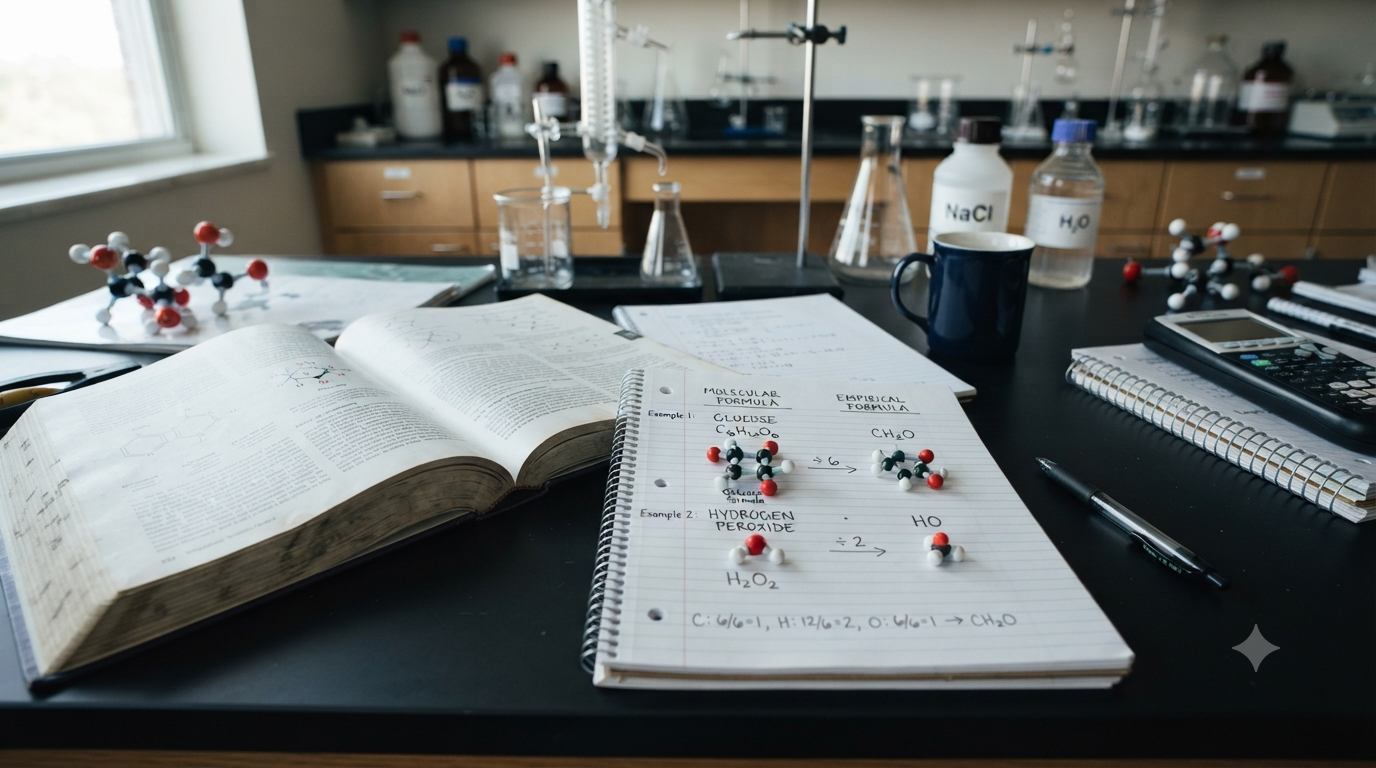
Chemical formulas give us a compact way to describe the composition of substances. Instead of writing the names and numbers […]
Read MoreWhy can different compounds have the same empirical formula?
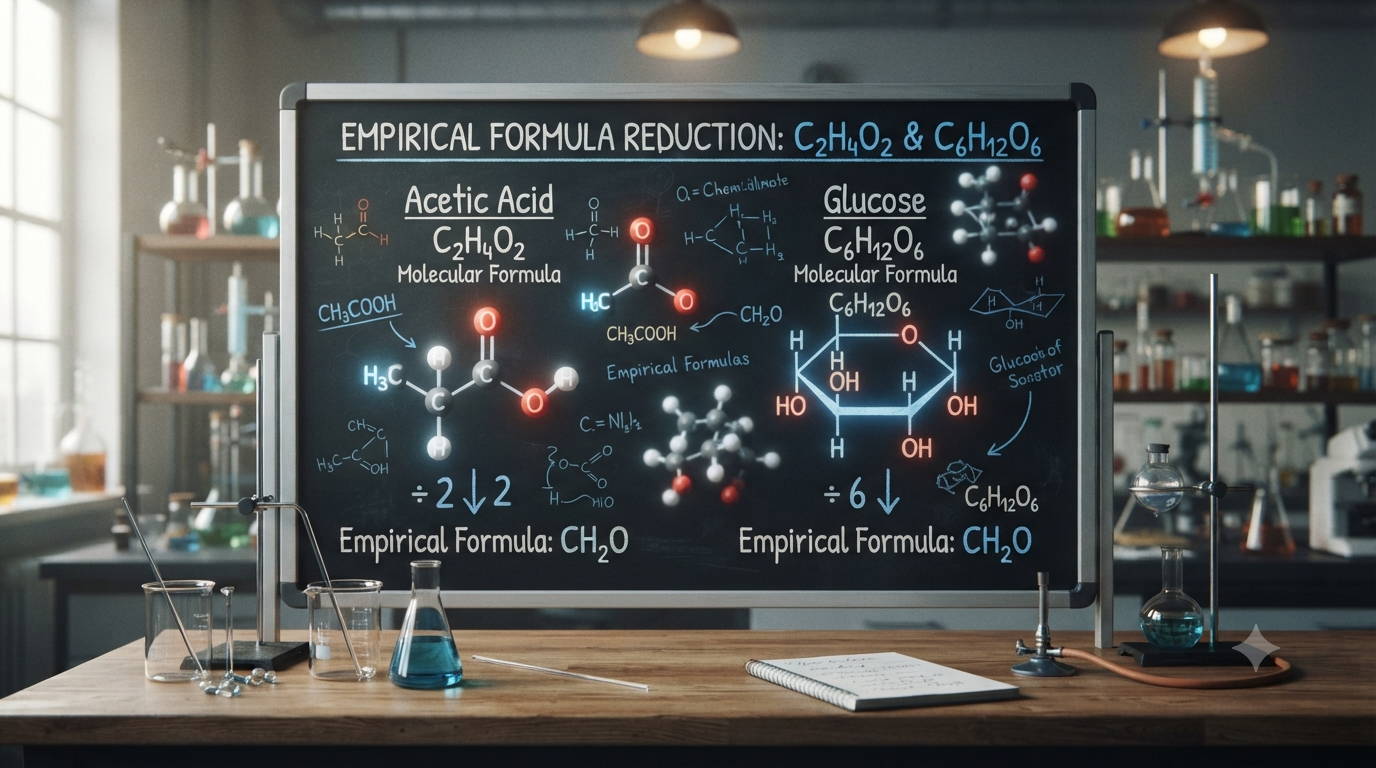
An empirical formula gives the simplest whole-number ratio of atoms present in a compound. It is useful because it tells […]
Read MoreHow do parentheses affect the number of atoms in a formula?
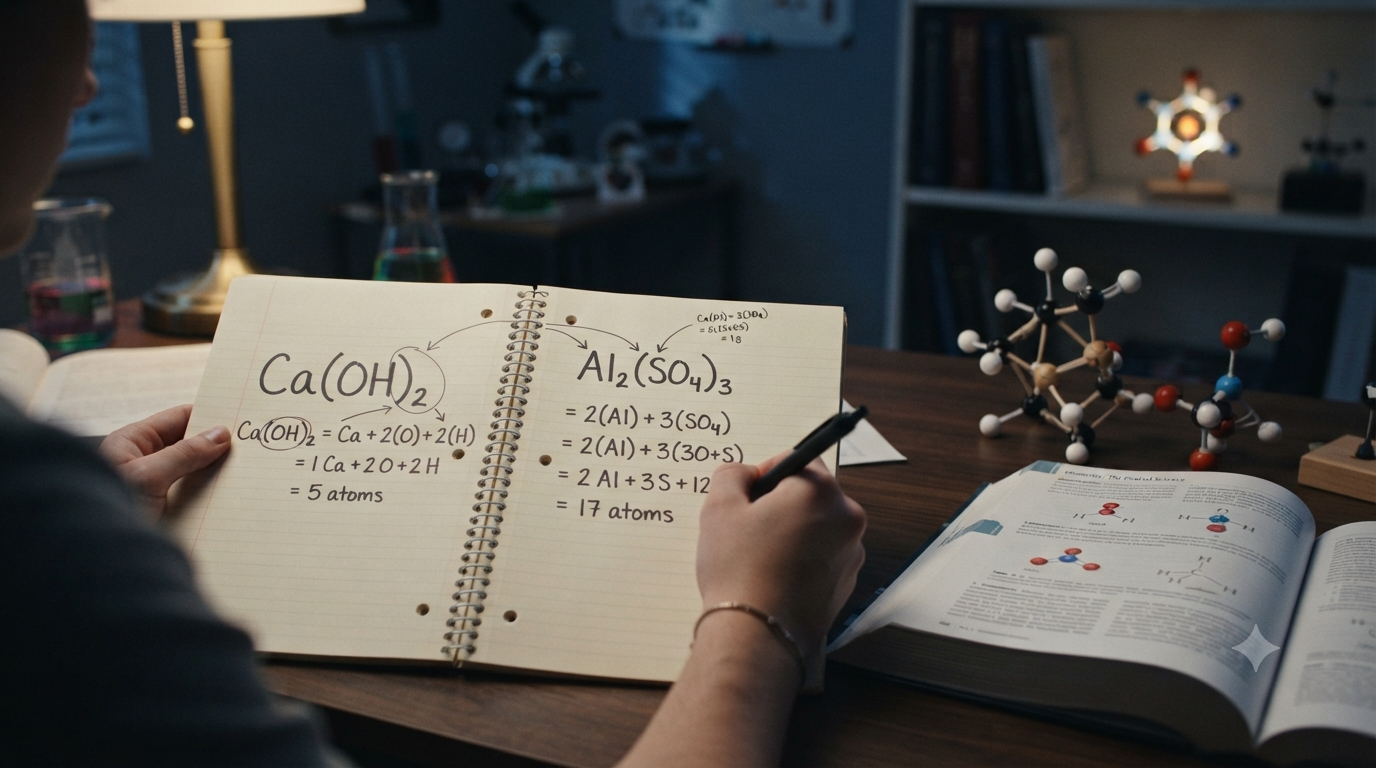
Chemical formulas tell us which elements are present in a substance and how many atoms of each element are included. […]
Read MoreHow can you count atoms from a chemical formula?

A chemical formula tells us much more than the name of a substance. It also gives information about the types […]
Read MoreWhy is a subscript different from a coefficient?
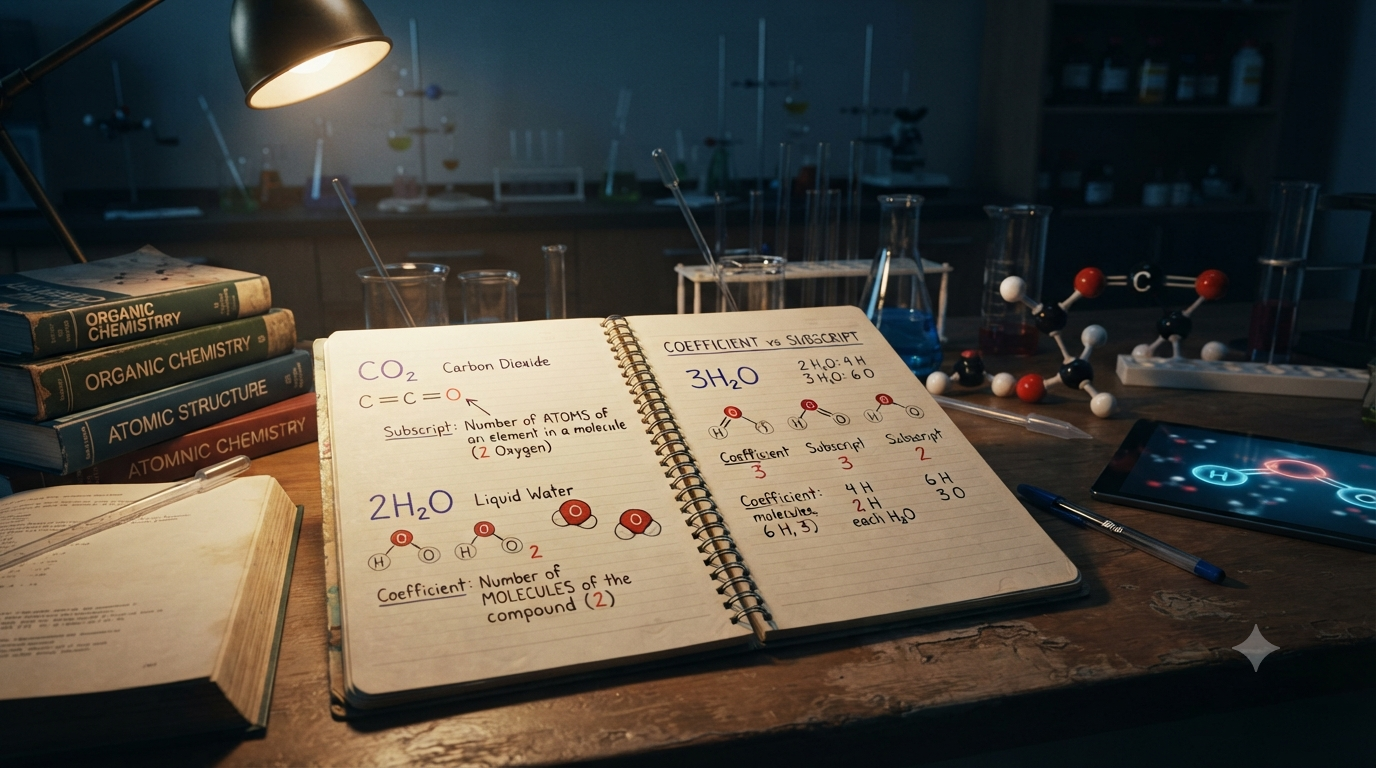
When learning chemical formulas, two small numbers can appear next to chemical symbols and look surprisingly similar. One is called […]
Read MoreWhat does a coefficient mean in a chemical equation?

A chemical equation is a compact way of representing a chemical reaction. It tells us which substances take part in […]
Read MoreWhat does a subscript mean in a chemical formula?
A chemical formula is a short way of showing what a substance is made of. Instead of writing the names […]
Read MoreHow can you identify the elements present in a formula?

A chemical formula is a short way of showing what a substance is made of. Instead of writing the complete […]
Read MoreHow are element symbols used to write chemical formulas?
Chemical formulas are one of the simplest and most useful ways to represent substances in chemistry. Instead of writing the […]
Read MoreWhat is the difference between a chemical symbol and a chemical formula?

Chemistry uses a special language to describe elements, atoms, compounds, and chemical substances. Two of the most basic parts of […]
Read MoreWhat information can be obtained from a chemical formula?

A chemical formula is a short and powerful way of representing a substance. It uses chemical symbols and numbers to […]
Read MoreHow does a chemical formula represent a substance?

A chemical formula is a short and precise way of representing a substance using chemical symbols and numbers. Instead of […]
Read MoreWhy are chemical formulas important in chemistry?

Chemistry is the study of matter, its properties, composition, and the changes it undergoes. To understand and communicate these ideas […]
Read MoreWhat exactly is a chemical formula?

A chemical formula is a short way of representing a chemical substance using symbols and numbers. Instead of writing the […]
Read More